










![Lec-01: রাসায়নিক পরিবর্তন [গ্রিন কেমিস্ট্রি, E-Factor, Atom Economy, Question Bank Solve]](https://i.ytimg.com/vi/OHZD7V-rqBA/maxresdefault.jpg)








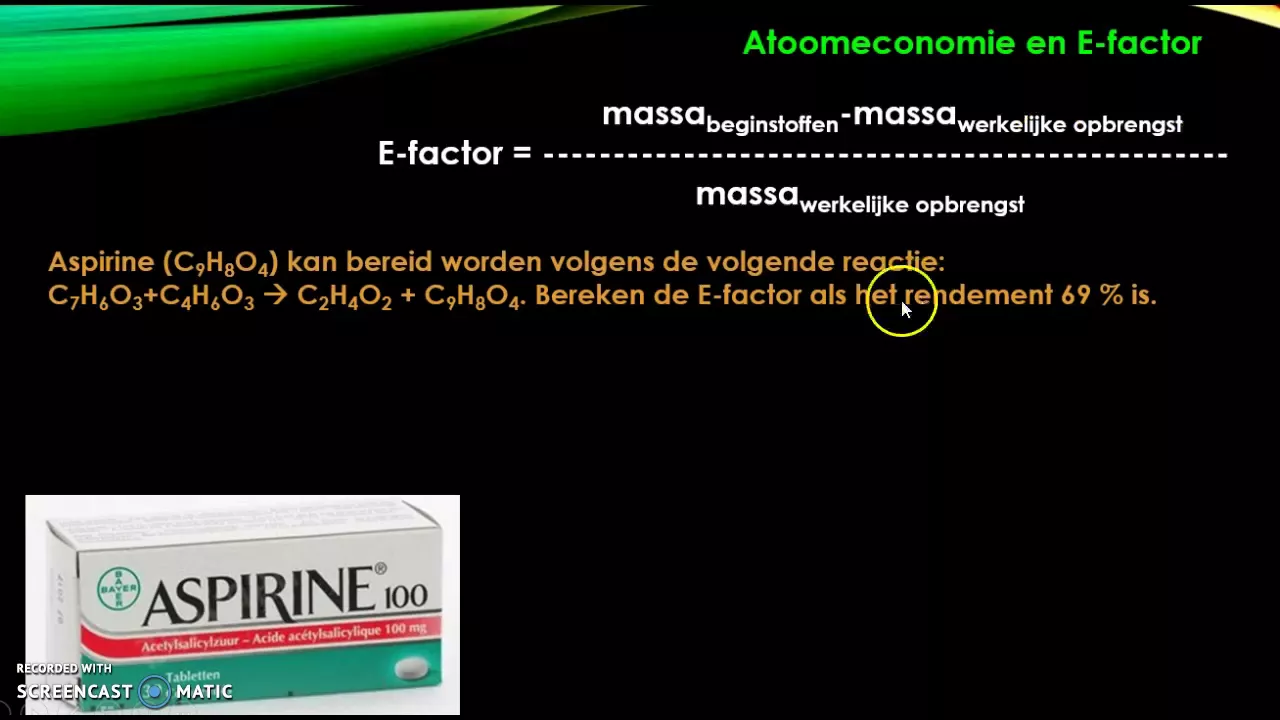
The E-factor (Environmental Factor) is a green chemistry metric that measures the mass ratio of waste produced to the mass of desired product in a chemical reaction, calculated as E-factor = (total mass of waste) / (mass of product), where waste includes all consumed reactants, solvents, and auxiliaries minus the product mass; unlike atom economy which is purely theoretical, E-factor provides practical waste measurement for comparing the environmental impact of different synthetic procedures, with ideal values around 0.1 (10 times more product than waste) versus problematic values above 25 in pharmaceutical manufacturing.
How to Calculate the E-Factor for Green Chemistry Reactions
Added:Stoichiometry and balancing chemical equations to understand reactant-to-product mass relationships.
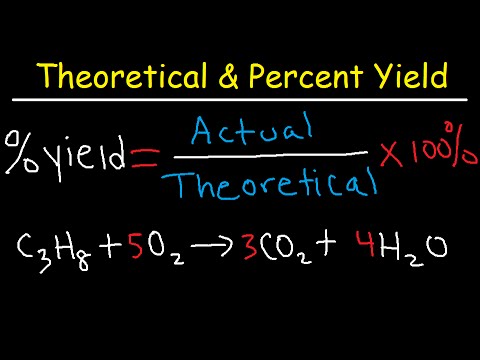
Calculation of theoretical, actual, and percent yields in chemical reactions.
Basic principles of Green Chemistry, particularly the goal of waste minimization.
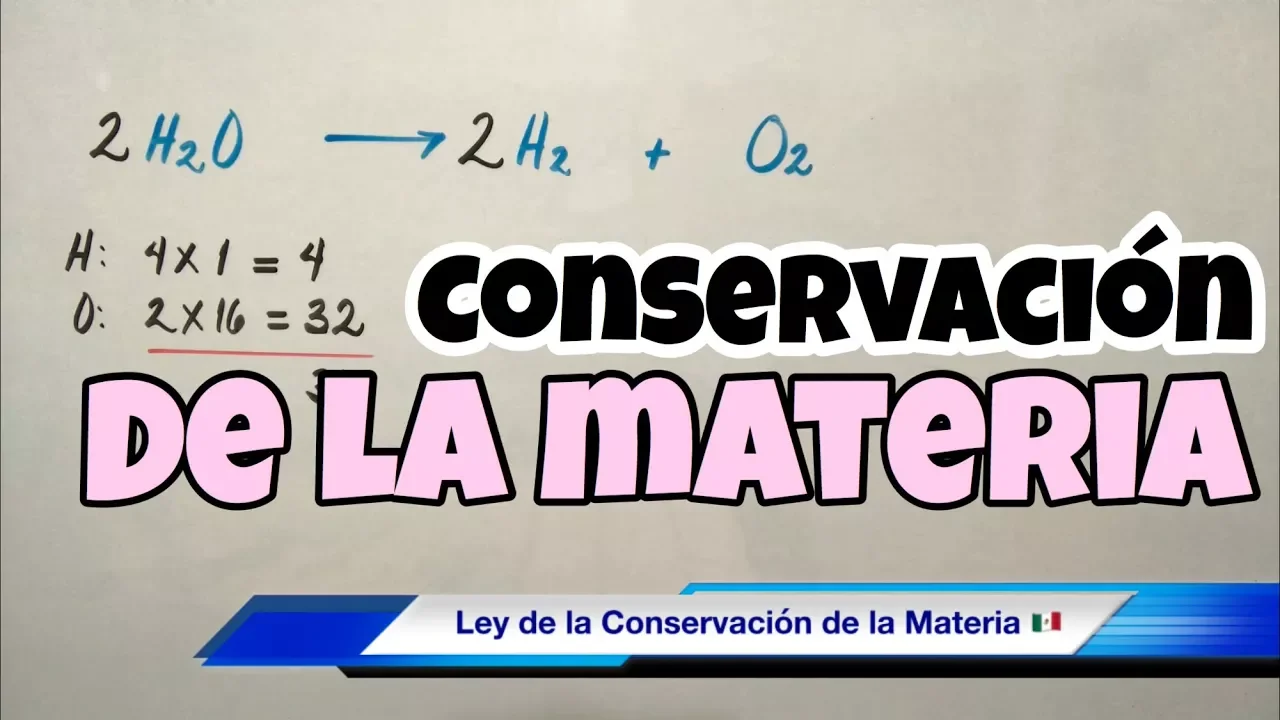
The Law of Conservation of Mass and how to perform basic mass balance calculations.
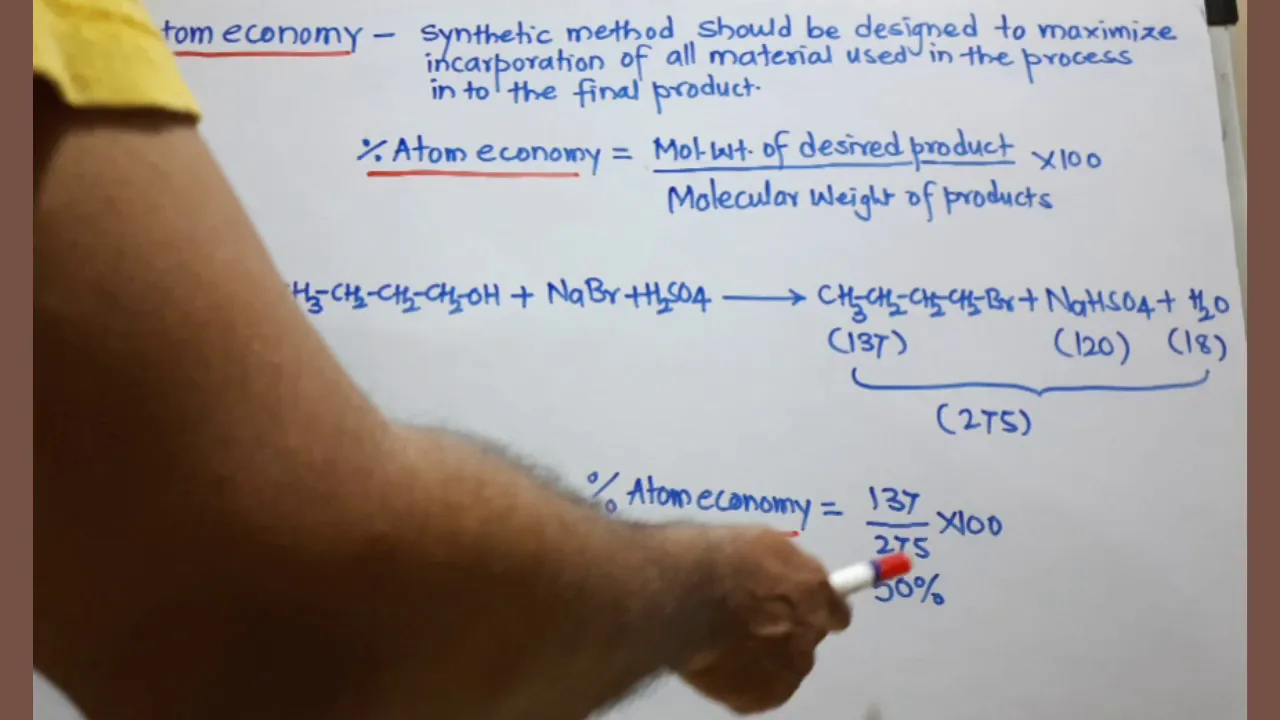
Comparing E-factor with Atom Economy to evaluate the theoretical vs. practical greenness of a reaction.
Understanding Process Mass Intensity (PMI) and its application in industrial pharmaceutical chemistry.
Conducting a comprehensive Life Cycle Assessment (LCA) to evaluate broader environmental impacts beyond mass waste.
Applying E-factor analysis to optimize synthetic pathways through catalyst selection and solvent recycling.
8.3K views73likes11:49Original Release: 2022-10-28
hello everyone this is Dr young and in this video I want to talk to you about another green metric that we use so we've talked about uh atom economy and I want to talk to you about e Factor so I'm going to give you a little bit of background and then I'm going to work through an example and show you how to calculate it for a given reaction so remember we have these 12 principles again um in a previous video we talked about the atom economy which we use the molar masses of the reactants in the products to kind of get a sense of how many atoms of your reactants end up in your actual products in this video what we're going to talk about is one of these ways that we can kind of measure how much waste we're producing and that's the environmental Factor the E Factor so we're going to look at well how many grams or kilograms of waste are we producing per every gram or kilogram of uh product that we actually make now this uh e factor is different from atom economy again I know I showed you this in a previous video but just kind of compare and contrast the two the atom economy is purely theoretical right you just you don't have to do a reaction you just need to know the equation and you can look up molar masses and calculate it and it only talks about the molar masses of the reactants so not the actual amount that you put in anything it doesn't have any solvents it doesn't say anything like that it's just purely theoretical you can just you could do the Adam economy for any reaction that you want right now that is different from the e Factor this environmental factor is a ratio of the actual mass um of the waste and the actual mass of the product from a reaction that you did right so that's what we're looking at here you just take the mass of the stuff that you waste that you end up throwing away and you divide it by the mass of your product so of course higher yielding products will have lower e-factors just because you have more uh more product there in the in the denominator so you know just kind of look at this some some general numbers if I have an e factor of 2 what that means is that you have twice as much waste as product right because there'll be two over one right so two over one there'd be twice as much waste as there is product that's probably not where you want to be ideally uh an e factor of 0.1 or in other words 1 10 means you produce 10 times as much product as waste right so you'd have a one up in the numerator and a 10 in the denominator to get 0.1 so you'd have 10 times more product than waste that's a much better place to be you're not really throwing away that much stuff and you've made a whole bunch of product that you're keeping um this is a great little list of different parts of the chemical industry so we have oil refining bulk chemicals Fine Chemicals and pharmaceuticals and then just what their average sort of e factors are you know sort of across that sector you notice that Pharmaceuticals Is Not Great anyone from 25 times more waste than product to over a hundred times more waste than product whereas things like oil refinery they've used just about everything right they take that oil they fraction it into all kinds of different parts and they make use of pretty much everything so their e-factor the amount of waste is pretty low it's like 0.1 so again that would be 10 times as much useful stuff as you have actual waste so you can kind of see across sectors as you know oil refining is not very wasteful whereas Pharmaceuticals is much more wasteful and we'll take a look at an example here in a second to see where all that waste really really comes from so some additional notes Here Right the idea is that I in order to figure out the E factor I have to actually do the experiment you can't just sit at home and do this for any experiment you want you need to go into the lab really mix things together really see how much someone to use really see how much water or silica or whey papers or whatever it is that you need in order to complete the reaction you have to actually go and figure out what that is and what that weighs so you actually need to do that the kind of downside about this is that you have to like keep track of everything too you have to wait you know how much how many milliliters of solvent did I use in that recrystallization or in that column chromatography or how much did that wave paper weigh or how many uh how much water did I waste when I was doing the vacuum filtration and I was using that aspirator you know in the sink like you have to actually keep track of all these things and by all these things I mean the actual reactants the amount of solvent the solvent crystallizations the Whey papers the water the silica for columns all of the stuff that you use not like glassware and stuff because you reuse that but all the things that get consumed and are not going to be reused you have to take all that into account so let's look at this example here um so I have this Vivid reaction and I have the procedure right I've got one story material I've got 10 grams of fat and you react with falaldehyde which is 1.685 grams of that and they were allowed to react in dry THC 50 milliliters of it according to a procedure that was written somewhere else that doesn't really matter to us the resulting residue was purified by Passage through a six centimeter diameter plug so someone did call them chromatography and they used 65 grams of silica and they alluded it with this one to one this 50 ratio of ethyl acetate and hexanes to give the compound apparently 2.12 grams of it as a white solid and then um I made notes that the density of thf is 0.889 grams per milliliter because I need to know the mass of everything that I use but I only you know you you measure out solvents by volume you usually don't weigh them so my density I'll use in just a sec to get the grams apparently it took 250 milliliters of eluding solvent in my column so that's much solvent I used when I ran my columns that was solvent used and then I also have the density of the ethyl acetate hexanes mixture which is roughly 0.778 grams per milliliter so what I have down here is a little table of I need to keep track of all the material I used I need to look at look at the mass of the product I made and then I can calculate the E Factor so let's look at this here right so my reactants what were my reactants these were my reactants I had 10 grams of this stuff and I had uh what looks like 1.685 grams of that so that would be under my reactants so I'm going to have 10.0 grams and 1.685 grams if I look at the solvents that are used it says you do this actual reaction in 50 milliliters of thf and it said that I was using a column of ethyl acetate and hexane that I use 250 milliliters of that right so for the solvents I have two things going on I have the straight up thf that I used so the thf it said that there were 50 milliliters of thf but I need to know the mass of everything so I need to convert this to grams which is why the density is going to help me out here right apparently the density is 0.889 grams per milliliter I can just look that up or it might be in a table that I have in my notebook and if I do that I see that the thf weighs about 44.45 grams now if I'm looking at my um my ethyl acetate hexanes mixture said that we use 250 milliliters of that right it says right down here 250 milliliters and that the approximate density of that mixture is 778 grams per milliliter which would give me looks like about 194.5 grams uh for that solvent mixture so I'm just again I'm just getting the mass of all the stuff that I used what about auxiliaries so these would be things that are not solvents and reactants with things like whey paper or water use for something or recrystallization solvents uh or Not Sorry recrystallization solvent would be with solvents but like in my case this is silica so 65 grams of silica that's something that I use to purify this compound but it's not my product right it's just something that I use to help isolate my product so I'd also have to add that 65 grams of the silica and so if I add all of those numbers up the 10 the 1.685 the 44.45 the 194.5 and the 65 I get a total of 315.635 grams I'm not being a stickler about sig figs here by the way we're trying to get a rough idea of the E Factor that's the total amount of stuff used in this reaction what was the mass of my product flat out told me that the mass was 2.21 2.21 grams so when the mass of my product was 2.21 grams so I used I used 315 grams of stuff and I only got 2.2 only 2.21 of that was turned into actual product so when I'm looking at my e factor and I'm looking at grams of waste over grams of product I'm going to figure out my waist by simply subtracting the amount of stuff I used by the amount of product that I got because that means everything but that 2.21 grams was garbage so if I subtract 2.21 from this that's going to give me a 313 415 that's how many grams of waste that's all this the massive stuff that did not end up as product so I'm going to use that for my numerator here so 313.45 grams of waste and divided by my grams of product which is just 2.21 that's going to give you my e Factor so how much waste over how much product and again your waste is going to be the mass of everything you used minus the mass of the stuff that you got out of the product and if I do that I see that my my uh e factor is going to be 141.8 that is my e Factor that's not great right that's saying that I produced 141.8 times more waste than I did actual product that's a lot of waste that's a lot of waste that's not a very efficient thing and we'll see for example in the future that doing things like running a silica column is very wasteful it's not the greenest way to isolate a compound recrystallization for example would be much much better but anyways this is an example of how to calculate the E Factor add up the mass of everything you used subtract out the mass of your product and then you just divide that grams of waste by your grams of product and that's it so to kind of sum up the E Factor what's nice about it is that it does actually account for all the waste unlike the atom economy so it does account for solvents and auxiliaries and stuff like that atom economy doesn't even it doesn't even register for atom economy um and you can easily compare how wasteful two different actual procedures are so if I do a reaction One Way versus another way or I purify it one way versus a different way you can see using e Factor exactly how different um amounts of waste are produced from that that process the cons of this is it doesn't really say anything about the waste quality it doesn't say if it's hazardous or biodegradable because if you produce you know 100 grams of water uh like is that really a big deal is that really an environmental impact is that is that really that bad or if your waist is super biodegradable and you're going to go you know throw it as compost you know for your plants or something like that so it doesn't really talk about the nature of the waist it just says waste is bad and it considers all always the same so having Water waste or some carcinogenic Benzene talk you know solvent as waste would be considered equal in using the E Factor uh another con of this is that you do actually have to perform a reaction you can't just like go go in ahead of time without having to perform it you need to go perform it and get real numbers and you have to do a lot of record keeping to actually calculate these you know so if you forget to measure something boom now you can't do your e Factor so anyways I hope you have a better idea of what the e-factor is and how to calculate it and why how it is different than atomicami so take a take a practice at this apply this to your labs and to your work in the future thank you so much take care
Up Next

10:32
Green Chemistry Explained: Paul Anastas | Sustainable Innovation
@volvoenvironmentprize4501
34.1K views•2021-12-01
83:56
Biocatalysis and Catalysis in Islatravir Synthesis | Merck Webinar
@SCIwheresciencemeetsbusiness
675 views•2020-10-08
16:42
How to Calculate Atom Economy in Chemistry
@DrDougYoung
4.1K views•2021-04-29

17:31
Edible Water Bottles: A DIY Guide to Sodium Alginate Spherification
@ryan
10.5M views•2019-06-21
Related Study Plans & Knowledge Roadmaps
Structured learning paths in Chemistry
chemistry
Nuclear Chemistry: Decay, Meds & Fuel Cycle
01Introduction to Nuclear Structure and Radioactivity
02Decay Dynamics and Kinetics
03Radiation Interaction and Detection
+ 2 more learning modules
24h5 modules
Explore Roadmap
chemistry
Supramolecular Chemistry: Forces & Machines
01Foundations of Chemical Bonding and Intermolecular Forces
02Introduction to Host-Guest Chemistry
03Thermodynamics and Dynamics of Self-Assembly
+ 2 more learning modules
16h5 modules
Explore Roadmap
chemistry
Photochemistry: Excited States & Reactions
01Foundations of Light-Matter Interactions
02Molecular Orbitals and Electronic States
03Photophysical Processes and Jablonski Diagrams
+ 2 more learning modules
18h5 modules
Explore Roadmap
chemistry
Coordination Chemistry: Bonding & Properties
01Introduction to Transition Metals and Ligands
02Crystal Field Theory (CFT) and Geometry
03Magnetic Behavior and Spin States
+ 2 more learning modules
14h5 modules
Explore Roadmap