



















Complex organic molecules essential for life are synthesized on the surfaces of interstellar dust grains, where unique catalytic sites enable chemical reactions between hydrogen, oxygen, and carbon to form molecules like methanol, water, alcohols, aldehydes, amino acids, sugars, and nucleobases; computational chemistry approaches combining quantum chemistry (for precise simulations of small systems) and molecular dynamics (for larger systems) help scientists understand these processes, bridging theoretical models, laboratory experiments, and astronomical observations to explain how biological molecules may have been delivered to Earth via comets and asteroids.
Surface Chemistry of Interstellar Dust: Computational Insights
Added:Fundamental concepts of heterogeneous catalysis and surface science, specifically adsorption (physisorption and chemisorption), reaction, and desorption mechanisms.
Basic principles of computational chemistry, including Density Functional Theory (DFT) and molecular dynamics (MD) simulations.
An overview of the Interstellar Medium (ISM), including its physical conditions (extreme low temperatures and pressures) and the general composition of cosmic dust grains.
The basic chemical structures of prebiotic molecules, such as amino acids, simple sugars, and formamide, which are considered the building blocks of life.
Advanced astrochemistry modeling techniques, such as gas-grain chemical network simulations and Kinetic Monte Carlo (KMC) modeling.
Observational astrochemistry methods, focusing on how computational models are validated using infrared and radio spectroscopy data from observatories like the James Webb Space Telescope (JWST) and ALMA.
Laboratory astrophysics and experimental astrochemistry, where researchers recreate interstellar ice analogs in ultra-high vacuum chambers to test simulation predictions.
The study of abiogenesis and prebiotic delivery, exploring how organic compounds formed on interstellar dust are transported to young planets via meteorites and comets.
4.2K views21likes4:22Original Release: 2022-04-13
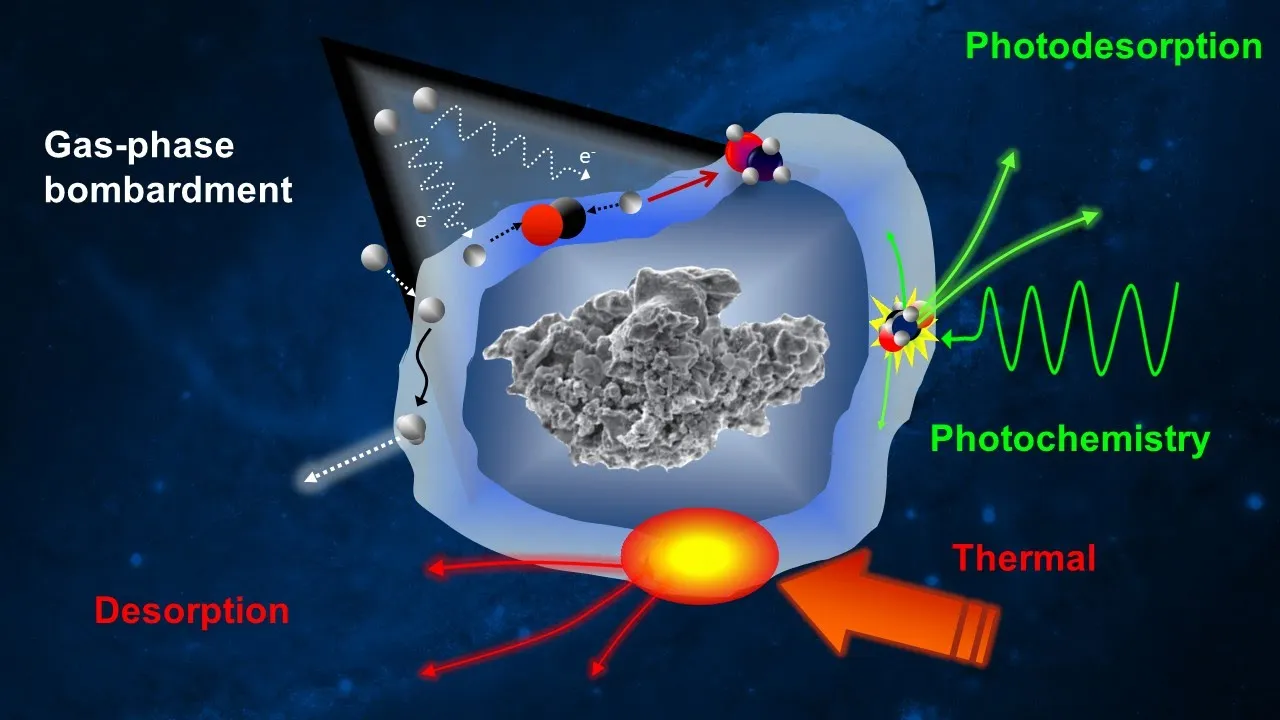
exploring the surface chemistry of interstellar dust interstellar space may seem like the last place you would look for the chemical origins of life however many complex molecules are synthesized on interstellar dust grains the unique structures of dust grain surfaces are believed to act as catalytic sites allowing chemical reactions to occur [Music] the story of this process begins when a dying star ejects gas and dust forming a cloud that cools and contracts over time hydrogen molecules which are abundant at this stage react with oxygen and carbon on dust grain surfaces to form simple molecules such as methanol and water coating the grains with a layer of so-called dirty ice as the cloud continues to collapse its dense core may heat up and begin to form a new star this heat releases the frozen molecules on nearby dust grains triggering the formation of organic molecules including alcohols and aldehydes the dust cloud then collapses into a disk encircling the star which over time coalesces to form asteroids comets and planets in the coldest regions of such protoplanetary disks organic molecules become re-frozen on grain surfaces this introduces further chemical complexity potentially producing biological molecules such as amino acids sugars and nucleobases our knowledge of these processes has been shaped by a combination of strategies including theoretical models lab experiments and astronomical observations however each of these approaches comes with limitations preventing astro chemists from gaining a full understanding of how complex molecules form in interstellar space to overcome these limitations dr albert rimola at the autonomous university of barcelona turns to computational chemistry this approach uses computer simulations to represent the steps of complex chemical reactions such steps include molecules binding onto dust grains reacting with other molecules and the chemical products being released from the grain surfaces in a recent study dr ramona's team explored techniques that can simulate the surfaces of interstellar dust grains and the chemical processes they catalyze the first technique is quantum chemistry which uses calculations to determine how individual electrons and atomic nuclei interact with each other quantum chemistry allows for incredibly precise simulations but these models are limited to systems of hundreds of atoms or less this approach can be combined with lab experiments and astronomical observations this is quicker and less costly allowing researchers to simulate larger chemical systems but comes with lower accuracy the second approach is molecular dynamics simulations these ignore electrons and their interactions and instead describe chemical systems using ball and spring models where atoms are the balls and bonds are springs this approach is less accurate but its reduced complexity allows researchers to simulate systems containing thousands of atoms this enables them to recreate complex molecular systems but not chemical reactions by drawing these approaches together and assessing their capabilities dr rimona's team hopes that their study could spark a wave of research into the computational chemistry of interstellar dust grains their research may also expand to consider the surface chemistry of comets and asteroids which may have delivered biological molecules to earth the team believes that computational chemistry could offer clues about the emergence of life on earth and even planets beyond our solar system you
Up Next

38:13
How Stars, Planets & Life's Ingredients Form in Space
@ScienceCocktails
1.4K views•2022-10-15
83:56
Biocatalysis and Catalysis in Islatravir Synthesis | Merck Webinar
@SCIwheresciencemeetsbusiness
675 views•2020-10-08
10:06
1H NMR: Determining Number of Peaks from Structure
@MSJChem
59.2K views•2017-04-06

17:31
Edible Water Bottles: A DIY Guide to Sodium Alginate Spherification
@ryan
10.5M views•2019-06-21
Related Study Plans & Knowledge Roadmaps
Structured learning paths in Chemistry
chemistry
Nuclear Chemistry: Decay, Meds & Fuel Cycle
01Introduction to Nuclear Structure and Radioactivity
02Decay Dynamics and Kinetics
03Radiation Interaction and Detection
+ 2 more learning modules
24h5 modules
Explore Roadmap
chemistry
Supramolecular Chemistry: Forces & Machines
01Foundations of Chemical Bonding and Intermolecular Forces
02Introduction to Host-Guest Chemistry
03Thermodynamics and Dynamics of Self-Assembly
+ 2 more learning modules
16h5 modules
Explore Roadmap
chemistry
Photochemistry: Excited States & Reactions
01Foundations of Light-Matter Interactions
02Molecular Orbitals and Electronic States
03Photophysical Processes and Jablonski Diagrams
+ 2 more learning modules
18h5 modules
Explore Roadmap
chemistry
Coordination Chemistry: Bonding & Properties
01Introduction to Transition Metals and Ligands
02Crystal Field Theory (CFT) and Geometry
03Magnetic Behavior and Spin States
+ 2 more learning modules
14h5 modules
Explore Roadmap