



















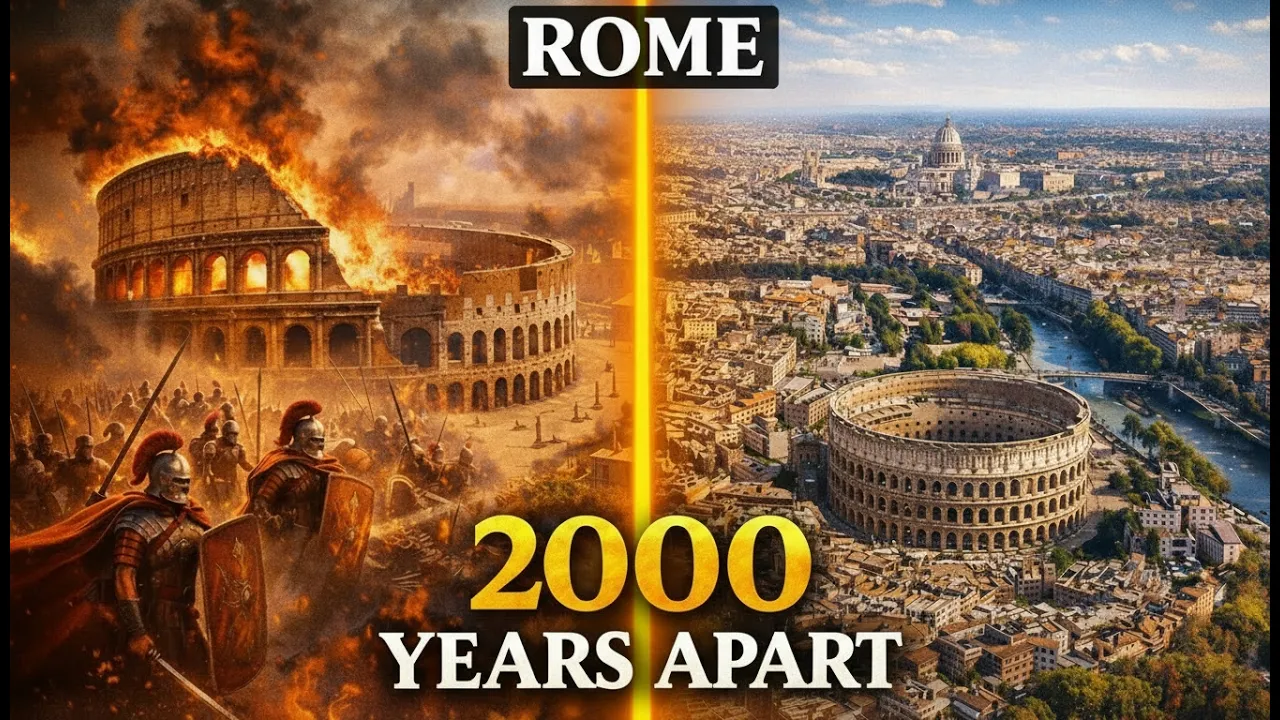

The Roman Republic fell due to structural weaknesses where military generals accumulated excessive power, leading to civil wars that culminated in Julius Caesar's dictatorship and assassination, ultimately resulting in Octavian's establishment of the Roman Empire in 27 BC.
Roman Republic History: Rise and Fall of an Empire
Added:Understanding of basic political structures, specifically the differences between a monarchy, an oligarchy, and a democracy.
Familiarity with the geography of the Mediterranean basin and the Italian peninsula, which shaped Rome's expansion.
Knowledge of early Roman foundational myths and the influence of neighboring civilizations, particularly the Etruscans and Ancient Greeks.
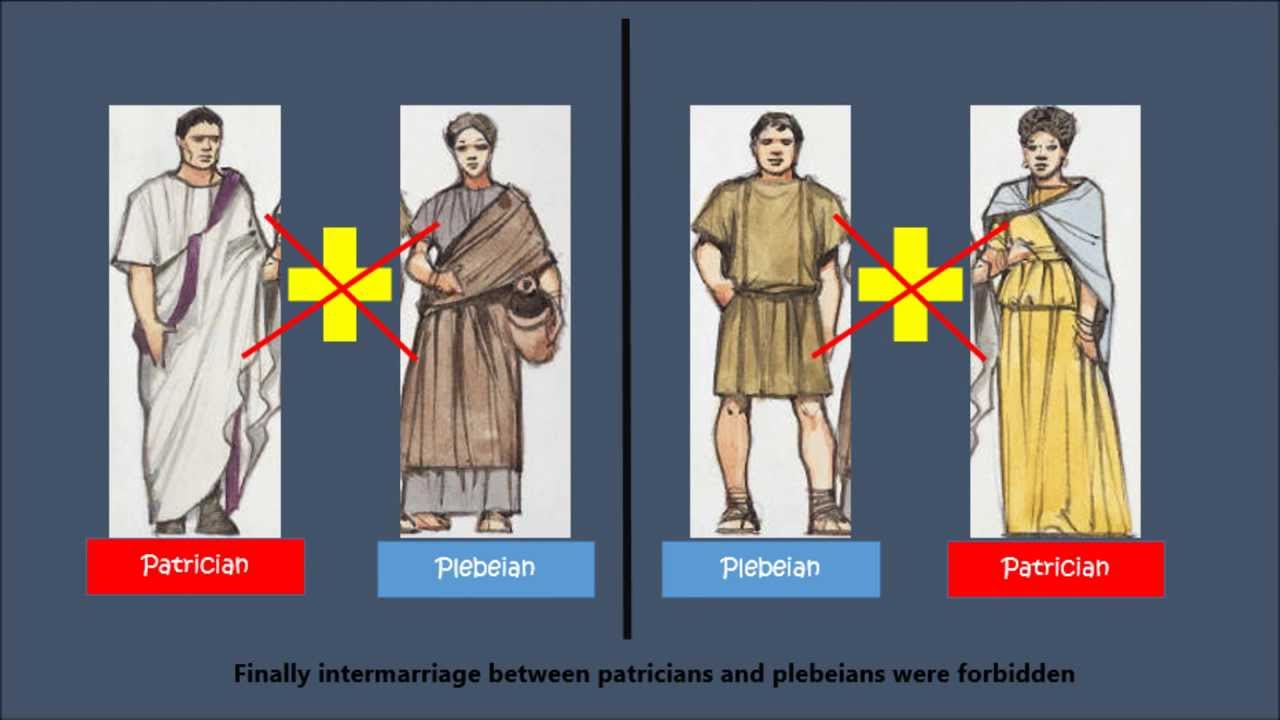
An awareness of the societal divisions in early Rome, specifically the distinction between Patricians (aristocrats) and Plebeians (commoners).
In-depth analysis of the Pax Romana and the political consolidation of the Roman Empire under its early emperors.
The study of Roman military strategy, engineering marvels, and their role in maintaining imperial control.
Investigation into the division of the empire into the Western Roman Empire and the Byzantine Empire, and the factors leading to the fall of Rome.
Exploration of the enduring legacy of Roman law, republican governance models, and Latin on modern Western legal and political systems.
146.2K views1.6Klikes1:11:07Original Release: 2025-06-22
In early 49 BC, a Roman general and politician by the name of gas Julius Caesar led an army south towards central Italy. He soon reached the river Rubicon, a relatively small and shallow river for all the importance which it has taken on historically.
By law, no Roman general was allowed to bring an army south of the Rubicon towards the city of Rome. Regardless of this prohibition, this is exactly what Caesar now planned to do. The crossing of the Rubicon was a pivotal moment in the history of Rome and of the ancient world. It signaled the beginning of a civil war which would bring about the death of the Roman Republic and the emergence of the Roman Empire. It was in many ways surprising that this was the case. Three and a half centuries earlier, a Celtic army had marched through this part of Italy and sacked the city of Rome. Back then, it was little more than a provincial town unknown to most of the world. its remarkable ascent in the period between when the Kelts came through here and when Caesar made his decision to contravene Roman law and cross the Rubicon had seen the rise of a power that would come to rule most of the known world. This is the story of the Roman Republic and its rise and fall.
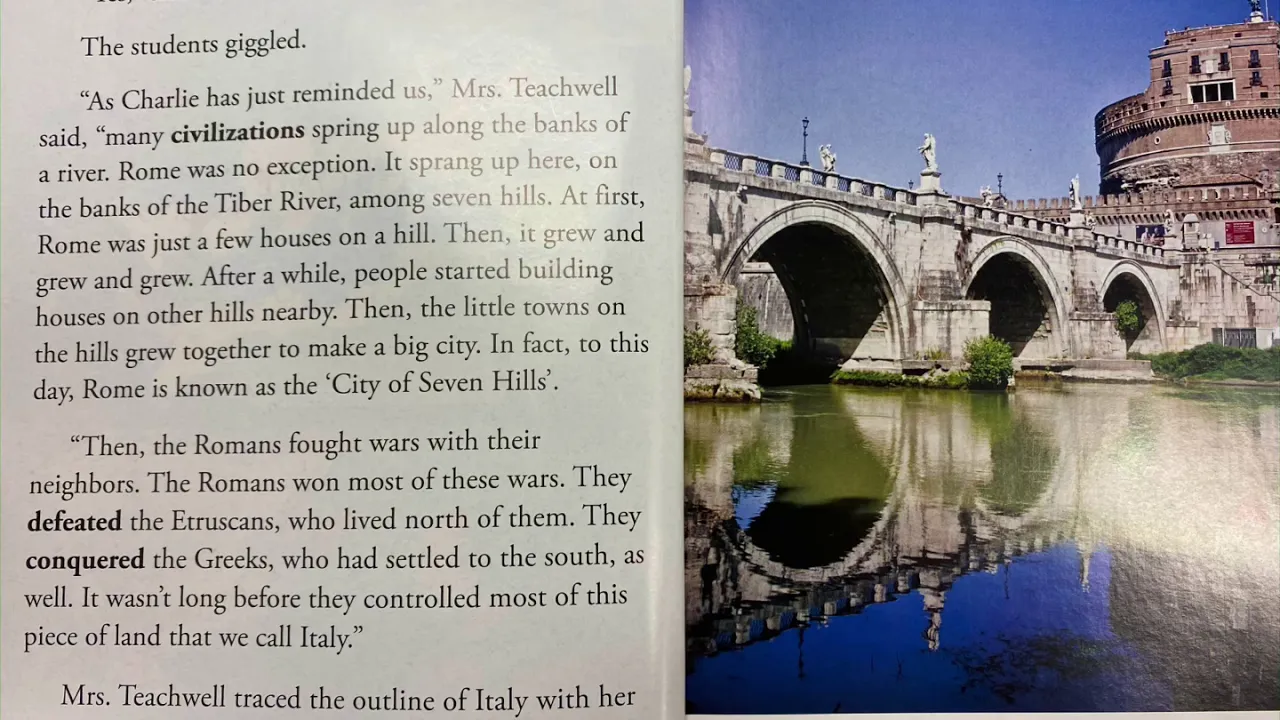
[Music] There are two versions of how the city that would come to rule much of the known world first came into being. One is a myth but makes for a colorful story. In this version, the city was founded by two twins, Romulus and Remis, on the banks of the river Tyber in the year 753 BC. The story is that the pair had been born from the union of Ria Sylvia, a vestalled virgin and daughter of the deposed king Numur of Alba Longa with the Roman god of war Mars. They were later abandoned and were raised by a shewolf by the Tyber. When they grew up, they gathered followers to them and founded the city of Rome around the seven hills that lie at the center of the city. Romulus subsequently killed Remis after a dispute broke out about which hill the city should be centered on, following which he became the settlement's first king and named the city Rome after himself. Later this foundation myth would be expanded by the great poets of the early Roman Empire Virgil. In the Aniid he presented a story which claimed that Albolonga the city which Romulus and Remis' mother hailed from was originally founded by Anias, a prince of the fabled city of Troy, which he had fled from after the siege of the city recounted in Homer's Iliad. In this way, the Romans claimed the line of descent from the Trojans.
As exciting a story as this is, it is almost certainly a complete fabrication.
In reality, archaeological investigations have revealed that there were settlements in the region as far back as the Bronze Age, while by 1,000 BC, there were several villages around the seven hills of Rome. The city wasn't established all at once. Instead, it emerged from the amalgamation of these villages into a larger town at some stage in the early Iron Age.
While the foundation myth of Romulus and Remis seems fairly dubious, there was probably some kernel of truth to it.
Perhaps it was around the middle of the 8th century BC that the semblance of a city began to emerge from these villages and it could well have been a man called Romulus who oversaw this process. It certainly is the case that Rome was ruled as a monarchy during its early years. The Romans later believed that they had seven kings. Romulus came first and reigned until 716 BC or what the Romans would later identify as 37 Abbecond, meaning the 37th year from the founding of the city in 753 BC. He was followed by Numer Pompilius who was credited with establishing many of Rome's important institutions notably the emphasis in their religious system on Mars the god of war and Jupiter the king of the gods. He was also said to have introduced the first Roman calendar. After Numa came Tullus Hostilius, then Ankus Marcus, Lucius Tarquinius, Prriscus, Cervius Tullius, and finally Lucius Tarquinius Superbus.
This was a quai elective monarchy and each of the kings after Romulus was said to have been selected by the curate assembly, a council of the heads of the different clans or family groups that made up Roman society at that time.
Whether this chronology is accurate or not is debatable.
These seven kings are said to have reigned down to 509 BC, a period of nearly 2 and 1/2 centuries, meaning that each ruled for an average of 35 years, an improbably long time for there to have not been some period in which a king only ruled for a few years. As with so much else concerning Rome's early history, there is an element of myth here. And it is worth noting that the earliest histories of Rome were only written hundreds of years later in the 3rd and 2nd centuries BC.
Lucius Tarquinius Superbus would be the last king of Rome. He was a tyrant who was said to have usurped the throne in the first place in 534 BC and then ruled in a heavy-handed manner. For instance, he refused to afford his predecessor Cervius Tulius a proper burial and he tried to manipulate the Senate, the representative body of the Roman aristocratic families into doing his bidding. He engaged in a series of wars with Rome's neighbors in central Italy and also undertook an elaborate building program in the city. His actions eventually caused widespread resentment, which peaked when it was learned that the king's son had defiled a noble woman named Lucricia, and Superbus had tried to cover it up. A popular revolt followed, and the king was driven from the city, dying in exile years later.
Once he was gone, the Romans decided to change their system of government. The date this occurred is interesting.
Tradition holds that it was 509 BC, right around the time that tyrannies and monarchies all over the Greek world were being overthrown and replaced with democracies.
The Romans elected to do something similar. They created a republic, one with a mixed constitution.
The Roman Senate, an assembly of several hundred men from the leading families of Rome, was the main deliberative assembly. The most senior magistrates were the consils. Two of these were elected each year and served for 12 months. Nominally, these had to be 42 years of age, though this rule was flouted on occasion. They also tended to come from the patricians, the aristocratic families of Rome. Other officials included the tribunes who had great powers over the management of the municipal government and who were primarily elected by the plebeians, the common folk of Rome. Thus, the Senate had more than an heir of an aristocratic assembly, but this was balanced by more populist democratic offices such as that of the tribune.
By the fifth century BC, as the fledgling Roman Republic began to take shape, there is a growing body of more substantial evidence available for us to reconstruct the history of the Romans.
Prior to this, we are broadly reliant on a number of histories that have survived from much later. Most notably, the monumental history of Rome written by Titus Livius or Libby in the 1st century BC. His aburbeond from the founding of the city is an immensely valuable work. That being said, he was broadly drawing on traditions of oral history rather than facts which could be affirmed when it came to describing the early history of Rome centuries later. As we move into the era of the republic, there is more information available and it often comes from multiple sources, meaning it is possible to verify it to an extent. For instance, we can say with certainty that early in the days of the republic, the Romans decided to promulgate a comprehensive law code. This was drawn together and published in 449 BC on a series of 12 bronze tablets that were put up on public display in the Roman Forum, the large open market space at the center of the city. The 12 tablets would form the basis of Roman law and its social hierarchy for centuries to come. For example, the first tablets outlined the procedures and rules of the Roman courts. Other tablets outlined the rules around marriage, family arrangements, and landlaw. There were provisions for how individuals should be compensated if they had been wronged in some way by another. One rule even concerned the legalities of removing a tree if it fell onto another person's property. This concern for the minutia of the law and for governance would be a cornerstone of how the Romans governed much of the known world in years to come. and our legal systems today are still greatly indebted to them.
Rome did not immediately emerge as a superpower under the republic. One of the surprising things about its history is the length of time it spent as an embattled minor power in central Italy.
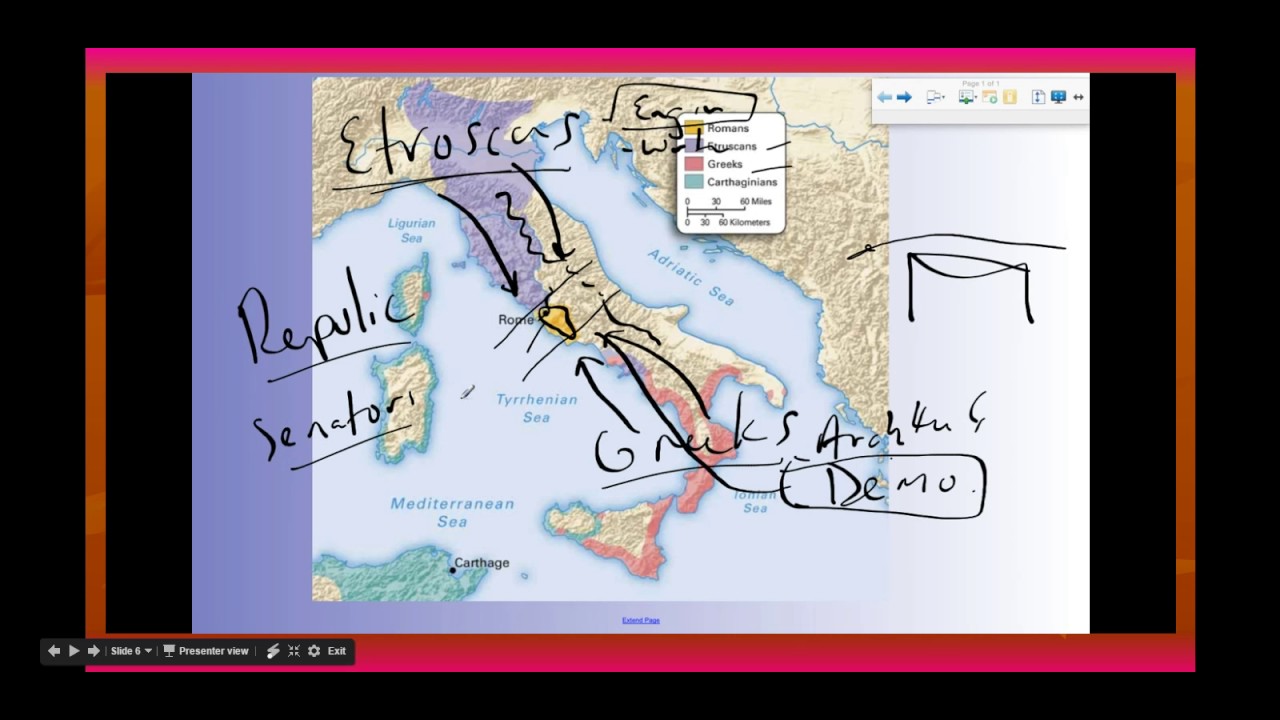
During the days of the kings and then the early republic, Rome was just a city state. It controlled the immediate vicinity around the city and down the river Tyber to where it poured into the terraneian sea at the port of Austia.
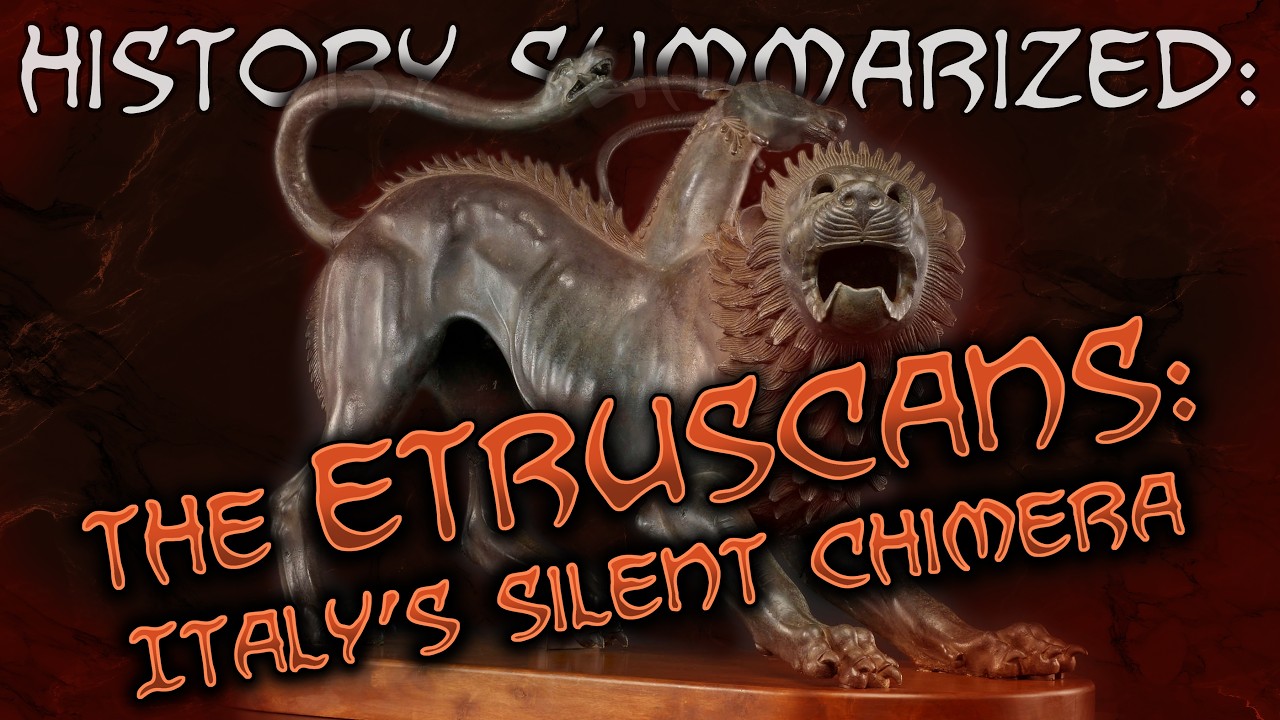
But beyond this and some farmland in the surrounding countryside, Rome was no major power. The cities of the Atruscans to the north in Tuscanyany or the Greek colonies in the south of the peninsula were much richer and more powerful and had a more developed culture during this period. The Atruscans dominated Rome for a time. Indeed, as we have seen in 390 BC, the city was sacked by an army of Kelts that had campaigned south to ransack much of Italy. an indication of how insubstantial Rome's power was by the early 4th century BC.
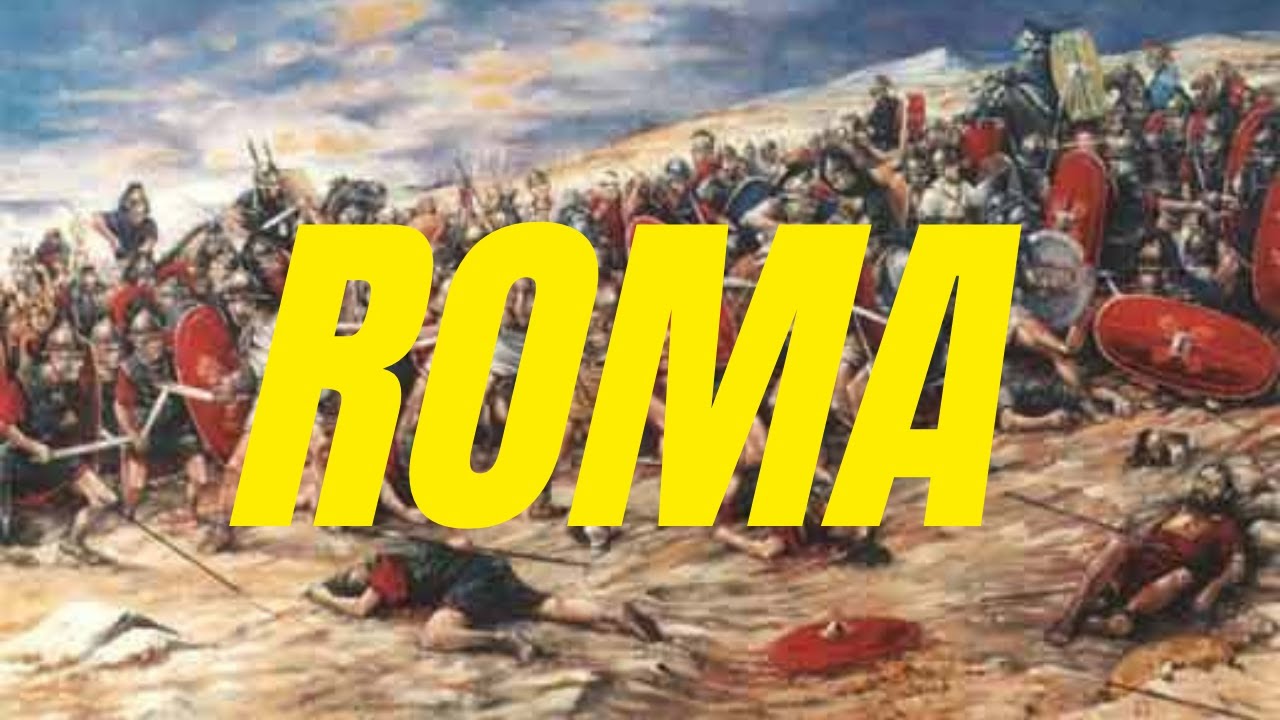
The sack of the city might have been important though. It was directly after this that Rome first began to emerge as a more aggressive power in central Italy and the attack on their city might have caused the Romans to adopt a more militaristic outlook. Henceforth they began a series of wars with neighbors such as the Samites and other Latin people in the center of Italy. They did so with a citizen army. Most city states at the time had male citizens who fought for the state when needed. Rome's soldiers earned a reputation as a particularly well-honed fighting force, but there would be no professional legionaries for many centuries yet. This citizen army had succeeded by the late 4th century, less than a 100red years after the Celtic sacking of the city in conquering most of central Italy and north into the Atruscan region. They then began looking southwards towards the wealthy Greek colonies there. It was then that Rome's ascent as a great power really accelerated.
While all of this was occurring, there was a social conflict playing out in Rome itself.
This is broadly known to historians today as the conflict of the orders. As noted, Roman society was divided early on into two main groups. The aristocratic patricians and the lower order known as the plebeians.
One's position as a patrician or plebbeian was dictated by which family or gens a person hailed from. There were material differences as well. Early on in Rome's history, the Petricians owned much of the land in the city and around it and were much wealthier. In line with this, the Petricians held a greater amount of power in the early years of the republic, effectively making the city's government more of an aristocratic oligarchy than a proper democracy.
This had led to tensions over time.
One notable incident right around the time that the 12 tablets were set up in the forum concerned the election of the tribunes of the plebeians.
10 of these were elected each year at the time. In this particular case, the patricians had manipulated the system so that some of the 10 spots were granted to patricians that year causing understandable unrest amongst the plebbeians.
These divisions were compounded as time went by when the plebeians did much of the fighting in Rome's wars. Yet the patricians seemed to benefit most in land and spoils.
Social tensions continued until numerous laws were passed which in totality eroded the distinction between patricians and plebeians.
Eventually, the plebeians would come to occupy as great a place in Roman society as the Petricians, and many plebeian families would become even richer than the Petricians.
However, the Romans were a conservative hierarchical people and even long after the conflict of the orders came to an end with the passage of laws which blocked certain patrician powers in 287 BC. Romans continued to identify themselves as either patrician or plebeian.
The conflict of the orders came to an end just as Rome was about to burst into the consciousness of the entire Mediterranean world. Following the conquest of central Italy and victory in the Samite Wars, the Romans wasted no time expanding further south. The southern parts of Italy and the island of Sicily had been extensively colonized by Greek city states like Corinth hundreds of years earlier to such an extent that the Greeks knew this part of the world as Magna Grecia, Great Greece.
Many of the cities here were wealthy on account of their extensive trade networks. Rome ended up at war with them in the late 280s BC after it tried to muscle in on the territory of the port city of Torrentum, modern-day Toronto in Apulia. The resulting conflict expanded until Rome and its Italian allies faced a coalition of the Greeks of southern Italy. Moreover, the Greeks enlisted the aid of King Pius of Epirus, the ruler of a Hellenic or Greek kingdom in what is now Albania.
While he managed to win several victories over the Romans in the years that followed, these were so costly in terms of the number of men that he lost that in the end he would not fully defeat his enemy. This has resulted in his name becoming a byword for a very costly victory, a pirick victory. In the end, he abandoned Italy and the Romans finally claimed control of Torrentum.
It was a substantial moment in their history, but it only opened up the possibility of a new war again. As the conquest of southern Italy brought Rome to the edge of Sicily, an island which Carthage, a great trading city where Tunis in Tunisia lies today, controlled much of being the dominant naval power of the Western Mediterranean at the time. The Romans referred to them as Phoenicians as Carthage had been founded hundreds of years earlier by the Phoenicians of the Levant.
Hence, the wars between Rome and Carthage that now followed would be termed the Punic Wars. Punic being derived from Phoenician.
The first Punic War began in 264 BC. It is hard to understate how important these clashes between Carthage and Rome were. The outcome dictated who would become the hegemonic power of the Western Mediterranean.
Had Carthage been victorious, the history of the ancient world could have been very different. At the outset of the First War, Carthage had the advantage in many ways. Back when the Romans were deposing their last king and setting up their republic to rule over a small plot of land in central Italy, Carthage was already an established power in the Mediterranean.
Right around that time, it had even sent an expedition to travel down the coast of Western Africa. Its leader, Hano, left behind an account that indicates that he traveled at least as far as Senagal and maybe considerably further.
It should be clear from this alone that the Carthaginians were a formidable naval power, whereas the Romans had basically never fought at sea. As a consequence, much of the first Punic War centered on Sicily and the Italian mainland.
Over time though, the Romans began building a fleet and in 256 BC they even launched an invasion of North Africa.
For years, hundreds of warships of both sides patrolled the Western Mediterranean and large armies of Romans, Carthaginians, and their many allies fought in various theaters. It's a testament to Roman dynamism that they managed to wear the Carthaginians down.
and emerged victorious in the war in 241 BC. After nearly a quarter of a century of fighting at the war's end, Rome claimed control of most of Sicily and a few years later it also occupied Sardinia and Corsica.
Carthage was far from defeated though.
Under the guidance of one of its leading generals, Hamilar Barka, it quickly began acquiring new territory in Hispania or Spain to the west, which it now intended to use as a base to strike again at Rome in a second war.
The second Punic War came in 218 BC. The Romans instigated it over a dispute concerning the status of the city of Sagundum in Hispania. When the war came, the Carthaginians were better prepared.
Hamlar Barka's son Hannibal was now in charge of the Carthaginian war effort with his brother Hazdrabal.
When the war broke out, Hannibal led a large army from Hispania over land through southern Gaul or France and then over the Alps before descending into Italy. The Romans were taken by surprise by this land invasion, having expected a naval attack. Over the next two years, Hannibal won a series of victories in Italy, culminating in the battle of Canai on the 2nd of August 216 BC. At this, an enormous Roman army of roughly 70,000 men was largely obliterated by Hannibal's forces. Had the Carthaginian marched on the city of Rome, there is a good possibility he could have seized it and defeated the Romans at this point.
Yet for some reason he declined to do so. Instead he remained in Italy carrying out attacks here and there.
Rome recovered and was soon able to begin sending reinforcements to its army in Hispania.
Over time through sheer attrition and effective campaigning by Publius Cornelius Scipio a young Roman general the war turned. By 206 BC, the conflict was won in Hispania by Scipio and he convinced the Senate to allow him to lead an expedition to North Africa. With Carthage itself under threat, Hannibal had no option other than to return to his homeland.
There he and Scipio faced each other at the Battle of Zama in 202 BC.
Scipio and the Romans emerged victorious and the Carthaginians surrendered the following year with their capital under siege. Victory in the second Punic War reduced Carthage to no more than a city state in North Africa. Rome established control over the south and east of Hispania and was now unequivocally established as the dominant power of the western Mediterranean.
The second Punic War was not just a clash between Rome and Carthage. It had involved many of their allies in Italy, Spain, and North Africa. A novel element to the war was the role played by the Kingdom of Macedon. one of the successor states to the empire of Alexander the Great which had collapsed into civil war and division after the great conqueror had died in 323 BC.
This was a sign of the growing position of Rome as not just an Italian or western Mediterranean power. The Greeks of the Eastern Mediterranean were now aware of Rome's growth and were anxious to gain the Romans as an ally in their interminable wars with one another.
Within a year of peace being concluded with the Carthaginians, the Romans were at war again with Macedon.
It allied in this instance with several Greek powers such as Athens and Roads.
This initial war pald by comparison with the Roman Seucid war from 192 BC to 188 BC. The Seucid Empire was along with the TMIC kingdom of Egypt the most powerful of the successor kingdoms and ruled Syria and eastern Turkey. The Seucids had angered the Romans after taking Hannibal into their service as a military commander after he was expelled from Carthage. It was the first of several wars that would be fought between the two powers over a 130-year period. What is unusual about these early wars in the Eastern Mediterranean is that Rome seems to have been initially reluctant to conquer territory there. It won most of the engagements against Macedon and others. However, initially at least it settled for taking large tributes as compensation and generally negotiated treaties which were favorable to its Henistic allies. For a while though, the Romans did not engage in mass annexation of territory, almost as though they wanted to restrict their sphere of direct control to the Western Mediterranean.
If there was a distinct episode which saw a shift in Roman strategic thinking in the Eastern Mediterranean, it came about during the Third Macedonian war fought against the Kingdom of Macedon between 171 BC and 168 BC. After winning a comprehensive victory at the Battle of Pidner in central Macedon, the Romans elected to carve up Macedon's lands into a number of client states. These would rule parts of Macedon and Greece for Rome going forward. This form of clientage was typical of Roman rule under the Republic and early empire.
Rather than directly administering some territories, local elites did so on Rome's behalf and sent tribute to Rome.
A period of unusual peace followed after this as the Romans focused on reducing Hispania further to their rule. However, this was just the precursor to a period of unusual violence, even by Rome's standards.
Although it had been reduced to a non- entity as a military and imperial power, Carthage had been allowed to continue as a city state in North Africa at the end of the second Punic War. Many in Rome were unhappy with this state of affairs.
And in 149 BC, the Romans launched a third Punic War against them. To call it a war possibly oludes the sheer brutality of this. Carthage was laid siege to and in 146 BC the city was taken and destroyed and its people were enslaved.
The Romans even went so far as to spread salt over the soil to ensure nothing could grow there. While Carthaginian culture was virtually erased from history. Almost no texts have survived from what must have been a thriving culture. This is one of the most striking examples of what was effectively an ancient genocide. And it was not the only such case around this time. That very same year, 146 BC, the Romans completed the conquest of Greece by defeating the Aan League in a very swift war at the end of which they leveled the city of Corinth to the ground.
Rome was fast becoming the dominant power of the Mediterranean world. It was not though a very cultured place by this time. There would not be a coliseum or the great temples of the Roman forums for many centuries yet. And the great Roman writers, poets, philosophers and historians like Cicero, Virgil, Ovid, Swatonius, Horus and Senica would not be born for quite some time. The Romans were a conservative people who early on in their history were interested in quite rustic pursuits. We can get a sense of this by looking at the corpus of writings by one of the earliest Roman writers whose works have survived. Kato the Elder. He is most famous for his jingoistic refrain whenever he ended speeches in the Senate. Kartago denderest Carthage must be destroyed which eventually led to the third Punic War and the desired destruction of Carthage.
When not advocating the destruction of the North African city, he was writing books on subjects like agriculture and rural life, a study of the local history of the Italian towns and a guide book on soldiering as well as a collection of moral sayings. There were not many writers of a decent caliber in Rome at this time. The only notable element of their public culture was an outpouring of Roman comedy by playwrights such as Plotus and Terrence in the first half of the 2nd century BC. While Enus was an important poet around the same time.
Their philosophical systems were pedestrian by comparison with what prevailed further east in Greece and Egypt. Even the city of Rome was rustic.
The urban metropolis of fine marble buildings that Rome became was a product of a later age under the Roman emperors.
In the days of the republic, it was a city of plain brick, the one that was getting bigger and bigger all the time.
While this was the cultural situation at Rome, as the city began to dominate the western Mediterranean and then expand into the east, things were about to change. While Rome was conservative and rustic, it was also something of a cultural sponge. When it conquered different cultures, it absorbed elements of them. The gladiatorial games that Rome is famous for today most likely originated amongst the Atruscans to the north of Rome in Tuskanyany before Rome conquered that region. Kato the Elder might have been a mighty defender of Roman culture and society, but his work on Roman agriculture de agricultura was almost certainly derived to a large extent from a similar 28 volume study of agricultural life by the Carthaginian writer Margo. Now in the 2n century BC as they expanded into the eastern Mediterranean the Romans began to absorb all things Greek. Greek culture was far more developed and sophisticated than Roman culture. And before long individuals like Kato were arguing that the Romans needed to resist Greek or Hellenic influences and maintain their own identity.
They failed to do so. By the 1st century BC, the Romans had absorbed all manner of Greek cultural traits. The Stoic school of Greek philosophy, for instance, became particularly prominent in Rome. Fortunately for today's historians, the Romans adopted the Greek fascination with recording past events and began writing detailed histories of events in the Republic. Greekstyle theaters were built in Rome and Greek concepts of social manners began to abound in Italy. There was even a debate amongst the Romans about growing beards.
The Romans considered it univilized to have a beard. While the Greeks deemed it to be a sign of wisdom and maturity, the Romans held out surprisingly long against this particular aspect of the helanization of their society. Though in the 2n century AD they finally succumbed to this too. The Romans conquered the Greeks politically and militarily. But Greek culture ultimately conquered Rome.
Rome's culture wasn't the only thing that was changing. So was its society.
When the republic began expanding to conquer Italy in the 4th century BC, Rome itself was already a fairly large city by ancient standards. It continued to grow thereafter and it also got wealthier. Rome was an extractive imperial power, meaning that when it conquered a region, it extracted a vast array of resources from it, often in the shape of gold, silver, and other valuable goods, as well as large numbers of slaves. Huge numbers of these slaves were then employed in the large country estates of wealthier Romans around Italy, and these people then generated further wealth. However, the wealth acquired had not been evenly divided across Roman society.
Many people were still quite poor and lived in the large insuli apartment blocks of Rome, not in nice sprawling villas. By the late 2nd century BC, this uneven division of the spoils of conquest was causing a lot of friction within Rome. Political reformers like the Grai brothers Tiberius and gas attempted to reform the system. Both were assassinated for their troubles.
What was more, there were growing problems beyond the city itself.
Rome had conquered vast lands, but it had not conferred the honor of Roman citizenship on many of its subjects.
Even those in Italy who had been living under Roman rule for over 200 years were still excluded from that privilege and were legally classified as soi, meaning allies. In 91 BC, many Italian towns revolted in opposition to this. The resulting social war would last down to 87 BC.
The Romans won it while also agreeing to grant citizenship rights to many of the Italian allies. The privilege of Roman citizenship, though remained exactly that, a privilege for most others, and it was not until the early 3rd century AD, that all free subjects of the empire were automatically deemed to be Roman citizens.
The social war was significant in the history of the Roman Republic for reasons beyond the issue of citizenship for the Italian allies. It also brought the rivalry between Gas Marius and Cornelius Sula to a head. Marius was a veteran general of Rome. He was born in the middle of the 2n century B.C. and in his 40s and 50s he emerged as the preeeminent political and military figure of the republic. This came about due to his command in Hispania where parts of the north and west was still being pacified and then in North Africa where he fought in a major war between Rome and King Jagura of Numidia, ruler of a kingdom which approximated to modern-day Algeria. Most importantly, he played the leading role in defending Rome from one of the gravest threats it faced in centuries. In 109 BC, a Germanic tribe known as the Simri defeated a Roman force on the northern border of Rome's territories near the Alps. This left Italy and the city of Rome itself dangerously exposed to attack from the Simbre. Marius saved the situation when he led an army north and defeated the Simbre and their Germanic allies. Flush from these successes in North Africa and on the northern border.
He is generally credited with implementing a series of reforms to the army in 107 BC which transformed it from a citizen militia into a professional standing force. One in which Korea soldiers would serve as legionaries for upwards of 20, 30, or even 35 years.
There was also an unprecedented situation where he served as console for 5 years in a row between 104 BC and 100 BC.
Marius's rise was indicative of forces which were beginning to threaten the security of the entire Roman Republic.
As the republic grew and became more powerful, its generals acquired more and more power too. And it was not just Marius. Cornelius Sula, a man around 20 years younger than Marius, had risen as well. As a result of his service during the Jagerine war in North Africa during the social war, his developing rivalry with Marius and his faction escalated.
Sula was sent off to the east to wage war on King Mithrates of Pontis at one point and garnered much acclaim. Before long, a major rivalry was developing between Sula and his party at Rome and the Marians whose cause was continued by Marius's son after he himself died in 86 BC. The dividing lines stretched beyond the souls and the Marians and there were now clearly two factions within Rome.
One represented at this juncture by Marius and his son were the popularis who appealed to a broad base of support amongst the Roman population. On the other side were the Optimatis, a more conservative faction that wished to preserve the power of the senatorial families and their grip on power within the republic. This spilled over in 83 BC to civil war between Sula and the Marian faction. Sula emerged victorious after marching on Rome and established himself with power of dictator, a position within Roman law that allowed a person to assume immense power in an emergency.
Sula engaged in a series of purges of the Marians before ultimately renouncing the power of dictator in 79 BC and retiring to his estate. He died the following year. The clash with Marius had not only indicated that the generals were now becoming far too powerful within the Republic. A question loomed over the whole episode as well. What would happen if someone came along and did exactly what Sula had, but without renouncing absolute power?
The civil war between Sula and the Marians was important in more ways than one.
It was the crisis which forged the subsequent generation of Roman generals and political leaders and their ideological outlooks. For instance, one protetéé of Sulas during it was Na Pompeus, later known as Pompeus Magnus or Pompy the Great. On the other side, a young man by the name of gas Julius Caesar had barely avoided being executed in the prescriptions that followed Sula's victory in the civil war, as he had been closely allied with the Marian.
It would take time for Caesar to make his mark on the Roman world after Sullah's retirement and death.
Conversely, Pompy quickly established himself as one of the new generation of emerging generals in the 70s BC. He was charged with leading an army to Hispania where a Maran commander Quintis Storius had set himself up with a power base and was determined to resist the government's efforts to prescribe him.
This was indicative of the last decades of the Roman Republic. There were frequently commanders who had gained control of a legion or two, who held control over a province for several years at a time, independent of the central government's control. Pompy earned his stripes, defeating Sertorius, but it took several years to do so.
Having accomplished it, he returned to Italy where he briefly aided another figure, Marcus Graasus, reputedly the richest man in Rome, in reducing the surviile revolt led by the infamous gladiator Spartacus in southern Italy.
This was done by 71 BC.
It was just the beginning of Pompy's rise and he was about to be central to the further expansion of the Roman Republic.
On the back of his success against storiius in Hispania, Pompy was elected to the consil ship in 70 BC. By this time in the history of the republic, the office of console was primarily coveted because those who held it had the option of governing a province and taking command of an army directly after they were console. This could then act as a springboard to greater power. still if the person ended up conquering a new territory. In Pompy's case, he left Rome at the end of his term as console to take charge of a vast fleet of ships that had been assembled to try and tackle the piracy problem that had become an epidemic of lawlessness in the Eastern Mediterranean, one which was seriously impacting on trade. The pirates had even audaciously raided the port of Austia and the mouth of the river Tyber, kidnapping several senators in the process. Pompy conducted a devastating campaign, cornering the pirate fleets into the Greek islands and the coast of Anatolia and defeating them at the battle of Coricasian in 67 BC.
His timing could not have been better.
He now found himself in the eastern Mediterranean with a large fleet and army just as Rome's longunning conflict with King Mithridatis of Pontis was reaching an ampass.
Pompy joined the conflict and finally defeated one of Rome's bitterest enemies in the east. Further campaigns eastwards saw him quickly bring what was left of the Seucid Empire to an end in Syria while the Kingdom of Judea was made a client state. By the end of 63 BC, Pompy had succeeded in completely reducing the Eastern Mediterranean to Roman rule, annexing the Kingdom of Pontis and the Seucid Empire and turning states like Judea and Egypt into client kingdoms. He even sent out expeditions to begin establishing relations with the Nabotans at their capital Petra and to discover how the lucrative spice trade they controlled along the Red Sea and in Western Arabia functioned. It was these accomplishments which earned Pompy the name Pompeus Magnus, Pompy the Great.
Back in Rome, history would soon repeat itself.
Just as Marius had been the man of the hour a half a century earlier and then been slowly eclipsed by a younger upstart, Pompy would be overshadowed before long by a slightly younger rival.
While Pompy was off in the east, Julius Caesar was beginning his ascent in Rome, acquiring the office of Ponte Maximus, the chief priest of Rome in 64 BC. A populist, he sprayed money around the city and allied with opportunistic politicians to build his power base.
Then in 59 BC, he acquired the console ship. When his term was over, he made an unusual decision. He did not want a command in the wealthy east to continue the work Pompy had been engaged in.
Instead, he took control of the Roman territories in southern Gaul, what we know as France today. The Romans held a small part of the south of the country here by the mid 1st century BC, enough to connect Italy to Hispania. But north of the Alps and the Massie Santral were dozens of independent Celtic tribes. Few Romans had ever ventured towards the north of Gaul away from the civilized Mediterranean.
Caesar now planned to conquer this vast semi unknown territory. And that's exactly what he did. In a blistering campaign between 58 BC and 52 BC, Caesar reduced the entirety of Gaul to Roman rule, culminating in the siege and battle of Allesia in 52 BC, where he defeated the Celtic warlord Versingix, who had managed to convince the GIC tribes to unite against the Roman threat. Caesar even crossed to Britain to evaluate the possibility of conquering it later. As word of all these conquests arrived at Rome, Caesar became the man of the hour. And like Marius before him, Pompy was in danger of becoming yesterday's news.
The possibility of outright conflict between Pompy and Caesar in the way that Sula and the Marians had once clashed had been temporarily reduced years earlier. In 60 BC, Pompy, Caesar, and Marcus Cassus, the wealthy Roman who had led the suppression of the revolt of Spartacus had joined together into a political alliance known as the first triumvirate. Through this they had aimed to facilitate each other in securing more power within the republic. Yet all knew that it was a tentative alliance that each might exit whenever the circumstances suited them. To secure the alliance, Pompy had married Caesar's daughter Julia in 59 BC. The triumphvirate did not last though.
Firstly, Caesar's rapid conquest of Gaul put him into a stronger position. Then he also managed to begin acquiring greater power within Rome itself as he sent lieutenants of his such as Mark Anthony to acquire political offices in the city even while he himself remained in Gaul. Then Julia died in 54 BC scuppering the marital alliance between Caesar and Pompy. Finally the third prong of the triumvirate was removed from the scene a year later. Rome's great emerging nemesis in the east was the Paththean Empire which ruled over Mesopotamia and Persia. After serving his second spell as consul in 55 BC, Craas had the idea that he could earn as much renown as Caesar, if not more, if he managed to conquer the Paththeians.
He had set off to the east with an army after his term as consil was up.
However, it did not go as planned. In the heat of the Syrian desert in the summer of 53 BC, Craas and his very large army of seven legions was practically obliterated by the Paththeians at the Battle of Karai, one of the worst military defeats ever suffered by the Romans. With this, the first triumvirate was all but at an end, and Caesar and Pompy were ever closer to conflict with one another.
The march towards war between Pompy and Caesar was not just about these two individuals.
There were factions behind them which reflected the wider systemic issues inherent in the Roman Republic for many years. Pompy had in many ways inherited the mantle of his former mentor Sula as head of the Optimatis the conservative faction within the Senate. Caesar was the new figurehead of the popularis that had once been synonymous with the Marians.
Caesar, for instance, had appealed to a popular base of support in Rome, allying for a time with the notorious demagogue Publius Claius Pulche and engaging in populist policies with regard to the people of Rome. Pompy, by way of contrast, had the backing of many of the more conservative elements within the Senate. Men like Kato the younger and Marcus Tullus Cicero. In some ways, this reflected long-standing tensions within Rome that went all the way back to the conflict of the orders between the Patrician and Plebeian classes in the early days of the republic, as well as the tensions that the Grai brothers had tried with only partial success to remedy many decades earlier. Added to this was the sheer thirst for power of Caesar in particular. As his spell in command of the legions in Gaul came to an end, he began maneuvering using his proxies in Rome to retain control of a large army. As he did, a large portion of the members of the Senate moved to block him and threw their support behind Pompy. It was this brinkmanship which led Caesar to begin marching south. And so it was that early in 49 BC he found himself nearing the river Rubicon.
One of his ancient biographers Satonius writing over 150 years later claimed that Caesar shouted out Yaka aliest when he made the fateful decision to cross the river. meaning the dye is cast.
Caesar had rolled the dice. The civil war with Pompy and the Optimatis had begun.
The civil war of Caesar and the Pompeians lasted for many years, but the decisive stages of it occurred over a period of just over 20 months. As Caesar led his forces south of the river Rubicon towards Rome in the early weeks of 49 BC, Pompy and the Optimatis abandoned the city. The same laws that meant Caesar should not have led the legions over the river Rubicon towards Rome had ensured that the Pompeans had no large army available to withstand Caesar's arrival. They headed to the south of Italy and then made passage over the Adriatic Sea to Greece, which they would use as a staging base for their war against Caesar. Theoretically, the Pompeans were well positioned on paper to defeat Caesar and his armies.
Pompy had many supporters, particularly in Hispania, where he had garnered many followers during his time fighting the Seran War and where several legions were still stationed. However, the Pompeians were spread around the Mediterranean and they were less organized than Caesar's men. Pompy's rival had a solid cohort of legions that had fought under him for years in Gaul and who were loyal to him.
With these he quickly made his way to Greece to engage the Pompeians as quickly as possible. The war climaxed at the battle of Farcalis in Thessal 48 BC. Here, Caesar and Mark Anthony led an army that was numerically inferior up against upwards of 50,000 troops under Pompy's command. After routing Pompy's cavalry charge, Caesar committed all of his men to an assault and the Pompeian lines broke. In the end, Pompy fled the field and sailed from Greece for Egypt, which was still independent of Rome, albeit a client state. He had hoped to acquire fresh support there, but he was instead killed by his hosts in late September. Individual Pompeian armies continued to fight Caesar and his faction around the Mediterranean for years to come. Though after Farales, Caesar was clearly the victor.
Many people wondered what would now happen in the aftermath of the battle of Farales.
Like Suler before him, he had claimed the power of dictator after entering Rome early on in the civil war. Would Caesar simply try to quell the remaining unrest across the empire before relinquishing his power as Sula had done? Or would he try to establish himself as a monarch of some kind? The question hung in the air for quite some time as he began a series of reforms and attempted to crush localized pockets of Pompeian resistance in Hispania and North Africa. In the spring of 46 BC, for instance, he campaigned in North Africa and defeated an army of the Optimatis led by Quintis Quesilius Matelis Scipio and Kato the Younger. In the capital, his reforms were unusually longasting.
Caesar, for example, introduced the Julian calendar. It would remain in effect throughout most of Europe until the Gregorian calendar was introduced in the 16th century. The months of the year that we still use are largely taken from Caesar's reforms.
July is named after him. Another set of reforms concerned the management of city affairs in Rome and also how the legionaries should be rewarded for their years of service with land. As important as many of these initiatives were, though, what many senators wanted to know was when Caesar would relinquish his extensive powers and restore the normal functions of the republic. They were dismayed when in early 44 BC, he declared his intention to serve as dictator for life. Even many of Caesar's strongest supporters were unwilling to accept this. On the 15th of March 44 BC, not long after the announcement had been made, they surrounded him during a meeting of the Senate and stabbed him 23 times. The dictator died right there.
Yet his assassination created more problems than it solved.
What would happen now?
There would be no returning to the civilized norms of the republic as it had been centuries earlier. Caesar's assassination simply triggered a scramble amongst his allies and those close to him to succeed him as the strong man of the state. The foremost candidate to step into the breach was Marcus Antonius, better known as Mark Anthony. He had served as one of Caesar's deputy commanders in Gaul for a time and had been sent to Rome to act as Caesar's proxy in the politics of the city in the late 50s BC.
During the civil war, Caesar had promoted him in such a way as made it clear that Anthony was considered his right-hand man. He was for instance given the title of magister equitum the master of the horse an office that was the left tenant to the holder of the power of dictator at the beginning of 44 BC shortly before he was killed. Caesar had also appointed Anthony to serve as console alongside him for that year. Anthony was a brash soldier with a hard edge to him and he commanded the loyalty of a large section of Caesar's legionaries.
He had several rivals amongst Caesar's other left tenants, notably Marcus Lepedus, a figure who had emerged as a talented politician and commander during the civil war. The surprise element in this was the emergence of Caesar's great nephew, Octavian, who was just 18 years of age at the time of the dictator's assassination as a potential successor to his great uncle's mantle. Octavian impressed many people by asserting his desire to exact revenge on Caesar's killers. He, Anthony, and Lepedus quickly formed the second triumvirate and waged war for the next few years on the killers of Caesar and their armies.
There were even Pompeians still a foot at this stage. Sexus Pompeus, the son of Pompy the Great, ruled Sicily during these years with a large fleet and army.
Effectively, what was left of the Roman Republic had descended into semianarchy with generals carving out their own fftoms in individual provinces and regions, each looking for a path to Rome and the claiming of power.
During the course of the 30s BC, the second triumvirate largely fizzled out.
And as individuals like Sexus Pompeus were defeated one by one, the politics of Rome began to descend once again into two factions squaring off against one another. In this case, it was Octavian against Mark Anthony. As was the first triumphvirate years earlier, a marriage alliance had been introduced to bind the two men closer together. Mark Anthony had married Octavian's sister Octavia in 40 BC.
This did not have the desired effect and the union became a source of conflict rather than harmony. The problem stemmed from Antony and Octavian's decision to divide up the republic and its provinces into spheres of influence between them.
Octavian would have oversight of the western provinces from Rome itself while Anthony planned to head east and oversee a campaign against the Paththean Empire.
He used Egypt as a staging base for this. And while he was there, he became involved in a relationship with the queen of Egypt, Cleopatra, a former lover of Caesars.
She soon bore Antony children, events which embarrassed Octavia, to whom Anthony was married at the same time.
These developments caused a lot of bad blood between Octavian and Antony. For a time they had their respective concerns in the western and eastern Mediterranean which kept them away from each other.
But when Sexus Pompeus was defeated and killed in 35 BC and when the war against the Paththean Empire did not produce the sought after results in the east. The pair began to prepare for a final showdown.
The ancient sources, doubtlessly aware that the emperors needed to be flattered in any age and that Octavian was ultimately the founder of the imperial system, were inclined to favor him in their interpretation of the events that followed. Still, this bias aside, there seems to be little doubt that Anthony acted in a highly inflammatory fashion in the years leading up to the war between him and Octavian.
In 34 BC, he and Cleopatra oversaw an event known as the donations of Alexandria in the capital city of Egypt.
Through this they decided to bestow titles on their children which effectively donated or granted them control over the eastern provinces of Rome. Their youngest son Tommy Philadelphia for example was given the lands of Syria, Silicia and Phoenicia to rule. These were Roman provinces and to any senator in Rome, the donations sounded like a clear effort by Anthony to establish himself as a monarch of the eastern provinces.
Octavian exploited these undiplomatic moves expertly in Rome and by 32 BC there was enough support there for him to convince the Senate to declare war on Anthony and Cleopatra.
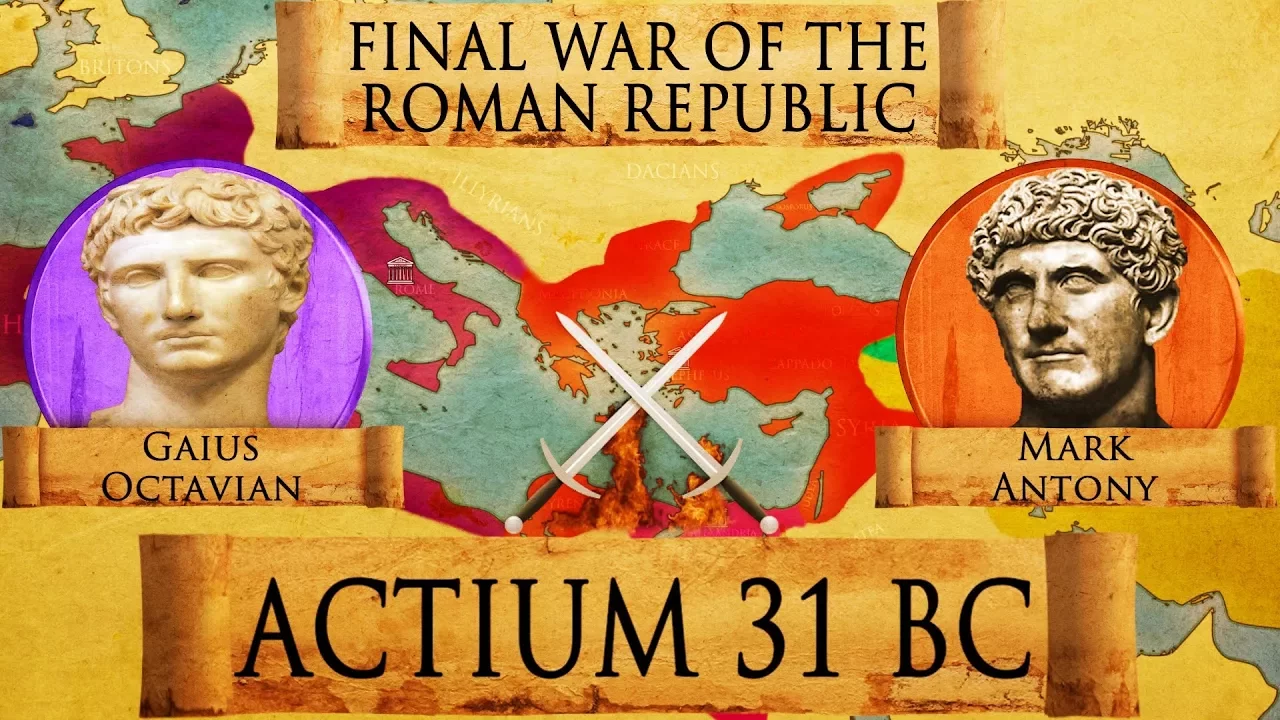
The clash that followed is known as the War of Actum on account of the fact that it was decided in a single battle. This was one of the largest and most important naval battles in history. It took place in the waters off the coast of northwestern Greece at the mouth of the Gulf of Corinth on the 2nd of September 31 BC.
Anthony and Cleopatra had gathered their forces in Greece when Octaven and his allies decided to confront them. On the morning of the second, Antony and Cleopatra attempted to break out from their position in the Gulf. Initially, they had more ships than Octavian.
However, through a combination of disease and desertion, they did not have enough men to man all of these. Hundreds of ships were involved in the engagement that followed. In the course of it, the smaller and more maneuverable ships of Octaven proved better suited to the conditions, and Antony's fleet was decimated.
He and Cleopatra only barely managed to escape and fled back to Egypt.
Defeat at Axium had doomed Anthony and Cleopatra's cause. Octavian took his time before pursuing them. He wintered on the northern side of the Mediterranean and prepared for a campaign to Egypt, eventually marching by land through Asia Minor and the Levant to Egypt. For his part, Antony was desperately trying to raise a new army in North Africa, all to little avail. his chances of winning the war had slipped away when he left much of his army in Greece. There is a lot of mythology surrounding what happened at the end of the conflict. Octaven arrived at Egypt and laid siege to the capital Alexandria following which Anthony decided to fall on his own sword rather than be captured alive. The story of him surviving for long enough to be taken to Cleopatra and her then deciding to join him in death by having a poisonous snake bite her is a bit too colorful to have been accurate. It is more likely that she learned that he was dead and drank some poison. Whatever the truth of their passing, the end was the same in the war. Octavian was victorious.
Egypt was annexed into the empire of Rome, completing the annexation of the major successor states to the empire of Alexander the Great. This also gave the Romans access to the Red Sea and within a few months expeditions were being sent out to establish trade with India and other distant lands.
The end of the war of Actium left the Roman Republic, or at least what remained of it, at a crossroads.
Octavian was victorious in the same way that Sula had been a half century earlier after defeating the Marians, and as his great uncle Julius Caesar had been two decades earlier once he had vanquished Pompy. To any dispassionate observer, it must have appeared that a fresh round of chaos might be imminent.
Sula and Caesar had both claimed the power of dictators, and both had soon departed from the scene. One through retirement and one through assassination, triggering a fresh race to claim power in the Republic amongst its leading politicians and generals.
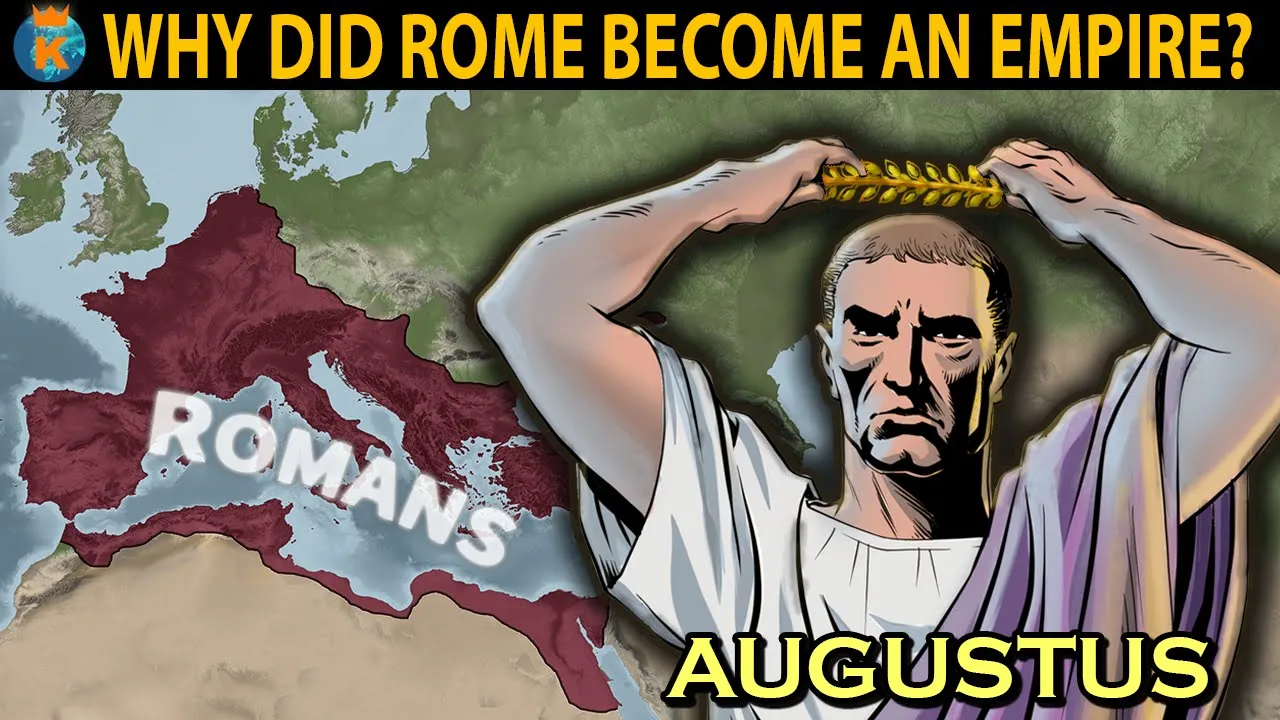
However, that isn't what would happen this time. Octavian, who would soon become known as Caesar Augustus, would prove to be a shrewder politician than his great uncle, one who saw a way to pleate the political classes of Rome, while also establishing himself as the preeeminent citizen of the state. He would become the emperator, a word which meant commander or conqueror at the time. We know it in its more anglicized version today as the word emperor.
As we will see in the next part of this history of the Roman Empire, Octavian would very soon establish the imperial system and become the first emperor of Rome.
What do you think of the history of the Roman Republic? Was it inevitable, given how militarized and warlike the Republic became, that a Roman commander would eventually try to seize absolute power over the Republic? Or was the Roman state betrayed by power- hungry figures like Julius Caesar? Please let us know in the comment section. And in the meantime, thank you very much for watching.
[Music]
Up Next
14:40
Battle of Actium 31 BC: Fall of the Roman Republic
@KingsandGenerals
1M views•2017-09-03

33:02
The Great Schism of 1054: Causes and Consequences
@SacredCathedrals
113.5K views•2026-02-19

58:24
The Ancient Origins of the Roman Empire | Rome History Documentary
@odyssey
673K views•2022-11-16
17:05
Understanding the Cold War: Superpower Conflicts and the Road to Détente
@OverSimplified
46.1M views•2019-01-24
Related Study Plans & Knowledge Roadmaps
Structured learning paths in History
history
Byzantine Iconoclasm: Theology, Art & Politics
01Foundations of Byzantium and Early Christian Images
02The First Iconoclasm: Leo III and the Crisis of Images
03Empress Irene, Nicaea II, and the Second Iconoclasm
+ 2 more learning modules
9h5 modules
Explore Roadmap
history
Iranian Revolution (Causes, Events & Legacy)
01The Pahlavi Dynasty and the Roots of Discontent
02The Spark of Rebellion and the Rise of Khomeini
031979: The Fall of the Shah and the Climax of the Revolution
+ 2 more learning modules
8h5 modules
Explore Roadmap
history
Mali Empire: Mansa Musa, Trade & Timbuktu
01Foundations of the Mali Empire
02The Trans-Saharan Gold and Salt Trade
03The Reign and Pilgrimage of Mansa Musa
+ 1 more learning modules
6h4 modules
Explore Roadmap
history
1947 Partition: Politics, Borders & Legacies
01Foundations of British India and the Divide
02The Political Negotiations and the Mountbatten Plan
03Drawing the Boundary: The Radcliffe Line
+ 2 more learning modules
8h5 modules
Explore Roadmap