















![[서울대 나용수교수님] 플라즈마 기초 26강 Equilibrium & Stability 3 Plasma Instabilities Kink & Sausage](https://i.ytimg.com/vi/hQSpvz8HCuM/maxresdefault.jpg)



![[핵융합 플라즈마 개론] Lecture 18-1 Anomalous transport. 서울대 나용수교수님](https://i.ytimg.com/vi/GYVpcCDnZoo/maxresdefault.jpg)




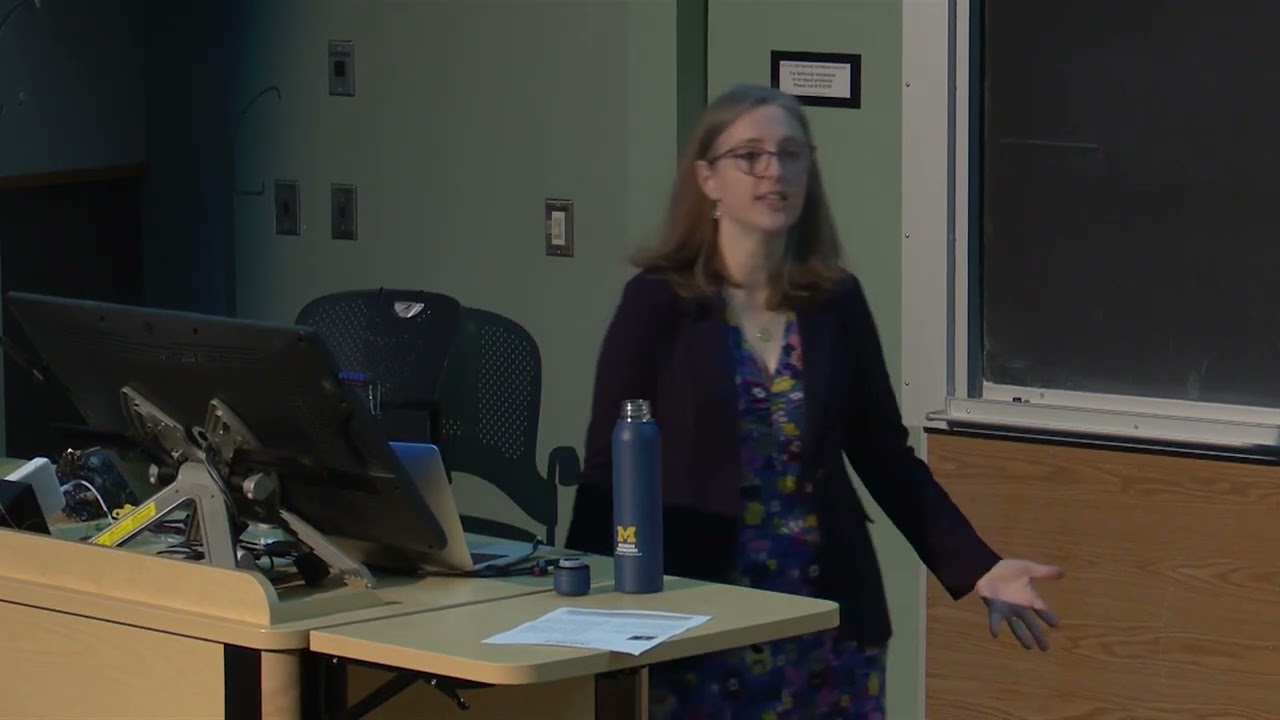
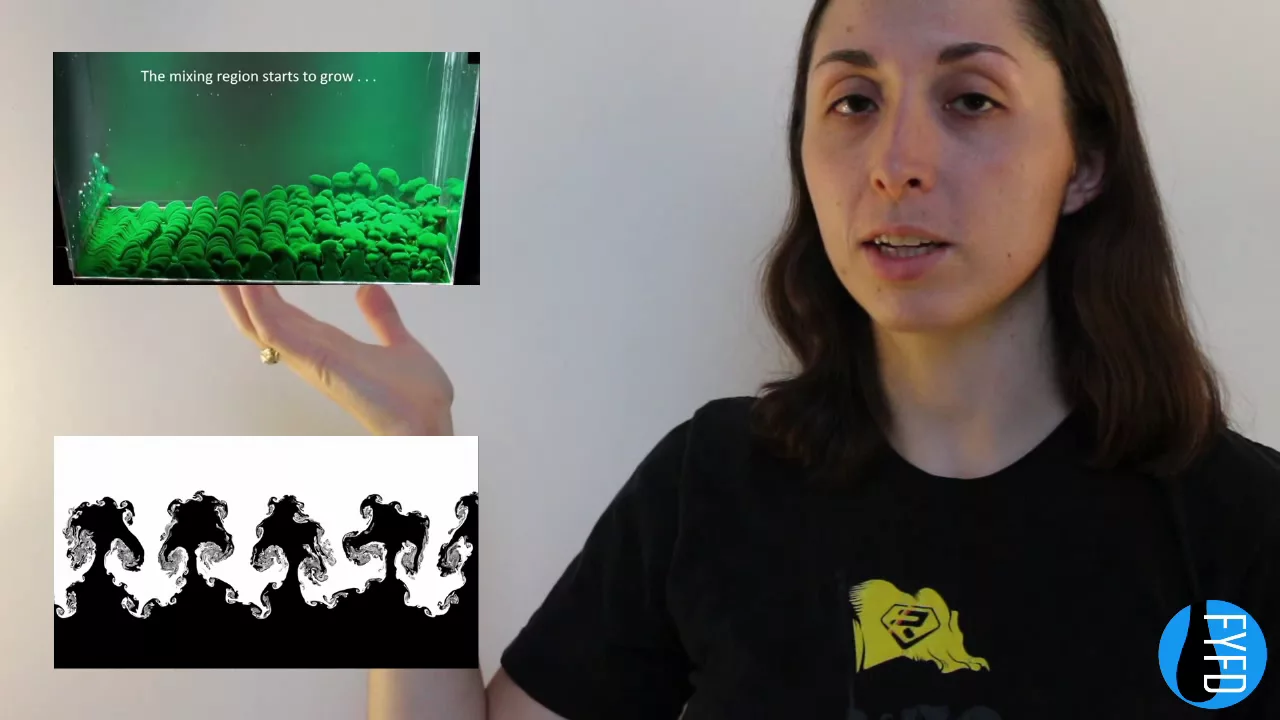
In highly conducting plasmas, magnetic flux is 'frozen' into the plasma (frozen flux theorem), but with finite electrical resistivity, magnetic fields can diffuse through the plasma with a diffusion coefficient η/μ₀. Plasma instabilities arise from free energy sources including spatial gradients (density, temperature), flow velocities, and velocity-space anisotropies. The Rayleigh-Taylor instability demonstrates how a heavy fluid over a light fluid becomes unstable under gravity, with the dispersion relation ω² = -(∇ρ₀ · ∇g) showing that instability occurs when density and gravitational gradients align. In magnetized plasmas, this transforms into an interchange instability where the effective gravitational potential is grad G_eff = (P/B)∇(log B), causing plasma to migrate toward regions of lower magnetic field strength.
Plasma Instabilities & Magnetic Diffusion | Plasma Physics
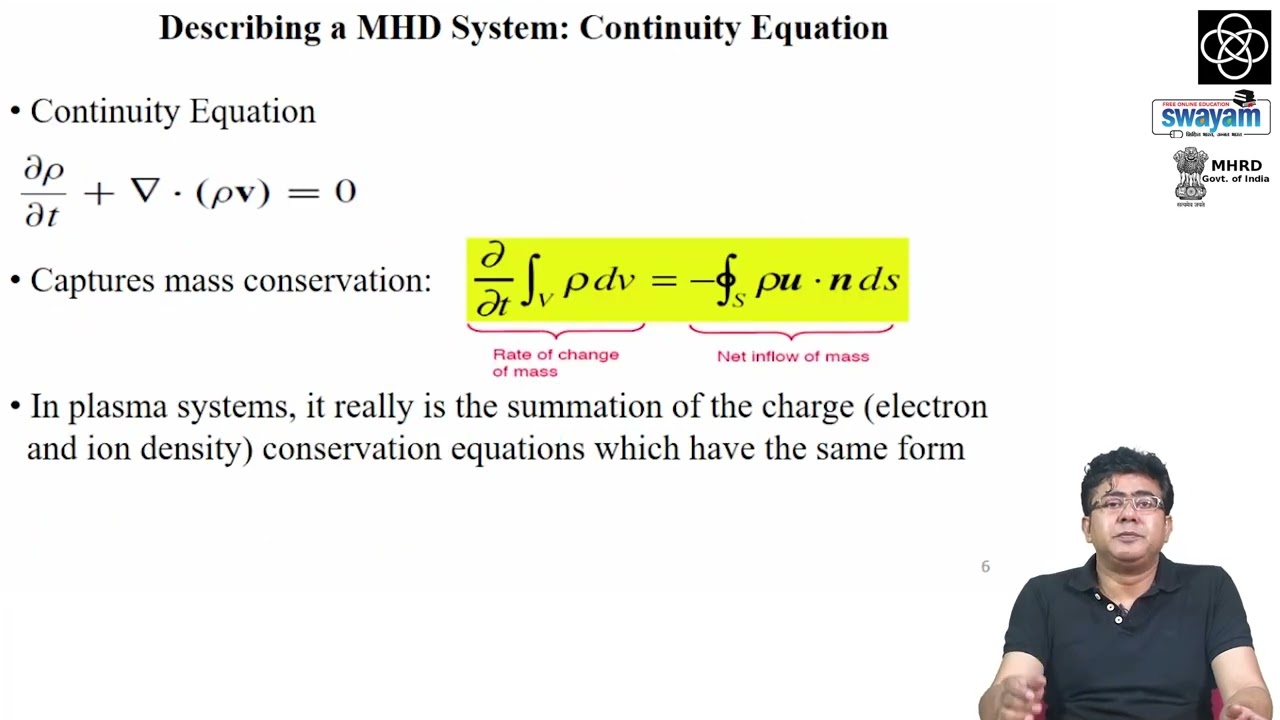
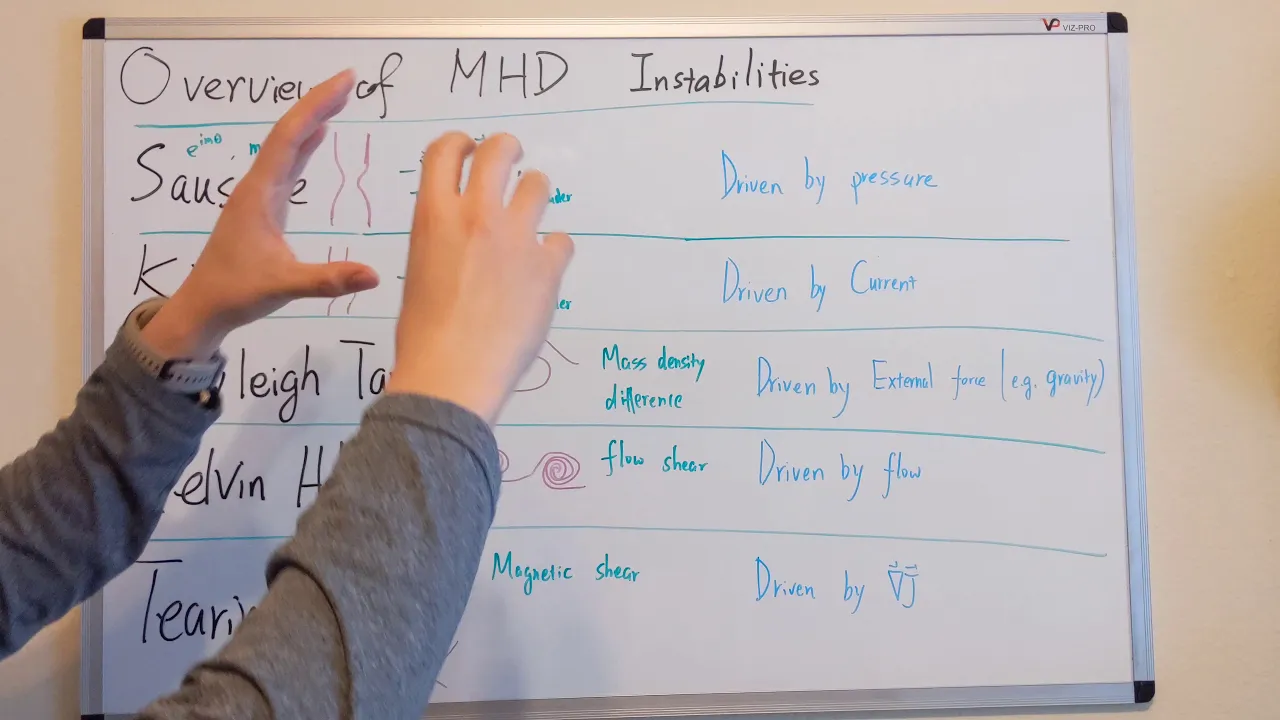
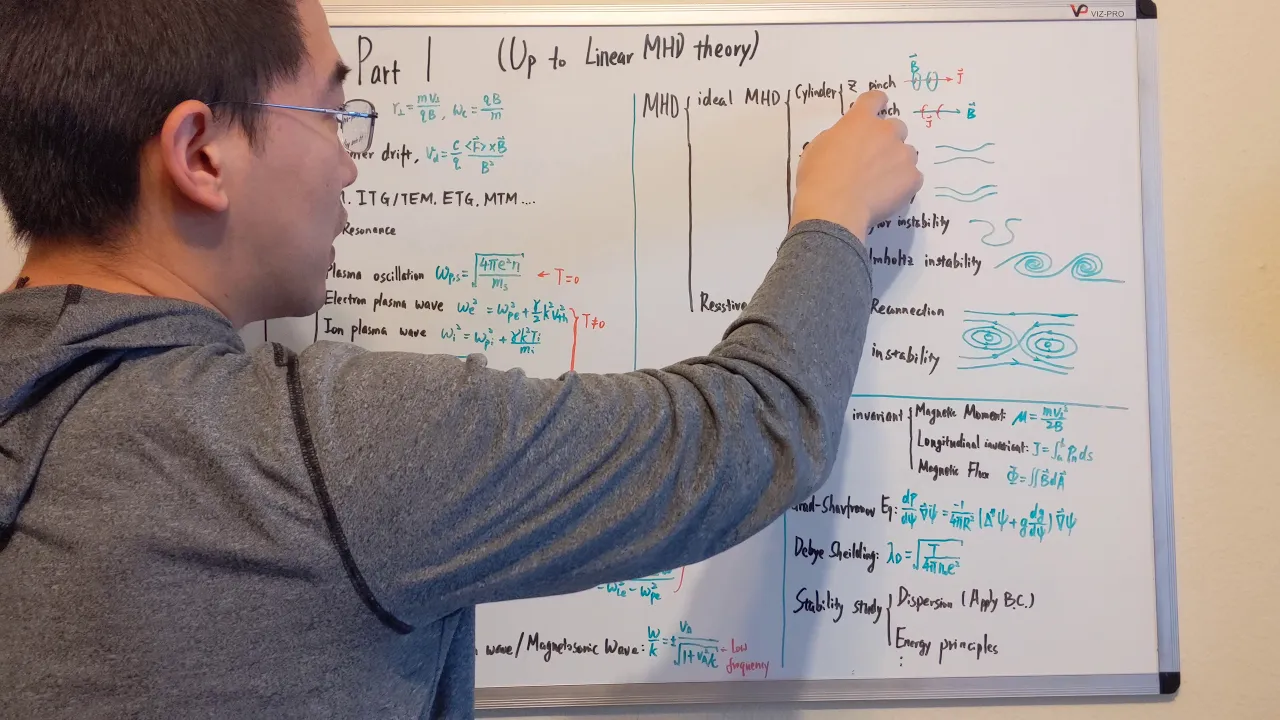
Added:okay we're still on this subject of equilibrium and stability in plasmas which is more or less what is really kind of the fun part particular stability in plasmas and so well anyway so I want to just remind you that that's what we're trying to talk about equilibrium and stability now in this regard before we get into stability a sort of general thing that we need to realize about plasmas is that they are highly conducting media and that in fact if you had a regular you know superconductor you know that if you had any magnetic flux embedded in that superconductor that in a wire say and you move the wire you would expect the magnetic flux to stay in the wire and move with it and if a plasma is a very good electrical conductor it then shouldn't surprise us that in fact magnetic flux embedded in a highly conducting plasma will more or less stay there so what I want to do is to remind you that we kind of quickly at the last of last time wrote down that well this so-called frozen flux theorem which was and I want to illustrate and talk about that a little bit and then add resistivity and show you then something else happens and that frozen flux theorem was written as d by DT of the integral and maybe I should say at constant total mass or constant let me say number of particles let me do it that way times D s dot B is equal to zero so the idea is that if we have a bunch of field lines here and a plasma so these are a bunch of field lines B and we've got plasma embedded in them let me just put it between let us say those two field lines then the idea of the frozen flux theorem is that if I was somehow able to move this field line up to here that in fact the plasma would also move on on up to there as well that is to say you know if I had a certain number of particles between these two magnetic field lines are really in a kind of bundle of flux at a certain number of particles that in fact those particles would just spread out and still encompass the same number of magnetic field lines so what this means is then in the limit of infinite plasma conductivity that is to say the plasma is more or less than a superconductor or resistivity goes to zero the plasma moves with the magnetic field lines and we should say and vice-versa which is to say that the B field moves with the plasma same number of flux lines per number of particles is the basic idea now the next thing we want to address is to say well okay that's fine if I had an infinitely electrically conducting plasma what about if I had a more realistic situation as we do in a plasma usually with a little bit of finite electrical conductivity or resistivity and so what we want to do is add resistivity to this picture and to see what we think that does to the to the business so let's say add resistivity and what we ended up doing let's recall as we used Holmes law and so what our Ohm's law now is is that we have J is equal to electrical conductivity times the electric field plus V cross B and we also used Faraday's induction law or Faraday's law from Maxwell's equation equations and that is of course that which we wrote in the form of DB DT is equal to minus the curl of e so what we now want to do is to solve Ohm's law for the electric field and stick it into there and so if we solve Ohm's law for the electric field what we find is that E is equal to minus V cross B and that from before was the part that caused the plasma to convict with the magnetic field but then we have this additional term due to the electrical conductivity which will be plus J over Sigma but we often now will write this as let's say ada x j8 of being the electrical resistivity of course so now so we substitute then this elected this solution or representation of the electric field from Ohm's law in the Faraday's induction law and doing that what we find is that we have DB DT is equal to and now - curl of e the first term gives us the curl of V cross B and then the other term gives us minus del cross ADA over mu knot of del cross B now there's a you know there's a little bit of complication in the operators here and so for simplicity what we will do to illustrate things is will assume ADA is equal to constant in space and with that then we can take the ada over mu knot outside of the spatial derivative operators and another thing we have to take into consideration or do is to realize that the curl of the curl of B if you just look up in vector tables like in the NRL formulary is in fact - del squared B for the laplacian and then there's another term which is equal to minus the gradient of del dot B however we have of course solenoidal field we have a sorry well anyway we have no monopole so the divergence B is equal to zero so putting all of this together what we find is that the magnetic field evolution with a little bit of resistivity is then given by the curl of V cross B and then minus minus becomes plus so this becomes plus a de over mu knot times del squared B now we can kind of identify the terms namely this first term is the term we dealt with in getting this frozen flux there namely what it says is it's the movement of the magnetic field with the plasma flow velocity V okay so this says I convict the and it's a little complicated because of the curl here but anyway I convict the magnetic field along with the plasma because the in this term I have effectively infinite conductivity and and therefore the field lines are frozen into the plasma electrically what about the second term well if we kind of remember we know where our density equation we had like DN DT this is sort of let's just say a side comment over here plus del dot gamma is equal to 0 and if we used fixed diffusion law gamma is equal to minus D grad n it's supposed to be a D kind of hard to see then this equation became DN DT minus D D squared n by DX squared equals 0 so that's a diffusion equation you know mass diffusion equation and if you look at the structure of this it's a vector field B which is being operated on but frankly it's just a diffusion operator that happens okay that is present here so what this last term is is that well in fact there is some diffusion of the magnetic field - just moving with the plasma because of the finite resistivity so this is what's often called resistive diffusion of B relative to - V that is to say some magnetic flux lines leaked out of a certain number of particles in the plasma because of the fact that I have a really a finite electrical resistivity in the plasma so what we often like to refer to this then as is this is then a diffusion coefficient and so what we like to say is that the diffusion coefficient of the magnetic field is equal to a 2 over mu naught and that's the diffusion of the magnetic field relative to a not quite perfect electrical conductor now if I had that term alone then we know how to solve these diffusion equations and we know that then this would lead to a magnetic field which would sort of you know be some e to the minus T over tau 8 and some cylindrical model or something like that and we would get that the diffusion of the magnetic field out of let's say a cylinder of plasma of radius L let's call it L sub R here for a moment I'll sketch in a moment we have this vessel function business about when we dealt with diffusion out of cylinders and it's just a different diffusion equation here its diffusion of magnetic flux instead of diffusion of plasma particles or heat or something like that and I made too small a cylinder here but I'm trying to say that the sort of L sub R would be sort of the radius of this okay so the idea is this is called the magnetic diffusion diffusion rate and this is sometimes called the skin diffusion time and it is that if I set up some magnetic field in a plasma with finite resistivity this is the rate or time scale of the ultimate lowest order eigenmode the rate at which that eigenmode diffuses away okay in typical laboratory plasmas like some of the tokamaks on campus this will be like ten seconds or something because the plasma is a killable turn out to be as good a conductor as copper actually and so they hold the flux pretty well it turns out now there's another so so this is magnetic diffusion so magnetic fields are pretty well frozen into plasma as it turns out there's another aspect if I now imagine going to the edge of some cylindrical plasma and I impose an oscillating magnetic field or something like that I can ask how far will that magnetic field permeate into an almost superconductor type plasma or a fairly highly conducting plasma and so let's ask about something I won't go through this in detail but I just want to kind of mention these things anyway so let's ask for what's called the resistive skin depth for a B like e to the minus I Omega T imposed at the edge and now to give you an idea how you check these things on let me call them back of the envelope type calculations what you can do is say well look I'll just kind of scale I won't worry about this movement of B relative to V that's in there and it's important but what I care about is how much diffusion there is relative to that and so what I can do is I can say that I will have a delta B over a delta T that is of order and then it's order a though over mu naught times and then there will be a delta B but that's a Dell squared so I'll have to put some scale length squared downstairs so all I'm doing is scaling this diffusion equation and if I do this I can see that the scale length of the gradient of the diffusion okay I can estimate that scaling of that infusion length namely you just work this back through and what you find is that Delta X is of the order of the square root okay of Ada over mu naught times delta T and the delta T that's relevant okay becomes approximately 1 over the frequency if I have an oscillating wave and so out of this and you can do this up better and good algebra let's say is you end up with a skin depth for how far does an oscillating electromagnetic field penetrate into a slightly resistive plasma or frankly this could be a copper bar at this point the answer is as sort of ADA over mu naught Omega although often ADA is written as conductivity and so the more standard form of this is Omega mu not electrical conductivity and so this is known as the resistive skin depth again it's how far does a wave penetrate into a slightly resistive plasma but notice that if I applied an electromagnetic field to the edge of a fairly conducting plasma in fact what I would have is mostly the plasma just shakes with the magnetic field because it's more or less conducting on the other hand there there's a slight losing of the magnetic field relative to the relative to the plasma now also comes with this resistivity sorry electrical resistivity is a Joule heating or ohmic dissipation in the plasma because you know I'll get some EJ and so forth but I really will come back to that when we talk about tokamaks in which you lay in magnetic flux from the outside you soak it in all the time and it's dissipated through Joule heating but that's kind of for later okay now so this we kind of have to understand about a plasma but next I then want to go on to this subject of plasma instabilities and so let's kind of start discussing that and the kind of comment is this is going to be relaxation of a plasma via instabilities and I briefly mentioned a little bit of this last time in a certain sense if we just have a plasma we just have a plasma of the magnetized plasma and it you know it'll collisional II scatter out and slowly diffuse out but if we create a plasma in a sort of funny ways as we'll talk about in a little bit the plasma thinks that gets impatient and gets across magnetic fields by virtue of collective instabilities now so I'm gonna try to talk about those instabilities but before we talk about the instabilities we'd like to talk about how in fact the kind of general constraints on how how a plasma could relax and for this we imagine the plasma is collision less because we're interested in processes by which the plasma can move across magnetic fields relatively rapidly compared to collisions hence the collisions are unimportant on that time scale so for collisionless plasmas there is no H theorem what do I mean by that well in collisional situations you have the so-called Boltzmann H theorem or entropy production or however you want to rate it and the plasma that H theorem in a collisional gas in this room or if you had a collisional plasma would drive the plasma towards a thermodynamic equilibrium with a maxwellian distribution and so forth and equilibrium statistical mechanics whether quantum mechanical or non quantum mechanical is all based on that the problem is in a plasma we don't have an H theorem in general which tells us where the plasma is trying to go so it's so the problem is we can't tell what relaxed state the plasma is trying to go to okay that is to say it's not clear it's like a maxwellian or exactly what so the way to say it is it's not clear what the relaxed state it's trying to get to is another way maybe I should say the reason why we might think it's out of thermodynamic equilibrium is because we're often trying to confine hot plasmas away from walls where there are plasma density gradients or pressure gradients and that seems like it ought to be some sense of non equilibrium that at least collisions would try to relax and the question is what about also what about collective processes this is sort of beyond this course but let me just say that if you go into a collisionless plasma it turns out that actually either you can show that either an entropy functional integral DQ v f log F or even the internal DQ v of some generalized entropy functional G of F is conserved in a collision less plasma so it's a constant of the motion actually and so the basic idea there is that entropy has usually defined is not a very useful concept but you can show using that sort of logic that if the distribution function and we're going into kinetic theory later so really dwell upon this but anyway is only a function of energy and that the distribution is a monotonically decreasing function of energy of which a maxwellian is one class then the plasma is stable but that doesn't really help us much because it says any distribution function which is a monotonically decreasing function that the energy is okay and there's a lot of those let's just say so the problem then is that in a plasma you can't really define entropy you can't define an h theorem you can't define a free energy and so what can you do well what you end up doing is saying okay I'll just put the plasma and I'll figure out that it does some oscillation that grows and then I'll work it worry about the linear growth of that oscillation and then the nonlinear growth of it now even though you cannot precisely define a sense of free energy you can kind of qualitatively do it and again this is so let's call this sense of free energy that may cause instabilities and those would be from various possible sources in the plasma in a plasma and there's basically three different types one is grad n grad T spatial gradients of temperature density etc and this is known as expansion free energy because if the plasma removes the density or temperature gradient it expands and flattens out right so this is called expansion free energy and these are going to be and this is what I'm going to talk about in a moment this will called Rayleigh Taylor type instabilities in a fluid at least the second thing that can give us certain types of instabilities are sort of flow flows or streaming in the plasma and this would be that you know my plasma has a flow velocity or maybe heat flow velocity or etc and we'll get into so-called to stream instabilities and various things like that and then finally so these are all describable in a fluid way finally you end up with some velocity space instabilities and these would be like maybe we have different perpendicular temperatures compared to parallel temperatures in the direction of a magnetic field and or maybe you remember in a mirror machine we have various loss cone type instability lost cones where half of velocity space is empty and so you can imagine a plasma instability would like to fill that in basically like to put some particles there so those are the general sense now before I get on to an instability calculation I need to kind of tell you this kind of schema of how you go about calculating instabilities and figuring out what what happens so let's call this the general scheme of instability / plasma relaxation calculations now the first comment is that we had best make sure that the plasma is in fact in equilibrium first so first is is calculate the equilibrium situation and for this of course what we mean is that the figure out you know all the variables the magnetic field structure and so forth in which the net force at each position and the fluid plasma is in fact zero then what you do is you say okay now let me suppose a a small perturbation on the plasma and then the comment is that this will lead to this is just like our wave analysis you know we imposed a small perturbation on the other hand what we now look for is that it grows linearly so we try to find those cases for which the imaginary part of the frequency is greater than zero and we assume I mean that's the sort of sense of these instability calculations that that does so by tapping the free energy so the idea is I have some expansion free energy and perhaps or one of those other sources of free energy and if I put a wave or oscillation in there it is somehow able to get at that source of free energy and have the wave grow at the expense of that free energy let's just remember that e to the minus I Omega T if I make Omega is equal to Omega real plus I ma Omega I e to the minus I Omega T then just becomes e to the minus I Omega real T and then plus Omega I T so if Omega I the imaginary part of Omega is greater than 0 for some wave in a plasma it in fact means that that mode is growing in time linearly growing in time now can it grow forever well no usually we did some linearization right we neglected a whole bunch of second and third and so so forth order terms and so you presume and this is really hard work to calculate but you presume that there's then some nonlinear saturation and it turns out that can come in more or less two different ways one is a single well a single coherent mode you know that one you could SAP up all the energy into one mode or more often what happens is you get plasma turbulence on a on a sort of small scale and then once you get that then you typically get this leads to anomalous transport in the plasma and it means anomalous because it's larger than that's the only reason why we would care larger than the Coulomb collision induced transport okay so the next thing I want to talk about now is a particular instability and it's one that's very familiar from you know real life experiences and it's called the Rayleigh Taylor instability and I'll show you how we go through at least the linear version of that so and this mode this will called Rayleigh Taylor instability is very analogous really gotta be the other way around rayleigh-taylor instability it's very analogous to well it's a fluid instability but it's very analogous to a plasma instability and the basic the most fundamental okay way that this can be Illustrated is let us imagine we had a tank of water okay and so we'll put in a tank of water here and fill it up to some level and now I will put on top of this water some oil or other immiscible liquid and I'll fill it up with another liquid on top now the basic question is what's going to happen physically if the liquid that I put on top and I'm I can't tell you how I keep the surface from jiggling but that's incidental I'm somehow able to perfectly prepare experiments here if the liquid on top is lightweight compared to the liquid on the bottom then we know it'll just sit there okay but if the liquid on top is heavy weight compared to the liquid on the bottom we know that it's gonna fall down basically and that falling down process is is sort of leaks through and little wiggles and that is called the Rayleigh Taylor instability that removes that so now on what I want to do is just show you how that process gets described mathematically and then we'll show how this process is in fact very analogous to what happens in a plasma so if you imagine that you had a gravitational force of course gravity's the key aspect here right it tells me which ways up and down so I'm going to have a gravitational force in this direction and I'm also going to have a gravitational potential which I will define as up in this direction Capital G will be that gravitational potential so the Rayleigh Taylor instability is this is the classic let's call it expansion instability of a heavy fluid over a light fluid and over a course direction is determined by gravity gravity what about collisions in this situation well collisions are extremely small scale okay I mean there there is a viscosity in this fluid but that's very very very small scale what happens here then as we we will care about let me just say it that way a gravity force which is equal to the mass density times the gravity G or I can write that as minus Rho mass gradient of this gravitational potential gene so what I want to do now is do a little bit of mathematics and show you how we find that this is an instability the idea is that we begin with the fluid equations that would be relevant for this case which are mass conservation D Rho DT plus del dot Rho mass V is equal to zero and the momentum balance equation which is Rho mass DV DT is equal to the forces but in a fluid ordinary neutral fluid I won't have the usual Lorentz force Rho mass E Plus V cross B or well Romanus speaker and J cross B but I will have potentially a pressure gradient but I won't worry about that it turns out and then I'll have this gravitational force density Rho mass times the gravitational constant G but in fact we will neglect the pressure here so what we're doing is neglecting sound waves it turns out but I'll mention what they do as we kind of go along here now just like in the wave analysis okay what we next want to do is linearize these equations and ask whether or not a small perturbation now in our case is going to grow or damp is the question so what we want to do is linearize and what we end up with then is d rho mass tilde by dt plus and now have V dot grad Rho mass knot and then it turns out you work this all out there's another term Rho mass divergence of V tilde and that's all equal zero and this equation when linearize becomes Rho mass not D the tilde by DT is equal to when I wrote it in the other form now minus Rho mass tilde gradient of G now it's customary in this business you don't have to do it to also assume that this is 0 divergence of V and assuming that 0 basically means that I'm considering only incompressible oscillations so you know most fluids are pretty incompressible it turns out so it says I can't compress them so I well don't have enough room to write in incompressible here so we'll just only consider incompressible oscillations yeah it's consistent with the neglect of the grad P term to not put in that compressibility if I did put that sound waves in then I would need to put in the divergence V correct so it's consistent with with neglecting that but since I'm not interested in that I'll avoid it so to speak it's just a little more algebra included okay so if I now then the final step in our linearized transient analysis is we assume that the modes that might be in the plasma have e to have you know like Rho tilde goes like e to the minus or e to the I K dot X minus I Omega T and so putting that in my mass conservation equation then becomes minus I Omega romance tilde actually linearizing that should have become a partial derivative because the equilibrium flow should be zero and so forth and then this will be plus let's just call it V tilde dot gradient Rho mass not is equal to 0 and the that was the continuity equation linearized and the momentum equation becomes minus I Omega Rho mass naught V tilde and that's equal to minus Rho mass tilde grad G so now I can solve the second equation for the V tilde and then stick it into the first equation ok so what you find is that V tilde is then equal to Rho mass tilde over Omega Rho mass not times the gradient of G and then what you do is you substitute that into V and so we'll do that and what we then obtain is well sticking this in and sticking that on the other so I'll leave it that way - I Omega Rho mass tilde and then plus Rho mass tilde over Omega romance knot times gradient G dot gradient of the mass density and now I get got myself a dispersion relation as usual cancel out the common term and oh now I see that I left out a critical high hi there and so I can you know I multiply these two together and again see I squared Omega squared and so finally putting this together what we find is that we have a dispersion relation that Omega squared is equal to minus grad G dot gradient of the mass density and then there's a normalization also the mass density in here now if I had taken account of sound waves it turns out they would give me minus K squared V sound squared but they're not sort of mostly interested in that we're mostly interested in this part okay so now what I want to do is say well how would I get stability or instability out of this plot out of this fluid situation well so move this guy up here let's suppose that we had the heavy fluid on the bottom now in that case if I come back to my little sketch here of the fluids then grad G is upward okay this gravitational potential grad G is upward then we would have grad Rho mass would be let's see oh I'm sorry it would be up yeah sorry it would be downward so grad Rho mass would be downward okay because I'd have the heavy mass on the bottom light mass on the top so I'd have grad Rho mass but then if I dotted that into grad G they would be in the opposite direction so grad Rho mass dot grad G would be less than zero so if I now use that in this dispersion relation which we had okay now sure you can get all this on the same graph here better so let's go back to this dispersion relation ignoring now the sound waves which puts a limit on the K values for which that's going to happen if I have this negative then what this says is the Omega squared would be greater than zero and then we would just get omega is equal to plus or minus Omega naught you know some oscillatory frequency and physically that's a stable situation and what this analysis says if is effectively that if I wiggle the interface between the heavy and light fluid the heavy fluid if the heavy fluids on the bottom find it's all stable okay on the other hand suppose I put the light the the heavy fluid on the top well then now my gradient ro mass is upward from bottom to up I find that grad ro mass dot gradient G they're aligned so it's greater than zero my Omega squared becomes less than zero and now what I have is an Omega is equal to plus or minus I times Omega naught and I have two roots but one of those roots is growing in time so what happens is then I have an instability and therefore I have an unstable situation and what really happens well if we go back to here what happens on these little charts is that if I put the heavy fluid on the top a little interface okay develops here and basically those things just permeate those little fissures just permeate into each other and you can even get into situations where they roll around and do all kinds of interesting things as the two fluids inter permeate into each other by the way in plasmas there is a direct analogy of this in laser fusion when you apply a electromagnetic wave that creates a pressure that tries to hold the edge of a of a plasma you see a Rayleigh Taylor type instability right at the interface between the plasma pressure applied by the electromagnetic wave and the plasma I'm sorry the pressure applied by the file by the electromagnetic wave and the plasma okay so you know you would say well no fool would put you know a heavy liquid on top of a light flick would and expect it to sit there right but in the early days of plasma physics people didn't kind of realize the analogy of this and it turns out the magnetic field the a minimum or maximum in the magnetic field from is the same basic type of mechanism so that's what I want to talk about next is the relationship of this rayleigh-taylor instability to what happens in a plasma so it turns out and and to do this upright takes a good bit of algebra but we won't go through that but in a magnetized plasma it's as if we have an effective gravity so let's call it grad G effective which is like 1 over B grad B or you could make it you know 1 over B squared grad B squared 1/2 here I guess if we wanted to do it that way so what happens is the magnitude or strength of the magnetic field tends to take the place of the gravitational potential so if we put the plasma at a minimum of the magnetic field it's going to stay there if we put try to put it on a magnetic hill it's going to fall off hence instability what happens and we'll go through a bit of this now what happens is the so-called Rayleigh Taylor instability which we've been talking about in a fluid goes over in a plasma to what's called an inter change instability and that interchange instability is an interchange of magnetic field lines and flux and and pressure just interchanges of units of pressure across magnetic field I should say so it's an interchange instability and it's in fact very analogous now to see all this what we have to do is go in to think about the various well the drift velocities in a plasma so if you go back and remember that our drift velocity is in fact given by an eco Spee ah drift velocity then in addition it's given by we had all these curvature and grad B drift sand stuff like that and so this is being on cross mu Granby and then there was the curvature MV parallel squared B dot del B and then in addition we wrote and I won't worry about the polarization type drift the force on the gravitational well any ordinary force on the guiding center of the particles cross B over QB squared and so and we had as our we could have written our force on the guiding center was equal to minus mu grad B plus MV parallel squared I should say this is or that and if I write it out as the force on the guiding Center it's minus mu grad B plus MV square law I'm sorry minus MV parallel squared of B del B now suppose on the other hand that I had a gravity a real gravity in a plasma we usually neglected what it would it look like well in terms of what we've been dealing with it'd be minus M grad G this would be the gravitational force so I can use this to say do these represent something like a gravity that's the the sense of what I'm going to be doing here and in particular these two if you remember that this in the low beta plasma was 1 over B grad B the sense of this is that then I can in fact write that the gravitational potential first two terms give me minus M V parallel squared plus V perp squared over 2 and then 1 over B grad B and then this mass em grad G so with that being the case that's on a single particle basis I then would kind of like to add all this up for the entire set of particles in a plasma and so let's try to estimate the net force and that would be the integral over all velocity space times some distribution function times the force on the guiding centers and you can see if you go through this that this would be minus now MV squared is just going to give me a take of velocity integral that's the temperature or the I'm sorry the pressure so it would be minus P it turns out over B grad B and this last term the gravitational effect the true gravitational effect would just give me the mass density times the gradient of G so the idea then is that I can see out of this that the effective gravitational potential I'm going to write this one as grad G effective okay well Mac actually minus Rho mass not gradient G effective so the effective gravitational potential would be like the pressure over the mass density times the gradient of B over B which I could write as the gradient of log B so in other words the in homogeneity in the strength of the magnetic field the density magnetic flux density mop you know the not the vectorial direction but the modulus of B is in fact has the same effect okay as if there was a gravitational force so this is g effective then for a magnetized plasma and if we wanted to note it this P over Rho mass is of course the sound speed squared maybe some other things I should note here is that the pressure is ne te plus ni TI it encompasses both species both species and the pressure over Rho mass naught is equal to V sound squared plus or minus the factor of gamma depending upon degrees of freedom and so forth anyway so what I want to describe in a minute then is how actually we can look at various particular magnetic field configurations and see that well that it's like a Rayleigh Taylor instability that it's sort of like there's an effective gravity here and the idea is that you know the gravitational potential is highest well sorry points from the earth outward let's say where as the gradient log be points from hi small regions of regions of low B to regions of high V and what we can see by this it'll turn out that we want to put the plasma in a region of lowest magnetic field hence what's called minimum V and we'll do that in just a moment here you
Up Next

Fusion Energy Explained: Wendelstein 7-X Stellarator Overview
@HelmholtzTV
27.3K views•2016-10-06

21cm Hyperfine Transition in Neutral Hydrogen: Radio Astronomy Basics
@AaronRobertParsons
12.4K views•2011-10-13

Plasma Fluid Equations | Magnetohydrodynamics Basics
@luciusfox9508
6.4K views•2015-12-24

Entropy and the Second Law of Thermodynamics Explained
@veritasium
27.5M views•2023-07-01
Related Study Plans & Knowledge Roadmaps
Structured learning paths in Physics