





![[#벌거벗은세계사] (3시간) 전 세계 700여 곳 이상의 바다에 내려진 사망 선고💥 이젠 생태계까지 붕괴될 위기다?ㄷㄷ](https://i.ytimg.com/vi/5P9R_1TBTZs/maxresdefault.jpg)




















Coral bleaching occurs when corals expel their symbiotic zooxanthellae algae due to elevated sea temperatures (as little as 1°C above normal), causing corals to starve and experience lasting physiological damage including reduced growth, impaired reproduction, and increased disease susceptibility; the fourth global coral bleaching event, beginning in early 2023, has affected at least 72 countries and territories across all major oceans, with 76.7% of global coral reefs experiencing bleaching-level heat stress, surpassing previous records from 1998-2017, and authorities in affected regions like Florida, Thailand, and the Maldives have implemented emergency measures to minimize additional damage to already-stressed coral ecosystems.
NOAA Coral Reef Watch: Fourth Global Coral Bleaching Event Analysis
Added:The symbiotic relationship between coral polyps and zooxanthellae (microscopic algae).
The biological process of coral bleaching as a stress response to elevated sea temperatures.
Fundamental concepts of marine ecology, including the role of coral reefs as biodiversity hotspots.
Basic climate change drivers, specifically greenhouse gas emissions and ocean heat absorption.
The concept of marine heatwaves and how sea surface temperature (SST) anomalies are measured.
Advanced coral restoration methodologies, such as microfragmentation, larval seeding, and assisted evolution.
The synergistic effects of ocean acidification and thermal stress on reef calcification and structural integrity.
Satellite remote sensing technologies and predictive modeling tools used by NOAA's Coral Reef Watch.
Socio-economic adaptation strategies for coastal communities dependent on reef fisheries and tourism.
Global environmental policy frameworks, such as the Kunming-Montreal Global Biodiversity Framework, and their application to marine conservation.
500 views14likes49:55Original Release: 2024-10-29
Hello.
My name is Derek Manzello.
I am the coordinator of NOAA's Coral Reef Watch.
Today, I'm going to talk to you about coral reefs, the threat of coral bleaching, and the ongoing progression of the fourth global coral bleaching event.
So what is a coral reef?
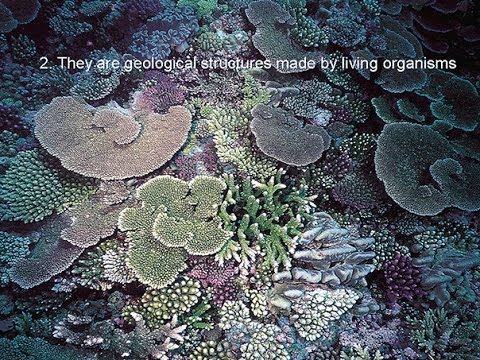
Well, in the simplest sense, a coral reef is a complex structure built by corals and other calcifying organisms.
Now, depending on where you are on planet Earth, coral reefs can look quite different.
So I just wanted to bring you in and show you what different coral reefs look like around the world.
So here's a few examples from Papua New Guinea, as well as the Indian Ocean.
Here on the left, we see Mountainous Star corals in the Florida Keys.
This species is listed as threatened under the Endangered Species Act.
To the right, we see a coral reef in Panama on the Pacific Coast.
Now, this location is very unique because you get build-ups of corals by one coral species.
Now, these are called pocilloporid corals.
And as you can see, this is all just one species constructing a reef.
And here again, we see more typical coral reefs in the Western Pacific and Fiji.
And also we see a beautiful example of a coral reef exposed at low tide on the island of Saipan, in the Commonwealth of the Northern Mariana Islands.
So why do we care about coral reefs?
Well, they are biodiversity hotspots, also called the rainforests of the sea.
Now, it's estimated about one in every four of everything living in the ocean associates with coral reefs at some point in their lives.
Now, the total number of species living on coral reefs is estimated to be somewhere between 550,000 and 1.3 million species.
So these, again, are the rainforests of the sea.
Now, in addition to all this biodiversity, they provide coastal protection from storms.
So areas with healthy coral reefs, the land-based-- excuse me, the human settlement and the human populations living close to shore will experience less impacts from hurricanes, tropical storms, cyclones.
Now, coral reefs are generating billions of dollars to the US economy every year.
It's estimated that coral reefs are producing about $3.4 billion contributing to the US economy every year.
Now, this number is in the trillions globally.
So coral reefs have many, many important characteristics.
And these are just a few of the big ones that I'm highlighting today.
So coral bleaching has emerged as one of the primary threats impacting the health of coral reefs.
Now, corals are an animal.
They're a very simple animal.
There are only four cell layers thick.
But they've established a symbiosis with a type of dinoflagellate that lives within their tissues.
Now, these algae that live within their tissues provide upwards of 95% of the nutritional requirements of the coral animal.
Now, the Achilles heel of this symbiotic relationship is that it's highly sensitive to elevated temperatures.
So if sea surface temperatures are as little as 1 degree Celsius, which is equivalent to 2 to 3 degrees Fahrenheit above the normal summertime maximum average, and the temperatures stay there for a sustained period of time, corals will start bleaching or expelling their symbiotic algae.
Now, to put this image here on the right into perspective and scale, you're looking at a Mountainous Star coral living off the Coast of Islamorada, Florida, that is fully bleached.
Now, this coral is about 6 feet tall, about the same height I am.
That's roughly 2 meters.
Now, this coral grows about a centimeter a year.
So 200 centimeters is 200 years.
What this means is that this coral began its life living off the Coast of Islamorada, Florida, about 50 years before the American Civil War.
Now, to give you a brief physiology 101 on coral bleaching, I just want to show you how the symbiotic algae and the coral host interact.
The algae are providing food to the coral, oxygen, as well as sunscreen via Mycosporine-like amino acids that do an excellent job blocking out ultraviolet radiation.
Now, in turn, the coral is providing a home for these algae, it's providing carbon dioxide for photosynthesis, as well as food via nutrients and waste products.
Now, again, this relationship is highly sensitive to elevated temperatures.
So when temperatures get too hot, the symbiosis breaks down, the coral expels the algae, and then that coral is essentially starving to death unless the temperatures cool off, and it's able to regain its algal populations.
Now, coral bleaching is not a death sentence.
That tends to be one of the things that people most often misunderstand.
Just because a coral bleaching doesn't mean it's going to die.
But the issue is there are lasting physiological impacts from bleaching that the coral then has to deal with.
For instance, corals have depressed growth and calcification for about two to four years after they bleach.
Also, they have impaired reproductive output for upwards of five years after they bleach.
And what's most devastating to corals in the Caribbean Sea is that they become highly susceptible to disease for one to two years after the bleaching stops.
Now, to put this in an ecosystem scale context, the issue is once you lose enough corals on your reef, that reef structure may shift into what is called a net erosional state.
Now, again, it's the three-dimensional habitat complexity of coral reefs that the myriad species biodiversity is depending on.
So as you start losing that three-dimensional habitat complexity, you will, in turn, start losing that biodiversity on your reef.
Now, again, the Caribbean Sea has gone through many disturbance events over the last 40 to 50 years and about more than 30% of the reefs in the Caribbean now are in a net erosional state, meaning they are losing more structure than they're gaining every year.
And then in Florida, it's even worse.
About 70% of Florida's coral reef was net erosional before the most recent severe record-setting bleaching event.
Again, this has downstream negative impacts to all the other organisms and animals and plants that are dependent on coral reef habitat for their survival.
So to put this in context of pretty pictures.
So the impacts from coral bleaching do affect many, many other plants and animals.
Now, today, I'm going to talk to you about corallivores and coral obligates.
Now, corallivore is a term that describes animals that feed on coral tissues.
Now, in the top left here, we see this little yellow pufferfish.
This is a guineafowl pufferfish in the Indian Ocean, swimming amongst a field of bleached corals.
Now, these pufferfish are obligate corallivores, which means they need to eat coral to survive.
So if corals die en masse, you have a mass mortality event.
These guys are essentially losing their food source.
And that's not good for your future survival if you no longer have anything to eat.
Now, I'd like to draw your attention to the crab in the bottom middle left picture there.
This is called a crustacean guard.
These are types of crabs in the genus Trapezia.
Now, these guys form a symbiotic relationship with the corals themselves.
So what they do is they protect the coral from crown-of-thorns starfish and other predators.
So what they'll do is they'll be able to sniff out the crown-of-thorns starfish coming into the water, and they'll go out onto the branch tips, and they'll actively basically push off the crown-of-thorns starfish.
They'll clip off its tube feet, they'll grab its and spines.
And basically, eventually, the crown-of-thorns starfish goes, all right, I've had enough.
I'm going to go to a different coral.
I want to deal with this.
And, again, these crabs, they are benefiting the coral, and in turn, they're feeding on fat bodies that are produced by the coral.
So if corals die, these crabs unfortunately also die.
Now, these other images here show you just some of the dazzling marvelous biodiversity you can find on coral reefs.
And these are different organisms that are dependent on living corals in some way.
Now, corals are not the only thing that bleach.
There are many, many tropical marine organisms are highly sensitive to elevated temperatures.
And there are other organisms on coral reefs that also live in symbiotic relationships with these dinoflagellate algae.
Now, perhaps, the most famous other coral, other species that lives in this symbiosis are the anemones that clownfish have an established relationship with.
Now, clownfish and these anemones exist in what is called a symbiotic mutualism.
Again, that's a fancy way of saying the clownfish and the anemones depend on each other for their survival.
Now, these anemones, just like corals, are very sensitive to elevated temperatures.
These are among the first things you see bleaching on reefs in the Indian Ocean and the Pacific Ocean when there is a heat stress event.
Now, the issue here is these clownfish are essentially using the anemones to not get eaten.
They're using the anemones as protection from predation.
So if their anemone dies, their future is not going to be very bright.
They're likely going to be eaten if they're anemone dies from heat stress.
So it's really, really important that we understand that the implications of coral bleaching are wide-ranging and affect so many different organisms that are dependent on coral reefs.
So the ocean is warming, unfortunately, due to climate change.
And it's warming at such a rate that it is predicted that coral reefs around the planet are going to bleach essentially every year starting somewhere between 2040 and 2050.
Now, the concern here is we know corals can recover from bleaching events if the heat stress isn't too severe.
But if it takes them four to five years to recover from one bleaching event, the prognosis is not bright if we're talking about bleaching events happening every year.
Essentially, what you will have is corals in a chronic straight state of stress, and you will likely see attrition of corals, which means you're going to start losing corals over time.
Even those corals that are able to withstand, say, one bleaching event, two bleaching events.
Eventually, they're likely going to succumb to things like disease because it's essentially just a drastic negative physiological impact.
So I want to take you to the Eastern Tropical Pacific.
Believe it or not, well, coral reefs have been called the canaries in the coal mine.
Well, believe it or not, the canaries started dying over 40 years ago.
The first mass bleaching event that was observed due to elevated sea surface temperatures took place on the back of the 1982, '83 El Niño in the Eastern Tropical Pacific, which caused severe impacts to the coral reefs there.
Now, again, this was the first time a mass coral bleaching event took place due to elevated temperature.
The phenomenon of coral bleaching was very well-known at this point.
It had been known for over 100 years.
Essentially, if you stress a coral, it'll bleach.
So if you hit a coral with seawater, that's not salty enough, maybe it's too fresh, if you hit a coral with too much light, if you hit a coral with too much sand, too many nutrients, it'll bleach and it'll expel those zooxanthellae.
And it was also very well known that corals were sensitive to elevated temperature.
But again, this was the first time this had ever happened.
The only previous mass bleaching event before this occurred in Jamaica in the early 1960s, there was a hurricane.
It dropped tons of rainfall.
All this fresh water funneled into Discovery Bay, caused the reef to bleach due to low salinity stress.
However, that reef completely recovered from that stress event.
So that was a very different natural event compared to what we're seeing now with climate change.
Now, when we talk about the response of coral reefs to elevated temperature, we can really break down the response of Eastern Pacific reefs into a best-case scenario and a worst-case scenario.
So the best-case scenario is what has happened in Panama.
So on the Pacific Coast of Panama, these reefs experienced the lowest magnitude of heat stress during the 1982, '83 El Niño.
However, they did experience about 75% to 85% coral mortality.
What that means is more than 3/4 or 75% of all the corals monitored on these reefs died from this one thermal stress event.
Now, this graphic here shows you the heat stress there on the top, as well as the coral cover since before the 1982, '83 El Niño on the bottom.
And what you'll notice is after the '82, '83 El Niño coral cover plummeted on this reef, however, since it has come back.
And not only has the coral cover come back, but these corals that are there now have shown an increased tolerance to heat stress.
And this has been due to the association of a heat-tolerant type of algae, Durusdinium glynnii.
So these algae have increased their relative abundance on these reefs and have allowed this reef to recover.
So this is a good news story because it means these reefs have shown acclimatization to ocean warming and climate change.
So this is a very, very good thing to happen.
But we also need to keep in mind that this response, again, these reefs in Panama on the Pacific side are essentially built by one or two coral species.
So the main reef-building species have shown this increased thermal tolerance.
But all the other species in Panama have not shown this increase in thermal tolerance.
Likewise, there was a local extinction event of two species of fire coral in 1982, '83.
So even though there is a nugget of hope that comes out of this Panama story, we still need to realize that this one bleaching event had very severe lasting impacts.
Now, the worst-case scenario is what happened in the Southern Galapagos Islands.
Now, there is some irony in this story because coral reefs were not discovered or known from the Galapagos until the mid-1970s.
Even Charles Darwin talked about the lack of reef development in the Eastern Tropical Pacific.
Well, in the mid-1970s, a man by the name of Jerry Wellington was working with the Peace Corps did some snorkeling around the Galapagos, found some coral buildups, contacted his buddy Peter Glynn.
They went out, they documented these coral reefs.
And then ironically, their publication describing these reefs and alerting the world that coral reefs existed in the Galapagos Islands was published in 1983, which is the same year these reefs died.
So 1982, '83, the Galapagos experienced the most severe heat stress of this marine heat wave.
95% to 99% of all the corals died.
And the reefs were completely bio-eroded in about 10 years time.
So this is an image that I took about 12 years ago showing that there has been no recovery at that site.
And basically, what you're looking at now is the foundation basalt or lava rock on which that reef formerly existed.
So, again, this is the worst-case scenario.
We're talking about a complete extinction of an ecosystem, not an extinction of a species.
This is a complete loss of an entire ecosystem due to one coral bleaching event.
So we've learned a lot from the response of corals in the Eastern Pacific.
The main take-home I want you to remember today is that the response of corals and the response of a reef to a warming or bleaching event is a function of the magnitude and the duration of the heat stress.
The higher the thermal anomaly and the longer it lasts, the worse your impacts are going to be.
So we've learned from the Eastern Pacific, the recipe for how to eliminate coral reefs off the planet.
If we want to see coral reefs disappear, all we need to do is warm the oceans by about 2 to 3 degrees Celsius, and then double or triple atmospheric CO2 levels.
Now, I'm not going to discuss this today.
But another consequence of elevated atmospheric CO2 is this process called ocean acidification.
So about 30% of all the excess CO2 emitted into the atmosphere since the Industrial Revolution has been taken up by the world's oceans.
This is because carbon dioxide reacts with water, produces carbonic acid, which dissociates into a hydrogen ion and carbonate.
So, basically, every time CO2 dissolves into the oceans, you're generating a hydrogen ion, so you're lowering the pH of the oceans.
The reason I'm telling you this is the Galapagos provides a real-world natural laboratory for ocean acidification conditions with a doubling and tripling of atmospheric of CO2.
So, again, not only are the Galapagos get hit by this intense heat wave in 1982, '83, but it also persists under a more corrosive seawater chemistry environment.
So these reefs persist much less through time because the ocean chemistry in these areas is much more corrosive.
So, again, we already know the recipe for how to eliminate coral reefs.
And the concerning thing is we're on the trajectory towards that with climate change and ocean acidification.
Now, a fun fact is I'm going to talk to you next about NOAA's Coral Reef Watch.
These data and these observations and subsequent lab experiments from the Eastern Pacific are what fed and created Coral Reef Watch’s primary bleaching algorithm.
Now, all this work in the Eastern Pacific was done by a man named Peter Glynn.
So anybody that's ever been associated with Coral Reef Watch has basically been riding on the coattails of Peter Glynn's observations and work that he did in the Eastern Pacific in the 1980s.
Again, the good news story is that the Pacific Coast of Panama, the reef there, has been able to maintain reef accretion and recover its pre-1982, '83 coral cover.
And this is due to an association with heat-tolerant algal symbionts.
The one caveat to this is it's unclear how much heat stress this mechanism is going to be able to sustain and still survive and maintain this increased tolerance.
Because these sites have not been hit with the levels of thermal stress that we've seen in Florida and the wider Caribbean in 2023 and 2024.
So why is Coral Reef Watch needed?
Well, coral bleaching due to ocean warming is universally accepted in the coral reef science community as the number one threat facing coral reefs this century.
Now, I always like to say coral reef scientists, we don't agree about anything.
If you want to see a bunch of belligerent men argue, go to a coral reef science meeting.
However, the one thing everyone does agree on, climate change is having devastating drastic impacts on coral reefs.
And it is the biggest threat facing coral reefs this century.
So Coral Reef Watch's mission is to provide managers, scientists, and the public information on where bleaching is likely happening.
Therefore, research, management, and any intervention actions can be taken in response to the bleaching event.
And I'll discuss that briefly in a few slides.
So at Coral Reef Watch, we are producing satellite-based sea surface temperature products that are utilized to predict where and when on planet Earth coral bleaching is likely to be happening.
So at Coral Reef Watch, we produce our own satellite sea surface temperature product called CoralTemp.
Now, this is called the Geo-Polar Blended Sea Surface Temperature product.
And the reason it's called that is because it blends data from geostationary satellites and polar-orbiting satellites.
And this provides a daily gap-free 5-kilometer by 5-kilometer resolution product for the entire globe.
So you can go to the Coral Reef Watch website and see what the temperature was at any coral reef on planet Earth yesterday, essentially.
So it's done in near real-time.
And these are updated daily.
Now, when we talk about coral reefs, again, we are most often interested in anomalies or how temperatures are relative to what they normally are on average.
So what you're seeing here is how temperatures as of September 22, 2024 compared to the average in the satellite record.
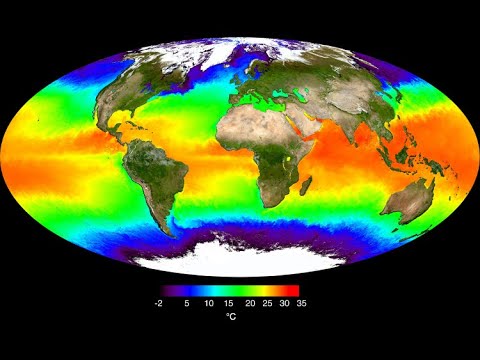
And the take-home here is much of the world's oceans right now is much hotter than average, except for that blue band there in the Eastern Equatorial Pacific, which is associated with the development of La Niña, which I'll cover in a few slides.
So the coral bleaching hotspot is the thermal anomaly we are most interested in when we talk about coral reefs.
And the reason this is because this is a thermal anomaly that represents the deviation in temperatures above the maximum average temperatures these corals experience during the warmest month of the year.
So the simplest way to think about this is, what is the average temperature during the warmest month of the year for a coral reef?
So, in Florida, the warmest month of the year in the oceans is August.
So if you look at the satellite record, take an average of those data for the month of August, and basically, add 1 degree Celsius to that.
That's how you estimate a bleaching threshold.
So the coral bleaching hotspot shows where on planet Earth that sea surface temperatures are 1 degree Celsius above the climatological maximum monthly mean sea surface temperature.
So, in this image, everywhere you see that has coral reefs that is showing up as yellow or warmer color, that means those corals were being stressed on September 22, 2024.
Now, the primary algorithm we use to estimate where and when bleaching is happening is this thing called degree heating weeks. Now, degree heating weeks Simply summarize or-- excuse me, simply sum the coral bleaching hotspots for the last 12 weeks.
So this is a time and dose measure of heat stress that is being experienced by the coral reefs.
Now, the degree heating weak algorithm is a little complicated.
So we try to simplify this at Coral Reef Watch.
Gang Liu, in particular, Senior Scientist and Product Developer was really the man behind this product.
And, basically, this is called the Bleaching Alert Area.
And it distills down the information from that degree heating week algorithm and those coral bleaching hotspots and to these alert level categories.
So you don't need to understand the degree heating week algorithm.
You can go to the website, look at the bleaching alert level index, and figure out where on planet Earth coral reefs are experiencing bleaching level, heat stress, and where you can expect coral bleaching.
We also produce regional virtual stations that summarize all the Coral Reef Watch products for particular regions like this example here is the Florida Keys.
So 2023 presented us with many unique challenges.
The first was we saw heat stress develop in the Atlantic Ocean.
That has never occurred before in the satellite record.
So what you're seeing here is the classical bleaching alert levels that Coral Reef Watch used prior to 2023.
And, essentially, what happened was by the end of October in 2023, the entire wider Caribbean basin was just this blanket of dark red, these bleaching alert level 2 categories.
While there were two issues here.
One, it was not doing a good job reflecting just how hot it had gotten.
And two, some of our end users were misinterpreting what a bleaching alert level 2 meant.
Some folks were inferring that this meant once you hit bleaching alert level 2, essentially, everything would die, which is not the case.
So we essentially had to add in three more additional alert levels just to show how hot it had gotten.
And then in concert, we dug into the literature to understand what the ecological ramifications of these new alert levels were.
So a bleaching alert level 5 is analogous to a category 5 hurricane.
I mean, this is when you can expect potentially catastrophic near-complete mortality on your reefs.
So there's been four examples in history so far where coral reefs have experienced this level of heat stress.
The Galapagos Islands, which I talked about twice in Kiribati and once in Jarvis.
And in those four cases, coral mortality ranged from 89 to 99% of all corals.
So this, again, is analogous to a category 5 hurricane.
This is when you can expect severe catastrophic damage.
And, unfortunately, you can see pretty wide area of the Caribbean last year experienced this alert level 5 condition.
And again, you can step back in these different alert levels and see that pretty much all of the Caribbean last year experienced at least an alert level 4.
And based on the published literature, we expect that the reefs in those regions are at risk of losing upwards of 50% of their corals.
Now, there are a few caveats to this.
Now, again, the bleaching alert level 2 threshold is still very relevant for some species of coral, in particular, the Acropora corals.
Now in the Caribbean, these are the elkhorn and staghorn corals.
They are the most thermally sensitive.
And thus, they still will show mortality at an alert level 2 condition.
Also, when a reef experiences its first mass bleaching event, that is when the impacts are most severe.
And one of the reasons for this is because you essentially have a calling or winnowing of the most heat-sensitive species.
So during subsequent bleaching events, reefs can show what appears to be an increase in thermal tolerance.
But in some cases, that may just be because all the thermally sensitive species have unfortunately perished.
So this shows you max degree heating weeks.
Again, you don't need to understand this algorithm.
What you need to understand is any color on this plot that's warmer than yellow indicates bleaching level heat stress.
So anywhere you see in the tropics, that is a color that is warmer than yellow has likely experienced bleaching in the last year and a half since January 2023.
Now, that same plot shown in the bleaching alert level-- excuse me, the bleaching alert area level algorithm is basically showing you the same thing.
But now, I've superimposed where on planet Earth we've confirmed reports of mass coral bleaching taking place.
So as of September 22nd -- 24th, 2024, at least 72 countries and territories have experienced mass bleaching since January 2023.
So this is a record-setting global coral bleaching event that unfortunately is still increasing in spatial extent.
Now, there were some actions taken in response to this event.
For instance, the Maldives completely shut down coastal development for about a month.
And the reason they did this is they wanted to limit any secondary impacts that could be impacting their corals during the severe heat stress event.
In Thailand, in Pling Island in Phuket, They shut off certain areas to tourists because they basically wanted to ensure there weren't any additional secondary stressors on these corals as they were going through bleaching.
So there are actions that can be taken to try to ameliorate the impacts or lessen the impacts from bleaching events.
So this shows you where the record-setting heat stress has been during this event.
So what this is showing you is the maximum degree heating weeks from 2023 to 2024 minus the previous maximum.
So the take-home message here is that the Atlantic Ocean, for whatever reason, has experienced unbelievably high sea surface temperatures from 2023 to 2024.
We've seen record-setting levels of heat stress, bleaching, and mortality in both the North Atlantic and the South Atlantic.
Our colleagues in Brazil, unfortunately, just went through their most severe bleaching event on record earlier this year.
Now, if you go to the Indian and Pacific Oceans, the Southern Great Barrier Reef just saw its most severe bleaching event on record.
Also there's that big patch there.
centered over American Samoa and surrounding areas that also saw record-setting heat stress.
And then in the Indian Ocean, we see that spot there in around the Seychelles, North of Madagascar, that experienced record-setting heat stress.
So to put the four global coral bleaching events in context, again, this is the fourth global coral bleaching event.
The first one happened in 1998.
Now to decipher when a global coral bleaching event is happening, we use this thing called the global bleaching event index.
And this is simply a measure of the percentage of reef areas that have experienced bleaching level heat stress within the last 365 days.
So the benchmark for a global coral bleaching event is what happened in 1998.
So this bleaching event index number peaked at 20%.
So 20% of the world's coral reefs experienced bleaching level heat stress within a year.
So you can see during the second global coral bleaching event, this went up to 35%.
The third global coral bleaching event took place over three years, and this peaked at 56.1% This event, which has been less than half the time of the third event, is already much higher.
And it's 73.3% of the world's coral reefs have experienced bleaching level heat stress just within the last 365 days.
This is record-setting and it's increasing as we speak.
So what does this all mean?
Well, it's estimated that about 8% of the world's corals died during the 1998 first global coral bleaching event.
And then there was a further 14% loss from 2009 to 2018.
So, again, it's going to take at least a year or two for us to fully understand the ramifications of this event.
But the take-home message here is these events are increasing in scale and severity.
And it's likely it's likely that we're going to see the most severe impacts from this event relative to the previous events.
Now, cumulatively, 76.7% of the world's reefs have experienced that bleaching level heat stress since January 2023.
Now, the previous record to that cumulative number was 65.7% during the third global coral bleaching event.
So we're a full 11% more of the world's reef areas have experienced stress and half the time during this event as to what we saw during the third event.
And again, 99.9% of all Atlantic reef areas have experienced bleaching level heat stress within the past year.
Basically, what that means is if you're a coral living in the Atlantic Ocean, you've been heat-stressed within the last year.
So, 2023, Florida saw its most severe historic coral bleaching event on record.
Now, this event was quite unique because the media and the United States has gotten really, really well-educated about climate change impacts, ocean warming, coral bleaching.
And the media was basically on top of the water temperatures in Florida before coral bleaching even started, and started reaching out to Coral Reef Watch, and wanted to know the implications for these very high water temperatures they were seeing being reported on X/Twitter, and wondering if that had implications for the corals.
Now, we unequivocally told the media corals are going to be bleaching in a matter of days.
And this is going to be the worst bleaching event on record.
And, unfortunately, we were right.
Within about two to three weeks, we began receiving reports of not only bleaching, but mass mortality events happening in a very, very short amount of time.
Now, in certain locations.
I'll discuss this a little bit in the next slides.
In certain locations, we saw what can only be described as an acute heat shock response.
So corals didn't even bleach, they just sloughed their tissues off because it got so hot so fast, they just dropped dead immediately.
Again, this photo here on the left from the Coral Restoration Foundation, that's Acropora palmata.
That is the elkhorn coral.
Now, that coral right there is the most important reef-building coral for the entire Caribbean Sea.
Now, that has been the dominant reef builder for the Caribbean for at least the past 250 to 500,000 years.
Essentially, any reef that has been built to sea level in the Caribbean was built by Acropora palmata.
So that image there, what you're seeing is an Acropora palmata coral going through that acute heat shock and rapid tissue loss.
And these other photos show you some Orbicella faveolata.
And a brain coral looks like a Pseudodiploria that had just recently died.
Now, to the layperson, they probably wouldn't realize these were dead.
But if you look in really close, you can see these white corals have what almost looks like scuzz on them.
I like to jokingly say it looks like a 14-year-old's beard.
It's like this very scuzzy, scuzzy look.
And that is a type of cyanobacteria that opportunistically attaches, and basically, feeds off the dead coral tissues.
Because once that coral dies, that's a nutrient source for algae to grow on.
And that's the first thing you see when a coral dies.
You see that scuzz come in.
One of the things that was the most surprising to me last year in Florida is we saw this acute heat shock response in the soft corals, the sea fans, the gorgonians, the sea whips.
And the reason this was shocking is because throughout the entirety of the wider Caribbean, all the hard corals have shown essentially declines.
All the reef-building hard corals have declined over the last 40 years.
Their abundances are dwindling with time.
One of the few good news stories in the Caribbean has been the soft corals.
Their populations have maintained their abundances or even increased their abundances.
And these guys have become really ecologically important on a lot of reefs.
So it was thought that they would be a winner with climate change.
Well, unfortunately, they too are also highly sensitive to heat stress.
It was just apparently the heat stress had not gotten high enough in the Caribbean yet to show these rapid mortality responses like we saw in Florida last year.
So we saw rapid mass mortality of soft corals in certain locations, and that was very unexpected.
Again, just to highlight the point that within two to three weeks of temperatures spiking in Florida, we already had very significant mortality of reef building corals.
And I've just circled some of the hard and soft corals that were already dead before the end of July due to this heat stress event in Florida last year.
Now, this is the data.
If you don't want to get too data-heavy, you can just basically read the slide.
Basically, what we saw last year was the heat stress started earlier than ever before.
It lasted longer than ever, and it shattered previous records.
So prior basically last year, sea surface temperatures in Florida for 29 straight days were higher than had ever been recorded in the satellite record.
So before 2023, basically, temperatures that had never been reached in Florida.
In 2023, they were reached in Florida and sustained for a whole month.
So that is a crazy statistic to think about.
And this figure you're seeing here, this is all the data in the satellite record for daily average sea surface temperature.
Those squiggly lines on top there; that's showing you daily average sea surface temperature for every year.
The bottom is that degree heating weeks metric here.
And you can see this is an alert level 2.
Up here is an alert level 5.
This is 2023.
As you can see, heat stress in Florida last year was two to three times greater than has ever happened before.
And the reason that's significant is because Florida had already had eight mass coral bleaching events before this event.
So, basically, things changed fast last year and in a bad way.
And this just shows you the same pattern we saw across pretty much the whole Caribbean in the Eastern Tropical Pacific.
We saw this heat stress event develop in late June, early July.
Before the end of July, we saw mass coral bleaching and mass mortality across two ocean basins and both the Caribbean and the Eastern Tropical Pacific.
The good news is that El Niño is over.
Now, these four global coral bleaching events I've talked about, these all occurred on the backs of El Niño.
So during periods of ENSO neutral or La Niña, the ocean generally is cooler than average.
Whereas during El Niño, it's hotter than average.
So we are now in La Niña watch.
And it's expected that La Niña will develop here sometime between September, which is this month through November, which hopefully will start bringing down those percentages of reef areas, experience bleaching, level heat stress.
So the fact that El Niño is over is a good thing.
Because hopefully, it means that the bleeding will stop on this event.
But we need to keep in mind that the ocean is still very anomalously hot.
Again, this is an anomaly plot.
And, basically, what you see here is the entirety of the world's oceans is hotter than average, except for that wavy line you see right here in the Eastern equatorial Pacific.
Now, that is prototypical signature of a La Niña developing.
And that's good, like I said, because that should start bringing down the global average sea surface temperatures.
But the issue is everywhere else in the oceans is still hotter than average.
The only place that is not really hotter than average is some of these reefs in the very far Southern part of French Polynesia.
So the ocean is still running a very serious fever.
And the reason this is important is because we are now seeing mass bleaching events take place out of phase with El Niño.
Again, over the last 40 years, very strong El Niños have been the harbinger of global coral bleaching events.
But now, we're starting to see mass coral bleaching take place during La Niña.
So the Great Barrier Reef Bleached in 2022 during La Niña.
And the reason this is happening is because with the current state of the world's oceans and how hot they've gotten, La Niña is today are essentially similar in temperature value as El Niños were 50 years ago.
So the ocean has warmed to such an extent that even during La Niña, we're seeing mass bleaching events.
So we can no longer let our guard down just because El Niño is over.
Again, this shows you maximum bleaching alert levels for the Caribbean for 2024.
We are seeing another very, very hot year in the Caribbean.
So, basically, the worst possible thing that could happen after last year, which was the worst bleaching event on record, we're seeing the return of these very severe heat stress levels.
And in some places, like I'll show you next, we're breaking records again this year.
So this plot here in the top left, that shows you the Caribbean side of Panama, the Bocas Del Toro region.
And I drew a big red circle around that line because that shows you the accumulation of degree heating weeks for 2024.
That line underneath the black, I guess, it's gray for 2023.
2023 was record-setting.
Again, breaking records this year.
Same pattern in Nicaragua as well, which is very alarming again.
Because like I said, we've received reports of severe and widespread mortality of corals.
Now in Puerto Rico and the US Virgin Islands, what we saw this year is the development of bleaching level heat stress two months earlier than has ever happened before.
So this is very, very alarming.
Because if you remember what I said early on, the response of reefs and corals to warming is a function of the duration and the magnitude.
If you're adding in two extra months of a bleaching event, that is not good news.
So we really need to keep an eye on what's going on in the US Virgin Islands and Puerto Rico.
Because again, we're seeing unprecedented patterns in the Caribbean this year once again, which is crazy considering how crazy it was last year.
So, now, you're probably asking, well, now what?
Well, the more we can learn from these events, that means the more we can potentially do in the future.
So history is usually the best predictor of the future.
Any geologist will tell you that.
So there's only one prior example of the amount of heat stress the Caribbean experienced in 2023 in the past.
And this is what occurred in 2005 in the US Virgin Islands.
So in 2005, the US Virgin Islands experienced about 15-to-16-degree heating weeks, which is right on the threshold between alert level 3 and alert level 4.
Now, remember, pretty much the entirety of the Caribbean hit at least an alert level 4 last year.
So what happened in the Virgin Islands?
Well, some pretty interesting things happened, actually.
The first thing was a lot of the corals didn't die from the heat.
What killed them was they experienced disease outbreaks one to two years after the heat stress went away.
So, again, corals become immunocompromised and very, very susceptible to disease after they bleach.
So the heat itself might not actually be what's killing the corals, it could be the fact that their immune systems basically just are completely out of whack because they were dealing with that heat stress.
Another thing we need to keep an eye on is this Corallivory.
Now, say that three times fast.
So corallivores are animals that feed on coral tissues.
Now, things like the crown-of-thorns starfish can be devastating, and basically, wipe out large areas of live coral on places like the Great Barrier Reef.
But over here in the Atlantic Ocean, the big problem we face here are from these coral-eating snails.
Now, in the Atlantic Ocean, these guys are in the genus Coralliophila.
In the Indo-Pacific, these guys are in the genus Drupella.
Well, these guys have a knack for coming in after a bleaching event, and basically, chomping down all the corals that survived.
Now, in the Maldives, it was found by Andy Bruckner and colleagues that these guys had a preference for corals that were more heat-tolerant, which makes sense if you think about it, because the coral is more heat-tolerant than it probably has more lipid reserves after a bleaching event.
So more tasty, more nutritious.
Now in the Caribbean, the coralliophila, they seem to cue in on damaged corals.
So, again, what you can have happen is after a mass mortality event, the surviving corals and surviving tissues that are still there, you get aggregations of these coral-eating predators that come in and basically finish the job.
The corals survive the heat, but then these coral predators came in and basically ate them.
So removing certain coral predators or corallivores is a well-known viable intervention step that can be taken to help corals recover from bleaching events.
So bleaching monitoring, what is it good for?
That's a question I've been asked because I've been saying since this event started, we need more data on what's happening on these reefs.
And people say, well, we have enough monitoring data.
What do we need more monitoring data for?
Well, with bleaching monitoring data, you could establish intervention timelines.
Now, what you're seeing here is a mortality curve relative to heat stress from Florida for Acropora palmata and Acropora cervicornis.
Now again, elkhorn and staghorn corals, these are two of the most important reef builders in the entire Caribbean.
And they experience a very significant, unfortunately, catastrophic mortality event in 2023.
Now, if there's any silver lining with this, we now know when you can expect to see about 50% of your elkhorn and 50% of your staghorn corals to die.
Now, you might be saying, well, why is that important?
Well, it gives managers and restoration practitioners information for when they need to do their interventions.
So what you're seeing here is that elkhorn coral is much more thermally sensitive than staghorn coral.
So a manager whose job it is to go out and salvage the genetic diversity of elkhorn coral by clipping fragments off corals, they know they need to go out and get the elkhorn corals first and they need to do it before you hit this level of thermal stress because that's when about 50% of your corals are going to die.
Staghorn corals, you can wait a little longer because they're a little more tolerant to elevated temperatures.
So, again, the more information we know about how these things are playing out, the more it helps people trying to save corals on the ground.
And the other thing I think we really need to figure out is, is the timing of these disease and corallivore outbreaks, are these predictable?
If they're predictable in time, then moving forward, we know, OK, three months after a bleaching event, that's when white plague starts.
We need to get out and start intervening for white plague disease.
Again, corallivores is it just they're there all the time, or are they coming in after the bleaching?
So, again, there are interventions that can be taken.
And the more information we know, again, knowledge is power, the more we can do.
And, obviously, the other big things are you can identify refugia, heat tolerant genotypes, as well as the potential for acclimatization, which is what we've seen, remember, in the Pacific side of Panama.
If those reefs weren't monitored, we would never know that they are showing increased thermal tolerance.
Also, if we're not documenting what is lost, and how can we restore what was previously there if we don't know what was previously there.
And also on the Great Barrier Reef, I was talking to colleagues there, Neal Cantin, and he was showing me data that they can predict mortality as a function of how severely the corals are bleaching.
So if we have these monitoring data that do a good job of showing us bleaching severity, and then we can relate that to mortality, that means during subsequent bleaching events, if you just go out there once, and see how severely the corals are bleached, then you can estimate how many of those are going to die.
So there is a lot we can do with bleaching monitoring data.
Again, this is just scratching the surface.
And one of the best things about science, especially oceanography and coral science, is you generally find out a lot of new things that you don't expect.
So there is a lot more we can learn from monitoring bleaching events.
So, in conclusion, the world is experiencing its fourth global coral bleaching event.
Since February of 2023, coral bleaching has been reported from at least 72 countries and territories spanning all ocean basins.
And, again, 76.7% of the world's coral reef areas have been impacted since January 23, 2023.
And this number is still increasing as we speak.
Again, these are strange days for global ocean temperatures.
What you see here is the daily average sea surface temperature for the whole world.
This large line is 2023, which was the hottest year on record.
2024 came in hot.
Again, hotter than 2023, but has since cooled down and been a little bit cooler than 2023.
This shows you the same plot for the North Atlantic Ocean.
Again, you can see 2023 was just crazy.
2024 is also very, very anomalously hot.
The only reason the media isn't going crazy again this year about this is because it wasn't as hot as 2023.
But if 2023 hadn't happened, this year would be all over the news for sure.
Again, the end of El Niño is good news.
But our oceans are still running a very serious fever, as you can see here.
Again, and I think it's very important to understand the timing of corallivore outbreaks and disease outbreaks.
Because, again, a lot of corals can survive the heat, but it's these subsequent secondary stressors that come in and essentially finish the job.
And one of the things I like to say is preventing a local extinction can be as simple as picking snails off corals.
And I mean, that's not a joke.
You can literally prevent a local extinction of a species like Acropora palmata by going out periodically and picking out all these little snails.
And finally, it's going to take about a one to two years before we truly understand the ramifications of this event.
And again, this is because of the fact that the impacts from bleaching are delayed for years.
And sometimes you can see mortality taking place one to two years after the corals start recovering.
Finally, I'd like to acknowledge the NOAA Coral Reef Watch team who make all these wonderful data products available to you every day.
Gang Liu, Senior Scientist, Product Developer who's been with Coral Reef Watch since, I believe, 2001, since its inception.
Our Operations Manager, Morgan Pomeroy, Eric Geiger, and Blake Spady, two excellent young scientists.
And thank you very much for your time.
Up Next

3:21
Wave Attenuation by Periodic Obstacle Arrays: Mangrove Simulations
@NilsBerglund
33.6K views•2021-06-27

15:54
Life in Biosphere 2: Sustainable Ecosystems & Human Survival
@TED
334.9K views•2009-06-16
14:30
Microplastics Everywhere: How Plastic Impacts Our Lives
@TEDx
100.9K views•2018-05-08
10:28
Ice Stupa Artificial Glaciers: Solving Ladakh's Water Crisis
@SonamWangchuk66
3.2M views•2015-05-03
Related Study Plans & Knowledge Roadmaps
Structured learning paths in Environmental Science
environmental-science
Ocean Noise: Cetacean Impacts & Mitigation
01Fundamentals of Underwater Acoustics
02Marine Mammal Bioacoustics
03Anthropogenic Noise: Shipping & Seismic Surveying
+ 2 more learning modules
16h5 modules
Explore Roadmap
environmental-science
Road Ecology: Corridors, Overpasses & Fencing
01Foundations of Habitat Fragmentation and Carnivore Ecology
02The Road Barrier: Ecological Impacts of Transport Infrastructure
03Principles of Ecological Corridors and Connectivity Mapping
+ 3 more learning modules
14h6 modules
Explore Roadmap
environmental-science
Ocean Acidification: Kelp Buffering & Shellfish
01Fundamentals of Ocean Chemistry & pH
02Chemical Pathways of Coastal Acidification
03Bivalve Physiology & Calcification Under Stress
+ 2 more learning modules
18h5 modules
Explore Roadmap
environmental-science
Ice Stupas: Glacial Retreat & Water Security
01Foundations of Glaciology & Mountain Hydrology
02Climate Change and Glacial Retreat Dynamics
03The Science of Ice Stupas & Artificial Glaciers
+ 2 more learning modules
14h5 modules
Explore Roadmap