
![[공학도를 위한 확률론-확률 미적분학 세미나] 3. 리만 적분 과 달라지는 르벡 적분의 정의](https://i.ytimg.com/vi/anQAkk74rLQ/sddefault.jpg)























![Cédric Villani - Fields Medal 2010 - On Measure Theory and Lebesgue Integration [Excerpts]](https://i.ytimg.com/vi/qBbq4RepjxE/sddefault.jpg)



The Riemann-Stieltjes integral generalizes the standard Riemann integral by integrating with respect to a continuously differentiable function g(x) rather than just dx; specifically, ∫f(x)dg(x) = ∫f(x)g'(x)dx, which allows for nonlinear scaling of partitions and can yield different results than the standard integral, as demonstrated by ∫₀¹ x dx² = 2/3 versus the standard ∫₀¹ x dx = 1/2.
Riemann-Stieltjes Integral: Integrating x with respect to x²
Added:Standard Riemann integration and the Fundamental Theorem of Calculus.
The concept of differentials (e.g., understanding how dy relates to dx) and the chain rule.
Formal definition of limits, partitions of an interval, and Riemann sums.
Basic properties of continuous and differentiable functions.
Riemann-Stieltjes integration with non-differentiable integrators, such as step functions.
The concept of functions of bounded variation and their role in defining integrability.
Applications in Probability Theory, specifically calculating expectations of random variables using Cumulative Distribution Functions (CDFs) via the Riemann-Stieltjes integral.
Transitioning to Measure Theory and the Lebesgue Integral for a more generalized theory of integration.
Introduction to Stochastic Calculus (Itô calculus) where integration is performed with respect to random, non-differentiable paths.
89.7K views3.3Klikes23:02Original Release: 2024-07-20
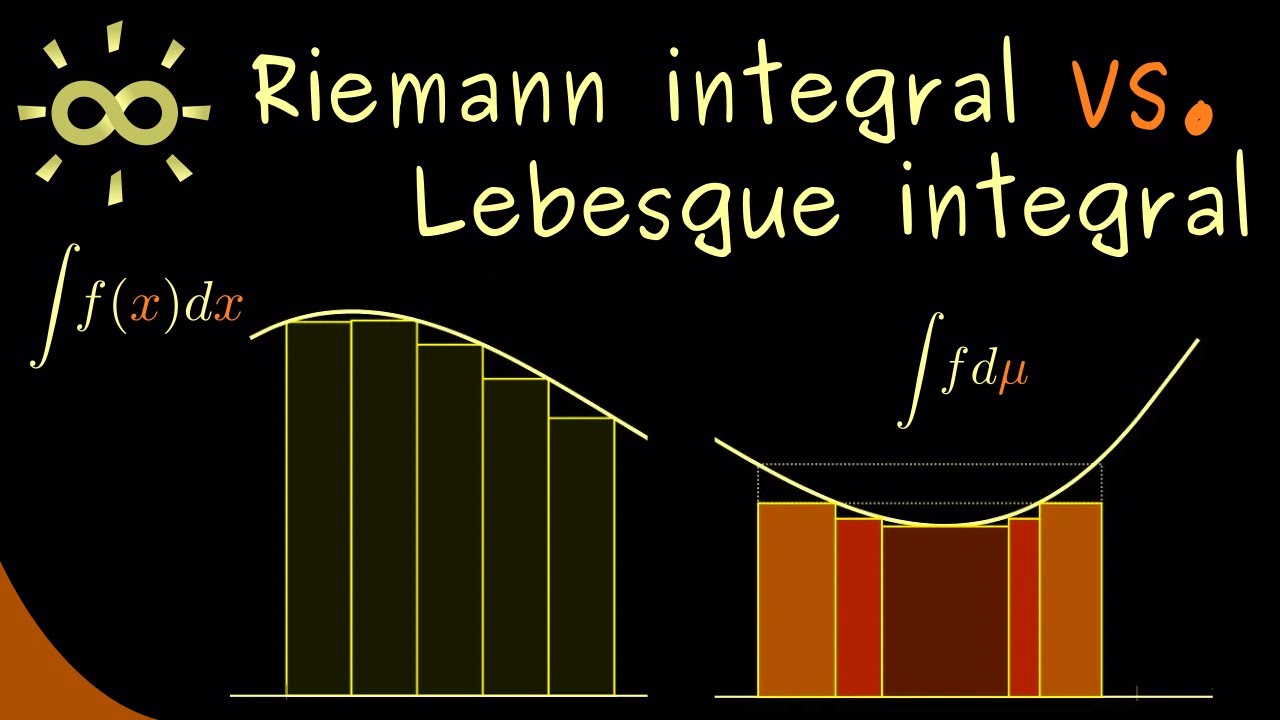
a huge thanks to Brian for sponsoring this [Music] video math welcome back to another video today a very easy integral namely the one from 0 to one of x² the it should be the other way around right x² DX this is looking kind of kind of weird but you know me I wrote it out right yes you can indeed integrate x with respect to x^2 and this what we call mathematics the REM CS integral it first arrived to me over on functional analysis and we over and we also build a bridge over to physics back in functional analysis and this right here is a class of very interesting integrals and at the end of the video I'm going to show you an easy procedure you could say to calculate integrals of that form where this differential one form that we have at the very back is a continuously differential function so definitely make sure to watch the entire video to get a crib of all the Nifty little details that we cover here and if you're interested in the graphical side of theat Cs integral why not check out the content of today's sponsor print more information at the end of the video and now we are going to Dive Right In so before we cover this integral right here I would like to go back to the so-called rean integral this is the one that we are used to and before we get to that we are going to take a look at the easier version namely the integral from 0 to one of X integrated with respect to X now most teachers say well this DX right here just tells you what you are integrating with okay with respect to X for example but this is not the case this differential one form that we have at the very back is actually really important especially when you have something like the Remus integral where this right here can be any random arbitrary function now first I would like to take a look at the graphical interpretation of what the rean integral actually is so if we take a look at this integral right here from 0 to 1 then this right here is just the parent function f of x being equal to X and what we want to do is we want to C the calculate the area under this curve from 0 to one how would you go about calculating this area while using the integral or by using infinitely many little rectangles so what we do in normal case with reman integral is we split up this interval that we have right here from 0 to one into n many equidistant partitions so we're going to take for example five partitions here 1 2 3 4 five and with that we can construct ourselves little rectangles that we can add up and get an approximation for the area under this curve so this right here is going to be the first rectangle then this right here is going to be the second rectangle and so on and so forth I think you know um how that one works out so by adding up those five rectangles for example you are going to get an approximation for the area under this curve but how can we get an accurate approximation like 100% accurate approximation of the area under this curve well we are just going to make more and more partitions meaning we are going to half those partitions once again 10 partitions we are going to get a smaller and smaller error up here and if we have infinitely many partitions we're going to get an exact area under this curve so if we have n partitions down here and those partitions have a length of length of Delta X so this little length right here is going to be called Delta X then we can actually get ourself a formula for the reman integral on this certain interval namely in general we are going to take the limit as the number of partitions goes to Infinity off and what we are going to do is we are going to add so to sum all of our rectangles together where I starts at one and goes to n because we have n many rectangles because we have n many partitions obviously and what we are going to do is we are going to take base times the height the base is Delta X which is going to correspond to our infinitesimal that we have over here DX our um our differential one form and what is the height exactly the height is for example our function f ofx evaluated at one or the function f of x evaluated at this spot right right here we are going to call this spot XI so if we evalate our function at x i and multiply it by D DX Delta X and we add all of those together infinitely many times we are going to get the area under this curve now we still have a few things in here which are pretty uncertain now F of XI what is Xi exactly let us take a look at how we can land at our XI here let us try to find an expression for our XI now XI is we take the starting spot our lower bound a in our case this is zero and how are we going to land at x i well since all of those partitions are equidistant so all are Delta X apart we can L at x i by just multiplying Delta X by I because if we take four times Delta X we are going to land at Delta X Delta X Delta X Delta X we're going to land at x i and this right here would be X4 1 2 3 4 meaning our XI is Zer our lower bound plus I * Delta X this right here is an expression for our x i but this includes Delta x yet again what is Delta X exactly now Delta X you can Define in different ways what you can say is that Delta X is if you have the x i member and you subtract from it the X IUS one partition then obviously this right here is going to just give you the distance between those two x i and x i- one so that Delta X is the same as x i - x i - one but this doesn't help us right now because then this is kind of circular then you would have um Delta X just with respect to X I once again this doesn't help in our case so we need to get to Delta X in some find a different way how can we get to Delta X well Delta X is just our whole length of the interval in our case 1 - 0 or B minus a divided by the number of partitions namely n so if we have 1 minus Z and we have five petitions then each and every Delta X would be 1 / 5 which is 0.2 apart so this is going to give us 1 / n meaning our x i is going to be the same as I * 1 / n or I / n so meaning we can calculate the integral that we have up here as being the limit as n approaches Infinity I'm going to denote it as capital L of the sum where I is bounded between um zero and N of f of x i in our case x i is I / n and f of x is nothing other than x this is our function here just going to be I / X and Delta X that we get right here is 1 / n no um I divided by n sorry not I divided by X and then you can start and calculate the stuff okay so you have the sum where um I runs from 0 to n of I this is just little g n * n + 1 / 2 and so on and then you can calculate this very integral giving you overall x² / 2 from 0 to 1 is just 1 12 okay this right here is the regular reman integral but now something is going to change for our reman steel this integral remember where we want to get namely for the reman integral our differential one form our infinite tal is dependent on some function G of X where our T of X is x s in our example here the Remus integral basically is substituting this equidistant partition that we have down here for a nonlinear scaling for example for a quadratic scaling or maybe for a logarithmic scaling or whatever you wish or a fractional scaling it it really doesn't matter only thing you do is you scale it up in different proportions like for example this one right here is going to just um stretch in in par in a parabolic manner for example this is everything that the reman stus integral does and the reman integral is just basically the linear version of that where you have nice equidistant partitions and that is easy remember our Delta X is the same as x i - x i- one well for the reman stus integral all we do is we substitute our differential one form for G of x i minus G of X IUS one and this is exactly the term which is going to give you a nonlinear scaling in the process and now we can just plug this term our Delta X nothing is going to change for the remon sum that we have right here into here and then we can calculate our stus integral X integrated with respect to x² let us do that and see where this is going to get us so this is the limit as n approaches Infinity of the sum where I is bounded between um one oh I have written zero here and ter sorry about that um I is bounded between one and N now f of x i our f of x is X once again our x i are I / by n so we going to have that term once again multiply This Time by G of X IUS G of X IUS one where G of X is x² we still have our terms um I / n okay this is our x i and our x i - one is going to be i - one / n and all of this is going to be just squared because this right here is the um function that we are using by the way those functions are supposed to be real to real okay so our G is a mapping from the real numbers to the real numbers this is one of the um one of the restrictions for integral to B integral so we are going to get I / n minus I and all of the squar umus 1 / n squar and this right here T this integral and now we can start to calculate further this right here always works for each and every real valued functions re to function that you have over here in the differential form now we can start multiplying stuff out that's the limit s n approach as Infinity of our I I'm just going to denote it with i i / n now we're going to get I 2 / n^ 2 and then we have negative this right here is just a binomial formula so i^ 2 - 2 I and then + 1 / n 2 and now we can start to bring those fractions together we can in fact factor out the 1 / n^ 2 and put it to the front that's limit as n approaches Infinity over 1 / n cubed n * n 2 is n cubed time I now what we still have here in parentheses in Brackets is i^ s minus i^ s this is going to cancel out giving us in the process just 2 I minus I and this is where we stand at the moment and now we need to um start simplifying all of that a bit further obviously we still have our summation and now we can drag our I into here and break this summation up it's a finite summation so it's there's no restriction in breaking it up whatsoever and giving us overall the limit as n approaches Infinity of 1 / n cubed times now the first summation that we are going to have is where I is bonded between one and and zero all of um 2 I 2 and then we have negative I'm going to bring the two to the front this really doesn't hurt either too and then we have I being bounded between um Zer and N once again so many indices I'm terribly sorry um and now we have I here as mentioned previously with the regular reman integral if we sum up and it starts from one if we sum up um our I from 1 to n this is just going to be little gals that we get right here so n * n + 1 over two so just imagine you sum up 1 2 three so 1 + 2 + 3 this is going to give six in the process or with little GS you are going to have n the number of a members is three three * 3 + 1 so 4 is 12 / 2 is 6 so this checks out and this right here is kind of a similar formula with just one more term this can be comprised to if you sum up all the I squares into n * n + 1 * 2 n + 1 / by 6 I think I made a video on that already but I'm not certain this is like a a harder version of gaus you could say it's it's it's the bigger GS not the little GS and now with that out of the way we can start to multiply stuff out and just um put some stuff together don't forget we still have two as a factor here and we also have n + 1 * 2 n + 1 I'm going to make a little um side calculation here this is going to result in 2 n 2 then we are going to have 3 n and lastly we have + 1 and multiply this by n we are going to have 2 N cubed plus 3 n^ 2 + n / 6 we also have a factor of two over here all in all we are going to get limit as n approach Infinity of n uh 1 / n cubed we are going to get um on the first term 4 n cubed next up we are going to get um + 6 n 2 + 2 N / by 6 and then we are going to get netive n^ 2 + n / two and last thing that's just a bit of algebra we can bring those together we can expand this by three giving us six in the denominator here and overall we're going to be left with the limit as n approaches Infinity of n cubed and then we are going to get a fraction where we can break it up into we don't have a factor of n cubed anymore so we are going to get um 4 / 6 or 2 / 3 but with an N cubed next up we are going to get plus so we have 6 n^ 2 - 3 n^ 2 is 3 n 2 / 6 is going to give us n^ 2 / 2 and last but not least we are going to get 2 N - 3 n is n so n / 6 and now we can bring our 1/ n cubed into here and see if we can cancel stuff out so this is the limit as n approaches Infinity now I'm going to write it out in the last step of n cubed and N cubed is going to cancel out so we get 23 here then we have n cubed and n s we are going to be left with a 1/ N in some kind of way so 1/ 2 N and here we are going to have a factor of n s in the denominator so -1/ 6 n² and I think everyone can see where this is going now when n approaches Infinity those are going to vanish giving us in the process that the value of our remat integral from 0 to one of X integrated with respect to x^2 is going to yield 2/3 and that's a bit different from the regular one half that we would get in normal case if we were to integrate x with respect to X now this right here was just some um some hard abstract mathematics and you can formalize this bit more just like with the regular reman sums you get upper and lower reman sums and you get the same with the reman stus integral so you can take take those rectangles from this perspective or the lower rectangles okay if you take those rectangles and sum those lower ones up and if the limit of those are equal then you're going to get um rean ste's integrability now there is an easier way to calculate stuff like this just with the regular reman integral but this only works if and only if your function G of X is continuously differentiable continuously differentiable means if you have a function which when differentiated is continuous once again then it's continuously differentiable obviously the original function must also be differentiable otherwise you can't differentiate it obviously not in the um Regular mathematical sense if this is the case if your function T of X is continuously differentiable then you can turn the integral from A to B of f of x d g of X into the integral from A to B of f of x g Prime of X DX this right here is the magic formula for Theus integral in the nicest case possible and this obviously works for DX s where G of X is x s because this right here is continuously differentiable if you differentiate it you you are going to get 2x out and 2x is continuous and also differentiable once again so we can apply this trick here meaning the integral from 0 to 1 of um X dx2 is the same as the integral from 0 to 1 of x times the differential of x^2 which is 2x DX this right here is going to be 2 x^2 and if we integrate this we are going to get 2 first X cubed from zero to one on zero it's going to vanish on one it's just going to be 2/3 and I leave it as an exercise to to the few to figure out what the integral from 0 to 1 of um let's say just cosine of x d s of X is figure out at first of if s of X is continuously differentiable on set interval and then see if you can use our little trick that we have right here and if you did enjoy what you have seen today maybe you will also enjoy the content of today sponsor PR to we kind enough to sponsor yet now video on this channel to really understand what's going on here I seriously invite you to try out the cake list courses over on brand and their integration courses they really give you a great understanding about hean Sams and what is going on here exactly in a very Visual and playful manner just take a look at any of those things that I'm going to show you here on screen right now it doesn't matter what I show you if it's out of the of their physics courses or maybe it's out of their chemistry courses kless courses Etc no matter what it is you're probably going to say to yourself man that looks really clean and tidy and it seriously is like that they are just so good at transferring knowledge over to the users in the stem field in such a unique manner that it just seems like magic like seriously when I say it I mean it pre with the nearly 70 interactive courses in all topics stem gives you some of the best online learning content that you can find out there on the internet and the repertoire of courses is just outright amazing it's outstanding how much they already have available on their website and how good they are at what they are doing it's seriously cool to see how students can use their website to learn something new about trigonometry for example today it's not about learning the trigonometric formulas the addition formulas for the sign and cosine it's also about understanding the graphical side of things how the unit circle works out to get those addition formula out in the first place it's not about learning the abstract stuff or just looking in a lookup table to see what the value of an integral is going to be no the visual understanding of the topics at hand is also something that you really need to learn in order for you to understand mathematics physics Computer Sciences and all the other stuff in in the first place and I invite you to try it out today for completely free by using my Link at the top of the description pr.org fbl Ms fre day free trial of amazing awesomeness try out the whole landscape for completely free over on PR and see if it's something for you and if you feel like this could turn into a long-term relationship between you and their services then definitely make sure to make complete use of my link here down there in the description and the first 200 people to do so get 20% of an any PR subscription also you can use some of my QR codes up here somewhere at the top doesn't matter check it out and see if it's something for you you can really enhance your knowledge any day with their app on the go or maybe just at home it's really going to help you in your studies doesn't matter if you're at high school or in University they always got something up their sleeve for anyone out there so check it out and support the channel as way thank you guys for watching this concludes today's video and has been a long time since I wanted to make a video on the REM Theus integr let me know what's your fault and maybe the DOR integr is going to be next see you
Up Next

78:02
Itô Calculus Explained: Brownian Motion and Stochastic Integration
@mitocw
356K views•2015-01-06

4:43
Elliptic Curve Cryptography Explained: ECC, ECDSA, ECDH
@PracticalNetworking
28.5K views•2024-10-21

48:31
Mathvengers: Euler's Game Math Collaboration
@PapaFlammy69
74.8K views•2019-12-24

6:00
The Mathematical Impossibility of Accurate World Maps
@Vox
23.3M views•2016-12-02
Related Study Plans & Knowledge Roadmaps
Structured learning paths in Mathematics
mathematics
Tensor Calculus: Vectors to Riemann Curvature
01Mathematical Foundations: Linear Algebra & Calculus
02Covectors, Dual Spaces, and Tensor Basics
03The Metric Tensor and Index Gymnastics
+ 2 more learning modules
40h5 modules
Explore Roadmap
mathematics
Gödel's Incompleteness: Logic, Proofs & Limits
01Introduction to Formal Systems & Hilbert's Dream
02Set Theory, Cardinality, and Cantor's Diagonal Argument
03Arithmetization and Gödel Numbering
+ 2 more learning modules
14h5 modules
Explore Roadmap
mathematics
Galois Theory: Fields, Groups & Solvability
01Foundations of Abstract Algebra: Groups & Fields
02Polynomials & Field Extensions
03Splitting Fields & Symmetries
+ 2 more learning modules
24h5 modules
Explore Roadmap
mathematics
Non-Euclidean Geometry: Models & Geodesics
01Euclid's Fifth Postulate and the Birth of New Geometries
02Hyperbolic Space and the Poincaré Disk Model
03Geodesics: Defining Straight Lines in Curved Spaces
+ 2 more learning modules
15h5 modules
Explore Roadmap