

















Third-party logistics (3PL) is a business model where companies outsource their warehouse, inventory management, and distribution operations to specialized third-party providers, allowing businesses to focus on their core competencies while benefiting from professional logistics services that enhance supply chain efficiency, reduce costs, and provide access to advanced technology and resources.
Third-Party Logistics (3PL): Definition, Functions, and Benefits
Added:Basic understanding of Supply Chain Management (SCM) flows, including procurement, production, and distribution.
Familiarity with fundamental logistics operations such as warehousing, inventory management, and transportation modes.
The business concept of 'outsourcing' and the strategic decision-making process of 'make vs. buy'.
Understanding core business competencies and how companies leverage external partners to scale operations.
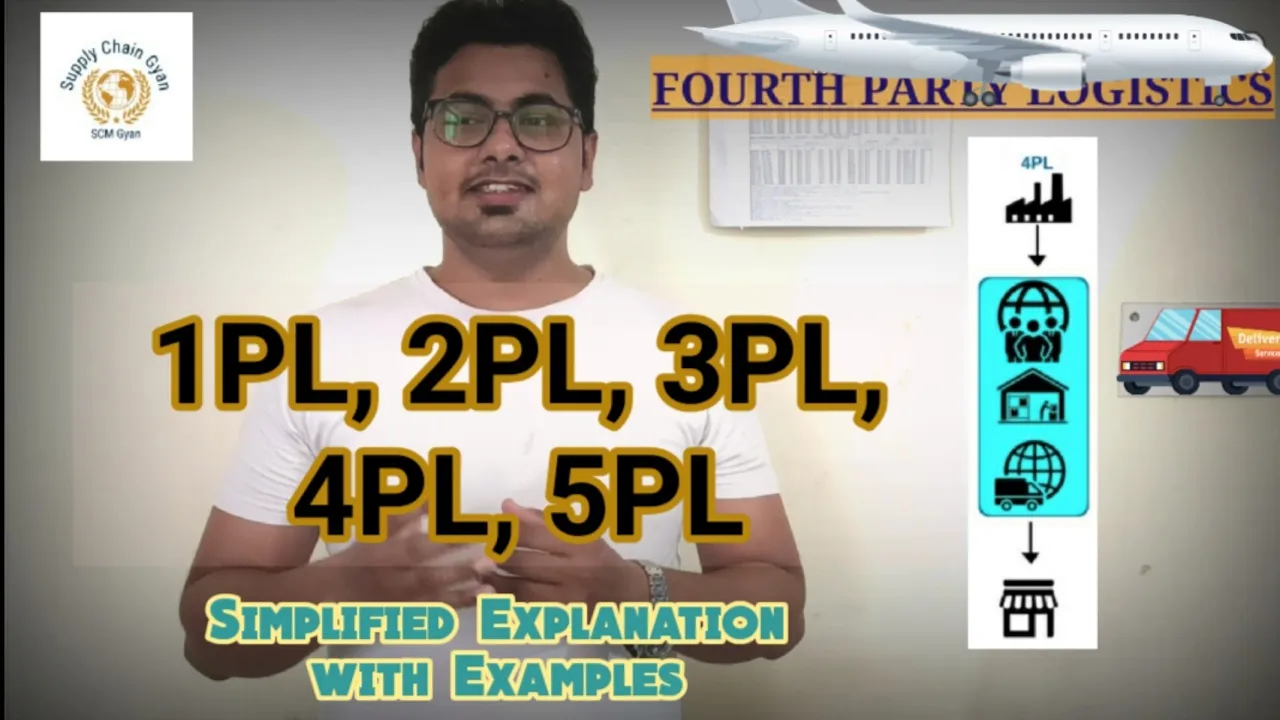
The evolution from 3PL to Fourth-Party Logistics (4PL) and Fifth-Party Logistics (5PL), and their roles in global supply chain integration.
Designing and managing Service Level Agreements (SLAs) and Key Performance Indicators (KPIs) for logistics partners.
Technology integration challenges, specifically connecting Enterprise Resource Planning (ERP) systems with 3PL Warehouse Management Systems (WMS) and Transportation Management Systems (TMS).
Risk management strategies in outsourcing, including data security, cargo liability, and mitigating supply chain disruptions.
1K views14likes8:55Original Release: 2023-09-21
[Music] like us subscribe Channel and click the Bell icon on an Logistics what is third-party Logistics or 3pl third-party Logistics commonly known as 3pl or TPL 3pl is when considering a company it is outsourced Warehouse inventory management and distribution facilities for third party the full explanation of 3pl is when considering a company it is outsourced warehouse and distribution facilities from third party so the company acts as a client of thirdparty logistics provider the company client does not maintain a logistics department or warehouses because that company has outsourced logistical activities from thirdparty logistics companies first you need to identify factors that you have to consider when starting a 3pl business factors affecting to start a new 3pl business one need to check warehousing demand that selected area two investigation about types of Warehouse facilities customers need three analyzing competition in the selected area four differentiate your 3pl service five pricing methods and charging six value added Services you are going to [Music] do what are the functions of a 3pl service provider one Warehouse facilities providing two Inventory management three Freight forwarding services four shipping and distribution services five packaging and labeling six custom clearance for shipments seven order fulfillment and customer returns handling process eight procurement of goods nine rout optimization and Fleet Management 10 transportation and distribution [Music] services why do more businesses use 3pl Logistics Services when answering this question the simple answer is the logistics process is a more complicated and more stressful process in a business for avoiding these stressful logistical activities more companies use 3pl Logistics when Outsourcing the logistical process for 3pl companies businesses can give more attention to their core business process than Logistics activities reasons for companies Outsourcing Logistics activities finding a 3pl partner one when your company space is not enough two when you need to enhance delivery efficiency for example free 2 days delivery three handling a lot of shipments in a month [Music] what are the benefits of using 3pl one increasing supply chain efficiency two cost reduces three saving money and time four can be accessed super resources and new technology what are the disadvantages of 3pl one lost control out of control in logistics activities by a Core Company [Music] what are the factors need to consider When selecting the right 3pl company for your business if your company is looking for 3pl services you need to get a better idea of the business requirements and options available then you can select the most suitable solution for Logistics it should be affordable to your budget the below list expresses another factor that should know when taking decisions for outsourcing Logistics activities [Music] one type of the products three PL companies vary in the services that they are offering therefore according to your product need to select three Place service providers for example goods are perishable you need Cold Storage to keep your products chemical or hazardous Goods need specialized storage facilities according to the product and requirements you can select the most suitable 3pl companies two location or place of the warehouse third party Logistics Warehouse distance means cost because more distance incurs more Transportation costs so it is essential for low distance need to consider the distance between the manufacturer and the warehouse or the distance from the Ware Warehouse to the final customer it should be a better 3pl Warehouse near to manufacturer or final customer it can reduce unnecessary traveling it saves money as well as time three availability of value added Services When selecting the right 3pl partner for your business need to consider available services in addition to warehouse management M according to your requirement for the products the 3pl service provider is in a position to fulfill other requirements also such as customized packaging and labeling order fulfillment facilities reverse Logistics facilities [Music] Etc four need to check customer reviews and the reputation of the company after selecting a 3pl partner you you both need to go on a long journey it is a long-term partnership you need to contact and coordinate 3pl providers daily basis. Soo you must select a more flexible and trusted company 3pl provider handling is not an easy thing it should be critical and has more [Music] responsibility five company's future plans and strategy with the 3pl partners you need to go successful journey in long term so you need to consider that 3 p supplier is the most suitable partner for your business as well as your future and growth sometimes you need to adopt new technologies like software and apps it should be supported 3pl provider system also it may advantage to your company for your future growth your 3pl partner should match your requirements and plans [Music] six technology When selecting the right 3pl partner for your business need to consider about Technologies they used and what your company is using it should be integrated with both company systems before selecting a 3pl partner you ensure that their systems support your company system as well as that both companies work with that system [Music] thank you for watching see the below video description section click the link for full article on any Logistics like us subscribe Channel and click the Bell icon on in logistics
Up Next

7:11
Shopify Amazon FBA Integration: Free Order Fulfillment Tutorial
@scott_suggs
18.7K views•2020-03-13

12:54
Triumph of Orthodoxy Icon: Byzantine Art & History Explained
@BenCallan
2.1K views•2024-08-06

9:49
FastAPI vs Flask vs Django: Choosing the Right Python Web Framework
@TechWithTim
302.5K views•2024-05-26

1:42
Game of Thrones Opening Credits: A Cinematic Analysis
@gameofthrones
46.3M views•2011-04-18
Related Study Plans & Knowledge Roadmaps
Structured learning paths in General & Interdisciplinary Studies
general-studies
Elevator Engineering: History, Physics & Cities
01From Hoists to Safety Brakes: The Dawn of Vertical Lift
02Hydraulic vs. Traction: The Engineering Physics of Elevators
03Modern Speed, Safety, and Algorithms
+ 2 more learning modules
12h5 modules
Explore Roadmap
general-studies
Rubber: Material Science, History & Geopolitics
01Origins of Natural Rubber & Mesoamerican History
02The Chemistry of Natural Rubber & Vulcanization
03The Geopolitics of the Rubber Boom & Colonization
+ 2 more learning modules
12h5 modules
Explore Roadmap
general-studies
Containerization: Evolution, Logistics & Trade
01Ancient Trade & Bulk Cargo: Amphorae to Barrels
02The Industrial Revolution & Cardboard Packaging
03The Containerization Revolution: Malcom McLean
+ 2 more learning modules
12h5 modules
Explore Roadmap
general-studies
Textile Tech: Evolution, Labor & Global Impact
01Pre-Industrial Textiles: Handloom & Cottage Industry
02Mechanization: The Spinning Jenny to the Power Loom
03The Factory System & Global Labor Transformation
+ 2 more learning modules
10h5 modules
Explore Roadmap