









![[오시브런치6회] 못 다한 이야기, 그리운 사람을 추억하기](https://i.ytimg.com/vi/8Ws1gz36uLQ/maxresdefault.jpg)










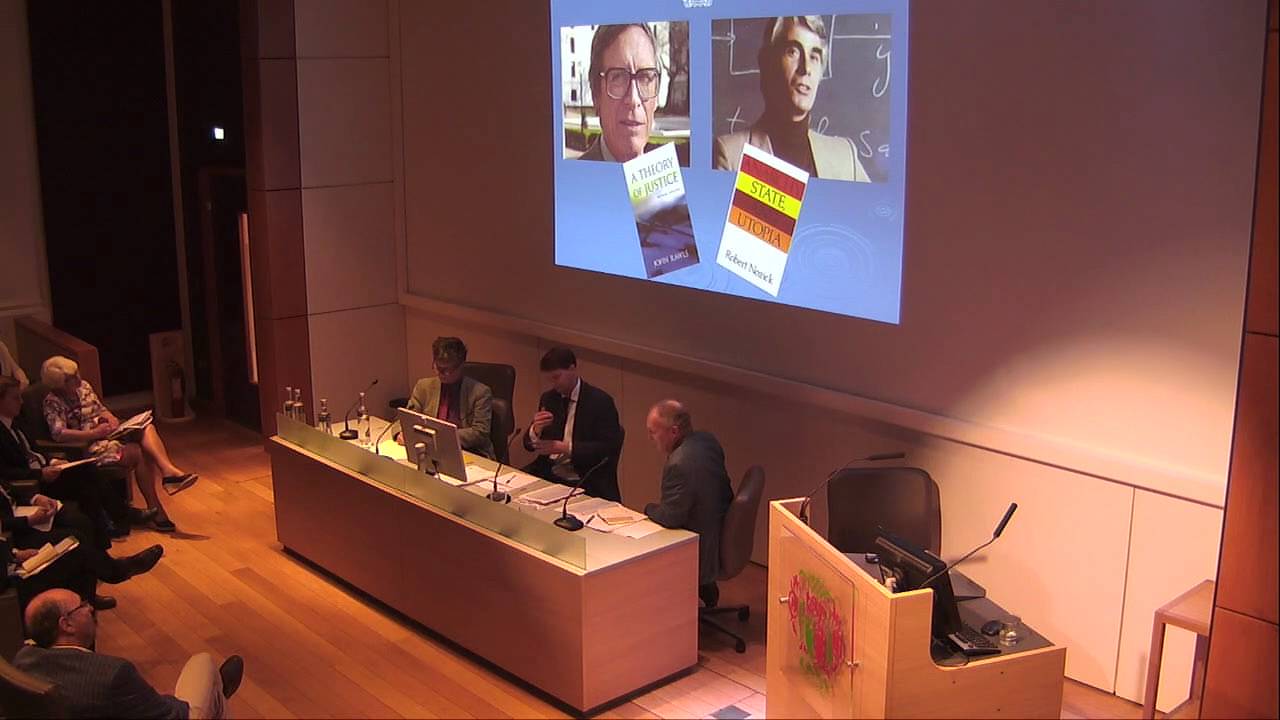

This video explains two contrasting theories of justice: John Rawls' 'veil of ignorance' thought experiment, where individuals choose principles of justice without knowing their personal characteristics, leading to two principles (basic liberties and the difference principle favoring the worst-off), versus Robert Nozick's libertarian view emphasizing absolute property rights and a minimal 'night-watchman state' that only protects person and property. Dworkin critiques Rawls for relying too heavily on technical economic arguments while praising the philosophical enterprise of establishing neutral principles of justice independent of personal moral theories.
Rawls vs. Nozick: Social Justice Theories | Dworkin & Magee 1977
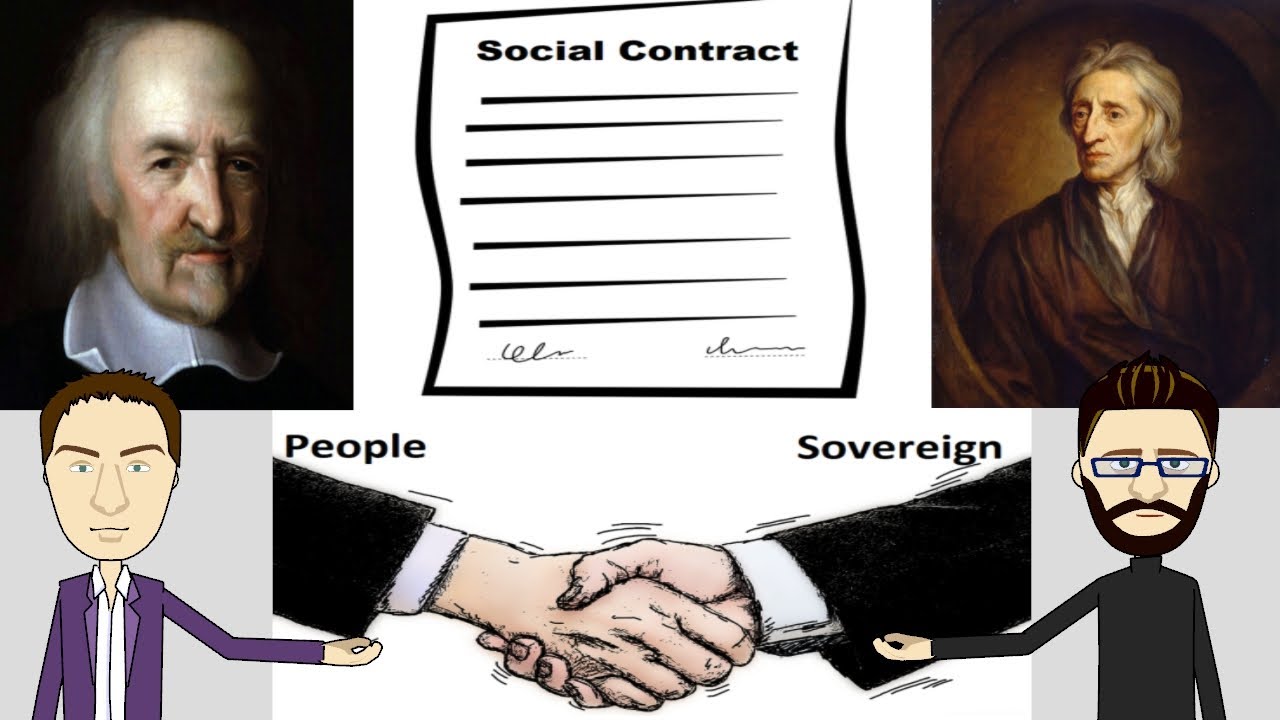
Added:Basic understanding of Social Contract Theory, particularly the ideas of John Locke regarding property rights and the state of nature.
The core concept of Distributive Justice and the fundamental question of how a society should allocate wealth, power, and opportunities.
Familiarity with Utilitarianism, as John Rawls's theory of justice was largely formulated as a direct alternative to utilitarian frameworks.
A foundational grasp of the distinction between classical liberalism (focusing on individual liberty and free markets) and modern social/egalitarian liberalism.
The Communitarian critique of political liberalism, exploring arguments by theorists like Michael Sandel, Charles Taylor, and Michael Walzer.
Ronald Dworkin's own contribution to egalitarian philosophy, specifically his theory of 'Equality of Resources' and 'luck egalitarianism'.
The Capabilities Approach formulated by Amartya Sen and Martha Nussbaum as an alternative framework for evaluating human well-being and justice.
Applying Rawlsian and Nozickian frameworks to contemporary socio-economic policy debates, such as progressive taxation, universal basic income (UBI), and private healthcare.
114.9K views2.6Klikes20:31Original Release: 2021-06-15
uh I know this is a very tall order but is it possible for you to characterize comparatively briefly I mean within the context of a television discussion what it is that RS is saying yes I I I think for for that purpose it would be a good idea to to to take up two topics in in the book The First is uh the topic of the method He suggests and employs and the second the conclusions he reaches and I think it's useful to distinguish them because some people are impressed with the one not the other the method is um arresting it's in it's intriguing Ross tells us that when we're concerned with questions of Justice what rules that could govern the basic structure of a society would be just that we ought to think about those in the following way we ought to tell ourselves a fairy story for a start we ought to imagine a Congress of men and women who don't belong to any particular society yet who come together in a kind of Constitutional Convention they're going to agree among themselves on a constitution how their society is to be run and they're like everybody else these people they have specific identity specific weaknesses specific strengths specific interest only thing that makes them different is that they suffer from a total Amnesia the most crippling kind of Amnesia they don't know who they are they don't know whether they're old or young men or women black or white talented or stupid in particular this is very important they don't know what their own individual moralities are that is they don't know each one has some conception of what he wants his life to be like what his preferences are in sexual morality and so forth but no one knows what his views are on those questions so it's as if as in rs's phrase they were separated from their own personalities by a veil of ignorance now these amnesiacs nevertheless must agree on a political Constitution R says if we ask ourselves what people in this strange situation would agree upon by way of a constitution that the answer to that question will be for that reason principles of Justice this is a somewhat farfetched thing to ask people to assume isn't it well it's it's of course far-fetched to ask the to assume that it ever has happened or could happen it's a dramatic way of asking people to imagine themselves making cons choices in their own self-interest but without knowing things which separate one person from another and that's of course just a way of enforcing uh a certain conception of equality on political decisions but but for the moment can I think it's better to not to leave Leave Behind The Myth because the myth has itself great power now the question is what would people in this situation agree upon and that's the second question namely the second topic namely what conclusions does this method yield these are two and rs calls them the two principles of Justice they are principles I should say for a society with a certain measure of Economic Development so that there's enough to feed everyone once you reach that point Point says RS people in the original position as he calls this strange situation would agree on the following two principles first everyone shall have to the greatest degree possible the basic Liberties which rolls enumerates these basic Liberties are the political the conventional political Liberties Liberty to vote Liberty to speak on political matters freedom of conscience they also include freedom to hold personal property to be protected in your person not to be arrested suddenly and without due cause and so for the conventional what you might call liberal Liberties are protected in this way secondly the second principle of Justice no inequality in society in distribution no difference in wealth is to be tolerated unless that difference works for the benefit of the worst off group in the society it's a very dramatic principle the second principle it means that if you could change society by making it overall poorer so the middle class for instance was work substantially worse off you should do so if the result of that is to benefit the lowest off group in the society so you have two principles the first is the principle that says there are certain Liberties that must be protected the second is the rather more egalitarian principle that says look to the situation of the worst off group every change in the social structure should benefit that group the two principles are related through what RS calls the principle of priority he calls it a lexicographic ordering and says that the first principle dominates over the second what that means is that even if for example it would benefit the worst off group in the society to abridge political Liberties take away rights of free speech even if that would benefit the worst of our groups in society you must not do it only when Liberty has been protected to the full are you entitled to consider the economic questions raised by the second principle when you do come to those economic considerations you must benefit the worst off class but you can't do that until everyone's Liberties are sufficiently protected what do you yourself regard as the chief shortcomings of the theory I think that RS relies too much on rather technical arguments appealing in a very learned way to recent work in economics about what people in his original position would do and I think those arguments are to some degree flawed that is doesn't seem to be inevitable that people in his original position would come out with just what he is I think what's more important and what I wish he had stressed more is the Deep theory that underlies the use of this device the sort of thing that you ask for when you say quite rightly why should what people decide in this rather strange situation why should that have to do with uh justice so I think it's a weakness that he as it were hides the real question appears to hide the real question but I also think that's the great strength of the book that is this is the kind of a book in which the usefulness the importance of the book is not exhausted by the particular arguments it makes it presents us with an Enterprise and says to us look if you if these conclusions are appealing to you if the idea that we must think about Justice by thinking about the through these devices of fness is it all appealing why is that so doesn't this tell us something about our philosophical capacities doesn't it tell us something about our moral capacities that we think this doesn't it help to structure how we think about now it's an Enterprise R's book one of the reasons why it's so important is that it's launched an Enterprise of thinking along these lines of which he would be the first to say that this book is only the beginning each person who reads it will have a different vision of what the Enterprise is I for one have a particular way of reading this book that makes it seem more important to me um and uh and that is this it it does seem to me that the great question the root question for liberalism by liberalism of course I don't mean Party politics and I'm not referring to the liberal party as a party in this country I mean the the the philosophic doctrine the philosophic political Theory called liberalism the root question it seems to me is this there are two possible approaches to the question of what is just what is Justice in community one Theory says that the answer to what is Justice what Arrangements of goods in society is just depends upon the answer to a further question namely what kinds of lives should men and women lead what counts as excellence in a human being one Theory says treat people as excellent people according to some Theory would wish to be treated the liberal rejects that notion of Justice he says that justice has a call upon institutions which is independent of any particular notion of what the good life is but rather can appeal to people as a a way of regulating society that can be agreed upon rationally by people who hold very different kinds of theories of let's say personal morality this book is an attempt to show how far an appealing and altruistic and Humane political Theory can be generated consistent with the basic posture that of liberalism on this conception namely that it's neutral amongst the various personal moralities that people hold and that's a very important ambition you said what you yourself regard as the as the most interesting or important important uh discussion points in roles are there any others with which you may not necessarily yourself uh directly sympathize very strongly which are nevertheless interesting to large numbers of the other critics or writers about this book large part of the work on Royals has been as you indicate critical that is they have pointed out the flaws in the argument that lead from the original position to the conclusion I we I described one of the arguments a minute ago and I said he's assuming that people are all conservative whereas they might be gamblers another part of the literature is and I think more interesting part of literature is critical of the conclusions and this comes from both the right and from the left the criticism from the right says that it's absurd to suppose that we should be ridden by concern for the worst off group there are values more important for example cultural values that it's important to perpetuate even if Mal distribution or inequitable distribution is the result criticism from the left is more complex it fixes first of all on the first of the principles that I offered and says R says that when Liberty and further equality conflict Liberty is to be preferred and there are positions on the left which contest this and say that it's a Bourgeois middle class liberal View the second criticism from the left fixes on the second principle when I described it I said the second principle said there shall be no inequalities except is benefit the worst off group a criticism let us say from the far left holds that inequalities are bad even if they do benefit the worst off group so that we should prefer a society of complete equality even if everyone is worse off including those who would be worse off under uh a rosian distribution that strikes me as being a masochistic view but but it is held by some serious people oh it is indeed who make the argument that Envy or resentment is itself such a divisive thing that the self-respect the the damage to self-respect that comes from seeing others better off in a social structure is such a malign influence on personality that it's it's wrong to suppose in effect that they can be better off if they're materially better off but other people are better off still yes it's a view that's very strongly held I would say of all the criticisms of RS the one most fiercly contested is this seemingly cut off your nose despite your face View and I'd like to move on now from RS to the other important book that I named apart from your own uh namely Anarchy State and Utopia by Robert nosik um we've I wouldn't ask you to to deal with that at such length as we've just discussed rules but I think it's not so important to do so as it hasn't been quite so influential but could you do as it were do more briefly nosic what you've just done for rols I'll try uh nosik starts his argument with remarkable proposition it's remarkable in it Simplicity individuals have rights he says and there are some things that cannot be done to them without violating their rights well that's an unexceptional statement of course that sound then we find out what these rights are and it turns out that the no zian rights have this force that it is wrong either to injure a person or take away his property for any reason except with his consent unless to do so is necessary to protect someone else's rights to his property or his person now this means this is very very strong indeed it's so strong that one might ask is it possible to have a state at all that respects that principle and surprisingly the first third and the most densely argued part of nok's book is presented as a defense of the state itself against the anarchist Royals uh sorry nosic obviously takes this as no mean question and obviously it isn't after all if you take my property away from me then you have violated my rights I have a right to take it back but a state claims a monopoly of the power to use Force the state claims the right to stop me from taking back my property against you I've got to go to the police and ask them to do it it it prevents you from taking the Law into your own hands as every state must yes but what it's done is to violate my right because it stopped me from doing something which I have every right according to nosic to do namely to protect my own property which you wrongly taken from me nevertheless nosic agrees that if everyone did take the law into his own hands there'd be Anarchy so the question is what's wrong with Anarchy and his argument here is very Lambert uh it it may or may not work there's a considerable doubt about it uh but in any event the upshot of the argument is that there can be a state there can be what NOS it calls a night Watchman state which means a state that exists simply to protect property and person to punish people on behalf of other people question then arises can the state do any more than than that after all modern states do a lot more than that they tax you and me and use our our the money they get in taxes to help other people to uh do things in the common interest NOS it gives that question a very firm answer no the state may not do anything except act as a nightwater and it may not tax for example for any purpose other than supporting the police there are no doubt a lot of people listening who would feel some sympathy with that view and noac has been rather popular in certain political circles for at least this part of his views now what argument could he give for this defense of what he calls the minimal or night Watchman State well his argument is this in large part it's argument is typically ingenious and complex but I think the the main thrust of it comes to this he asks us to distinguish between two kinds of theories about what he calls Justice in distribution you we each have certain things in society which we own and the question is is that distribution just now says noic one theory is what he calls a historical Theory and that says this the present Holdings are just what you own you justly own provided people gave it to you voluntarily either as a gift or in return for what you did for them if however it was taken away from anyone else by taxation for example and then given to you the holding is not just this of course makes Holdings this of course would tolerate the most inequitable distribution you can imagine the second kind of theory says noic of Justice doesn't appeal just to history as his does who gave who to what but rather offers some general pattern and says let us look at how the thing ended up the simplest form of a patterned theory is NOS it calls them is a egalitarian Theory unless things ended up equal it's wrong even if it was all done voluntarily now nosic says only a pattern Theory could oppose his view of the limited power of the state because if the state is going to intervene to take money away from some and give it to others it must be in pursuit of a pattern nosic therefore wishes to argue that any patterned theory is intolerable and his argument goes like this he says suppose you could collect all the Holdings everyone sweep up everyone's weal and they distribute it all according to your favorite pattern suppose you're an egalitarian you distribute the same amount everyone now you turn your back and people are going to begin trading with one another suppose he says he uses here the name of a very famous American basketball player called Will Chamberlain he says suppose Will Chamberlain plays basketball extremely well which he does and people wish to pay money he doesn't wish to play basketball but people give him money ask him to play basketball he's going to end up with more money than anybody else in order to stop that you are going to have to interfere with Liberty to a constant degree to stop these transactions stop people from doing what they wish to do you're going to have to have a dictatorship you will not preserve a patent uh a pattern of Justice if that's what you want without the most serious inroads on people's freedom therefore you can't have a patent theory of Justice therefore the only tolerable state is his State namely the night Watchman or minimal State well this seems to be based fundamentally on a concept of the importance of free exchange would that be right that seems to be absolutely the root comes back to this notion of consent anytime you lose something it must be with your consent yes yes what would you what what would you advance as the chief criticisms of noix theory two first that his notion of what basic rights people have namely this right not to lose their property except with their consent simply arbitrary there is some appeal in that right but there's also plenty of appeal in competing rights which would have to U sanction inroads against it for example I see nothing less appealing just as an intuitive beginning point with the notion that people have a right to the concern of others when they are in desperate situation themselves now that obviously is going to sanction things being done that no that nok's basic principle wouldn't permit noik has no argument for his basic right in my view he simply presents it as a starting point and therefore it's an arbitrary St starts too far along with an arbitrary position secondly I think as the Wilt Chamberlain argument I gave you I think well illustrates his arguments tend to be All or Nothing arguments they're ingenious but there there many of them of the form it would obviously be impossible to prevent any exchanges therefore it follows that automatically um if that's a great Injustice a little interference with Liberty is a only also an injustice Poss a smaller one and of course that doesn't follow and in fact in in in American society and British Society we do have the state uh interfering constantly with these exchanges but it would be quite untrue to say that this constitutes dictatorship yes exactly it's there certain threshold of interference a threshold of degree and kind obviously taxing a man taxing Wilt Chamberlain at the end of the year and saying you've got to give back half of what you have earned is not the kind of interference with Liberty that it would be to say no one can pay money to see play basketball those are two different things
Up Next

9:40
Martha Nussbaum on Human Development vs GDP Metrics
@harvardupress
113.4K views•2011-05-19

164:01
John of Damascus on Holy Images: A Theological Defense
@BannedBooks
139 views•2026-04-25

74:32
John Searle: The Logical Structure of Human Civilization | Social Ontology Explained
@Philosophy_Overdose
201.4K views•2022-07-27
4:57
The Myth of Sisyphus: A Greek Legend of Eternal Punishment
@TEDEd
8.6M views•2018-11-13
Related Study Plans & Knowledge Roadmaps
Structured learning paths in Philosophy
philosophy
Frankfurt School: Critical Theory & Culture
01Foundations of the Frankfurt School and Critical Theory
02Horkheimer & Adorno: The Critique of Instrumental Reason
03The Culture Industry and Mass Deception
+ 2 more learning modules
12h5 modules
Explore Roadmap
philosophy
Philosophy of Language: From Frege to Austin
01The Linguistic Turn: An Introduction to Language in Philosophy
02Gottlob Frege: Sense and Reference
03Early Wittgenstein: The Picture Theory of Meaning
+ 3 more learning modules
15h6 modules
Explore Roadmap
philosophy
Feminist Epistemology: Standpoint & Injustice
01Introduction to Epistemology and Feminist Critiques
02Sandra Harding and Standpoint Theory
03Donna Haraway and Situated Knowledges
+ 2 more learning modules
12h5 modules
Explore Roadmap
philosophy
Environmental Philosophy: Ethics & Deep Ecology
01Foundations of Environmental Ethics & Anthropocentrism
02Biocentric Individualism and Animal Liberation
03Ecocentric Holism and Deep Ecology
+ 1 more learning modules
10h4 modules
Explore Roadmap