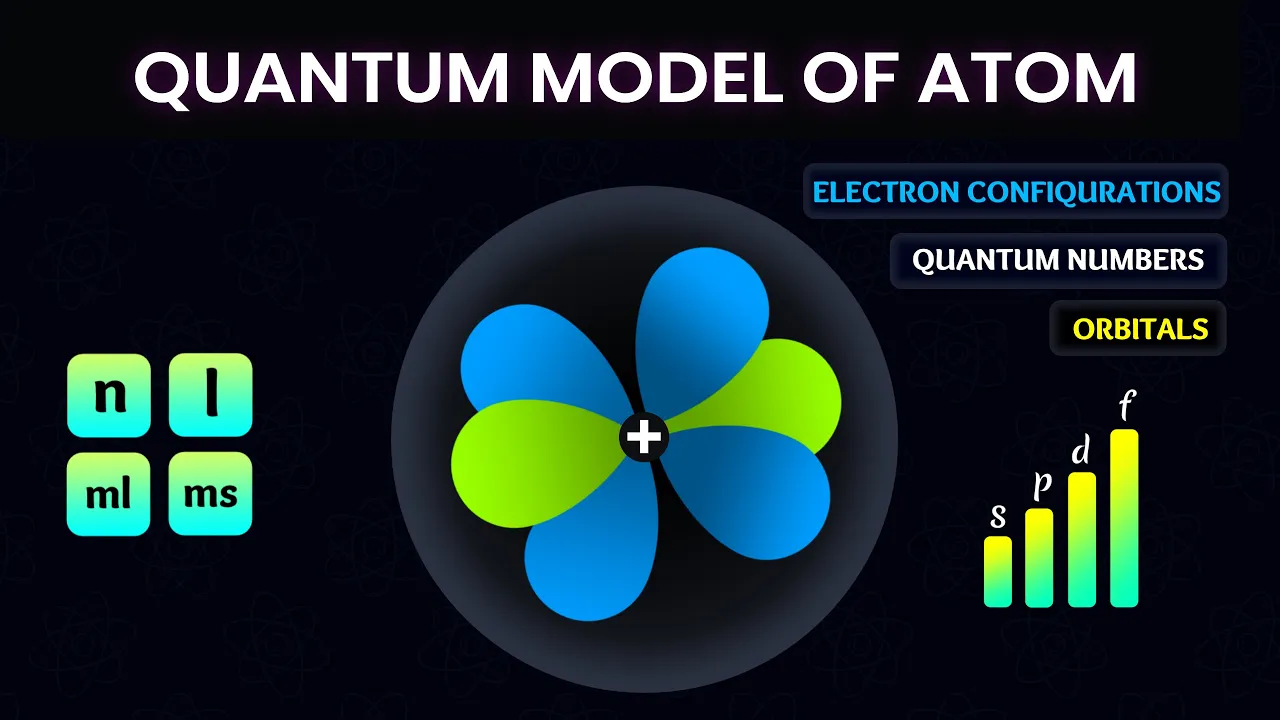


















Orbitals are three-dimensional regions where electrons are likely to be found, with their shape determined by the azimuthal quantum number (l) and size determined by the principal quantum number (n); S orbitals are spherical and non-directional with no nodes, P orbitals have a dumbbell shape with three orientations (px, py, pz), D orbitals have five complex orientations (dxy, dyz, dxz, dx²-y², dz²), and F orbitals have even more complicated geometries, with orbital size increasing as n increases.
3D Visualization of Orbitals: Shapes, Sizes & Orientations
Added:The fundamental principles of quantum mechanics, specifically wave-particle duality and the transition from the Bohr planetary model to the quantum mechanical model of the atom.
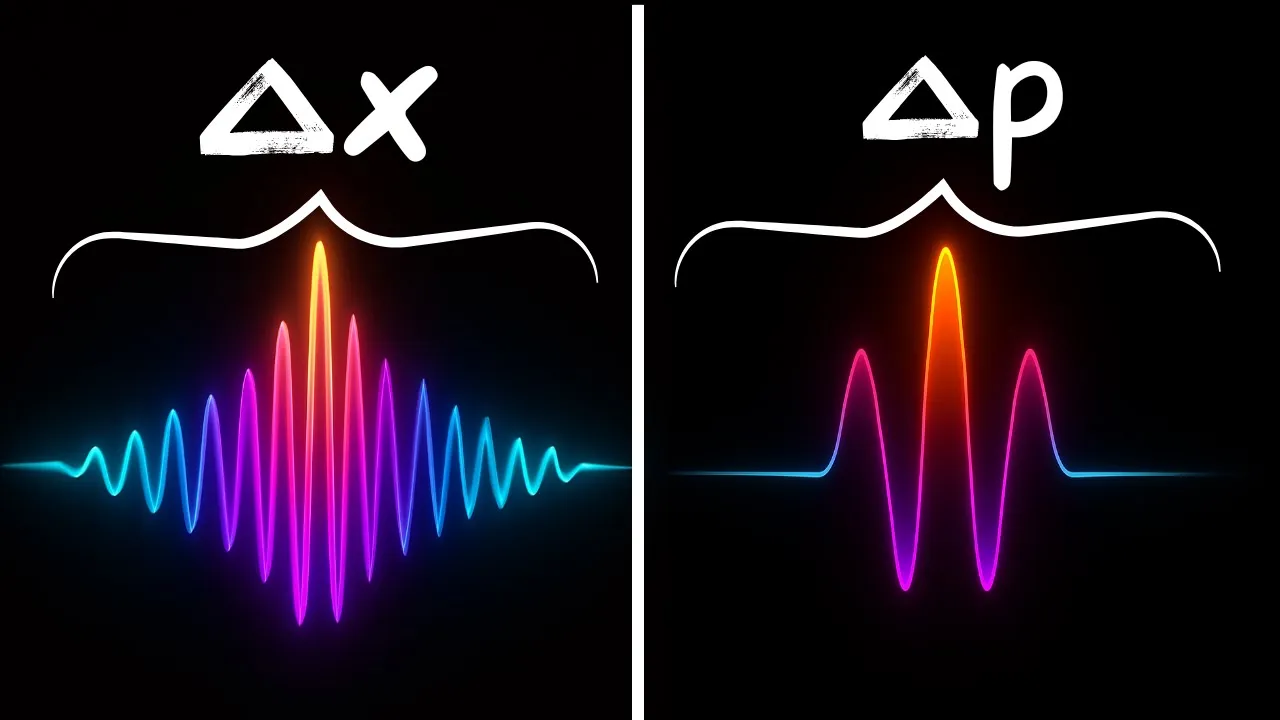
The concept of the Schrödinger wave equation and the physical meaning of the wavefunction squared, which defines electron probability density.
The definition and significance of quantum numbers (principal, angular momentum, magnetic, and spin) and how they mathematically define electronic states.
Applying the rules of electron configuration (Aufbau principle, Pauli exclusion principle, and Hund's rule) to write the electronic structures of multi-electron atoms.
The concept of orbital hybridization (such as sp, sp2, and sp3) and Valence Bond Theory to explain molecular geometries and chemical bonding.
Molecular Orbital (MO) Theory, which describes how atomic orbitals combine to form bonding and antibonding molecular orbitals delocalized over an entire molecule.
The application of d-orbital orientations in coordination chemistry, specifically Crystal Field Theory, to understand the colors and magnetic properties of transition metal complexes.
110.7K views2.8Klikes7:43Original Release: 2019-07-01
in this video we are going to understand the shape and size of orbitals by shape of an orbital we mean the shape of the region in space in which there is more than ninety percent probability of finding an electron it is determined by the azimuthal quantum number l while the orientation of the orbital depends on the magnetic quantum number M the size of an orbital increases with increase in the value of the principal quantum number n shapes of orbitals in various sub shells are to be shown now orbitals let's say what it is they are the imaginary place or imaginary 3d space where electrons exist and an orbital can contain maximum two electrons now people have different kinds of confusions regarding how to exactly orbitals look and do the orbitals overlap with each other does the electron which is of suppose the 2's electron and 2p electrons do they have is in a region where there is a coming through ability of finding them both so let us visualize the shapes and sizes and orientations of each and every orbital and let's see how to exactly look so this is the S orbital this is non directional you can see there are three axis the x axis y axis and the z axis now the S orbital is perfectly spherical there is it's completely non directional and there are no nodes absolutely there is ZERO nodes now let's check in 2p orbital now P orbitals in general looks like this now this is at be orbital which has the double double ship while the p orbital has a single dumbbell shape now this is F orbital it has a very complicated geometry now there are three types of P orbitals px py and PZ now here we can see the PX py and PZ all together in a single diagram now there are five types of D orbitals D XY dy z D exit D X square minus y square and DZ square now this is B X Y D XY is basically on the XY plane but this is actually 3d you can see along the z axis there is no probability of finding the electron so this is d XY the red colored rod shows the x axis when the green colored rod is the y axis and the blue color rod is the z axis so you can see this is d X Y now we have D Y Z this is along the Y Z plane and along the x axis there is no Megatron probability now this is d XZ this is on the x and z then and along y axis there is no probability of finding the electron now this is DX square minus y square now the lobes are on the axis on the x axis and the y axis along the z axis there is no probability of finding electron this is not in the XY plane but this is in the along the oriented along the x axis and along the y axis as you can see this green colored rods you can see is the y axis and red color toward is the x axis so this is DX square minus y square now we have D Zeta square now this has a very beautiful shape the there is a dumbbell shape along the z axis and you can see a spherical kind of shape along the x and y axis so this is the 3d diagram now let's see some examples now this is helium there are two electrons in its only shell there is one is two so this in these diagrams we will be seeing how the different orbitals are the sub energy levels look so there is only one s and only two electrons now here we have the rhenium now this to electrons the outermost share electrons are shown in the diagram you can see there is one s as well as two is the one s is the Inner Sphere and the two s is the outer scale now the to whisk engulfs the one s okay now in general the 2's electrons can be anywhere the 2's electrons can be there in the place of one is also but they can be outside the place of 1s also so 2 s Enders 1s so you can see the this 3d diagram very clearly now we have a bit more complicated thing this is carbon electronic configuration 1 is 2 2 s 2 and 2 P 2 now see you can see all the three orientations of P px py PZ 3 are present again you are seeing that some region is overlapping the P has some region in common with the one is and some region in common with the twist this is the actual real life diagram what it really looks like the probabilities everywhere so in this region in some regions like this near the nucleus you can find the 1s electron also selection also and to be reference but in general to be electrons will be at a further distance the average distance from nucleus of 2p electrons will be higher this was carbon and now let's take into oxygen more complicated now let's check into neon you see that 2p 6 that means the p orbital the P sub level is completely full all the px py PZ everything is full now only the outermost electrons are shown in the diagram now we have magnesium you see it's really very complicated you can see 3s has come into place so together all the orbitals look like this then we have arden bit more complicated now you see 3p has come into existence 3 P 3 P is engulfing 2 T 3 P it starts from the nucleus only from from near the nuclear and extends more so in general 3p electrons will have more average distance from the nucleus and will have more energy than but the thing is that they come can come together they can come near each other for example a 3p electron can come here a 2p later on okay they just they are all in the cloud and in a kind of 3d they mixed kind of motion now we have calcium bit more complicated we have 4s you see 4s is engulfing everything kind of forest forest is huge now this comes really very complicated elements of the periodic table now let's just not discuss let's just see how they reality look so it's getting more and more complicated so we have 3d it's really complicated so so this has helped you to understand more and more clearly about orbitals and ships hope you will like this video thank you
Up Next
13:12
Coordination Chemistry: Introduction & Complex Ions | Chem Basics
@ChadsPrep
70.8K views•2022-04-18

83:56
Biocatalysis and Catalysis in Islatravir Synthesis | Merck Webinar
@SCIwheresciencemeetsbusiness
675 views•2020-10-08
10:06
1H NMR: Determining Number of Peaks from Structure
@MSJChem
59.2K views•2017-04-06

17:31
Edible Water Bottles: A DIY Guide to Sodium Alginate Spherification
@ryan
10.5M views•2019-06-21
Related Study Plans & Knowledge Roadmaps
Structured learning paths in Chemistry
chemistry
Nuclear Chemistry: Decay, Meds & Fuel Cycle
01Introduction to Nuclear Structure and Radioactivity
02Decay Dynamics and Kinetics
03Radiation Interaction and Detection
+ 2 more learning modules
24h5 modules
Explore Roadmap
chemistry
Supramolecular Chemistry: Forces & Machines
01Foundations of Chemical Bonding and Intermolecular Forces
02Introduction to Host-Guest Chemistry
03Thermodynamics and Dynamics of Self-Assembly
+ 2 more learning modules
16h5 modules
Explore Roadmap
chemistry
Photochemistry: Excited States & Reactions
01Foundations of Light-Matter Interactions
02Molecular Orbitals and Electronic States
03Photophysical Processes and Jablonski Diagrams
+ 2 more learning modules
18h5 modules
Explore Roadmap
chemistry
Coordination Chemistry: Bonding & Properties
01Introduction to Transition Metals and Ligands
02Crystal Field Theory (CFT) and Geometry
03Magnetic Behavior and Spin States
+ 2 more learning modules
14h5 modules
Explore Roadmap