


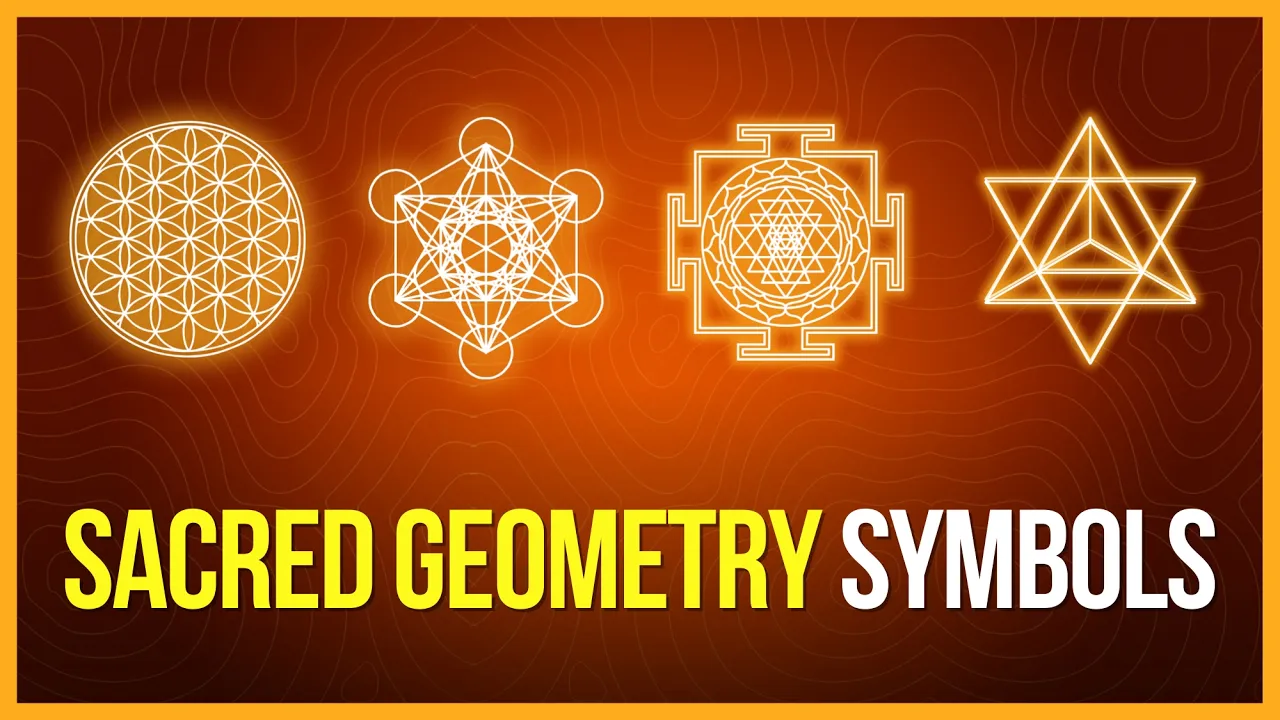








Ibn Arabi's geometric cosmology presents a hierarchical structure of existence where the point represents the essence (being al-haq), the line represents the Angelic plane (direct divine messages), the plane represents the world of imagination (where images appear without substance), and the cube represents the human realm. This geometric framework, rooted in the Pythagorean tradition and expressed through diagrams showing the divine presence at the center surrounded by the four major names (life, knowledge, will, and power), then the intellect, nature, matter, soul, and finally the elements (fire, earth, water, air), illustrates how reality reveals itself through different dimensions of space. The speaker demonstrates this through the example of the Alhambra Palace, where the geometry of origination becomes the geometry of formation, with proportions following root 2, root 3, and root 5 systems, creating spaces that invite contemplation and reorientation of being.
Geometry and Ibn Arabi: The Point of the Compass
Added:okay um good morning and good afternoon and greetings and welcome to the hidden treasure series seminar series co-organized by Monash University and the Asia Pacific branch of the even Arabi Society my name is devaki and together with my friend aguan we will serve as the co-host of today's seminar on IBN Arabi one of the most influential Mystics in world history the fourth meeting and our speaker Jane Carroll is joining us today from California the United States and just before I introduce Jane I'll just tell you that next month we'll be having a break due to the New Year holiday and we'll be back to our regular meetings in February 2021.
um yes in our distinguished speakers in the new year will include Muhammad rastan from Canada Cecilia trench from the UK and summer Akash from Australia foreign so our speaker today and we're very very lucky and privileged to have her is a senior research fellow at the urban Arabi society and is secretary of the society in the US excuse me she first studied the works of urban Arabi at the bashara school in Scotland in the 70s while concurrently studying at the architectural Association in London with a specific interest in traditional geometry and Islamic architecture she studied under Keith critchlow and worked with him on projects at the shattra Cathedral Jane currently has a design practice in Ohio California and it sounds like an amazing place to have a design practice and fitting to her expertise in architecture and mysticism the title of her talk is the point of the compass geometry and even Arabi thank you so much for joining us Dear Jane and it's now over to you thank you thank you so much for that introduction and hello to everybody for wherever you are and whatever time of day it is greetings from around the world um so I'm going to attempt now to um share my screen foreign might take a moment okay I'm sorry people it's not coming up and testing oh you'll see oh here we go are you seeing that yes it's perfect yes good okay right that's a relief um okay so um just as an extension of the introduction this is a very similar to um the talk I gave for me as UK I take my cue from Keith pritchlow who would give um repeated lectures showing images to just sort of embed themselves and people in people looking at him my education and my daily practice is in architecture which necessarily is concerned with how bodies live and move through three-dimensional space in this world um I've Had The Good Fortune as as was mentioned in the introduction to study in some extraordinary great buildings created by people of profound insight which give up and knowledge which is not necessarily accessible intellectually or in words a kind of knowledge which we can call embodied cognition that is that what you can take in through the senses through the sense of space through eyes through hearing or giving you um a certain invitation or a certain provide a kind of opening um as Stephen huttenstein was describing a few weeks ago an opening to a another way of being or another orientation in life and of course these great buildings like any work of art provide this anything on Earth can do this obviously you can fall in love you can be transported by Beauty you can just have a moment at any time but nonetheless there are these special places as IBN Arabi said someone who does not find any difference in the experience of his heart between the marketplace and the mosque is a person of State Hull not a person of place so I'd like to start by saying we have these connections we have these pattern recognitions as Pablo Benito was describing in his talk these primordial primordial pattern recognitions the most significant being the movements of the Sun and the Moon across the firmament which human beings from the earliest times we know of have taken note of have structured their physical environment around have divided their uh Earth into quadrants according to the movements of the sun through the equinoxes and the solstices so there's a basic geometry accessible to every human being on earth watching the planets move through the firmament and I would just like to point out one other extraordinary piece of patterning this is a photograph of a total solar eclipse of the sun I know a couple of these have occurred in Australia over the last 20 years or so there is one happening in Argentina in two weeks time which I was planning to go to witness um but covered interrupted um I've seen them before it is an extraordinary sight it is this specific geometry of the Sun and the Moon and the Earth and the alignment connected with the distances between them which allows the moon in these rare occasions where it passes directly in front of the Sun where you we on Earth can look up and because the moon fits exactly over the sun you can look directly at it and see these Flames coming out you know yourself in your experience that the sun is a fiery ball and the Moon is its reflector it's an extraordinary symbol an extraordinary thing to witness if you have a chance to do it so I feel happy for the people in Argentina in a specific line so what does the banarabi have to say about geometry um he starts with the point we have been given the point because it is the origin of the existence of the circumference of the circle Jane Clark spoke about the instant in her talk the moment between past and future this this indivisible moment which is outside time so the equivalent in space is the point it is here and not there but it has no Dimension it takes up no space that it is the center of everything that emerges from it that if an Arabi says the point is being al-haq the space outside the circumference is non-being and that which is in between is the possible the world in its entirety is circular in form within which are then differentiated the forms of all figures such as quadrature triplicity hexade and so on indefinitely so all the possible relationships uh between entities happen within this circumference of being now whether you think of the point on the macrocosmic level in this universe as something like the big bang out of which everything in our known universe appeared or whether you think about it on the microscopic level as the human egg from which each of us each of our bodies emerge this minute cell less than the diameter of the human hair um which if we also go back to what Jane was talking about the moment the instant between the past and the future it also looks towards the future it is also oriented towards the future it is oriented towards becoming so does also the point so our own origin our own bodily origin emerged out of this single cell which divides and then divides again into three-dimensional geometry until it eventually builds this extraordinary DNA double helix which is this strand of quite complicated geometry which determines our unique characteristics so we ourselves are geometry this is the relationship of these energies coming together in particular geometric relationships and understanding through that where this came from where this point of of no dimension um Roots Us in the reality of our being so these are diagrams of IBN Arabi diagrams which um would describe as geometry of origination these are the sort of theoretical diagrams these diagrams in the imagination of how existence comes into being these are from the photo hat and this is the divine presence at the center um surrounded by the four major names life knowledge will and power and then further out emerging the intellect nature matter soul and then on the outside the elements fire earth water and air this is a drawing based on another of IBN arabi's drawings the diagram of the Throne of God and it's pedestal with universal matter in the in the outward Circle and Universal body the throne God's feet the footstool the the an image of how the world came into being thank you so the language of geometry um is something that IBN Arabi would have known through the Pythagorean tradition as expressed through IBN masara in the Andalusian School so this was brought through through Plato um who famously said the knowledge at which geometry aims is knowledge of the Eternal and not of anything transient which will decay the language of geometry is beyond any particular verbal language it is accessible to everybody of any culture it follows the same rules no matter what the same proportional systems emerge own this plane in this world that we live in so it becomes this eternal these Eternal ideas and if an Arabi brings forth the meanings out of them other other cultures bring out slightly different meanings from it but it comes from the same basic reality so we don't know that IBN Arabi himself was a practicing geometer he obviously knew about enough to do the drawings that he did um but if we start with the practicing geometry and look through the phases that we work through we have the compass representing the point the compass needle the fixed area coming from a dimension outside of the plane establishing a point of course in this world um what summer and cash would call the geometry of formation the point is never going to is actually going to take up space it's just going to be a representation of a real point which has no dimension and then the open leg of the compass inscribes the circle then if the point of the compass is put on the circumference of one circle and a second circle is drawn we have the vesica this shape known as the vestica Pisces which is a very important shape in Christianity because it's used to represent Christ but it is also brought out as a very important shape with the banaraby as this intersection between the human and the world at the where the perfect man operates between these two worlds I don't know if I can read this quote all right okay man alone possesses two perfect relationships by one he enters into the divine presence and by the other he enters into the cosmic presence thus he is as it were a mediator between the world and the real bringing together the created and the Creator he is the dividing line between the Divine and Cosmic presences as the dividing line between the Shadow and sunlight this is his reality he has the Perfection of both eternity and newness now the wonderful thing that emerges out of these first movements in Geometry this beautiful shape of the circle moving into the perfect image of the circle is we have the first three-ness this shape is a perf to perfect equilateral triangles and it brings forth the relationship of one the number one to the square root of three so geometry is in some way a visualization of number everything that is profound and extraordinary that number can also be seen in Geometry sometimes much more easily the square root of three is a number which is irrational in arithmetic um you can't it's a never-ending but in Geometry it's perfectly clear to see this relationship of these proportions and then of course you have the first fullness between the vertical line of the vesca and the horizontal line you create this fullness in the first Square so these original shapes start emerging out of the point to the circle to the movement of the circle to the to the proportional systems that emerge out of that and then we have three dimensional geometry which IBN Arabi represents through the movement of the point through to the line the line through to the plane and the plane through to the cube so he is talking about what these uh Dimensions come to mean in this three-dimensional world we live in as far as I know the only um shape that ibnorobi spoke of in three-dimensionals was the cube the cube is of course one of the five platonic solids these extraordinarily wonderful three-dimensional shapes um Each of which the the the nodes of each of which sit within a sphere and the sphere fits directly inside the center of the planes of each of its size there are only five they were first described or discovered by Pythagoras and described by Plato and known as the platonic solids it seems obvious that IBN Arabi would have known of them but I've not yet come across anything to suggest that he speaks of any of them other than the cube this is an illustration of how they fit Within These spheres they are magical extraordinary shapes and this is how a cube is also intersected with an octahedron they relate to it they all relate to each other as well it is um an astounding thing that these these patterns appear so for urban Arabi he would describe the point as the essence the line which has length but no breadth or depth is the reality of the Angelic plane it is the reality of a direct messages from the Divine which he says except no deviation they come in a direct line from the Divine to the Earth the plane which has a length and breadth but does not have any depth is the is the plane of the gin and the spirits and the world of the imagination it's the plane on which images appear in the world of the imagination but they have no substance and then the cube is Visa and the human Realm it is how reality reveals itself through the levels of being indifferent dimensions of space and then of course represented this Cube this um extraordinary shape of Six Dimensions with the Kaaba which for Muslims of course is the center of the world about which everything rotates if an Arabic goes on to talk about the cosmic body of man who fits Within These six directions in his Essence he says the individual man corresponds to the divine presence God created him in respect of his figure and his organs with six directions these were made manifest through him because he is to the world as the point is to the circumference so the vertical dimension from above is the and is the direct Angelic presence coming down to the human being without deviation from beneath it's the vegetable world it's the nourishment from the earth which again is given freely both of these this vertical Dimension are gifts to man there's nothing you can do not to receive them they happen anyway on the horizontal level This Plane of the of the methyl This Plane of the imagination we have the interaction with the world the area where we can be in a sense um uh wobbly we can lose our sense of balance It Forward its Vision behind us it's fear to our left is our weaknesses to our right is our strengths this is the world in which we have to find our balance find our Center Spot become established on the vertical plane foreign image the same thing um and just to bring up again that if an Arabic goes on to talk about in the chapter of Muhammad uh as he describes the ritual prayer he goes over also these three dimensions this is how the body moves through space um existence comes from an intelligible movement which transports the world from non-existence to existence and prayer includes all the movements which are three in number the vertical movement when the person praying stands upright the horizontal movement when the person praying bows and the inverted movement when the person praying prostrates so what was the banarabi's own experience of geometry um he at the time of his birth Andalucia had been in Muslim under Muslim control since the year 711 and in Cordoba um there was an extraordinary center of learning from particularly in the 10th century it was a the major intellectual Center of Europe at the time and studies in Geometry astronomy the Medical Arts all kinds of things were going on there to a extraordinary sophisticated degree and the geometry that was being developed there had been brought there from Damascus when the Damascus fell and that had come from Baghdad and they had bought the ancient classical works with them this is the interior of the great Mosque of Cordova which evinerably would of course have known well and this is the stunningly beautiful mirab which we know from IBN arabi's own record that he says he made his final renunciation of the world in front while praying in the mirab at the age of 19.
after seeing his Alma had Commander prostrating he said if this the ruler of this land is so humbly submissive before God then this world is nothing and he renounced the world and took up the way so this meth Rob has extraordinary geometry governing it um here you can see the basic shape of the vesica these two circles and here you can see the generation of the uh the column of the areas of text or around it this is a generation of triangles and squares so the root 3 geometry and the square root of two geometry two very important proportional systems this is there is a hidden Circle formed by continuing the lines of these 19 beautiful floral decorations around the edge of the entrance to the mirab if you extend each of those lines down they meet a point that you can't actually see and create a circle which does not actually exist in invisibility the number 19 appears over and over again in the musket Cordoba um there are various reasons why this might be the case but number and geometry were both known so well it certainly would have been deliberate there are 19 um arches going into the mosque there are 19 petals around this uh there are 19 segments of the ceiling of the mcrob 19 is the number of letters in Bismillah regime it's the number of Wahid it's the number of the configuration of the solar and lunar calendars the number of years where they come together there are maybe many many other reasons why number by 19 was chosen and this is an image of the three different circles with three different centers that are either evident or hidden in the entrance to this mikhrab and inside the mirab is this beautiful ceiling which helps to uh Propel the word of the sound of the Imam back through the mask again 19.
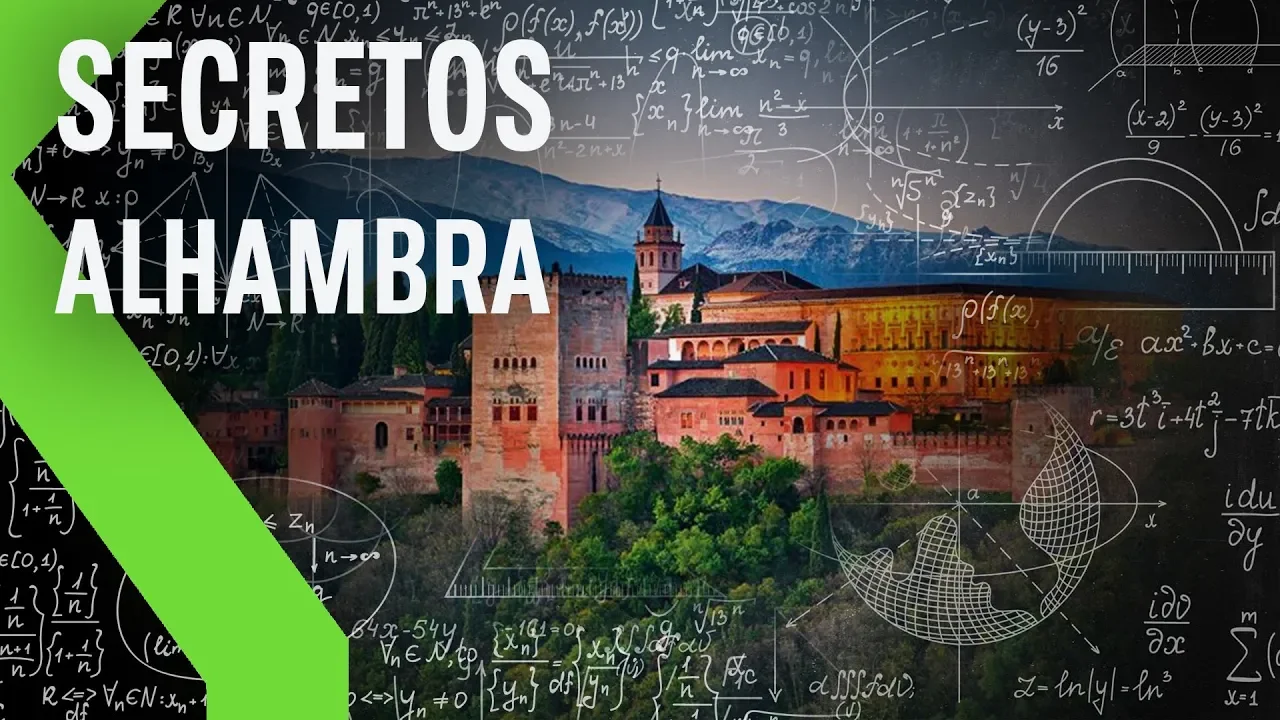
segments to this shell and here is the point from which the word emerges you can say so the last great building in Moorish culture in Spain with built the Alhambra Palace the nazrid dynasty the Palace of the Nazareth Dynasty it was built after IBN Arabi left Spain mainly built between 1240 and 1350.
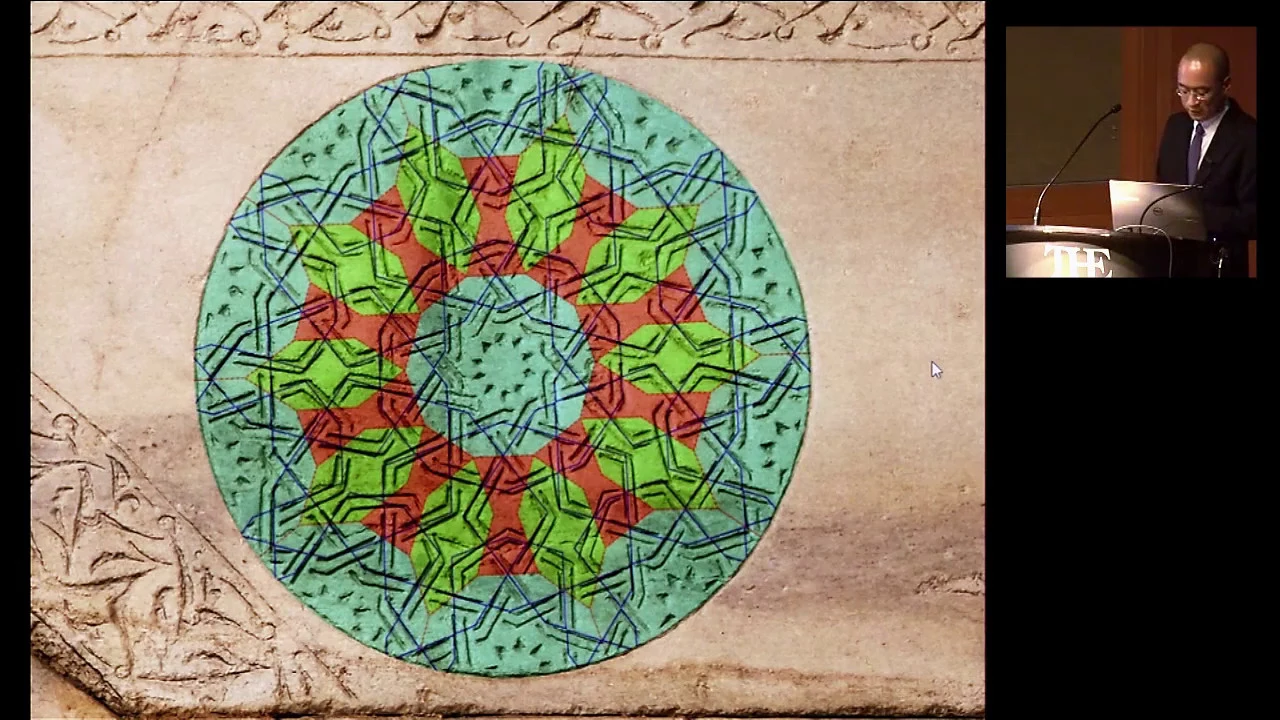
but we know it was influenced by the nairabi the two vizias of the of the rulers who were most responsible for building the nazarud palace were even carted and IBN samrak both of whom at periods during their life were exiled to North Africa they were and while they were in North Africa and rabbat they studied under in the IBN mazuk who was a great and close follower of IBN Arabi so we know they knew his work well and they were responsible for these special parts of of the building these are Courtyards which uh went through each other this is uh can't possibly do service to the Alhambra in this very short talk but just to say for the and those of you who've been there know this you go from Courtyard to Courtyard that not necessarily not ever in fact in a straight line it is not a logical progression it doesn't have a facade it's not like for instance the Taj Mahal which was another building very influenced by the work of Liberty where its geometry is very apparent from the outside in this one the geometry is discovered walking through these completely perfect beautiful courtyards um this is the first one you enter and then you come through this glorious one the court of the myrtles with the beautiful Reflections in the water this is again how when geometry with the geometry of origination becomes the geometry of formation so these ideas of geometry Now find their expression in water and plaster and wood and simple simple materials but constructed in these glorious proportion systems it's really made of Light and Water this this Palace and this is that this is the famous saying that is is inscribed throughout the palace on the walls this is in in honor of the saying that um Muhammad made when he came back from a battle and the people around in Granada were greeting him as a Greek Victor and he famously said God is the only Victor and this is repeated throughout this is the beautiful Court of the Lions um extremely intricate with a central Fountain which opens out into the four streams the four rivers of paradise these spaces are again invitations they're invitations to an orientation of your being or a reorientation of your being and perfectly proportioned this is a small drawing of how the proportions follow the root 2 Route 3 Route 5 proportional systems and this is the layout of that courtyard the court of the lines and the two lovely areas at both ends and then throughout we have these beautiful geometries on the walls these extraordinarily complex two-dimensional geometries in tile work in plaster different kinds of relationships of numbers so you get the this this has actually got a nine-fold geometry in green there relating to a 12-fold and other geometries just intersecting geometries in light and then these extraordinary three-dimensional geometries these pieces of um sophisticated shapes of plaster which come down in a kind of honeycomb from the ceiling this visualization of how light descends into matter filtering down from a single light in heaven this is just an illustration of some of the pieces that go to make up to make up these macaribis and just to linger on but just in any any one of these panels any one of these panels can be contemplated endlessly there there's the quote from IBN Arabi that says the gnostics give each thing it's due just as God gives each thing its creation if you see each of these shapes as having a point of origin which you cannot see because it has no Dimension but it is what generates the shape so whether it generates an eight-fold shape or a 12-fold shape or a four-fold shape it comes out of this point of origin and if each point of origin is given its due if it's reality it's a central reality appears with a right with within the meanings of the names of the name of Huck it's reality is this sense of right it has a right to appear because it's the truth so if each is given it's due the interrelationships between the different entities are perfectly in accord are perfectly in proportion with each other it is um a visualization of the notion that there cannot be peace without Justice that once things are given they're due once they're allowed to be recognized as nothing other than images of the representations manifestations of the truth that's when true peace appears um and this is the gnostics vision of the world and I'll just finish with this image of this beautiful mirror door of the Linda Raha um and the verses of IBN samrak which are around the top of the two windows here I breathe fresh breezes the air is healthy and the Zephyr agreeable I joined together all beauties surely I'm in this garden and I filled with joy and the pupil of visai is veritably my Lord so this building allows for us to um bring our senses into a kind of order where we are receptive we're not projecting we are receptive we are invited into an opening um and given information about our true nature so thank you on that lovely image of the fountain I will finish thank you so much foreign
Up Next
Economic Forecasting Failures: Gary Stevenson, Abby Innes & Nadhim Zahawi
@TheInstituteOfArtAndIdeas
202.8K views•2025-03-13

John of Damascus on Holy Images: A Theological Defense
@BannedBooks
139 views•2026-04-25

Should We Destroy the Machines? Big Tech Surveillance Critique
@TheStoriesWeTell303
167.9K views•2025-11-30
The Myth of Sisyphus: A Greek Legend of Eternal Punishment
@TEDEd
8.6M views•2018-11-13
Related Study Plans & Knowledge Roadmaps
Structured learning paths in Philosophy