
















![[Запись 2020 г ] Наноустройства, наномашины, нанороботы. Основы нанохимии и нанотехнологий](https://i.ytimg.com/vi_webp/_b5qnNpDAUQ/maxresdefault.webp)


Molecular machines are mechanically interlocked molecules (catenanes and rotaxanes) that can perform controlled mechanical movements through non-covalent interactions and redox chemistry, enabling applications in molecular electronics, drug delivery, and artificial molecular pumps that operate away from thermodynamic equilibrium.
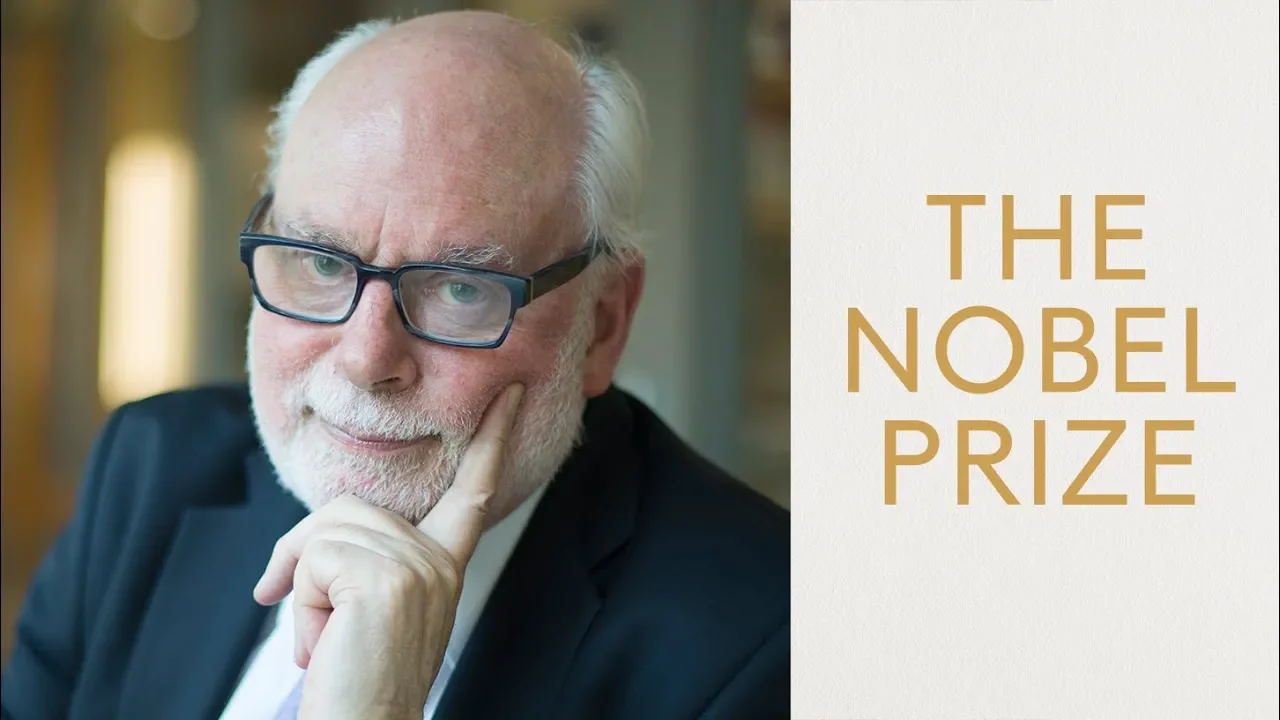
Nobel Lecture: Molecular Machines & the Mechanical Bond
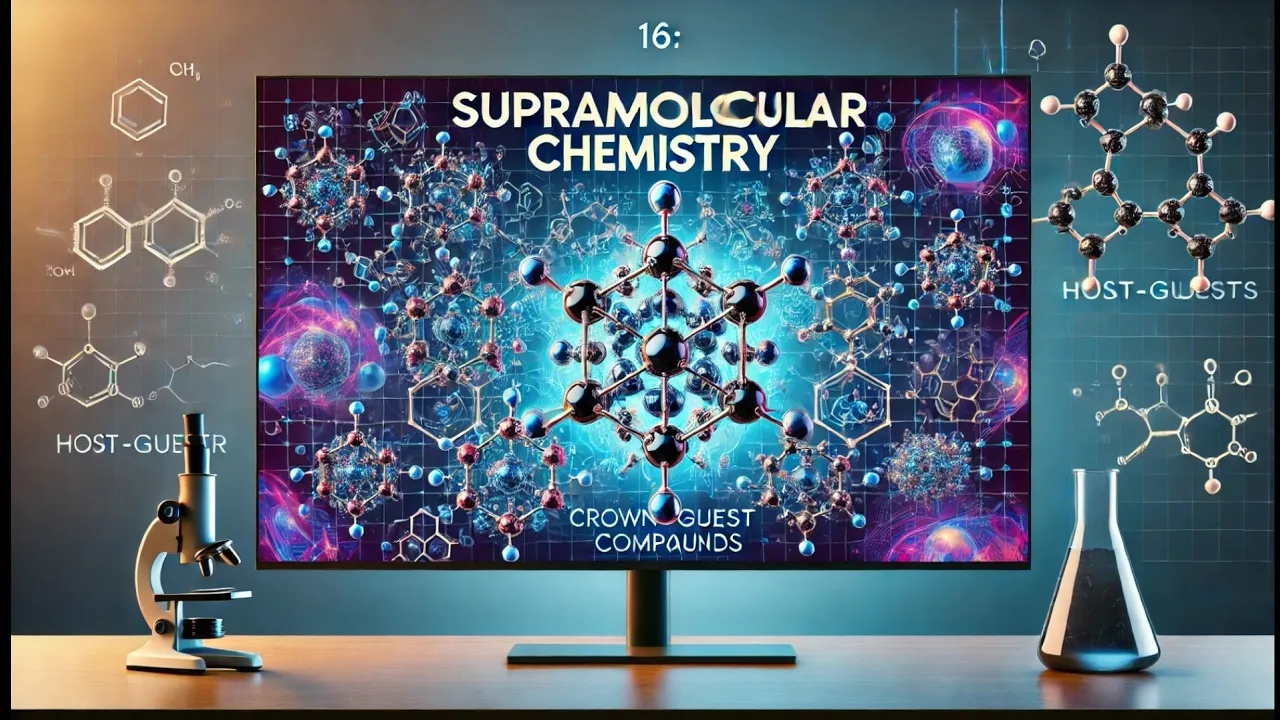
Added:Fundamental concepts of supramolecular chemistry, specifically host-guest chemistry and molecular self-assembly.
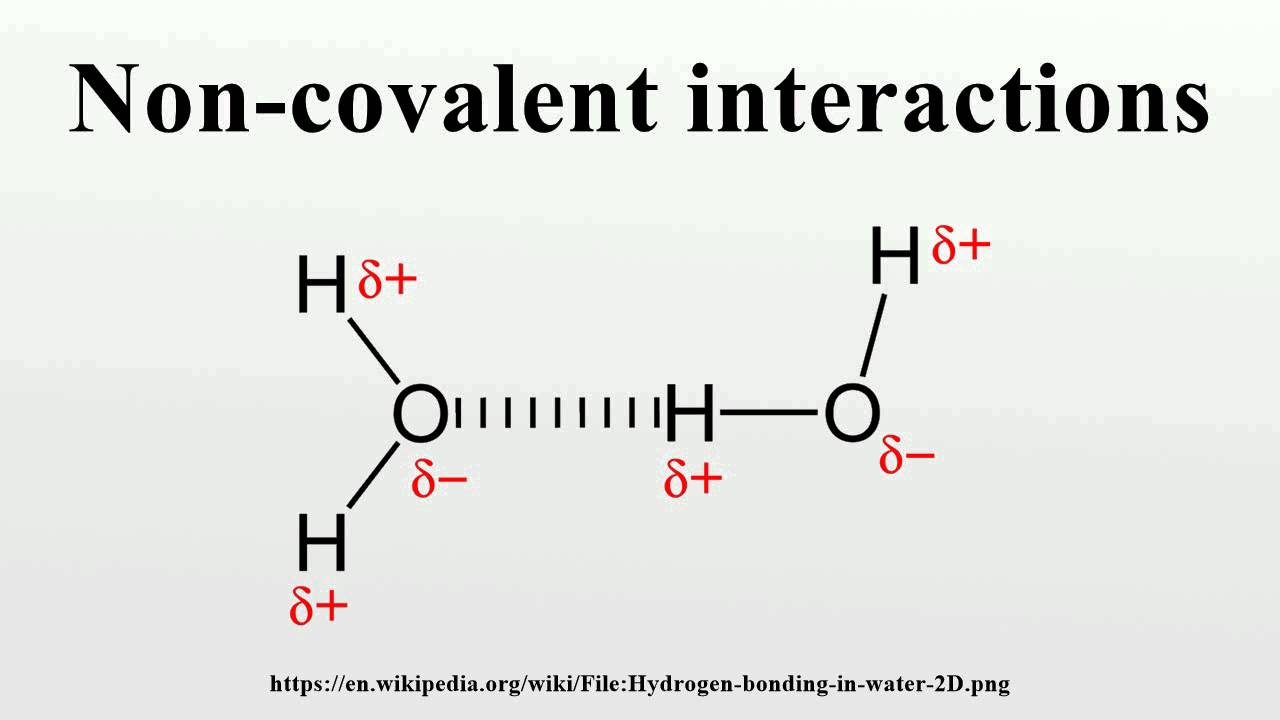
The distinction between traditional covalent bonds and non-covalent interactions, such as hydrogen bonding, hydrophobic effects, and pi-pi stacking.
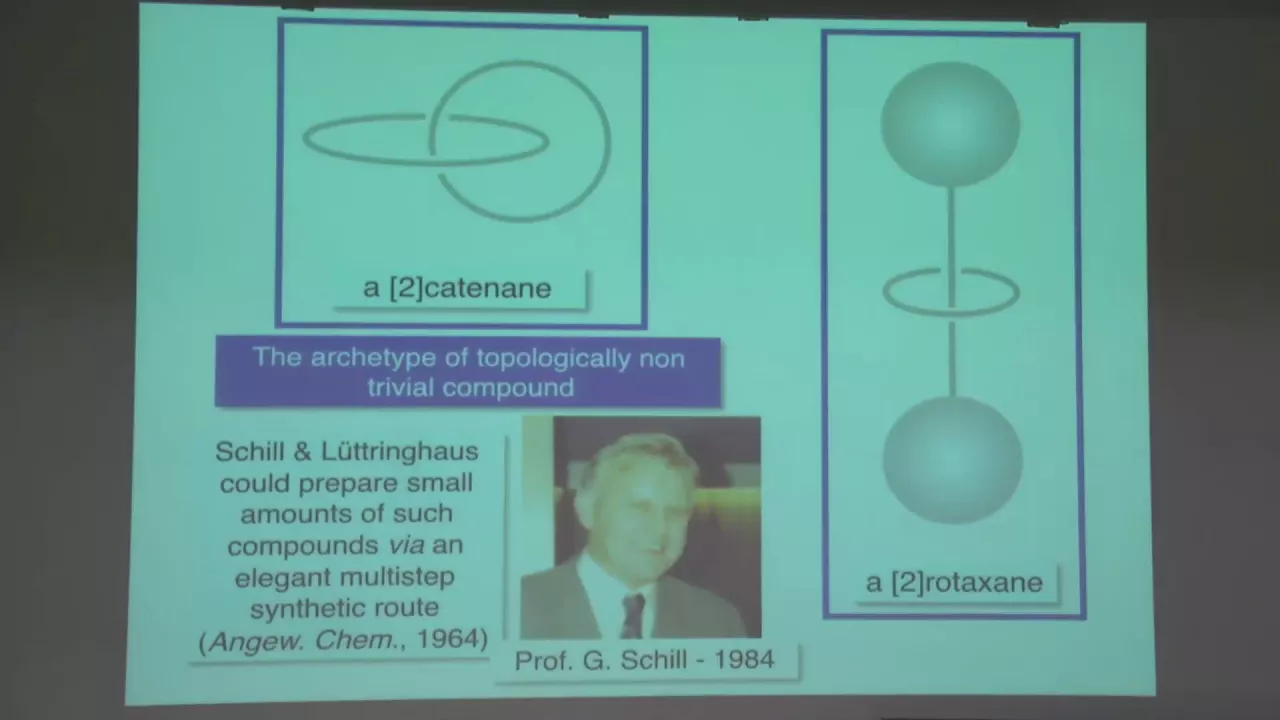
Basic stereochemistry and molecular topology, explaining how molecules can be physically interlocked without direct chemical bonds.
Core principles of chemical thermodynamics and kinetics, particularly how molecular motion is governed by thermal energy and energy barriers.
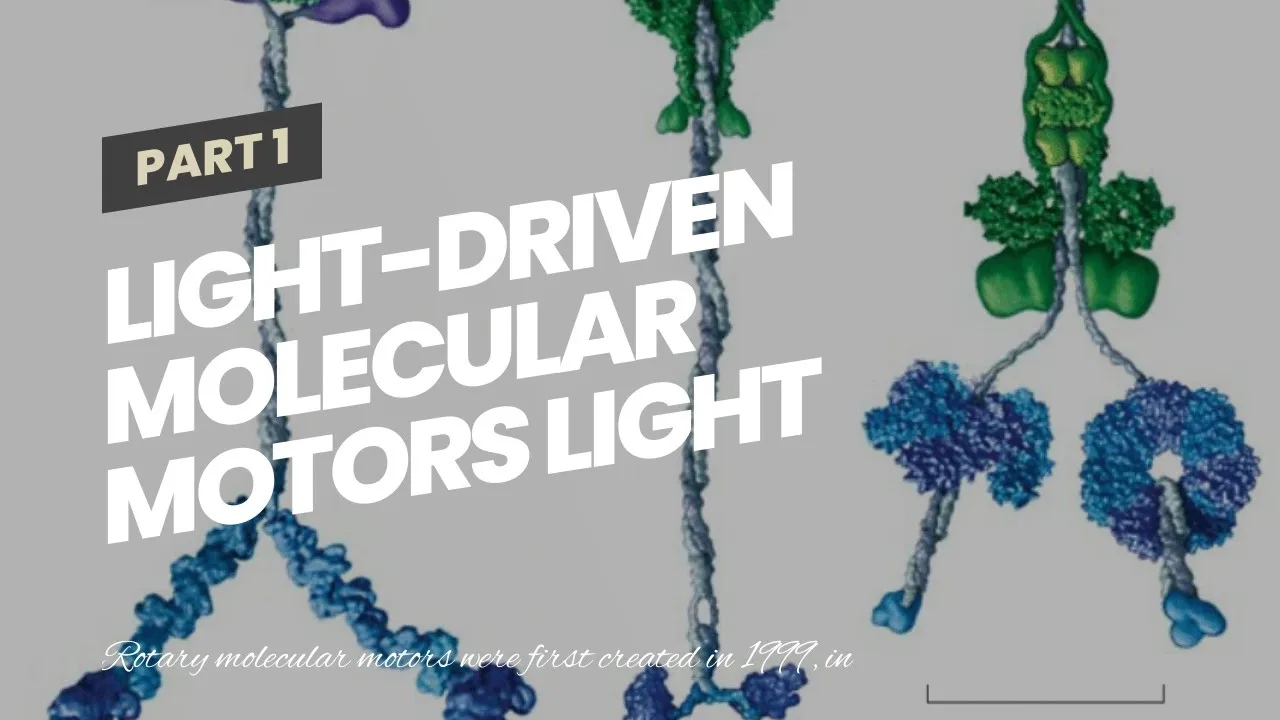
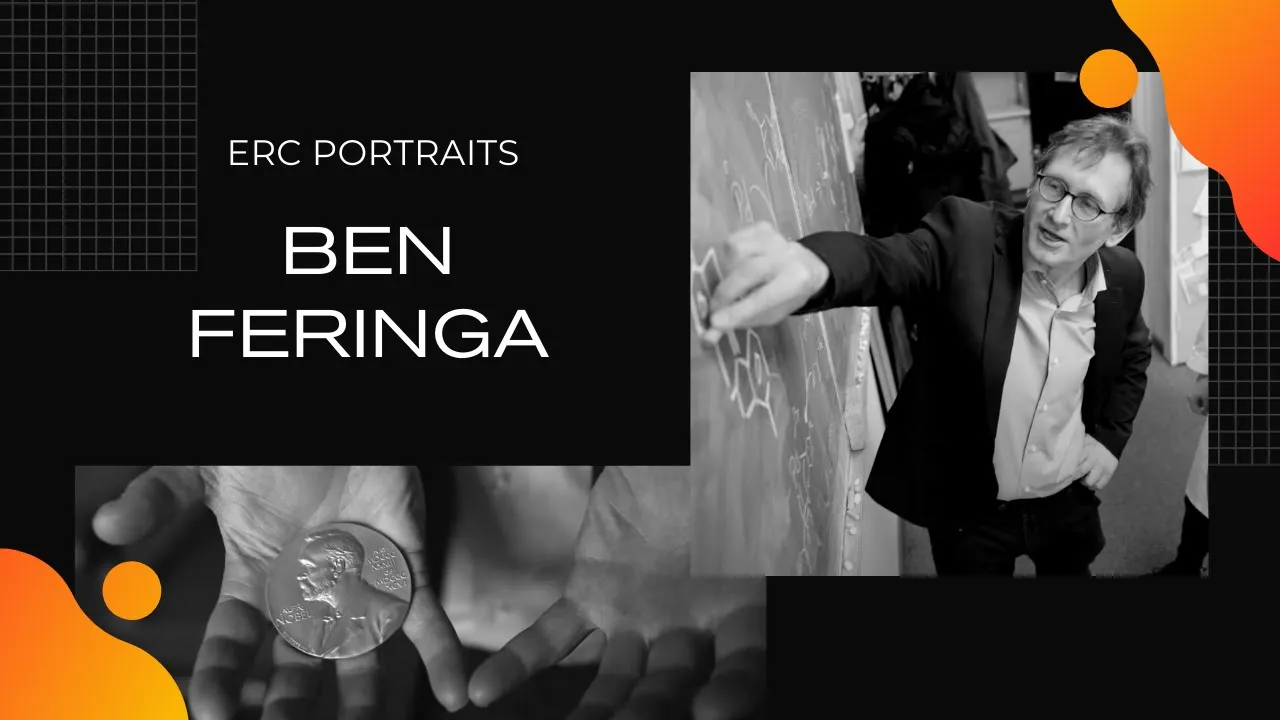
The design and operation of light-driven molecular motors, such as those pioneered by Ben Feringa, to understand rotational molecular motion.
Practical applications of molecular machines in targeted drug delivery systems and smart materials that respond to environmental stimuli.
The study of biological molecular machines (like ATP synthase and kinesin) to compare artificial systems with natural, evolutionary designs.
Advanced research in molecular electronics, utilizing rotaxanes and catenanes as nanoscale switches and memory storage devices.
Non-equilibrium statistical mechanics to understand how molecular pumps operate continuously away from thermodynamic equilibrium.
19.1K views218likes35:22Original Release: 2016-12-11
sir Fraser stodart and Sir Fraser was born in 1942 in Edinburgh in Scotland UK he was awarded a PhD in 1966 from Edinburgh University and he has also moved around quite a bit during his career but he is now a Board of Trustees professor of chemistry at North Northwestern University in Evanston just outside Chicago in ill o USA and U just want to say one more thing uh and I will welcome uh sir Fraser up to the stage that uh sir Fraser is part of the so-called Fraser clan in in Scotland in north of Scotland if I understand correctly and the Fraser Clan is well known for being extremely stubborn and but well very trustworthy people I think both of these uh characteris ICS are very good for science but there is a third characteristic for the Fraser Clan they are very very fierce in battle so and I think maybe that is also something good for science actually sometimes so by that sir Fraser please welcome up to the stage well thank you Olaf um honorable hosts um fellow uh laurates um respected guests um it's an enormous honor for me to be standing here and sharing this uh platform today with uh jeanpier sage and Ben finger the Coates um that have been recognized by the Nobel foundation and the Royal Swedish Academy of Sciences I want to take you on a story that uh will reflect in some ways the citation um the design and synthesis of molecular machines based on the mechanical Bond now Jean Pierre has uh already introduced you to cines and Rines I like to use this word that was coined by first back in 1953 um the mechanical bond to describe a situation where within a molecule you have a physical bond between either two rings or between a dumbbell component and a ring um this is not a chemical bond it's a physical Bond and as such um I think it's a very much uh revolutionary change in uh chemistry um we often refer to them as mechanically interlocked molecules and I just put up this definition by Wikipedia to underline the fact that even Wikipedia appreciate that these are not super molecules they are molecules and you see how they are derived D from uh Latin as is uh the uh two ring situation I want to segue into immediately because we've had a marvelous introduction from johel Pierre into a structure that uh we uh when I say we uh David IM bino who's in the audience um made in the mid90s when I was at this marvelous University of Birmingham uh and he here you see a yellow component and a green component have the same chemical Constitution as do uh in a pair the blue and the red one um the black one is a slightly expanded version uh because it has to accommodate a yellow and a green ring here uh of the blue and the red here is a framework representation which uh shows the uh interactions that I'm going to be talking about primarily during my lecture between P electron Rich units this dioxy apine unit for example and these B peridinium units the uh molecular recognition that you see here um is that that you can find in DNA and in proteins and in fact these piie interactions in this direction here over here and in this direction here um are AED in a Ed in a huge amount by hydrogen bonds and also uh to a lesser extent by CH Pi interactions which you find in proteins the uh Olympia in molecule um I should say came to the world uh without um too much effort on my part um as I say David in the audience was was the synthetic chemist and uh the crystal structures you're looking at are um the courtesy of uh David Williams earthw professor of structural chemistry at theal College London uh you'll see that we went on and made a branched seven cine and there is the crystal structure of that particular molecule now at one time I was hoping that the Olympic movement would uh rally around and support my research but the opposite was true uh they don't like to see any use of their Olympics h um as some of you may know from the response during the London Olympic Games To The Butchers putting uh rings of sausages in their windows that were colored like this okay so I want to pay a tribute to Ed waserman because it is uh debatable maybe um I know that whether this was the first cine that was made back in 1960 but you can see as a result of an aselin so-call condensation and using some duyan labeling um it could be argued um if you read this paper carefully that uh this was maybe the first C of name to be made but luk in a very very small yield this this uh maybe is an overstatement of uh the yield in this reaction uh Jean Pierre already mentioned the uh very important publication in 1964 by godfried shill from um Friberg University this was a 22 step synthesis of which you see in a um telescope downway the last four steps of the synthesis and this involved the use of uh classical chemical bonds Cove valent bonds to bring the pieces together and then at the end of the day to cleave them and one of my Bibles has been this book um C taxes and Knots uh written by godfried shill and translated published in English in 1971 and now of course I pay homage to uh the uh remarkable breakthrough uh it was a game changer this French uh article in tetr region letters which uh I did struggle to uh read a little bit where are you Jean Pierre but um we got the message from all these beautiful uh representations and here I have uh perhaps put more detail in them you've already heard this story from Jean Pierre so it was in 1989 after about a decade of developing molecular recognition around uh donors and acceptors that we carried out a reaction in which um we started off with this dactin and um a crown ether over here that I will call a template and these two two don't speak to each other there's no molecular recognition but as soon as uh this carbon bond is formed you have a bip peridinium unit and this wants to make its way inside this Crown ether so that you can get donor acceptor interactions augmented by hydrogen bonds and then finally another nitrogen carbon Bond formed and aconine is um the result and the amazing thing for us in 1989 was that this arrived with a 70% yield now the uh uh crystal structure again um was CED out by David Williams and uh I know that Peter G is in the audience uh he helped to uh Orient that molecule I remember in a pub in Sheffield um in a particular way that leaves it I think attractive so now we go to retaing and using the same type of uh thought process here's our template now we don't have a ring anymore we have a dumbbell and again no recognition um but very easily in a one-step reaction you can take these uh uh chemicals here and cedon Nitro and uh prepare presumably in the first step the same as the last time with the cathine and then uh see these non-covalent bonds coming into place in the rotaxane environment um and again getting closure and this time of course not with the same high yield as with the cine because this is a more flexible template but still very respectable 32% yield now the importance of this uh Discovery um and this takes us to 1991 now is that this was the first example in our lab of what we called the molecular shuttle this is a turx scene where the ring can um dart back and forth you can see about 2,000 times a second at room temperature in acetone the next challenge was to um take away the degeneracy in that system and make it non degenerate in other words turn it into a switch so re replaced one of the hydroquinone rings by this U uh B phenol unit and by this benzidine unit uh there's a story here um U Bing was such a beautiful place we were not allowed to carry out the chemistry uh using benzidine in Birmingham and Richard Bissell had to go to University of Miami where uh the restrictions on using U benzidine weren't so high and made this compound in Miami University under the guidance of anhel Kyer and now you can see we have a situation where the U ring spends most of its time um on this um unit here the um benzen unit until it is protonated and because the ring carries four positive char chares the uh ring moves away from the proteinated benzidine unit um to form another um species where it is in circling the uh Bol unit and all of this can be controlled obviously by pH now I'm moving on to the first device that was made at UCLA in collaboration with Jim Heath and what I want to show you here is uh in a movie how the synthesis carried out so this is now a tetrathiofulvalene unit and this is a dioxyline unit um here you see the templation of the blue ring around that unit uh this is a hydrophilic stopper and that's a hydrophobic one and by again Redux chemistry we can put positive charge onto that uh ttf unit and have the ring move to the dioxyline unit U equipped with this type of of amphilic rot taxine now we could fabricate a crossbar device in which by hard lithography you could prepare a chip with say four wires on it uh this goes into a so-called lime your trough and in the langot TR this monolayer of molecules is squeezed together until it's at a right um level of pressure to when the chip is brought out by the so-call langard project technique the monolayer is spread onto the um surface of these four wires and then more hard lithography is required and all of this was done in Jim Heath Lab at UCLA and subsequently Caltech to give us a so-called 4x4 crossbar device I go fast forward over a decade we had a wonderful collaboration with Jim and this is now a 400 * 400 uh crossbar device with wires around about 16 nanm wide and this gave us the basis for a 160 kilobit molecular random axis memory uh Jim was quite uh uh hard on the uh switches that he had the threshold had to be uh at least 1.5 in this diagram here so this meant that three quarters of them for one reason or another were condemned but at least uh a quarter ruined and that allowed him to um punch out using the asy Cod California Institute of Technology on a device where um we have white blood cells here here is a device here are white blood cells and so we're looking at a device that is in its cross-section uh smaller than the cross-section of a white blood cell and this is Le was 2007 roughly where the uh semiconductor industry is expected to be by 2020 one thing was uh not to our liking about these uh switches and that is uh they don't last they might go at best through 100 switching Mo motions and then the system just degrades so I want to give you some very upto-date uh results and so this is a paper that's just been accepted uh for publication and in fact uh has appeared now um in which we've used this uh by stable cine with the same principle of playing off ttf against uh the DI oxy naine unit um placed inside a metal organic framework by a technique uh that has been uh featured and uh developed by my two colleagues Joop and Omar Fara called solvent assisted liid incorporation so you just plug these um switchable catenates into the pores of what is called nu1000 this particular moth and you can see here this is a film where you can see switch ing uh just by looking at the absorption round about 800 of the ttf unit um and that switching is taking place I can't tell you how robust it is yet the other uh development of our work at UCLA was in collaboration with Jeff zinc where we put essentially rot taxin on the surface of mesoporus silica nanop particles and showed that um we could use these and uh I have a movie here to show you the um incorporation of drugs under uh a concentration gradient and then using the rings on the Rines to close up onto the surface hold the drugs inside and then let them in principle um be admitted into uh the environment of a cell here's the cell coming and the um capsule is inside and when you give it a signal by any means possible then the drugs will spill out and of course the is not going to be good news for the cell okay so I'm going to make a fast transition now to molecular machines and they are going to be based on uh this so-called flashing energy ratchet mechanism and so this is where um we need to have a situation where we can get unidirectional motion to begin with in a situation and I'll use cartoons to begin with where we use the cyclophane you're already familiar with and we want to to be able to bring it on to this uh dumbbell such that it comes over the neutral end and uh after having done that because of the recognition between the napoline and the ring system uh to eject it by the right hand side uh over the charged end and this is achieved by juggling around of uh energy barriers so here is the lower energy barrier it comes over the neutral one and then by changing the uh oxidation State a reduction state of the ring and taking it to Abyss radical cattin we reduce the positive charge and it comes off the right hand side so this is a way by which you uh can get one of the necessary things to be able to build a molecular machine that is getting unidirectional motion okay so um again we are inspired by Nature I just want to point out that bacteria ropson uses the same principle to pump protons across from outside to inside a cell here's the chemical constitution of the dumbbell that you've been looking at and uh you've seen the cyclophane before and again this uh principle can be used to make what we've called a molecular pump so this is the Prototype that uh allows us to take the ring on from the right hand side and leave it from the left hand side anyway um we didn't have enough uh as it were uh driving force in this uh particular system and we were able to um change that situation for the better on the back of a discovery made at the end of uh 2009 published in 2010 in Stuart Cal's journal and he's in the audience um and this amazing discovery that uh a tradical tritin can be a very stable species allowed us um to be able to play off reducing against uh oxidizing conditions and so one can contemplate now a situation where we turn the dumbbell through 180° the charge system on the dumbbell is on the left hand side now and the neutral one on the right hand side and we're going through a sequence of uh reductions relaxation oxidation relaxation um we could show that we can direct the ring from left to right this um form of templation can be illustrated by the making of U the first um homo name um in the uh series of this so-called blue box and this was carried out by Jonathan Barn who's in the audience um in a remarkable 41% yield um based on uh the U interaction that was such a surprise it was uh so surprising that it's been described by one of my post talks as an intellectually um uh disturbing uh invention as it were and this uh mon radical can be further oxidized um to a totally oxidized OCTA and there's the crystal structure of that one how am own time 10 minutes thank you um we can affect radical templation uh also in the rot taxine era or area um by simply using um a photosensitizer and a sacrificial electron donor and the result is uh the formation again of this Tris radical trionic complex and when you see these aside groups at the end at least every chemist knows that U you can carry out in principle a so-call click reaction with a an appropriate alkine and we were able to do this or how Lee um now a professor in China uh very efficiently um the point about this system is that when you bring it out of and in our atmosphere this chemistry has to be done in say nitrogen or um Argan then um columbic repulsion will take place and the ring will be pushed away from uh the formal bip peridinium DTI so here is the design of uh the um molecular pump where what you see going on here with this movie is um the juggling about of transition States and energy Wells to allow this ring to come on when it is in a reduced State and then to be sent to the left hand side over a barrier we call this a speed bump sometime and when we get it over there it is such that it can't make its way back and this is the uh again cartoon version and we have a long collecting chain here this is where we want to collect these rings and demonstrate that we're doing chemistry as you'll see away from equilibrium in other words we're moving away from molecular switches to molecular Motors uh another movie here that shows the ring coming on from the left uh while it's being reduced and then after being oxidized going over the speed bump and when the second one comes on the first one wants to come back but it can't because of the speed bump so there's an enormous amount of uh delicate uh stereochemistry involved here in a huge amount of synthesis the uh process that we're looking at again is one of consecutive reduction oxidation a little bit of thermal um energy needed to push this ring over the uh speed bump into the collecting Zone and further reduction and oxidation and termal uh process to bring the second uh ring on so it's interesting that uh pumping one followed by two rings is possible and in the context of doing this we are more and more taking a system away from equilibrium and what was very interesting was that uh we could carry out the first Redux cycle here in a 90% yield uh the second one a little lower 77% yield sorry 85% yield overall 7 7% yield for the production of this two catanine and what I want to point out is the energy barrier that has to be crossed to put the second ring on is within experimental error of that for the first ring and so what we're seeking to do now is to use the same type of approach the radical chemistry with a Redux um system that involves reduction forming the very strong complex and then oxidating um giving colic force that pushes it to the right and you'll notice as this happens I'm increasing the level of the energy here and so we're going up in energy we're doing work and this is what the biological motors do as well we are that's the fourth one so each cycle traps one ring in a high energy State some of the energy input is trapped and we've gone from working with molecular switches to to molecular scre because work has been done time five okay um now why would we be interested in going down this road because everybody's looking for applications and let me give you a taste of what might be an application so-called entropically dominated polyoxins and so now we're putting the pumping part of uh the molecule at each end of a long polymer chain and using um a light powered system and even an electrically powered one uh we can show uh we're making progress here that we can do work progressively and repetitively from each end of these polymer chains and I take a movie here to show you uh what's going on in solution we have uh the Redux chemistry reduction followed by oxidation forcing the rings on over this speed bump in two different parts two ends of the chain here so that we accumulate a lot of rings in an environment where they are both entropically and enthalpically unhappy so what's the consequence of this well before I come to that um I just want to summarize the principle that we're developing here um and that is to use a very stable interaction of a host gu nature and then after the reduction process to get this to happen an oxidation process to uh switch on columbic forces at a very big level so that we've got a highly unstable species and this forces the uh units to come apart so we have a modulation here involving kinetics of Association and kinetics of disassociation we're doing chemistry away from equilibrium and the point I want to make here is that uh if you've been an undergraduate in chemistry or a graduate student in chemistry in the last 50 60 70 years it's usually been all about equilibrium processes in the class we've got to move now into the direction of studying systems that work away from equilibrium because this is how the motors in our bodies work so what are some of these big questions uh in this context um they are what are the consequences of dissipation on materials properties well we a hint that these could be very useful because in Japan Professor Ito and Kato have uh using um cyclodextrin and uh polymers like p PE ethylene glycol polyethylene glycol have been able to show that you can make these so-called slide ring materials and these show properties of being scratch resistant but we would like to be able to do this in a more widely um uh def finded Arena involving organic solvents and U organic um type uh polymers so we want to be able to design systems that operate repetitively and progressively away from equilibrium along the lines that I've just been uh describing okay so just to summarize this has been a journey that's taken at least um 25 years although I will just dip back for a little while at the very end to point out that to get to 1991 was already a decade of uh a lot of um shall we say difficult experiments that uh seemed to take a long time a lot of uh situations where uh things didn't work out the way we expected but eventually by the turn of that decade when we went to Birmingham we were able to um make degenerate molecular shuttles and to um put into them um radically enhanced uh Redux switches by um 2010 uh we then could introduce unidirectional translation um as a result of uh having these asymmetrical dumbbells uh first of all we use donor acceptor interactions but found that um the discovery of the radical chemistry made it much more feasible to make U linear Motors and we have had to optimize columbic barriers after having optimized theic barriers there the uh uh chemistry that was done here and making these energetically demanding Transport Systems ultimately led to the production of these artificial molecular pumps and in this context there are these early players and I should recognize the very important contribution of theoretical chemist computational chemist Bill Godard at ctech because we do everything with a lot of uh computational work Dina stuman who's been really um our guide uh through all of this uh physicist from the University of Maine and then other people who some of them in the audience Jonathan Barnes Christian Pato Paul mcgonagal and Jang Jen who've really pushed forward our work on molecular machines the leading molecular machinists uh I would of course uh recognize right away my coate um Ben faringer uh but I just want to put up with some trepidation of course the same that uh was expressed by Jean Pierre saage other main players in this field so vinen Bano um Alberto KY who's in the audience my ex- student David Lee Dena stuman again Joseph Miko Colorado and Prague uh Steve Lu in Canada uh Eddie cic in Australia the Anu uh Miguel Garcia gabbe at UCLA RAF Klein at The vitman Institute ammer flood in the audience uh Ivan rahimian in the audience and I know that also Nicholas gon is in the audience so I think the field is moving forward um at Great knots and the recognition by the noell foundation and the raw Swedish Academy of Sciences will I think give it a great impetus um can I just take one minute okay um can we go back to Nobel laurate Alfred Verner because some of the introduction that I didn't put in because I thought I might not have time um goes back to Alfred Verner uh and then a man called Joe shat who was associated with Imperial chemical Industries where I spent three very productive years between um 1978 and 1981 uh before we go there here is just a statement for the young people in the audience in a review by chat that I think is worthy of some mention scientific discovery is not yet predictable note that if you have an exciting road to follow do not be put off by those who say there is nothing at the end of it they do not know persevere and enjoy the excitement of exploring the unknown and I think your three laurates in chemistry have all experienced uh some of the sentiments written there um in the audience is har ghun from the University of reading who when I first knew him was at ICI and here is the crystallographer that I paid homage to earlier and his student uh Alex loen and it was the uh entry into a field of second sphere coordination involving transition metals and Bodine lians that led in SEC successive steps to um organic systems that were very like the transition metal based ones and this happened in my lab during the 1980s um finally um just to recognize the importance of the human and financial resource situation um first of all this was my postdoctoral mentor in Canada Ken Jones um this was the professor of the School of carbohydrate chemistry at Edinburgh um Sir Edmund Hurst under whom I studied um he was a student of Walter Norman howorth 1937 Nobel lawat in chemistry uh who was a student of Oto wallik 1910 um Nobel laurate in chemistry and they go back through Kuli and wait for this one in color do you recognize him so I've got a good link to Sweden here and back of course to Waller who um challenged the vital force in his time I just put up a few of the postdoc and graduate students that have played a big part in my uh resarch over almost five decades now and also some of my collaborators um at Northwestern Berkeley uh usri BOS panacean Nano who's sitting over there and Roger Pon um of course it's not all done without U some uh brass as we call it in Britain so uh I got a lot of support ultimately from this University of Birmingham uh it was amazing when I went there in 1990 um and also at Imperial from Imperial chemical Industries well supported by both universities in the United States UCLA and Northwestern and the funding agencies there uh but last but not least in recent times the King Abdul City for Science and Technology in had in Saudi Arabia and I will just close there and allow if time permits about 400 names to come and go in red and blue that uh have contributed to my research um I wouldn't be standing here if it wasn't for the contributions by this amazing group of people you know it's a enormous privilege to work no sorry to practice one's hobby um every day along with young people roughly between their ages of 22 and 32 and their names are going up there I've been so privileged I'm very privileged to be here thank you thank you so much for this fantastic inspiring and and animated talk and also very Visionary and it's really nice to see some some results that are really hot off the press right I always want to give results that are hot off the press and also the link to berselius was fantastic thank you so much
Up Next
10:54
Intermolecular Forces and Boiling Points Explained | Chemistry
@ProfessorDaveExplains
2.7M views•2015-11-05
83:56
Biocatalysis and Catalysis in Islatravir Synthesis | Merck Webinar
@SCIwheresciencemeetsbusiness
675 views•2020-10-08
38:38
Nobel Lecture: Carolyn Bertozzi on Bioorthogonal Chemistry (2022)
@NobelPrize
148.7K views•2022-12-08
17:31
Edible Water Bottles: A DIY Guide to Sodium Alginate Spherification
@ryan
10.5M views•2019-06-21
Related Study Plans & Knowledge Roadmaps
Structured learning paths in Chemistry
chemistry
Nuclear Chemistry: Decay, Meds & Fuel Cycle
01Introduction to Nuclear Structure and Radioactivity
02Decay Dynamics and Kinetics
03Radiation Interaction and Detection
+ 2 more learning modules
24h5 modules
Explore Roadmap
chemistry
Supramolecular Chemistry: Forces & Machines
01Foundations of Chemical Bonding and Intermolecular Forces
02Introduction to Host-Guest Chemistry
03Thermodynamics and Dynamics of Self-Assembly
+ 2 more learning modules
16h5 modules
Explore Roadmap
chemistry
Photochemistry: Excited States & Reactions
01Foundations of Light-Matter Interactions
02Molecular Orbitals and Electronic States
03Photophysical Processes and Jablonski Diagrams
+ 2 more learning modules
18h5 modules
Explore Roadmap
chemistry
Coordination Chemistry: Bonding & Properties
01Introduction to Transition Metals and Ligands
02Crystal Field Theory (CFT) and Geometry
03Magnetic Behavior and Spin States
+ 2 more learning modules
14h5 modules
Explore Roadmap