

































For most of human history, blue did not exist as a recognized color because humans lacked the linguistic and conceptual tools to categorize it; despite observing blue in nature (sky, water, lapis lazuli), ancient civilizations like Greeks, Hebrews, and Chinese had no specific word for blue, and it wasn't until the development of synthetic pigments like ultramarine and Prussian blue that blue became widely accessible and culturally significant, eventually becoming the world's most popular color.
The Elusive History of the Color Blue in Human Culture and Language
Added:Basic color theory and the physics of light, specifically how the human eye perceives different wavelengths of the visible spectrum.
The concept of linguistic relativity (the Sapir-Whorf hypothesis), which posits that the structure of a language affects its speakers' world view or cognition.
An understanding of ancient pigment chemistry, including how early civilizations sourced and manufactured dyes from natural minerals and plants.
Fundamental knowledge of historical trade routes, such as the Silk Road, which facilitated the exchange of rare materials like lapis lazuli.
The evolutionary linguistics of color categorization, specifically the landmark Berlin-Kay theory on how color terms enter languages in a predictable order.
The art-historical significance and symbolic evolution of blue, such as its association with royalty and divinity in Medieval and Renaissance European art.
The modern chemistry of synthetic pigments, exploring the creation of Prussian Blue, international Klein Blue, and the recently discovered YInMn Blue.
The psychological and sociological impact of color in branding, marketing, and corporate design in the modern global economy.
3.4M views112.2Klikes15:14Original Release: 2017-08-10
Vsauce!
Kevin here -- now let’s paint a classic rainbow.
Green, good.
Yellow, nice.
Red, spectacular.
And we’re done.
Because for most of human history, there was no blue.
I mean, of course blue existed.
Ancient humans had the same biological visual systems for observing colors we have today and clothing dyed blue with indigo has existed from the Indus Valley Harappan to the Han Dynasty in China.
But take a look at these old paintings and you'll see there's no blue.
So did rainbows themselves change!?
No.
You can even see blue sky and blue water in these paintings -- which means blue paint existed but the rainbow of colors is missing blue.
They observed blue and used blue, but didn’t see blue as part of the rainbow.
Why?
Because blue is clearly an important color.
It’s everywhere.
Except it’s… not.
When it comes to blue foods, you have blueberries, which are actually a deep purple.
Plants have no true blue pigment.
The less than 10% of flowers that look blue-ish are like that due to the natural modification of a red pigment called anthocyanin - the same thing in blueberries and cherries.
Well, what about blue animals?
Bluebirds?
A Mandrill’s blue nose and… butt?
The blue-footed booby?
Your Uncle Louie may have a pet parrot with bright blue feathers, but blue animals haven’t been and continue not to be a very common part of our lives.
In terms of blue minerals, the Egyptians imported the rare blue stone lapis lazuli from thousands of miles away 6,000 years ago.
The legendary talisman of Charlemagne, king of the Francs, purportedly contained a fragment of the cross upon which Jesus Christ was crucified set between two blue sapphire gems.
The most valuable object of the most powerful Christian King was encased in blue.
While in the East, the blue Buddha carved from lapis lazuli represented healing, wisdom and compassion.
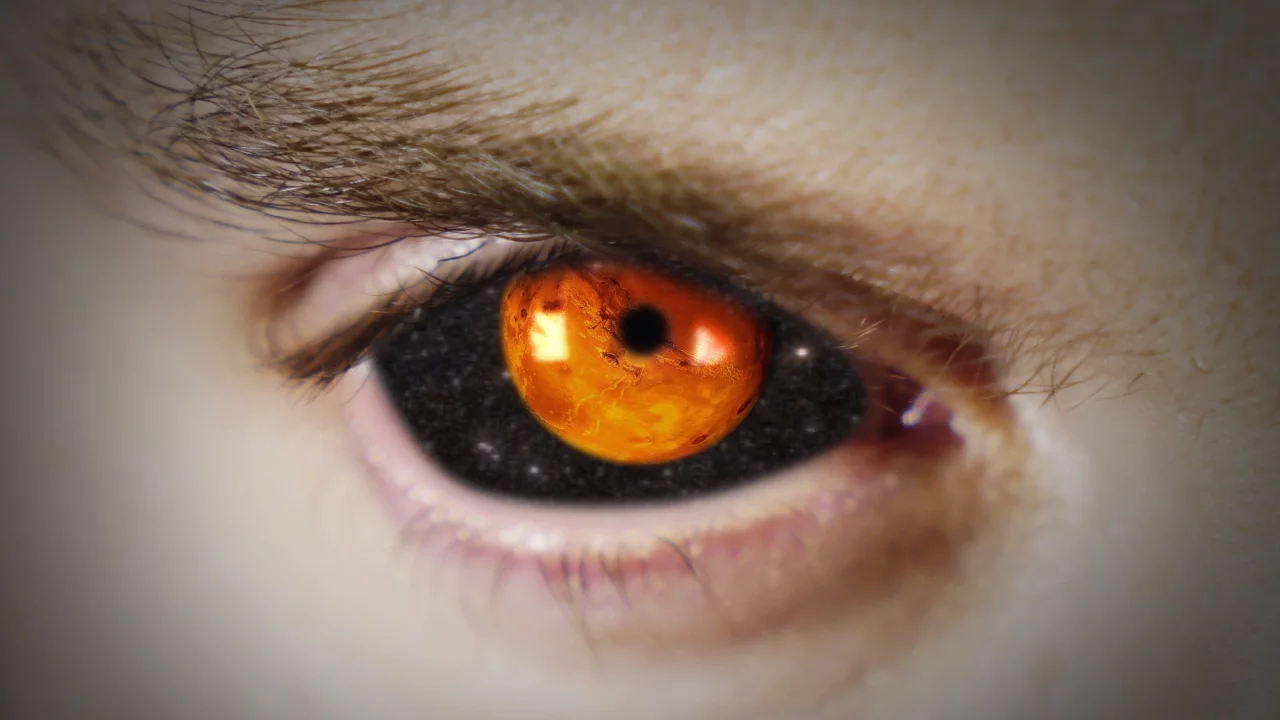
So basically when we finally found something blue it was like….”THIS SEEMS IMPORTANT.” Like my eyeballs.
Blue eyes have only existed for about 7,000 years and were traced to a common ancestor in Spain.
Today, people with blue eyes only represent about 8% of the population.
So on this blue marble called Earth, there’s not really much blue anywhere.
Except the entire sky.
I think.
Classical Arabic and Persian poetry frequently refer to the sky as “the green” and up until about the 13th century, the sky was primarily considered white because of its association with light during daytime.
And yeah, the sky and water are often blue but not always.
On overcast days the sky can be white or gray, and at night it’s black.
Water can look gray, green, or have no color at all.
Water was often green on maps and wasn’t established as blue until the 17th century.
Green and blue are separated by only 35 nanometers on the visible light spectrum, making them even closer than violet and indigo.
The thing is… in languages ranging from Old Irish to Japanese, green and blue were just one word.
It’s tough to imagine lumping together blue and green, but you probably lump together goluboy and siniy.
In Russia, light blue and dark blue are known as goluboy and siniy respectively and a 2006 study found that Russian speakers were faster at discriminating two separate colors when shown blues that fell into their linguistic category.
English speakers, who really only have one word for blue, showed no advantage.
When you don’t have different words to distinguish shades, blue is just blue -- it’s really hard to categorize a difference quickly.
But not only were green and blue once one color - for a while there were actually only three colors.
Black, white, and red were the first recognized colors in virtually every civilization.
Here’s why.
Black and white come from dark and light.
Red comes from poisonous fruits and from blood spilled during hunting, battle or injury, and also represents the fertility associated with menstruation.
The deeply-rooted impact of the Black/White/Red three-color system can been seen in Snow White, a story that has existed cross-culturally in multiple forms for hundreds of years.
Snow White with lips as red as blood and hair as black as ebony wood.
And when her evil stepmother tries to poison her with a red apple, she tries to convince Snow White it’s not poisoned so she eats the apple with her but the stepmother eats the white part which is not poisoned and makes Snow White eat the red part which is poisoned.
The colors are important is what I’m trying to say.
Humans have always observed other colors, but we just compartmentalized them into black, white and red.
Yellow was associated with white, and green, blue and violet were linked with black.
Eventually yellow and green became unique colors in their own right -- there’s plenty of both in nature -- but still no one was talking about blue.
Early languages like Greek, Hebrew, and Chinese had no specific word for blue.
The words they used to represent colors weren’t necessarily describing an exact hue, but instead could reflect brightness or even quality.
So, a better translation for green might be “pale” and white might be “shining.” You hear that, Doctor Resnick?
I’m not vitamin D deficient.
I’m shining.
Hey, how about you give us a specific example of blue missing from the past?
Okay.
A famous 1858 study by William Gladstone showed that Homer’s The Odyssey mentions black 200 times, white around 100, red less than 15, yellow and green under 10, and blue a whopping zero times.
The Greeks did have a word -- glaukós -- that could mean light blue, but glaukós was more about describing the feeling of a color and could also mean gray, yellow or brown.
And the Hebrew tekhelét described a colorant which came from a mollusk that could be used to dye garments blue or violet.
When we did develop words for blue they were rooted in materials rather than the abstract concept of color.
The Egyptians had a word for their blue pigment: irtiu, the first synthetic pigment ever created.
But after the fall of Rome, the complicated process of making Egyptian blue was lost -- along with the Romans’ word for it, caeruleum.
Since the Latin lexicon had a gap for blue, the most common modern words for blue derive from German and Arabic, both of whom made and traded blue.
In the 13th century, woad began being produced on a large scale for dying clothes.
Making blue from yellow flowers for the masses influenced the culture’s need for a word to describe that color.
That word was blau.
The word Azure comes from the Arabic lazaward, which was used to describe cobalt oxide blue glass and ceramics as well as lapis lazuli.
The deep blue metamorphic rock was mined from a single mountain range in Afghanistan, the Sar-i Sang or “The Valley Of The Stone.” After about 3,000 years we finally figured out how to extract just the magnificent blue to create a pigment called ultramarine.
Ultramarine was the first truly vibrant blue pigment in the world and was extremely rare and expensive — blue became more valuable than gold.
Painters reserved it for only the most important subjects like the Virgin Mary’s robe.
But only the rich “blue bloods” could possibly afford ultramarine.
It took an accident with red blood to bring blue to the world.
A pigment maker named Diesbach was trying to create a popular red out of cochineal, an insect still used for red dye in everything from lipstick to ketchup.
He added iron sulfate mixed with potash which we later discovered has a useful element now called potassium.
Anyway, the potash he used was contaminated with animal blood, which contains iron, and rather than creating red, he accidentally invented an affordable, long-lasting true blue.
When it came to making red pigment… he really blue it.
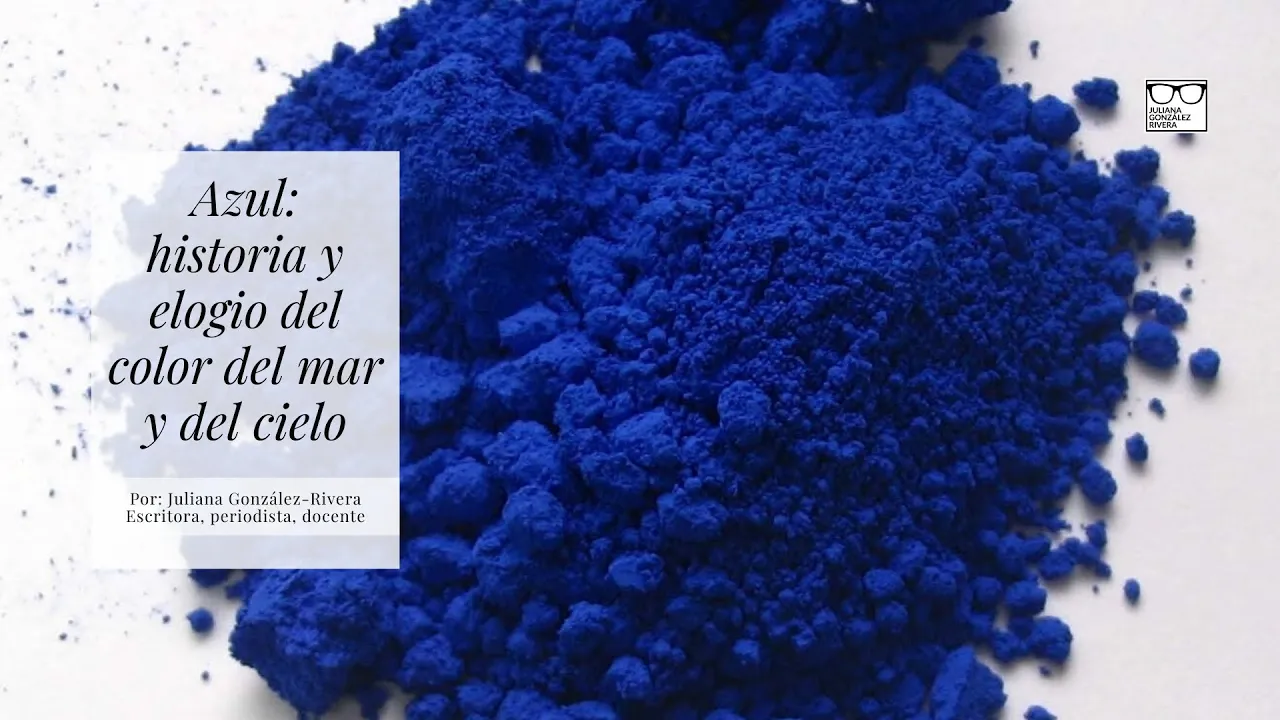
Named Prussian Blue after its use as a dye for Prussian army uniforms, its popularity went global.
It reinvigorated Japanese woodblock paintings, which went on to influence manga, which led to Japanese animation.
And it also revolutionized architecture.
In 1842, English astronomer Sir John Herschel used Prussian blue to invent blueprints, eliminating the need for architectural drawings to be arduously hand-copied.
So you can thank blue for Dragon Ball Z and buildings.
But clothing is where blue cemented its use in everyday life.
Black gave way to blue as the color of choice for uniforms from sailors and guards to police officers and postal workers.
The working class became “blue collar.” And the explosive popularity of rugged denim jeans brought blue to everyone.
It’s impossible to understate how quickly our modern world exploded with color.
It was only 350 years ago that Sir Isaac Newton changed the world when experiments with prisms led him to divide the visible spectrum into five colors: red, yellow, green, blue and violet.
He later added orange and indigo simply because he wanted the number of colors to align with the ancient Greek belief in the power of the number seven.
Seven notes in a musical scale, seven known planets, seven days in a week.
Four centuries later, you have a telephone in your pocket that displays over 16.7 million colors with clearly defined hex codes so I know that the specific blues for Vsauce2 are #3399ff and #0066cc.
And now blue - a color with no name for most of existence - is the most popular color in the world.
We invented the color of our planet and it’s changed how we see life.
Norwegian Painter Edvard Munch had a perceptual phenomenon known as synesthesia which causes sensory and cognitive signals to cross -- and it led him to see emotions as colors.
He said, "In my art, I attempt to explain life and its meaning to myself.” And while The Scream remains his most legendary work, Munch’s painting Starry Night represents how human perception colors our reality.
Having just lost his first love, Munch painted the view from his hotel room in Oslo.
Tapping into his synesthesia to express this once-in-a-lifetime feeling, the entire landscape is bathed in the color of a bruised heart, the color of transcendence beyond the ordinary, the color blue.
Describing the painting, he said, “… a landscape will alter according to the mood of the person who sees it.” But the invention of blue didn’t just alter the landscape - it allowed us to advance from simply observing our surroundings to finally seeing our world.
Which means the question, “why is the sky blue?” actually has two answers.
The first is that the shorter, smaller blue light waves from the sun scatter when they hit molecules in our atmosphere.
The second is… we found blue.
And as always - thanks for watching.
Hey if you want to learn more about yourself then click here to watch my previous video, Scapegoats.
For this video I want to thank Joshua, Trevor Something, Kidmograph, Victoria and Virginia all for their help.
Now the new Curiosity Box just arrived this is the new T-shirt but what I really want to talk about is this.
Say hello to Nikola Tesloth.
The first in our brand new pin series, Curious Creatures.
Which is a mashup of some of the most curious humans of all time with some of the awesomest creatures of all time.
On the back you get to see a brief biography of Nikola Tesloth.
And this is the first of many to come.
So starting now, each Curiosity Box will include another Curious Creature.
So if you subscribe now you get to start your collection from number one.
As always a portion of the proceeds from The Curiosity Box goes to Alzheimer's research.
So thanks for supporting all of our brains, thanks for supporting your brain and thanks for supporting Vsauce.
Up Next

2:37
Art Fraud Detection: Titanium White Reveals Museum Masterpiece Fake
@WickSteam
206.9K views•2026-04-03

12:54
Triumph of Orthodoxy Icon: Byzantine Art & History Explained
@BenCallan
2.1K views•2024-08-06
11:42
Psychology of Isolation in Simulated Mars Missions
@Vsauce2
2.3M views•2016-11-10

1:42
Game of Thrones Opening Credits: A Cinematic Analysis
@gameofthrones
46.3M views•2011-04-18
Related Study Plans & Knowledge Roadmaps
Structured learning paths in General & Interdisciplinary Studies
general-studies
Elevator Engineering: History, Physics & Cities
01From Hoists to Safety Brakes: The Dawn of Vertical Lift
02Hydraulic vs. Traction: The Engineering Physics of Elevators
03Modern Speed, Safety, and Algorithms
+ 2 more learning modules
12h5 modules
Explore Roadmap
general-studies
Rubber: Material Science, History & Geopolitics
01Origins of Natural Rubber & Mesoamerican History
02The Chemistry of Natural Rubber & Vulcanization
03The Geopolitics of the Rubber Boom & Colonization
+ 2 more learning modules
12h5 modules
Explore Roadmap
general-studies
Containerization: Evolution, Logistics & Trade
01Ancient Trade & Bulk Cargo: Amphorae to Barrels
02The Industrial Revolution & Cardboard Packaging
03The Containerization Revolution: Malcom McLean
+ 2 more learning modules
12h5 modules
Explore Roadmap
general-studies
Textile Tech: Evolution, Labor & Global Impact
01Pre-Industrial Textiles: Handloom & Cottage Industry
02Mechanization: The Spinning Jenny to the Power Loom
03The Factory System & Global Labor Transformation
+ 2 more learning modules
10h5 modules
Explore Roadmap