Harry Frankfurt's theory distinguishes between first-order desires (desires about external objects like food, exercise, or entertainment) and second-order desires/volitions (desires about one's own desires), which he uses to defend compatibilism—a position arguing that free will can coexist with determinism by emphasizing that our higher-order desires reflect our authentic self.
Frankfurt's First vs Second Order Desires: Higher-Order Volitions
Added:Deep Dive
The fundamental debate between free will and determinism, including the core concepts of causal determinism.
Determinism in Philosophy - Correctly Understanding the Determinism vs Free Will Argument
17.7K
The free will versus determinism debate is one of philosophy's most important and confusing questions. Many experts misunderstand the semantics of what free will and determinism actually mean. Causal determinism states that prior states completely determine subsequent events, while predeterminism claims all events are determined far in advance. Free will is defined as the ability to choose between different courses of action unimpeded, including the capacity to choose otherwise and being the source of one's actions. Theories range from incompatibilism (free will and determinism cannot coexist) to compatibilism (they can coexist). Understanding these definitions is essential before attempting to resolve the debate.
Click to watch →

VF-. Necessarius, necesitarismo. Fatum, fatalismo. Determinismo, liberum arbitrium
129
This section presents the core conflict between determinism and free will. Determinism is a form of necessitarianism that identifies necessity with causal determination, affirming that everything is caused and effects necessarily follow from causes. It applies the universal quantifier 'todo' (all) without exception, meaning absolutely nothing exists that is uncaused. For human beings, this means each person is what they are due to causal chains - physical characteristics, psychological traits, and behaviors all have causes such as genetics, education, environment, and upbringing. Free will (liberum arbitrium), as defined by Luis de Molina, is a faculty that can choose to act or not act even when all conditions are presupposed. Free will operates without any reason or cause - it is absolutely autonomous. This creates a fundamental conflict: if everything is causally determined, free will cannot exist; if free will exists, determinism must be false.
Click to watch →

Free Will and Determinism
160
This section establishes the foundational concepts of the free will debate. Free will is defined as the ability to choose one's future actions and take control over what one does. Determinism is defined as the thesis that at every moment, the way things then are determines a unique future, meaning only one of the alternative futures relative to a given moment is physically possible. The three main positions are introduced: incompatibilism (free will and determinism are incompatible), hard determinism (determinism is true and free will does not exist), libertarianism (free will exists and determinism is false), and compatibilism (free will is compatible with determinism).
Click to watch →

Do We Actually Have Free Will?
177
Causal determinism is the philosophical theory that every event has been caused by a preceding event, creating an unbroken chain of causes and effects. This means the universe operates like dominoes falling in sequence, where each moment follows inevitably from the one before it. The theory extends beyond physical events to human decisions, thoughts, and experiences. If every cause leads to an effect, then there was only ever one possible future—not because it was destined, but because each moment follows inevitably from the previous one. This challenges our intuitive sense of free will by suggesting that if all factors leading to a decision had remained exactly the same, no different decision could have emerged.
Click to watch →
Debating Free Will with a Cambridge Philosopher | Dr. Nathan Hawkins
2.3K
The free will debate centers on three main positions: (1) Hard incompatibilism denies free will entirely, arguing the concept is incoherent; (2) Libertarianism holds we have free will as the source of actions with genuine alternative possibilities; (3) Compatibilism maintains free will involves alignment between actions and desires without requiring alternative possibilities. Hard incompatibilism argues free will requires both that we could have done otherwise and that actions flowed from prior causes, which are seen as incoherent requirements. Causal determinism faces a self-defeating problem: if everything is causally determined, then our belief in determinism itself would be merely caused and not rationally justified. Frege's distinction between how people in fact think and how they ought to think is essential for recognizing valid reasoning versus invalid reasoning. Arguments for causal determinism rely on hidden assumptions about time and causation. The Lapslace's demon assumes the future is open while the past is fixed, which is not necessarily true. Physics provides mathematical relationships that don't necessarily involve causation in the ordinary sense. There are fundamentally different kinds of causation: mathematical explanations are abstract and indexical-free, while experimental sciences involve causation understood in terms of manipulation and intervention. Collingwood argued that causal reasoning is always tied to what could have been done differently and what is manipulable by us.
Click to watch →
Deep Dive
The basic thesis of compatibilism: the philosophical position that free will and determinism can logically coexist.
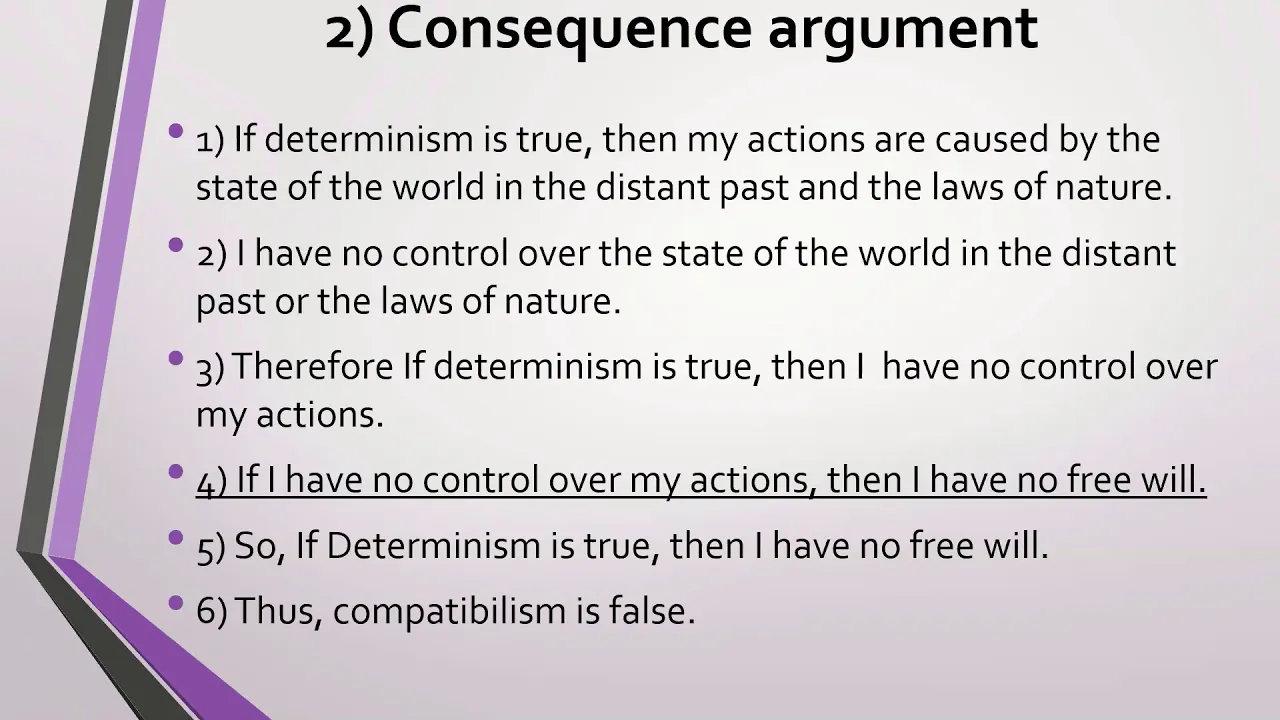
W.T. Stace Part 2: Criticisms of Basic Compatibilism
999
Basic compatibilism, which claims that freedom and determinism are compatible because free actions are those caused by internal psychological states, faces significant criticisms: (1) It fails to account for the essential element of options in making free choices, as demonstrated by counterexamples where actions caused by internal psychological states (like stealing due to fear of beating) are intuitively unfree; (2) The consequence argument shows that if determinism is true, our psychological states are themselves determined by factors beyond our control, meaning we never truly have the ability to do otherwise; (3) The argument from deliberation reveals that compatibilists hold inconsistent beliefs, believing both that determinism is true (which eliminates alternatives) and that determinism is false (since deliberation requires believing alternatives exist).
Click to watch →

Ерен НЕ має свободи вибору? | Відео, яке переверне твоє уявлення про Атаку титанів
81.3K
Compatibilism is the philosophical view that free will and moral responsibility are compatible with determinism. While determinism states that all events are predetermined, compatibilism argues that people can still make choices and be held responsible for them. The key insight is that while people may not be able to choose what they want to want, they can still choose to act on those desires. This means that even in a deterministic universe, people can be said to have free will in the sense that they act according to their own motivations. The video explains that when someone predicts rain or sunshine, they are not claiming that multiple futures are possible, but rather that they do not know which single future will occur.
Click to watch →
Compatibilism Explained: Free Will in a Deterministic World
1.7M
Compatibilism is a philosophical position that accepts determinism (the idea that all events are caused by prior events) while maintaining that human actions can still be considered free. According to this view, an action is free when it is self-determined—caused by internal factors within the agent themselves rather than external forces. The key distinction is between being pushed off a diving board (externally caused) versus jumping off (self-caused), where both result in the same outcome but differ in the source of causation.
Click to watch →
What is Compatibilism? (Free Will)
16.2K
Compatibilism addresses the philosophical challenge of reconciling free will with a deterministic universe. The free will trilemma presents three premises that cannot all be true: the universe follows deterministic laws, free will requires the ability to do otherwise, and free will exists. Compatibilism resolves this by denying the second premise—free will does not require the ability to do otherwise. Instead, it redefines freedom as the ability to act according to one's desires without external impediment. This position maintains both that the universe operates deterministically and that meaningful free will exists, offering a practical solution to preserve both scientific understanding and ethical responsibility.
Click to watch →

Jerry Walls: What's Wrong With Calvinism, Part 1
212.5K
Compatibilism, also called soft determinism, holds that there is no logical inconsistency between freedom and determinism. Freedom and responsibility are compatible with total determinism. According to this view, a free act is not caused by anything external to the agent (like being forced against one's will), but is caused by internal psychological states such as beliefs and desires. Once you have these internal states, you cannot act otherwise given those states, but you are still doing what you want to do because you're acting out of your own feelings, thoughts, wishes, and desires. Additionally, if you had wanted to act differently, you could have done so. This allows for genuine freedom within a deterministic framework.
Click to watch →
Deep Dive
Basic concepts of action theory and philosophical psychology, specifically how 'desires' and 'beliefs' motivate human agency.

Kevin Kinghorn Christian Philosopher Faith in God
2.4K
Following Hume's framework, desires always do the motivating, while beliefs guide our actions. When desires conflict with the world, we are motivated to change the world to make it fit with our desires rather than changing our desires to fit the world. For example, the desire to get to Cincinnati motivates the action, while the belief that I-75 goes north guides which route is chosen. This distinction is important because it shows that beliefs explain why we take certain actions in attempts to achieve our desires, but desires themselves are what provide the motivation.
Click to watch →
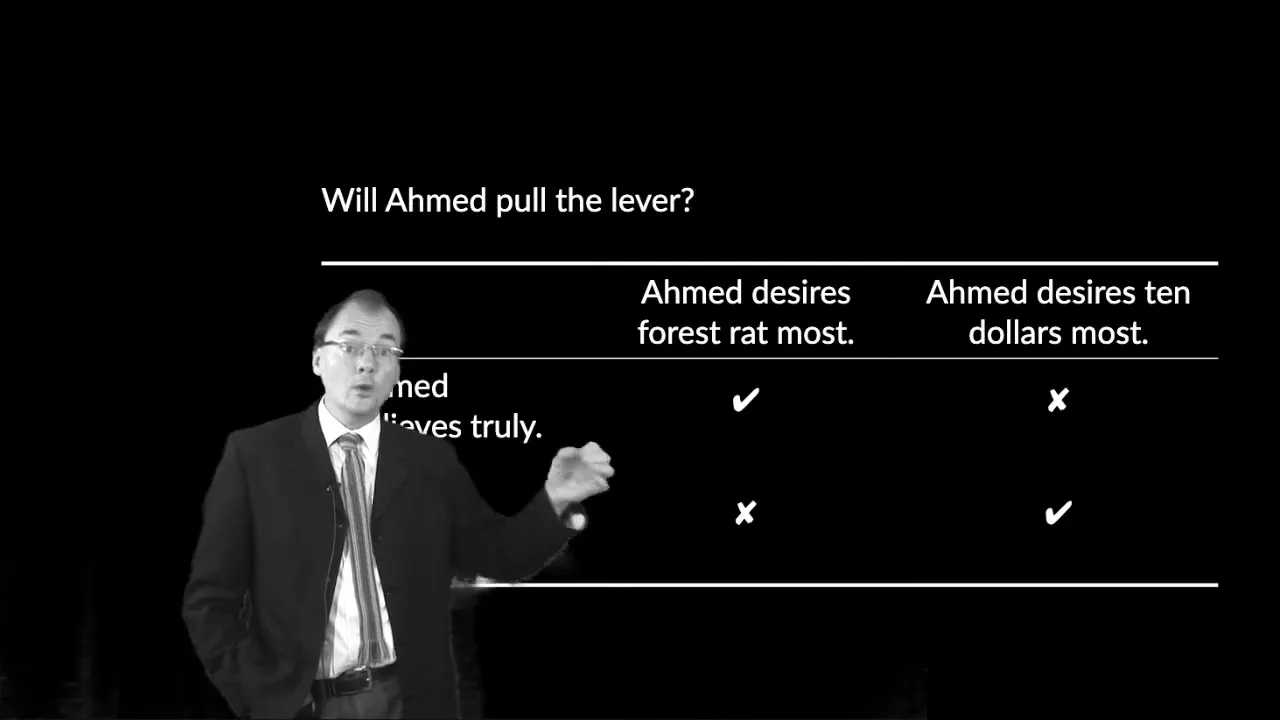
Causes of Action: Belief and Desire
182
According to the causal theory of action, a person's actions are determined by two essential factors: their beliefs about what different actions will cause, and their desires regarding the outcomes of those actions; thus, to predict what a person will do, one must know both what they believe about the consequences of available actions and what they desire most.
Click to watch →

When Desire and Belief Engage Action; Jim Class Series
109
Belief-desire psychology explains that all actions result from the interaction between desires and beliefs. Action occurs when desire collides with instrumental belief about satisfying it. Both are necessary conditions. Desires create a continuous stream that provides life direction and meaning. The paradox is we cannot recall a time without desire, yet remain unconscious of our desires until they conflict. James teaches that desires give birth to sin, which brings death. Understanding desires requires observing behavior, as desires are already formed within us before we recognize them.
Click to watch →

Post-Truth Politics - Epistemology Video 35
2.5K
The belief-desire model of action is a philosophical framework explaining how actions are motivated. According to this model, an action occurs when a person has a desire (what they want) and a belief (what they think will satisfy that desire), and these two mental states combine to produce action. For example, if someone desires a drink and believes that getting water from the tap will satisfy that desire, they will take the action of walking to the tap and drinking.
Click to watch →

Chat with Lance Bush about Moral Realism
1.4K
On a desire-based account of action, all voluntary behavior is ultimately driven by desires. When we act, we are following the desire that has been most strongly activated in us at that moment. The speaker argues that this is the most straightforward account of human action and that attempts to distinguish between 'belief-motivated' and 'desire-motivated' action may conflate different aspects of the same psychological process.
Click to watch →
Deep Dive
Classical compatibilist definitions of freedom, such as Thomas Hobbes' or David Hume's view of freedom as merely the absence of external constraints.

7.2 Different Concepts of Freedom
44.4K
This lecture distinguishes three distinct concepts of freedom: (1) contracausal libertarian freedom (non-causal freedom opposed to determinism), (2) intentional agency (the capacity to act according to one's will, which Hume identified as essential for moral responsibility), and (3) absence of unwelcome restrictions (freedom from coercion, compulsion, or political influences). The compatibilist position, exemplified by Hobbes, argues that freedom properly defined as the absence of external opposition is entirely compatible with determinism, while the contrastive argument challenges incompatibilists by asserting that we distinguish free acts from unfree acts based on whether someone was coerced or constrained, not whether the act was caused or uncaused.
Click to watch →
What is Compatibilism? (Free Will)
16.2K
Three major versions of compatibilism offer distinct definitions of free will. Classical compatibilism (Hobbes) defines freedom simply as the ability to do what one wants without impediment—if you can achieve your desires without obstruction, you're free. Frankfurt's hierarchical compatibilism challenges this by introducing second-order desires: for an action to be free, your immediate desires must align with your deeper volitions about what kind of person you want to be. This is illustrated through Frankfurt's thought experiment where Jones freely chooses to stab Taylor despite lacking the ability to do otherwise, showing that the ability to do otherwise is insufficient for free will.
Click to watch →

Ph от ВШЭ #6.1 Свобода воли ч.1 Как свобода становится проблемой - Основы философии
501
Thomas Hobbes, a compatibilist, accepted determinism that all human actions are caused by external factors. However, he distinguished voluntary from involuntary actions. A voluntary action follows from a person's desire, which constitutes their will. Freedom consists in the absence of external impediments to action. If there are no obstacles in the nature of the acting subject's internal qualities, and the action follows from their desire, then the action is free. The key is what the action is determined by, not whether it is determined.
Click to watch →

Free Will - General Philosophy (Peter Millican)
9.9K
Compatibilists argue free will and determinism are compatible by redefining freedom. Thomas Hobbes defined freedom as the absence of external opposition—being able to do what one wills. A.J. Ayer's contrastive argument shifts focus from caused vs. uncaused actions to coerced vs. uncoerced actions. Three distinct concepts of freedom operate: contra-causal freedom (libertarian), intentional agency (acting according to one's will), and absence of unwelcome restrictions (coercion-free). Ordinary language typically refers to the third, while morality depends on the second. Frankfurt distinguished first-order desires (for actions) from second-order desires (about one's desires), enabling compatibilists to distinguish degrees of freedom within determinism.
Click to watch →

2.2 Introduction to Thomas Hobbes
108.8K
Thomas Hobbes (1588-1679), an English philosopher known as the 'monster of Malmsbury,' developed a radical materialist philosophy asserting that only physical matter exists and that everything operates according to deterministic physical laws; he famously argued that human nature in its natural state leads to a 'war of all against all,' making absolute sovereignty the only solution to prevent civil conflict, and he pioneered compatibilism by defining freedom as the absence of external impediments rather than the ability to choose between alternatives.
Click to watch →
Prerequisite Knowledge
- Concept 01The fundamental debate between free will and determinism, including the core concepts of causal determinism.
- Concept 02The basic thesis of compatibilism: the philosophical position that free will and determinism can logically coexist.
- Concept 03Basic concepts of action theory and philosophical psychology, specifically how 'desires' and 'beliefs' motivate human agency.
- Concept 04Classical compatibilist definitions of freedom, such as Thomas Hobbes' or David Hume's view of freedom as merely the absence of external constraints.
Subsequent Learning
- Step 01Frankfurt's distinction between a 'Person' and a 'Wanton' (an agent who acts on first-order desires without reflecting on them).
- Step 02Frankfurt-Style Cases (FSCs) and their challenge to the Principle of Alternate Possibilities (PAP) in theories of moral responsibility.
- Step 03Major criticisms of the hierarchical model, such as Gary Watson's critique and the problem of infinite regress (e.g., why not third- or fourth-order desires?).
- Step 04Practical applications of Frankfurt's framework to the philosophy of addiction, specifically analyzing the willing versus the unwilling addict.
- Step 05Alternative contemporary compatibilist frameworks, such as Susan Wolf's 'Reason View' or John Martin Fischer's guidance control.
First vs. Second
Higher-order Desires
First vs. Second
0:00Playing Section
- 1
Defines first-order desires as wants for tangible objects like cake or movies.
- 2
Introduces higher-order desires, which are wants about other desires.
Gary Watson's Valuational Account and the Regress Objection
Philosopher Gary Watson presents a major critique of Harry Frankfurt’s hierarchical model, identifying what is known as the 'regress' or 'authority' problem. Watson argues that simply having a higher-order desire (such as a second-order volition) does not automatically give it authority or make it speak for the agent's 'true self.' If a second-order desire is just another desire, we would logically require a third-order desire to validate it, leading to an infinite regress. To resolve this, Watson proposes an alternative compatibilist theory that distinguishes between an agent's 'motivational system' (what they desire) and their 'valuational system' (their rational judgments about what is good or valuable). According to Watson, free agency is achieved not by aligning desires hierarchically, but when an agent's motivational system aligns with their valuational system. This shifts the focus of free will from Frankfurt's purely desire-driven, psychological harmony to a framework of rational evaluation and moral judgment.
Deep Dive
Frankfurt's distinction between a 'Person' and a 'Wanton' (an agent who acts on first-order desires without reflecting on them).

Harry Frankfurt on Free Will and Concept of a Person Part 1
6.5K
Frankfurt distinguishes persons from wantons based on second order volitions—the will to want certain desires to be effective. A wanton has rational faculties but lacks reflection on which desires they want to have; they're simply ambivalent toward their first order desires. Young children and most animals are wantons. An unwilling addict has conflicting second order desires but isn't a wanton. Frankfurt crucially distinguishes acting freely from having free will: one can act freely without having free will (like an unwilling addict taking drugs), and vice versa. This distinction resolves weaknesses in traditional literature and clarifies that moral responsibility depends on the structure of the will, not just external constraints.
Click to watch →

Harry Frankfurt: "Freedom of the Will and the Concept of a Person"
7.4K
Frankfurt traces personhood to Locke's definition of self-conscious beings capable of moral assessment. Personhood shouldn't be tied to biological species—aliens could be persons if they have the right capacities. Frankfurt distinguishes first-order desires (desires to perform actions) from second-order desires (desires about one's own desires). Volition is a specific type of second-order desire: wanting a particular first-order desire to become effective (become your will). Wantons are beings that lack volitions—they can have desires but lack desires about which desires should become effective. Small children and addicts exemplify wantons. Persons are beings who have volitions—they reflectively evaluate and organize their desires, wanting certain desires to drive their actions. This reflective capacity distinguishes persons from mere creatures moved by desires without reflection, making persons capable of moral agency and true freedom of will.
Click to watch →

The essence of being a person, according to Philosopher Harry Frankfurt (MADE EASY)
7.3K
Philosopher Harry Frankfurt argues that a person is fundamentally defined by their capacity for second-order volition—the ability to want their own desires to be effective in guiding their actions—distinguishing true persons from 'wanton' individuals who lack this reflective self-governance despite having first-order desires and even second-order desires; according to Frankfurt, while reason is necessary for will, it is not sufficient, and the strongest first-order desire typically becomes one's will, but only when accompanied by second-order volition does one achieve genuine personhood.
Click to watch →

"Freedom of Will and the Concept of a Person" by Frankfurt | Plato's Cave Ep. 35 (Reading Group)
147
Frankfurt develops a comprehensive hierarchical model of human psychology spanning multiple levels of desire. First-order desires are straightforward wants for objects or actions. Second-order desires are desires about one's own desires - wanting to have or not have certain first-order desires. Crucially, second-order volitions represent a subset of second-order desires where one specifically wants a particular desire to be effective in moving them to action. The will is defined as the effective desire - the desire that actually moves or would move a person to action. Frankfurt introduces the concept of a 'wanton' as an agent who has first-order desires and possibly second-order desires but lacks second-order volitions. The essential characteristic of a wanton is indifference toward their will - their desires move them to act without caring whether those desires are being satisfied or whether other desires should take precedence. Frankfurt argues that while it is logically possible for a wanton to exist, such creatures would not qualify as persons. Adult humans may be more or less wanton at different times, reflecting moments of reduced self-reflection. The distinction between wantons and persons hinges on the capacity for genuine self-evaluation and the ability to endorse particular desires as one's will, establishing clear boundaries for what constitutes authentic personhood.
Click to watch →
Osoby i lekkoduchy
1.5K
According to Harry Frankfurt's influential philosophical analysis, a being qualifies as a 'person' if it can perform acts of second-order volition—specifically, the ability to form desires about one's own desires and to identify which first-order desires should constitute one's will. While all persons possess first-order desires (desires for objects or states), only persons can engage in second-order volition by reflecting on and evaluating their own desires to determine which should guide their actions. This capacity for reflective self-evaluation distinguishes persons from 'wanton beings' who, despite having desires, cannot reflectively choose which desires should determine their behavior.
Click to watch →
Deep Dive
Frankfurt-Style Cases (FSCs) and their challenge to the Principle of Alternate Possibilities (PAP) in theories of moral responsibility.

Divine Foreknowledge and Human Freedom | Dr. Taylor Cyr and Sean Clements
2.8K
This section presents an alternative approach to the free will debate through compatibilism and Frankfurt style cases. Frankfurt style cases challenge the Principle of Alternate Possibilities (PAP)—the view that moral responsibility requires the ability to do otherwise. In classic examples, agents are prevented from exercising alternative possibilities yet remain morally responsible. These cases motivate compatibilist views suggesting that what matters for responsibility is the causal history of one's actions rather than the presence of alternative possibilities. This provides an alternative framework for understanding freedom that does not require rejecting divine foreknowledge, offering a semi-compatibilist position that accepts theological fatalism while preserving meaningful moral responsibility.
Click to watch →
![【哲學讀書會】別無選擇也要負責?|《另類可能性與道德責任》[美]Harry Frankfurt (Alternate Possibilities and Moral Responsibility)](https://i.ytimg.com/vi_webp/J6YbRlmNSfY/maxresdefault.webp)
【哲學讀書會】別無選擇也要負責?|《另類可能性與道德責任》[美]Harry Frankfurt (Alternate Possibilities and Moral Responsibility)
183
The Principle of Alternative Possibilities (PAP) states that moral responsibility requires the ability to have done otherwise. This is considered a fundamental moral intuition. However, Harry Frankfurt challenges this principle, arguing that moral responsibility depends on whether actions stem from one's own will, not on whether alternative actions were possible. Frankfurt presents four hypothetical cases: Jones 1 (strong-willed robber) and Jones 3 (robber whose threatened action aligns with their desires) are morally responsible because their actions stem from their own will. Jones 2 (robber acting purely from fear) is not responsible because external coercion completely determined their action. Jones 4 (robber with an implanted chip that would force them to rob if they hesitated) is still responsible because the chip never actually intervened—their action was driven by their own motivations. These cases demonstrate that moral responsibility depends on internal motivation, not on whether alternative actions were physically possible.
Click to watch →

Accounts of moral responsibility or Conditions for holding someone morally accountable
229
This section presents Harry Frankfurt's influential challenge to the Principle of Alternative Possibilities through his famous Frankfurt Style Examples. The video explains the voting scenario where Jones votes Republican either on his own initiative or because Black intervenes to ensure he does so. Frankfurt argues that in cases where Jones acts freely without intervention, he remains morally responsible even though he couldn't have done otherwise. This challenges the PAP by showing that moral responsibility might not require alternative possibilities. Frankfurt responds to this challenge by developing a hierarchical model of desires, distinguishing first-order desires (motivating actions) from second-order desires (about what desires one should have). He argues that when there is conformity between these desire levels, moral responsibility exists without requiring the ability to do otherwise.
Click to watch →

Episode 51: Flickers of Freedom with Bradford Stockdale
300
The Principle of Alternative Possibilities (PAP) asserts that moral responsibility requires the ability to do otherwise. Frankfurt cases challenge this by presenting scenarios where agents cannot do otherwise yet remain morally responsible. In the classic example, Jones plans to assassinate a prime minister while Green implants a device that forces Jones to shoot if Jones shows any inclination not to. Since Jones decides on his own to shoot, he seems blameworthy despite lacking alternative possibilities. This challenges compatibilism, as deterministic worlds would seem to preclude moral responsibility if PAP is true.
Click to watch →
The Philosophy of Harry Frankfurt
2.7K
Frankfurt challenged the Principle of Alternate Possibilities (PAP)—the view that moral responsibility requires the ability to do otherwise. Through thought experiments involving neuroscientists implanting chips that can override decisions, he demonstrated that people can be morally responsible even without alternative possibilities. This supports compatibilism—the view that free will and moral responsibility exist even under determinism. However, critics argue Frankfurt's examples rely on intuitive judgments that don't provide independent justification for moral responsibility if determinism is true.
Click to watch →
Deep Dive
Major criticisms of the hierarchical model, such as Gary Watson's critique and the problem of infinite regress (e.g., why not third- or fourth-order desires?).

Rationality Rules Stephen Wordfurd makes many mistakes trying to debunk Aquinas
319
Phayer includes the infinite regress within his argument, specifically in premise 11 of his 49 premises. This has nothing to do with going back in time—Aristotle and Phayer have no problem with an infinite regress going back in time. The problem is with hierarchical infinite regress. It is an unfounded assumption to claim that a mirror can reflect a dog if there is no dog to reflect. Adding infinite mirrors doesn't magically give the infinite set of mirrors the power to reflect a dog that doesn't exist. Saying A exists because of B doesn't explain how A or B exist at all.
Click to watch →

LA RÈGLE DES RÈGLES - Grain de philo #14 (Ep.6)
113.6K
This section presents the solution to the regress problem through the distinction between object language and metalanguage. Rules of inference like Modus Ponens belong to the metalanguage and cannot be expressed within the formal system itself. The video demonstrates this by showing how specifying rules requires moving to a higher-level metalanguage, which in turn requires its own metalanguage, creating an infinite hierarchy. This hierarchical structure reveals that formal systems ultimately depend on natural language for their definition, and that no purely formal system exists independent of interpretive frameworks.
Click to watch →

The Problem with Frames: Metaphysics, Ethics, and Agency (with Darius Parvizi-Wayne and Tim Jackson)
948
Active inference employs hierarchical motivated control, where policies are determined by precision-weighted preferences. Precision is the inverse variance of a probability distribution, representing the priority given to signals or beliefs. The problem is that precision weighting requires another policy, which requires another set of highly weighted preferences, leading to an infinite regress. This mirrors Aristotle's notion of unmoved movers and Whitehead's primordial nature of God, which serves as a ground norm that sets in place the precision weighting scheme.
Click to watch →
Aristotle's Nicomachean Ethics - Book I
223.4K
Aristotle argues that if everything we desire is only desired for the sake of something else, then our desires would go on infinitely without ever reaching an endpoint. This would make our desires empty and vain because there would be no final thing we actually want for its own sake. Therefore, there must exist at least one thing that we desire for its own sake, which serves as the ultimate end of all our desires.
Click to watch →

Tema 5. LA MEMORIA SEMÁNTICA
3.9K
The hierarchical network model faced criticism. Lichtenstein and colleagues introduced semantic distance, showing response time depends on word association frequency rather than hierarchical position. Collins and Quillian modified their model in 1975 to incorporate semantic distance and allow properties to be repeated at multiple nodes.
Click to watch →
Deep Dive
Practical applications of Frankfurt's framework to the philosophy of addiction, specifically analyzing the willing versus the unwilling addict.
Harry Frankfurt and Free Will | Philosophy for the People
653
Frankfurt proposes that what matters for moral responsibility is whether our actions align with our higher-order desires (desires about our first-order desires). Using addiction as an example: an unwilling addict neither wants to quit nor doesn't want to quit—they just act on impulses; a willing addict wants to quit but can't; a willing addict who decides to continue using has higher-order desires that align with their actions. Frankfurt argues that willing addicts are morally responsible despite lacking the ability to do otherwise.
Click to watch →
Harry Frankfurt on Free Will and Concept of a Person Part 1
6.5K
Frankfurt contrasts two types of addicts to illustrate his theory. An unwilling addict has a first order desire to take drugs that conflicts with their second order desire not to take drugs. Despite identifying with the second order volition (not wanting to be an addict), they continue acting on the first order desire. A wanton, by contrast, is ambivalent toward their first order desires—they don't care whether they have desires for drugs or not. Both lack full personhood, but for different reasons: the unwilling addict has conflicting second order desires, while the wanton lacks any preference regarding their first order desires.
Click to watch →
Personhood: The MOST important question of Morality?
704
Frankfurt uses three addict types to illustrate his theory: (1) The unwilling addict possesses both a first order desire to take drugs and a second order desire to refrain, yet fails to act on the latter; he is still a person because he wants his will to be constituted by his second order desire. (2) The wanton addict follows impulses without caring what constitutes his will; despite potential intelligence, he lacks second order volitions and is not a person. (3) The willing addict possesses both first order desires and a second order volition to continue using drugs; though not free (corrupted by addiction), he remains a person and thus morally responsible due to possessing second order volitions.
Click to watch →
Harry Frankfurt: "Freedom of the Will and the Concept of a Person"
7.4K
Frankfurt distinguishes his concept of freedom of will from what others mean when discussing free will. Most people mean the ability to have had a different volition (could-have-done-otherwise), but Frankfurt's account doesn't require this—it only requires your actual volition is satisfied. This distinction matters because Frankfurt's account is entirely compatible with determinism. Using the willing addict example: someone whose addiction is so strong they would take drugs regardless of their volition. Despite being unable to do otherwise, they are morally responsible because they acted according to their volition. We should assess agents according to their volitions, not just their actions. Frankfurt acknowledges potential infinite regress problems with second-order desires but argues meaningful freedom requires at least second-order volitions. Without resolving conflicts in second-order desires, an agent has no clear preference about which first-order desire should be effective, thereby lacking freedom of will. Frankfurt's sophisticated compatibilism addresses criticisms that classic compatibilism fails to capture genuine freedom while avoiding libertarian mysteries of undetermined will.
Click to watch →

Power Threat Meaning Framework: An Alternative to Psychiatric Diagnosis –Mary Boyle & Lucy Johnstone
4.1K
The framework applies to addiction by viewing substance use as another threat response—people turn to substances when their lives are desperate and overwhelming and when they don't have other ways of dealing with their pain. Current stories about addiction are unhelpful: the shaming story ('it's your fault, why are you so weak-willed') and the medical story ('it's not your fault at all, it's an illness'). The framework offers a way in between, recognizing addiction as a response to difficult circumstances while acknowledging the effects of addictive substances.
Click to watch →
Deep Dive
Alternative contemporary compatibilist frameworks, such as Susan Wolf's 'Reason View' or John Martin Fischer's guidance control.

Free will and moral responsibility Derk Pereboom
28K
Contemporary compatibilists include John Fischer, who argues that as long as we are rational or responsive to reasons, we will have the sort of free will required for deserved praise and blame. Dana Nelkin and Susan Wolf have also contributed important work on this view. They argue that free will is required for praise but not for blame, presenting an asymmetrical view on the requirements for moral responsibility.
Click to watch →

Ep. 22 - John Martin Fischer: Moral Responsibility & Semi-Compatibilism
1.2K
Semicompatibilism is the philosophical view that causal determinism is compatible with moral responsibility without requiring freedom to do otherwise; instead, moral responsibility requires guidance control, which involves acting from one's own moderately reasons-responsive psychological mechanism, combined with mechanism ownership (the mechanism must be genuinely the agent's own rather than externally manipulated), thereby preserving our status as morally responsible agents regardless of whether determinism is true.
Click to watch →

Susan Wolf: The Reason View of Free Will and Moral Responsibility Part 1
1.7K
The reason view contrasts with two major alternatives: the autonomy view (requiring constant ability to do otherwise) and the deep self view (requiring acting from firmly held desires). Wolf argues these views focus exclusively on metaphysical concerns about control while neglecting the essential capacity to recognize what is truly good. Her counterexample involves a person raised with warped moral reasoning who acts according to their real self but lacks the ability to reason toward truth and goodness, demonstrating that acting from one's real self is insufficient for moral responsibility.
Click to watch →

A Reformed View of Free Will and Moral Responsibility | w/Dr. Michael Preciado - PPP ep. 42
483
Reformed theology is a form of compatibilism that denies the sourcehood condition and the principle of alternate possibilities. Once these are denied, reformed theology enters the realm of compatibilism, where free will and moral responsibility are compatible with determinism. There are multiple compatibilist models available, and reformed theologians are not required to hold to Fischer and Ravizza's guidance control specifically. The goal is to show that reformed theology is compatible with contemporary philosophical discussions of free will and moral responsibility, helping theologians stay current with philosophical developments and effectively engage with contemporary audiences.
Click to watch →
53. John Martin Fischer | Free Will
1.7K
Philosophy is fundamentally about engaging in critical inquiry, questioning everything, and learning the tools for doing so. Semi-compatibilism (source compatibilism) is the view that moral responsibility is compatible with causal determinism. This view holds that moral responsibility does not depend on whether free will in the sense of freedom to choose and do otherwise is compatible with determinism. There are two distinct kinds of freedom: regulative control (freedom to choose or do otherwise) and guidance control (acting freely in the actual sequence). Moral responsibility does not require regulative control but does require guidance control. The consequence argument is a powerful argument for incompatibilism, relying on the fixity of the past and natural laws. Manipulation arguments challenge compatibilism by pointing out no principled difference exists between ordinary causal determination and covert manipulation. Frankfurt cases challenge the view that moral responsibility requires freedom to do otherwise. Reflective equilibrium is a methodological approach where one starts with judgments, intuitions, and reactive attitudes, then develops general criteria that accord well with those judgments. Thought experiments are essential for testing views but must be used carefully.
Click to watch →
First vs. Second
Higher-order Desires
First vs. Second
0:00- 1
Defines first-order desires as wants for tangible objects like cake or movies.
- 2
Introduces higher-order desires, which are wants about other desires.
Gary Watson's Valuational Account and the Regress Objection
Philosopher Gary Watson presents a major critique of Harry Frankfurt’s hierarchical model, identifying what is known as the 'regress' or 'authority' problem. Watson argues that simply having a higher-order desire (such as a second-order volition) does not automatically give it authority or make it speak for the agent's 'true self.' If a second-order desire is just another desire, we would logically require a third-order desire to validate it, leading to an infinite regress. To resolve this, Watson proposes an alternative compatibilist theory that distinguishes between an agent's 'motivational system' (what they desire) and their 'valuational system' (their rational judgments about what is good or valuable). According to Watson, free agency is achieved not by aligning desires hierarchically, but when an agent's motivational system aligns with their valuational system. This shifts the focus of free will from Frankfurt's purely desire-driven, psychological harmony to a framework of rational evaluation and moral judgment.
The fundamental debate between free will and determinism, including the core concepts of causal determinism.
The basic thesis of compatibilism: the philosophical position that free will and determinism can logically coexist.
Basic concepts of action theory and philosophical psychology, specifically how 'desires' and 'beliefs' motivate human agency.
Classical compatibilist definitions of freedom, such as Thomas Hobbes' or David Hume's view of freedom as merely the absence of external constraints.
Frankfurt's distinction between a 'Person' and a 'Wanton' (an agent who acts on first-order desires without reflecting on them).
Frankfurt-Style Cases (FSCs) and their challenge to the Principle of Alternate Possibilities (PAP) in theories of moral responsibility.
Major criticisms of the hierarchical model, such as Gary Watson's critique and the problem of infinite regress (e.g., why not third- or fourth-order desires?).
Practical applications of Frankfurt's framework to the philosophy of addiction, specifically analyzing the willing versus the unwilling addict.
Alternative contemporary compatibilist frameworks, such as Susan Wolf's 'Reason View' or John Martin Fischer's guidance control.
9.2K views287likes3:33@CarneadesOfCyreneOriginal Release: 2021-02-01
welcome back to carnegie.org today we're going to be continuing with our series dumbfounding definitions disney distinctions and diabolical doctrines the series zoning through some of the jargon of philosophy in this video we're going to be looking at first versus second order desires frankfurt's higher order desires or higher order volitions so let's take a look now philosophers sometimes make a distinction between first order desires and second or higher order desires these distinctions are particularly used by harry frankfurt in his defense of compatibilism a position on free will that we're going to be covering in an upcoming series on free will very soon so this is a good primer for some of that stay tuned first order desires are pretty simple their desires about things other than desires so you might have a desire to eat a piece of cake a desire to go to the gym or a desire to watch a new movie all of these desires are first order desires because their object the thing that they are about the thing that you are desiring is something which is not itself another desire cakes gyms and movies are not themselves desires higher order desires sometimes called volitions are desires about other desires specifically second order desires are about first order desires third order desires are about second-order desires and so on and so forth though usually we only mostly talk about first and second-order desires though you can talk about the higher orders for example you might not have the desire to exercise every day but you might wish you were the kind of person that wanted to exercise every day your desire to not exercise is a first order desire but your desire to wish that you exercised every day or you wish that you desired to exercise every day your desire that you want to desire something is a second order desire or you might want to eat a third piece of pie but wish that you didn't want to that wish that you didn't want to is a second order desire whereas your immediate want to eat the pie is a first order desire this desire about your desires is a second order desire since it takes as its object is the thing that it's targeting your first order desires so you're desiring something about your own mental states your third our desires would then be desires about your second order desires you could want to have a second order desire to wish that you wanted to go to back to college but you might not really want to want to go back to college the further you get from the actual desire the actual first order desire about something in the world not inside your head the less intuitive sense these kinds of things make what do you think are your forced order desires generally in line with your second order desires do third or fourth order desires even make any sense stay tuned for an upcoming series coming very soon on free will that will touch on how frankfurt uses this distinction to defend his version of compatibilism watch this video and more here at carneitis.org and stay skeptical everybody
Up Next

10:05
Dennett on Free Will: Compatibilism vs Determinism
@silverstream314
206.7K views•2008-08-30

164:01
John of Damascus on Holy Images: A Theological Defense
@BannedBooks
139 views•2026-04-25
6:07
Gottlob Frege: Founder of Analytic Philosophy and Modern Logic
@CarneadesOfCyrene
15.3K views•2016-12-08
4:57
The Myth of Sisyphus: A Greek Legend of Eternal Punishment
@TEDEd
8.6M views•2018-11-13
Related Study Plans & Knowledge Roadmaps
Structured learning paths in Philosophy
philosophy
Frankfurt School: Critical Theory & Culture
01Foundations of the Frankfurt School and Critical Theory
02Horkheimer & Adorno: The Critique of Instrumental Reason
03The Culture Industry and Mass Deception
+ 2 more learning modules
12h5 modules
Explore Roadmap
philosophy
Philosophy of Language: From Frege to Austin
01The Linguistic Turn: An Introduction to Language in Philosophy
02Gottlob Frege: Sense and Reference
03Early Wittgenstein: The Picture Theory of Meaning
+ 3 more learning modules
15h6 modules
Explore Roadmap
philosophy
Feminist Epistemology: Standpoint & Injustice
01Introduction to Epistemology and Feminist Critiques
02Sandra Harding and Standpoint Theory
03Donna Haraway and Situated Knowledges
+ 2 more learning modules
12h5 modules
Explore Roadmap
philosophy
Environmental Philosophy: Ethics & Deep Ecology
01Foundations of Environmental Ethics & Anthropocentrism
02Biocentric Individualism and Animal Liberation
03Ecocentric Holism and Deep Ecology
+ 1 more learning modules
10h4 modules
Explore Roadmap