







![線形代数って何をやるの?大学数学へのスタートダッシュ![大学数学準備講座2/4]](https://i.ytimg.com/vi_webp/9ETT1S5Kv4E/maxresdefault.webp)


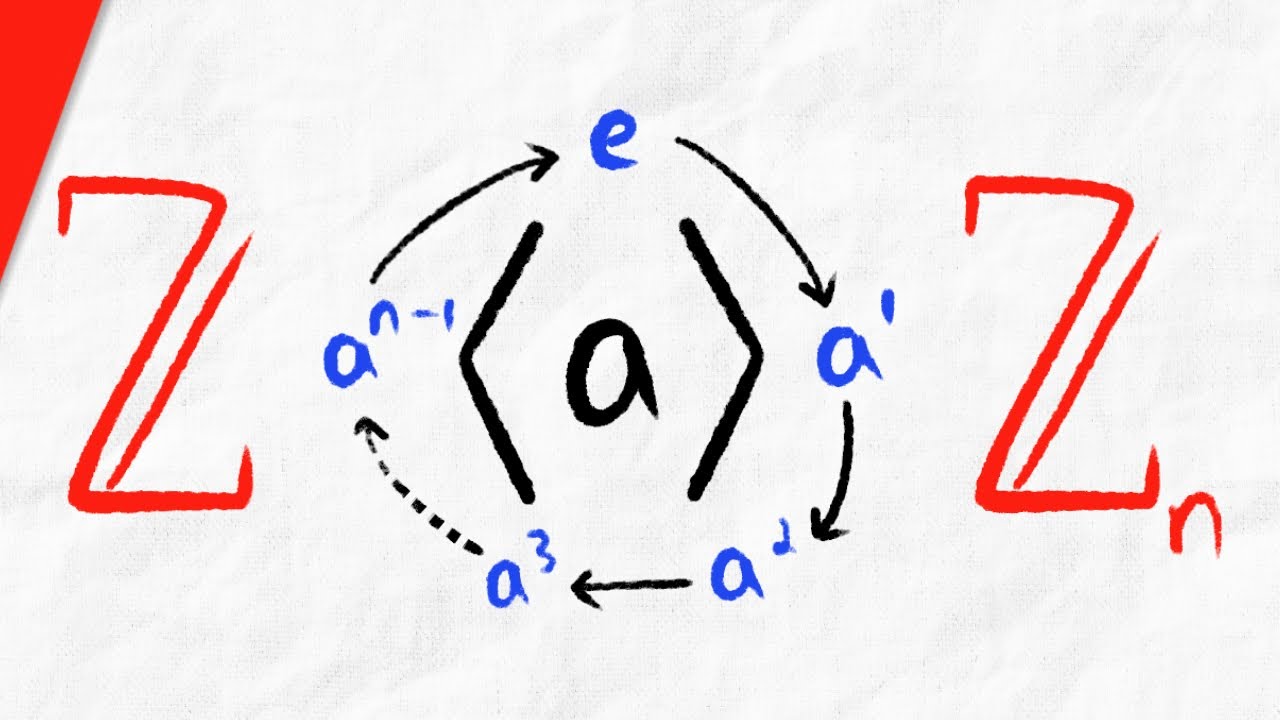

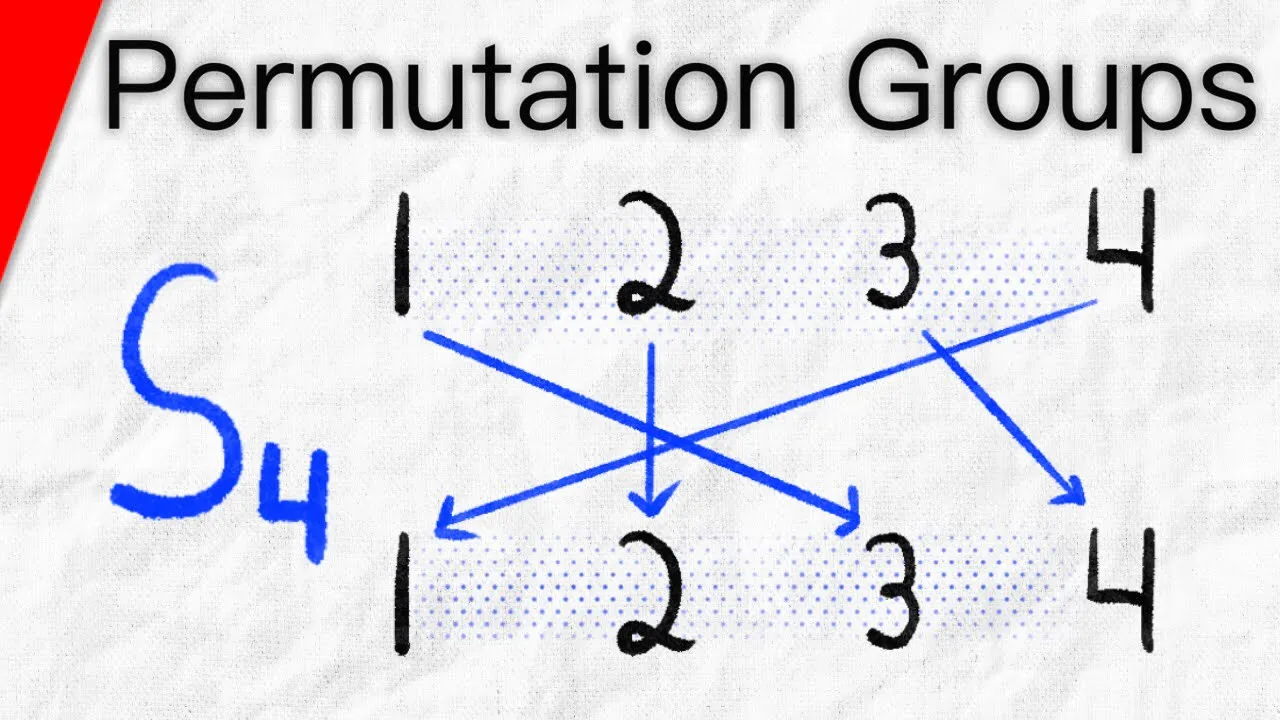










A group is a set equipped with a binary operation that satisfies four fundamental properties: associativity (for all a, b, c in the set, (ab)c = a(bc)), existence of an identity element (an element e such that ea = ae = a for all a), existence of inverses for every element (for each a, there exists an a⁻¹ such that aa⁻¹ = a⁻¹a = e), and closure under the operation. The first and most important example of a group is the general linear group GL_n(R), which consists of all n×n invertible matrices over the real numbers. A matrix is invertible if and only if its determinant is non-zero, and GL_n(R) is closed under matrix multiplication, contains the identity matrix, and every element has a unique inverse. Other examples include the integers under addition (an abelian group) and the symmetric group S_n, which consists of all bijections from a set of n elements to itself under composition.
Abstract Algebra Lecture 1: Review of Linear Algebra and Groups
Added:for this course. We may have others. He did it last year as a pro at this.
You're a senior this year. Okay. He knows everything about it. Now I want to explain how the course is going to be given because uh I have too many responsibilities this year uh beyond just teaching in the math department. So I have to frequently go out on the road uh and so at those times Peter Green will substitute for me as a lecturer and in fact he'll lecture for you on Friday so you get an idea of his penetrating and lucid style of presentation before you have to decide whether you want to choose the course. I would imagine that Peter will be lecturing for me one out of every four or five lectures, but I don't know exactly when they're going to be now because I don't have my exact schedule.
The way we're going to organize the course is that the textbook is going to be this nice algebra text by Mike Arton.
So, this is quite an advanced algebra text. I think it can be used profitably by students here and by students at MIT for whom it was written. Mike Arton is a senior uh guy in the MIT math department, one of the leading algebraists and algebraic geometers of the last 50 years. When you get further on, you'll learn about his work in the art and representability theorem, and you'll learn about his work with Groen Deak and settling the uh the foundations of of modern algebraic geometry. In any case, he wrote this book in mind to show really how algebra interacts with a lot of other subjects. And uh that's really the way it it does later in mathematics.
And I think it's a great viewpoint here.
I think you'll find it a challenging text. By the way, Mike's father was Amal Artin who was the greatest number theorist of the 20th century. Invented the subject called class field theory.
So he comes from a distinguished uh distinguished mathematical tradition. Um I think we're going to do homework assignments every class. Now I know most of you are coming out. What what is the background one should have for this?
Everyone wants to know that. So, if you've come out of 23 or 25 or 55, you're fine. That you you clearly have the background to take this course. If you've been through 21 and you felt comfortable with the linear algebra in 21b because I'm going to need some of that and you you are willing to move to a slightly more abstract level of knowledge, this is good. Otherwise, I would suggest taking a course like a 121 or a 101 to get to that level of abstraction. But if you're coming out of 23, 25 or 55, it's fine. I know that those courses had weekly assignments and big long weekly assignments where everyone would devote all of Thursday night or all of Sunday night to finishing the assignment. I want to do it more on a every every lecture there'll be some assignments to keep people up to date.
And the reason is that unlike 25 or 55 or or 23, taking an algebra course is like learning a new language. Algebra is really more of a language of modern mathematics. The way mathematics organizes itself and speaks to itself.
And so when you learn a new language, you have to go to language lab a lot.
You have to do a lot of keeping up and practicing. That's the way I've got it organized. Now, Peter is even going to arrange for some assignments due Wednesday and Friday. Those are optional assignments, right? Are they available now on the web page? Not yet. They will be available on the web page. Those are optional assignments. Highly recommended so you can check whether you understood what I said today, but also to give you an idea of what the level of homework is going to be. So you can assess how much work there's going to be for the course before you decide to take it or not. And then once we get to Friday, we'll just start doing regular assignments due Monday and Wednesday and Friday. We'll also organize problem sessions probably on Tuesday and Thursday once we get our CA situation straightened out and find out how many people are in the course and when they're free, but we're not going to do that um right now. There'll be two hour exams in the course. Those weeks are marked on the web page. We're going to get a full syllabus up on the web page so you see exactly what date you're going to have the hour exam. And there'll be a three-hour final in January.
questions in general before I start actually talking about the math in the course.
That was easy. Okay. So, what are we going to use from linear algebra? Well, if you want to review your linear algebra in a nice way, it's done in chapter one of this book. And I'm going to go through it and just tell you what we need from it. So, you can go back and find out what you remember and what you don't remember, etc. um because we need some linear algebra initially to generate examples of groups which are the first topic of the course and the linear algebra we're going to need all concerns the set of all n byn matrices where n and n is the same number so square matrices now the entries of the matrix if you're if you're in the i row and you're in the j column the entry would be aig j that that'll be the notation I'll use so the First row looks like a11, a12 up to a1n.
And then we have a n1 down here all the way over to a nn.
And the entries of a matrix are numbers.
That's all art says in the beginning.
And they can be numbers in v various different places. But before we get into the theory of rings or vector spaces or abstract fields, I'm going to take the entries all just to be real numbers.
in the set of all n byn matrices I'm going to denote mnr.
So that's all collections of n byn matrices. So those of you who've studied linear algebra know that that's a vector space over the real numbers. It has dimension n squared because you have you have a basis for that vector space of the matrices that have zeros everywhere but a one in the i j place.
So in particular as a vector space you can do a number of things in this in this uh set. For example, you can add matrices a plus b. So if you have a ma matrix where the entries are aig and you have a matrix where the entries are bi, then the sum of these two matrices has entries aig plus bj.
So you just add the elements in the j place. That's the addition law in the vector space of n byn matrices. And you can also multiply matrices by a real scaler. If you have a a real number alpha and you have an n byn matrix ai j then you can multiply alpha times a and get the matrix where the entries are alpha * aigly multiply every member by alpha that's the scalar multiplication in the vector space. So that's what makes this a real vector space of dimension n^ squ as I say you have to write down a basis that's not difficult now what's unusual that would be true for n by m matrices too you can add them you can multiply them by scalers and the dimension is m * n what's unusual about n byn matrices is not just that you can add them or multiply them by scalers but that you can multiply apply them. So that's another thing I'm going to ask you to remember from linear algebra. Is it okay if I erase this? Because of the video setup today, which didn't know whether I was going to be using this or the blackboard, I have to stay somewhat on the left side of the board with your apologies. So all that wonderful space, I'm aware of it, but I'm not going to use it. Okay. Is this okay the way I am?
Good.
Okay. So that's a big thing about n byn matrices is that there's a multiplication [applause] which is a fairly complicated operation.
Namely if you have two matrices A and B you can define a new matrix A * B. So uh those of you who've studied this since uh 10th grade know that the uh if this has entries CI then you get the J entry of CI in the following matter. You go across the E column of A row of A. You go down the J column of B. You multiply this element by this element. Then you multiply this element by this element and add those.
You multiply and you add up. So the formula in mathematics although it's not that useful is the sum over k of uh what a i k time bkj and you might wonder what the heck is that mean but it certainly defines given 2 n byn matrices a third the matrix multiplication. Now when you study linear algebra right and we will review linear algebra done right you get a little bit away you step back from the theory of matrices and you see what matrices represent and what matrices represent are linear operators. So in particular this is the set of linear operators from an n-dimensional real vector space to itself.
Every matrix is a some a way of writing down a specific linear transformation.
We'll do that later on. But it's a good thing to bear in mind because if you understand that a matrix represents a linear transformation, then what multiplication of matrices represents is the composition of transformations.
That's not obvious from this formula at all. You have to you have to unwind a million things to see that. So if A represents the transformation that of T from Rn to RN and B represents the transa let's see I'll do uh B first and A second and B represents a transformation S from Rn to RN represented by B and remind yourself how this works and that's done in art and two then the product first do B then do a represents the composition of the transformations. First take the transformation s and compose it with the transformation t.
Now one thing that we emphasize a lot when you study linear algebra is that that may not be equal to first doing the transformation t and then doing the transformation s. So remember and this is really important that it is true that if you add A to B it's the same as B to A. That's just the commutativity of the laws of addition because matrix addition just play takes place coordinate by coordinate. But it is not necessarily true that a * b is equal to b * a. There are examples where this is not equal. So the only way to really convince you of that is to write down a specific example. So I will write down a specific example for you which Arton uses. If you multiply this matrix, you have to go to 2x two matrices because multiplication of one by one matrices is just multiplication of real numbers. Right? I mean if if n is this is k it goes from 1 to n. So if n is equal to one, this is just you get this matrix by taking the product of the entry in a by the product of the entry in b. And multiplication of real numbers is commutative. But if you go to 2x two matrices, it's no longer the case. So for example, if you multiply this matrix by this matrix, you'll find that the only nonzero entry you get is when you go across this row and down this column, right? So that would be an entry up here. and all the other entries you find to be zero.
On the other hand, whoops, did I just do that wrong? Uh, yeah, it should be sorry. The last row, the top row, and the Yeah, it's all zero.
They're all zero. No, zero, one.
So, if I go across this row and that column, I get a one. But in all the other cases, the one is multiplied by zero and I get zero. Let's try it in the other direction. See if I got this right. This would be typical where I work this example out wrong. So that's this matrix here. Then this one goes up here.
Are there any places where we get a non-zero entry here? This is zero. This is zero. This is zero. And this is zero.
So this turns out to be the zero matrix.
So this is the product of A and B. This is the product of B and A. These matrices are clearly different. By the way, this matrix I'll just call the zero matrix. It's the zero element of the vector space. It's whatever. It's the element of the vector space such that when you add it to an arbitrary vector, you get the vector back because you're not changing anything. The matrix that looks like this one one one all the down the diagonal and zero elsewhere. I'll call that the the identity matrix. That's a distinguished matrix. And that has the property if you work out this addition this multiplication law that if you multiply anything by the identity matrix you get it back. So um I'm running out of room here. Let's go here.
So 0 + a is equal to a + 0 is equal to a. And no matter which side you multiply by the identity matrix sorry is i * a.
Sorry, this is yeah this is a if you add zero and if you multiply by i you get a.
So you have a multiplicative identity and an additive identity.
Okay. Some other laws of matrix multiplication uh and addition. For example, you have the distributive law and you have the associative law. So the distributive law says if you multiply a * b + c, it's the same as multiplying a by b and then adding the product of a by c. And the associative law, which is the most important, is that if you multiply a * b * c and you first multiply b * c and then time a, that's the same thing as multiplying a by b and then multiplying by c. So the normal laws of arithmetic, addition and multiplication all hold except for the commutivity of multiplication.
Now you might ask how do I prove something like this? Well, it's truly hideous if you try to do it with this formula for the matrix product, you know, but if you think of it in terms of composition of transformations, these are three different transformations. is there's an ST and maybe an R.
Mhm. Or U, let's call it U for a transformation.
And to do A composed with B and C would be first compose S with U and then compose with T. And to do this would be first compose U with S, sorry, S with T and then compose with U. But all all two ways of doing it are just giving you the composed trans transformation where you take u and then you take s and you take t. Namely the the effect of this on any given vector in Rn is to calculate t of s of u of v no matter which way you do it. So if you think of it in terms of composition of transformations this associative law is more or less clear.
Same thing you can think of the distributive law if you want to. Uh in any case, the way this was proved in the original world of linear algebra before people understood linear alge uh linear transformations was just by computing with this formula, which as I say is not the most pleasant thing to do.
Okay. So these are what I want you to remember about multiplication and addition of m bym matrices. And as I say, it's all reviewed in chapter 1, but I'm not going to go over that. I'm going to assume you've seen this. Have most of you seen this material?
No. How many have not seen anything about N byN matrices? I'm just amused.
Don't be embarrassed. I got to know.
Okay.
Now, a much trickier thing about M byN matrices is the question of inversion.
So we say A is invertible an M byNm matrix if and only if there exists a matrix B with the property that when you multiply on either side by B you get to the identity matrix.
So the it requires the existence of a second matrix. Now invertability is a tricky business in tricky business in matrix theory. Not every matrix is invertible. For example, the zero matrix is never invertible because if you multiply any matrix by zero, you get zero.
If you have zeros in all entries, no matter what the entries of A are, when you compute the matrix product, you get zero. So there's no way I could find another matrix to multiply by zero to get the identity because any product with zero is zero. So example zero, I is invertible. There's a good case. You take B is equal to I and Z is not invertible.
But between those two it's it's a tricky business. For example, for one by one matrices it's an easy answer but already for 2x2 it's quite complicated. So for one by one matrices.
So the matrix just looks like a uh is invertible if and only if a is not equal to zero.
And then the inverse matrix is just given by the entry 1 / a. That's the only thing you could multiply a by and get to the identity matrix which is just the the the thing one. So a real number is invertible if and only if it's non zero for 2x two matrices turns out to be as invertible.
I'll just give you the answer.
if and only if a certain quantity is non zero. Namely, if you take the product of a by d and you subtract off the quantity bc is not equal to zero.
And in fact, if that's the case, I'll write down the inverse matrix for you.
Usually, if you don't want to just know if a matrix is invertible or not, you want to know what its inverse is. So if this is a then a inverse is equal to 1 / a d minus b c and you can write that real number down because this number was non zero so it has an inverse times the matrix d minus b minus c a and this means you take the scalar product of this matrix by that real number. So we can check that we ought to do at least one matrix multiplication in class to see that I can do it. So let's multiply the matrix A B C D by the matrix D minus B minus C and A.
Okay. The entry here I go across this row and down this column I get a d minus b c.
The entry here minus a b plus ab. So the entry here is zero.
The entry here I go across this row and down this column. CD minus cd zero. And the entry here I go across this row and here I get minus bc plus a d. Same thing. A D minus BC.
So if I just took this matrix, I can multiply by my matrix and get something which isn't the identity but looks pretty close to the identity. Namely, it's a scalar multiple of the identity.
And the only problem might be that this scaler might be zero. But if this scaler is non zero, then I could have taken this matrix and multiplied by one over it and I would get the identity.
Okay.
Now in general the answer to the question of whether a matrix is in invertible or not is the following.
There's a certain function from the set of n byn matrices to the real numbers called the determinant which I'll write just debt which maps n byn matrices over the reals to the real numbers.
And the determinant of a matrix is a polomial in its entries. It's a polomial of degree n in its entries.
[clears throat] So for example, this is the determinant of the 2x2 matrix A. And you probably know the formula for the determinant of a 3x3 matrix or even generally the formula for the determinant of an n byn matrix. It's it's given by a formula. Determinant of a is sum over n factorial terms with a plus or minus one in front of it and then products of of n matrix entries.
So n factorial here is just two terms.
But if you go to a 3x3 matrix, there are six terms in the determinant expression.
4x4 they're 24 terms. In short, it's a useless formula because once you get to 10x10 matrices, you don't want to be dealing with 10 factorial terms.
Nonetheless, there is such a formula and the the the key fact is a is invertible vertable if and only if the determinant of a as a real number is not equal to zero.
in which case there's a formula for the the inverse of a and the formula looks very much like this formula. The formula then looks like you get in fact there's always a matrix there is an unique matrix that means there exists a unique matrix B such that A is equal to BA is equal to the determinant of A times the identity matrix there's always such a matrix you can't always multiply something to get to the identity but you can always multip find a unique matrix where the product is the determinant of a time the identity matrix. Well, no, I shouldn't say unique. I mean, if a were the zero matrix, then then anything would work. So, sorry, there exists a mat there's a there's a natural matrix.
Let me just say that.
And that B is sometimes called the matrix of co-actors and you get its entries by taking partial determinants around A. Have you all seen that once or twice? So this is this is the matrix for example of co-actors of the original 2x2 matrix A. So there's always a matrix you can find where you multiply to get the determinant and if this is non zero you divide B by the determinant and you found a matrix to multiply through to get the identity.
So please review this kind of determinant and inverse topics. We don't need the exact formula for the determinant at this moment. Although when we start doing linear algebra more in a more sophisticated way, I'll tell you what the determinant really is. This formula is about as useful as the formula for products of matrices where you sum over K etc. What you really want to think of them is composition of transformations. This determinant is really the action of a linear operator not on the original vector space but on some vector space which is one-dimensional that's constructed from the original vector space. And when you have an action of a linear operator on a one-dimensional vector space, it gives you a scaler. That's the determinant.
We'll get there.
Okay. So now I can make my first important definition in this course. So this vector space of n byn matrices is not what we're really interested in.
We're interested in a subset that I'm going to call gln of r, which is a subset of all n byn matrices over r.
And this subset consists of all matrices A such that the determinant of A is not equal to zero or equivalently A such that there is an inverse matrix A inverse.
So for one by one matrices the the set is everything but the zero matrix. But for 2x two matrices, you have to throw away other matrices. For example, you have to throw away that matrix that we wrote down before like this. This is not in GL2 because its determinant is 0 * 0 - 1 * 0 which is 0.
So this is a large set of n byn matrices. It's defined by the nonvanishing of a certain polomial on this set. So almost everything's in it.
But we just want to look at that set of matrices, the invertible ones. By the way, if an inverse exists, it's unique.
Let's write that. Let's prove that for ourselves.
This again is all in Artton's chapter 1.
Exists.
It is unique. So one can talk about the inverse of a matrix. There can't be two different matrices that serve as an inverse for a matrix. And the reason is the following. Suppose we had two inverses. So suppose I could say A is equal to A * C is also equal to I.
Suppose that were the case.
And I want to show B is equal to C.
Well, remember that what an inverse is defined to be is not just a right inverse under multiplication, but a left inverse under multiplication. So if I took this thing and I multiplied on the left by any matrix that inverts A, for example, B, I could say, well, this implies that BAB is equal to B * A C.
And then I use the associative law to reassociate things. This, on the other hand, is BA * B and this is BA * C. And since B was assumed to be an inverse for A, this is equal to the identity time B. And this is equal to the identity time C. And the identity times any matrix is itself. And therefore B has to equal C. So even though this matrix here doesn't have to be unique as I said if A were the zero matrix, any matrix B would work here.
However, if you use the canonical one, the matrix of co-actors and the determinant turns out to be non zero so that you can divide by it, then that inverse is in fact unique.
And so I should add that there is an inverse matrix A inverse which is unique.
All right. Now let's look at the properties of this subset of uh the n byn matrices because we gain things and we lose things.
One thing that we lose right away is addition. There is no addition defined on the set GLNR. If you I mean you even know that for one by one matrices you could take a the matrix one and you can add it to the matrix minus one and both of those are invertible and their sum is the matrix zero which isn't invertible. So there is no addition law.
So we lose the vector space plus or scalar multiplication by zero.
If you took a a nice invertible matrix and you multiplied it by the zero scaler, you'd get down to zero, which is not invertible. So forget about addition. However, the beautiful thing is that it's closed under multiplication.
I'm closed under multiplication. So, I'll give you two proofs of that. Yeah.
Peter, did you have a question? You're just stretching.
Anyone else need to stretch?
Here's here's a principle I like to do in my lectures. So, uh, since it's a principle, um, it'll apply. Um, I go pretty fast and when nobody's stopping me, my tendency is to go faster.
So, if you find yourself getting a minute behind and then 2 minutes behind and then 3 minutes behind in your notes, it's not a profitable experience because all you're doing is writing down gibberish, which you're going to have to decipher later on. Much better that you're with me when I'm talking about it. So the principle is that anyone can ask for a minute or two of silence. This may may not be repeated 30 times in the course of a lecture. But if you feel that you need 2 minutes to just catch up to what I've said on the board and digest it so that you can even ask me a meaningful question, you may just raise your hand and ask for some silence.
Believe me, the other people in the class will appreciate it. And if you're confused, undoubtedly someone else is confused. So, I've said something either too fast or incorrect and I will make mistakes. That's why Peter's here, but he may miss it, too. Okay? It's closed under multiplication. I'll give you two proofs. Here's the first proof.
Suppose A and B are invertible.
I have to prove that the product a * b is invertible.
Well, to to prove something's invertible, I just have to find an inverse for it. Can someone suggest what would be a nice left inverse for it? Go ahead. So suppose that yeah B minus one A inverse exists.
So call this consider this product and let's multiply it on the left times AB. So I have B inverse A inverse. This is the way it's associated times AB. Now once you have the associative law for three parenthe for three products you can reassociate for any number of products. That's a nice fact about the associative law. So this can be written as B inverse * A inverse A * B which is B inverse time the identity matrix * B because A a inverse A was invertible so there's identity matrix and then the identity commutes with any matrix and so this B inverse I is I B inverse so this is I * B inverse B and then I associate these two together to get I * I which is the identity. So namely this is the inverse.
Notice that I have to take them in the opposite order. The inverse is not a inverse time B inverse but B in and then similarly if you multiply on the right by this first you multiply the B * B inverse that cancels then you multiply the A * A inverse. So that's the first proof.
Suppose we took this definition of invertible.
So we'd have to say that if we had two matrices, each of which had a nonzero determinant, their product had a non-zero determinant. That's what we're saying, right? If that previous condition for invertability really worked, just being a non-zero determinant. How would we check that?
That if two matrices had a non-zero determinant, their product had a non-zero determinant.
Someone else?
Yeah, we know familiarity with that. Dead A* dead B is dead B.
Exactly. So if you another this is the first proof and the second proof is there's a famous identity for determinance that the determinant of a product of two matrices is the product of the determinants.
Again you can never prove that using the definition of determinance is the sum of n factorial terms. But we'll see how to prove that intelligently in a while. Now if you know this and each of these numbers are non zero. The product of two non-zero real numbers is a non-zero real number. So therefore, this set is closed under multiplication. Exactly.
What can we say about the multiplication on this set?
Well, it has the following properties.
Can I erase this now, guys? Normally, I'll be using more board. We'll be set up a little bit better next time.
It's closed under multiplication.
has a multiplicative identity which is the matrix I. I * anything is the the something times I is itself uh has multiplicative inverses.
A inverse because that's how this set was defined. It's exactly the set of matrices that have a multiplicative inverse. So anything in this set you can take products there's a multiplicative identity on the set anything has an inverse and finally the product is associative because that was true of the product on the larger set of matrices a * c is a * bc so we have four properties of this subset of the set of matrices it has a multiplication law. The multiplication law is associative. There's an identity element and there's an inverse for every element.
And those properties make up the properties of what we call a group. So this is the first and most important example of a group. So I'll now tell you what a group is.
And that's why we need the linear algebra to generate for us immediately some good examples of groups. I'll give you some more examples, but that's our first example. So, a group G is a set with a product operation.
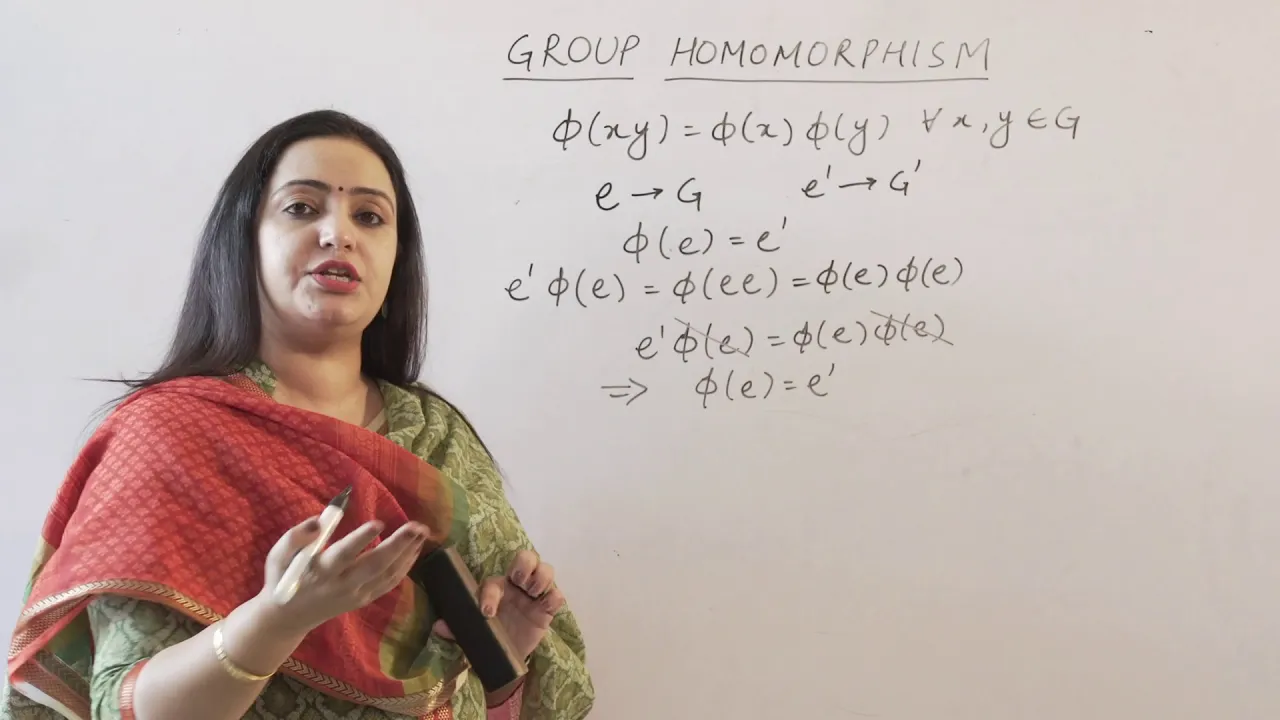
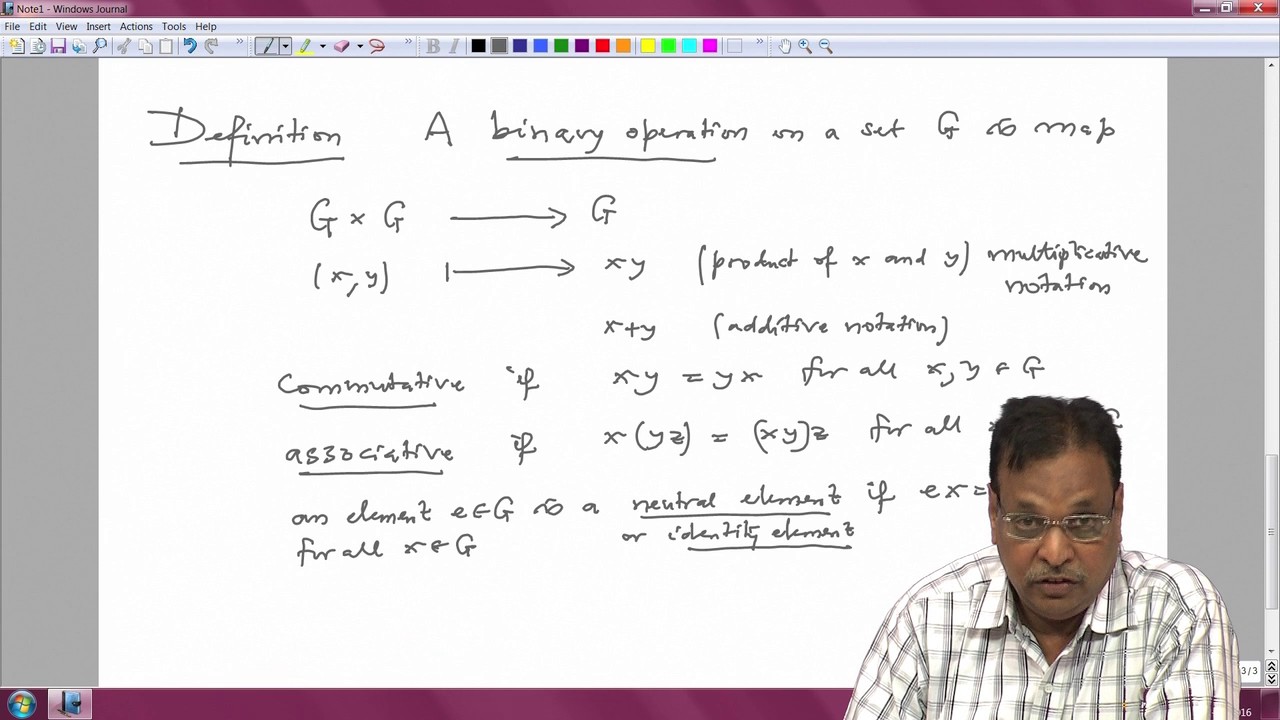
So, if you have two elements in the set, you can take their product, not necessarily commutive. So G * H which is one associative two has an identity element which is sometimes denoted E or sometimes denoted one has inverses namely every element in the group.
There is another element called G inverse whose product with G is the identity element.
That's it. Those are the properties of a group. A product it has to be associative. There has to be a distinguished identity element there.
And there have to be inverses for every element. There does not have to be commutative.
If if GH is equal to HG for all pairs, you either say the group say G is commutive or sometimes Aelion.
Aelion comes from the great Norwegian mathematician. Abble was one of the invenils Abel early 19th century Norwegian mathematician who uh was one of the originators of group theory. The great originator of group theory was the famous young French mathematician Avarist Gawwa. Both Abel and Galwa lived in the early decades of the 19th century. Both died in their 20s. Gawwa died as a result of a duel.
Abble died basically because he was too poor and couldn't find employment for a Norwegian. It was very hard to find employment in mathematical Europe at the time. But together they really put together the foundations of group theory. Gow's work wasn't appreciated for about 50 years. So he sent his work to the great mathematicians of the time Gaus Koshi etc. and they all put it aside. It was only at the end of the 19th century when French mathematician Jordan realized how fundamental Galwa's discoveries were, many of which were written up in a letter he sent to a friend the night before he died in this duel. If any of you have been to Paris and take the lean diss uh you pass through a beautiful or I shouldn't say beautiful a disgusting Parisian suburb called Bouren where Gowa's father was mayor and Gowa B was born and lived much of his life and there's a plaque in the most disgusting uh intersection in the middle of Bareen where the trucks are going by and it says Illustra mathematician France that's the way a country honors its heroes um actually many streets in Paris are named after mathematicians if any of you have been on the rum was a great mathematician who accompanied Napoleon to Egypt to do surveying and Egyptology but um Gawa is undoubtedly the most famous young mathematician to die young but in his head he discovered not only the theory of finite fields which we'll cover later on and wrote the treatment of finite fields that's the best treatment in the literature today but also discovered almost all the foundations of group theory and it was GAWA who realized there could be very interesting groups where GH was not equal to HG. Yeah.
Is it required that the product operation is closed or is that yeah that when I say a product operation it means that for any two elements in the set G there's a product GH which is in G.
So associated to any two elements you get a third. I'm going to get now this this is a very interesting group the the group of invertible matrices in that already when we get to 2x two matrices we have a lot of non-commutative groups right that you can find two invertible matrices the ones I wrote down by the way weren't invertible so that'll be a challenge for you to find invertible matrices such that AB is not equal to ba good homework problem there Peter it's already there it's or he's ahead of me damn kids. Um anyhow uh so uh but good question. Yeah that you must have you you have to stay in your set for any two elements in the set. Sorry the product is defined and in the set it's associative gh is the same as gh * k.
There's an identity element e such that eg is equal to g is equal to g for every element in the set. Right? And let me give you a simpler example of a group because this seems awfully complicated uh to go through to get a group. So you've been doing groups all your lives.
Um it's like speaking pros. So here's an example of a group an aelion group. Why don't we do an aelion group?
The simplest aelion group is the integers. So that's the you know 0 plus or -1 plus or -2 plus or -3 positive and negative integers.
denoted by a bold faith Z here. So uh the the the uh product operation in the integers is addition you know a plus b that's the product operation. Uh that's clearly associative. When you add three things it doesn't make any difference which order you do the adding. What's the identity element for addition in the group Z?
It's kind of stupid. Zero.
Zero. Exactly. The identity element is zero. If you add zero to a, you always get a. What's the inverse element? What is a inverse?
Minus a. So if you take the negative, that's how that's why we have negative numbers really to turn counting numbers into a group if you think of it. Well, what is minus3? It's the thing you add to three to get zero.
Okay. And um well, that does it. So this is a very simple group which has the property that a plus b is b plus a. So groups like this of course were studied before there was a notion of a group. I I'll tell you a funny story. So a a great um great German mathematician who I've collaborated with many times and is an altogether um is is a rare example of a prodigy who actually worked out. Uh his name is Don Zagier. uh he's the director of the Mox Plunk Institute uh for mathematical research in in Ban and um Don went to uh schools in about seven different countries when he was young.
By the age of 13 he was speaking nine different languages and applied to get his uh undergraduate degree at Oxford and he had taken the A levels and O levels even though he had never been to England and uh he was denied admission on the grounds that no one could attend Oxford be before the age of 16. So he got into MIT and finished MIT in two years and then applied to Oxford as a graduate student at 15 and there was no objection at that point because that was as a graduate student. So Don said when he recalled his algebra course from MIT he was so confused the whole time he took the course but he learned how to do it because he was very good mathematician. He said that his idea of a group as he got out of this course was that a group was the integers. all groups were the integers except that somehow when you were doing the problems you weren't allowed to use the fact that a plus b was b plus a and he thought that this was very strange and it was a strange way to teach but if those were the rules of higher mathematics he would go with it so I want to point out that sometimes you are allowed to use the rules that a plus b is b plus a when it holds another example of a group is any vector base that's a group because you just forget about the scalar multiplication. The addition the the binary operation is addition of vectors. The identity element is the zero vector, right? You add the zero vector to any vector, you get the vector back. The the the the inverse element is the negative vector. Okay? So you just you just forget scaler multiplication.
So it turns out that once you come up with this rather simple definition, they're groups all over the place. This is also an aelion group.
In some sense, the most general group you get as follows.
Uh and this will be the last thing I'll talk about and then I'll let you get out of here. uh if you start with any set call it the set T and you let G be the set of all bjections G from T to itself.
So that means one to one and on to maps from a set to itself all bjections then that's a group it's sometimes I'll denote it by the symmetries of t or the symmetric group of the set t is a group someone's got a phone call I hope it's not me mine plays lat traviata so occasionally there'll be an emergency someone's about to jump off a bridge or something that requires the attention of the dean So you'll hear I fig I I wanted a cheerful tune. So to deal with it. So this is a group under composition.
Composition of bjections. If you compose one bjection with another, you get a third because if two maps are one to one and you compose them, you get a third one to one map. If two maps are onto and you compose it, you get another onto map. So that's the the composition law of transformations.
The identity element is the identity transformation that takes every element in the set t to itself. That's certainly one one and onto. The inverse element is the inverse transformation. If you have a transformation that's one and on to, you can send the transformation back. That's G inverse.
And composition of maps is associative just like we prove composition of linear maps is associative because if you have three maps then and you compose them no matter how which way you do it then it's the final map that takes an element in T first to this map then to that map then to the third thing in P.
So this is the most general group in some sense of the word. One second I just want to finish. and all groups all groups we'll see somehow arise by putting extra conditions on this invertible bjection. So for example this group GLNR how did that come about? Well, I started out with a set which was Rn. A set which was Rn. And I considered all invertible maps from Rn to Rn which preserve the linearity which preserve the structure of a vector space. That's not all maps but the ones that preserve some structure. And that's how I got invertible matrices. So we're going to see that this is somehow and this was Gowa's big idea that you when you study maps or symmetries of a set that was one group and then you could get very interesting groups by studying symmetries that preserve some extra structure in the set like some linear structure on the set and in particular we're going to have one very famous group where this T is the set of n a finite set and all finite sets are determined by the number of elements in them. So the set from 1 to n then we'll call the symmetry group of t the symmetric group s subn. We'll just write it that way. And what is this?
Turns out to be a group with only finitely many elements in it because there are only finitely many ways you can permute n different objects. How many ways are there permuting n different objects?
Yeah. So this is a group where it's a finite group of order n factorial and you'll find that it's nonabelion and you should check that once n is at least three. So once there's a finite group with six elements in it that's nonabelian the permutations the onetoone maps of a set of three things to itself and you should play with that a little bit.
Okay, this is our introduction. This gives you an idea of what groups are.
Peter has some interesting things. Are you want to put them on the board?
Why not? So, here's the homework recommended optional. And it'll be on the web page for those of you who have to run now, but I'll put it on the blackboard, too. This will give you an idea of whether you're up to speed, whether this is the right course for you. And if you want to talk to me or Peter about it, please do. So, read 1.1 and pages 38 to 42.
And the exercises 1.1.7, 1.16, and 1.17.
Do those three exercises. If you want to hand it in, Peter or Peter will take a look at them for you. Okay. Thanks, Peter. See you guys on Wednesday.
Up Next
Cosets in Group Theory: Visual Lecture & Lagrange's Theorem
@ProfessorMacauley
29.9K views•2016-03-07
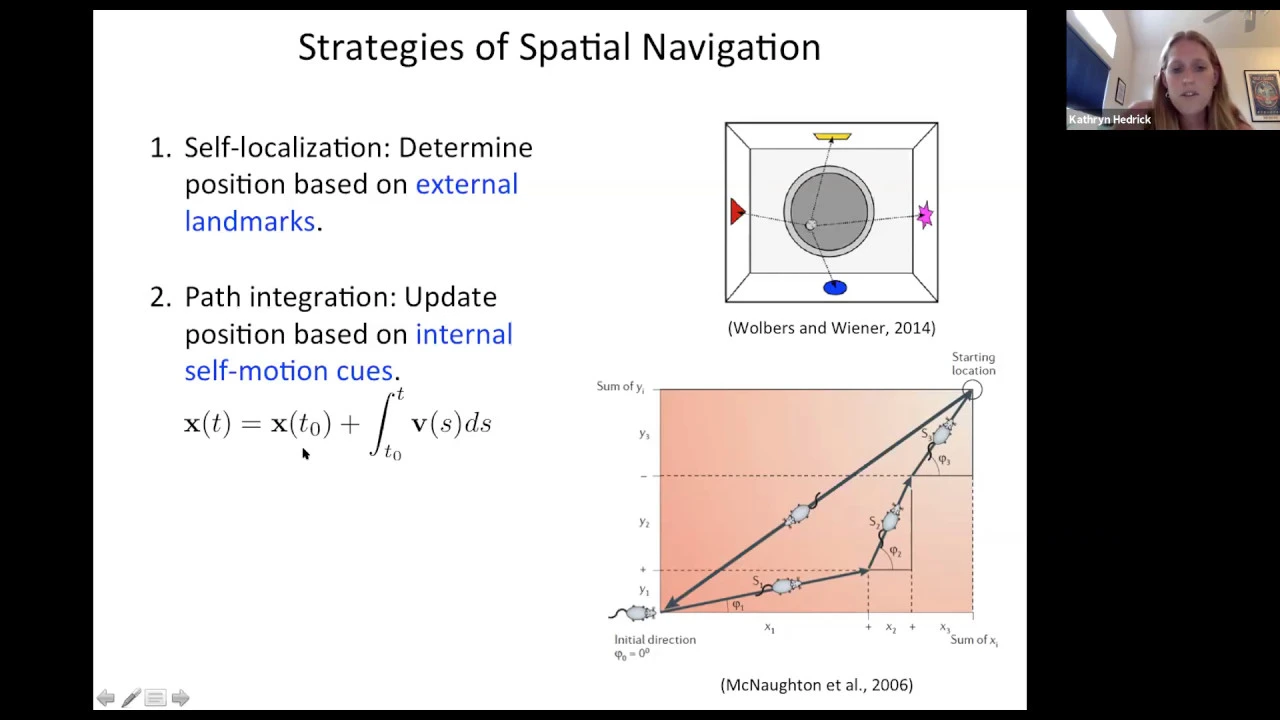
Gain Recalibration in Hippocampal Path Integration: Math Theory
@1024kyz
144 views•2020-07-02

Chaos Theory Explained: Lorenz Attractor & Butterfly Effect | Math Documentary
@itssoblatant
280.9K views•2013-09-14

The Mathematical Impossibility of Accurate World Maps
@Vox
23.3M views•2016-12-02
Related Study Plans & Knowledge Roadmaps
Structured learning paths in Mathematics