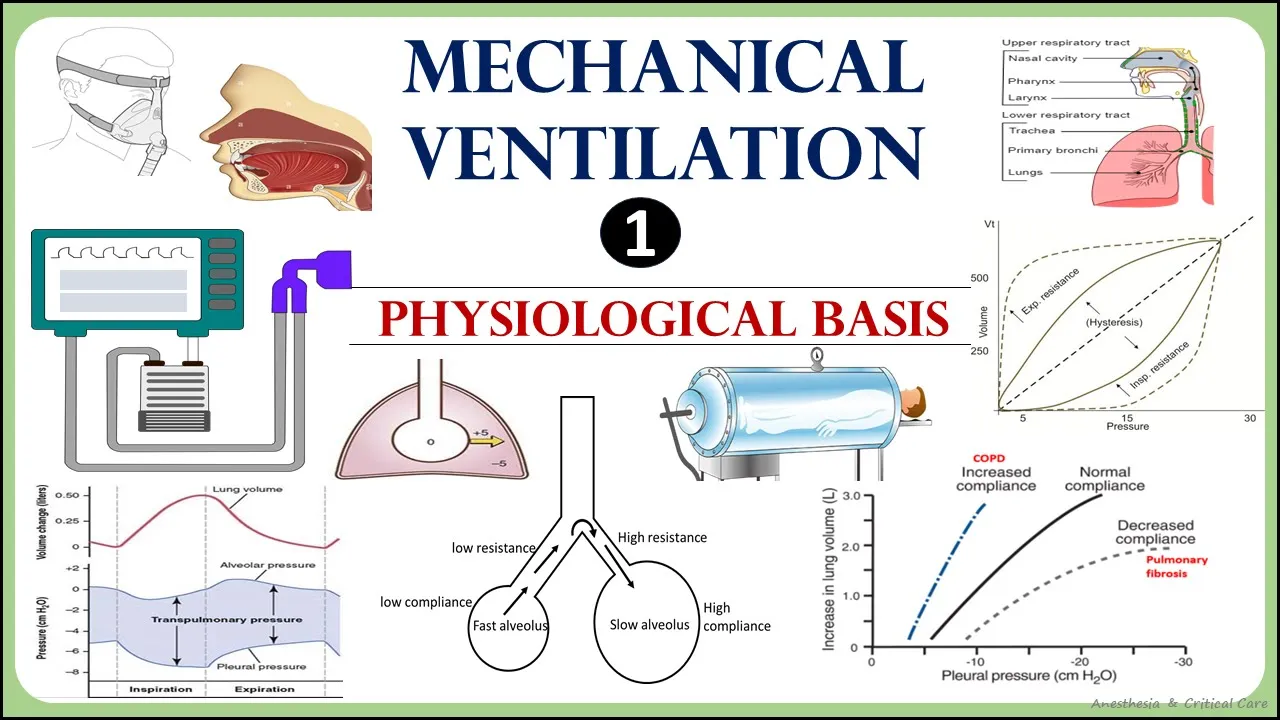


























In mechanical ventilation, peak pressure represents the maximum pressure in the proximal airway at the end of inspiration, reflecting both airway resistance and lung compliance, while plateau pressure measures the pressure after a breath hold at end-inspiration, representing only lung compliance; a difference greater than 5mmHg between them indicates elevated airway resistance, helping clinicians diagnose whether respiratory issues stem from airway obstructions (like secretions, mucus plugs, or bronchospasm) or lung compliance problems (such as pneumothorax, pulmonary edema, RDS, or pneumonia).
Peak vs Plateau Pressure in Mechanical Ventilation Explained
Added:Basic respiratory physiology, including the mechanics of ventilation and pressure-gradient driven airflow.
The anatomical distinction between the conducting airways (where air flows) and the alveoli (where gas exchange occurs).
Fundamental concepts of mechanical ventilation, particularly the differences between volume-controlled and pressure-controlled ventilation.
The Equation of Motion for the respiratory system, which mathematically relates airway pressure to flow, volume, resistance, and compliance.
Calculating static lung compliance and airway resistance using peak pressure, plateau pressure, tidal volume, and PEEP.
Clinical troubleshooting and differential diagnosis of high-pressure ventilator alarms (e.g., distinguishing bronchospasm from mainstem intubation or ARDS).
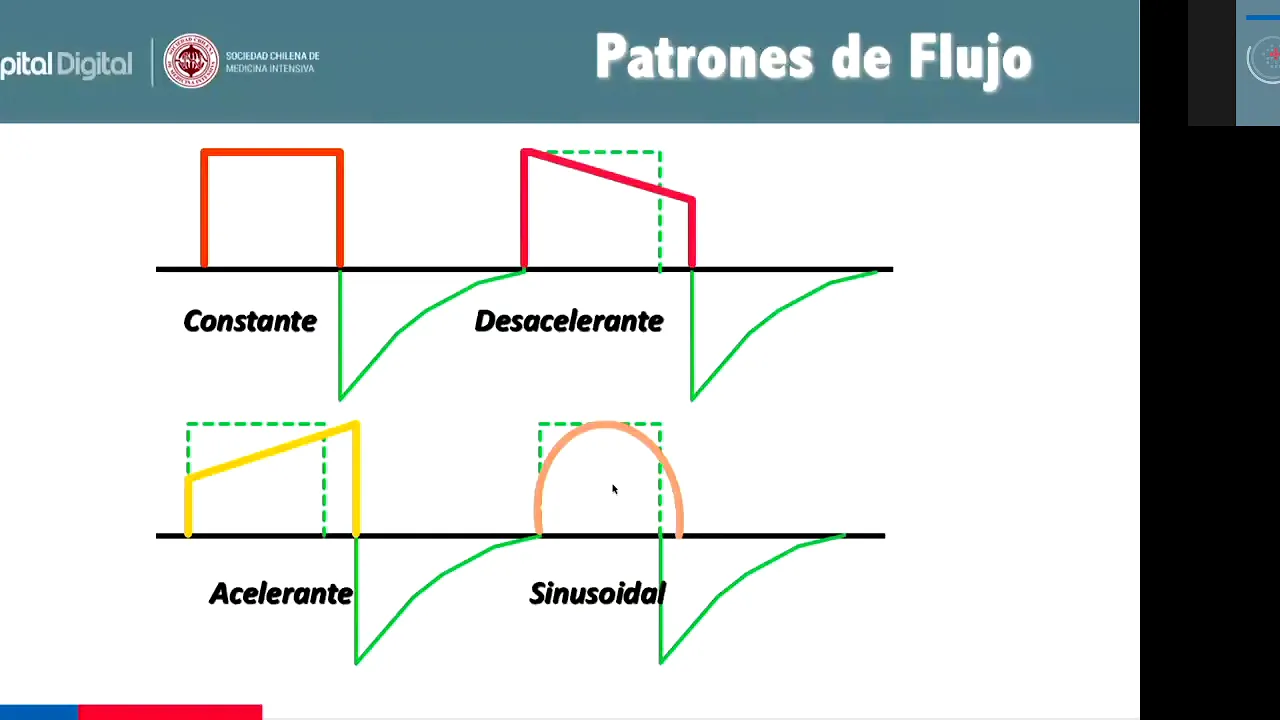
Analyzing real-time ventilator scalar graphics (pressure-time and flow-time curves) to identify patient-ventilator dyssynchrony.
Implementing lung-protective ventilation protocols, such as limiting plateau pressure to under 30 cmH2O to prevent ventilator-induced lung injury (VILI).
96K views2.7Klikes4:31Original Release: 2018-02-06
So what's the difference between peak pressure and plateau pressure and why is it important? Let's go find out?
Hello there and welcome to my youtube channel if this is your first time here, and you want more of this content Don't forget to hit the subscribe button below, and if you hit the bell You'll get notified whenever I release more content So the pressure in your ventilator is comprised of two parts the resistive pressure and the elastic pressure the resistive pressure is that which is encountered when air flow is pushed through the Airways the Elastic pressure is that which inflates the lungs and the chest wall So increasing ventilator pressures must be due to one more both of these if your patient's airway Pressures are going up There's either a problem with the resistive pressure or the elastic pressure So let's talk about peak pressure and plateau pressure so the peak pressure in the ventilator circuit is related to the resistive pressure and Plateau pressure is related related to the elastic pressures, so let's look at this diagram to imagine We're ventilating the lung and we can see here. The pressure. Curve as we do so Point one where we're ventilating the lung and the airway pressure goes up And you can see that the volume also Increases at point two during expiration the pressure goes down and the flow moves in the opposite direction as the air moves out so if we understand that the peak pressure is the Maximum pressure in the proximal airway at the end of the inspiration we can see this at 0.4 0.5. We've instigated a breath hold which can easily be done by most modern ventilators through a simple press of a button This is the equivalent of occluding the endotracheal tube at the end of an expiration when you do so the pressure At the end of inspiration NOT expiration Equalizes between the tube and the alveoli so consequently plateau pressure is a surrogate for end inspiratory alveolar pressure I think using the balloon analogy might be useful at this point imagine You're blowing up a normal balloon as you inflate the balloon blowing quite hard this equates to the peak pressure Imagine then that you stop blowing but keep the balloon in your mouth the pressure then Equalizes between your airway and inside the balloon this pressure will not need to be as high as when you are actually Inflating the balloon and this for this therefore equates to plateau pressure So peak pressure is dependent upon the resistance in the airways and also on the compliance of the lungs If the airway resistance is high or the lungs have become stiff then the peak pressure will rise The plateau pressure however is only related to the compliance of the lungs in other words how stiff those lungs are Let's look quickly at these two examples in this example. You can see that There is a high peak pressure if the difference between the peak pressure and the plateau pressure is greater than 5 millimeters of mercury Then it is defined as an elevated peak pressure in the next diagram. You can see that There is an elevated plateau pressure, so what can this tell us?
Well if we have a high peak pressure. There is possibly an airway issue for example We may have a bronchospasm we train secretions mucus plug or the endotracheal tube tip might be blocked or it might be sitting against the wall of the bronchus for example if We have a high plateau pressure and remember. This is related to the compliance of the lung we may have a pneumothorax pulmonary edema a RDS or a pneumonia So if we can understand the difference between peak and plan so pressure we may be able to diagnose what's wrong with our patients Ventilation and consequently what we might be able to do to improve it Please remember to hit the subscribe button and hit the bell button as well, and you'll get notified whenever I produce a new video Thanks for watching
Up Next

51:29
Respiratory Physiology: Mechanics, Gas Exchange & Acid-Base Balance
@professorfink
126.8K views•2012-05-25

48:47
Graphic Medicine: Comics for Collaborative Healthcare Communication
@nationalpatientadvocate
189 views•2023-12-04
9:31
Proning in ARDS: Mechanisms and Physiological Rationale Explained
@TheCriticalCarePractitioner
228.1K views•2018-03-28
3:05
Stages of Labor and Vaginal Birth | Childbirth Animation
@nucleusmedicalmedia
52.1M views•2017-08-18
Related Study Plans & Knowledge Roadmaps
Structured learning paths in Medicine
medicine
Abnormal LFTs: Diagnostic Workup & Pathology
01Liver Anatomy and Basic Physiology
02Introduction to Liver Function Tests (LFTs)
03Hepatocellular vs. Cholestatic Patterns
+ 3 more learning modules
12h6 modules
Explore Roadmap
medicine
Analyzing Blood Smears: RBC, WBC & Platelets
01Introduction to Blood Components & Smear Preparation
02Normal Morphology of Blood Cells
03Erythrocyte Pathologies & Morphological Variants
+ 2 more learning modules
12h5 modules
Explore Roadmap
medicine
Mechanical Ventilation: Waveforms & Alarms
01Anatomy and Physiology of Breathing
02Introduction to Mechanical Ventilation & Core Modes
03Ventilator Settings and Waveform Interpretation
+ 2 more learning modules
12h5 modules
Explore Roadmap
medicine
Neuro Exam: Localization & Stroke Syndromes
01Foundations of Neuroanatomy and Vascular Supply
02The Neurological Examination: Step-by-Step
03Principles of Neurological Localization
+ 3 more learning modules
18h6 modules
Explore Roadmap