








![Artful Painter Podcast: Eric Bowman - Following a Circuitous Path [AUDIO-ONLY]](https://i.ytimg.com/vi/s3G4FrWwuqY/maxresdefault.jpg)


![뉴욕 메트로폴리탄 뮤지엄에 직접 다녀왔습니다 | 전원경 세종사이버대학교 교수 [전원경의 아트앤더시티 시즌 2]](https://i.ytimg.com/vi/mIwwQS1DnyE/maxresdefault.jpg)








American art transformed dramatically from the early 20th century to the present, evolving from provincial artistic traditions to becoming the global epicenter of contemporary visual expression; this transformation was driven by interconnected social, technological, and political upheavals including industrialization, two world wars, the Great Depression, the Civil Rights Movement, and ongoing cultural shifts, with key movements such as the Ashcan School's urban realism, Synchromism's abstraction, the Harlem Renaissance's celebration of African-American culture, Regionalism's celebration of American identity, Social Realism's political critique, Abstract Expressionism's establishment of New York as the new global art capital, Neo-Dada's playful irreverence, Pop Art's embrace of consumer culture, Minimalism's reductionist approach, Conceptual Art's emphasis on ideas over execution, Feminist Art's challenge to male-dominated art history, and Neo-Expressionism's return to emotional intensity, all reflecting and shaping American identity and its place in the world.
American Art Movements: 1900s Evolution Timeline
Added:The transformation of American arts from the early 20th century to the present day is one of the most dramatic cultural shifts in modern history.
The United States evolved from a provincial artistic outpost to the global epicenter of contemporary visual expression.
There was unprecedented social, technological, and political upheavals that directly impacted artistic production.
From the industrial optimism of the early 20th century, through two world wars, the Great Depression, the Civil Rights Movement, and into our present day.
The story of American art in the past century is fundamentally one of liberation, whether from academic constraints, from European hegemony, or from traditional boundaries between high and popular culture.
Today, we will examine how these interconnected forces propelled American art as a compelling voice in both national and global conversations.
In the early 1900s, American cities were tough places to live.
Most people scraped by on modest incomes.
Kids often worked instead of going to school, and urban neighborhoods were cramped and unsanitary.
Artists took notice, and rather than painting the usual beautiful landscapes or portraits of the wealthy, a group called the Ashcan School set out to show what city life was really like.
This school of American artists wanted to distinguish themselves from the American Impressionists that came before them, so they took to Realism.
The school's first generation of artists were based in Philadelphia and were led by Robert Henri.
They looked back at the works of masters such as Diego Velazquez, Francisco Goya, and Edward Manet, and used their classical methods to create realistic and gritty scenes of modern working-class life, or what Henri called art for life's sake.
After the group relocated to New York City, a second generation of artists followed, including George Bellows, whose drawing that was captioned, Disappointments of the Ashcan, gave the group its name.
The artists, many of whom began their careers as newspaper illustrators, favored broad calligraphic forms, which they painted quickly, often from memory, to evoke the immediacy of the urban experience.
In Bellows' as Cliff Dwellers, we see a crowd of people in the street of Lower East Side, New York, on a hot summer day.
We can feel the energy and congestion of life in these tenement buildings, with crowds of adults and children spilling onto stoops, sidewalks and fire escapes.
There's laundry strung overhead and a street vendor working his cart.
Bellows uses gestural brushwork and darker color palettes to depict both vitality and hardship of New York's working-class neighborhoods.
In 1913, Morgan Russell and Stanton MacDonald Wright launched Synchromism, America's first avant-garde and abstract art movement.
They adopted the color theories of Ernest Percival Tudor, a Canadian living in Paris who believed that 12 colors of the spectrum corresponded to the 12 steps of the musical scale.
Russell coined the name of the movement by combining the words symphony and chrome.
The swirling colors of a synchrome in green, which is not publicly acquired and so there's no image of it available unfortunately, was said to have created a visual symphony or musical effect.
It was exhibited at the 1913 Salon des Indépendants in Paris, and there it launched the movement.
Although synchromism was brief and initially an underappreciated movement, it contributed to the gradual acceptance of non-objective art in the United States, paving the way for later developments in American modernism and abstraction.
Georgia O'Keeffe, said to be the mother of American modernism, continued in the abstraction ideals of synchromist artists.
Her work distills organic forms into powerful simplified shapes and vibrant colors.
In her seven-decade career, she produced more than 2,000 artworks of flowers, barren landscapes, and close-up still lifes.
These have now become an inseparable part of the mythology and iconography of the American artistic landscape.
In her work, Cow's Skull, Red, White and Blue, we see a stark white skull with its sharp edges and a worn surface.
She often painted bones and skulls, a motif she developed during her visits to New Mexico in the late 1920s.
To her, they represented the desert's enduring beauty.
She once stated that bones were strangely more living than the animals walking around.
The vertically striped background in red, white, and blue, a color combination that Americans know all too well, evoke a nationalist spirit that, like the skull, is undying.
Through such works, O'Keeffe helped continue the establishment of abstraction as a legitimate artistic pursuit, fusing natural imagery with a distinctly modernist vision.
In the 1920s in Harlem, New York, a profound intellectual and cultural revival was taking place.
And this time, perhaps for the first time ever, it was a celebration of African-American music, literature, visual arts, and theatre.
The Harlem Renaissance emerged in the context of the Great Migration, when approximately 300,000 African-Americans moved from the racially oppressive Jim Crow South to northern urban centers such as Harlem, seeking better opportunities and freedom from segregation.
The visual arts were one component of a very rich cultural development, and there was no single style that defined this movement.
Rather, artists found different ways to celebrate African-American culture and their identity by combining African art with contemporary themes, creating a link that dignified and expanded the history of this community's experience.
Jacob Lawrence's migration series uses bright colors and simplified forms to narrate the mass movement of African Americans from the rural South to the urban North.
Through sharp planes of color like shards of stained glass, he tells the stories that history books ignored.
Aaron Douglas, often called the father of African-American art, developed a signature style using bold silhouettes, concentric circles, and radiating beams.
His murals, like this one, narrate the Black experience from slavery to modern urban life, blending history with visions of progress and hope.
Here, we see the years between the Emancipation Proclamation and the beginning of the Reconstruction period.
Douglas gives us the moment of freedom itself, the Emancipation Proclamation being read aloud, but he doesn't let us stay in this celebration for long.
Let's look closer at the figures. Some are ecstatic, their bodies tipped upward, arms flung open and dance.
But just beside them on the left, Union soldiers march out of the frame as hooded figures of the Ku Klux Klan enter it.
Freedom, Douglas is saying, arrived with his undoing already in tow.
The figure at the center points towards a distant city on a hill, presumably the northern cities of the Great Migration.
Both Lawrence and Douglas' works are allegories of the resilience, liberation, and cultural affirmations of Black Americans, and they challenge the derogatory caricatures that dominated pop culture by dignifying Black identity and collective memory through a distinctly modernist visual lexicon.
The Great Depression began in 1929 with the stock market crash, instead of a period of national crisis.
The country was once again searching for identity and meaning, and so came back to the truth of Realism.
Specifically Regional Realism, Social Realism, and Urban and Rural Realism.
These are all often grouped under the umbrella term of American scene painting, and sometimes overlap in subject matter, setting, or intent.
First, let's take a look at Regionalism.
This movement rejected European modernism and urban abstraction in favor of detailed representation and narrative scenes grounded in local traditions and uniquely American sensibilities, especially those of the Midwest and the South.
The three leading figures, or regionalist triumvirate, were Grant Wood from Iowa, Thomas Hart Benton from Missouri, and John Stuart Curry from Kansas.
They each drew from their own source of inspiration.
Wood was influenced by the Northern Renaissance artist Hans Memling.
Benton had been part of the Synchromist movement, and Curry drew from his past career as an illustrator.
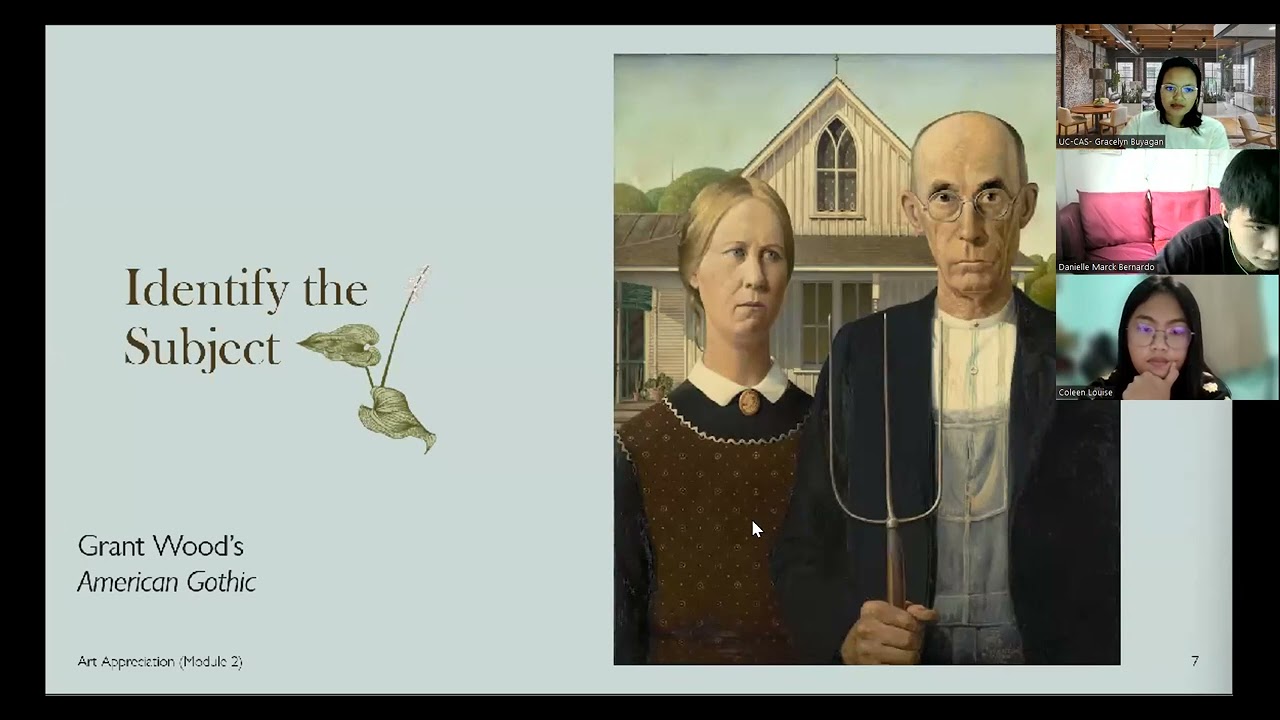
The best-known work of this movement is one that you've previously seen in its originality or as a reinterpretation, Wood's American Gothic.
This painting was awarded a bronze medal at the Annual Exhibition of American Painting held at the Art Institute of Chicago in 1930, and so was immediately disseminated through national newspapers and magazines.
The public began to notice, and in doing so, the movement was launched.
The pristine clarity and meticulous precision we see here are the tools of the Regionalists.
The subjects are real people, Wood's sister and his dentist.
Yet here, their identities go beyond that.
They are archetypes of Midwestern Americans.
A farmer and his daughter, standing outside their 1880s white farmer-style home with a Gothic revival window.
They stand facing us directly, a position inspired by Flemish Renaissance art which would encounter during his travels to Europe.
They are at once real and symbolic, representing the stoicism, resilience, and moral fortitude of small-town America.
In this seemingly simple composition, Wood remarkably conveys the authenticity and the dignity of ordinary people.
Another well-known Regionalism piece is Norman Rockwell's Freedom From Want that was created for the Saturday Evening Post magazine.
This work was part of his Four Freedoms series, inspired by President Franklin D. Roosevelt's 1941 State of the Union address outlining four fundamental human rights; freedom of speech, freedom of worship, freedom from want, and freedom from fear.
In his work, we see a multi-generational family gathered around a table for a holiday meal, with an aproned matriarch presenting a large turkey and the patriarch looking unapprovingly from the head of the table.
Though Rockwell is most commonly regarded as an illustrator that worked in American Realism, he is often associated with Regionalism due to a subject matter of choice.
We see an idealized image of everyday American life, and this reflected the nationalist identity that was shaping the United States during the 20th century.
He uses sophisticated compositional strategies and a keen sense of storytelling to melt the world of fine art and mass media.
Social Realism had a more explicitly political agenda.
This movement is best understood as a continuation of the earlier tendencies like the ones we saw from the Ashcan School.
Artists such as Jack Levine, Reginald Marsh, Isabel Bishop, William Gropper, and Raphael Soyer turned their attention to the realities of city life people often looked away from, documenting the struggles of the working and the lower class, and in doing so, highlighting the failures of governmental and social systems.
This movement was shaped by the optimism inspired by the Mexican and Russian revolutions, the devastation of the Great Depression, and the ominous rise of fascism in the 1930s.
Jack Levine uses grotesque figuration in works like The Feast of Pure Reason to critique political corruption, further cementing Social Realism's role as a critical voice in American art.
Reginald Marshall's etching, Breadline - No One has Starved, done at the height of the Great Depression, shows a line of men waiting for governmental food handouts, giving us a look at the tangible consequences of the period.
In these works, we see the human cost of economic collapse and the decisions made by our governments.
And instead of the nostalgic comfort of Regionalism, these works confront social problems directly.
The geographical movements of Urban and Rural Realism are best understood through the lens of artists like Edward Hopper and Andrew Wyeth, whose works trace the pulse of American anxiety and longing across city streets and open fields.
Edward Hopper, more than any other, captured the isolation of the individual within the modern society.
His imagery of figures within urban settings go well beyond their role as modern cityscapes to expose the underbelly of the human experience.
We can see that in his New York movie painting.
In an almost empty theater, a lone usherette leaning on the wall and holding a flashlight is in deep thought.
Hopper has bathed her in a dramatic shaft of light that splices through the darkened theater auditorium.
The colors are beautiful, rich blues and reds.
The stone gray walls and red seats frame her figure, further emphasizing her quiet detachment amidst the vast empty public space.
So while his oeuvre officially falls within the rubric of Urban Realism, it offers a far more evocative look at life in the United States between the two world wars.
In fact, by stripping away almost any sign of life or movement and adding dramatic means of representation with striking lighting schemes in claustrophobic spaces, Hopper suggests something of the psychological inner lives of his subjects, and in doing so, he led the way towards the principles of Abstract Expressionism.
Andrew Wyeth, one of America's best-known rural Realist painters of the 20th century, created canvases filled to the brim with the mystery of the real world he was a part of.
He rendered landscapes, portraits, and scenes of everyday life in rural Pennsylvania with exacting detail, working primarily in watercolor and tempera instead of the more typical oil or acrylic.
While famous for his astoundingly realist depictions, Wyeth's composition's curious sense of the uncanny, which led some critics to call him a magic Realist.
In his painting, That Gentleman, we feel an eerie stillness, an unsettling tension between presence and absence as we look at the subject without his knowledge.
Tom Clark was Wyatt's elderly African-American neighbor in Pennsylvania.
We see him positioned off-center, occupying the left side of the canvas, while the negative space, an expansive muted wall, claims the right.
A deliberately placed beam of light catches the back of the chair and Clark's right arm and left hand.
The emptiness of the scene, punctuated only by two pairs of scissors hung on the wall and a pair of worn-out shoes, is telling.
It is a room stripped bare of narrative embellishment.
Tom is the only thing that matters.
His quiet dignity, his presence filling the room, even with his face turned away.
This is one of those works that demands slow looking.
At first glance, the scene is subdued, cloaked in darkness and earthly tones, but linger a few moments longer, and every brushstroke becomes charged with understated meaning.
Although he was beloved by a popular audience and for a time to critic establishment, Wyatt's reputation declined in the 1960s as some felt his paintings did not keep up with the times and were not relevant to a contemporary global culture that was ever-changing.
But he refused to stop painting what felt so authentically inspirational to him and continued depicting the rural life he had always known.
The end of World War II was a time of profound transformation in most countries, including the United States, which rose to become a global superpower with a newfound cultural confidence.
Abstract Expressionism, which began in the early 1940s and lasted about 20 years, signaled this new world order by establishing New York as the new epicenter of the Western art world, a role that had previously belonged to Paris.
This was the first distinctly American art movement to gain international recognition.
It emerged from the convergence of American Social Realism and Regionalism, the influx of European modernist ideas brought by emigrating artists and intellectuals escaping World War II, and the collective trauma and existential instability caused by the war.
Abstract Expressionism was not a monolithic style.
It is actually divided into two principal tendencies, Action Painting and Color Field Painting.
Jackson Pollock, Franz Kline, Lee Krasner, and Willem de Kooning fell into the action painting group, who emphasized the physical act of painting as an essential component of the finished artwork.
The process, dripping, splattering, or energetically applying paint, was as important as the finished product.
Pollock's piece, Mural on Indian Red Ground, measuring at 1.8 by 2.4 meters, is a large-scale painting he completed by laying the canvas on the floor and moving around it to drip, fling, and smear paint across the surface.
We see a vivid red background, covered with primarily black, white, and yellow paint that can't help but scream the word spontaneity.
This technique was a radical departure from traditional easel painting and challenged fundamental assumptions about how art should be made.
Color field artists like Clyfford Still, Mark Rothko, and Barnett Newman created planned compositions where the psychological and spiritual effect of color itself was the intent.
Stills' works showcased bold colors in jagged forms.
Rothko turned towards delicate rectangles of color, and Newman created zip paintings, where vertical strips of color intersected large horizontal fields of color.
Then there is Helen Frankenthaler.
She was most closely associated with color field painting, yet also held close the ethos of action painters and their emphasis on the process.
She came up with a new technique of applying art.
Soak-Staining, which we can see in Mountains and Sea, is a method of painting where she would pour thinned paint onto unprimed canvas and would give it time to sew and spread organically.
The final product is luminous flowing fields of color.
As a whole, Abstract Expressionists were united by their belief that art should convey deep emotion, psychological states, and universal themes through abstraction rather than representation.
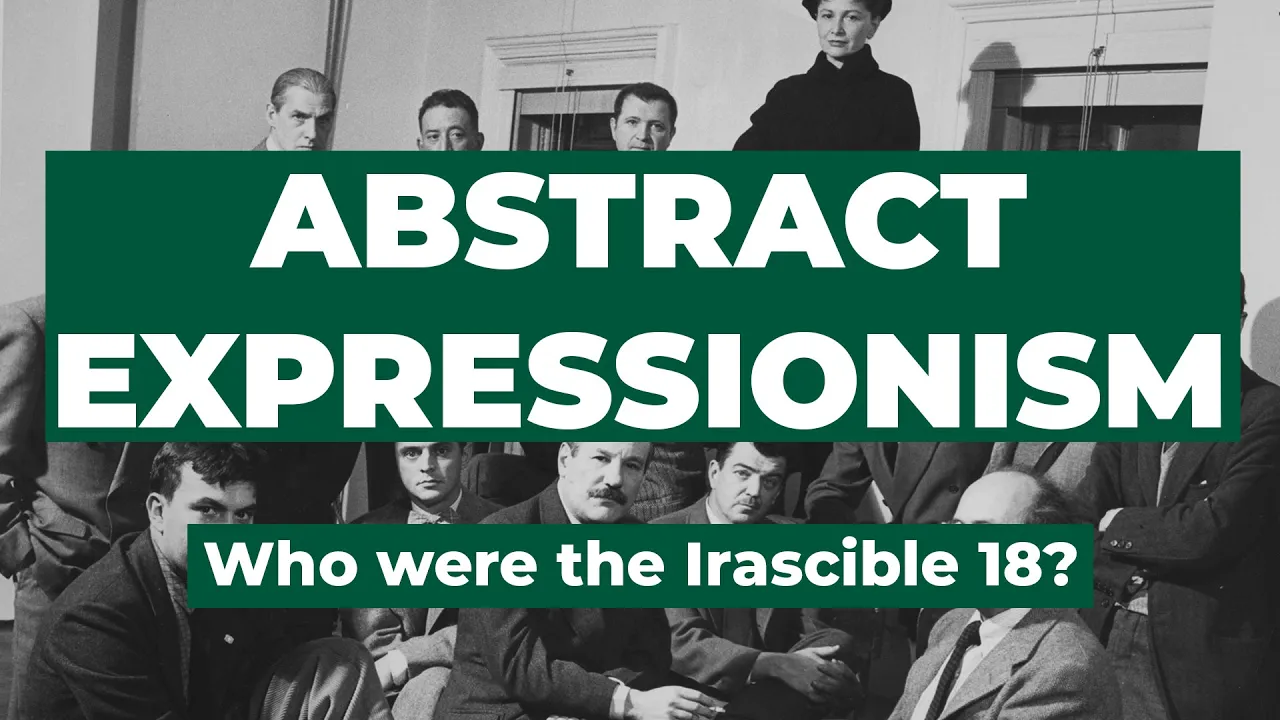
Peggy Guggenheim's exhibition at her "Art of This Century" gallery supported this emerging movement.
It was innovative in both its design and its curatorial approach, as you can see here, and gave young artists such as Jackson Pollock, Mark Rothko, and Clyfford Still unprecedented exposure and opportunities to develop their work.
At the same time, influential art critics like Clement Greenberg and Harold Rosenberg were essential in shaping the public and intellectual understanding of Abstract Expressionism.
They spoke under theoretical frameworks that explained and justified the movement's new approaches, helping to give it legitimacy and international prominence.
Beginning in 1952, the Neo-Data movement developed as a response to the dominance of Abstract Expressionism.
These artists drew inspiration from the earlier Dada movement of the 1910s and 1920s, which rejected conventional aesthetics and embraced absurdity.
However, while Dada was anti-art and anti-meaning, Neo-Dada artists believed in personal meaning, and worked within the art world to expand its boundaries.
They rejected the emotionally charged Abstract Expressionists before them, and instead adopted a more ironic, playful, and sometimes critical approach, both mocking and celebrating popular culture.
They incorporated non-traditional materials and found objects, such as newspapers, fabric, and household items, into their work.
Robert Rauschenberg is known for his “Combines,” which merged painting and sculpture using found objects.
In his piece “Bed” we see a pillow, a sheet, and a quilt mounted vertically on a wall.
It is painted with expressive strokes of paint here, and pencil here.
By using real bedding as both the canvas and subject, a choice that the artist made because he didn’t have a canvas to paint on, Rauschenberg collapsed the boundary between art and everyday life, embodying the core Neo-Dada idea that art could be made from anything and could exist anywhere.
Jasper Johns is another notable artist of the movement.
You might know his familiar series of flag paintings.
He used this subject matter to question the meaning and status of everyday imagery as art.
This movement was the bridge between Abstract Expressionism and later movements such as Pop Art, Minimalism, and Conceptual Art.
Pop Art was an international movement that had begun in Great Britain in 1952, led by the Independent Group which included artists such as Richard Hamilton, Nigel Henderson, John McHale, Sir Eduardo Paolozzi and William Turnbull.
It was fueled by American pop culture viewed from a distance.
The American version however, began to take form in the early 1960s, and was inspired by what American artists saw and experienced living within that culture.
At the same time, the US was becoming more and more consumer-oriented.
Young artists felt that what they were taught in art school and what they saw in museums did not have anything to do with their lives or the things they saw around them everyday.
So they turned to Hollywood movies, advertising, product packaging and comic books for inspiration.
This subject matter in fine art was a novel one, and one that took into consideration commercial aesthetics.
Andy Warhol, Roy Lichtenstein, and James Rosenquist, used images taken from mass media and pop culture to challenge the hierarchies between high and low culture.
They believed that these subjects were as worthy of artistic attention as traditional themes from mythology, religion, or nature.
Unsurprisingly, critics were not immediately on board and viewed it as a joke or a fad rather than a serious movement.
Warhol’s “Campbell’s Soup Cans” consists of 32 canvases, each depicting a different variety of Campbell’s soup.
The repetition and uniformity here reflect the influence of mass production and the ubiquity of branded goods in postwar America.
The movement also introduced commercial techniques like screen-printing and used materials associated with mass production.
It’s important to note that while Pop Artists celebrated consumer culture, they also critiqued it, using irony and satire to question the values of celebrity worship, and the commodification of everyday life.
As Lichtenstein has said, In the early 1960s in New York, Minimalist artists such as Agnes Martin, Dan Flavin, Robert Morris and Frank Stella created works from industrial materials.
This movement once again redefined what constituted as art, but this time through reduction or restraint.
Minimalist artists often rejected traditional art-making methods and materials, opting instead for industrial material and techniques, as a way to remove any visible trace of their artistic hand.
These artworks composed of simple geometric shapes with clean lines and hard edges, lack brushwork, bold colours, narrative, or any emotional content.
The object’s presence and the viewer’s direct experience are the only things that matter.
They embraced the idea that "what you see is what you see," meaning the artwork is simply itself, nothing more, nothing less.
The one element that is integral to minimalist pieces is the placement, scale, and environment in which it’s exhibited.
We are asked to experience the work in relation to the surrounding space.
Influenced by Minimalism's reductive simplicity, came Conceptual art.
Beginning in the 1960s, this movement asserted that the underlying idea, or concept of a piece of art, was paramount.
More important than the artist’s technical skills, the visual aesthetics, or even the materials themselves.
In fact, the execution of creating is often a secondary priority.
Sol LeWitt's "Paragraphs on Conceptual Art" became the de facto manifesto of the movement, and there he wrote "no matter what form it may finally have it must begin with an idea."
And so Conceptual artists used whatever materials best suited their ideas, including text, documentation, photography, installations, everyday objects, and even instructions.
LeWitt’s "Wall Drawings, ” are a great example of this movement.
1,350 wall drawings from the late 1960s until 2007, executed not by the artist himself but by others following his written instructions.
The physical realization could be carried out by anyone, anywhere, at any time.
The artists’s hand or even presence was no longer necessary, redirecting the focus back to the idea or concept itself.
The 1970s marked the beginning of what we call Contemporary Art.
This movement doesn’t fit into a neat little box like many of the ones that preceded it.
It’s diverse, in mediums, techniques, materials, subject matter, and even ideologies and often speak on social and political matters.
Out of the civil rights and women’s liberation movements came a subset of contemporary art; The Feminist Art movement.
Women artists have never gotten the serious attention, and certainly not the serious money that male artists do.
Artists, many of whom were women, began making work that addressed gender inequality, identity, and the representation of women in society.
They wanted to rewrite a falsely male-dominated art history, change the contemporary world around them through their art, intervene in the established art world, and challenge the existing art canon.
The formation of women’s art organizations such as the Art Workers’ Coalition and Women Artists in Revolution was critical in this regard.
These groups advocated for equal representation in museums and galleries, organized protests, and established alternative spaces and publications to support women artists.
Institutional initiatives were equally significant.
Judy Chicago and Miriam Schapiro founded the California Institute of the Art’s "Womanhouse," a performance and exhibition space centred upon female empowerment.
Here, Women artists collaborated and created major installations that explored women’s roles in society.
Chicago’s “The Dinner Party,” is an iconic work within the movement.
This large-scale installation consists of elaborate place settings on a triangular table for 39 mythical and historical guests, celebrating the women that came before, fought, and chieved great success despite the limitations placed upon them.
Other artists, such as Faith Ringgold, used media traditionally associated with women’s work, quilting and storytelling, to highlight the experiences of Black women.
The influence of feminist art extended far beyond its immediate context.
It actively supported and inspired the development of Queer Art, which addressed issues of queer identity and responded to the Gay Pride movement and the AIDS crisis.
It also ushered in an era of identity art and identity politics, foregrounding the experiences of marginalized groups and exposing the systemic inequities they faced.
In 1970s Germany, an artist by the name of Georg Baselitz led a revival of the Expressionist movement of the early 1900s.
Expressionism was a response to the anxiety around humanity’s increasingly discordant relationship with the world and accompanying lost feelings of authenticity and spirituality.
By the 1980s, the resurgence of expressionism, or Neo- Expressionism found its way to the United States.
This movement distanced itself from the emotional detachment of Minimalism and Conceptual art, and instead turned towards the reintroduction of emotion, narrative, and figurative elements.
These works are often quite large in size, shocking at first glance, and are filled vivid colors.
They draw from the artist’s subjective experience, yes, but also look to mythological, cultural, historical, nationalist, and sometimes erotic subject matter.
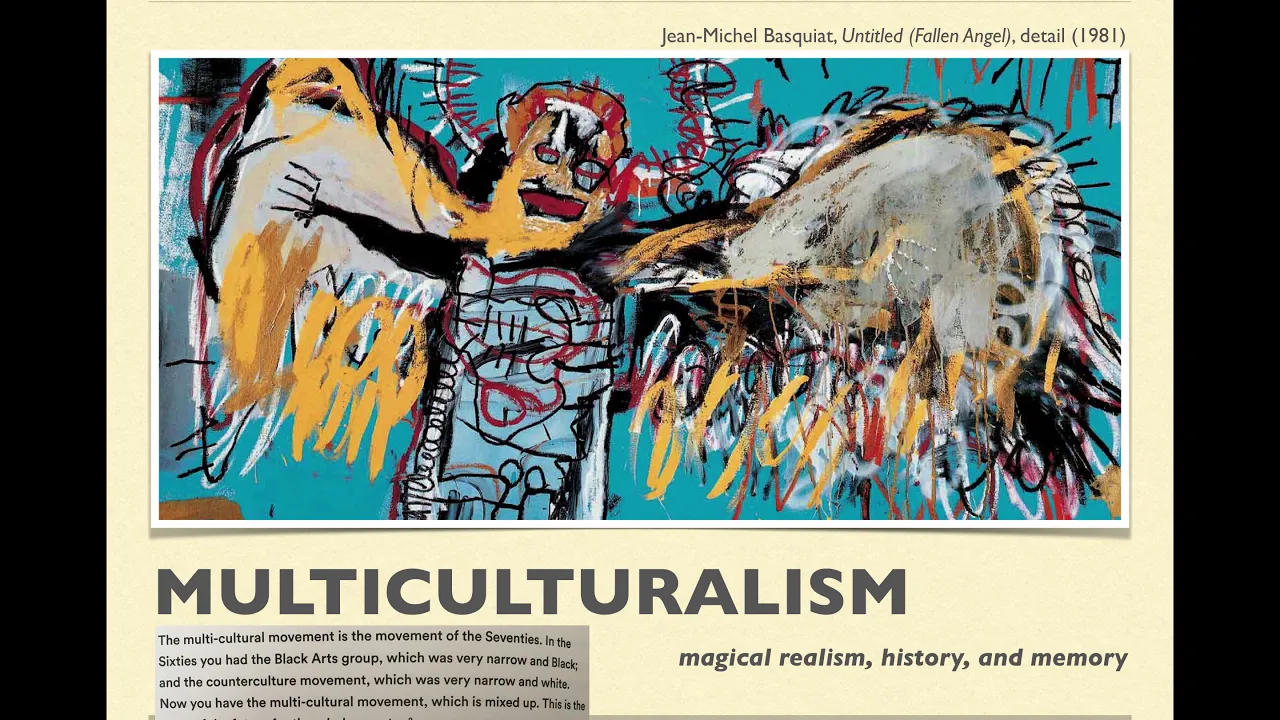
Artists like Jean-Michel Basquiat, and Leon Golub depicted their subjects in an almost raw and brutish manner, using highly textural and expressive brushwork and intense that had been rejected by the immediately preceding art movements.
Basquiat’s "Untitled (Skull)" is large-scale painting measuring at approximately 1.8 by 1.7 metres.
It features a skull-like visage painted in gestural strokes using acrylic, oilstick, and spray paint.
The background is layered with graffiti-like marks, illegible text, and symbols, such as the recurring three-pronged crown that reference Basquiat’s engagement with African-American identity, power structures, and his own mortality.
The artist however has wiped out the hieroglyphs and the crown, leaving us with only hints of meaning rather than a proclamation.
The skull with its bold, vibrant colors and chaotic lines dominates the canvas in a manner that conveys both rawness and a sense of urgency.
Basquiat had the ability to evoke a feeling of anguish and existential anxiety, channeling the complexities and tensions of urban life, particularly as experienced by marginalized communities in contemporary America.
America’s artistic timeline is less a parade of masterpieces and more a record of what Americans have found worth seeing, and sometimes how they wanted to be seen.
It’s a story of feelings, ambitions, accidents, and the occasional stroke of genius.
The art of a time is its emotional weather report and by tracing this progression, we see how artists responded to and shaped the American experience.
Today, the American art scene continues this tradition of transformation, incorporating digital technologies, global cultural influences, and expanded definitions of artistic practice while building upon the foundational achievements of previous generations.
Up Next

Faith Ringgold: Quilting Black Women's Stories & Activism
@FAMSF
52.7K views•2022-08-23

Christian Iconography: History, Theology, and Meaning | Fr. Panayiotis Papageorgiou
@Trisagionfilms
58.8K views•2020-02-21
Ukiyo-e Art: History, Woodblock Printing & Influence
@japanathand
6.3K views•2023-06-08

Earliest Depictions of Jesus in Art: 10 Ancient Images Explained
@UsefulCharts
5.9M views•2022-06-03
Related Study Plans & Knowledge Roadmaps
Structured learning paths in Art History