


![الدولة أركانها ومقوماتها [المحاضرة: 5/24]](https://i.ytimg.com/vi/MOkeoT1ENs8/hqdefault.jpg?sqp=-oaymwEmCOADEOgC8quKqQMa8AEB-AH-BIAC4AOKAgwIABABGGUgVShTMA8=&rs=AOn4CLCinVqcWrfe854Y_AmjesFDGnoA5A)












![지방행정 7-2 [중앙집권과 지방분권]](https://i.ytimg.com/vi/k-mY7kUzAzg/maxresdefault.jpg)










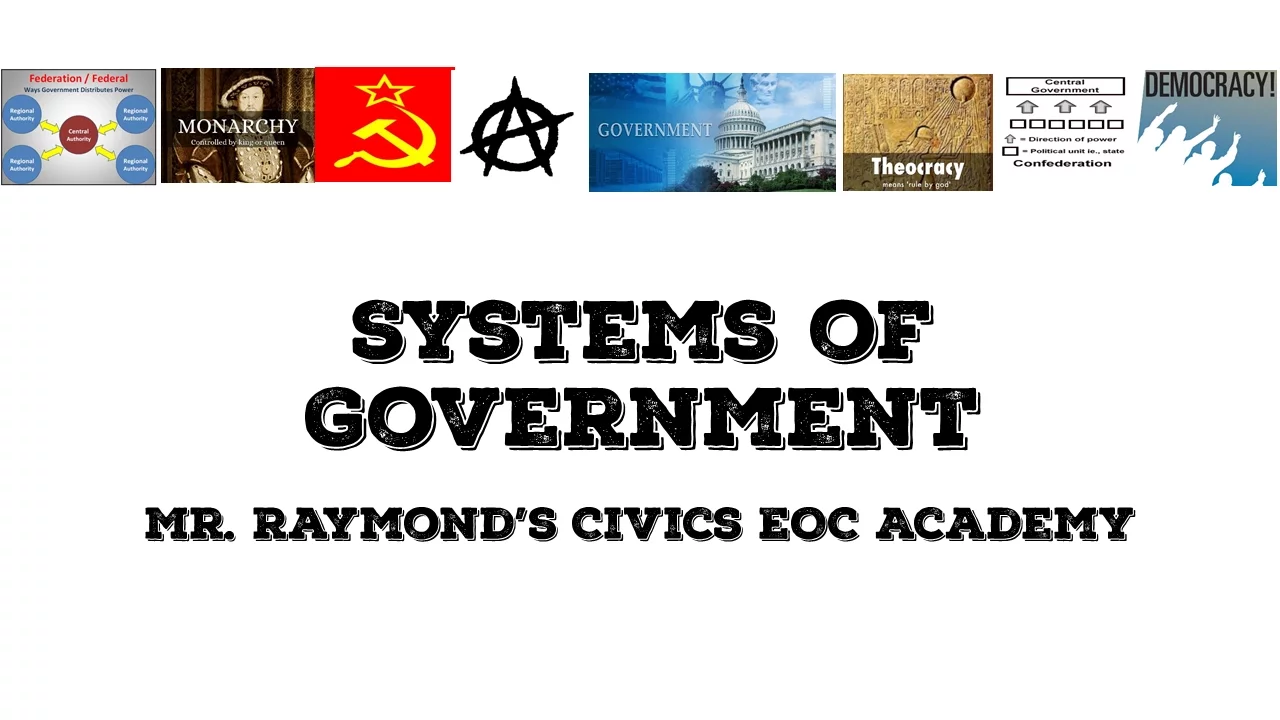
Governments distribute political power through three primary systems: unitary systems concentrate power in a central government (e.g., UK, China, Russia) with minimal authority for subunits; federal systems share power equally between national and state/provincial governments (e.g., USA, Mexico, Nigeria); and confederal systems grant most power to subunits with a weak central government (e.g., historical Articles of Confederation, modern European Union). This distribution can be visualized on a spectrum where unitary systems allocate approximately 90% of power to the center versus 10% to states, federal systems split power roughly 50/50, and confederal systems reverse this ratio.
Unitary, Federal, and Confederal Systems Explained
Added:The basic definition of a sovereign state and how government authority is established.
The concept of political power and the distinction between national (central) and subnational (local) levels of governance.
The difference between horizontal separation of powers (branches of government) and vertical distribution of power (levels of government).
An understanding of what a constitution is and its role in outlining the framework of a nation's government.
Analyzing real-world historical and modern examples of each system, such as the United States (federal), France (unitary), and the European Union or early US Articles of Confederation (confederal).
Evaluating the advantages and disadvantages of centralized power versus decentralized power regarding efficiency, unity, and local autonomy.
Exploring advanced political concepts like devolution in unitary states and the shifting dynamics of federalism (e.g., cooperative, dual, or fiscal federalism).
Examining how the structural distribution of power affects policy-making, crisis management, and the protection of civil liberties.
151.2K views1.7Klikes9:09Original Release: 2014-09-03
systems of government unitary federal and confederal systems they're three very basic ideas that are very complicated in nature and it has to do with what kind of government a country wants to set up so as a general overview when you talk about unitary federal or confederal systems what you're talking about is how political power is distributed between National and smaller governments those smaller governments could be States like the United States they could be provinces they could be cities they could be municipalities they could be counties they could be any smaller unit of government so when you think about systems of government in this way think about how power is distributed between a central government and a smaller subunit now our topic obviously is the United States the United States has has States it also has local governments which are City governments they also have County governments for the purposes of this presentation we're only in our life together and US History we're really only going to be talking about the relationship between the federal government of the United States the national government and the state governments now I use the word Federal the term federal government and national government and I what I mean by them is interchangeable so when I'm talking about the United States government um or I say national government or I say federal government I'm talking about the big government okay the national government so I'm starting off with some definitions of each of the three terms and you might be able to hear my kids in the background they're playing in the hallway um you might be a I'm going to talk about the three different systems and give you a nice um definition and then I have some examples from around the world so a unitary system unitary meaning one is a concentration of political power in a central government with very little power reserved for the subunits or the states examples from around the world have to do with the United Kingdom the United Kingdom is a parliamentary system parliamentary systems are unitary in nature which means that London has in Parliament has all of the power they did back in the days of the American Revolution and they still do now though they are going through a process which kind of interesting called devolving which means they giving power away to the smaller units but they're still considered a unitary system and the Parliament has supreme power over all subgovernments Iran has a central government a centralized unitary system they base theirs on theocracy in this case it's the Quran and and and Islam China is an example of a unitary system of government is one party rule they are governed by the Communist party then the Communist party has all of the Power and all of the power is resides in Beijing Russia is set up very interesting case study actually but Russia is set up a little bit like a federal system but in reality they have a unitary system in that all power resides in Moscow with the Kremlin so there's a definition and some examples of a unitary system of government a federal system of government is a system of governance in which political power is shared between the national government and the subunits or state governments as I mentioned it could be provinces or other units but state governments examples from around the world the United States is a federal government Mexico is a federal government Nigeria is set up as a federal government in the way in which they're structured by their constitutions Nigeria functions differently than a federal system in that the federal government has much more power than the states but in its structure it is a federal system a confederal system is a system of government that spreads power among many subunits such as States and has a weak central government so the Articles of the Confederation set up a government where power was spread amongst the 13 states and left the central government with very little power and therefore created a weak central government examples from around the world there are no confederal systems of government in the world today but the European Union is a good example of one in that it's it's called a supernational organization but the European nations that are a part of the European Union have come together and aligned themselves they like a friendly Alliance and they have a common currency and they have common laws and they have they have a political body Congress that gets together and makes decisions for all subunits but of course all the member nations of the European Union also have an enormous amount of um political power naturally they have presidents and prime ministers and their own uh governments but the European Union is a good example of a modern time of of maybe what could be considered a Confederal System all right so those are the definitions now how does it work well here's a spectrum of of political power of power distribution and I have this this way of explaining power and I what I do is I think of I want you to think of that there only being a 100 units of political power in the world okay so if you're a unitary system a federal system or Confederal System how would you how would it look what would it look like how many units of power would reside in the national government in unitary system versus a federal system versus a confederal system so if you look at the top of the screen unitary system if if you had 100 units of Power 90 units of power would reside with the central government or the national government and only 10 would go to the state government okay so the national has all the power at the center and the state would have state governments would have very little power a federal system if you had 50 100 units of power 50 roughly 50 of those units of power would reside with the national government and 50 units of power will reside with the state government so they're sharing power now the way that plays out a good example in the United States is the way that plays out is the federal government decides how the president of the United States is going to be elected that's in the Federal Constitution however the states decide how the elections are actually going to work and so there's a good example of 5050 some states have set up a system where people do a caucus and some people have a primary and the states themselves decide but the actual election of the president um those rules are decided by the federal government then if you had 100 units of power down at the bottom of the screen there you and you had a Confederal System 10 units of power would reside at the national level and 90 units of power at the state level so a national government in this and a Confederal System had very little real power to govern maybe a lot of influence the European Union works well for this they had a lot of influence But ultimately the member nations can can kind of do what they want to do to a certain extent and the states would have most of the power to govern themselves so a spectrum of power distribution um I like the way that works out I hope that makes sense in your head it's it's a nice way I think of explaining it and then I just have three other slides here um to show you a visual so here's an a visual that Circle the pi represents uh 100 units of power in a unitary system the orange part represents National Power that's 90% And the states only have 10% % as you move from unitary system to a federal system you see the the the green or blue color get much larger and that you have a basic even distribution of power the N national government has has its realm of power and the state government have their realm of power as you move on to a Confederal System you see that all of a sudden the states have an enormous amount of power and the national government less so unit Ary national federal system National Power getting smaller and a Confederal System the National Power is much less B Federal unitary unitary federal confederal okay so I give you all of that information as background background to our debate coming up next week um and I hope that helps give you some idea of how governments can be structured in uh both in the past and in the present and certainly in the future
Up Next
9:14
Federalism Explained: US Government & Politics Crash Course
@crashcourse
3.8M views•2015-02-14

24:30
BRICS Pay and de-dollarization: A New Financial Order Emerges? | 55 chars
@DannyHaiphongYT
164.6K views•2024-10-22

7:33
Government Surveillance Methods: 10 Ways You May Be Watched
@BeAmazed
1.6M views•2017-04-09
10:19
Explaining the Saudi-Iranian Proxy Conflict in the Middle East
@Vox
18.2M views•2017-07-17
Related Study Plans & Knowledge Roadmaps
Structured learning paths in Political Science
political-science
Economic Statecraft: Sanctions & Chokepoints
01Foundations of Geoeconomics and Economic Statecraft
02The Mechanics of Weaponized Interdependence
03International Sanctions: Types, Implementation, and Efficacy
+ 2 more learning modules
12h5 modules
Explore Roadmap
political-science
Central Bank Independence: Politics & Policy
01Foundations of Central Banking and Monetary Policy
02The Time Inconsistency Problem & Inflation Bias
03The Delegation Model and Designing Independence
+ 2 more learning modules
12h5 modules
Explore Roadmap
political-science
Consociationalism: Power-Sharing & Stability
01Democratic Dilemmas in Divided Societies
02Introduction to Consociational Democracy
03The Four Pillars of Consociational Design
+ 2 more learning modules
12h5 modules
Explore Roadmap
political-science
Rebel Governance: Legitimacy, Economy & State
01Foundations of Rebel Governance and Statehood
02Establishing Political Legitimacy and the Rebel Social Contract
03Wartime Economies and Rebel Resource Management
+ 2 more learning modules
14h5 modules
Explore Roadmap