















![[Collisions | видео 1] Крайне неожиданный результат подсчёта](https://i.ytimg.com/vi_webp/ONIXeET4UNE/maxresdefault.webp)




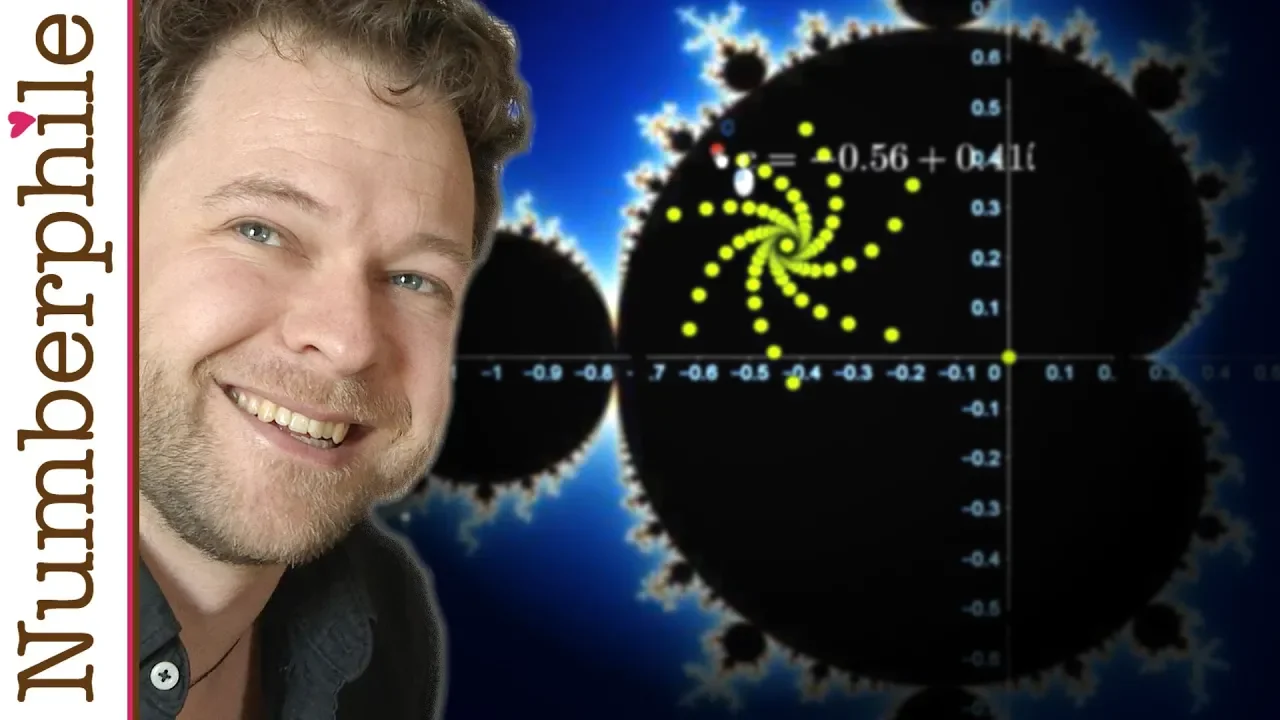
The Mandelbrot set can be used to approximate the mathematical constant pi through an escape-time algorithm: by taking real numbers slightly larger than 1/4 (the cusp point on the real axis) and counting how many iterations of the function z² + c are needed for the result to exceed 2, the escape times converge to pi as the numbers approach the cusp. For example, with epsilon = 1/100 (c = 0.26), it takes approximately 31 iterations to escape, yielding the approximation 3.14, which gets progressively more accurate as epsilon decreases.
Approximating Pi via the Mandelbrot Set | Numberphile
Added:Understanding of complex numbers, their arithmetic, and how they are plotted on the complex plane.
The definition and iterative formula of the Mandelbrot set (z_n+1 = z_n^2 + c, starting at z_0 = 0) and the concept of boundedness.
Fundamental concepts of sequences, limits, and mathematical convergence/divergence.
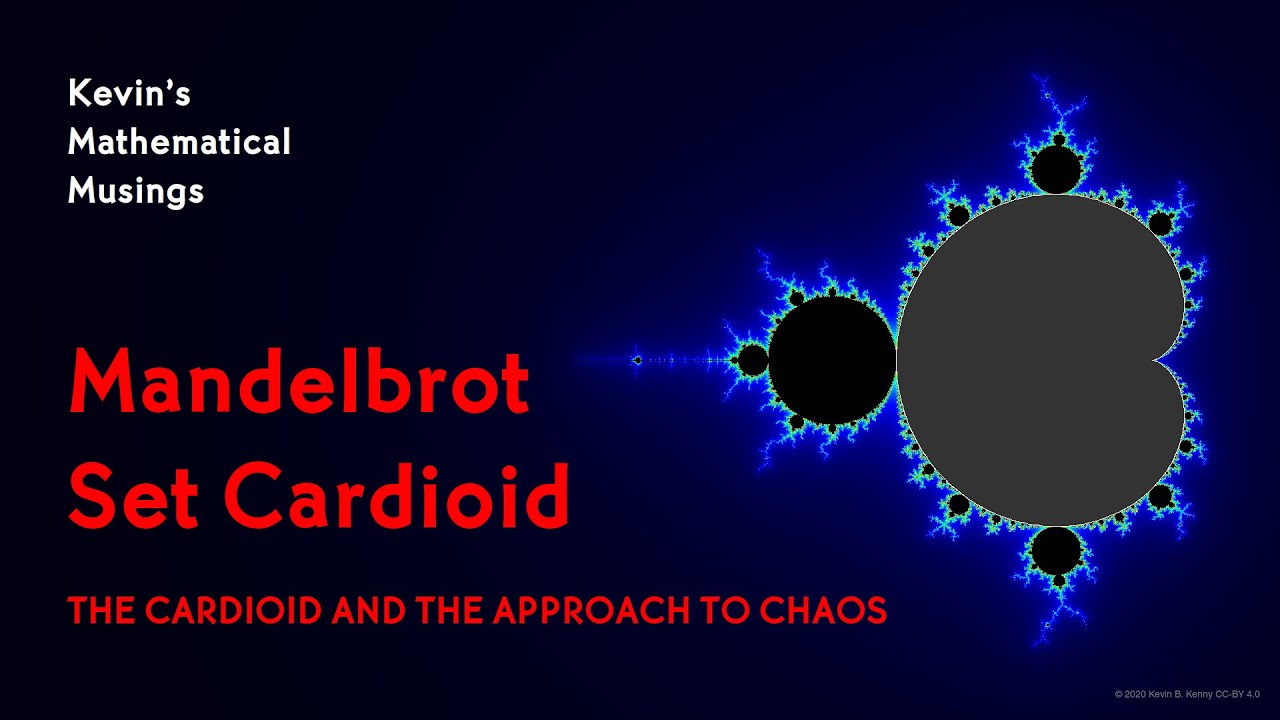
The geometric structure of the Mandelbrot set, specifically the location of the main cardioid and its cusp at c = 0.25.
The formal mathematical proof by Dave Boll and Gerald Shaddix linking the behavior of the cusp's boundary to the value of Pi.
The study of Julia sets and their deep, localized relationship to corresponding points on the Mandelbrot set.
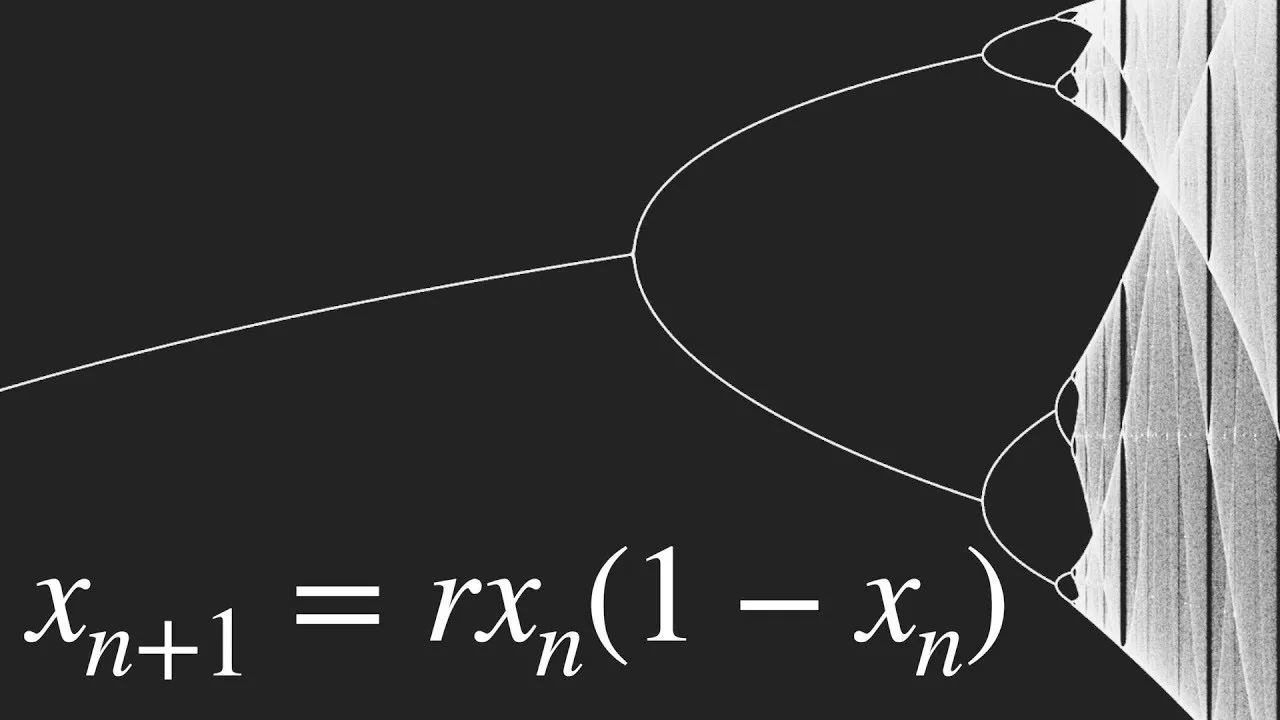
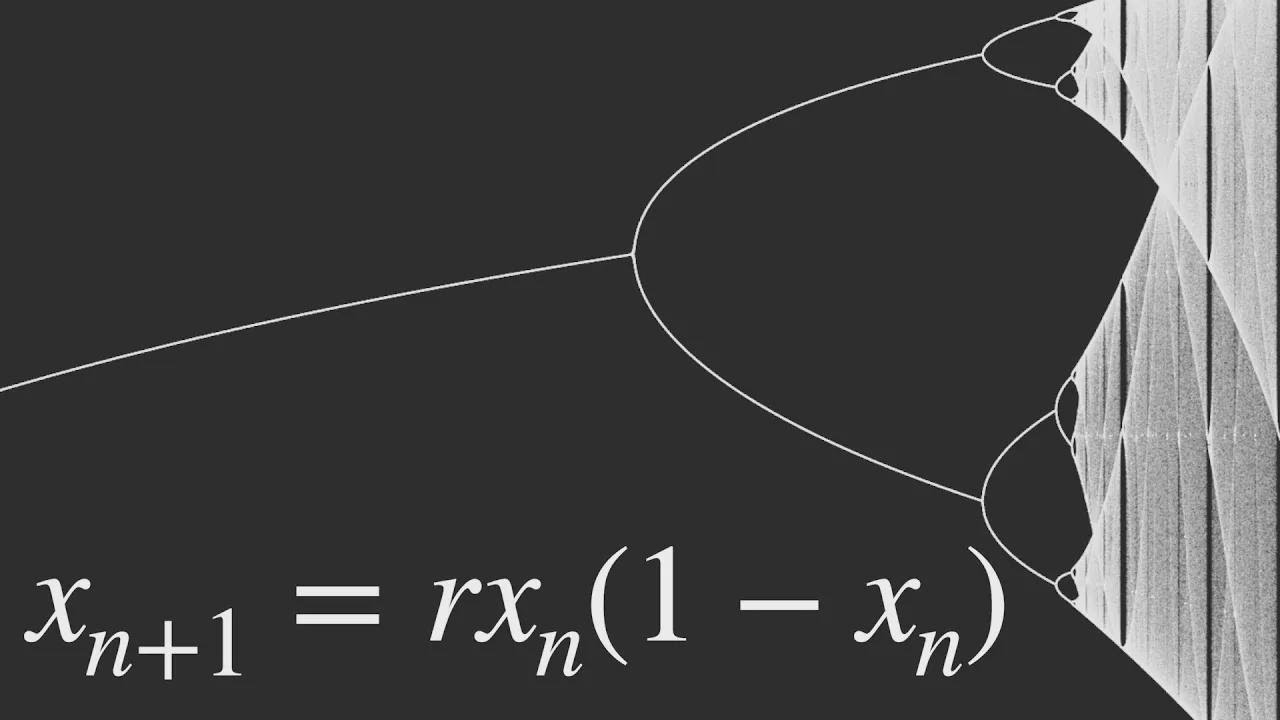
Bifurcation theory and chaos theory, exploring how systems transition from stable states to chaotic behavior.
An analysis of alternative, highly unusual Pi-approximation methods, such as Galperin's dynamical billiard-ball method.
Computational complexity and numerical analysis, comparing the efficiency of chaotic dynamics approximations to modern algorithms like the Bailey-Borwein-Plouffe (BBP) formula.
871.6K views18.7Klikes7:55Original Release: 2015-10-01
HOLLY KRIEGER: So what I want to talk about is what is maybe the least efficient way possible to approximate the number pi.
BRADY HARAN: Well, that's not a good sell!
HOLLY KRIEGER: It's not a good sell but it's really interesting.
So I wanna talk about approximating pi in the Mandelbrot set Maybe it's best to do a bit of a reminder about what the Mandelbrot set is.
So, remember, the Mandelbrot set was this object that we have in the complex plane.
So, here are the real numbers.
And here are the imaginary numbers.
And the Mandelbrot set was a collection of complex numbers, so I'll try and sort of draw a nice version of this here.
And-- it's complicated, right?
And it was this collection of complex numbers that had the property that when we look at the function z squared plus c and we apply it to zero, so zero plugged into this function is c, and then we do that again with the output.
So c plugged into this function is c squared plus c.
And so on.
A number c is in the Mandelbrot set exactly when when we do this process and repeat and repeat and repeat The number stays smaller than or equal to two.
But today I'm not too worried about complex numbers.
I just want to talk about real numbers in the Mandelbrot set.
BRADY HARAN: Does that mean we're just talking about things along the line?
HOLLY KRIEGER: Exactly, exactly.
And in fact I'm just gonna be interested in what happens On this portion of the real line here.
So, one thing that I should say first is that this point, this point is called the cusp of the Mandelbrot set.
And this point is exactly the value where c is one quarter.
BRADY HARAN: That's the last point on the real line-- in that direction.
That's in the Mandelbrot set. And pi is here somewhere presumably.
So pi is not in the Mandelbrot set.
HOLLY KRIEGER: Pi is not in the Mandelbrot set.
That's absolutely right.
And when I say that I'm going to approximate pi in the Mandelbrot set I don't mean I am just gonna approximate pi on this picture here I mean that I'm gonna cook up a bunch of numbers that have to do with the Mandelbrot set that approximate pi.
BRADY HARAN: So you're going to use the Mandelbrot set as a tool.
HOLLY KRIEGER: As a tool to approximate pi, exactly.
And, of course, you know, looking at this you can say "well, it looks like there's a circle in there".
Which, indeed, this is a circle.
Inside of the Mandelbrot set.
But I'm not gonna use that one, that's a little too straightforward of a way to get pi.
So, here's the idea.
What happens if we take a real number That's larger than one fourth.
So, as you said, it's not in the Mandelbrot set.
Right?
And what that means-- let's call this number... Say... uh.... Well, I've already used c, but let's call it c anyways Whatever this number c is, when we start doing this process for this number c, we look at the function z squared plus c and we plug in zero and we output c.
Then we plug in the output and we get c squared plus c, then we plug in that output and so on.
At some point, these numbers are gonna be larger than two.
Right, because that was our restriction that you're not in the Mandelbrot set if these numbers are eventually larger than two.
Okay?
So what we're gonna do is to each number c we're gonna associate this number, say, N of c.
And this is equal to the number of steps of iterating zero under z squared plus c --So exactly the process I was describing before-- Until we get something larger than two.
BRADY HARAN: Any number after the cusp?
HOLLY KRIEGER: Yes.
BRADY HARAN: Is a killer? It's gonna kill the Mandelbrot set?
HOLLY KRIEGER: That's right, it eventually gets big.
BRADY HARAN: The thing you're interested in now is how quickly that number will kill us?
HOLLY KRIEGER: Exactly. And this is something that's totally natural to be interested in This is how people draw pictures of the Mandelbrot set for example, is exactly counting these kinds of steps.
So if we start with the real number c that's larger than two then after the first step of iteration here we get c itself which is larger than two.
And so we know that after just one step that that parameter cannot possibly be in the Mandelbrot set.
So in that case, N of c is just equal to one.
And we have this very small value of N.
BRADY HARAN: And that applies to all numbers above two.
HOLLY KRIEGER: That's right, but as you might imagine, the closer you get into the cusp, the more steps it takes to get larger than two, right?
We're starting with the smaller number here and so it takes more steps to get there.
All right. So let's make this a little bit precise.
We start with a number really close to one fourth, say... Say, c equals one fourth plus epsilon.
Where this is some very small positive and real number.
BRADY HARAN: So we're just after the cusp.
HOLLY KRIEGER: That's right, you're just to the right of the cusp.
On the real axis there. And then we count the number of steps it takes us to escape This is something you can do in, say, you know, Wolfram|Alpha or Sage or whatever.
Can be the program you wanna use. So if you draw a table of how this number N of c depends as epsilon is coming in and getting smaller and smaller, we're coming in towards the cusp with c you can actually count, just by iterating, how long does it take to have a number that's larger than two.
So for example, if epsilon is one, then c is one plus one fourth, which is one point two five.
Then N of c is just two.
It only takes two steps to get larger than two.
BRADY HARAN: Well that was, uh, that was over quickly.
HOLLY KRIEGER: That's right. On the other hand if we take some much more reasonable value of epsilon, say like One one-hundredth, and so c is point two six, say... Then the number of steps it takes to escape turns out to be Thirty, actually.
And if we take epsilon to be, say Even smaller, and so c is even closer to one quarter, then the value we get in that case is three fifteen.
BRADY HARAN: Oh, wow, that's a lot of steps.
HOLLY KRIEGER: It's a lot of steps, right, but we're really close to the cusp here, it should take a lot of steps to escape.
And if we take epsilon even smaller, so that c is even closer to the cusp We get something even better.
Even larger value of N of c.
BRADY HARAN: Ooooh... HOLLY KRIEGER: But you can see something suspicious happening here, right?
BRADY HARAN: I can see it. We can all see it.
HOLLY KRIEGER: Everyone can see it.
So, what's happening here is as long as you put the decimal point in the right place And as you can see, I've changed my epsilon sort of regularly here, so the decimal point kind of moves regularly, too.
As long as you put the decimal point in the right place, these values N of c are actually converging to pi.
BRADY HARAN: That's cool!
HOLLY KRIEGER: Yeah, yeah! So you get these approximations of pi right, okay, three point one five is not such a good approximation three point one four is a little better, it turns out the next one is something like three one four one four.
Which is even better and so on.
And so, this tremendously inefficient method of taking some value of c that's really close to the cusp of the Mandelbrot set and iterating it many thousands of times until you get a number that's larger than two will give you approximates of pi.
Up Next

10:12
How to Calculate Fractal Dimension: A Simple Guide for Self-Similar Fractals
@AshleyMillsTube
42K views•2015-10-29
4:43
Elliptic Curve Cryptography Explained: ECC, ECDSA, ECDH
@PracticalNetworking
28.5K views•2024-10-21
7:42
Understanding Gaussian Curvature Through Pizza: A Mathematical Insight
@numberphile
1.5M views•2016-06-16

6:00
The Mathematical Impossibility of Accurate World Maps
@Vox
23.3M views•2016-12-02
Related Study Plans & Knowledge Roadmaps
Structured learning paths in Mathematics
mathematics
Tensor Calculus: Vectors to Riemann Curvature
01Mathematical Foundations: Linear Algebra & Calculus
02Covectors, Dual Spaces, and Tensor Basics
03The Metric Tensor and Index Gymnastics
+ 2 more learning modules
40h5 modules
Explore Roadmap
mathematics
Gödel's Incompleteness: Logic, Proofs & Limits
01Introduction to Formal Systems & Hilbert's Dream
02Set Theory, Cardinality, and Cantor's Diagonal Argument
03Arithmetization and Gödel Numbering
+ 2 more learning modules
14h5 modules
Explore Roadmap
mathematics
Galois Theory: Fields, Groups & Solvability
01Foundations of Abstract Algebra: Groups & Fields
02Polynomials & Field Extensions
03Splitting Fields & Symmetries
+ 2 more learning modules
24h5 modules
Explore Roadmap
mathematics
Non-Euclidean Geometry: Models & Geodesics
01Euclid's Fifth Postulate and the Birth of New Geometries
02Hyperbolic Space and the Poincaré Disk Model
03Geodesics: Defining Straight Lines in Curved Spaces
+ 2 more learning modules
15h5 modules
Explore Roadmap