Mexican muralism was a 20th-century artistic and social movement commissioned by the post-revolutionary government, led by José Vasconcelos as Secretary of Education, which used public wall paintings to educate all social classes about Mexican history and identity. The movement's three main painters—Diego Rivera, José Clemente Orozco, and David Alfaro Siqueiros—depicted key historical moments including pre-Columbian civilization, the Spanish conquest, Mexican independence, and the revolution itself, reflecting the national identity crisis that emerged after the Mexican Revolution (1910-1920) and Porfirio Díaz's oppressive regime.
Mexican Muralism: Art, History, and National Identity
Added:Deep Dive
Understanding the historical context of the Mexican Revolution (1910-1920), including its social causes and political outcomes.

¡ALERTA!CENSURA RELIGIOSA, PRESOS POLÍTICOS, RIESGO AMBIENTAL, VIOLENCIA Y DEUDA
12.7K
The Mexican Revolution (1910-1920) was the most important social movement of the 20th century, characterized by social and economic inequality, repression, lack of democratic government, and land concentration. Francisco I. Madero proclaimed the Plan of San Luis, calling for armed uprising on November 20, 1910. This revolution established the foundations for modern Mexican democracy and institutions, including the 1917 Constitution.
Click to watch →

Revolução Mexicana
29.6K
The Mexican Revolution (1910-1920) was the first social revolution of the 20th century, representing a culmination of centuries of accumulated contradictions from Spanish colonial rule, French intervention, and American influence. While involving intellectuals and urban workers, 80% of participants were peasants (indigenous and mestizo). Porfirio Díaz maintained power through electoral fraud, army support, and foreign loans from England and the U.S. His modernization expanded railways and ports but intensified social inequalities, with latifundios growing while peasants lived in poverty. Political freedom was severely limited, creating conditions for revolution.
Click to watch →

Revolución Mexicana
207
The Mexican Revolution (1910-1920) was a social and political uprising driven by widespread social injustice, where the wealthy elite enjoyed privileges while common people suffered from hunger, abuse, and inequality; the revolution, led by heroes like Madero, Zapata, Villa, and Carranza, achieved key outcomes including the establishment of the principle of non-reélection to prevent dictatorship, land reform, and the transformation of Mexico into a free and independent nation based on peace, equality, and love.
Click to watch →
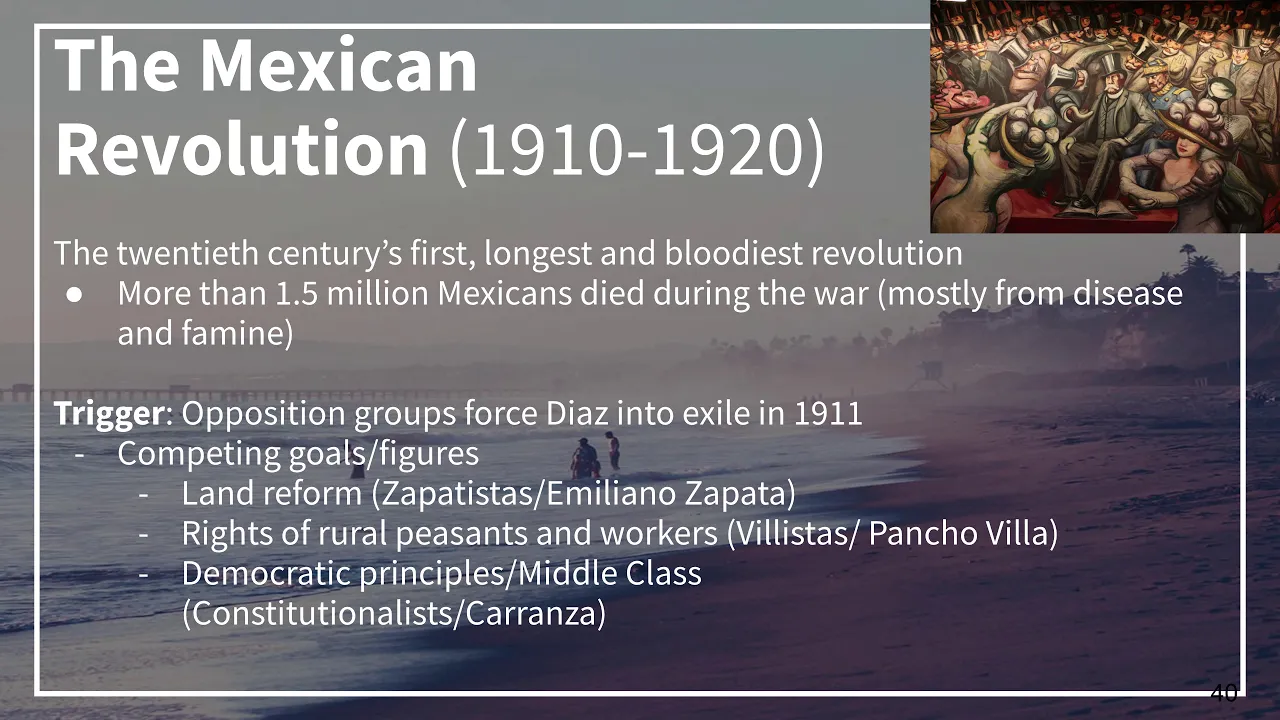
Mexican Revolution (1910-1920)
3.4K
The Mexican Revolution (1910-1920) was a violent decade-long conflict resulting in over 1 million deaths, triggered by the poor population not benefiting from Porfirio Díaz's reforms; it featured three main factions: Emiliano Zapata and the Zapatistas advocating radical land reform for peasants, Pancho Villa seeking rights for both rural peasants and urban workers, and Venustiano Carranza representing liberal constitutionalists who ultimately won U.S. support and drafted the progressive 1917 Mexican Constitution, which included resource nationalization, separation of church and state, worker rights, and moderate land reform, though implementation failed to satisfy revolutionary supporters.
Click to watch →
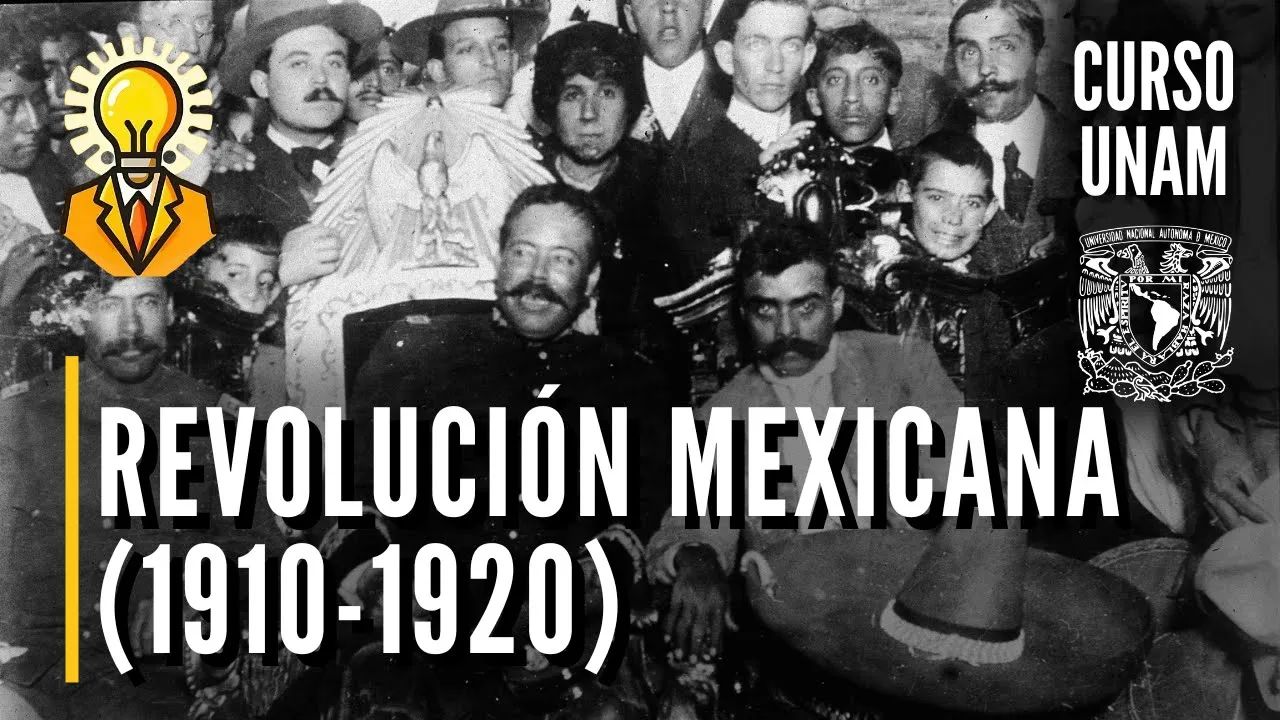
🇲🇽 La Revolución Mexicana (1910 - 1920) | Curso UNAM historia de México | Antecedentes y etapas
137.9K
The Mexican Revolution (1910-1920) was a transformative social and political upheaval that overthrew Porfirio Díaz's authoritarian dictatorship, driven by demands for political freedom, land reform, and social justice. The revolution began with Francisco Madero's Plan de San Luis (November 20, 1910), which called for 'effective suffrage, no re-election.' After Madero's assassination in 1913, Venustiano Carranza led the Constitutionalists to victory, culminating in the 1917 Constitution that established public secular education (Article 3), national ownership of natural resources (Article 27), and labor rights (Article 123).
Click to watch →
Deep Dive
Basic knowledge of pre-Columbian Mesoamerican history (such as the Aztecs and Mayans) and the subsequent impact of Spanish colonization on Mexican culture.
HISTORIA DE MÉXICO: poblamiento, culturas prehispánicas, conquista, Independencia, Revolución
2.4M
The history of Mexico begins with the arrival of the first humans approximately 30,000 years ago, who crossed the Bering Strait and migrated southward through diverse ecosystems. These nomadic hunter-gatherers eventually settled in regions offering abundant resources. Over millennia, complex civilizations emerged: the Olmec civilization (c. 1500 BCE) pioneered monumental architecture and ceremonial centers; the Maya civilization (c. 2000 BCE) developed sophisticated mathematics, astronomy, and hieroglyphic writing; the Zapotec civilization (c. 500 BCE) established Monte Albán as a major urban center; Teotihuacán (100 BCE-600 CE) became one of the world's largest cities; and the Toltec civilization (650-1200 CE) influenced subsequent cultures including the Mexicas. The Spanish conquest of the Mexica Empire (1519-1521) represents a pivotal moment in world history. Hernán Cortés arrived in Mexico with approximately 500 men, exploiting internal divisions among indigenous peoples. Key figures like Gonzalo Guerrero (who integrated into Maya society) and Malinche (who served as interpreter) facilitated Spanish objectives. After capturing Tenochtitlán and holding Moctezuma II hostage, Cortés faced rebellion when his forces massacred civilians during a religious ceremony in May 1520. The subsequent retreat known as La Noche Triste (June 30, 1520) resulted in devastating losses. Cortés regrouped with Tlaxcalteca allies and laid siege to Tenochtitlán, cutting off supplies and attacking from Lake Texcoco. The city fell on August 13, 1521, with Cuauhtémoc captured as the last Mexica ruler. The colonial period established a rigid hierarchical society based on race and birthplace, with devastating demographic consequences: European diseases caused an estimated 90% population decline among indigenous peoples within the first century.
Click to watch →
ESPAÑOLES REACCIONAN a LA VERDADERA HISTORIA DE MÉXICO 🇲🇽😱 *ESTO NO lo CUENTAN en EUROPA*
31.6K
Mexico's history spans millennia, beginning with nomadic tribes 20,000 years ago who transitioned to agriculture. The Olmecs (1200 BCE) established the first civilization with writing and astronomy. The Maya (3rd century CE) developed feudal systems and advanced mathematics. The Aztec Empire (1325) conquered neighboring peoples. In 1492, Columbus arrived, initiating Spanish conquest. Hernán Cortés defeated the Aztecs using indigenous alliances, establishing the Viceroyalty of New Spain. Spanish colonial society featured rigid hierarchies with racial mixing producing criollos and mestizos.
Click to watch →
Esse filme entendeu a cultura mexicana melhor que muita gente…
327
Before European arrival, Mexico was inhabited by sophisticated indigenous civilizations, particularly the Aztecs and Mayas, who possessed enormous cities, advanced religions, and knowledge in astronomy and architecture. Spanish colonization began in 1519 with Hernán Cortés and lasted approximately 300 years. During this period, indigenous culture mixed with European culture, forming many traditions that exist in Mexico today. After independence in 1821, Mexico experienced political instability with divisions between monarchists and republicans, conservatives and liberals. The Mexican Revolution (1910-1920) sought to combat social inequalities and brought agrarian reforms, greater political participation, and new labor laws. The 1917 Constitution established advanced social rights including worker protection, education access, and limits on large landowners, fundamentally transforming Mexican society.
Click to watch →

MEXICO | Así es México | Lindo y Querido
1.6M
Mexico's multicultural heritage spans millennia, with 69 pre-Columbian languages still spoken alongside Spanish. Four major civilizations shaped Mesoamerican history: the Olmecs of the Gulf Coast pioneered monumental architecture; Teotihuacán in the Valley of Mexico became one of the largest pre-Hispanic cities; the Aztecs, most famous for Tenochtitlán, were nearly destroyed during conquest; and the Maya of southern Mexico developed advanced writing systems and enduring architectural marvels. UNESCO recognizes multiple sites: Teotihuacán, Monte Albán, Chichén Itzá (one of the New Seven Wonders), Palenque, and the partially buried Great Pyramid of Cholula. Colonial expansion transformed mining towns like Guanajuato (UNESCO 1988) and Oaxaca (founded 1529) into opulent cities. The cacao trade brought chocolate to Europe, with Tabasco and Chiapas remaining cacao cultivation centers since Maya times.
Click to watch →

LA VERDAD tras la LEYENDA NEGRA de la CONQUISTA de MÉJICO | Juan Miguel Zunzunegui #70
282.6K
Mexico did not exist as a nation before the Spanish conquest. The modern country of Mexico is fundamentally a product of Spanish colonization and integration. Without the Spanish arrival, there would be no modern Mexico as we know it today. The cultural, political, and social foundations of contemporary Mexico were established through the Spanish colonial period. When the Spanish arrived in 1519, many pre-Columbian civilizations in Mesoamerica were already in decline—Teotihuacan had fallen 1,000 years earlier, Monte Albán 1,000 years earlier, Tula 700 years earlier, Chichén Itzá 300 years earlier, and Mayapán 400 years earlier. The Aztec political structure was not an empire but a loose confederation of city-states paying tribute, lacking centralized governance and mutual obligations. The Spanish approach was characterized by integration and alliance-building rather than military conquest, with indigenous peoples making rational strategic decisions to ally with Spanish conquistadors for better outcomes. Moctezuma II reportedly asked Cortés to care for his children upon dying, demonstrating complex personal relationships. The most severe repression of indigenous peoples occurred after Mexican independence, when the population dropped from 60% indigenous in 1821 to 10% in 1921, resulting from policies of the independent Mexican government, not Spanish colonial rule.
Click to watch →
Deep Dive
The concept of 'indigenismo'—the cultural and political movement in Latin America that champions indigenous identity and heritage.
Fernando Diaz Villanueva - Alberto Garín - Patricio Lons - En DEFENSA de la HISPANIDAD
42.5K
Indigenism is a political ideology that emerged in the 19th century among Latin American elites. This ideology romanticized indigenous peoples as noble savages and emphasized their ancient civilizations as equal to or superior to European cultures. The ideology was adopted by various political movements, including leftist movements in the 1960s and 1970s. A notable feature was the deliberate exclusion of Spain from the concept of Latin America, creating a paradox where Spanish-speaking nations defined themselves in opposition to their linguistic and cultural origins.
Click to watch →

16 - Nobleza de sangre: el indigenismo en América Latina - 13.08.21
2K
Indigenism in Latin America is not an authentic movement from indigenous communities but an academic ideology created in the 20th century by intellectuals and the bourgeoisie to defend existing social hierarchies; it falsely constructs 'indigenous' identity as a racial or cultural category when, historically, there were hundreds of distinct pre-Columbian societies that were constantly migrating, conquering, and transforming each other over 4,500 years, meaning true 'indigenous' communities no longer exist as they were fundamentally destroyed by colonialism and capitalism, leaving only fragmented cultural identities that serve to atomize the working class rather than unite it against exploitation.
Click to watch →

Historia del indigenismo
302
Indigenismo emerged as an influential cultural and political movement in the Americas during the late 19th and early 20th centuries. Following the military defeat of indigenous peoples, governments in the United States and Canada implemented reservation policies. In response, figures like John Collier and Manuel Gamio advocated for new approaches to indigenous affairs. The movement gained institutional momentum through the 1938 Pan-American Conference in Lima, leading to the first Inter-American Indigenist Congress in 1940. Manuel Gamio became the first director of the Inter-American Indigenist Institute in 1942, serving until his death in 1960. Culturally, indigenismo produced significant literary works, including Jorge Icaza's 'Huasipungo' (1934), and was promoted by writers such as José María Arguedas, Miguel Ángel Asturias, and Rosario Castellano.
Click to watch →

INDIGENISMO con Pensando la Nación
490
Indigenism is an ideology that originated from European Romanticism, particularly Rousseau's concept of the 'noble savage,' which portrayed indigenous peoples as possessing superior virility and purity compared to 'civilized' Western society. This concept influenced Latin American independence movements and was later adopted by 20th-century leftist movements like those of Carlos Mariátegui and Marta Harnecker, who used indigenous identity as a revolutionary vector to promote communism, anarchism, and autonomism rather than to establish indigenous states. The ideology romanticizes pre-civilized indigenous peoples while promoting hostility toward Western civilization, serving as a political strategy to dissolve colonial unity and create alternative political structures.
Click to watch →
Se Derrumba el Discurso Racista: El Mestizaje y el Indigenismo claves del COLONIALISMO INTERNO
23.5K
El indigenismo fue y es una forma de discursividad nacionalista que la académica Sochileiva del CIESAS ha definido como una ideología paternalista autoritaria. Aunque parece reivindicar a los pueblos indígenas, es una política de Estado para indígenas, pero sin indígenas, que les exalta y los folcloriza en sus identidades culturales. Se caracteriza por retórica de respeto a lenguas y costumbres con práctica de destrucción de estructuras étnicas. Pensamos que los indígenas solo son lengua y costumbres, pero las estructuras étnicas incluyen formas de gobierno. El indigenismo celebra rituales y vestidos, pero mantiene decisiones sobre la vida de los pueblos en gobiernos, sin reconocer territorios ni formas de organización social.
Click to watch →
Deep Dive
Familiarity with the distinction between public art (intended for the masses) and academic or gallery-focused easel art.

Hampshire College • Tashmoo Lecture Series • Joyce Kozloff
606
The artist explains that she approaches public art differently than private work because public art has a much larger and broader audience than work shown in galleries and museums. She wanted to communicate in those public art pieces but didn't want to pander. She wanted to reach out to people and show them things that might be familiar to them but in a different way. This demonstrates how artists consider audience and context when creating work for different spaces.
Click to watch →

Nytt spännande konstverk i Väskinde nya förskola
167
Public art differs from gallery art in several key ways: public art must be durable and withstand frequent use, it is designed for a much larger and more diverse audience, and it is experienced in everyday contexts rather than in dedicated viewing spaces. The artist finds particular value in knowing exactly who their audience is and understanding that their work will impact daily life.
Click to watch →
Art for the Public | Tony Tasset | TEDxUofIChicago
1K
The speaker distinguishes between private art and public art based on their purpose and audience. Private art refers to specialized art learned in academic settings—such as art history, theories, movements like abstract expressionism, modernism, neo-expressionism, and postmodernism—that uses technical language and is typically experienced in galleries or museums. Public art, in contrast, is encountered incidentally during daily life, such as on the way to work, rather than being a destination. The key difference lies in accessibility: private art requires specialized knowledge to appreciate, while public art speaks to wide audiences without requiring prior expertise.
Click to watch →
NSE #340 | Senga Nengudi & Amanda Sroka with Jason Rosenfeld
212
Nengudi distinguishes public art from institutional gallery/museum art. Public artworks exist continuously in everyday life—protecting people at bus stops, waiting patiently for viewers to notice them over years. Institutional art requires deliberate visits with expectations about how to look. Public art represents the ultimate act of generosity because it exists for everyone regardless of whether they seek it out or understand it, unlike museum experiences that may feel exclusive or intimidating.
Click to watch →

Josh Garber
227
Public art differs significantly from gallery work because artists must apply for projects, handle bureaucracy, and deal with liability issues. Public art is often site-specific and requires artists to incorporate client desires, making it more like a commission or teaching position than traditional gallery work. Josh Garber describes public art as requiring artists to wear multiple hats including project manager, accountant, and administrator. While challenging, public art projects can be valuable for artist development because they force artists to think differently and expand their capabilities.
Click to watch →
Prerequisite Knowledge
- Concept 01Understanding the historical context of the Mexican Revolution (1910-1920), including its social causes and political outcomes.
- Concept 02Basic knowledge of pre-Columbian Mesoamerican history (such as the Aztecs and Mayans) and the subsequent impact of Spanish colonization on Mexican culture.
- Concept 03The concept of 'indigenismo'—the cultural and political movement in Latin America that champions indigenous identity and heritage.
- Concept 04Familiarity with the distinction between public art (intended for the masses) and academic or gallery-focused easel art.
Subsequent Learning
- Step 01An in-depth study of 'Los Tres Grandes' (The Big Three)—Diego Rivera, José Clemente Orozco, and David Alfaro Siqueiros—and their unique stylistic and ideological differences.
- Step 02The direct influence of Mexican Muralism on the Chicano Art Movement and political activism in the United States during the 1960s and 1970s.
- Step 03Analysis of how contemporary street art and modern community mural projects globally trace their techniques and social purposes back to post-revolutionary Mexican art.
- Step 04Critical evaluation of state-sponsored art and its complex role in political propaganda, national identity construction, and historical narrative shaping.
Background
Movement Start
National Identity
Conquest & War
Background
0:00Playing Section
- 1
Mexican muralism roots in ancient traditions, distinct from earlier eras.
- 2
Porfirio Diaz's inequality and corruption led to the Mexican Revolution.
The Rupture Generation (Generación de la Ruptura)
While Mexican Muralism is celebrated for its revolutionary spirit, it faced strong opposition from the 'Generación de la Ruptura' (Rupture Generation) in the mid-20th century. Led by artists like José Luis Cuevas and Rufino Tamayo, this movement criticized the 'Big Three' (Rivera, Orozco, and Siqueiros) for establishing an artistic monopoly supported by state patronage. Critics argued that muralism had degenerated into dogmatic, nationalistic propaganda that stifled individual creativity and forced a singular, state-sanctioned version of Mexican identity. La Ruptura championed abstract art, apolitical expression, and cosmopolitanism, challenging the notion that Mexican art must serve a collective, didactic purpose. Additionally, contemporary critics point out that the muralist movement was highly patriarchal, marginalizing prominent female artists like María Izquierdo, and often romanticized indigenous cultures rather than addressing their ongoing systemic struggles.
Deep Dive
An in-depth study of 'Los Tres Grandes' (The Big Three)—Diego Rivera, José Clemente Orozco, and David Alfaro Siqueiros—and their unique stylistic and ideological differences.

Orozco, Rivera, Siqueiros. Mexico, la mostra sospesa
147
The three Mexican muralists—Rivera, Orozco, and Siqueiros—developed distinct artistic styles while sharing a common commitment to social and political engagement. Rivera, who received extensive European education in Paris and Italy, developed a more elegant, symmetrical approach to painting that reflects his training in the European tradition. In contrast, Orozco and Siqueiros, who did not receive such extensive European education, developed more aggressive, expressionistic styles that reflect their direct connection to Mexican reality and their rejection of European artistic conventions. This distinction illustrates how educational background can significantly shape artistic style and how artists can consciously choose to develop artistic identities that reflect their cultural heritage.
Click to watch →

Mexican Muralists: Rivera, Orozco, Siqueiros & Revolutionary Art
105
Mexican muralism emerged after the Mexican Revolution (1910-1920) as a uniquely Mexican art form that celebrated working-class people and indigenous heritage, with three major artists taking distinctly different approaches: Diego Rivera was an idealist communist who optimistically depicted the Revolutionary Trinity (soldier, farmer, factory worker) united and hopeful; José Clemente Orozco, who witnessed revolutionary violence firsthand, was a realist anarchist-syndicalist who depicted the same trinity suffering, divided, and blinded by their own power; and David Alfaro Siqueiros was a modernist experimenter who used industrial techniques like spray paint and projectors, collaborated with other artists, and directly influenced American abstract expressionism, including Jackson Pollock.
Click to watch →

El Muralismo Mexicano: identidad, intencionalidad y filosofía.
225
Diego Rivera (1886-1957) was the most Mexicanist, with his disciples coining much Mexican iconography. As a Communist Party member, he believed in proletarian revolution and material progress. He studied indigenous art and organized the first Mexican popular art exhibition in 1922. For Rivera, painting is creation, not reproduction—speaking truth and interpreting it. He combined love for indigenous Mexico with enthusiasm for industrialized North America, seeking union between both poles. He maximized architectural space integration, using cubic spaces to narrate history as ascending spirals. José Clemente Orozco (1883-1949) viewed freedom as supreme value, maintaining critical distance from political parties. He believed creation starts with conflict, and themes are means, not ends. His tragic aesthetic stems from the impossibility of knowing the absolute. He proclaimed American identity, seeking a new American art. David Alfaro Siqueiros (1896-1974) participated in the 1911 student strike and revolution. Like Rivera, he shared optimism about the future and interest in the proletariat, exalting the revolution with didactic intent. Unlike Orozco, he proposed class struggle, rejected individualism, and exalted collective creation. He proclaimed the aesthetic of the machine and praised speed, coinciding with Italian futurism principles. His technical innovations included using air guns and metallic surfaces, introducing sculpinture, and experimenting with exterior mural techniques. Mexican muralism emerged from a desire to educate senses, taste, intellect, and spirit of individuals and popular populations by painting on public walls where access was casual and free. It created a national school with universal dimensions, animated by humanistic nationalism encouraging all inhabitants regardless of social position.
Click to watch →

Mexican Muralism: Aesthetic & Political Legacies of Los Tres Grandes
6.5K
The three leading Mexican muralists—Diego Rivera, José Clemente Orozco, and David Alfaro Siqueiros—each developed distinctive artistic styles and political ideologies that significantly influenced American art between 1925-1945. Orozco, arriving first in 1927, pioneered expressionistic figuration with angular forms and tragic themes, profoundly influencing Jackson Pollock and other Abstract Expressionists. Rivera, the most prolific and famous, developed soft organic forms celebrating the masses and pre-Columbian heritage, inspiring regionalists like Thomas Benton and later Chicano artists. Siqueiros, the youngest and most technically innovative, introduced experimental techniques including airbrush and cement, establishing a collective workshop methodology that influenced generations of artists. Despite their individual differences, all three shared a commitment to making art accessible to the masses rather than serving elite audiences, a principle that continues to resonate in contemporary community mural movements and socially engaged art practices.
Click to watch →

MURALISTAS vs LA RUPTURA: Una batalla por el arte
273
This segment analyzes the three great muralists and their distinct approaches. Rivera created 'La Noche de los pobres' contrasting with 'La Noche de los ricos,' showing exhausted campesinos resting while hiding cycles of exploitation. Siqueiros transformed the mural into a visual barricade, declaring art that does not position itself neutralizes itself, and attacked art for art's sake as bourgeois privilege. He declared 'No hay más ruta que la nuestra' (There is no other route than ours). Orozco, the least believing in institutional ethics, became an uncomfortable witness to what the revolution omitted. Rather than being a traitor, he was an internal critic who preferred discomfort over obedience, representing workers from expressive strokes, allegory, and illustrated satire.
Click to watch →
Deep Dive
The direct influence of Mexican Muralism on the Chicano Art Movement and political activism in the United States during the 1960s and 1970s.

The Chicano Mural Movement
418
The Chicano Mural Movement was a civil rights movement in the 1960s-70s that used vibrant murals to express political activism and cultural pride for Mexican-Americans, inspired by the earlier Mexican Mural Movement of the 1920s; these murals, often painted on community buildings in California and Texas, featured bright colors and local iconography to depict social struggles and aspirations, serving as powerful tools for cultural identity and political awareness.
Click to watch →

Muralism & Activism with Gina Hernandez | April 7, 2022
163
Muralism emerged as the primary artistic mode for Chicano/Latino social movements in the 1960s-70s, following civil rights activism and increased university enrollment. Unlike poster art requiring institutional support, murals could be created directly on walls, making them accessible to grassroots movements. Art historian Chez M. Goldman describes murals as representing movements rather than mere assemblies of artists. The proliferation correlates with Chicano/Latino population centers, with Stanford serving as one such location where students established belonging through public art. This tradition continues today as murals serve therapeutic, educational, and community-building functions.
Click to watch →

Chicano Park (1988)
286.2K
This section traces the development of Chicano art and the evolution of the Chicano movement from the late 1960s through the 1980s. In the late 1960s, artists established cultural centers for the artistic and political voice of the Chicano community. Many traveled to Mexico to study Aztec murals, returning with new artistic visions. The concept of mural painting profoundly influenced Chicano artists, who began depicting themselves and their communities. Artists noticed the Virgin of Guadalupe was portrayed as passive, so they created positive images using mothers, grandmothers, and themselves as prototypes. Following the park takeover, the community organized to paint murals, facing bureaucratic challenges requiring paperwork and permissions. Despite obstacles, hundreds of people spontaneously painted walls with images representing Chicano experience: the United Farm Workers flag, Aztec symbols of the four directions, Quetzalcoatl the plumed serpent, a Mayan pyramid, La Catrina representing life and death, and the Aztec face symbolizing fusion of Indian, Spanish, and Chicano cultures. This period saw the emergence of community institutions: La Clinica (free clinic), La Escuela (free school), La Estación (youth center), and Toas in Aztlán (artist collective). Politically and culturally, Logan artists traveled to other communities to paint, while artists from elsewhere came to Chicano Park. Artistic collectives developed where artists worked together in groups, sharing and reinforcing ideas and styles. A visual language for Chicano art developed, anchored in pre-Columbian imagery of Aztlán and inspired by Mexican Masters Rivera, Orozco, and Siqueiros. Subject matter came from political issues: farm worker struggles, land rights, and community empowerment. By the late 1970s, spontaneous mural creation ended as committees required artist proposals. Conflicts emerged between male and female artists, with women often relegated to supportive roles despite their contributions. By the 1980s, the national Chicano movement had fragmented. In Bario Logan, activists focused on enlarging the park to the Bay, but years of struggle had taken their toll, weakening organizations and causing some leaders to leave. Despite mixed feelings about continuing involvement, some stayed because letting division continue would set a bad example for children.
Click to watch →

MURALISMO MEXICANO: A ARTE REVOLUCIONÁRIA
26.1K
Mexican Muralism is a revolutionary art movement that emerged in the first half of the 20th century, closely tied to the Mexican Revolution (1910-1920), which sought to address extreme social inequality and land concentration; this movement broke away from academic art traditions by painting directly on public walls instead of using easels and canvases, making art accessible to all citizens rather than keeping it confined to galleries and museums; key artists include Diego Rivera, José Clemente Orozco, and David Alfaro Siqueiros, whose works featured vibrant colors, strong outlines, and themes of Mexican history, indigenous heritage, anti-colonial resistance, and socialist ideology, serving as powerful tools for social critique and political education.
Click to watch →
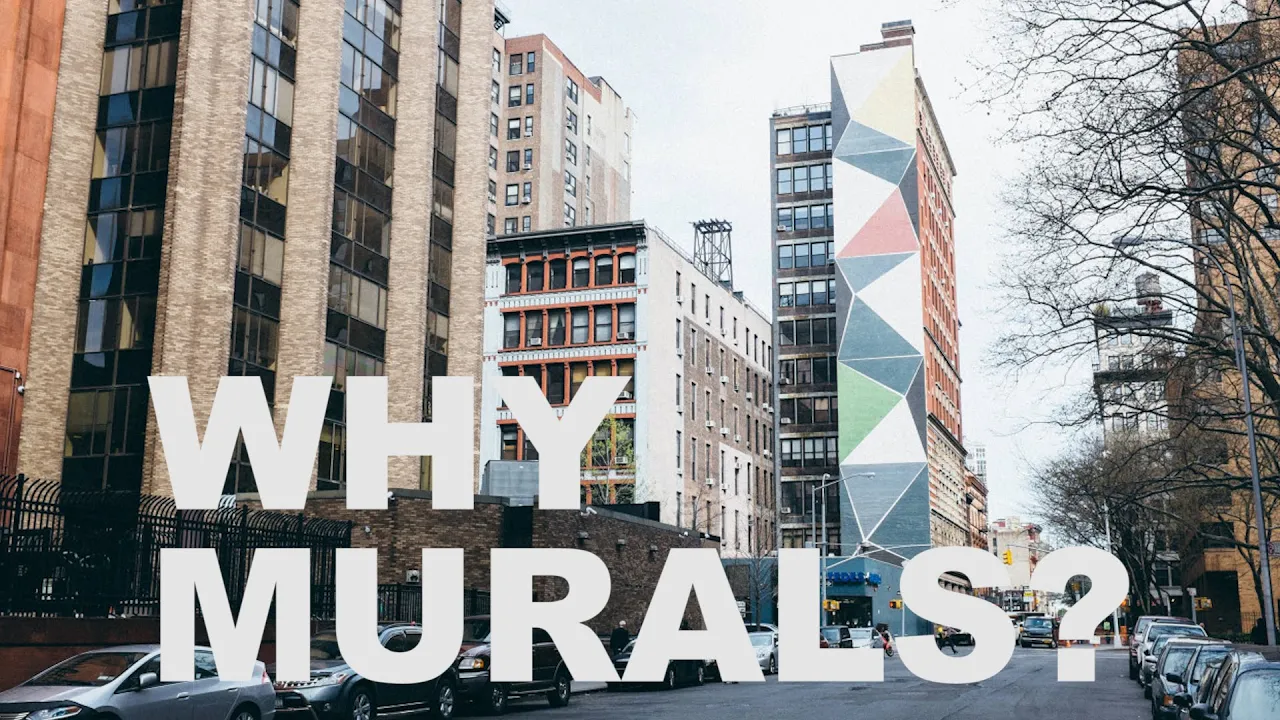
Why Murals? | The Art Assignment | PBS Digital Studios
142.8K
Graffiti and unauthorized street art have produced many great murals and important artistic statements without permission. The Chicano art movement and El Mento movement in the late 1960s frequently represented Mexican-American people in the US and their cultural, economic, and political struggles. This marked a decisive shift in what murals could do, transforming them from government-commissioned national narratives into tools of community activism that highlighted local community values and places.
Click to watch →
Deep Dive
Analysis of how contemporary street art and modern community mural projects globally trace their techniques and social purposes back to post-revolutionary Mexican art.

223. Довге мистецьке відлуння Мексиканської революції (про муралізм та муралістів).
120
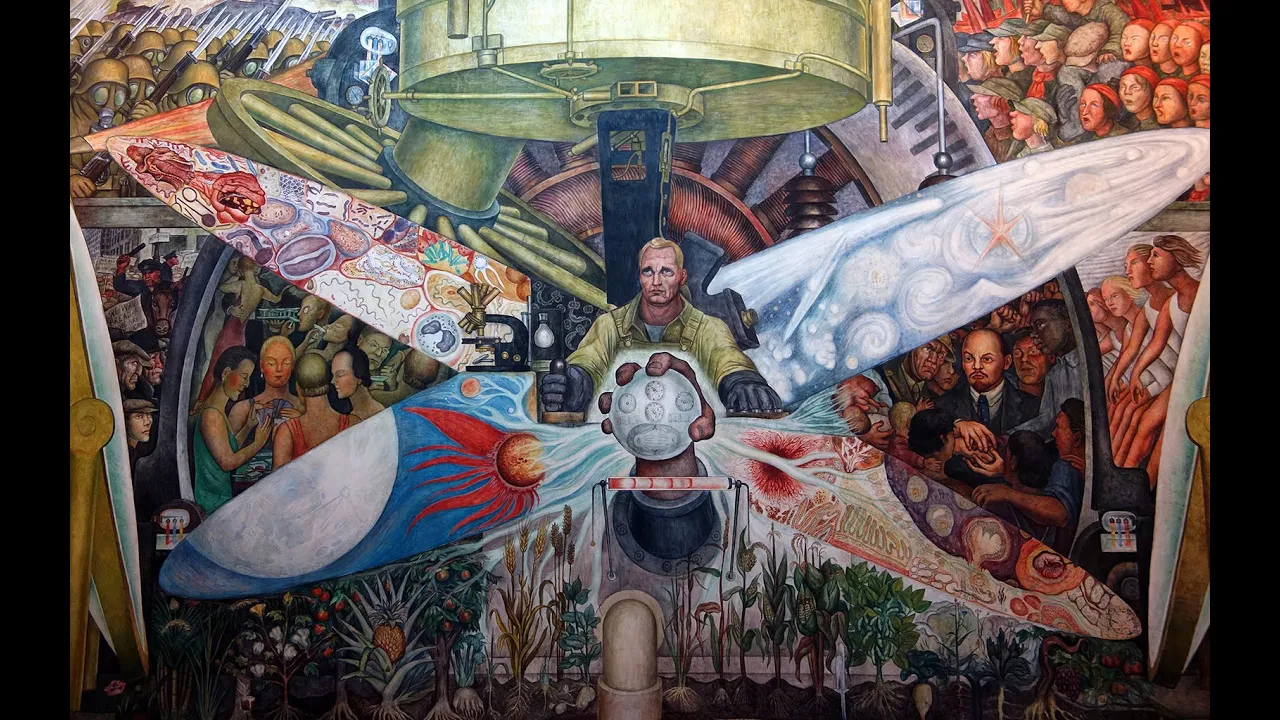
Mexico possesses a remarkable tradition of public art where entire communities participate in creating murals. Streets in small towns are decorated with colorful painted designs featuring unified artistic concepts, with hundreds of people from children to elderly working together. Muralism is an art movement that originated in Mexico in the early 20th century following the Mexican Revolution, initiated by artists and intellectuals seeking to create art serving social and political purposes. The Mexican Revolution (1910-1920) was driven by growing demand for genuine social change and radicalization of protest demands, including calls for social, political, and economic revolution. Metis, middle, and lower classes united against dictator Porfirio Díaz. When Álvaro Obregón came to power, significant changes were implemented: over 3 million hectares of land were redistributed to peasants, educational programs were improved, and funds were created to encourage the arts. In 1921, Obregón appointed José Vasconcelos as Secretary of Public Education, who implemented reforms to improve education for the masses, launching programs to build rural schools and libraries and making classic world literature widely accessible. In 1906, Gerardo Murillo returned to Mexico from Western Europe and adopted the indigenous name 'Atl' (meaning 'water' in Aztec). From 1875 to 1964, Atl addressed students with a manifesto calling for a new Mexican painting. As an expert in ancient Mexican art from the colonial period, he advocated for monumental painting incorporating achievements from Mexico's indigenous past and Italian Renaissance examples. His followers established an artistic center in October 1910, but the Mexican Revolution began and these attempts remained unrealized. During the revolution, students who supported the revolution organized mass strikes. Military coups interrupted discussions about academic art. After General Victoriano Huerta's coup, many activists joined Obregón's revolutionary army. In 1913, in the newspaper 'Avant-garde' edited by Atl, drawings by José Guadalupe Posada began to be published, forming the graphic series 'Mexico in Revolution.' Artists who were soldiers began printing revolutionary-themed posters called 'Mural de Papel' (paper murals), which gave the new art movement its name. The Mexican tradition of mural painting dates back to the Olmec civilization, considered the first in Mesoamerica. Colonial-era murals primarily served evangelization needs, often lacking artistic value. The modern tradition began in the 10th century and increasingly focused on socio-political themes. Juan Carder was the first to address philosophical themes in his art, though the church remained the primary patron. President Porfirio Díaz supported the San Carlos Art Academy and sent Mexican artists abroad, but his ideology focused on modernizing Mexico according to European models, leaving the general population outside this process. Doctor Atl was one of the first modern artists who believed Mexican art should reflect the Mexican way of life rather than imitate Europe. Understanding that government-subsidized galleries commissioned works from the ruling power, Atl's supporters demanded public buildings for their works. They also organized independent exhibitions where indigenous artists developed national themes in colored sketches, which later influenced the stylistics of muralism. The graphic works of José Guadalupe Posada, who created social and political caricatures often mocking European style, also contributed to this movement. With the start of the revolution, a group of intellectuals emerged in the anti-Porfirian opposition, including Antonio Caso, Alfonso Reyes, and José Vasconcelos, who advocated for populist philosophy combined with social and political criticism, influencing the next generation of muralists. In 1922, the Revolutionary Syndicate of Technical and Art Workers was formed. This period saw revolutionary movements in Russia and Europe expressing socialist ideas through artistic methods and attempting to attract woodcarvers, weavers, and folk artists whose work was not considered true art. These folk artists were seen as a connecting link capable of spreading muralism ideas among the broadest masses. The group established the publication 'El Machete,' accessible to both urban and rural populations. From 1923, muralists became known both in Mexico and internationally. The three great muralists—Diego Rivera, José Guadalupe Posada, and David Alfaro Siqueiros—continued their work under the patronage of the Ministry of Education until its replacement, though support continued only for Rivera. One of the most famous murals was 'Man at the Crossroads' for Nelson Rockefeller, intended as a collaborative work by Picasso, Matisse, and Rivera. The patron imposed conditions on the color scheme, leading all three to refuse. Rivera took over in 1934 and convinced Rockefeller to change from a three-color palette to polychrome. The composition included figures of Darwin, Marx, Engels, Trotsky, and Lenin as a central figure, allegorically depicting capitalist exploitation. When the figure of Lenin appeared, the press called it communist propaganda, and Rockefeller requested its removal. Rivera's refusal led to his exclusion, and the mural was destroyed and replaced. Art critics identify distinctive features of Mexican muralism: political engagement, direct presence in official and mass discourse, visual presence sometimes in provocative forms, development of social themes, influence of socialist realism aesthetics, and the artists' desire to influence the consciousness of the broadest masses. Muralism was characterized by rejection of the idea of art for the chosen few and a desire to create for the broadest masses of workers. While it is clear that ordinary Mexicans knew their artists much more than in other countries, the depth of their knowledge and the forms in which they received it remain subjects of ongoing research. Muralism significantly changed how Mexicans thought about the indigenous component of their heritage and their present. For example, President Benito Juárez, a pure Zapotec Indian, wrote about his parents belonging to a 'primitive tribe' with primitive cultural views. The idea of expressing political and social ideas through painting profoundly influenced many artists beyond Mexico, particularly in the United States, where some artists specifically came to Mexico's art studios. Under the influence of muralists, various forms of Mexican folk art became popular. Their creators, often simple farmers or craftsmen from small towns, received support and numerous commissions. Their works filled museum collections and exhibition spaces, and today Mexico has many exhibitions of folk art. Diego Rivera was born on December 8, 1886, in Guanajuato, Central Mexico. He received artistic education at the San Carlos Academy of Arts in Mexico City, where his academic success earned him a scholarship to study in Europe. He briefly studied in Madrid and from 1909 in Paris, where he met Picasso, Ehrenburg, and Madeline. He lived in Spain, Belgium, Netherlands, Great Britain, and Italy, but spe
Click to watch →

🟡 Mural "Alegoría de la Virgen de Guadalupe" Fermín Revueltas | Muralismo mexicano historia
406
Mexican muralism served as powerful political and social commentary during the post-revolutionary period. Revueltas' work exemplifies how art addressed contemporary issues: the mural celebrates indigenous, Afro-descendant, and campesino communities while positioning the Virgin of Guadalupe as protector of marginalized groups against Catholic conquistador symbolism. The artist signed his work with the hammer and sickle, representing the Sindicato de Obreros Técnicos Pintores y Escultores, establishing 'marxismo guadalupano'—combining Marxist ideology with religious themes. This represented a proclama for collective public art against individualism. The technique of caustic painting enhanced color vibrancy, reflecting both international influences from Chicago and national folk traditions like pulquería paintings and exvotos.
Click to watch →
Ángulos: Fernando González Gortázar (Parte 1)
2.5K
Street art represents a second stage in the evolution of public art following the Mexican muralist movement. While muralists had political, didactic, and educational intentions, they taught us to see art as a collective value belonging to everyone rather than being confined to museums or mansions of the powerful. Street art takes this further by bringing art directly to the streets where people live, transforming everyday life through artistic intervention.
Click to watch →
MURALISMO MEXICANO: A ARTE REVOLUCIONÁRIA
26.1K
Mexican Muralism is a revolutionary art movement that emerged in the first half of the 20th century, closely tied to the Mexican Revolution (1910-1920), which sought to address extreme social inequality and land concentration; this movement broke away from academic art traditions by painting directly on public walls instead of using easels and canvases, making art accessible to all citizens rather than keeping it confined to galleries and museums; key artists include Diego Rivera, José Clemente Orozco, and David Alfaro Siqueiros, whose works featured vibrant colors, strong outlines, and themes of Mexican history, indigenous heritage, anti-colonial resistance, and socialist ideology, serving as powerful tools for social critique and political education.
Click to watch →
Frida Kahlo: Life and Works
29.8K
After the Mexican Revolution, mural painting became one of the primary vehicles for representing new revolutionary ideals to an illiterate population. The Mexican Revolution's population benefited largely from illiterate workers and farmers, making visual art essential for communication. Mural painting, which had been used in Renaissance Italy, was adapted to show everyday Mexicans including workers and farmers. This democratized access to revolutionary ideals and established muralism as a key component of modern Mexican identity.
Click to watch →
Deep Dive
Critical evaluation of state-sponsored art and its complex role in political propaganda, national identity construction, and historical narrative shaping.
РУКОЖ*ПЕ мистецтво на рф-болотах: як ДЕГРАДУВАЛА "вєлікая культура"? I ДАМО ПО МОРДОРУ #22
46.2K
Modern Russian art objects created in the last 10 years are characterized by poor quality and lack of artistic merit. The speakers express that viewing these objects does not produce admiration or aesthetic appreciation, but rather a sense of something being fundamentally wrong with them. Russia spends enormous amounts of money on materials like bronze, paint, mosaics, metal, and gypsum for art objects, yet the execution is poor. The speakers argue that artists are recruited from the streets without proper skills, and approximately 95% of funds are embezzled while only 5% is used for actual artistic work. In 2014, Russian military forces occupied Crimea without wearing recognizable military insignia, wearing only green camouflage. President Putin initially claimed there were no Russian forces in Crimea, denying Russian involvement in the occupation. This demonstrates how political leaders can use deception to conceal military operations and manipulate public perception. Art objects can be used to manipulate political memory and create false historical narratives. The speakers describe how monuments are created based on fabricated stories that authorities invent and then materialize through physical objects. This process creates an illusion of historical authenticity while actually spreading propaganda and manipulating collective consciousness. Russia implemented state-sponsored graffiti programs to promote patriotic messaging through public art. The government launched projects to decorate thousands of buildings with pro-Russian graffiti, transforming what was previously considered unauthorized street art into a state-sanctioned propaganda tool. This demonstrates how political systems can co-opt artistic movements to serve ideological purposes.
Click to watch →

Коментар каналу "Київ" до Дня української державності
11.8K
Russia employs systematic propaganda techniques to promote its historical narrative, including the conflation of terms like 'Rus' and 'Russia' and the use of 'Україна' as 'окраїна' to diminish Ukrainian identity. These techniques rely on emotional appeals and general statements rather than specific historical facts. Russia has established state-sponsored academic projects, such as the 'History of Russia' series led by Patrushev, which produce multi-volume academic histories violating standard historical principles. These publications present a narrative of Russia's 'millennium-old continuous history' beginning on the Dnieper banks, despite archaeological evidence showing that 9th-century cultures described were not located on modern Russian territory.
Click to watch →

【北村弁護士】北村晴男が外務大臣を告発しました!日本人は必ず見てください!
1.7M
This segment explores how governments use education and media to shape national identity and international perceptions. The Chinese Communist Party's systematic propaganda teaches distorted historical narratives about the Second Sino-Japanese War, portraying the CCP as liberators while the Kuomintang was the actual resistance force. This manipulation creates generations of citizens with biased views of other nations. The segment also examines how surveillance of emigrants and tourists enables intelligence gathering and cultural influence operations, demonstrating how states can extend their ideological reach beyond their borders through controlled information flows.
Click to watch →

ВЕЧНОГО Путина ВАМ МАЛО? О чём мечтают УРА-ПАТРИОТЫ, поставленные на КОЛЕНИ — Гражданская оборона
1.1M
The video analyzes how Russian state media systematically creates and promotes patriotic narratives through music, art, and public displays. The video describes how artists like 'Shaman' (Yaroslav Drozdov) were developed through state projects like Golos Russia and signed with Atlantic Records Russia to create state-approved cultural content. The video argues these songs contain generic patriotic slogans 'pushed from above' and mixed with music. The video also discusses how Russians are increasingly reluctant to identify as Russian due to international isolation, claiming they avoid using Russian abroad and wear Ukrainian flags as protective amulets. The video presents this as a crisis of national identity where citizens feel unwelcome internationally and self-censor their national identity.
Click to watch →

«Бандера не наш»: псевдоісторичні байки Яневського | Рагулі
49.2K
This segment examines how state policies construct national identity. The speaker discusses Ukrainization under Lazar Kaganovich (1927-1929), claiming academic sources attribute the greatest achievements of Ukrainization to this period. The analysis suggests that national identity can be constructed through state-sponsored cultural policies rather than organic development, and that such policies may serve political elimination rather than genuine cultural preservation.
Click to watch →
Background
Movement Start
National Identity
Conquest & War
Background
0:00- 1
Mexican muralism roots in ancient traditions, distinct from earlier eras.
- 2
Porfirio Diaz's inequality and corruption led to the Mexican Revolution.
The Rupture Generation (Generación de la Ruptura)
While Mexican Muralism is celebrated for its revolutionary spirit, it faced strong opposition from the 'Generación de la Ruptura' (Rupture Generation) in the mid-20th century. Led by artists like José Luis Cuevas and Rufino Tamayo, this movement criticized the 'Big Three' (Rivera, Orozco, and Siqueiros) for establishing an artistic monopoly supported by state patronage. Critics argued that muralism had degenerated into dogmatic, nationalistic propaganda that stifled individual creativity and forced a singular, state-sanctioned version of Mexican identity. La Ruptura championed abstract art, apolitical expression, and cosmopolitanism, challenging the notion that Mexican art must serve a collective, didactic purpose. Additionally, contemporary critics point out that the muralist movement was highly patriarchal, marginalizing prominent female artists like María Izquierdo, and often romanticized indigenous cultures rather than addressing their ongoing systemic struggles.
Understanding the historical context of the Mexican Revolution (1910-1920), including its social causes and political outcomes.
Basic knowledge of pre-Columbian Mesoamerican history (such as the Aztecs and Mayans) and the subsequent impact of Spanish colonization on Mexican culture.
The concept of 'indigenismo'—the cultural and political movement in Latin America that champions indigenous identity and heritage.
Familiarity with the distinction between public art (intended for the masses) and academic or gallery-focused easel art.
An in-depth study of 'Los Tres Grandes' (The Big Three)—Diego Rivera, José Clemente Orozco, and David Alfaro Siqueiros—and their unique stylistic and ideological differences.
The direct influence of Mexican Muralism on the Chicano Art Movement and political activism in the United States during the 1960s and 1970s.
Analysis of how contemporary street art and modern community mural projects globally trace their techniques and social purposes back to post-revolutionary Mexican art.
Critical evaluation of state-sponsored art and its complex role in political propaganda, national identity construction, and historical narrative shaping.
1.8K views18likes6:52@englishandmodernlanguagesc1480Original Release: 2020-06-23
in this video we are going to talk about Mexican muralism. Mexico has had a great tradition of painting on murals, starting during the Olmec civilization on pre-columbian times and also after the Spanish conquest during colonial times but in this video we are going to focus on one specific movement--artistic and social movement--that took place during the 20th century, A little bit of historical background: Porfirio Diaz was president of Mexico at the end of the nineteenth century and beginning of the 20th century. He was greatly criticized because of the great disparity between the rich and the poor, exploitation of workers, and the fact that he was always favoring European culture and seems to be ashamed of his own culture and didn't value Mexican culture and also there were some allegations of electoral corruption that allow him to stay in office for a long time this situation led to the Mexican Revolution between the years of 1910 and 1920 the main goal was to overthrow Porfirio Diaz but also to implement social and economic changes. Our relevant time begins now at the end of the Mexican Revolution the first president after the Revolution was a Alvaro Obregon, and he put Jose Vasconcelos as a Secretary of Education. Jose Vasconcelos was an advocate of education through public art and he commissioned the creation of paintings on government buildings; that is, he paid painters to paint on the walls of government buildings. Mexican muralism is both an artistic and social movement and it was commissioned by the government that resulted from the revolution for that reason muralism Mexican muralism reflects the ideals of the Mexican Revolution. Why paint on walls and not on paintings like in a regular museum?
muralism-- paintings on murals -- give access to all social classes to culture and also serves a purpose to educate the people. The main painters of this movement are diego rivera jose clemente orozco and David Alfaro Siqueiros.One of the most important themes of this movement was reflection about Mexican identity This was the time of crisis in the national identity of Mexico so it was a time to ask who are we as Mexicans and what does it mean to be Mexican. And where do we find answers to this question of the national identity? Usually history is a good place to start so what are the important and key history moments events and people in Mexican history? we might begin with pre-columbian past the life of indigenous peoples of the Americas until the arrival of Christopher Columbus. Also Spanish conquest was a key moment in the making of the Mexican identity. Also Mexican independence from both Spain and France and Mexican revolution. Here we can see an example of a painting depicting pre-columbian life by Diego Rivera called Mercado de Tlatelolco. It's a market and here we can see people that challenge the idea of indigenous people as savages on the contrary here we see civilization and we see peace. Here we have two different paintings that show a different view of pre-columbian life. Diego Rivera again showing civilization, peace, work, colaboration,... On the other side, we see a painting by David Alfaro Siqueiros that shows an Aztec sacrifice. This doesn't mean that Alfaro Siqueiros continue with the idea of Aztecs as savages. What happens is that David Alfaro Siqueiros was the most radical of the three muralist and he always saw or showed the most raw image of everything that he depicted he was the most critical and we see through images of the Spanish conquest also seeing different perspectives David Alfaro Siqueiros again showing the most raw moments showing the spaniards torturing Cuauhtemoc the last Aztec emperor while jose clemente orozco is showing a different image he's showing Hernan Cortes the spanish conqueror and Malinche who was an indigenous interpreter. Mexican independence another important time in history here we see two paintings by jose clemente orozco one of benito juarez was the leader of the mexican independence from France and another one of miguel hidalgo the leader of the mexican independence from spain and finally we see two paintings about the mexican revolution one is called revolucion mexicana by Diego Rivera again he's showing non controversial image in which we can see all the stakeholders of the Mexican Revolution the main phrases and slogans of the Mexican revolution: Tierra Libertad y pan / land, Liberty and bread and a painting by jose clemente orozco in which he's showing and our image of the revolution one that is a little bit more nuanced with some pain and suffering of the people during this conflict
Up Next
7:08
Diego Rivera's Man, Controller of the Universe: Mural Analysis
@smarthistory-art-history
152.2K views•2016-04-04

114:18
Christian Iconography: History, Theology, and Meaning | Fr. Panayiotis Papageorgiou
@Trisagionfilms
58.8K views•2020-02-21
7:48
Ukiyo-e Art: History, Woodblock Printing & Influence
@japanathand
6.3K views•2023-06-08

16:34
Earliest Depictions of Jesus in Art: 10 Ancient Images Explained
@UsefulCharts
5.9M views•2022-06-03
Related Study Plans & Knowledge Roadmaps
Structured learning paths in Art History
art-history
Gothic Cathedrals: Engineering, Light & Society
01The Birth of the Gothic: Romanesque to Suger's Vision
02The Structural Triad: Pointed Arches, Ribbed Vaults, and Flying Buttresses
03Theology of Light: Lux Nova and Sacred Geometry
+ 2 more learning modules
14h5 modules
Explore Roadmap
art-history
Pre-Raphaelites: Realism, Symbolism & Critique
01The Victorian Art Establishment and Academic Formula
02The Founding of the PRB and Radical Realism
03Medieval Revivalism and Literary Symbolism
+ 1 more learning modules
8h4 modules
Explore Roadmap
art-history
Street Art: From Subways to Art Market
01Subcultural Origins in Philadelphia and New York (1970s)
02The Subway Era and Style Wars (Late 1970s - 1980s)
03The East Village Scene and Early Gallery Crossover
+ 2 more learning modules
10h5 modules
Explore Roadmap
art-history
Classic Maya Art: Iconography, Glyphs & Ritual
01Foundations of Classic Maya Visual Culture
02Deciphering Maya Hieroglyphs & Text-Image Integration
03Sacred Geography and Cosmological Architecture
+ 2 more learning modules
14h5 modules
Explore Roadmap