
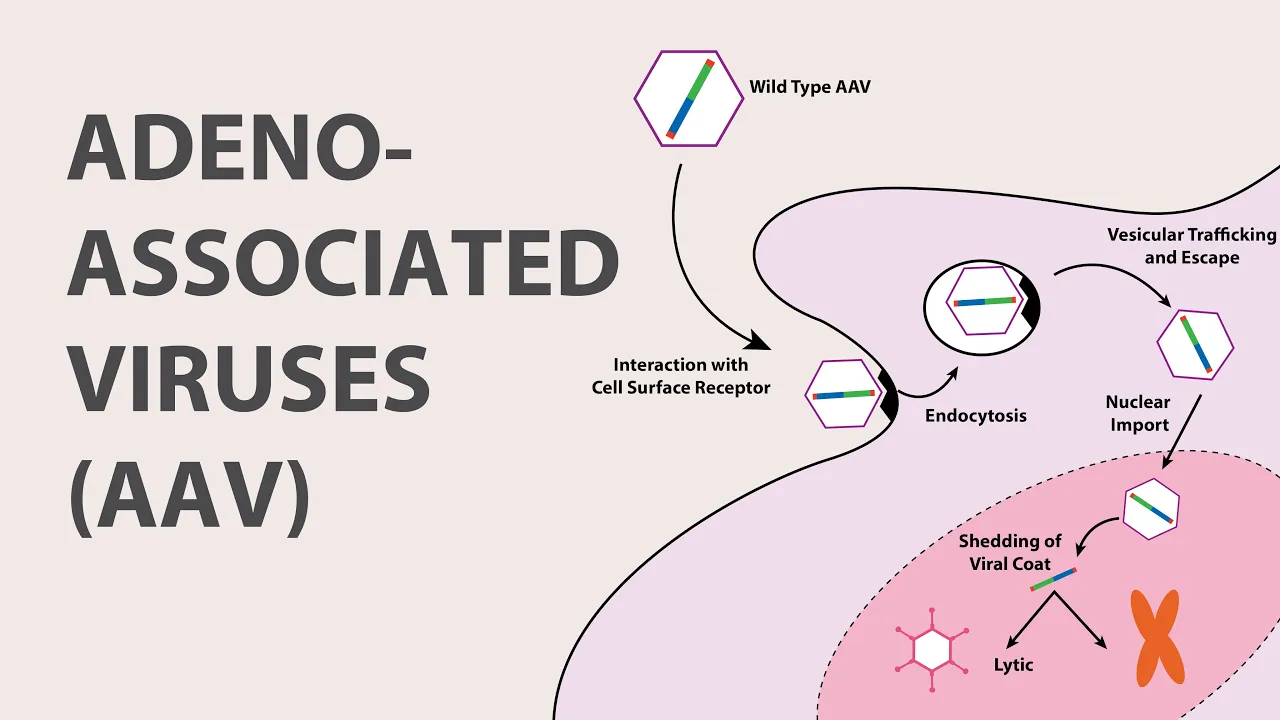





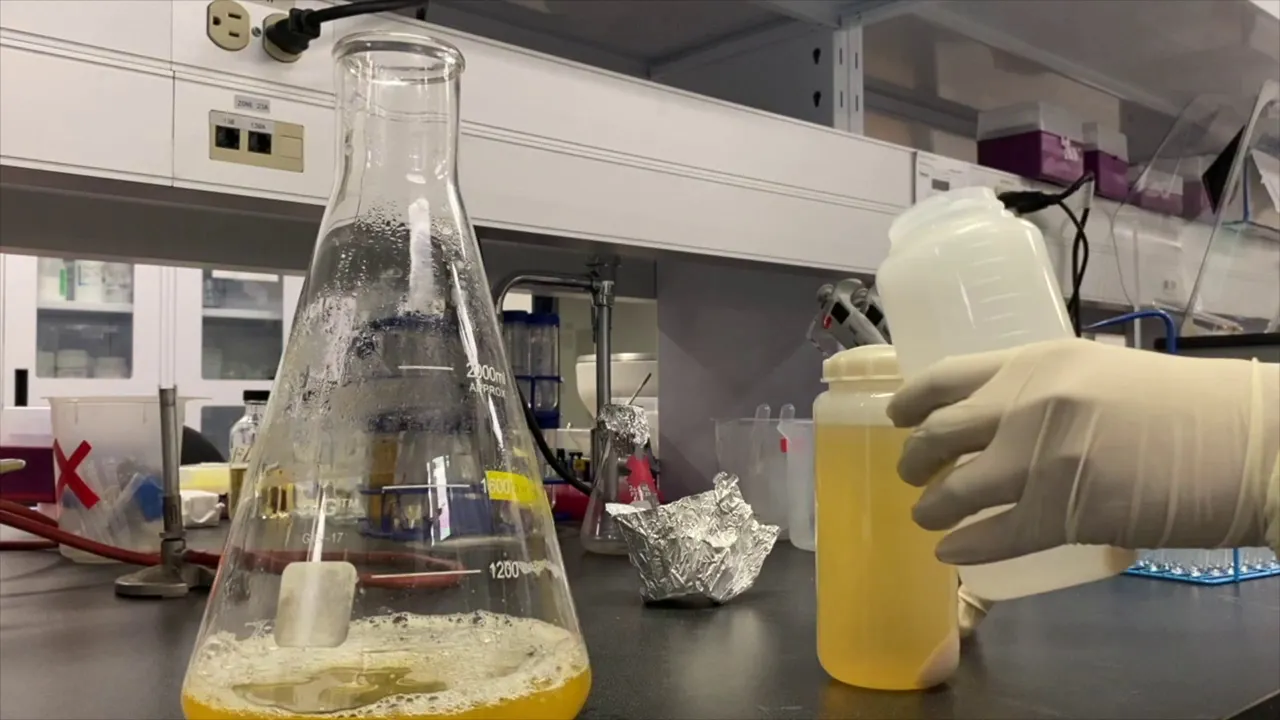






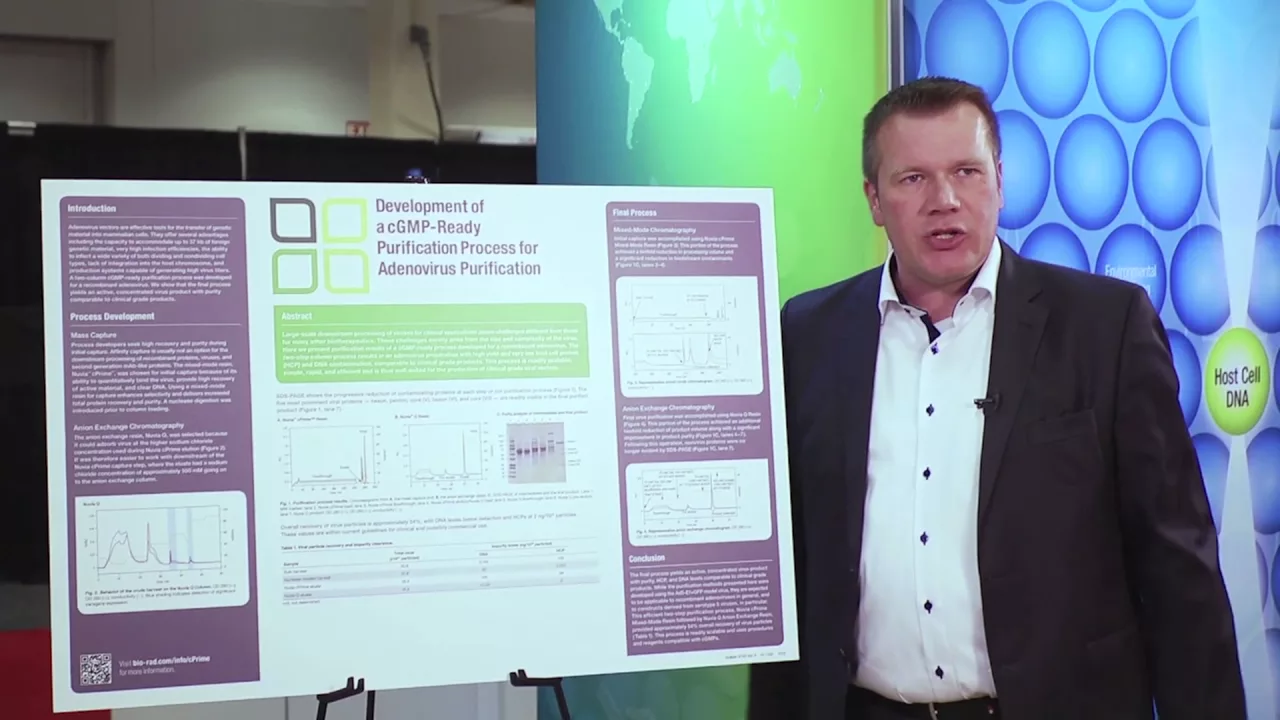





This video demonstrates a complete protocol for producing Adeno-Associated Virus (AAV) type 2 particles in HEK293 suspension cells, covering cell culture expansion, triple transfection with three plasmids (vector, rep, and cap), cell lysis, centrifugation, and purification using chromatography with specific buffer systems (binding, wash, and elution buffers). The process requires BSL-2 containment, uses Thermo Fisher's HEK293 cells designed for suspension growth, and produces viral particles that must be separated from empty and partially filled capsids for therapeutic applications.
AAV Production in HEK293 Cells: A Lab Protocol | NIIMBL
Added:Basic biology of Adeno-Associated Virus (AAV) and its structure, genome, and role as a gene delivery vector.
Fundamental principles of mammalian cell culture, specifically the maintenance and scaling of suspension HEK293 cell lines.
The concept of transient transfection and the triple-plasmid transfection system commonly used for AAV production.
Basic laboratory techniques in biochemistry, such as cell lysis methods and fundamental chromatography principles.
Analytical characterization methods for AAV vectors, including qPCR/ddPCR for genome titer and ELISA for physical capsid titer.
Quality control standards and purity analysis of viral vectors using techniques like silver staining, SDS-PAGE, or transmission electron microscopy (TEM).
Process scale-up strategies to transition from shake flasks to controlled bioreactor systems for industrial viral vector manufacturing.
Regulatory pathways and Good Manufacturing Practices (GMP) required for producing clinical-grade gene therapy products.
2.2K views25likes25:13Original Release: 2021-12-04
would you like me to invent your slice or would you like to advance your own slime yes if you can do that please absolutely yeah thank you um hi everybody else everybody said before they are jobs in this market especially now in the new area bio in syringe in therapy yesterday there was a ceo of a company here in massachusetts he came here and he won 300 workers stood now and and we produced 305 years so so this means we have to find new way to train people so training is needed so as a part of the nimble project so we we decided to create a protocol so that people can use it as a training even industry has also expressed the interest to come once we put something in place they will use it for training purposes before the employees work on cells that are going to go to to patients so so that's what we here at quincy college we work on aav2 so we call it av2 by biomanufacturing so we produce av particles in 293 cells uh the reason we choose ad2 is because uh first is the better known among the type of aavs and uh it's easy to get the raw material as opposed to jim and maggie and they have hard time getting the material to work over their server so this one is relatively easy to get the material needed so and also on the safety level is relatively low as long as you follow the regulation so what we we knew to start we didn't know anything about aav manufacturing the only thing we knew is um asap techniques and we also know how to work a way for yourself so we do that here but not the viruses so this this was a brand new thing for us next slide please yeah so so that's as you can see uh the nih recommend that um working aav um it's a biased level two so here um with um according to the the companies that sell aav and work with av the recommendations are if you use a buyer 70 cabinets class 2 is relatively safe and alcohol is not effective for this infection but 10 bleach is the one to use so that's what we've been doing here and we can autoclave the bio hazards before even putting the bio as a waste so that's what we've been doing slide please so we started with these cells called the viral production cells it's sold by a thermofisher and these cells are designed to produce asd particles so we use them to transfect on the transfection so we bought the cryoval the and when it comes it's recommended to store it out in liquid nitrogen in the vapor so that's what we did until it's ready to use and also thermo pressure provides media so there is um that's uh in the next slide so the media there is a production medium and there is a glutamax feed so the complete medium gonna be a production media way for four millimolar glutamates and that's ready to use uh the other good thing with this is that thermo fisher uh give you all all the the recommendations the volumes that are recommended to work with so you take the cry over and we thought the cry over i think that's in on the next slide so yeah so the gravel comes from the minus 150 liquid nitrogen so here we have a toaster on the right side of screen it's just used to de-ice the carver so you push it in and in less than two minutes you're gonna pops it out when it becomes mostly liquid if the cryoval is not cold enough if you take it from minus 20 it won't work here it has to be minus 80 or -150 so we de-ice it and put it directly into the medium and the thermo fisher recommended 30 ml of media and these cells are a trend to grow in suspension so they have other cells that you can grow into in t flask but you are to a harvest with trypsin since we didn't know anything about this we wanted to start with what is easy so here inside the biceptic cabinets aesthetically we transfer the entire content of the clever into 30 ml of complete medium and we put it this is a single user check shake flask so with a tubing so if for expansion you can just weld the tubing to a bag and pump it in there like mikey was talking about with a sterile welder but we at this stage we didn't need that so we just we just use uh use it as it is uh next slide please so after um after the inoculation so transfer the entire content of gravel into the medium and put in a shake flask in a in a shake incubator and they are recommended to use eight eight percent co2 not five percent like two cell and temperature 37 and the agitation 125 rpm so and it's recommended to they grow um not that fast but they took four four five days to grow uh so that's we see that here on the next slide please so after three days after four days i took we took a sample and we did a circle using the automated cell counter biorite cell counter and we can see um the viability the non-total number of cells and the good thing is um thermal fusion also recommend a self-density that is needed for transfection before we put in the viruses that's on the next slide yeah so um this here is uh the the egg cells before transfection under the microscope so what we did is we took a small amount put in a t flask and put it under a microscope and look at the shape of the cell so that just it tells only the confluency but it doesn't tell uh whether the cells are live or not the biot self-counter tells how many are alive so this is just for visual visualization next slide please so yeah here is another cell counter i like this one better because with the biorare cell counter when the cell density is very high you get a zero zero viability it shows you zeros because it just can count as many cells but this one can count the highest density of cells so we use this one as well and uh so we use this one uh when we reach a high cell density we we we did a crap reservation that's on the next slide so we use we started one cryoval and we we expanded them had a lot of cells and we took with with we took uh we did a cryo preservation they recommend that we use on 10 percent dmso and put them in 11 cryovals then we we have a bunch of of our cryovals to work with since we didn't know so what was going to happen actually at a certain point we got contamination and we had to use other cryovol so our next next slide please so here is when we had enough cells as recommended by thermofisher we've heard the ml of culture and they also tell you the volumes of uh plasmids so we we we bought the plasmid from another company that's what thermo fisher didn't have so we had to buy the pre-plasmid from another company called cell biolabis and thermo fisher give you the transfection reagents and they give you the recommended volumes for 30 ml of aquaculture so we can scale up if you have a larger volume scale down if you are smaller volume so that was very helpful next slide please yes and so this is these are the transfection reagents thermofish just sells this as well they just don't sell the plastic so we have to talk to another company actually a bunch of the mentee who found one that has the plasmid that's on the next slide so yeah these are the plasma called dj plasmid so they come in a box and you have all the three plasmid because the process is called triple transfection that's what jim was talking about so you put three different plasmid or you you mix them with a buffer and you just you just transfer them into the cell culture one time so but you have to pre-mix them before in a buffer and transfer them into the shake flask so these ones um you can also jim was talking about plus plasmid extraction the good thing you can actually take these plasmid put them transfects um e coli and uh scale up get a bunch of uh a large volume of a plasmid and you can harvest and cryopreserve the plasmid for the next transfection so so this also can be useful and next next slide please yeah so this is the cell culture transfected with the three plasmid triple transfection so they go the culture goes back to the incubator with eight percent co2 and it's recommended to stay there for 72 hours about three days and then that's what we see on the next slide next slide we continue with that um the the kids we buy with uh from thermo fisher comes with also a lysis buffer and they tell you the volume needed for a 30 ml of culture so you just what we did just add 3.3 ml of lysis buffer directly into the shake flask and put it back into the incubator for one hour so that's produced the cell lysis so the cells birth and if they took the plasmid so then they're gonna have the viral particles come out out of the cell and gonna be in suspension in the media so uh next next slide please so after the lysis they stay in the incubator for one hour then you have a broken cell cell debris media the viral particles supposed to be in the suspension liquids on the top so after centrifugation after the parameter recommended 10 minutes four degrees celsius for 13 000 years so then there is a palette at the bottom which are broken cells so we collect the supernatants and that's where the various particles supposed to be when we started we also another company sold us some purification kits some mini columns with a resonant and that one with we try it doesn't really work well get clogged um after you put a certain volume it doesn't go down because you have to do the chromatography by density so it won't flow through finally we discovered that thermo fisher has a reason to bind those particles so then we went we tried our resin that's on the next slide um no not but yeah this this one so so the resin is on the left and uh but they are reasonably designed to bind av virus so it also it also refines all the other type of aav then there is a we have to find a column that was not easy we finally found a column from a small company here in massachusetts and these columns are relatively new not they are not known that well the g columns are known but they are big and they are difficult to work with and this for this horizon we just need a small amount of resin so once we found this column was called a snap column and they work very well you can see top and bottom they have an adapter so you can hold the resin in the glass and you can actually measure the length of the resin so it's much easier to work away so we use that after the column uh with the resin from thermo fisher then we went to uh for purification on the actor that's that's uh on the next slide so we use that pure like maggie was talking about so the after pure uh is works very well with this um so we inject so we load the the harvest the lysates um so the the suspension of after centrifugation so that's where the values are then uh we you need a three buffers uh wash buffer and binding buffer and a lotion buff and those buffers are relatively cheap the illusion buffer is a glycine so i mean i should just turn 100 millimolar and the wash buffer is of phosphate um it's a pbs so we just use the pbs to wash and also we use the pbs as a binding wash buffer and binding buffer it's also recommended to use sodium chloride one molar sodium chloride to wash for wash after the binding so you're gonna see on the screen it doesn't it's not clear but you you find out that on the screen you actually see the impurities when you wash with the binding with the pbs you're gonna see impurity comes out but when you use one molar sodium chloride you see extra impurities coming out then finally after that we use the loading the pollution buffer and you can see the dna the aaz particle come out and we collected them so that's what we have done so we have collected uh the particles after purification and uh we working now on the the the key pcr the elisa we also um working on a hplc to separate the empty capsid from the full capsule so like jim was saying even when you get the capsid the viruses some of them gonna will not have the dna they are called um empty caps some of them gonna have partially the dna they call partial subset and some of them gonna be full so for patient treatment the ideal is to have the full capsule that's what can actually produce an effect so but it's not easy to separate we haven't been successful so far there is a column that um we found on in publications which will be using their column by trying different mobile offices but it doesn't really separate very well hopefully we're gonna be able to present more results during the second presentation in january so that's where we are for now on that project yeah so let me add that uh there are companies that claim they can separate uh empties from full capsids using chromatography but i'm i'm not sure i believe them that they i'm not sure that they can do it and so it's a lot to expect us to do it i guess is thermal scientific have an anion exchange column that the claim can separate is that the one you tried yes they do claim it yes that's the one a lot of companies do uh ultra centrifugation with either cesium chloride or another gradient maker but that's not really scalable correct thank you izzo um do we have any questions for izzo or to barbara we do um one question was uh the use of adherent versus suspension cells and is um one better than the other for this application and just for industry in general i'll add i i see both in industry i do too yes uh i i do too um the only the only thing is uh suspension is much easier to work with especially if you're not used to like us we just started we wanted to do something easier if we use trypsin um there is a risk of killing the cell nutrition so we didn't want to do that here there was also a question about what cell line you're using from atcc because there's an individual is having a hard time converting their adherent h e k cells to suspension but we'll provide those details with the lab protocol correct correct um i believe for if you go to thermo fisher they have cell design trained to to grain suspension that's what we bought but they have other cell line that can grow in uh you know in a t flask adherent cells and you have to harvest them with trypsin these cells um are specifically designed to grow in suspension i don't know if they can grow their they also can be an inherent in ethiopia and then we had one more technical question is it essential to shake the cells after transfection yes thermal fusion recommended that yes all right thank you alright i see a couple of questions we didn't get to one was do patients get chemotherapy before their auto autologous cell therapy treatment and that is yes so and an integral part of that is you hit the patient with chemotherapy and the way it's been described to me is it opens up the niches that your car t can go into the other question came up is can you do autologous earlier and everyone wants to do it as a first-line treatment currently the regulatory agency requires a failure in traditional chemotherapy treatment before starting car t but there's no reason not to make that your first line treatment and that's the hope of everyone there was one more question gemma had seen earlier what's most important for cell line development and clonal stability um well i'll put that a different way it is may it is important for you to maintain clonal stability and so that's the reason why you have the master cell bank working cell bank into the production line system and so you do maintain clonal stability and you do test for it and as everyone knows cell lines they'll throw out chromosome if you if you have them replicate for months and months they can throw out chromosomes or duplicate chromosomes or do all sorts of weird things in their karyotype can go all over the place and you want to avoid that okay is that any other questions before before we wrap up so i would like to to thank the we bet team for a great presentation thank you guys and um i'd like everyone to to look out for an invitation to our train the trainer session too through innovate bio and sandy porter and thank you sandy for for hosting us today and all the work you did ahead of time so we'll be sending out notification of our secondary in the trainer session where we'll be talking as i mentioned earlier about qc analytics the regulatory environment and more hands-on curriculum that we'll have developed and be ready to present to you so again thank you everyone for joining
Up Next

16:53
Gene Therapy Design Using AAV Viral Vectors | BHU Lecture
@APNAAMERICA
24.6K views•2025-11-10
14:12
Quantitative Real-Time PCR (qPCR): Principle, Method & Data Analysis
@animatedbiologywitharpan
129.2K views•2023-09-06

59:57
Teaching Biomanufacturing with NISTCHO Cells: A Practical Guide
@innovatebio
692 views•2024-03-22
16:04
CRISPR and Genetic Engineering: How Gene Editing Works and Why It Matters
@kurzgesagt
30.5M views•2016-08-10
Related Study Plans & Knowledge Roadmaps
Structured learning paths in Biotechnology
biotechnology
AAV Production: Transfection, Prep & qPCR
01Introduction to Gene Therapy and AAV Biology
02Mammalian Cell Culture: Suspension HEK293 Cells
03Upstream Bioprocessing: Triple-Transfection Optimization
+ 2 more learning modules
18h5 modules
Explore Roadmap
biotechnology
Building Gut-on-a-Chip: PDMS, Cells & TEER
01Foundations of Microfluidics and Gut Anatomy
02Cleanroom Fabrication & PDMS Soft Lithography
03Epithelial Cell Culture and On-Chip Seeding
+ 2 more learning modules
26h5 modules
Explore Roadmap
biotechnology
Optimizing CFPS: E. coli Extract & Yield
01Fundamentals of Molecular Biology and Translation
02Introduction to Cell-Free Protein Synthesis (CFPS)
03Preparing E. coli Crude Lysate (The Extract)
+ 2 more learning modules
19h5 modules
Explore Roadmap
biotechnology
Haematococcus PBR: Design, Stress & Astaxanthin
01Biology and Life Cycle of Haematococcus pluvialis
02Bench-Scale Photobioreactor (PBR) Design and Engineering
03Culture Media Formulation and Inoculation
+ 2 more learning modules
15h5 modules
Explore Roadmap