







![[s4 | 2026] Математический анализ, Трифанова Е. С., лекция 5](https://i.ytimg.com/vi/DmfGkg5_f8g/maxresdefault.jpg)








![[ОВиТМ] Основы вероятности и теория меры (продвинутый поток) 11.](https://i.ytimg.com/vi/e-H9fERXu00/maxresdefault.jpg)

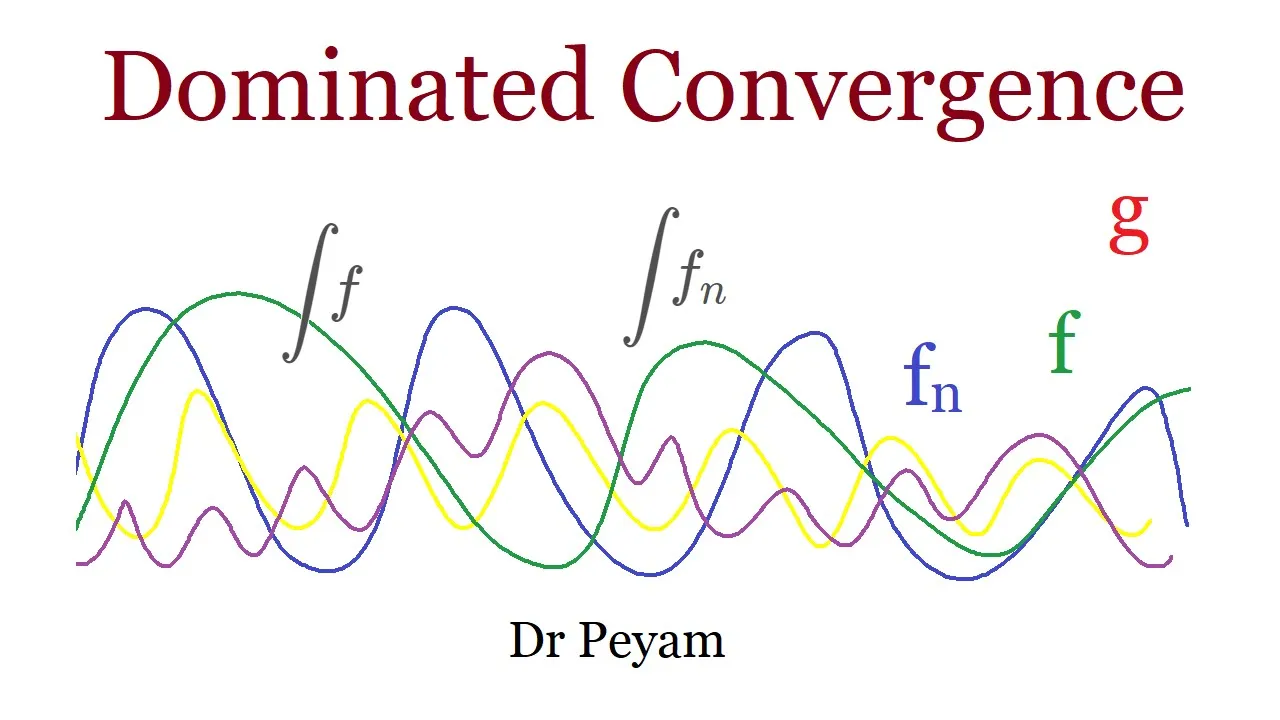
Lebesgue's Dominated Convergence Theorem states that if a sequence of measurable functions $ f_n $ converges pointwise almost everywhere to a function $ f $, and there exists an integrable function $ G $ such that $ |f_n(x)| \leq G(x) $ for all $ n $ and almost every $ x $, then $ f $ is integrable and $ \lim_{n \to \infty} \int f_n \, d\mu = \int f \, d\mu $. The proof uses Fatou's lemma on the non-negative sequence $ H_n = 2G - |f_n - f| $, showing that $ \lim_{n \to \infty} \int |f_n - f| \, d\mu = 0 $, which implies the desired convergence of integrals.
Measure Theory 11: Lebesgue's Dominated Convergence Theorem Proof
Added:Definition and basic properties of the Lebesgue integral for non-negative and general measurable functions.
The Monotone Convergence Theorem, which is the first major convergence theorem in integration theory.
Fatou's Lemma, specifically understanding its inequality and how it bounds the limit inferior of integrals.
The concept of 'almost everywhere' (a.e.) convergence and properties of null sets.
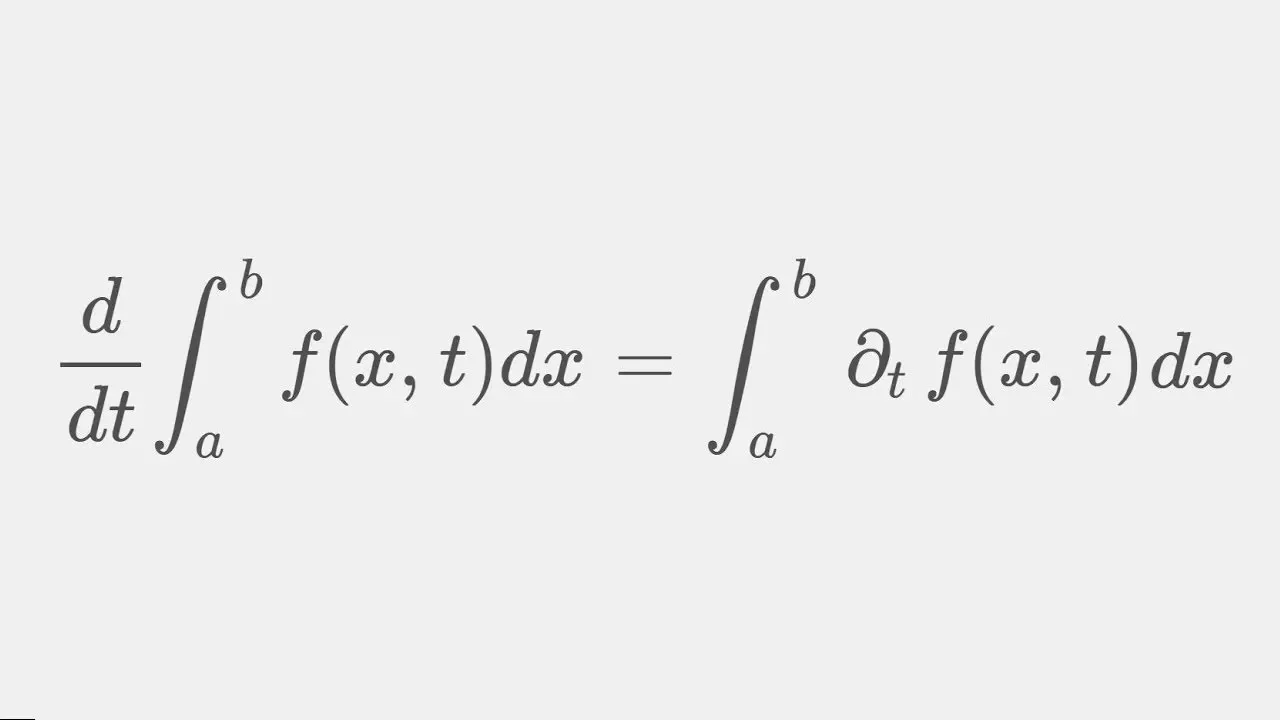
Interchanging limits and integrals, specifically establishing rules for differentiation under the integral sign.
The study of Lp spaces, including proofs of their completeness (making them Banach spaces).
The Vitali Convergence Theorem, which characterizes uniform integrability and generalizes the Dominated Convergence Theorem.
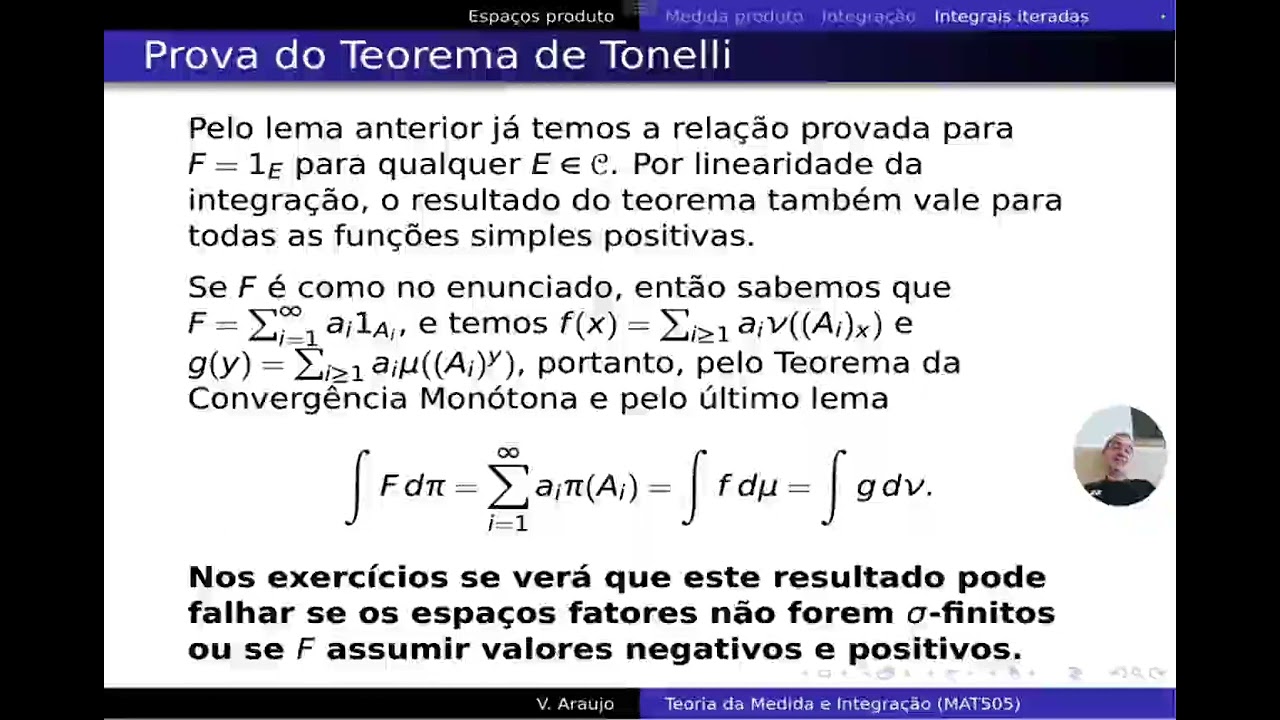
Fubini's and Tonelli's Theorems for integrating over product measure spaces.
33.3K views727likes14:48Original Release: 2019-11-05
hello and welcome back and as always I thank all the nice people that support this channel on steady today we consider part 11 in our measure Theory series and as promised it will be about the proof of lebecq's dominated convergence fear him I already told you this is one of my favorite theorems and you will see that the proof is indeed not so hard okay then let's recall the theorem from the last part of the series here you see all the assumptions we need for the backs dominated convergence theorem on the one hand we have a sequence of measurable Maps and also the point-wise limit function which we will call just F and on the other hand we have another function G which is in the crebbil and this function G is indeed the important ingredient in the whole theorem it should lie above all the functions FN and therefore we call it an integrable major event from these nice assumptions we now can conclude that all the functions in the sequence are also integrable and moreover also the MU almost every point wise limit function f is also integral from this we can conclude that all these integrals here make sense and the Equality tells us that we can pull in the limit into the integral and that's the reason we call it a convergence theorem well then let's start with the proof the ingredients we need for the proof on one side properties of the integral and also on the other hand Fatu Schlemmer from the properties of the integral we can immediately show the first property here please recall that lying in l1 means that the absolute value of f n has a finite integral please remember we have measurable Maps and this is a non-negative function therefore the integral always exists but in the worst case it could be infinity therefore lying in a 1 means this is not infinity so smaller than infinity ok now we can use our assumption we know that we have an integrable major end called G so we have an inequality here and you remember we have a monotonicity property of the integral this means we also have the inequality in the integral sense so let's put that to the left and then I know this is less or equal than the integral of G now note that this right hand side is indeed our assumption that the integral of G is indeed finite our conclusion is now this integral is also finite and this means all the FN lie in l1 obviously we can do the same for F instead of FN because we know it's the point-wise limit almost everywhere therefore this inequality holds almost everywhere and of course also almost everywhere the monotonicity property still holds which means we get the same inequality here for the integral of f on other words we also have F in l1 ok very good so what you have seen now is that the first part in the theorem was very easy to show hence the crucial thing and the theorem is indeed this convergence statement here ok so this is what we do in the next five minutes and indeed I want to show something a little bit more stronger we've shown that the integral of the absolute value of F and minus the point-wise limit f goes to 0 if n goes to infinity and from this we can immediately conclude the property we want here however let us start showing this property here okay in the integral we have the fashion F and minus F but in the absolute value now we know that for the absolute value going a detour makes it crater or the best case it stays the same now going to detour to zero this means we have your absolute value of f n plus the absolute value of f this is just the triangle inequality for the absolute value when we read at point wisely this means we could put in excess here for the functions but it holds for all the XS therefore this is just the short notation we use also what we know is that we have our major and G for F n and also for F as I told you therefore we have this as less or equal then 2 G 1 G plus 1 D now you could say this inequality only holds move almost everywhere however it does not matter at all because the integral does not see changes that happen almost and nowhere which is the compliment of almost everywhere therefore we could change or choose another function G where this inequality here does indeed hold everywhere hence we can assume that we do this here and therefore I can omit them you almost everywhere and it makes the proof just shorter okay now I can bring this on the other side and I get out a non negative function I want to call H n so this would be 2 G minus our absolute value f n minus F and we know it's non negative obviously this holds for all N and we know by the properties of measurable functions that age and is also measurable now I have written that down in such a way that you should recognize immediately for to Schlemmer simply because we have measurable functions and they are all non-negative therefore now we can apply far to Schlemmer but whose lemma tells us something about the limit inferior so limb in namely it tells us that we can look at the integral of the lemons and we can pull it out with an inequality sign in fact it's possible that it gets bigger if we pull the limb in outside however the inequality always haunts and that is what we can meet here of course you should ask yourself do we know the limb in fear and here maybe we should look first on the left hand side inside the integral it always means the point-wise limit now it's the point-wise limb ends but we know that the point-wise limit of H M indeed exists and therefore it should be the same as the limit okay so let's write it down we know this is the integral of our point wise limit of H n - G is 2 G but we know F is the point mass limit of F n and therefore this one is 0 so only 2 G remains here ok then let's look at the right hand side there we have the integral of H n however the integral is linear so we have indeed to enter codes 1 of 2 G and the other one of our FN minus F in the absolute value for the first part the libyans does not matter so we can write down immediately we have to GU then for the second part you have to be careful we subtract something positive and we look at the limb in which means 2 get out the lemons we have to subtract the limb soup the limit superior or maybe in other words if you want to find the smallest outcome here as non negative number you have to subtract here the biggest possible number okay so this explains why we have two lips up here but we don't change the integral at all so this is FN minus F Tim you okay with the left-hand side here and the right-hand side here we have a very nice inequality if I then add what I missed before here so DM you and our X then you recognizability that we have the same on the left and a right here of course now you should subtract the same thing on both sides if we do this we find zero on the left obviously and only this part here on the right hand side so minus our limbs OOP okay so the minus sign is not so beautiful therefore I want to bring this on the other side which means we now have two inequality here on the right which means this would be with all the minus sign less or equal than zero okay so now please note this is very interesting the lip soup of non-negative numbers should be non positive hands from this we can conclude that the limit exists we do this in the following way we say okay I have to live so pure so this is always greater or equal then the lament of course this holds for all sequence of numbers the lymph is always less or equal than the limbs up but still we have non negative numbers here therefore the limb end should be also non-negative so we have this inequality here this one here is now always nice we have in a but on the left is the same as on the right this simply means that all the inequalities here are in fact equalities they are simply no other way which means the limit is equal to the limbs up which means the limit exists and SV equal to this limb sub n limit which is 0 so let's write it down limit exists and the limit of this integrals is equal to 0 well this is what we wanted to show and I explained before this is a stronger result than that what we have in the bacterium but I will now show you how we get to the result in lebecq's dominated convergence theorem ok let's do that now so we want to show that the limit of the functions and the integral is equal to the integral of our function f therefore we can look at the difference and in the absolute value and show that this goes to 0 for n to infinity ok the first part we can notice this is also non-negative because it's an absolute value and in the next steps we can use the properties we already know from the integral for example the linearity so we know this is indeed just one integral where we have F and minus F in the in the code itself and the absolute value around now in the next part we use something that is also called triangle inequality but here now for integrals which means now put the absolute value inside and then we can get bigger or stay the same here we now reach something that we already know at least in the limit so it goes to 0 for n to infinity hence the last step we need here it's just a small sandwich theorem now only limit we have the zero left and white and therefore we know this limit also exists and is equal to zero and therefore the whole thing in the absolute value has a limit and is equal to zero so putting that on the other side we now can conclude limit of the integrals of FN is equal to the integral of f and here you see this is the convergence statement that we wanted to prove in the beginning and that most approve of lebecq's dominated convergence theorem I already told you this part dominated is the important ingredient for the theorem because we need such an integrable major end we call this major in just G but you saw we need this and then we can apply lebecq's dominated convergence theorem if you want to see some applications of this theorem please let me know because this could be a very good idea for the next part in this series so thank you very much and see you next time bye
Up Next
19:08
Dominated Convergence Theorem Explained | Real Analysis
@drpeyam
19.9K views•2020-09-25

4:43
Elliptic Curve Cryptography Explained: ECC, ECDSA, ECDH
@PracticalNetworking
28.5K views•2024-10-21
8:22
Laurent Series Explained | Complex Analysis
@brightsideofmaths
52.4K views•2022-04-06

6:00
The Mathematical Impossibility of Accurate World Maps
@Vox
23.3M views•2016-12-02
Related Study Plans & Knowledge Roadmaps
Structured learning paths in Mathematics
mathematics
Tensor Calculus: Vectors to Riemann Curvature
01Mathematical Foundations: Linear Algebra & Calculus
02Covectors, Dual Spaces, and Tensor Basics
03The Metric Tensor and Index Gymnastics
+ 2 more learning modules
40h5 modules
Explore Roadmap
mathematics
Gödel's Incompleteness: Logic, Proofs & Limits
01Introduction to Formal Systems & Hilbert's Dream
02Set Theory, Cardinality, and Cantor's Diagonal Argument
03Arithmetization and Gödel Numbering
+ 2 more learning modules
14h5 modules
Explore Roadmap
mathematics
Galois Theory: Fields, Groups & Solvability
01Foundations of Abstract Algebra: Groups & Fields
02Polynomials & Field Extensions
03Splitting Fields & Symmetries
+ 2 more learning modules
24h5 modules
Explore Roadmap
mathematics
Non-Euclidean Geometry: Models & Geodesics
01Euclid's Fifth Postulate and the Birth of New Geometries
02Hyperbolic Space and the Poincaré Disk Model
03Geodesics: Defining Straight Lines in Curved Spaces
+ 2 more learning modules
15h5 modules
Explore Roadmap