



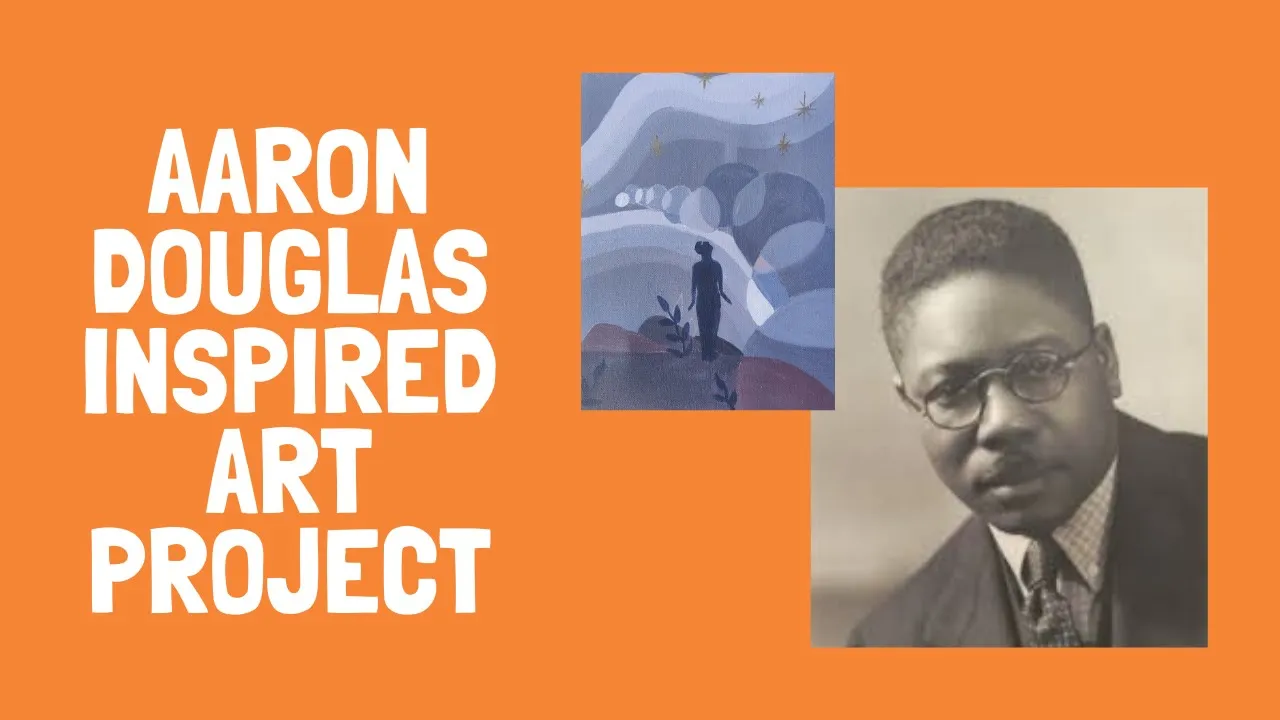
















Aaron Douglas's 1936 painting 'Aspiration' for the Texas Centennial Exposition exemplifies how African American artists during the Harlem Renaissance used visual art to reclaim cultural heritage and narrate historical experiences; the painting combines ancient Egyptian artistic elements (frontal profiles, pyramids, Mother Egypt figure) with modern African American achievements (Benjamin Banneker, George Washington Carver) to depict the Middle Passage and enslaved Africans' journey toward freedom, using symbolic imagery like the North Star and radiating circles representing jazz to convey hope and cultural pride despite the oppressive Jim Crow era.
Aaron Douglas Aspiration Art Analysis - Harlem Renaissance & Texas Centennial
Added:The historical and cultural significance of the Harlem Renaissance and its key literary and artistic figures.
Aaron Douglas's signature artistic style, characterized by silhouettes, geometric symbolism, and a limited color palette (often associated with 'Precisionism').
The socio-economic landscape of the 1930s United States, including the Great Depression and the pervasive segregation of the Jim Crow era.
The role of public art and federal patronage programs (such as the WPA) in promoting national identity and social commentary.
The history of the 1936 Texas Centennial Exposition, specifically the Hall of Negro Life and its role in challenging racial stereotypes.
A comparative study of Aaron Douglas's work with other prominent Black artists of the era, such as Jacob Lawrence, Archibald Motley, and Elizabeth Catlett.
The evolution of Black visual identity in art, tracing the lineage from Harlem Renaissance modernism to post-war civil rights art and contemporary Afrofuturism.
Analysis of how visual arts serve as tools for social activism, cultural preservation, and institutional critique.
58K views441likes7:41Original Release: 2019-03-04
(uplifting classical music) - My friends of Texas.
I have come here today to bear the tribute of the nation to you on your hundredth birthday, oh, you are 100 years young.
And what a birthday party.
A huge $25 million exhibition in Dallas with all Texans staying home.
- [Female Narrator] We're in the photo studio at the de Young Museum, part of the Fine Arts Museums in San Francisco, and we're looking at a painting by an important early 20th century artist, Aaron Douglas called Aspiration.
- [Male Narrator] Aaron Douglas' first major commission was for the iconic publication, The New Negro An Interpretation by Alain Locke.
In those illustrations, he takes a Alain Locke's lead that African American artists should embrace their African heritage.
Historically, Europeans had claimed the history of Africa in general, but especially Egypt as the bed rock of European culture.
Douglas and the other artists associated with the Harlem Renaissance were insistent that African Americans embrace this culture as their history.
- [Female Narrator] And we do see the influence of ancient Egyptian art here in the profiles of the figures, in the way that their shoulders are turned frontally, and even the influence of African masks.
But this painting had a very specific purpose, it was commissioned for the Texas Centennial Exposition of 1936 that commemorated Texas' independence from Mexico.
And for the hall of negro life that, despite many obstacles, was created for that Exposition.
- [Male Narrator] Aspiration was one of a four-part mural depicting the history of early Texas, but very importantly from an African-American perspective.
Two of the panels are lost, but the other extant panel shows Africans being taken into slavery to a ship that will then cross the Atlantic in the Middle Passage.
Aspiration is the other part of this story here on the American side of the Atlantic.
- [Female Narrator] We see hands in bondage, we see the shackles of slavery around the wrists of these upraised hands.
- [Male Narrator] And they are surrounded by these curvilinear flowing waves, this represents the Middle Passage of ships across the Atlantic Ocean carrying their human cargo of enslaved Africans.
Historians often point out if someone on these ships became ill, they were often thrown overboard because the slave traders didn't want to endanger the rest of their human cargo.
And so you see these arms upraised as if they are sinking beneath the waves, reaching upward for some kind of salvation.
- [Female Narrator] As we move up, we see three figures on a podium pointing to a city on the horizon.
- [Male Narrator] The three-tiered plinth symbolizes the Old, Middle, and New Kingdoms of Egypt.
Egypt was famous for its innovations in architecture, most famously the pyramids.
- [Female Narrator] And we see those pyramids here in the fractured forms between the five-pointed star.
And one female figure sits on the corner of that podium holding a book in her right hand, leaning back, and looking up toward the city.
Her face, her body intersects that star.
- [Male Narrator] This female figure for Douglas I think represents Mother Egypt.
She is the font of African-Egyptian history and culture.
She holds the open books, the symbol of knowledge.
And notice that the waves of the Middle Passage wash across her feet just as the Nile River when it floods every spring washes across the temples along its shores.
Her hair wig is a very typical symbol of that Egyptian culture, as is her purple color, which is a royal color.
So this introduces imagery of kingship, a symbol of pride for contemporary African Americans.
The pose of Mother Egypt holding the open book is derived from a Renaissance source, Michelangelo's Libyan Sibyl in the Sistine Chapel in Rome.
Sojourner Truth, one of the great freedom fighters against slavery was known as the Libyan Sibyl.
The two modern African Americans on the plinth embody new ideals of the Harlem Renaissance.
The figure holding the right-angle square, the compass and adjacent to the terrestrial or celestial globe might be Benjamin Banneker, a famous astronomer and mathematician.
The man holding the beaker in the center might be George Washington Carver who was an agricultural chemist.
But there are other associations for these two modern men who embodied the educated new negro.
There are three famous figures who might indeed have appeared upon a plinth or podium at this time.
Among them are Jesse Owens, the American olympian, Paul Robeson, the actor and singer, and Joe Louis, the champion boxer.
Three real-life African American heroes who set an example for the rest of society of the kind of aspiration and achievement embodied in Douglas' painting.
- [Female Narrator] And that idea of being uplifted, of imagining a future where racial discrimination is no more.
It must've been difficult to imagine in the segregated Jim Crow South of Texas.
But still, this sense of hope as the figures look up toward the upper-right corner of the composition.
- [Male Narrator] Viewers always notice that the glowing five-pointed stars point to the city on the hill in the distance.
The star could be seen as the Lone Star State, Texas, and the star was all over the fairgrounds in Dallas as a celebratory symbol of the dominant white culture.
On the other hand, for an African American viewer, they would've seen that star as the North Star that led slaves out of slavery in the Deep South to freedom in the North.
And not only do the stars radiate from Egypt, but also circles and Douglas felt the greatest contribution of African American culture to the world was jazz.
And he likened the radiating circles to sound waves spreading African American culture around the world.
- [Female Narrator] On the opposite corner, a threat looms, we see lightning, we see clouds, and a darkness that the figures turn away from.
- [Male Narrator] Douglas' glowing and radiating stars seem to dispel the darkness.
It's not an easy path, but it is possible to triumph and transcend the evils of the past, but also draw, nurture from the great accomplishments of the past.
When visitor entered the lobby of The Hall of Negro Life and cast their gaze upon Aaron Douglas' four extraordinary murals, white visitors, the few that dared to enter The Hall of Negro Life, the segregated building on the periphery of the main fairgrounds often challenged the attendant at the front desk, claiming that it was not possible that an African American artist could've created these murals.
These queries were so numerous, they actually had to post a sign stating these murals were painted by Mr. Aaron Douglas of New York, an African American artist.
- [Female Narrator] I'm struck by the incredible optimism of the people who put together The Hall of Negro Life, writing a history to be able to imagine a future in America.
(uplifting classical music)
Up Next

62:19
Harlem Renaissance & European Modernism: Paris Exchanges
@fondationgiacometti1
352 views•2025-03-20

114:18
Christian Iconography: History, Theology, and Meaning | Fr. Panayiotis Papageorgiou
@Trisagionfilms
58.8K views•2020-02-21

10:26
Redgrave's The Sempstress: Victorian Social Realism, 1846
@smarthistory-art-history
3.2K views•2011-10-22

16:34
Earliest Depictions of Jesus in Art: 10 Ancient Images Explained
@UsefulCharts
5.9M views•2022-06-03
Related Study Plans & Knowledge Roadmaps
Structured learning paths in Art History
art-history
Gothic Cathedrals: Engineering, Light & Society
01The Birth of the Gothic: Romanesque to Suger's Vision
02The Structural Triad: Pointed Arches, Ribbed Vaults, and Flying Buttresses
03Theology of Light: Lux Nova and Sacred Geometry
+ 2 more learning modules
14h5 modules
Explore Roadmap
art-history
Pre-Raphaelites: Realism, Symbolism & Critique
01The Victorian Art Establishment and Academic Formula
02The Founding of the PRB and Radical Realism
03Medieval Revivalism and Literary Symbolism
+ 1 more learning modules
8h4 modules
Explore Roadmap
art-history
Street Art: From Subways to Art Market
01Subcultural Origins in Philadelphia and New York (1970s)
02The Subway Era and Style Wars (Late 1970s - 1980s)
03The East Village Scene and Early Gallery Crossover
+ 2 more learning modules
10h5 modules
Explore Roadmap
art-history
Classic Maya Art: Iconography, Glyphs & Ritual
01Foundations of Classic Maya Visual Culture
02Deciphering Maya Hieroglyphs & Text-Image Integration
03Sacred Geography and Cosmological Architecture
+ 2 more learning modules
14h5 modules
Explore Roadmap