
![[L2] Espaces métriques - Distance, Boule & Norme - MP/PC/PSI](https://i.ytimg.com/vi/N2ScfM_tO7Q/sddefault.jpg)
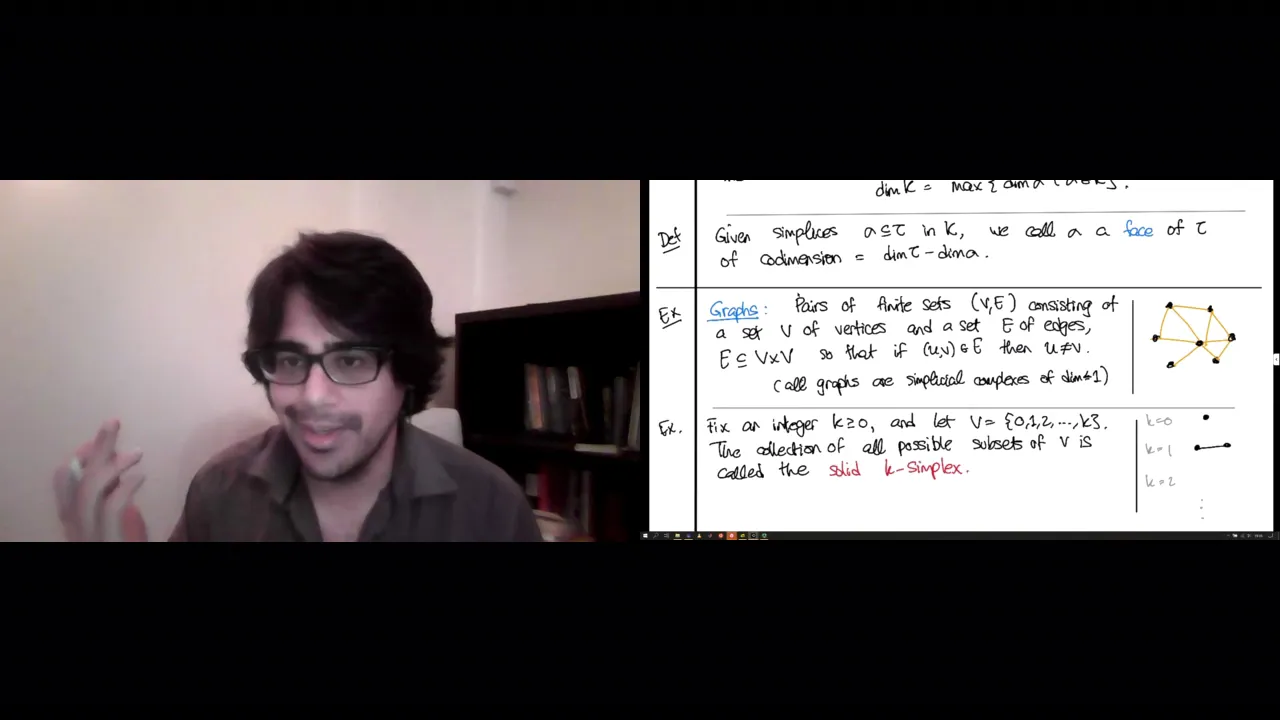
![Intro to Abstract Simplicial Complexes and Hypergraph Perspective [Hypergraph Episode 8]](https://i.ytimg.com/vi/Q9cqKEmzFh4/maxresdefault.jpg)



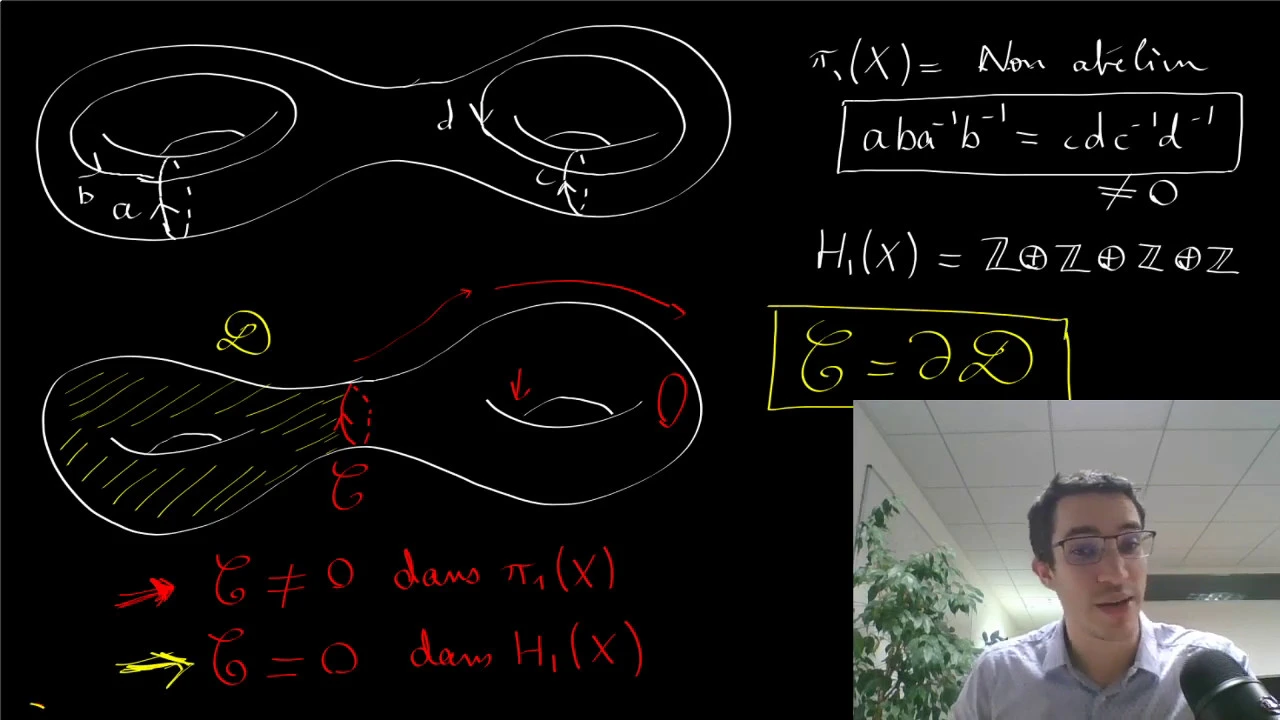





![Learning linear representation of persistence diagrams [...] | AI & Topology | Frédéric Chazal](https://i.ytimg.com/vi_webp/WqhZWj7GoQI/maxresdefault.webp)




![Tutorial on Ripser++ [Simon Zhang]](https://i.ytimg.com/vi/B1VVc9VvTiQ/hqdefault.jpg?sqp=-oaymwEmCOADEOgC8quKqQMa8AEB-AH-DoACuAiKAgwIABABGGUgZShlMA8=&rs=AOn4CLAnXhkSuICo7Fh5tnLCwccIIUU_hg)






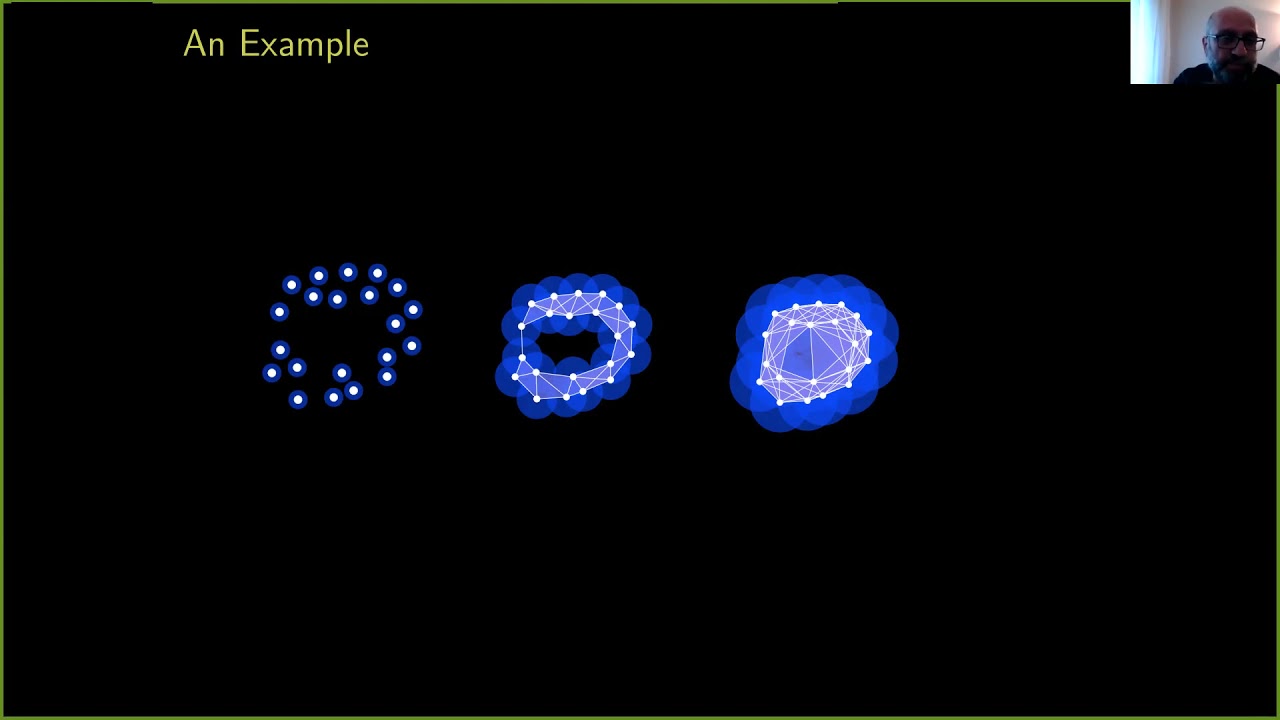
This tutorial introduces four types of simplicial complexes used in applied topology—Čech, Vietoris-Rips, Delaunay, and Alpha complexes—that are all associated with metric spaces and used to analyze topological features at different scales. Čech complexes add k-dimensional simplices when k+1 balls of radius r intersect; Vietoris-Rips complexes add simplices when subsets have diameter ≤ 2r and are clique complexes that always contain Čech complexes at the same scale; Delaunay complexes are parameter-independent and determined by Voronoi cells; Alpha complexes combine both ball intersections and Voronoi cells, making them subcomplexes of Delaunay complexes. The tutorial uses a simple 4-point example in R² to illustrate how these complexes differ and relate to each other, showing that while Vietoris-Rips complexes are always larger than or equal to Čech complexes, Alpha complexes respect both geometric (Voronoi) and topological (ball intersection) constraints simultaneously.
Čech, Vietoris-Rips, Delaunay & Alpha Complexes | Applied Topology Tutorial
Added:hi everybody and welcome to this video tutorial about czech miyatori strips delaney and alpha complexes these are all examples of popular symbitia complexes that are used in applied topology and they all they all have in common the fact that they are associated to a metric space in this case for simplicity this metric space that we consider is a finite submetric space of the d-dimensional euclidean space check the atori strips and alpha complexes have something more in common they all depend on a non-negative real parameter r whenever r changes also the simplicial complex changes and this gives rise to a filtration of simplicial complexes more in the details um check complexes at some scale are are uh simply should come are made of simplices that are given by letting balls grow around points of the of your metric space every time k plus one balls intersect you add a k-dimensional simplex to your complex things are a bit different for victoria strips complexes where instead of considering intersecting balls you consider subsets of your metric space and if these subsets have diameter less or equal than two times the parameter r then you add a simplex there as i've mentioned the linear complexes do not depend on a parameter so they are given once and forever uh when the metric space the underlying metric space is given they also do not um take into account intersecting balls but they take into account different kind of regions in your um in your underlying uh space which are called voronoi cells and intersecting warner cells will determine the simplices in the simply in the delaney complex and we will see in a minute or two uh what are these voronoi cells alpha complexes let's say that they are in between check complexes and delineate complexes because to construct them you will have to take into account both boron cells associated to points in your metric space and growing balls around these points let's check an example uh a simple example to see how these kinds of simplicia complex differ or in what way they are also similar to one another this um set of points for four points live in r2 and all pairwise distances are equal to 2 except for the distance between a and c which is 2 times the square root of 3.
the check filtration associated to this metric space is represented here or better three param three scales of the check filtrations are represented here let's concentrate on what happened for the czech complex at scale one here you see that every pair of points have associated balls intersecting except for the ones centered in a and c this means that for each intersection we are able to add a one simplex and that's why we have here all these one all these edges in the simplicial complex notice however that there are no three balls intersecting all together and for this reason the triangle that you see here um a b d and b c d are empty they actually feel are filled in when the scale the parameter reaches the value uh 2 over the square root of 3. in this case i didn't draw the balls but if you do that you will see that there are three balls centered in a b and d that all intersect together and also the balls centered in b c and f and we can imagine that the parameter r increases even more and this will give rise to uh other simplicial complex in this filtration but this is enough already to show a major difference between czech complexes and the authority ships complex indeed in here in orange you see the viatorius rip's context at scale 1 where the triangles are already present there whereas they are they were not in czech complex at scale one this is because the atari strips complexes are examples of click complexes so those are simulation complexes who are completely determined by their one skeleton so in this case whenever you have all the edges of a triangle you're forced to attach the triangle here and this is true also for tetrahedra or k-dimensional simplices in general in general we can also say that the vitoria strips at the sum scale always contain the czech complex at the same scale now delaney complexes so as we have mentioned they are simply sure complexes that do not depend on a parameter and here you have the dna complex associated to our initial metric space we have mentioned that they are determined by the voronoi cells associated to the points of the metric space in particular let's see an example um the voronoi cell associated to b is the set the collection of points in r2 that are uh closer to b than to all the other points in the metric space so closer to b then to a c and d and this form a subdivision of your ambient space in this case over two in this particular case you see that the voronoi cells of b of a and of d intersect and so we are able to add the triangle abd and the same for the triangle below let's move to alpha complexes well they are in particular subcomplexes of the delaney complexes in the sense that for every parameter r the alpha complex will be contained in the delineate complex so in some sense the lunatic complex give a bound an upper bound for for the simply for the alpha complex in this case you can see that the alpha complex at scale one um is equal to the check complex of at scale one but here there are two things to take into account both the intersecting balls growing around a b c and d but also their voronoi cells so in this case uh the very sets of a b and d would touch but the intersection but the inter the intersection of the their balls of the balls associated to these points is empty so we do not attach the triangle this is not always the case that the the check and alpha complexes are equal indeed if we let the parameter grow until a scale square root of 3 you can see that the balls centered in a b c and d all intersect together and this means that we have four balls intersecting and hence we cannot the three simplex so a tetrahedron and and it is this one in green whereas the alpha complex at that scale square root of three is much small is much smaller that is because the dna complexity complex is giving a bound for the for it for example it will never be possible that the alpha complex at uh there are no scale there is no scale for which the alpha complex contain for example this edge from a to c because the voronoi cells do not intersect their vulnerabilities do not intersect this is it from me and [Music] thank you for watching the video and i hope it was useful you
Up Next
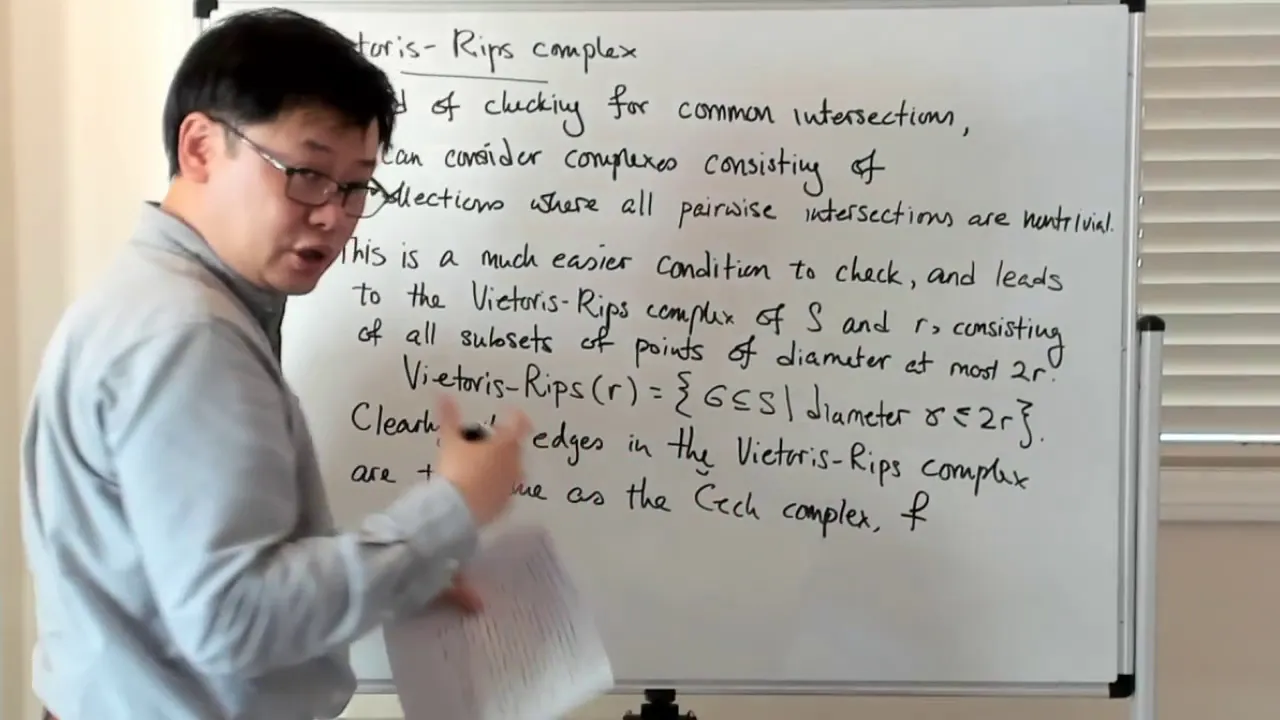
Vietoris-Rips Complex: Definition & Relation to Čech
@melvinleok
741 views•2020-12-25

Elliptic Curve Cryptography Explained: ECC, ECDSA, ECDH
@PracticalNetworking
28.5K views•2024-10-21
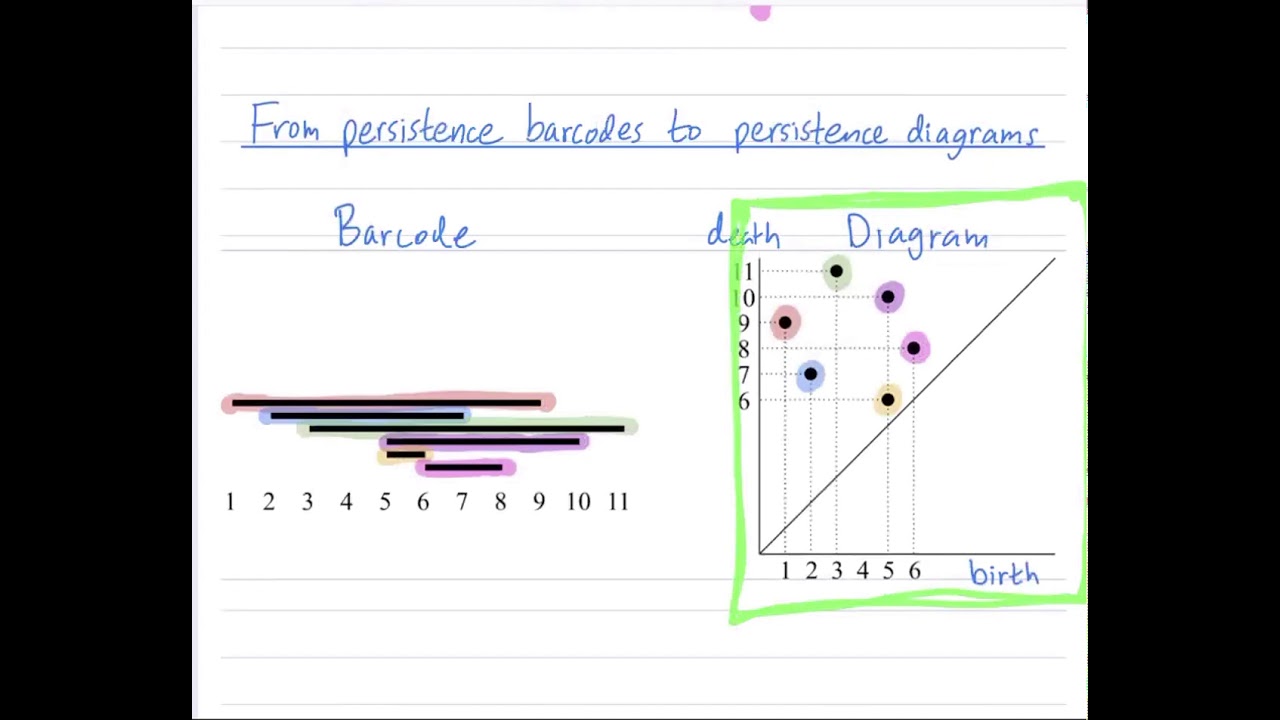
Persistence Barcodes vs Diagrams Explained | TDA Tutorial
@aatrn1
4.9K views•2021-02-18
The Mathematical Impossibility of Accurate World Maps
@Vox
23.3M views•2016-12-02
Related Study Plans & Knowledge Roadmaps
Structured learning paths in Mathematics