



























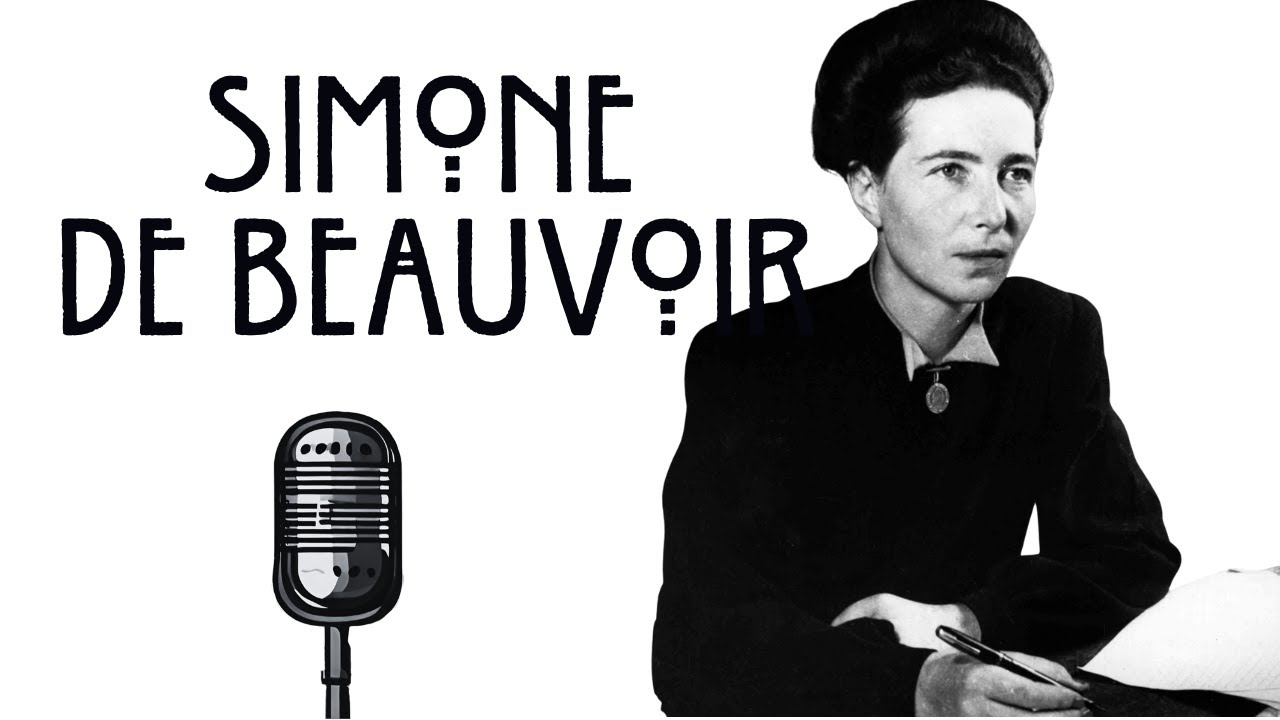
Simone de Beauvoir's existential philosophy, developed in 'The Ethics of Ambiguity,' presents ambiguity as the fundamental human condition arising from our dual nature as both free subjects (transcendence) and situated objects (facticity); she argues that ethics emerges from this freedom, which is not a psychological capacity but a nothingness that must be actively converted into moral freedom through recognizing our own freedom and the freedom of others, and that oppression occurs when one group denies another's freedom, creating a self-contradictory situation where the oppressor both requires recognition by a free subject while denying that freedom, requiring oppressed individuals to temporarily deny the oppressor's freedom to achieve liberation.
Beauvoir's Existential Ethics of Ambiguity and Freedom
Added:Hi everyone!
Today, we're talking about Simone de Beauvoir's concept of ambiguity.
I'll mostly be drawing on work that she develops in her book the ethics of ambiguity, from 1947.
Simone de Beauvoir is an existentialist philosopher, and she believes that existentialism is a philosophy of ambiguity.
Ambiguity is the human condition that we find ourselves in because we are caught between our freedom, our subjectivity, our transcendence on the one hand, and our facticity, our situatedness, on the other hand.
I am a subject for myself that I am an object for others.
And to be human means to have this dual condition.
The dual condition is what Beauvoir calls ambiguity.
She thinks that most philosophers have tried to flee ambiguity and that this has meant that they've gone off into abstractions or idealisms.
They've artificially reduced and oversimplified the human condition.
But existentialism for her is the philosophy that encourages us to actively assume or take up our ambiguity.
This means recognizing that we are freely projected toward an uncertain future.
That we can shape through our own projects and that we are also limited that we are shaped in relation to others.
So I shape my future, but I'm also shaped by my past, by my present, by my society, by the people around me, by things that are outside of my control, by facets of my body or my personality.
Let's think a little bit more about what she means by freedom, which for her is closely associated with transcendence.
Freedom for Beauvoir is a source of all values and justifications.
For Beauvoir, there is no ethics without human freedom.
We simply wouldn't need to negotiate questions of right and wrong to try and figure out what the right course of action might be if the course of action were already determined for us.
She says one does not offer an ethics to a God because God would already have omniscience, omnipotence, and so on.
Instead, ethics is really the domain of negotiation that happens among humans and within our own selves.
Right?
We're trying to figure out what the right course of action might be.
And that means recognizing that on the one hand, we are not totally unlimited.
Right?
We are situated.
We are facticity.
But then on the other hand, we are free, right?
These are the two sides of the same coin that constitute human ambiguity.
And so that dimension of freedom, I want to think about a little bit more.
As an existentialist, Beauvoir is in line with the view that freedom is not a thing, a faculty, a capacity that humans possess in some sort of set of psychological features.
Instead, freedom is nothing.
Freedom is the way that we hurdle towards an uncertain future.
Freedom is itself,the groundless ground of justification of activity of projects, but this original freedom that we have, this freedom that is nothingness, Beauvoir suggests we need to convert into moral freedom.
We need to actively take up our own freedom.
To recognize it.
And this also means recognizing the freedom of others when we don't recognize our freedom, we're in what Sartre calls bad faith.
Sartre and Beauvoir share a lot of these points in common, although they're different in other ways, um, because they were life partners and shared their philosophical works with each other, their philosophical ideas throughout their life.
For Beauvoir, freedom is an indefinite movement that always appears as a movement of freeing or freedom appears as liberation or freeing.
And the situations that are preferred in Beauvoir's ethics are those that enable freedom to self-actualize more and more.
The ones that allow for the indefinite movement of freedom.
So Beauvoir is against the idea that morality is a question of codes, rules, or principles that we need to apply in a given situation.
But this doesn't mean that she thinks that all situations are morally equal.
The aim of ethics is to realize freedom.
This leads to our account of oppression in the ethics of ambiguity.
Oppression for Beauvoir is not a natural fact.
It's a specific form of human interaction where one human or one group of humans denies the freedom of another human or group of people.
In denying another person's freedom.
One is denying their ambiguity because freedom is one of the features of ambiguity, right?
This dual human condition of being both free and being situated.
The oppressor takes the oppressed to be entirely situated so much so that they completely objectify the oppressed, failing to recognize that their objectivity is only one facet of their humanity.
The oppressor prevents the oppressed from participating freely in their own futures.
And what often happens in situations of group oppression over a long period of time is what Beauvoir calls mystification, borrowing a term from Marxian philosophy.
Mystification is the condition of being so oppressed that you don't even realize that you have freedom.
You are attached, desirous of your own oppression, because you are trapped in the false consciousness that the oppressor has instilled in you.
You believe that you are condemned to your condition.
This is what we see among women under the condition of patriarchy in Beauvoir's view, something she discusses at length in the second sex.
The oppressor treats the oppressed as a thing.
The oppressed often ends up treating themselves as a thing as a result.
And this is actually always a temptation for any person.
According to Beauvoir, freedom is really scary for us.
And so we're tempted to flee our freedom by treating ourselves as objects in the world.
Right?
It's easier for me to pretend that I don't have freedom than it is to actively take up responsibility for my own future.
And so the oppressor trades on the temptation that we all as humans have to treat ourselves as a thing, to deny our own freedom, and convinces the oppressed that they are not free.
In doing so, the oppressor undercuts their own power, however, because in order to be recognized as an oppressor, they need to be recognized by a free subject.
Only a subject can recognize something else.
And so the oppressor is also caught in this denial of their own human ambiguity by overlooking their own facticity.
And also by weirdly wanting to be recognized as an oppressor, which would be an aspect of factical existence, by someone whose very subjectivity and freedom they are denying.
In this sense, Beauvoir says in ethics of ambiguity that oppression is self contradictory.
How does one overcome oppression, especially if the oppressed are often caught in the trap of mystification, where they don't even realize that they are being oppressed?
Beauvoir says that the first step is that the oppressed need to be faced with their own freedom, ideally by others who are not oppressed, but obviously it's not going to be the oppressors.
And once the oppressed are faced with their own freedom, They can hopefully actively take it up.
This is sort of a classic moment of consciousness raising that we might find in feminist or Marxist theory.
And in order then to transition from actively recognizing one's own freedom when one is being oppressed to overthrowing the conditions of oppression, one needs to temporarily deny the freedom of the oppressor when needs to treat the oppressor as a thing, one needs to deny the ambiguity of the oppressor, according to Beauvoir.
So she actually does think that violence against oppressors is in some cases justified.
Now, one thing that happens is that the oppressors then say, well, there you go oppressing me.
So there's a strange false equivalency on which the oppressors trade by saying that they are now the ones who are being oppressed.
You might think about the common phrase that gets bandied about today, which is that equality feels like oppression or the removal of a privilege feels like oppression.
Beauvoir says that this is ultimately a,dishonest point of view.
Now the oppressors, however, I mentioned that before, it does think that violence is sometimes justified in the case of oppression, but she's not like, okay, this needs to be a free for all.
Violence is something to resort to, she thinks, when there are not other options.
The goal is really to encourage a conversion among the oppressors, where they are recognizing the freedom of the oppressed, as well as recognizing their own human condition of ambiguity.
So we may temporarily have to deny the freedom of those who are denying the freedom of others, but ultimately the goal is for there to be a widespread recognition of freedom among the participants in society.
That would be the overcoming of oppression.
Ultimately, Beauvoir's ethics is oriented toward human freedom.
But this also means, as I said, that human freedom that exists in relation to its situation.
That is the ambiguity side of it, right?
This is an ethics of ambiguity that Beauvoir is offering.
Now the closest we get to a sort of imperative in before his existential ethics is her claim that one must will oneself and others free, treating the other as a freedom.
This is a law of freedom, which she says has three parts.
The first part is to actively assume or freedom rather than fleeing.
The second part is to assume it by a positive and constructive movement.
Although freedom itself, as we said, is not a thing, a capacity that humans have, it's not a quality of our being, but rather a nothingness, this nothingness converts into something positive through the projects that we create in the world, through the choices we make, we are all participating in the creation of the human condition.
We all need to take action in order to create the world that we would like to see.
And the third aspect is that we also need to assume freedom by a negative movement.
And this negative movement is the rejection of oppression of both oneself and others.
Thanks so much for watching today!
I'd also love to shout out our podcast, which I co-host with my dear friend, David Pena- Guzman, Overthink.
Highly recommend checking it out.
We talk about Beauvoir and a bunch of other existentialists frequently on the show, and it's a fun, chill, conversational podcast that's meant to be accessible for folks who haven't read these thinkers that I discuss in my videos.
We have episodes on everything from existential anxiety to gaslighting, to cancel culture, to synesthesia, and so much more!
So follow and subscribe to our podcast.
And also subscribe here if you haven't already.
Up Next

Simone de Beauvoir: Subhuman and Serious Person Archetypes
@Einzelgänger
82.9K views•2024-12-21

John of Damascus on Holy Images: A Theological Defense
@BannedBooks
139 views•2026-04-25

Merleau-Ponty: Phenomenology of Perception Explained
@OverthinkPodcastPhilosophy
204.2K views•2022-06-10

The Myth of Sisyphus: A Greek Legend of Eternal Punishment
@TEDEd
8.6M views•2018-11-13
Related Study Plans & Knowledge Roadmaps
Structured learning paths in Philosophy