













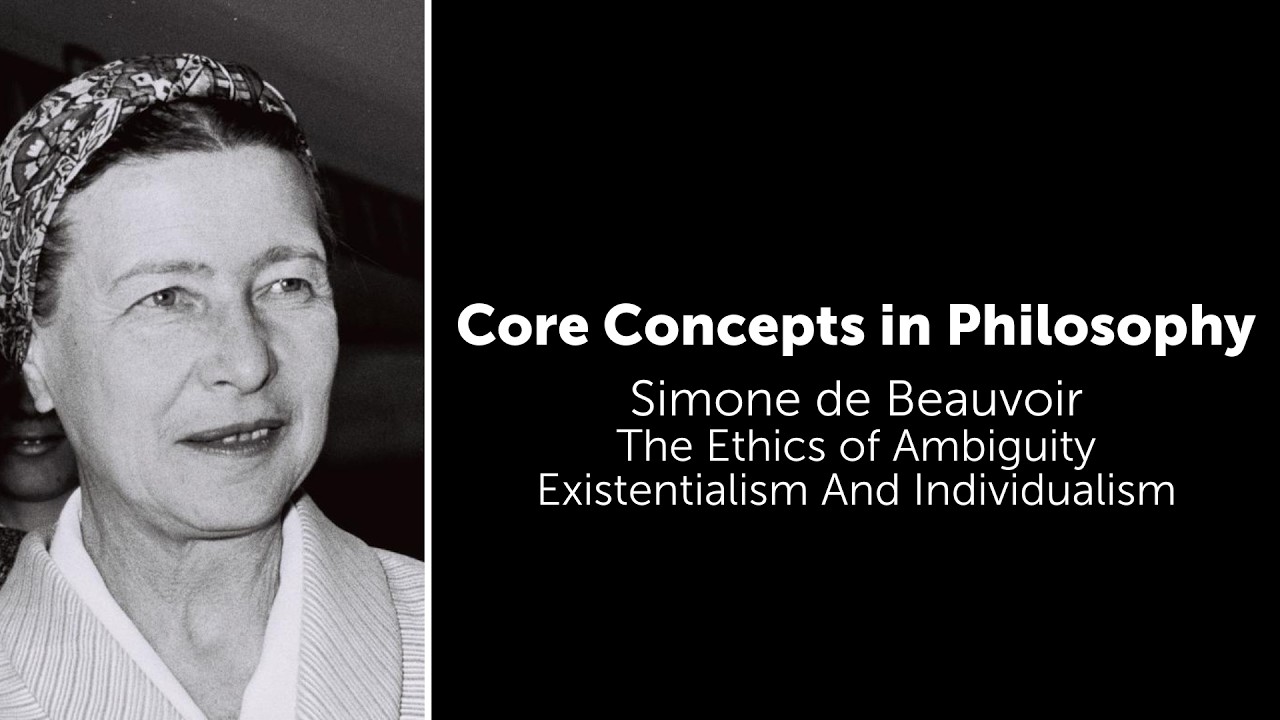



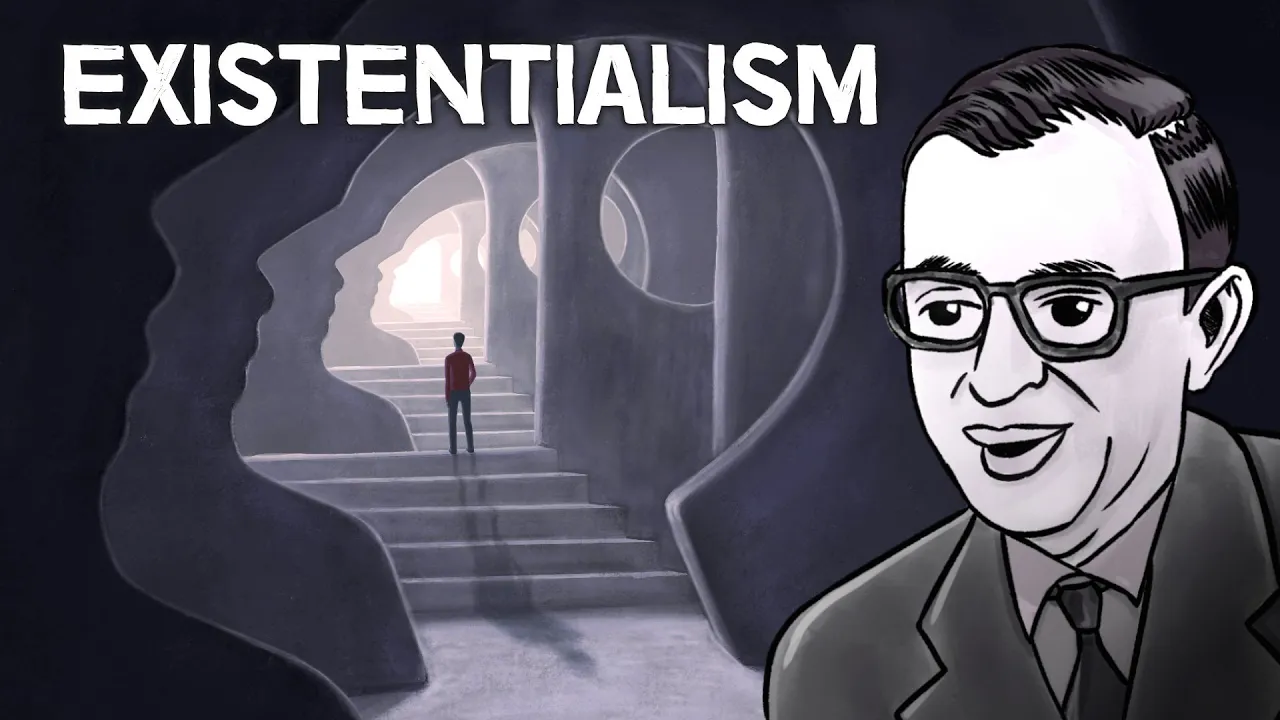
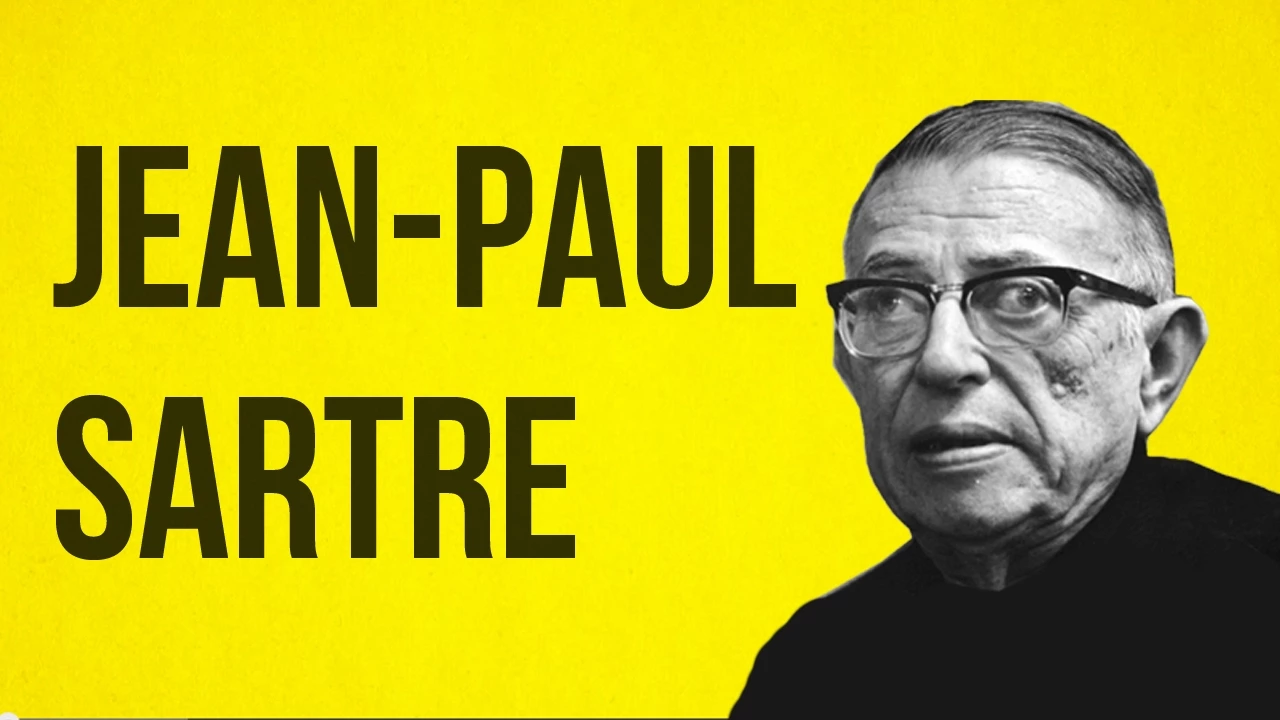







In existentialism, existence precedes essence, meaning that humans first exist without any predetermined nature or definition, and only afterward define themselves through their choices and actions. This radical freedom places the full responsibility for every choice squarely on the individual, who, in choosing for themselves, simultaneously chooses an image of what all humans ought to be. Far from leading to despair, existentialism is an optimistic doctrine of self-creation and human universality, where man is condemned to be free but finds meaning through committed action rather than predetermined essence.
Sartre: Existentialism Is a Humanism Audiobook
Added:The traditional metaphysical concept of 'essence precedes existence', which posits that human nature and purpose are predefined by a creator or cosmic order.
The core debates surrounding free will versus determinism, particularly how different philosophical traditions define human agency and moral responsibility.
The historical context of post-World War II Europe (circa 1946), which left a generation disillusioned with traditional religious and political institutions.
An introductory understanding of 19th-century precursors to existentialism, specifically the works of Søren Kierkegaard and Friedrich Nietzsche regarding individualism and the death of objective moral certainty.
Sartre's major philosophical treatise, 'Being and Nothingness', to examine the rigorous ontological distinctions between 'being-in-itself' (en-soi) and 'being-for-itself' (pour-soi).
Simone de Beauvoir's 'The Ethics of Ambiguity', which expands existentialist thought into a concrete ethical system that accounts for the freedom of others.
The concept of 'Bad Faith' (mauvaise foi) and how individuals deceive themselves into believing they lack the freedom to choose their own paths.
Albert Camus's Philosophy of the Absurd, particularly 'The Myth of Sisyphus', to compare Sartre's focus on creating meaning with Camus's embrace of the absurd.
The Marxist and Christian critiques of existentialism that Sartre was specifically responding to in his 1946 lecture.
156.3K views3.6Klikes1:17:58Original Release: 2020-05-03
existentialism is a humanism by jean-paul Sartre lecture given in 1946 my purpose here is to offer a defense of existentialism against several approaches that have been laid against it first it has been reproached as an invitation to people to dwell in quietism of despair for if every way to a solution is barred one would have to regard any action in this world as entirely ineffective and one would arrive finally at a contemplative philosophy moreover since contemplation is luxury this would only be another bourgeois philosophy this is especially the reproach made by the Communists from another quarter we are reproached for having underlined all that is ignominy ax sin the human situation for depicting what is mean sorted or base to neglect of certain things that possessed charm and beauty and belonged to the brighter side of human nature for example according to the Catholic critic Mademoiselle Messier we forgot how an infant smiles both from this side and from the other we are also reproached for leaving out of account the Solidarity of mankind and considering man in isolation and this say the communist is because we base our doctrine upon pure subjectivity upon the Cartesian I think which is a moment in which solitary man attains to himself a position from which it is impossible to regain solidarity with other men who exist outside of the self the ego cannot reach them through the coach Ito from the Christian side we are reproached as people who deny the reality and seriousness of human affairs for since we ignore the commandments of God and all values prescribed as eternal nothing remains but what is strictly voluntary everyone can do what he likes and will be incapable from such a point of view of condemning either the point of view or the action of anyone else it is to these various reproaches that I shall endeavour to reply today this is why I have entitled this brief exposition existentialism is a humanism many may be surprised at the mention of humanism in this connection but we shall try to see in what sense we understand it in any case we can begin by saying that existentialism in our sense of the word is a doctrine that does render human life possible a doctrine also which affirms that every truth and every action imply both an environment and a human subjectivity the essential charge laid against us is of course that of over emphasis upon the evil side of human life I have lately been told of a lady who whenever she let slip with vulgar expression in a moment of nervousness excuses herself by exclaiming I believe I'm becoming an existentialist so it appears that ugliness is being identified with existentialism that is why some people say we are naturalistic and if we are it is strange to see how much we scandalize and horrify them for no one seems to be much frightened or humiliated nowadays by what is properly called naturalism those who can quite well keep down a novel by zola such as la terre are sickened as soon as they read an existentialist novel those who appeal to the wisdom of the people which is a sad wisdom find ours satyr still and yet what could be more disillusioned than such sayings as charity begins at home or promote a rogue and he'll sue you for damage knock him down and he'll do you homage we all know how many common sayings can be quoted to this effect and they all mean much the same that you must not oppose the powers that be that you must not fight against superior force must not meddle in matters that are above your station or that any action not in accordance with some tradition is mere romanticism or that any undertaking which is not the support of proven experience is foredoomed to frustration and that since experience has shown men to be invariably inclined to evil there must be firm rules to restrain them otherwise we shall have anarchy it is however the people who are forever mouthing these dismal proverbs and whenever they are told of some more or less repulsive action say how like human nature it is these very people always harping upon realism who complain that existentialism is too gloomy a view of things indeed their excessive protests make me suspect that what is annoying them is not so much our pessimism but much more likely our optimism for at bottom what is alarming in the doctrine that I am about to try to explain to you is is it not that it confronts man with the possibility of choice to verify this let us review the whole question upon the strictly philosophic level what then is this that we call existentialism most of those who are making use of this word would be highly confused if required to explain its meaning for since it has become fashionable people cheerfully declare that this musician or that painter is existentialist a columnist in Clark's signs himself the existentialist and indeed the word is now so loosely applied to so many things then it no longer means anything at all it would appear that for the lack of any novel doctrine such as that of surrealism all those who are eager to join in the latest scandal or movement now seize upon this philosophy in which however they can find nothing to their purpose for in truth this is of all teachings the least scandalous and most austere it is intended strictly for technicians and philosophers all the same it can easily be defined the question is only complicated because there are two kinds of existentialist there are on the one hand the Christians amongst whom I shall name Jasper's and Gabriel Marcel both professed Catholics and on the other the existential atheists amongst whom we must place Heidegger as well as a French existentialist and myself what they have in common is simply the fact that they believe that existence comes before essence or if you will that we must begin from the subjective what exactly do we mean by that if one considers an article of manufacturer as for example a book or a penknife one sees that it has been made by an artisan who had a conception of it and he has paid attention equally to the conception of a paper knife and to the pre-existent technique of production which is a part of that conception and is at bottom a formula thus the paper knife is at the same time an article producible in a certain manner and one which on the other hand serves a definite purpose for one cannot suppose that a man would produce a paper knife without knowing what it was for let us say then of the paper knife that its essence that is to say the sum of the formulae and the qualities which made its production and it's definition possible precedes its existence the presence of such-and-such a paper knife or book is thus determined before my eyes here then we are viewing the world from a technical standpoint and we can say that production precedes existence when we think of God as the Creator we are thinking of him most of the time as a supernal artisan whatever doctrine we may be considering whether it be a doctrine like that of Descartes or of limits himself we always imply that the will follows more or less from the understanding or at least accompanies it so that when God creates he knows precise what he is creating thus the conception of man in the mind of God is comparable to that of the paper-knife in the mind of the artisan God makes man according to a procedure and a conception exactly as the artisan manufactures a paper knife following a definition and a formula thus each individual man is a realization of a certain conception which dwells in the divine understanding in the philosophic atheism of the 18th century the notion of God is suppressed but not for all that the idea that essence is prior to existence something of that idea we still find everywhere in did a row in Voltaire and even in Conte man possesses a human nature that human nature which is a conception of human being is found in every man which means that each man is a particular example of a universal conception the conception of man in count this universality goes so far that the wild man of the woods man in the state of nature and the boudoir are all contained in the same definition and have the same fundamental qualities here again the essence of man precedes that historic existence which we confront and experience atheistic existentialism of which I am representative declares with greater consistency that if God does not exist there's at least one being whose existence comes before its essence a being which exists before it can be defined by any conception of it that being is man or as Heidegger has it the human reality what do we mean by saying that existence precedes essence we mean that man first of all exists encounters himself surges up in the world and defines himself afterwards if man as the existentialist sees him is not definable it is because to begin with he is nothing he will not be anything until later and then he will be what he makes of himself thus there is no human nature because there is no God to have a conception of it man simply is not that he is simply what he conceives himself to be but he is what He wills and as he conceives himself after already existing as he wills to be after that leap towards existence man is nothing else but that which he makes of himself that is the first principle of existentialism and this is what people call its subjectivity using the word as a reproach against us but what do we mean to say by this but that man is of greater dignity than a stone or a table for we mean to say that man primarily exists that man is before all else something which propels itself towards a future and is aware that it is doing so man is indeed a project which possesses a subjective life instead of being a kind of moss or a fungus or a cauliflower before that projection of the self nothing exists not even in the heaven of intelligence man will only attain existence when he is what he proposes to be not however what he may wish to be for what we usually understand by wishing or willing is a conscious decision taken much more often than not after we have made ourselves what we are I may wish to join a party or write a book or to marry but in such a case what is usually called my will is probably a manifestation of a prior and more spontaneous decision if however it is true that existence is prior to SN man is responsible for what he is thus the first effect of existentialism is that it puts every man in possession of himself as he is and places the entire responsibility for his existence squarely upon his shoulders and when we say that man is responsible for himself we do not mean that he is responsible only for his own individuality but that he is responsible for all men the word subjectivism is to be understood in two senses and our adversaries play upon only one of them subjectivism means on the one hand the freedom of the individual subject and on the other that man cannot pass beyond human subjectivity it is the latter which is the deeper meaning of existentialism when we say that man chooses himself we do mean that every one of us must choose himself but by that we also mean that in choosing for himself he chooses for all men for in effect of all the actions a man may take in order to create himself as he wills to be there is not one which is not creative at the same time of an image of man such as he believes he ought to be to choose between this or that is at the same time to affirm the value of that which is chosen for we are unable ever to choose the worse what we choose is always the better and nothing can be better for us unless it is better for all if more over existence precedes essence and we will to exist at the same time as we fashion our image that image is valid for all and for the entire epoch in which we find ourselves our responsibility is thus much greater than we had supposed for concerns mankind as a whole if I am a worker for instance I may choose to join a Christian rather than a communist trade union and if by that membership I chose to signify that resignation is after all the attitude that best becomes a man that man's Kingdom is not upon this earth I do not commit myself alone to that view resignation is my will for everyone and my action is in consequence a commitment on behalf of all mankind or if to take a more personal case I decide to marry and to have children even though this decision proceeds simply from my situation from my passion or my desire I am thereby committing not only myself but humanity as a whole to the practice of monogamy I am thus responsible for myself and for all men and I am creating a certain image of man as I would have him to be in fashioning myself I fashion man this may enable us to understand what is meant by such terms perhaps a little grandiloquent as anguish abandonment and despair as you will soon see it is very simple first what do we mean by anguish the existentialist frankly states that man is in anguish his meaning is as follows when a man commits himself to anything fully realizing that he is not only choosing what he will be but is thereby at the same time a legislator deciding for the whole of mankind in such a moment a man cannot escape from the sense of complete and profound responsibility there are many indeed who show no such anxiety but we affirm that they are merely disguising their anguish or are in flight from it certainly many people think that in what they are doing they commit no one but themselves to anything and if you ask them what would happen if everyone did so they shrug their shoulders and reply everyone does not do so but in truth one ought always to ask oneself what would happen if everyone did as one is doing nor can one escape from that disturbing thought except by a kind of self-deception the man who lies in self excuse by saying everyone will not do it must be ill at ease in his conscience for the act of lying implies the universal value which it denies by its very disguise his anguish reveals itself this is the anguish that Kierkegaard called the anguish of Abraham you know the story an angel commanded Abraham to sacrifice his son and obedience was obligatory if it really was an angel who appeared and said thou Abraham shalt sacrifice thy son but anyone in such a case would wonder first whether it was indeed an angel and secondly whether I am really Abraham where are the proofs a certain madwoman who suffered from hallucinations said that people were telephoning to her and giving her orders the doctor asked but who is it that speaks to you she replied he says it is God and what indeed could prove to her that it was God if an angel appears to me what is the proof that it is an angel or if I hear voices who can prove that they proceed from heaven and not from Hell or from my own subconsciousness or some pathological condition who can prove that they are really addressed to me who then can prove that I and the proper person to impose by my own choice my conception of man upon mankind I shall never find any proof whatever there will be no sign to convince me of it if a voice speaks to me it is still I myself who must decide whether the voice is or is not that of an angel if I regard a certain course of action as good it is only I who choose to say that it is good and not bad there is nothing to show that I am Abraham nevertheless I am also obliged at every instant to perform actions which are examples everything happens to every man as though that whole human race had its eyes fixed upon what he is doing and regulated its conduct accordingly so every man ought to say am I really a man who has the right to act in such a manner that humanity regulates itself by what I do if a man does not say that he is dissembling his anguish clearly the anguish with which we are concerned here is not one that could lead to quietism or inaction it is anguish pure and simple of the kind well known to all those who have borne responsibilities when for instance a military leader takes upon himself the responsibility for an attack and sends a number of men to their death he chooses to do it and at bottom he alone chooses no doubt under a higher command but its orders which are more general require interpretation by him and upon that interpretation depends a life of ten fourteen or twenty men in making the decision he cannot but feel a certain anguish all leaders know that anguish it does not prevent their acting on the contrary it is the very condition of their action for the action presupposes that there is a plurality of possibilities and in choosing one of these they realized that it has value only because it is chosen now it is anguish of that kind which existentialism describes and moreover as we shall see makes explicit through direct responsibility towards other men who are concerned far from being a screen which could separate us from action it is a condition of action itself and when we speak of abandonment a favorite word of Heidegger we only mean to say that God does not exist and that it is necessary to draw the consequences of his absence right to the end the existentialist is strongly opposed to a certain type of secular moralism which seeks to suppress God at the least possible expense towards 1880 when the French professors endeavoured to formulate a secular morality they said something like this god is a useless and costly hypothesis so we will do without it however if we are to have a morality a society and a law-abiding world it is essential that certain values should be taken seriously they must have an a priori existence ascribed to them it must be considered obligatory a priori to be honest not to lie not to beat one's wife to bring up children and so forth so we are going to do a little work on this subject which will enable us to show that these values exist all the same inscribed in an intelligible heaven although of course there is no God in other words and this is I believe the purport of all that we have in France called radicalism nothing will be changed if God does not exist we shall rediscover the same norms of honesty progress and humanity and we shall have disposed of God as an out-of-date hypothesis which will die away quietly of itself the existentialist on the contrary finds it extremely embarrassing that God does not exist for there disappears with him all possibility of finding values in an intelligible heaven there can no longer be any good a priori since there is no infinite and perfect consciousness to think it it is nowhere written that the good exists that one must be honest or must not lie since we are now upon the plane where there are only men Dostoyevsky once wrote if God did not exist everything would be permitted and that for existentialism is the starting point everything is indeed permitted if God does not exist and man is in consequence for alone for he cannot find anything to depend upon either within or outside himself he discovers forthwith that he is without excuse for if indeed existence precedes essence one will never be able to explain one's action by reference to a given and specific human nature in other words there is no determinism man is free man is freedom nor on the other hand if God does not exist are we provided with any values or commands that could legitimize our behavior thus we have neither behind us nor before us in a luminous realm of values any means of justification or excuse we are left alone without excuse that is what I mean when I say that man is condemned to be free condemned because he did not create himself yet is nevertheless at liberty and from the moment that he is thrown into this world he is responsible for everything he does the existentialist does not believe in the power of passion he will never regard a grand passion as a destructive torrent upon which a man is swept into certain actions as by fate and which therefore is an excuse for them he thinks that man is responsible for his passion neither will an existentialist think that a man can find help through some sign being vouchsafed upon earth for his orientation for he thinks that man himself interprets a sign as he chooses he thinks that every man without any support or help whatever is condemned at every instant to invent man as polish has written in a very fine article man is the future of man that is exactly true only if one took this to mean that the future is laid up in heaven that God knows what it is it would be false for then it would no longer even be a future if however it means that whatever man may now appear to be there is a future to be fashioned a virgin future that awaits him then it is a true saying but in the present one is forsaken as an example by which you may the better understand the state of abandonment I will refer to the case of the pupil of mine who sought me out in the following circumstances his father was quarreling with his mother and was also inclined to be a collaborator his elder brother had been killed in the German offensive of 1940 and this young man with a sentiment somewhat primitive but generous burned to avenge him his mother was living alone with him deeply afflicted by the semi treason of his father and by the death of her eldest son and her one consolation was in this young man but he at this moment had the choice between going to England to join the Free French forces or of staying near his mother and helping her to live he fully realized that this woman lived only for him and that his disappearance or perhaps his death would plunge her into despair he also realized that concretely and in fact every action he performed on his mother's behalf would be sure of effect in the sense of aiding her to live whereas anything he did in order to go and fight would be an ambiguous action which might vanish like water into sand and serve no purpose for instance to set out for England he would have to wait indefinitely in a Spanish camp on the way through Spain or on arriving in England or in algier he might be put into an office to fill up forms consequently he found himself confronted by two very different modes of action the one creet immediate but directed towards only one individual and the other an action addressed to an end infinitely greater a national collectivity but for that very reason ambiguous and it might be frustrated on the way at the same time he was hesitating between two kinds of morality on the one side the morality of sympathy of personal devotion and on the other side a morality of wider scope but of more debatable validity he had to choose between these two what could help him to choose could the Christian doctrine no Christian doctrine says act with charity love your neighbor deny yourself for others choose the way which is honest and so forth but which is a harder road to whom does one owe the more brotherly love the Patriot or the mother which is the more useful aim the general one of fighting in and for the whole community or the precise aim of helping one particular person to live who can give an answer to that a priori no one nor is it given in any ethical scripture the Conte and ethic says never regard another as a means but always as an end very well if I remain with my mother I shall be regarding her as the end and not as a means but by the same token I am in danger of treating as a means those who are fighting on my behalf and the converse is also true that if I go to the aid of the combatants I shall be treating them as an end at the risk of treating my mother as a means if values are uncertain if they are still too abstract to determine the particular concrete case under consideration nothing remains but to trust in our instincts that is what this young man tried to do and when I saw him he said in the end it is feeling that counts the direction in which it is really pushing me is the one I ought to choose if I feel that I love my mother enough to sacrifice everything else for her my will to be avenged all my longings for action and adventure then I stay with her if on the contrary I feel that my love for her is not enough I go but how does one estimate the strength of a feeling the value of his feeling for his mother was determined precisely by the fact that he was standing by her I may say that I love a certain friend enough to sacrifice such her such a sum of money for him but I cannot prove that unless I have done it I may say I love my mother enough to remain with her if I actually have remained with her I can only estimate the strength of this affection if I have performed an action by which it is defined and ratified but if I then appeal to this affection to justify my action I find myself drawn into a vicious circle moreover as g'd has very well said a sentiment which is play-acting and one which is vital are two things that are hardly distinguishable one from another to decide that I love my mother by staying beside her and to play a comedy the upshot of which is that I do so these are nearly the same thing in other words feeling is formed by the deeds that one does therefore I cannot consult it as a guide to action and that is to say that I can neither speak within myself for an authentic impulse to action nor can I expect from some ethic formulae that will enable me to act you may say that the youth did at least go to a professor to ask for advice but if you seek counsel from a priest for example you have selected that priest and at bottom you already knew more or less what he would advise in other words to choose an advisor is nevertheless to commit oneself by that choice if you are a Christian you will say consult a priest but there are collaborationists priests who are resistors and priests who wait for the tide to turn which will you choose had this young man chosen a priest of the resistance or one of the collaboration he would have decided beforehand the kind of advice he was to receive similarly in coming to me he knew what advice I should give him and I had but one reply to make you are free therefore choose that is to say invent no rule of general morality can show you what you ought to do no signs are vouchsafed in this world the Catholics will reply oh but they are very well still it is I myself in every case who have to interpret the signs while I was imprisoned I made the acquaintance of a somewhat remarkable man a Jesuit who had become a member of that order in the following manner in his life he had suffered a succession of rather severe setbacks his father had died when he was a child leaving him in poverty and he had been awarded a free scholarship in a religious institution where he had been made continually to feel that he was accepted for charity's sake and in consequence he had been denied several of those distinctions and honors which gratified children later about the age of 18 he came to grief in a sentimental affair and finally at 22 this was a trifle in itself but it was a last drop that overflowed his cup he failed in his military examination this young man then could regard himself as a total failure it was a sign but a sign of what he might have taken refuge in bitterness or despair but he took it very cleverly for him as a sign that he was not intended for secular success and that only the attainments of religion those of sanctity and of faith were accessible to him he interpreted his record as a message from God and became a member of the order who can doubt but that this decision as to the meaning of the sign was his and his alone one could have drawn quite different conclusions from such a series of reverses as for example that he had better become a carpenter or a revolutionary for the decipherment of the sign however he bears the entire responsibility that is what abandonment implies that we ourselves decide our being and with this abandonment goes anguish as for despair the meaning of this expression is extremely simple it merely means that we limit ourselves to a reliance upon that which is within our wills or within the sum of the probabilities which render our action feasible whenever one wills anything there are always these elements of probability if I am counting upon a visit from a friend who may be coming by train or tram I presuppose that the train will arrive at the appointed time or that the tram will not be derailed I remain in the realm of possibilities but one does not rely upon any possibilities beyond those that are strictly concerned in one's action beyond the point at which the possibilities under consideration cease to affect my action I ought to disinterest myself for there is no God and no prevenient design which can adapt the world and all its possibilities to my will when Descartes said conquer yourself rather than the world what he meant was at bottom the same that we should act without hope Marxists to whom I have said this have answered your action is limited obviously by your death but you can rely upon the help of others that is you can count both upon what the others are doing to hell Pew elsewhere as in China and in Russia and upon what they will do later after your death to take up your action and carry it forward to its final accomplishment which will be the revolution moreover you must rely upon this not to do so is immoral to this I rejoin first that I shall always count upon my comrades in arms in the struggle insofar as they are committed as I am to a definite common cause and in the unity of a party or a group which I can more or less control that is in which I am enrolled as a militant and whose movements at every movement are known to me in that respect to rely upon the unity and the will of the party is exactly like my reckoning that the train will run on time or that the tram will not be derailed but I cannot count upon men whom I do not know I cannot base my confidence upon human goodness or upon man's interest in the good of society seeing that man is free and there is no human nature which I can take as foundational I do not know where the Russian Revolution will lead I can admire it and take it as an example insofar as it is evident today that the proletariat plays a part in Russia which it has attained in no other nation but I cannot affirm that this will necessarily lead to the triumph of the proletariat I must confine myself to what I can see nor can I be sure that comrades and arms will take up my work after my death and carry it to the maximum perfection seeing that those men are free agents and will freely decide tomorrow what man is then to be tomorrow after my death some men may decide to establish fascism and others may be so cowardly or so slack as to let them do so if so fascism will then be the truth of man and so much worse for us in reality things will be such as men have decided they shall be does that mean that I should abandon myself to quietism No first I ought to commit myself and then act my commitment according to the time-honored formula that one need not hope in order to undertake one's work nor does this mean that I should not belong to a party but only that I should be without illusion and that I should do what I can for instance if I ask myself will the social ideal as such ever become a reality I cannot tell I only know that whatever may be in my power to make it so I shall do beyond that I can count upon nothing quietism is the attitude of people who say let others do what I cannot do the doctrine I am presenting before you is precisely the opposite of this since it declares that there is no reality except in action it goes further indeed and adds man is nothing else but what he proposes he exists only insofar as he realizes himself he is there for nothing else but the sum of his actions nothing else but what his life is hence we can well understand why some people are horrified by our teaching for many have but one resource to sustain them in their misery and that is to think circumstances have been against me I was worthy to be something much better than I have been I admit I have never had a great love or a great friendship but that is because I never met a man or a woman who were worthy of it if I have not written any very good books it is because I had not the leisure to do so or if I have had no children to whom I could devote myself it is because I did not find the man I could have lived with so there remains within me a wide range of abilities inclinations and potentialities unused but perfectly viable which endow me with a worthiness that could never be inferred from the mere history of my actions but in reality and for the existentialist there is no love apart from the deeds of love no potentiality of love other than that which is manifested in loving there is no genius other than that which is expressed in works of art the genius of Proust is the totality of the works of Proust the genius of Racine is the series of his tragedies outside of which there is nothing why should we attribute to Racine the capacity to write yet another tragedy when that is precisely what he did not write in life a man commits himself draws his own portrait and there is nothing but that portrait no doubt this thought may seem comfortless to one who has not made a success of his life on the other hand it puts everyone in a position to understand that reality alone is reliable that dreams expectations and hopes serve to define a man only as deceptive dreams a board of hopes expectations unfulfilled that is to say they define him negatively not positively nevertheless when one says you are nothing else but what you live it does not imply that an artist is to be judged solely by his works of art for a thousand other things contribute no less to his definition as a man what we mean to say is that a man is no other than a series of undertakings that he is the sum the organization the set of relations that constitute these undertakings in light of all this what people reproach us with is not after all our pessimism but the sternness of our optimism if people condemned our works of fiction in which we described characters that are base weak cowardly and sometimes even frankly evil it is not only because those characters are base weak cowardly are evil for suppose that like Zola we showed that the behavior of these characters was caused by their heredity or by the action of their environment upon them or by determining factors psychic or organic people would be reassured they would say you see that is what we are like no one can do anything about that but the existentialist when he portrays a coward shows him as responsible for his cowardice he is not like that on account of a cowardly heart or lungs or cerebrum he has not become like that through his psychological organism he is like that because he has made himself into a coward by actions there is no such thing as a cowardly temperament there are nervous temperaments there is what is called impoverished blood and there are also rich temperaments but the man whose blood is poor is not a coward for all that for what produces cowardice is the act of giving up or giving way and a temperament is not an action a coward is defined by the deed that he has done what people feel obscurely and with horror is that the coward as we present him is guilty of being a coward what people would prefer would be to be born either a coward or a hero one of the charges most often laid against the Shamal de la liberté is something like this but after all these people being so base how can you make them into heroes that objection is really rather comic for it implies that people are born heroes and that is at bottom what such people would like to think if you are born cowards you can be quite content you can do nothing about it and you will be cowards all your lives whatever you do and if you are born heroes you can again be quite content you will be heroes all your lives eating and drinking heroically whereas the existentialist says that the coward makes himself cowardly the hero makes himself heroic and that there is always a possibility for the coward to give up cowardice and for the hero to stop being a hero what counts is the total commitment and it is not by particular case or particular action that you are committed altogether we have now I think dealt with a certain number of the reproaches against existentialism you have seen that it cannot be regarded as a philosophy of quietism since it defines man by his action nor as a pessimistic description of man for no doctrine is more optimistic the destiny of man is placed within himself nor is it an attempt to discourage man from action since it tells him that there is no hope except in his action and that the one thing which permits him to have life is the deed upon this level therefore what we are considering is an ethic of action and self commitment however we are still reproached upon these few data for confining man within his individual subjectivity there again people badly misunderstand us our point of departure is indeed the subjectivity of the individual and that for strictly philosophic reasons it is not because we are bourgeois but because we seek to base our teaching upon the truth and not upon a collection of fine theories full of hope but lacking real foundations and at the point of departure there cannot be any other truth than this I think therefore I am which is the absolute truth of consciousness as it attains to itself every Theory which begins with man outside of this moment of self attainment is a theory which thereby suppresses the truth for outside of the Cartesian coach ito all objects are no more than probable and any doctrine of probabilities which is not attached to a truth will crumble into nothing in order to define the probable one must possess the true before there can be any truth whatever then there must be an absolute truth and there is such a truth which is simple easily attained and within the reach of everybody it consists in one's immediate sense of oneself in the second place this theory alone is compatible with the dignity of man it is the only one which does not make man into an object all kinds of materialism lead one to treat every man including oneself as an object that is as a set of predetermined reactions in no way different from the patterns of qualities and phenomena which constitute a table or a chair or a stone our aim is precisely to establish the human Kingdom as a pattern of values in distinction from the material world but the subjectivity which we thus postulate as a standard of truth is no narrowly individual subjectivism for as we have demonstrated it is not only one's own self that one discovers in the Khajiit oh but those of others too contrary to the philosophy of Descartes contrary to that of Kant when we say I think we are attaining to ourselves in the presence of the other and we are just as certain of the other as we are of ourselves thus the man who discovers himself directly in the Khajiit Oh also discovers all the others and discovers them as a condition of his own existence he recognizes that he cannot be anything in the sense in which one says one is spiritual or that one is wicked or jealous unless others recognize him as such I cannot obtain any truth whatsoever about myself except through the mediation of another the other is indispensable to my existence and equally so to any knowledge I can have of myself under these conditions the intimate discovery of myself is at the same time the revelation of the other as a freedom which confronts mine and which cannot think or will without doing so either for or against me thus at once we find ourselves in a world which is let us say that of intersubjectivity it is in this world that man has to decide what he is and what others are furthermore although it is impossible to find in each and every man a universal essence that can be called human nature there is nevertheless a human universality of condition it is not by chance that the thinkers of today are so much more ready to speak of the condition than of the nature of man by his condition they understand with more or less clarity all the limitations which a priori define man's fundamental situation in the universe his historical situations are variable man may be born a slave in a pagan society or may be born a feudal Baron or a proletarian but what never vary are the necessities of being in the world of having to labour and to die there these limitations are neither subjective nor objective or rather there is both a subjective and an objective aspect of them objective because we meet with them everywhere and they are everywhere recognizable and subjective because they are lived and are nothing if man does not live them if that is to say he does not freely determine himself and his existence in relation to them and diverse though man's purpose may be at least none of them is wholly foreign to me since every human purpose presents itself as an attempt either to surpass these limitations or to widen them or else to deny or to accommodate oneself to them consequently every purpose however individual it may be is of universal value every purpose even that of a Chinese an Indian or a Negro can be understood by a European to say it can be understood means that the European of 1945 may be striving out of a certain situation towards the same limitations in the same way and that he may Rican see in himself the purpose of the Chinese of the Indian or the African in every purpose there is universality in the sense that every purpose is comprehensible to every man not that this or that purpose defines man forever but that it may be entertained again and again there is always some way of understanding an idiot child a primitive man or a foreigner if one has sufficient information in this sense we may say that there is a human universality but it is not something given it is being perpetually made I make this universality in choosing myself I also make it by understanding the purpose of any other man of whatever epoch this absoluteness of the act of choice does not alter the relativity of each epoch what is at the very heart and center of existentialism is the absolute character of the free commitment by which every man realizes himself in realizing a type of humanity a commitment always understandable too no matter whom in no matter what epoch and its bearing upon the relativity of the cultural pattern which may result from such an absolute commitment one must observe equally the relativity of cartesianism and the absolute character of the Cartesian commitment in this sense you may say if you like that every one of us makes the absolute by breathing by eating by sleeping or by behaving in any fashion whatsoever there is no difference between being free being as self committal as existence choosing its essence and absolute being and there is no difference whatever between being as an absolute temporarily localized that is localized in history and universally intelligible being this does not completely refute the charge of subjectivism indeed that objection appears in several other forms of which the first is as follows people say to us then it does not matter what you do and they say this in various ways first they tax us with Anarchy then they say you cannot judge others for there is no reason for preferring one purpose to another finally they may say everything being merely voluntary is a choice of yours you give away with one hand which you pretend to gain with the other these three are not very serious objections as to the first to say that it does not matter what you choose is not correct in one sense choice is possible but what is not possible is not to choose I can always choose but I must know that if I do not choose that is still a choice this although it may appear merely formal of great importance as a limit to fantasy and Caprice for when I confront a real situation for example that I am a sexual being able to have relations with a being of the other sex and able to have children I'm obliged to choose my attitude to it and in every respect I bear the responsibility of the choice which in committing myself also commits the whole of humanity even if my choice is determined by no a priori value whatever it can have nothing to do with Caprice and if anyone thinks that this is only g-d's theory of the at grat we over again he has failed to see the enormous difference between this theory and that of she'd she'd does not know what a situation is his act is one of pure Caprice in our view on the contrary man finds himself in an organised situation in which he is himself involved his choice involves mankind in its entirety and he cannot avoid choosing either he must remain single or he must marry without having children or he must marry and have children in any case and whichever he may choose it is impossible for him in respect of this situation not to take complete responsibility doubtless he chooses without reference to any pre-established value but it is unjust to tax him with Caprice rather let us say that the moral choice is comparable to the construction of a work of art but here I must at once digress to make it quite clear that we are not per pound an aesthetic morality for our adversaries are disingenuous enough to reproach us even with that I mentioned the work of art only by way of comparison and that being understood does anyone reproach an artist when he paints a picture for not following rules established a priori does one ever ask what is the picture that he ought to paint as everyone knows there is no predefined picture for him to make the artist applies himself to the composition of a picture and the picture that ought to be made is precisely that which he will have made as everyone knows there are no aesthetic values a priori but there are values which will appear in due course in the coherence of the picture in the relation between the will to create and the finished work no one can tell what the painting of tomorrow will be like one cannot judge a painting until it is done what has that to do with morality we are in the same creative situation we never speak of a work of art as irresponsible when we are discussing a canvas by Picasso we understand very well that the composition became what it is at the time when he was painting it and that his works are part and parcel of his entire life it is the same upon the plain of morality there is this in common between art and morality that in both we have to do with creation and invention we cannot decide a priori what it is that should be done I think it was made sufficiently clear to you in the case of that student who came to see me that to whatever ethical system he might appeal the Contin or any other he could find no sort of guidance whatever he was obliged to invent the law for himself certainly we cannot say that this man in choosing to remain with his mother that is in taking sentiment personal devotion and concrete charity as his moral foundations would be making an irresponsible choice nor could we do so if he preferred the sacrifice of going away to England man makes himself he is not found ready-made he makes himself by the choice of his morality and he cannot but choose a morality such is the pressure of circumstances upon him we define man only in relation to his commitments it is therefore absurd to approach us for irresponsibility in our choice in the second place people say to us you are unable to judge others this is true in one sense and false in another it is true in this sense that whenever a man chooses his purpose and his commitment in all clearness and in all sincerity whatever that purpose may be it is impossible for him to prefer another it is true in the sense that we do not believe in progress progress implies amelioration but man is always the same facing a situation which is always changing and choice remains always a choice in the situation the moral problem has not changed since the time when it was a choice between slavery and anti slavery from the time of the war of secession for example until the present moment when one chooses between the MRP and the communists we can judge nevertheless for as I have said one chooses in view of others and in view of others one chooses himself one can judge first and perhaps this is not a judgment of value but it is a logical judgment that in certain cases choice is founded upon an error and in others upon the truth one can judge a man by saying that he deceives himself since we have defined the situation of man as one of free choice without excuse and without help any man who takes refuge behind the excuse of his passions or by inventing some deterministic doctrine is a self deceiver one may object but why should he not choose to deceive him health I reply that it is not for me to judge him morally but I define his self-deception as an error here one cannot avoid pronouncing a judgment of truth the self-deception is evidently a falsehood because it is a dis simulation of man's complete liberty of commitment upon this same level I say that it is also a self-deception if I choose to declare that certain values are incumbent upon me I am in contradiction with myself if I will these values and at the same time say that they impose themselves upon me if anyone says to me and what if I wish to deceive myself I answer there's no reason why you should not but I declare that you are doing so and that the attitude of strict consistency alone is that of good faith furthermore I can pronounce a moral judgment for I declare that freedom in respect of concrete circumstances can have no other end and aim but itself and when once a man has seen that values depend upon himself in that state of forsaken as' he can will only one thing and that is freedom as the foundation of all values that does not mean that he wills it in the abstract it simply means that the actions of men of good faith have as their ultimate significance the quest of freedom itself as such a man who belongs to some communist or revolutionary society wills certain concrete ends which imply the will to freedom but that freedom is willed in community we will freedom for freedom's sake in and through particular circumstances and in thus willing freedom we discover that it depends entirely upon the freedom of others and that the freedom of others depends upon our own obviously freedom as the definition of a man does not depend upon others but as soon as there is a commitment I'm obliged to will the liberty of others at the same time as my own I cannot make Liberty my aim unless I make that of others equally my aim consequently when I recognize as entirely authentic that man is a being whose existence precedes his essence and that he is a free being who cannot in any circumstances but will his freedom at the same time I realize that I cannot not will the freedom of others thus in the name of that will - freedom which is implied in freedom itself I can form judgments upon those who seek to hide from themselves the wholly voluntary nature of their existence and its complete freedom those who hide from this total freedom in a guise of solemnity or with deterministic excuses I shall call cowards others who try to show that their existence is necessary when it is merely an accident of the appearance of the human race on earth I shall call scum but neither cowards nor scum can be identified except upon the plain of strict authenticity thus although the content of morality is variable a certain form of this morality is universal Kant declared that freedom is a will both to itself and to the freedom of others agreed but he thinks that the formal and the universal suffice for the constitution of a morality we think on the contrary that principles that are too abstract break down when we come to defining action to take once again the case of that student by what authority in the name of what golden rule of morality do you think he should have decided in perfect peace of mind either to abandon his mother or to remain with her there are no means of judging the content is always concrete and therefore unpredictable it has always to be invented the one thing that counts is to know whether the invention is made in the name of freedom let us for example examine the two following cases and you will see how far they are similar in spite of their difference let us take the mill on the floss we find here a certain young woman Maggie Tolliver who is an incarnation of the value of passion and is aware of it she is in love with a young man Stephen who is engaged to another an insignificant young woman this Maggie Tolliver instead of heedlessly seeking her own happiness chooses in the name of human solidarity to sacrifice herself and to give up the man she loves on the other hand the salsa Divina in stand Al's shot throughs to padam believing that it is passion which endow Sam Ann with his real value would have declared that a grand passion justifies its sacrifices and must be preferred to the banality of such conjul love as would unite Stephen to the little goose he was engaged to marry it is the latter that she would have chosen to sacrifice in realizing her own happiness and as stand out shows she would also sacrifice herself upon the plane of passion if life made that demand upon her here we are facing two clearly opposed moralities but I claim that they are equivalent seeing that in both cases the overruling aim is freedom you can imagine two attitudes exactly similar in effect in that one girl might prefer in resignation to give up her lover while the other preferred in fulfillment of sexual desire to ignore the prior engagement of the man she loved and externally these two cases might appear the same as a - we have just cited while being in fact entirely different the attitude of la Salsa Verena is much nearer to that of Maggie Tolliver than to one of careless greed thus you see the second objection is at once true and false one can choose anything but only if it is upon the plain of free commitment the third objection stated by saying you take with one hand what you give with the other means at bottom your values are not serious since you choose them yourselves - that I can only say that I'm very sorry that it should be so but if I have excluded God the Father there must be somebody to invent values we have to take things as they are and moreover to say that we invent values means neither more nor less than this that there is no sense in life a priori life is nothing until it is lived but it is yours to make sense of and the value of it is nothing else but the sense that you choose therefore you can see that there is a possibility of creating a human community I have been reproached for suggesting that existentialism is a form of humanism people have said to me but you have written in your nose a that the humanists are wrong you have even ridiculed a certain type of humanism why do you now go back upon that in reality the word humanism has two very different meanings one may understand by humanism a theory which of holds man as the end in itself and as the supreme value humanism in this sense appears for instance in Cocteau's story round the world in 80 hours in which one of the characters declares because he is flying over mountains in an airplane man is magnificent this signifies that though I personally have not built airplanes I have the benefit of those particular inventions and that I personally being a man can consider myself responsible for and honored by achievements that are peculiar to some men it is to assume that we can ascribe value to man according to the most distinguished deeds of certain men that kind of humanism is absurd for only the dog or the horse would be in a position to pronounce a general judgment upon man and declare that he is magnificent which they have never been such fools as to do at least not as far as I know but neither is it admissible that a man should pronounce judgment upon man existentialism dispenses with any judgment of this sort an existentialist will never take man as the end since man is still to be determined and we have no right to believe that humanity is something to which we could set up a cult after the manner of Auguste occult the cult of humanity ends in compton humanism shut in upon itself and this must be said in fascism we do not want a humanism like that but there is another sense of the word of which the fundamental meaning is this man is all the time outside of himself it is in projecting and losing himself beyond himself that he makes man to exist and on the other hand it is by pursuing transcendent aims that he himself is able to exist since man is thus self surpassing and can grasp objects only in relation to his self surpassing he is himself the heart and center of his transcendence there is no other universe except the human universe the universe of human subjectivity this relation of transcendence as constitutive of man not in the sense that God is transcendent but in the sense of self surpassing with subjectivity in such a sense that man is not shut up in himself but forever present in a human universe it is this that we call existential humanism this is humanism because we remind man that there is no legislator but himself that he himself thus abandoned must decide for himself also because we show that it is not by turning back upon himself but always by seeking beyond himself an aim which is one of liberation or of some particular realization that man can realize himself as truly human you can see from these few reflections that nothing could be more unjust than the objections people raised against us existentialism is nothing else but an attempt to draw the full conclusions from a consistently atheistic position its intention is not in the least that of plunging men into despair and if by despair one means as the Christians do any attitude of unbelief the despair of the existentialist is something different existentialism is not atheist in the sense that it would exhaust itself in demonstrations of the non-existence of God it declares rather that even if God existed that would make no different from its point of view not that we believe God does exist but we think that the real problem is not that of his existence what man needs is to find himself again and to understand that nothing can save him from himself not even a valid proof of the existence of God in this sense existentialism is optimistic it is a doctrine of action and it is only by self-deception by confining their own despair with ours that Christians can describe us as without hope
Up Next

26:31
Sartre's Bad Faith and the Horror of Freedom Explained
@EricDodsonLectures
28.3K views•2020-04-12

164:01
John of Damascus on Holy Images: A Theological Defense
@BannedBooks
139 views•2026-04-25

68:32
Should We Destroy the Machines? Big Tech Surveillance Critique
@TheStoriesWeTell303
167.9K views•2025-11-30
4:57
The Myth of Sisyphus: A Greek Legend of Eternal Punishment
@TEDEd
8.6M views•2018-11-13
Related Study Plans & Knowledge Roadmaps
Structured learning paths in Philosophy
philosophy
Frankfurt School: Critical Theory & Culture
01Foundations of the Frankfurt School and Critical Theory
02Horkheimer & Adorno: The Critique of Instrumental Reason
03The Culture Industry and Mass Deception
+ 2 more learning modules
12h5 modules
Explore Roadmap
philosophy
Philosophy of Language: From Frege to Austin
01The Linguistic Turn: An Introduction to Language in Philosophy
02Gottlob Frege: Sense and Reference
03Early Wittgenstein: The Picture Theory of Meaning
+ 3 more learning modules
15h6 modules
Explore Roadmap
philosophy
Feminist Epistemology: Standpoint & Injustice
01Introduction to Epistemology and Feminist Critiques
02Sandra Harding and Standpoint Theory
03Donna Haraway and Situated Knowledges
+ 2 more learning modules
12h5 modules
Explore Roadmap
philosophy
Environmental Philosophy: Ethics & Deep Ecology
01Foundations of Environmental Ethics & Anthropocentrism
02Biocentric Individualism and Animal Liberation
03Ecocentric Holism and Deep Ecology
+ 1 more learning modules
10h4 modules
Explore Roadmap