















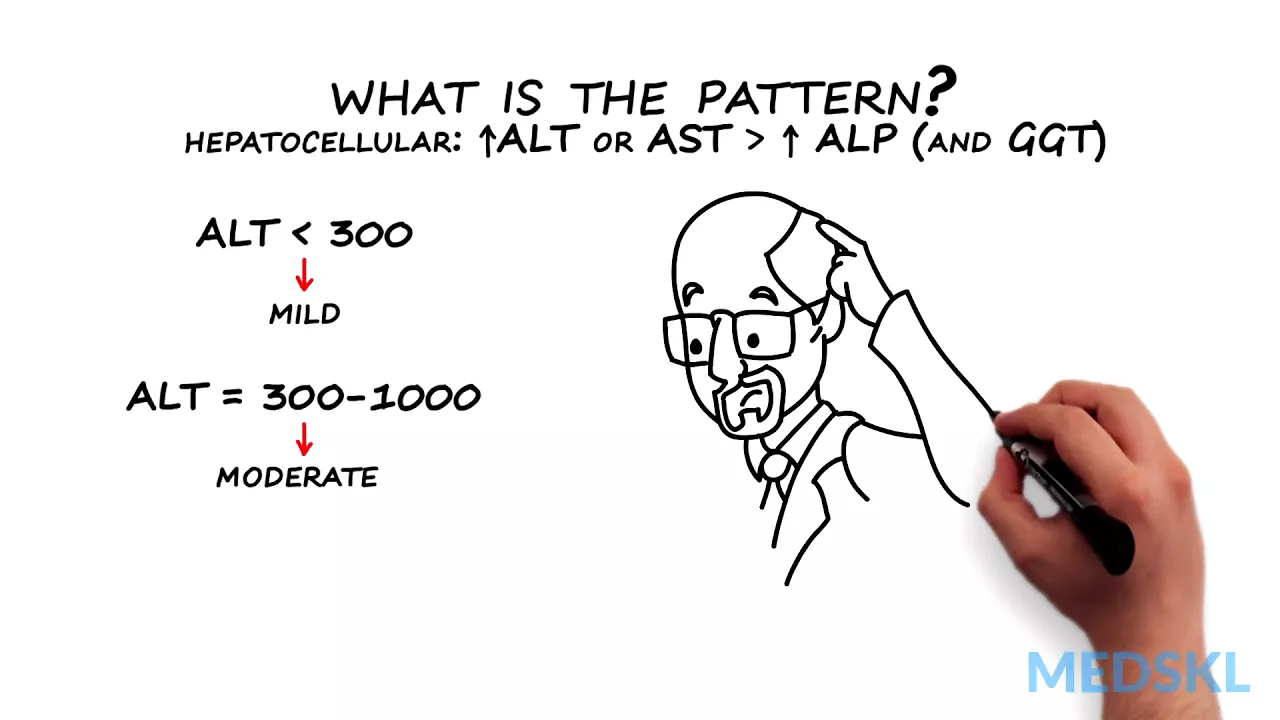













Liver function tests measure ALT (liver-specific), AST (liver and muscle), ALP (biliary and bone), and GGT (biliary-specific) enzymes; elevated ALT indicates hepatocyte damage, elevated AST may indicate muscle or cardiac damage, elevated ALP suggests cholestasis or bone breakdown, and elevated GGT points to biliary issues or alcohol use; key patterns include AST/ALT ratio >2 suggesting alcoholic liver disease and values >1000 IU/L indicating severe conditions like ischemic hepatitis or paracetamol overdose.
Liver Function Tests: Interpreting ALT, AST, ALP, and GGT
Added:Basic anatomy and cellular structure of the liver and biliary tract.
Fundamentals of enzyme biochemistry, including cellular localization and how cellular damage leads to enzyme leakage into the blood.
The primary physiological roles of the liver, such as metabolism, detoxification, and bile synthesis.
General principles of clinical pathology and how diagnostic blood tests use reference ranges.
Differentiating between hepatocellular (ALT/AST-dominant) and cholestatic (ALP/GGT-dominant) patterns of liver injury.
Evaluating true hepatic synthetic function using complementary markers like albumin, bilirubin, and prothrombin time (PT/INR).
Clinical diagnostic algorithms for investigating specific etiologies of abnormal LFTs, such as viral hepatitis, NAFLD, and autoimmune liver diseases.
Understanding the diagnostic utility of enzyme ratios, such as the AST/ALT (De Ritis) ratio, in clinical decision-making.
531.4K views7.7Klikes9:19Original Release: 2021-03-13
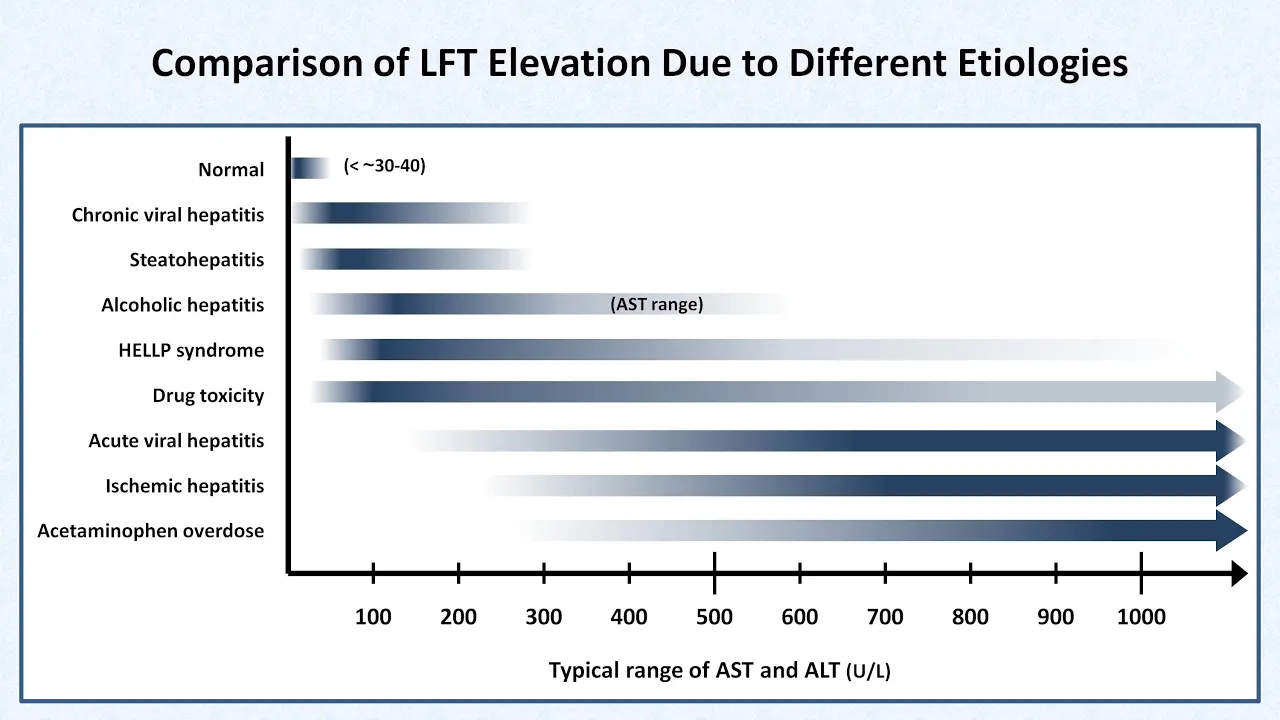
[Music] alt ast alp and ggt refers to enzymes that are found within the liver and the biliary tract the levels of these enzymes are measured as part of a liver function test elevation in the levels of these enzymes can indicate different pathologies including liver disease let's go over the basics of how to interpret the alt ast alp and ggt levels this is an important aspect of interpreting a liver function test so again we're going to discuss the basics of liver function tests so one of the enzymes that is measured in the liver function test is the alt enzyme level another enzyme that is measured is the ast enzyme another enzyme that is measured is alp alp stands for alkaline phosphatase and finally one of the other key enzymes that is measured in a liver function test is the ggt enzyme levels ggt stands for gamma glutamine transferees a very important point to remember about these enzymes is that the levels of these enzymes do not tell you anything about the function of the liver on the other hand elevation of these enzymes could indicate damage to the liver or the biliary system or both so when you are trying to interpret the levels of these enzymes it is best to think of the liver function test as a liver damage test as elevation of these enzymes indicates some form of damage to the liver biliary system or both it's also important to note that these enzymes can also be elevated when there is damage to other parts of the body and we will discuss that let's start off by discussing the location of these enzymes the alt enzymes are very specific to the liver so the alt enzymes are mainly found within the hepatocytes of the liver the asd enzymes can also be found within the liver but it is less specific to the liver compared to the alt enzymes the ast enzyme can also be found in muscle tissue specifically skeletal and cardiac muscle the alp enzyme is not located within the hepatocytes of the liver it is located within the biliary system so it can be found within the cells that line the biliary ducts within the liver and outside the liver the alp enzyme is not just found within the biliary system the alp can also be found in bone tissue as well as in the placenta of a pregnant woman and finally the ggt is very specific to the biliary system so unlike the alp which can be found in different tissues in the body the ggt is very specific to the biliary system so it is found within the cells lining the bile ducts now that we know the main locations of these enzymes let's discuss the significance of these enzymes when they are raised a raised alt indicates some form of liver damage now as we said the alt enzymes are mainly located within the hepatocytes of the liver so when there is damage to the hepatocytes of the liver the alt enzymes will leak out of the hepatocytes into the blood and this will cause a raised alt because the alt enzymes are very specific to the liver a raised alt is highly specific to liver damage so whenever there is any type of liver damage the alt levels will typically be raised there are many causes of liver damage and the alt will typically be raised when there is any form of hepatitis or inflammation of the liver the ast enzymes are also found within the liver so again when there is some form of liver damage the ast enzymes will also be raised but unlike the alt enzymes the ast enzymes are not only found in the liver so the ast levels can also be increased when there is some form of muscle damage for example if a patient has rhabdomyolysis which refers to skeletal muscle breakdown as the ast enzymes are found within the cardiac muscle as well if a patient has a myocardial infarction the ast levels can also go up so unlike the alt enzymes the ast enzyme is not as specific for liver damage and the ast levels can also increase in other situations the alp enzyme on the other hand is not located within the hepatocytes of the liver so it will not specifically increase when there is hepatocyte damage as the alp is located within the biliary system whenever there is some form of cholestasis which refers to a reduction or a blockage in the flow of bile through the billy system this will increase the pressure within the biliary system as bile is not able to flow properly and this pressure will lead to damage of the cells lining the bile ducts and as the alp enzymes are located within the cells lining the bile ducts in the biliary system the alp enzymes will leak into the blood and this is why a raised alp is highly indicative of cholestasis within the biliary system as we discussed earlier the alp enzymes are not only located within the biliary system they are also located within the bones as the alp is located within the bone when there are situations of increased bone breakdown the alp levels will increase there are many conditions which lead to increased bone breakdown some of these conditions includes paget's disease of the bone vitamin d deficiency bony metastases renal osteodystrophy or a primary bone tumor but the key point to remember is that when there is increased bone breakdown the alp levels will increase and finally because the alp enzymes can be found in the placenta there can be an increase in alp levels during pregnancy now finally let's talk about the ggt enzymes we said that the ggt enzymes are very specific to the biliary system so whenever there is a situation of cholestasis the ggt enzymes will typically be raised the ggt enzymes are much more specific for cholestasis compared to the alp enzymes so when there is an increase in both alp and ggt enzymes this is highly suggestive that the patient has some form of cholestasis if there is just an isolated increase in alp but the ggt levels are not raised then this suggests that the cause of the raised alp is not due to cholestasis because if there was cholestasis the ggt enzyme level would also be raised so in situations of an isolated increase in alp levels this likely means that the patient has some form of increased bone breakdown in the body or if the patient is a woman it could suggest that the patient is in the middle of her pregnancy another point to remember is that even though the alt and ast enzymes are not located within the biliary system whenever there is some form of cholestasis this can eventually lead to liver damage so in situations of cholestasis the alp and gt enzymes will increase initially but over time the cholestasis can lead to liver damage and this can increase the alt and asd enzymes later on an isolated increase in ggt could suggest alcohol use so an isolated increase in gtt could indicate recent alcohol use now that we've summarized the key points related to the enzymes let's now discuss some special relationships an ast to alt ratio of greater than 2 is highly suggestive of alcoholic liver disease so in alcoholic liver disease the ast generally increases much more compared to the alt but remember because there is liver damage the levels of both enzymes will typically increase there are many mechanisms which have been proposed to explain why the ast increases much more than the alt but again just remember the ratio is typically greater than two another key point to remember is the causes of an alt or ast greater than one thousand international units per liter there are very few conditions which will lead to such an increase in the alt or asd values but one of the major causes to remember is ischemic hepatitis ischemic hepatitis refers to conditions which will lead to ischemia to the liver and then this leads to inflammation this is the major cause of a significantly increased alt or ast and the values can typically be in the thousands another cause of an alt or asd greater than a thousand international units per liter is a paracetamol overdose other conditions which can lead to a significantly raised alt or asd is severe viral hepatitis or severe autoimmune hepatitis but in both these conditions typically the values will not go above 1000 international units per liter so the main causes of an alt or ast greater than 1 000 international units per liter is ischemic hepatitis and paracetamol overdose and that is a summary of how to interpret the alt ast alp and ggt values in liver function tests
Up Next
26:45
Liver Function Tests (LFTs) Interpretation Guide for Medical Students
@StrongMed
386.9K views•2014-10-08

48:47
Graphic Medicine: Comics for Collaborative Healthcare Communication
@nationalpatientadvocate
189 views•2023-12-04

10:28
Neuroanatomy: Central and Peripheral Nervous System Divisions Explained
@AKLECTURES
136.2K views•2014-09-20

3:05
Stages of Labor and Vaginal Birth | Childbirth Animation
@nucleusmedicalmedia
52.1M views•2017-08-18
Related Study Plans & Knowledge Roadmaps
Structured learning paths in Medicine
medicine
Abnormal LFTs: Diagnostic Workup & Pathology
01Liver Anatomy and Basic Physiology
02Introduction to Liver Function Tests (LFTs)
03Hepatocellular vs. Cholestatic Patterns
+ 3 more learning modules
12h6 modules
Explore Roadmap
medicine
Analyzing Blood Smears: RBC, WBC & Platelets
01Introduction to Blood Components & Smear Preparation
02Normal Morphology of Blood Cells
03Erythrocyte Pathologies & Morphological Variants
+ 2 more learning modules
12h5 modules
Explore Roadmap
medicine
Mechanical Ventilation: Waveforms & Alarms
01Anatomy and Physiology of Breathing
02Introduction to Mechanical Ventilation & Core Modes
03Ventilator Settings and Waveform Interpretation
+ 2 more learning modules
12h5 modules
Explore Roadmap
medicine
Neuro Exam: Localization & Stroke Syndromes
01Foundations of Neuroanatomy and Vascular Supply
02The Neurological Examination: Step-by-Step
03Principles of Neurological Localization
+ 3 more learning modules
18h6 modules
Explore Roadmap