


















Human behavior and decision-making are the result of distributed causality—numerous interconnected factors including genetics, environment, brain development, childhood experiences, and cultural influences—that operate from conception through life, leaving no room for traditional notions of free will; however, this deterministic framework enables meaningful insights into human behavior and provides practical guidance for understanding and improving societal systems.
Stanford's Sapolsky on Why Free Will Is an Illusion | Big Think
Added:Basic neurobiology, particularly the roles of the prefrontal cortex, amygdala, and neurotransmitters in regulating decision-making and impulse control.
The philosophical debate between determinism (the view that all events, including human actions, are ultimately determined by causes external to the will) and free will.
The principles of epigenetics, specifically how environmental factors can influence gene expression and subsequently shape neural pathways and behavior.
Foundational concepts in behavioral psychology, including how prior conditioning and developmental experiences unconsciously dictate current behavioral patterns.
The societal and legal implications of hard determinism, focusing on how criminal justice systems might transition from retributive punishment to rehabilitative models.
Compatibilism and alternative philosophical frameworks that attempt to reconcile biological determinism with personal moral responsibility.
The psychological impacts of disbelief in free will, exploring studies on how determinist beliefs affect human empathy, cheating behavior, and motivation.
An in-depth study of Sapolsky's broader academic works, such as 'Behave' and 'Determined', to examine the multi-scale timeline of behavioral causation from seconds to millennia.
1M views27.5Klikes53:35Original Release: 2024-05-10
- Your frontal cortex is the part of your brain that is the freest from genetic influences because it's still being sculpted by environment and experience a quarter-century after you plopped out there whereas most of the rest of your brain is sculpted by two or three years worth of experience.
Whoa, we evolved, our genes evolved to free our frontal cortex from strict genetic determinism, and to make it much more sculpted by environmental determinism.
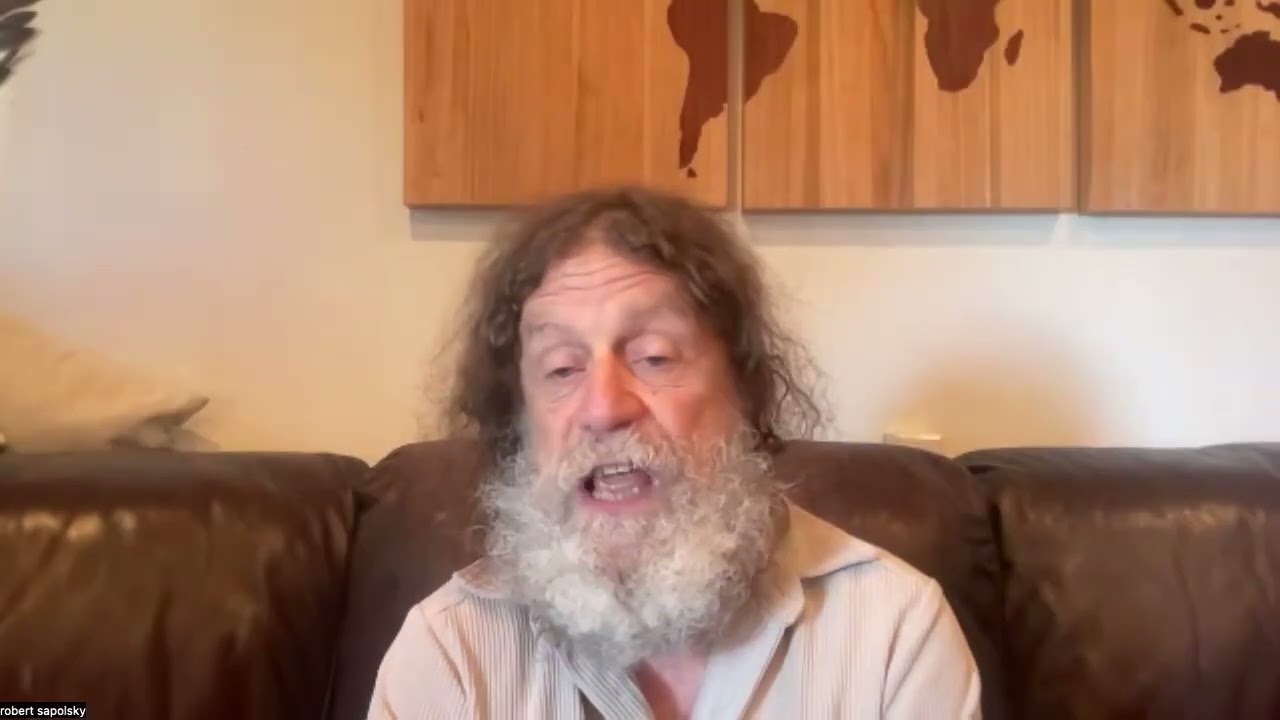
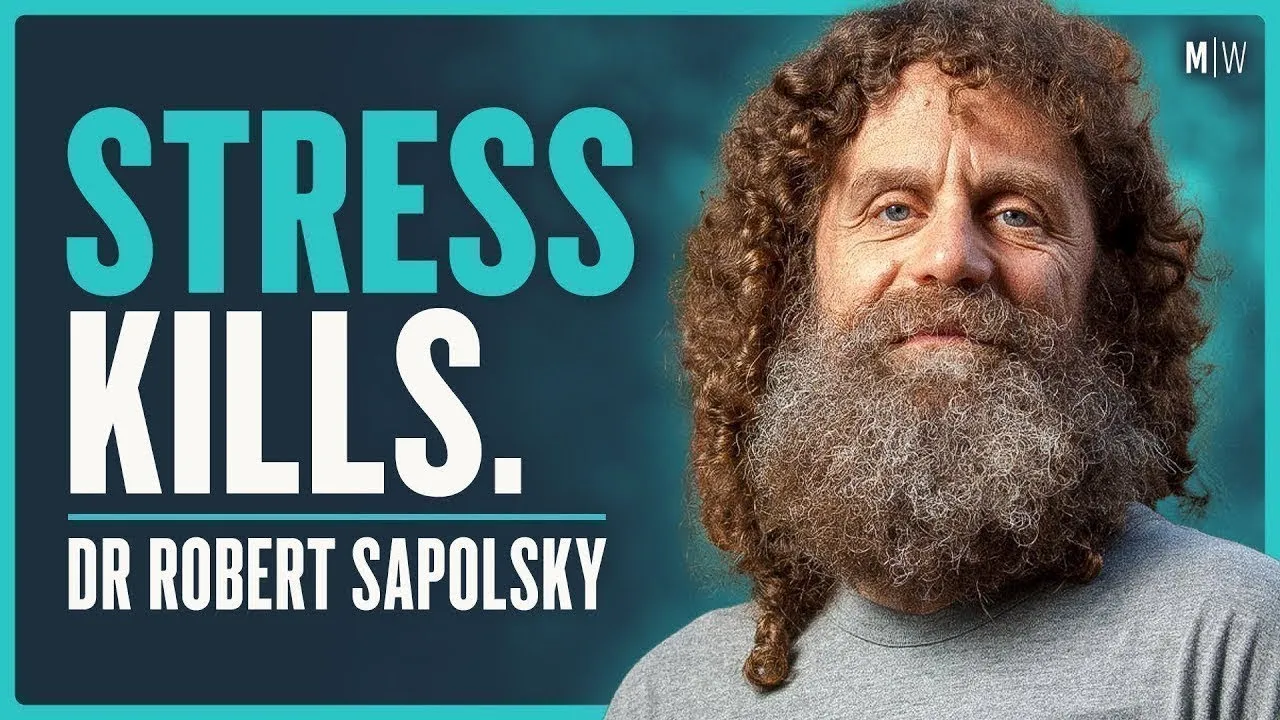
- Today on "Big Think," we delve into a thought-provoking conversation with Dr. Robert Sapolsky.
He shares with us his insights on his concept of free will or the lack thereof, and its profound implications for humanity.
Robert Sapolsky is a distinguished professor at Stanford University, acclaimed for his expertise in biology, neurology, and neurosurgery.
Renowned as a MacArthur Genius Fellow and a research associate at the National Museum of Kenya, Sapolsky offers a unique perspective on the human condition drawing from over three decades of experience as both a field primatologist and a laboratory neuroscientist.
Widely hailed as one of the best science writers of our time, Sapolsky is the author of several bestselling books, including "Why Zebras Don't Get Ulcers," "The Trouble with Testosterone," and his latest work, "Determined."
Dr. Robert Sapolsky, thank you for joining us on "Big Think" today.
- Well, thanks for having me on.
It's a pleasure.
- So I'm curious, why did you write this book?
- Well, I had no plans to, in that I thought I had written the necessary book about five years ago or so.
2017, I published a book called "Behave: The Biology of Humans at Our Best and Worst," and it's incredibly- like 800-page nightmare of a book.
And in the aftermath, doing a lot of lecturing about it and one of the themes that comes through in the book is our behavior is the end product of what happened to us a second ago, a minute ago, an hour, a year, a decade, a lifetime-all of that.
And I figured when I would lecture to audiences about this and take them through this, they'd all come away saying, "Oh, I get it, there's no free will whatsoever."
And instead, there'd often be questions like, "You know, given all the stuff you were just telling us, it seems like there might be a little bit less free will than we often think."
And I realized, "Oh God, the book was way too subtle.
I have to write one now of just hitting people over the head saying there's no free will, there's no free will."
So that's the follow-up book.
- You've written "Behave," you now have "Determined," and you've at length explained why we don't have free will.
I'm curious if you could provide us with the most succinct version of that argument for us, just to foreground things for our audience.
- Sure.
Everybody thinks they're seeing free will when we choose something.
We're consciously aware of doing it, we know what the consequences are likely to be.
Most importantly, we know there's alternatives available to us.
And for most people that's necessary and sufficient, there's free will.
And my whole point is that misses everything that's going on because you're not asking the only important question, which is: How did you become the sort of person who would have that intent at that point?
And the answer is because of the biology over which you had no control, interacting with the environment over which you had no control, stretching from one second ago to the moment you were an fertilized egg.
And when you look at how that stuff works, there's not a crack anywhere in there in which you can insert sort of the everyday intuitive notion of free will.
- One of the things that I think trips people up is just how much our language that we use to describe human action is just laden with meaning that feels like free will.
I'm curious, how much time do you spend thinking about the language that you use to describe human action and human behaviors so that it can somewhat be divorced or separated from this idea of free will?
- Where people sort of get into terminology troubles there is a difference between- you can be a causal mechanism.
I could pick up something and I've caused it to move upward in the air.
I have caused every molecule in it to move upward.
Is the ability to be a causal agent, causality the same thing as free will?
No, I may choose to do this at this point but that has nothing to do with the issue of "How did I become the sort of person who would say that to you at this point, and do this with my right hand instead of my left hand, and not find some item here to lift up at the same time?"
And people get gummed up at, yeah, we make choices and we cause things to happen, and it splits in the road.
We even make decisions as to which thing we're going to make happen, this instead of that.
But again, that's not an issue of demonstrating free will.
- In preparation for this interview I watched the conversation that you had with Alex O'Connor of the wonderful "Within Reason" podcast.
And in that conversation you use this term 'distributed causality' to describe the multitude of things that can lead up to a person performing an action or making a decision.
And I really wanna dig into that.
What is distributed causality and how does it influence the actions that humans perform or the decisions that humans make?
Hey, Big Thinkers.
We're gonna return to the interview with Robert Sapolsky in a moment but I wanna talk to you about our Big Think membership program.
If you wanna dive deeper into Big Think content you should become a Big Think member and join our members-only community at members.bigthink.com, where you can watch videos early and unlock full interviews.
What is distributed causality and how does it influence the actions that humans perform or the decisions that humans make?
- Great.
Okay.
So somebody behaves, does something or other and why did they do that?
Why did that occur?
And part of the answer is, "Well, what went on in their neurons a tenth of a second ago?"
But what you're also asking is, "What stimuli in the environment in the previous minutes got those neurons to do that?"
And you're also asking what did this morning's hormone levels have to do with it?
And you're asking what does the plasticity of the brain in the previous months to decades- trauma, heartache, finding love, finding God- all of those things change the brain.
And then before you know it, you're asking what are the person's adolescence and childhood and fetal life have to do with it?
What are the genes have to do with it?
And remarkably, you gotta go even one step further back.
What kind of culture were your ancestors inventing?
Parentheses in what sort of ecosystems 'cause that had something to do with it.
Culture centuries ago, why is that relevant?
Because your mother mothered you according to the ways in which she was raised in her culture or translated a different way.
Your brain was being constructed at that point as a function and part of what your ancestors were up to a millennium ago.
And the key thing there in terms of distributed causality is like you're trying to figure out why somebody did something- and this is someone who had a car accident and had massive amounts of damage to their frontal cortex.
And as a result, they can't regulate their behavior.
And it's easy for us to see where some unacceptable behavior of theirs came from.
Yeah, massive brain damage.
There's this big, massive cable of causal explanation going from that car accident to why they did what they did.
Distributed causality is the much harder thing we have for people where there's not an easy explanation because what you're doing instead is looking at the gazillion little microscopic threads of influence from your ancestors' culture and your fetal life and what color underwear you're wearing today and all of these things.
And it's so much harder to not only see all these little microscopic threads, but to believe that when you put them all together, that is as causative of a cable as something as simple as like a massive car accident.
It's easier for us to see in those cases.
It's really hard to see that there's a gazillion things, each of which contribute one-gazillionth of a percentage point to explain what went on.
- One of the things I was wondering if you could do for us is sort of relay the story of Phineas Gage.
He's obviously a famous example in neuroscience, but it seems like it's what I would call something like concentrated causality where we are able to identify what changed and what the change was to the person's brain.
So do you mind relaying that story for us?
- Phineas Gage marks like year zero that brain science had something important to say about how we become who we are.
1840s: Phineas Gage was a guy working on a railroad crew, building railroad lines and somebody screwed up something or other with some explosive TNT and he did something and the result was an explosion that blew a 13-pound, three-foot long iron rod up through one of his eyes and out the front of his head, landing 50 feet away and taking with it Phineas Gage's frontal cortex landing out there.
And the amazing thing was this shot through with sufficient force that it like cauterized all the blood vessels, like he wasn't bleeding out or anything, he was just kind of sitting there saying, "Whoa, that's weird."
And like all sorts of people were saying like, "Whoa, there's a hole going through your eye there up to the top of your head."
So they took him to the town doctor and showing how bizarrely clean of an injury this was.
He rode part of the way or he walked part of the way and he got to the doctor who could finally give like a medical diagnosis.
The doctor looked and said, "Whoa, you got a big hole going on there between your eye and the top of your head."
And that was about the state of science at the time.
And the key thing is this sober, reliable guy who was the foreman of the work crew became this impulsive, foul-mouthed bully doing all sorts of inappropriate stuff, was unable to keep a work schedule, wasn't able to work for years afterward.
And what one had just seen was something or other in this part of the brain has a whole lot to do with self-control and gratification, postponement and emotional regulation.
And Gage was like the perfect case of one single unsubtle TNT-driven explosive cause of his winding up having very poor regulation of his behavior.
And what we've learned since then is look at a gazillion events in fetal life and childhood, all of which are shaping the frontal cortex into whether it's good at making right decisions or not.
So he's the one everybody learns because it was so dramatic.
And yeah, all you do then is look at subtler stuff and it has the same thing.
Your frontal cortex is made of brain stuff and your ability to do the right thing when that's the harder thing to do is made of brain stuff also.
- I'd love to dig into some of that brain stuff.
And I know other parts of the body and your microbiology and even your environment can impact this distributed causality.
If say there was like an hour or even seconds prior to an action or a decision being made, what are some like specific systems that could lead to an individual or a person taking a specific type of action?
- So you've got a nice volunteer and you've given them this task, which is they have to decide whether or not to shoot somebody under the following circumstance.
They have a fraction of a second to look at the person and to decide if the thing in that person's hand is a cell phone or a handgun.
We know exactly the relevance of this to the real world.
And it turns out all sorts of things modulate people's ability to decide what it is they're seeing in a fraction of a second.
Are you hungry?
Are you tired?
Are you scared?
Are you stressed?
Are you in an environment you consider to be dangerous or benevolent?
Is it nighttime?
Is it daytime?
And as we know, tragically, what's this person's skin color?
Are they a young male?
All of that stuff.
And it shows that your brain in a fraction of a second will make different decisions as to whether or not that's a handgun based on the stuff that's been going on in the previous hour exactly as you say.
What we also know is say if that person, if they're male, if their testosterone levels had been elevated over the previous 24 hours, part of the brain would be functioning differently, part of the brain called the amygdala- and what happens is you look at somebody with a neutral facial expression and you're more likely than average to decide that instead they look threatening.
So you're that much more likely to decide it's a handgun and pull a trigger.
And if you went through trauma, combat trauma a decade ago and had PTSD, post-traumatic stress disorder, your amygdala would have grown bigger and been more reactive and been more likely to send a signal to pull the trigger before you had the chance to say, "Wait a second, let's look a second time and see if that really is a handgun- it's a cell phone."
All of this from one second ago to how much stress hormones you were exposed to when you were a fetus going into that moment as to whether or not you're gonna make a totally tragic decision in a fraction of a second.
- In thinking about that example, it's like, "Yes, okay.
I'm in a threatening situation.
It's pretty obvious that some of these sort of environmental stimuli might impact my behaviors."
I mean, we have reaction times as it relates to predators and things of that from our evolutionary biology- like I get that.
I can see how those other factors might impact the decision that I'm making in that particular moment.
But one of my favorite anecdotes from your book was actually about judges and parole and how their decisions are also causal related to things that they're doing earlier in the day.
Do you mind talking about that example for me?
- I love this study, and I should say it's become quite prominent.
I should also say a number of other researchers have challenged the results along statistical lines and the authors have completely refuted those challenges and the basic finding has been replicated, all of that, it's solid.
So this was a study published in this very prestigious journal, looking at a bunch of parole board judges and all the parole decisions they made over the course of the years, hundreds, looking at the simple question, is there anything that predicted who they let go free and who they sent back to jail?
And it turned out that the single most powerful predictor was how many hours it had been since the judge had eaten a meal.
Appear before the judge right after they've just had a great lunch and you had approximately 60% chance of getting parole, by a few hours later, you're down to 0% chance.
Oh my God, what's this about?
What this is about is your brain is expensive.
It takes a huge amount of energy to run, and it's 3% of your body mass, it takes 25% of the energy and if you got low blood glucose, your brain isn't gonna work as well, and especially the parts of the brain like your frontal cortex that are saying, "Wait, wait, wait, don't just jump to a fast decision and send them back to jail.
Think about this guy's life.
Think about his perspective in the world.
Think about, think a second time, a fifth time, do the harder thing," and it's easier for your brain to instead say, "Just send 'em back to jail."
And what's amazing to me is not only that we understand some of this workings of it, but what's also amazing is you sit down one of those judges at that point and say, "Whoa, that's really interesting.
Remember right after lunch, you had this guy here who had done X and you paroled him and just now this guy here who had done X also and you sent him back to jail, what's the difference here?"
The judge isn't gonna talk about his blood glucose levels, he's gonna talk about freshman philosophy class or something and studies since then have extended it.
If you wanna get a loan from a bank, do not go and ask for one when the person hasn't eaten for hours.
If you want somebody to spend more time looking at your resume, if you're applying for a job, ask him to look at it right after lunch, that yeah- that has something to do with it.
Yeah, that's part of what's going on and your brain is embedded in your body.
- When I heard that anecdote, part of me thought about like, what do we do with this piece of information?
Like specifically from like, if people are performing important actions and making important choices, where things like whether they ate a meal early enough for their body to sort of like have sufficient energy for them to do sort of some of the higher level processing that they need with complex decisions, it feels like that's an easy solve, like eat something.
- Yes, eat something.
And I had the singularly interesting privilege on a number of occasions to talk to groups of judges about exactly this and whoa, they do not like hearing about this study.
Yeah, that one's an easy fix, eat something.
What's not as easy of a fix is, "Whoa, you were exposed to a massive trauma 20 years ago," or "Oh, you were raised in poverty," or "Oh, your fetal brain was pickled in alcohol because your mother-" for those, for the ones where it's way in the past there, I think the easiest take home lesson is every time you're making a decision about why somebody just did something, including yourself, stop and question it and think about it a second time and a fifth time and a 10th time.
And as part of that decision, because you can't imagine what the world is like for that person as part of that decision, because their face doesn't register with yours as much as an "us's" face does there, just be skeptical and think again and again, and especially when you're tired and you just wanna make a fast attribution.
- One of the things this brings to mind for me is just like, how do we prepare people as a society?
I think in this context, I think about it in terms of education, and I actually think about it in terms of America's founding fathers.
Thomas Jefferson wrote a whole book on education and how it was important for society to educate future generations.
And they were thinking about it as a civic sense and like what our civic duty is.
But I think about these sorts of conditions, how do we train people to stop and reflect?
How do we get them to be the type of person where that is the likely course of action that they are going to take?
I think about what we're talking about here in those terms as well.
So I'm curious, how do we create the conditions that make it possible for the likely action that a person is going to take is when they're going into a situation where they might be stressed out or they might make a decision that could be harmful to some other person that they stop and reflect and realize all the distributed causality that might be causing them to take a certain action or be prone to a certain action at a certain point in time?
- Fantastic question because part of the ability to question and think a second time and a fifth and a 10th is did you wind up being the sort of person who could do that, who could do that well?
Are you so invested emotionally that you're unwilling to change your opinion?
Are you like perverse enough that you wanna come up with the opposite of it?
Yeah, how'd that happen?
The key thing here is, one of the things that people panic about when you say, "Oh, there's no free will."
I mean, they say, "Oh my God, don't tell people that they'll run amok and there'll be murderers on the streets."
And in addition, if there's no free will, if everything was determined, nothing can change.
And you couldn't possibly be more wrong than that; enormous change happens.
And the key thing is we do not choose to change, we are changed by circumstances.
And we are changed by those circumstances as a function of who we had been made into at the moment we experience it.
Look, you got two people, they go in to watch a movie.
It's totally inspirational, it's great.
And one person comes out of the movie changed, changed.
They make different decisions in their life.
They say, "Oh my God, that was so inspirational.
I'm immediately gonna give my life savings away to Doctors Without Borders."
And the other person comes out changed, changed so that they make different decisions in life.
And they say, "Oh my God, the cinematography was so amazing in that movie.
I'm gonna spend the rest of my life at the feet of the cinematographer worshiping them."
Whoa, they were both changed.
Neither of them chose to change.
They were changed by experience.
And they were changed as a function of who they had turned out to be at the moment they went into that movie theater.
So that's exactly where we get sort of prescriptions.
Not only are we biological machines like worms and redwood trees and crabgrass and stuff, but we're the only biological machines that can know that we're biological machines and have some insights as to where the buttons are and where the levers are and to understand what makes certain types of changes more readily happening than others.
And there's a whole world of changes you could bring about in people to make them's, for example, seem so different they hardly count as humans.
Every single dictator out there, every ideologue, every genocidal, whoever intuitively knows how to bring about those changes in people.
Yeah, we know how to change behavior and we get more insights into it all the time.
And another way of framing that is we learn more about the levers and the buttons.
And one of the most interesting things that come out of it is we have this meta-level of you were changed by experience and say, "Whoa, I'm totally moved by that movie and I never knew about that historical tragedy before.
I'm going to go read some more books about it.
I'm going to go reinforce that."
We're capable of observing the change in us and understanding what will make it less likely or more likely.
"Oh my God, that was the most depressing movie on Earth.
I'm going to now counteract that by go listening to K-pop for the next 12 hours so that my mind is completely drained of it."
Yeah, we even understand what our levers are within us.
And if we've been trained to respect that process and reflect on it, then that whole thing.
Yep, it's these recursive loops built around the fact that we can know our machine-ness.
- I wasn't planning to talk about artificial intelligence today but you called us a biological machine, and I think it's kind of interesting and "recursive loop" is a term that you use which is one of the things that as people have been experimenting with things like large language models that they've been talking about the ability for them to teach themselves and to learn.
I wonder if in some sense that some of the confusion that we've had around this idea of free will is in part because we've never met another intelligence that can also spit back to us in terms that we're familiar with that speaks the same language as us.
I wonder if you have any thoughts about the relationship between the machine intelligence that we're starting to interact with even though it's at levels that are far lower than what we consider human intelligence per se, and how that is going to interact or potentially shift some of our notions around free will because those things aren't self-directed yet.
They're programs, they're input, output but in some sense, they're spitting back to us things that feel intentional and we're imbuing them with these sort of anthropomorphized values.
So I'm curious if you think that's going to change or tip the way in which people think about things like free will.
- Well, for starters, I have to admit that I am beyond ignorant about all of this.
I don't even know enough to be wrong about AI.
Like I'm up to being able to handle a mouse on a computer.
That's about what century I'm functioning in and that's thanks to my wife teaching me how to use a mouse.
So all of those caveats, I think these issues are absolutely going to come up and they're gonna bring up a really interesting, fascinating, seductive domain that actually has nothing to do with free will; which is the notion that at some point these computers are gonna be so powerful with enough component parts that stuff is going to emerge that's so complex that it could only be described on the level of what has emerged.
And it's got a parallel- which is we throw enough neurons into our brains- our basic neuron is not all that different than one in a fruit fly, but we have a hundred million for every one that a fruit fly does, and throw enough of them together and more is different; and outcome stuff like consciousness and theology and music and aesthetics and all of that emergent stuff comes out that only has properties at that emergent level.
A molecule of water, H2O, cannot feel wet.
Wetness is an emergent property of a whole.
So that's like the most interesting stuff on Earth, and emergence how your brain wires up most efficiently and it's the same way that ants expend their least energy foraging and it's the coolest stuff and I love that stuff.
But then there's the seductive like quicksand to decide that free will is an emergent property.
And the reason why that doesn't work is every model you have out there of people saying, "Oh, you throw enough neurons in there or whatever it is you throw in to make a computer AI-ish," you throw enough stuff in there and with enough quantity, you invent quality and out will pop not only consciousness, maybe AI is going to do that and it does in us, but maybe free will as well.
And the problem is that every single model of how an emergently complex system can now generate free will requires that emergent level to be able to reach down to those little simple component parts and make them work differently and make them work smarter.
And that's like saying, you put enough ants together and not only can they construct this whole amazing ant society and colony and architectural stuff in their passageways, but they also like suddenly are able to speak French- and it doesn't work that way.
And the whole point, the amazing thing about emergentness, you start with some stupidly simple thing like a neuron or a ant or a whatever the hell computers are made of, a vacuum tube or something- and the whole point is each individual one is really simple and has a very finite number of rules.
And often the rules are solely about how you interact with the elements immediately around you.
And the amazing thing about emergence is they're just as stupid and simple when they're inventing things like philosophy coming out the other end, that's the whole point of it.
Every model that says free will is an emergent property requires the ants and the individual neurons to suddenly do stuff that they can't do, to be freed from their own histories.
So emergence is the coolest thing on Earth and I torture my students with hours of lectures on that, but that's not where you're gonna get free will from.
- Emergence is one of those things that I struggle to understand too.
And even when you say you can only describe the property at the emergent level, from a metaphysical sense, I'm not even sure what that is.
And the wetness example is instructive.
I get that intuitively, the interrelation between the different molecules that make up H2O and how they interact and produce wetness as an emergent property.
But when it relates to something like consciousness, and this is probably just the mystery of consciousness at this particular moment, I'm lost at where this emergence sort of sits.
Could you help me sort of understand that?
Like where is emergence as a property sort of within this material world that we inhabit?
- Well, the way to think about it is it's simply a consequence of numbers.
You take one ant and you put it on a table and it's just wandering around randomly and it makes no sense.
And you do 10 ants there and it's kind of the same.
And you put a hundred ants and I don't know, maybe they start marching at a line or something.
And you put 10,000 of them there and suddenly, collectively, in a "wisdom of Antdom," they know how to build a whole colony with like different jobs.
And like they know how to make slaves out of aphids and milk them for that.
And they do all this incredible- and it's simply properties that come out of that level.
An emergent property in us, where in the brain is conformity?
If you were raised in a box and you spend your whole life in a box, conformity is never an issue for you.
Conformity is only something that emerges when you're surrounded by other people and you care about what they think of you.
And that's like, there's a nuts and bolts that makes some people more conforming than others, and why we're more conforming when we're stressed or feel insecure.
There's like the nuts and bolts underneath the levers, the buttons, the building blocks are churning away explaining how conformity varies from one person to another.
But the most important thing is you can't be a human living alone on a desert island and conform or not to conform to something about human behavior.
Conformity or being an anarchist or being like a fan of Mozart or anything are only traits that emerge when you have other humans to interact with.
So that's a classic case.
- With distributed causality, we sort of talked about the short-term effects, the things that can be happening at the minute, the second, the hour-length of time that would impact or influence human actions or behaviors or decisions that someone is going to execute at a particular moment in time.
And we've even talked about things like child rearing, what is the sort of things that are going to impact a person's decision later in life because of the context of how they were raised.
But I'm thinking about broadening the lens even more: What are some of the things from genetics, from epigenetics, from our evolutionary history that ladder up into these distributed causes that influence human behavior, human actions and human decisions when they are interacting with other humans or society writ large?
- Here's like a great example of it- back to the frontal cortex.
Its evolution is really interesting.
It's the most recently evolved part of the primate brain.
We've got more of it or more complicated wiring than any other primate; it's like totally amazing.
Yeah, there's been this evolution of an increased capacity for self-regulation and impulse control and making the right decisions, all of that.
Evolution has given us an additional interesting thing with the frontal cortex.
Most of your brain is wired up and going about its business by the time you're three years old, five years old.
Some new stuff comes online when puberty upends everything, but your frontal cortex is not fully mature until you're about 25 years old.
It's the last part of the brain to mature.
What have we just explained?
We've explained why adolescents act in adolescent ways, and why like 15 year olds are not putting away their allowance for their retirement funds.
But then you ask sort of a mechanistic question: Why does it take 25 years for this part of the cortex to get wired up?
Whereas say this part of this part is in the first few years of life.
Is it because it's a more complicated building project?
Are there neurotransmitters that are only found in the frontal?
Nah, it's the same exact constituent parts.
It's not a more complicated building project.
What it is is we have evolved to have delayed maturation of the frontal cortex.
Why is that?
Because if the frontal cortex's job is going to be to make you to do the harder thing when it's the right thing to do, it's really challenging learning what counts as the right thing.
You gotta learn your society's hypocrisies.
You've gotta learn your society's rationales and lies, and "Thou shall not kill."
But if you kill one of them, we're gonna give you a medal and vote for you and maybe like preferentially mate with you.
It takes a long time to learn this stuff.
And we have a longer delayed frontal cortical maturation than any other primate and it's minuscule in rodent.
And this is a recent evolutionary invention.
Let's frame it this way: Your frontal cortex has evolved.
The genes that specify your frontal cortex have evolved to make you as free from genes as possible.
Your frontal cortex is the part of your brain that is the freest from genetic influences because it's still being sculpted by environment and experience a quarter century after you plopped out there whereas most of the rest of your brain is sculpted by two or three years worth of experience.
Whoa, we evolved, our genes evolved to free our frontal cortex from strict genetic determinism and to make it much more sculpted by environmental determinism.
Totally cool because one culture has a completely different set of moral compass rules than another culture, and they're hard to learn and they can't be coded for genetically.
You gotta spend a whole lot of time learning what counts as the right thing among the people with whom you're dwelling.
- That's absolutely fascinating.
I mean, one of the other favorite anecdotes from your book, I believe, was talking about mothers from different parts of the world and the ways in which they sing to their child, how long they hold their child, how long they let their child cry before picking them up and the different impacts that could have on the neural patterns on their brain.
I'm curious if you could sort of like talk about that a little bit more 'cause I find it absolutely fascinating that even those sorts of things can have impacts on how your brain develops.
- It's immensely interesting stuff.
Okay, when you study cross-cultural differences and psyches and all sorts of things like that, the classic comparison everybody gets around to is studying collectivist cultures versus individualist cultures.
Collectivist cultures, people are far more cooperative.
You do psychological tests, and they think in terms of "we" instead of "me."
There's all like wonderful ways of demonstrating.
Where are the collectivist cultures on Earth most prominent?
Southeast Asia, rice-growing regions, where you and the whole village have to plant this person's crop today.
And then all of you collectively plant the next person's tomorrow and the next person after that, and you all harvest in one day.
And you're also cooperating collectively with 50 other villages to maintain this irrigation system that starts in the mountains 100 miles away and that you've been collectively maintaining for centuries and centuries, literally.
Individualist world: The U.S., poster child for individualistic mindset, because we're mostly peopled by dependent descendants of malcontents and individualistic-like troublemakers who fled wherever they were to come here.
The U.S. is incredibly individualistic.
Ask like an American, "Tell me about yourself," And they'll say, "Well, I'm a urban planner or a barista."
Take somebody from Southeast Asia and on the average, you ask them, tell me about yourself, and they will say, "Well, I'm a parent, I'm a child."
It's relational stuff like that.
Okay, so hooray, different sorts of cultures.
And you look and there's different sorts of mothering styles.
And as you mentioned there, collectivist culture mothers on the average sing more quietly to their child than individualist cultures mothers.
There's differences, you start crying, you're an infant, you start crying- on the average, how many seconds do you cry before mom picks you up?
In collectivist cultures, mom picks you up earlier.
In individualist ones, it's a longer delay because they're toughening you up.
When do you start sleeping alone?
How much physical contact?
All of that, like you show like classic sort of cultural linguistic child training and stuff.
If you show a kid a picture of there's a whole bunch of fish here and there's a fish here in the front- and this is a colleague of mine who did wonderful research on this- and you get somebody from an individualist culture showing this to their child.
And the mother is saying, "look, look at this fish, this leader, this is the fish that's the leader of all these other fish."
And then you get somebody from a collectivist culture who's of that mindset.
And the mother is saying, "Oh, look at this fish, this poor fish, he's all alone.
He can't be with the rest of the group.
He must've done something very wrong where everybody else doesn't want him to be."
Like completely different mindsets with that.
And you get contrasts- were your ancestors, desert dwellers or rainforest dwellers?
If they were desert dwellers, they're significantly more likely to have invented a monotheistic religion.
Rainforest, polytheistic.
If your ancestors were pastoralists wandering the grasslands with their cows or camels or goats or whatever, they're much more likely to have come up with what's called a "culture of honor."
If somebody transgresses against you, you transgress twice as bad back at them because if you don't, they just stole your camel, tomorrow, they're gonna come and steal the rest of your camel and your wife and daughters.
But if you're a rainforest forager, you don't invent a culture of honor.
All this stuff goes into it.
And the job of every generation's child-rearing practices is to create a child whose brain has been constructed to replicate the cultural values that you have and thus passed on and passed on.
Okay, fabulous example of this.
Southeast China, rice-growing, flat floodplains; you get this extremely collectivist mindset.
There's a small pocket of Northern China mountainous where people instead do wheat growing and it's very individualistic in how it's done.
And you get people there who are just as individualistic as somebody living on the Upper West Side of Manhattan or whatever.
And here's an experiment showing, not in the farmers, their grandkids who were university students- this was this totally cool study- you go to a Starbucks there, and the researchers did an experiment.
There's two tables here and they moved two chairs so that they're back to back.
They're blocking the way between the tables.
And here comes your subject who's being observed and what do they do?
And if it turns out, if you were raised in the collectivist Southeast Asia rice-growing floodplain culture, you're more likely than average to walk around the table.
And if you come from the individualistic, wheat-growing ends, you pull the chairs apart because you are the captain of your own fate.
And whoa, this is because your grandparents either like planted seeds with 400 members of the village at once, or they looked out on the horizon and like thought of like heroic, like cowboy movie soundtracks before doing it all on their own.
This makes you act differently two generations later in a Starbucks just outside your university in China.
Whoa, that stuff matters as well.
- You know, that was fascinating.
I just wanna double-click on one thing you just mentioned: You talked about child rearing as it relates to society and I was curious to get a sense of, do you think that the evolutionary role of society is to ensure that the culture survives into the next generation?
- You know, there's this great aphorism in like evolutionary theory that sometimes a chicken is just an egg's way of making another egg.
If I were much more monomaniacal of a neurobiologist and were put in charge of the world, I would say that social anthropology is the study of how you wire up a brain like your parents' brains.
Yeah, that's like crazy, stupid, reductive, but on a certain, yeah, to pass on your values, to pass on your beliefs, to pass on what you love, what you hate, who you would kill for, who you would die for, what myths you have of heroism, what's gonna happen to you after you die, whether revenge or turn the other cheek- and all of that gets taught to us at a very early age, and reflects what our ancestors invented, and how mom and grandmom, etc., were raised- and all of it reflects how you constructed the brain.
And not in this, as you say, this volitional conscious sense, but it's just the wind tunnel that plays one of the big roles in sculpting the sort of brain you're gonna have.
- You know, I certainly plan things all the time.
If I wanna lose weight and I wanna eat better, that's a thing that I just do as a human.
I feel some agency and some steerability of those decisions that I have.
And it's not that you've lost those things, but you can better understand what those things are.
How would you explain to people that even though there is no free will, there's still steerability in the system to some extent.
Like how would you help people parse those differences?
- Well, that's that whole example of going into a movie theater, and you are changed by it as a function of who you are when you went in, and you have the potential as a meta-thinking human to be able to then reinforce that pathway with a recursive loop, all of that.
Let's translate that into you.
Let's unpack you.
How do you turn out to be the sort of person who knows what constitutes a healthy diet?
How do you be the sort of person where your values include wanting to forego an all-Cheetos diet instead to wanna be able to be healthy?
How did you turn out to be the sort of person with a frontal cortex that could make you actually stick with that resolution?
How did you turn out to be someone where you lucked out and you live in a neighborhood where there's actually like fresh food that's available?
How did all of those contributed to that moment?
And I think what that translates into, sort of most effectively for what people should think about, is if you really believe this stuff and take it to its logical conclusions- where nothing more than the biology and environment over which we had no control- if you really believe that, blame and punishment never make any sense either, intellectually or ethically.
Likewise, praise and reward never make any sense.
And those are the logical conclusions that come from this.
That being said, like I've thought this way since I was 14, and I can actually function this way for about three and a half minutes every month or so 'cause it's really, really hard.
And what you gotta do, I think, is do the, "Okay, how did they become who they are?
And what privileges did I have that I didn't earn that had something to do with how I turned out to be who I am?"
And go back and think through that a second time, a fifth time, the tenth time, when it's a setting that really matters, when you're about to judge somebody strongly because almost certainly if you think you know why they did what they just did, you're gonna be wrong because you're not thinking of a million distributed causes.
And virtually every time you decide, "Well, I just did a good job, I deserve my corner office, I deserve to be CEO, I deserve to have running water and electricity," any version of you winding up being one of the lucky humans, think about how you wound up this way, and how by one little thread being different could have been a totally different story.
So if it's gonna be hard, and it's incredibly hard for me, and I think for anyone, if it's gonna be, save it for when it really matters, for when you're really judging with a whole lot of sense of blame or you're judging with a whole lot of sense of praise, especially if it's for yourself or people who are like you, who look like you and pray like you and eat like you and love like you and all that.
Yeah, those are the times when do the hard work, go back and remember all we are is the end product of what came before.
- You know, I know you've done a lot of work in the legal system, within the criminal justice system: what should we do about those sticky situations where it's, you know, people are behaving in ways that are harmful to others and there needs to be some consequences to help to prevent them from harming other people.
If it's not blame or punishment, what is the way of looking at those sorts of things?
- Yeah, this is the juncture where people like burn a book like mine and saying, "Oh great, you're just gonna have murderers running around the streets!"
Of course, you're not gonna have murderers running around in the streets any more than you have cars whose brakes don't work out on the streets.
You put the car in a garage, but you don't go in every day with a sledgehammer and smash the car over the top because it has a crappy soul- it just turned out that way.
And in the same way, if you've got someone who's dangerous, you gotta protect society from them.
You constrain them, you "quarantine" them, which is a word that is getting a lot of currency in sort of criminology circles.
And with the same concept borrowed from public health, you have to quarantine the person because they are dangerous to other people.
You quarantine them the absolute minimum needed to make them safe and not an inch more than that.
You don't preach to them in the process and you put lots of effort into understanding root causes.
How did they wind up being a dangerous person like that?
What can you do to make fewer of those sorts of people in the future?
And this seems like totally wild and implausible because there's dangerous people out there.
Here's a sample of us using quarantine models with dangerous people: You're an airline pilot.
It's hay fever season and you're taking a lot of antihistamines or something.
And as a result, you're drowsy and you don't fly a plane at that time.
Whoa, we don't like burn them at the stake.
We don't say they've got a terrible upbringing or no capacity for empathy because if left alone, they would crash a plane.
We say, gotta quarantine you when you're taking something that makes you drowsy.
You can still go and like go get a coffee at Starbucks, which is clearly on my mind right now.
We're not gonna preach to you about how you're rotten.
And we, the airline, go fund research on how to make antihistamines that don't make pilots drowsy.
Whoa, we're running society where we have drowsy pilots who would be dangerous and we protect people without invoking a sense of responsibility.
And that's so obvious, it doesn't even occur to us that that's a realm where we've subtracted free will out of it.
The flip side is praise and reward make no sense.
Meritocracies are as insupportable as criminal justice systems.
But you got a problem there.
You gotta protect people from incompetent people doing stuff that's difficult.
If you got a brain tumor, you really don't want them to pick someone randomly from off the street to take out your brain.
You want them to spend years and years being trained.
You wanna protect people from murderers by quarantining them.
And you wanna protect the populace from people who are not up to doing difficult tasks.
And that requires skill and work and motivation and all of that.
That one's a tough problem because you have to figure out how to motivate someone to like sit there on Saturday night when their roommate is going and getting falling down drunk and they say, "I gotta study instead."
You gotta figure out how you're gonna motivate people if you're not gonna have a world where they come out the other end feeling entitled and feeling like they are intrinsically a better human than others.
- Robert, thank you so much for this discussion.
This has been really illuminating, and I'm really grateful to talk with you about free will, determinism and just the constraints that exist within all of our behaviors and actions that we take as people.
- Well, thanks for having me on.
It's a pleasure.
Want to dive deeper?
Become a Big Think member and join our members-only community, watch videos early, and unlock full interviews.
Up Next

64:23
Robert Sapolsky on Free Will, Justice, and Morality | Science Interview
@VertDiderEnglish
193.6K views•2020-12-27
21:55
Deciphering Neural Circuits Controlling Anorexia in Mice | Richard Palmiter
@AllenInstitute
2.3K views•2011-10-10
59:11
Bessel van der Kolk on How Trauma Affects the Body and Brain
@bigthink
226.3K views•2025-10-03
13:03
How Exercise Benefits Your Brain: Science Explained
@TED
11.4M views•2018-03-21
Related Study Plans & Knowledge Roadmaps
Structured learning paths in Neuroscience
neuroscience
Appetite Regulation: Brain Circuits & Hormones
01Foundations of Endocrinology and Brain Anatomy
02Introduction to Energy Homeostasis
03Peripheral Signals: Leptin, Ghrelin, and Insulin
+ 2 more learning modules
14h5 modules
Explore Roadmap
neuroscience
Neuroeconomics: Value, Risk & Brain Mechanisms
01Foundations of Neuroscience and Brain Anatomy
02Introduction to Neuroeconomics and Subjective Value
03Dopaminergic Prediction Errors & Reinforcement Learning
+ 3 more learning modules
18h6 modules
Explore Roadmap
neuroscience
Spatial Navigation: Cells, Grids & Brain Maps
01Foundations of Brain Anatomy and Memory
02Place Cells and Head-Direction Cells
03Grid Cells: The Brain's Coordinate System
+ 2 more learning modules
12h5 modules
Explore Roadmap
neuroscience
BCIs: Neural Decoding & Prosthetic Control
01Neuroscience Foundations: How the Brain Signals Intent
02Signal Acquisition: Recording the Brain's Activity
03Neural Decoding: Translating Brain Waves into Data
+ 2 more learning modules
25h5 modules
Explore Roadmap