



















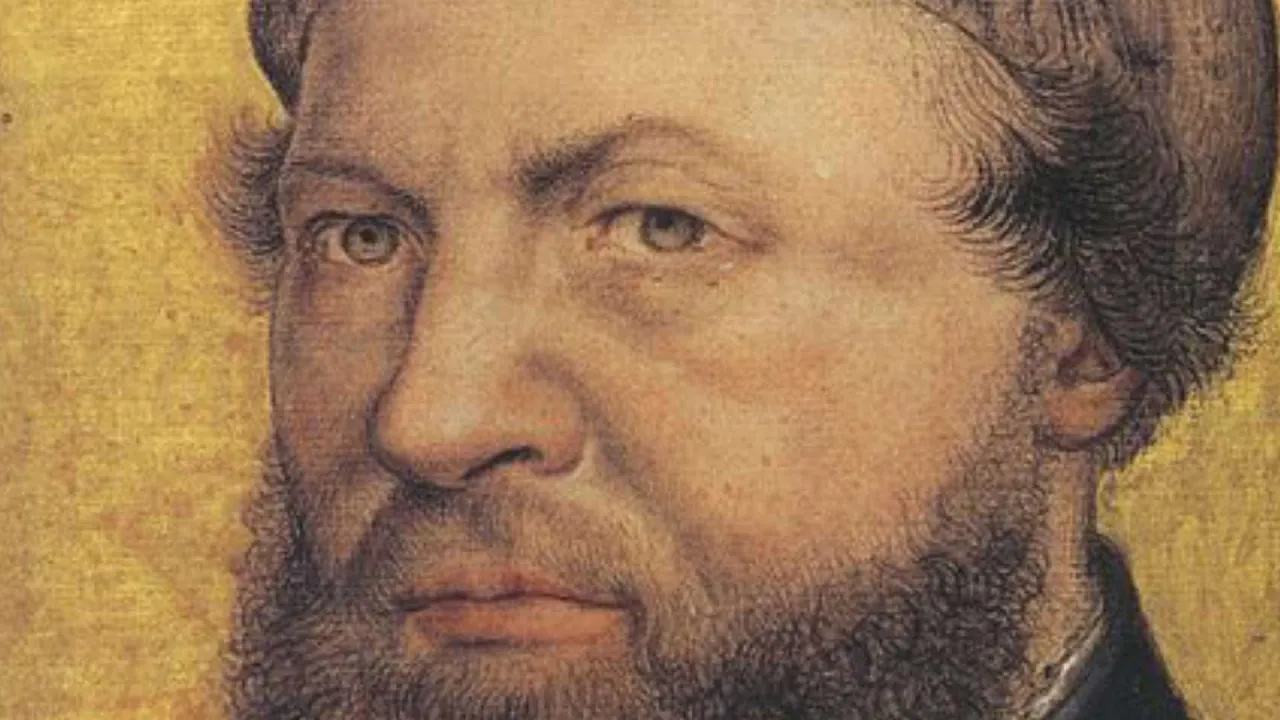

Hans Holbein's 1533 painting 'The Ambassadors' is a remarkable work of Renaissance art that combines meticulous realism with profound symbolism, featuring an anamorphic skull hidden in plain sight that becomes visible only from a specific angle, along with objects representing the quadrivium (arithmetic, geometry, music, astronomy) on upper and lower shelves that reflect the religious and political tensions of the English Reformation, particularly referencing Anne Boleyn's coronation as Queen on May 11, 1533, which marked Henry VIII's break with the Catholic Church.
Hans Holbein's The Ambassadors: Hidden Symbolism
Added:Understanding of Northern Renaissance art characteristics, particularly its emphasis on precise detail, realism, and rich oil mediums.
Familiarity with the 16th-century geopolitical and religious landscape, including the Protestant Reformation and the court of Henry VIII.
Basic knowledge of artistic perspective techniques and how optical illusions are constructed in two-dimensional art.
The concept of 'memento mori' (reminders of mortality) in European art history and its cultural significance during the Renaissance.
In-depth study of the scientific and musical instruments depicted in the painting (representing the Quadrivium) and their symbolic representation of human knowledge.
Exploration of the advanced mathematics behind anamorphic projection and its evolution into modern 3D street art and optical illusions.
A comparative analysis of other symbol-heavy Northern Renaissance works, such as Jan van Eyck's 'Arnolfini Portrait'.
Investigation into Hans Holbein the Younger's broader body of work as a royal court portraitist and his influence on Tudor iconography.
1.8M views45.2Klikes13:02Original Release: 2025-04-06
At first glance, it looks like a simple double portrait. Two well-dressed men surrounded by objects. But the closer you look, the more you realize it’s so much more than that. Every inch of this painting is a mystery.
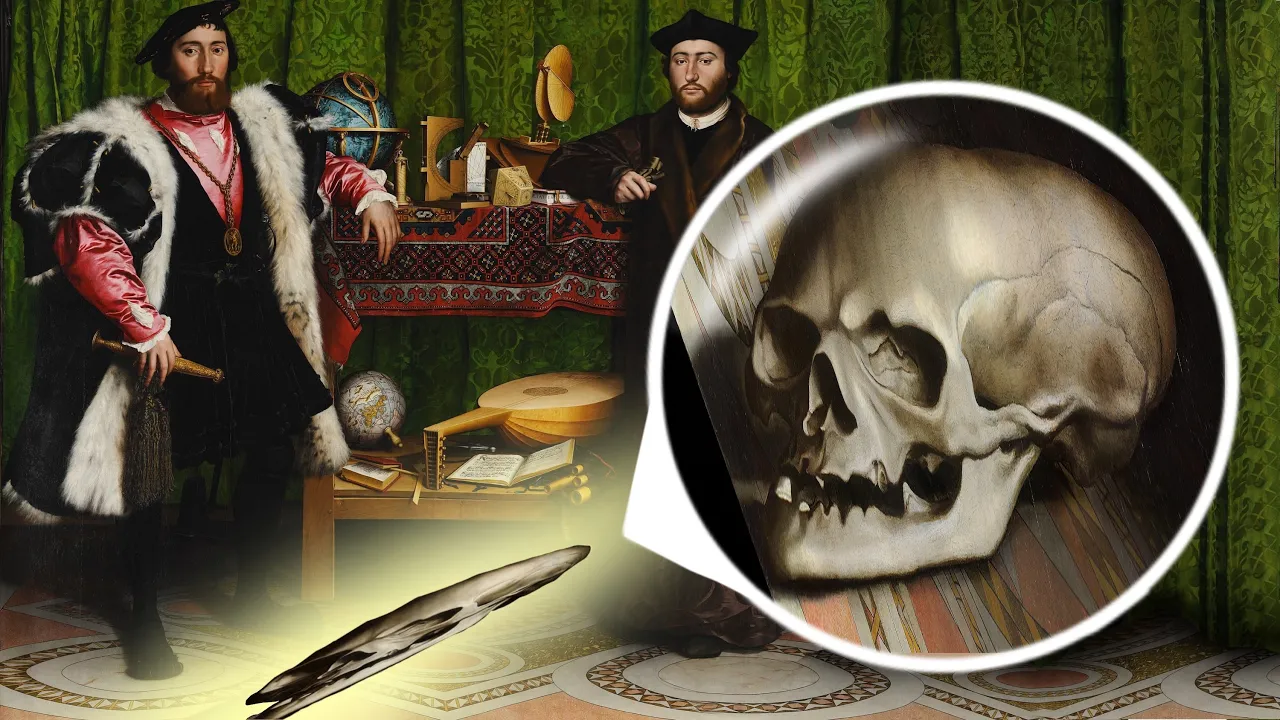
And without a doubt, the first thing that grabs your attention is that strange shape on the floor… a smear that doesn’t seem to make sense… until you change your angle. Viewed from a certain point, a perfectly formed skull appears, painted with a technique that was centuries ahead of its time. A silent reminder of death: a Memento Mori hidden in plain sight. But that’s only the beginning.
From astronomical instruments, a lute with a broken string, arithmetic books, globes, luxurious fabrics, and even a crucifix hidden in the shadows… The Ambassadors is not just a painting. Many consider it the most incredible artwork ever created—and in this video, we’re going to analyze it detail by detail.
We’ll uncover the meaning behind each object, and I’ll give you the historical context you need to understand why Hans Holbein painted this masterpiece.
This painting, titled Jean de Dinteville and Georges de Selve, is also popularly known as “The Ambassadors”.
What characterizes this painting at first glance is its meticulous realism, which we can observe in the wonderful rendering of textures. But it’s also a piece filled with objects. And although it may not seem like it, each one of them hides a symbolic meaning.
Let’s start from the most general to the most specific. Let’s begin by appreciating the rich textures that appear in the painting. Holbein truly outdid himself with the level of detail in every piece of fabric. On the first figure, we see pink satin sleeves covered by what appears to be a coat of long fur, with the fabric joined by beautiful golden trimmings. The second figure is dressed in an episcopal robe entirely covered by a fur-lined overcoat. Judging by the materials, we can deduce that these were very expensive garments for the time.
You can also appreciate the level of detail in the oriental carpet, with its tassels on the edges and various geometric motifs, and in the green velvet curtain with large patterns in the background. There are two details in this painting that give us subtle clues about who these men were—or at least some of their characteristics. In Jean’s hand appears a golden dagger engraved with the number 29. This was the age of the French diplomat when the painting was made. And if we move further to the right, we see a book right next to Georges with the number 25 written on it. This number likely also represented his age at the time the painting was completed.
But one of the most striking elements in this painting, without a doubt, is the shelf located right in the center. This shelf is packed with objects related to the "quadrivium", a medieval educational concept referring to four fundamental disciplines considered essential for a complete education of free individuals: arithmetic, geometry, music, and astronomy.
The arrangement of the objects—some placed on the upper shelf and others on the lower—clearly has a purpose. The upper shelf is dedicated to the heavens: these are objects related to celestial bodies. And the lower shelf is dedicated to the Earth: these are objects related to the earthly world.
Let’s start with the upper shelf. From left to right, the first thing we see is a celestial globe showing the constellations. If we move a little further, we find different instruments for measuring time and space, such as sundials. Studies of this painting have tried to decipher the dates, hours, and latitudes indicated by these instruments, and various theories have emerged. It’s unclear whether they all point to a specific date, so the meaning of these elements remains mostly speculative.
Let’s begin with the cylindrical dial. This sundial is designed with different quadrants that allow you to determine the hour and date based on the angle of sunlight. One theory identifies the date as April 11th—that is, Good Friday in 1533. But British historian Eric Ives argues that the date indicated is actually May 11th, 1533, the very day Anne Boleyn was officially recognized as Queen at Henry VIII’s court.
This detail is not trivial. It directly connects the painting to one of the most turbulent political and religious moments in English history: the break with the Catholic Church. Anne Boleyn’s recognition as queen marked the triumph of Henry’s defiance of the Pope and the beginning of England’s path toward Protestantism. By possibly referencing this exact date, Holbein anchors the painting in a precise historical moment, one charged with tension, change, and ideological conflict—elements that are reflected in the symbolic complexity of the objects arranged on the shelf Next, we find a universal dial that appears to be disassembled. Further along, we see what seems to be a polyhedral dial with a compass. Only three of the sides are clearly visible. However, the times indicated by the instrument vary greatly: two sides show 10:30, and another shows 9:30.
Further to the right, we come across a strange object: a torquetum. This instrument dates back to ancient Greek astronomy and was used to determine the position of planets and stars. During the Renaissance, this device was considered quite special and eye-catching. And it’s likely that, like many people of the time, Jean had an interest in it as well. Many of these measuring instruments had already appeared in another portrait by Holbein—that of the German astronomer Nikolaus Kratzer. That’s why it’s curious that, despite having so many scientific friends, Holbein didn’t ensure accurate spatial and temporal alignment in The Ambassadors. It’s also possible that this lack of alignment was intentional—a symbolic way of representing the chaos of the time. But we will never truly know.
Now let’s move on to the objects on the lower shelf.
The first thing we notice is a terrestrial globe placed upside down. Paris is given a privileged position on this globe. Interestingly, Holbein spelled it “Baris” instead of “Paris,” and did something similar with “Britannia,” which appears as “Pritannia”. These spelling quirks may reflect Holbein’s own pronunciation of French words, or perhaps the orthographic variations that were common in the 16th century. Either way, they offer subtle clues about the artist’s linguistic background and the multilingual environment in which this painting was created.
And it doesn’t end there. Another detail is that the artist also marked a place in France called Polisy, which, coincidentally, was where Jean’s estate was located. This detail was what ultimately helped identify the man portrayed in the painting.
Continuing, we find an open arithmetic book accompanied by a set square. This was a real book titled The New and Reliable Book of Calculation Instructions for Merchants, written by Peter Apian, a German humanist and mathematician.
What’s striking about this element is that it’s opened to a page about methods of division. The title reads “Divide”—that is, let the division be made. This was likely a reference to the division within Christendom that was tearing Europe apart at the time.
A little further to the right, we find two instruments: a lute, which was a very popular instrument in the Middle Ages and the Renaissance, and a case of flutes. One of the lute strings appears broken and curled, and one of the flutes is missing from the case. These instruments are typically symbols of harmony, but in this context, Holbein conveys the opposite: the loss of harmony during the ecclesiastical crisis of the Reformation.
Below that, we come across a choral book—specifically, a Lutheran hymnal written in German. This hymnal was also real, but in the original, the two pages shown in the painting are not placed consecutively. Holbein deliberately chose and arranged them this way. The left page features Martin Luther’s hymn Come, Holy Spirit, while the right page displays the shortened version of the Ten Commandments, also by Luther.
This can be interpreted as a plea for reconciliation, but it could also reflect Georges’ desire to heal the religious divide, highlighting the idea that the Ten Commandments were something that united both Catholics and Protestants. Georges de Selve, the man depicted on the right side of the painting, was not only a diplomat but also a bishop—he had been appointed Bishop of Lavaur at a very young age. He was known for his intellect, his moderate stance, and his concern over the growing tensions between Catholicism and the emerging Protestant movements. He was, therefore, a deeply religious man, and matters of faith affected him in a very personal way.
Now that we've looked at the most striking objects and the impact they might have had at the time, it's time to move on to two particularly significant elements in this painting. Two details that are hidden and yet paradoxically obvious: one is harder to find, and the other is harder to recognize—the anamorphic skull and the crucifix.
But before we get into that, let me remind you that if you’d love to have this painting in your home, now you can. It’s available through our website, where you’ll also find over 500 other masterpieces I’ve carefully selected for you to collect and display. I invite you to visit the link in the description once you finish watching this video and place your order. Shipping is free worldwide, and you’ll receive a reproduction as faithful as possible to the original artwork.
Thank you so much to everyone supporting the channel by shopping from our store—it's because of you that videos like this one are possible.
Now then, let’s continue.
Let’s start with the larger of the two: the strange element located in the lower center of the painting.
This detail caused a great deal of confusion, and for many years, no one could figure out what it was. Keep in mind that this painting has undergone countless restoration processes, and back then it wasn’t in the same condition as it is today—making the identification of this unusual element even more difficult.
In the 19th century, a worker at the National Gallery in London concluded that it was a fishbone—specifically, the bone of a cuttlefish.
It took years before scholars could finally decipher what this strange shape actually represented. The worker wasn’t wrong in thinking it was a bone—but he was mistaken in assuming it came from a fish. It was a human bone—specifically, a skull.
In the 15th century, it was quite common for people to be portrayed with skulls, but the distorted way in which Holbein painted this one made his work truly unique. Because while he placed it right in the foreground—drawing attention to it—he also concealed it through a technique of visual distortion.
This way, at first glance, viewers focus only on the ambassadors and the impressive objects related to art and science. But as you move and lose the frontal perspective of the scene, the skull becomes clearer and more visible.
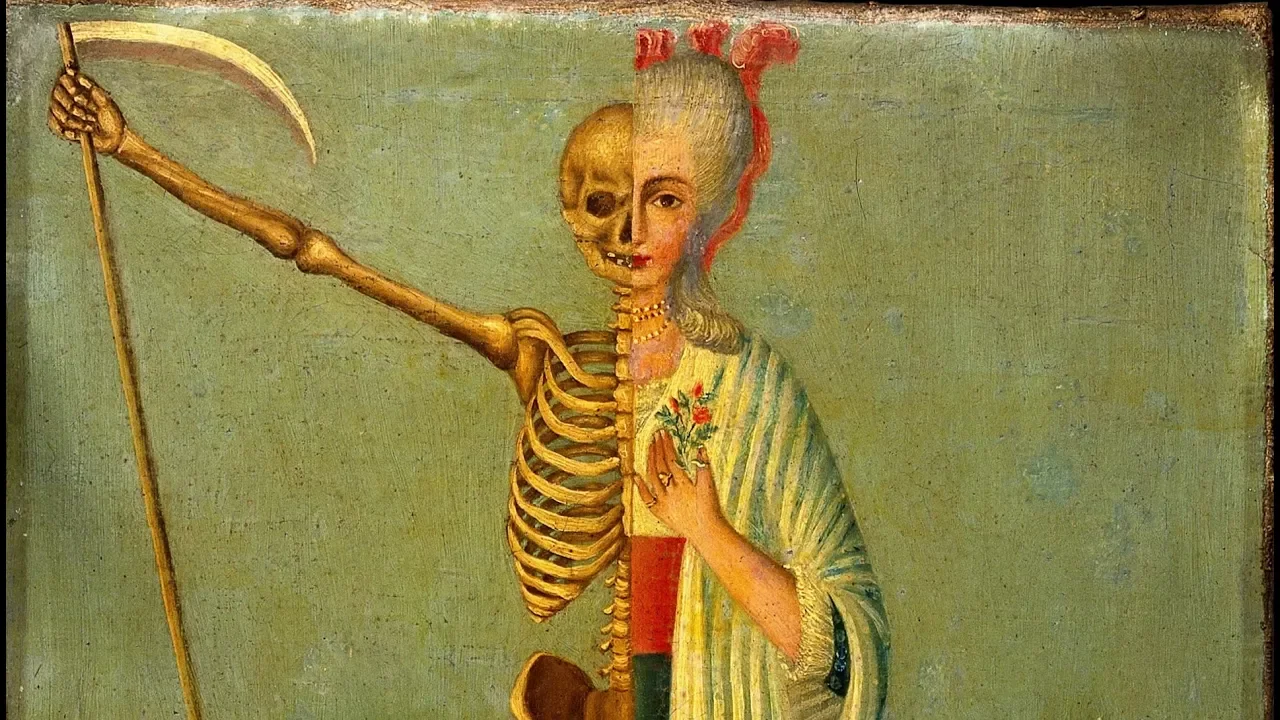
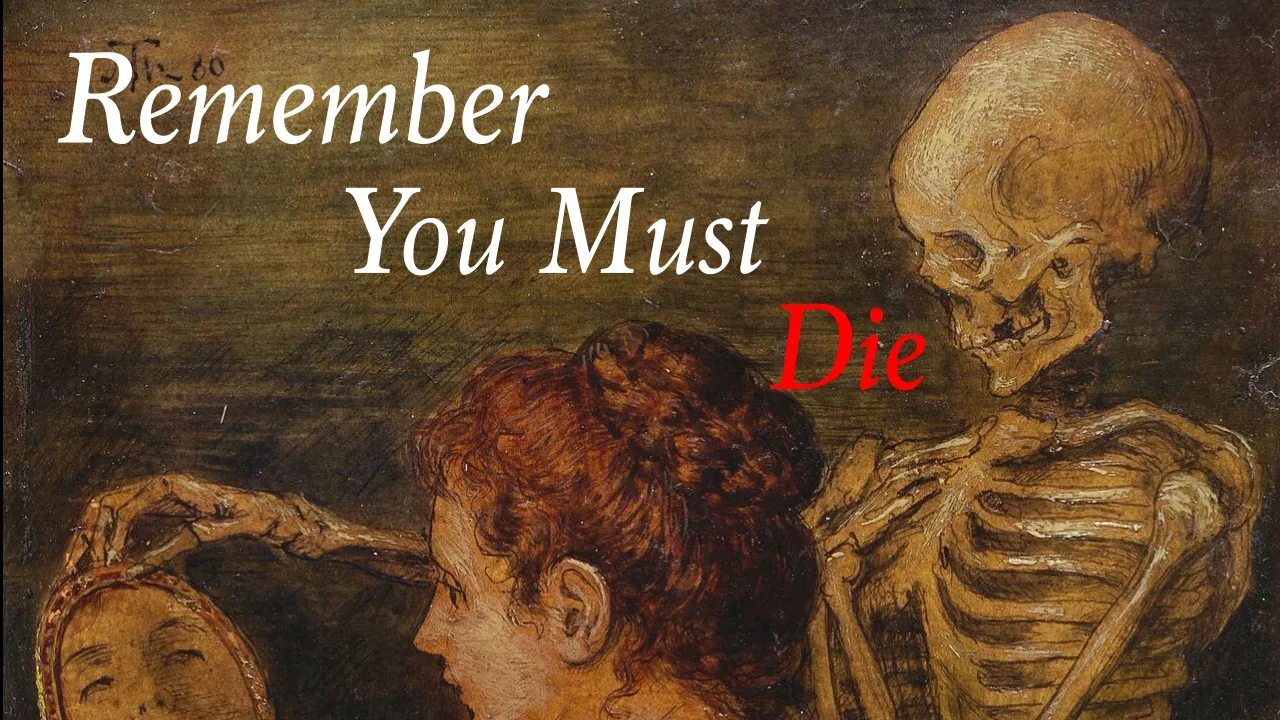
This painting is a memento mori, a reminder of mortality. During the Renaissance, plagues and epidemics made people far more aware of death—perhaps even more so than we are today—and our painter was no exception.
Through his art, Hans Holbein challenges us to look beyond the surface and reflect on our own existence. The distorted skull, visible only from a specific angle, reminds us that death is always present, even if we tend to ignore or hide it. It serves as a warning about our finitude, the limits of our perception, and our tendency to focus on the material and the fleeting.
With this visual technique, the artist not only celebrates the achievements of mankind—as represented by these men and the remarkable objects around them—but also confronts us with death as an inevitable reality, urging us to question our place in the world. No matter how much we achieve on Earth, none of it will shield us from our shared fate.
But between the earthly and the hidden, right on the threshold between the world of men and the mystery of the beyond, Christ appears—a symbol of hope and salvation. From that position, half-hidden between the visible and the unknown, he reminds us that even if human achievements take center stage, the transcendent is always present. Even when we don’t immediately perceive it.
I’d love to hear your thoughts on this painting in the comments. And of course, if you have another interpretation of this piece, it would be a pleasure to read it. Don’t forget to visit inspiraggio.com to place your order, and I’ll see you in the next video.
Up Next
66:07
Reformation Art in Germany and England: Dürer, Cranach, Holbein
@narrativearthistory
33.2K views•2023-01-24

114:18
Christian Iconography: History, Theology, and Meaning | Fr. Panayiotis Papageorgiou
@Trisagionfilms
58.8K views•2020-02-21

8:02
Ophelia by Millais: Symbolism and Pre-Raphaelite Art Explained
@inspiraggio
287.5K views•2025-09-07

16:34
Earliest Depictions of Jesus in Art: 10 Ancient Images Explained
@UsefulCharts
5.9M views•2022-06-03
Related Study Plans & Knowledge Roadmaps
Structured learning paths in Art History
art-history
Gothic Cathedrals: Engineering, Light & Society
01The Birth of the Gothic: Romanesque to Suger's Vision
02The Structural Triad: Pointed Arches, Ribbed Vaults, and Flying Buttresses
03Theology of Light: Lux Nova and Sacred Geometry
+ 2 more learning modules
14h5 modules
Explore Roadmap
art-history
Pre-Raphaelites: Realism, Symbolism & Critique
01The Victorian Art Establishment and Academic Formula
02The Founding of the PRB and Radical Realism
03Medieval Revivalism and Literary Symbolism
+ 1 more learning modules
8h4 modules
Explore Roadmap
art-history
Street Art: From Subways to Art Market
01Subcultural Origins in Philadelphia and New York (1970s)
02The Subway Era and Style Wars (Late 1970s - 1980s)
03The East Village Scene and Early Gallery Crossover
+ 2 more learning modules
10h5 modules
Explore Roadmap
art-history
Classic Maya Art: Iconography, Glyphs & Ritual
01Foundations of Classic Maya Visual Culture
02Deciphering Maya Hieroglyphs & Text-Image Integration
03Sacred Geography and Cosmological Architecture
+ 2 more learning modules
14h5 modules
Explore Roadmap