


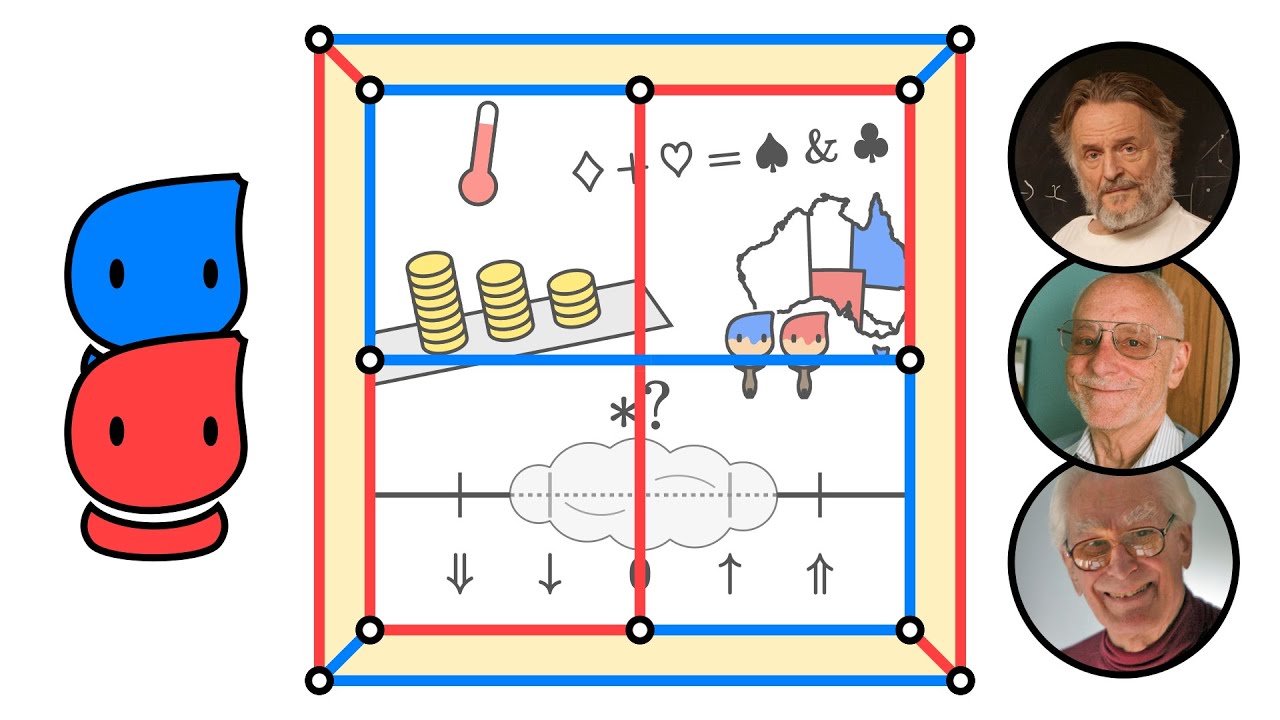



Partizan Game Theory studies two-player games of perfect information where players have different available moves (partisan games), using a formal algebraic framework where games can be added, negated, and compared; games are classified by their outcomes (L, R, N, P) and values (positive, negative, zero, or infinitesimal), enabling analysis of complex game positions by decomposing them into simpler components.
Partizan Combinatorial Game Theory: Introduction to Game Values
Added:Basic concepts of Combinatorial Game Theory (CGT), including the definition of normal play convention and perfect information.
Understanding of basic game trees and how sequential moves by two players are represented graphically.
Familiarity with basic mathematical set notation, as CGT games are recursively defined using sets of options.
The rules and objective of the grid-shading game 'Domineering' (Left plays vertically, Right plays horizontally).
Game arithmetic, including the addition of games (playing on independent boards simultaneously) and finding the negative of a game.
The classification of game values into numbers (integers and fractions) versus non-numeric values (like fuzzy or confused games).
Understanding infinitesimal values in CGT, such as 'star' (*), 'up' (↑), and 'down' (↓).
John Conway's construction of Surreal Numbers and how they mathematically emerge from partizan game values.
Analyzing and solving complex Domineering board states by decomposing them into independent sum-games.
285 views12likes1:27:53Original Release: 2025-11-30
I can see.
>> Great. I guess maybe I'll give like a couple minutes just in case others want to show up.
was great.
And you've all seen the previous talk, right?
>> Yep.
>> Yeah. I think everyone here was here for the last one.
>> Yeah.
>> I watched it after the after the fact. I couldn't really pay attention the first time around.
Whoa.
Okay, I'll get started. And people show up late, it'll be just fine.
especially if they've seen the previous talk or have heard anything about cominatorial game theory before.
So this is about partisan games of no chance and this is another introduction to cominatorial game theory. Just to be clear, cominatorial game theory is not the same uh field as game theory. Even though they both have the phrase game theory in the name, they're basically completely separate.
What is combinatorial game theory then?
Well, it's uh the modern renaissance of cominatorial game theory was really inspired by the game of go. Now, you don't need to know how to play go, but you can just uh believe me when I say that towards the end of the game of go, there's a bunch of white and black stones on a board, kind of like in this image. And even if you don't know anything about the rules, you can see that there are all these little sort of separate regions that don't have any stones. There's like this region over here and this region over here and maybe this region or something like that. Um there's all these tiny regions and this is near the end of the game of Go where most of the board is filled in.
And what you'd really want as a go player is to be able to say like, okay, there's all these tiny regions, can we take information about all the tiny regions and then combine that together to say who will win if they play well or how we should play well for the last bit of the game, something like that. So we want to take information of these small pieces and combine it together and so you get combinatorial game theory. That's the idea.
Now, one thing that is uh notable and perhaps easier to understand if you do have any experience playing Go is that you to do that effectively, you're going to need more information about the little regions than just like if you played only this little region, black would be ahead by two points or white would be ahead by three points or something like that. That's not enough information to tell you how to play this entire board.
And so I have this picture from the book Mathematical Go that sort of realized uh John Conway's dream of learning something about at least certain aspects of certain Go end games.
Uh can everyone hear me? Cuz it seems like >> Yep. Um, some >> I can hear you.
>> Yeah, I can hear you.
>> So, yeah. And so, this this sort of grainy scan uh gives you a little bit of a sense of the sort of information that you need in that example. There are some weird numbers. There's some, you can't see them too well, but there are some black dots and some white dots.
And there are numbers that you recognize like maybe uh one quarter or negative a quarter if that's what that is. And then there are numbers that you don't recognize like 0 squared vertical line thick plus sign subscript three halves. And then there's like a tiny x and a square over there.
And there are some other things with like these lines that I will not address in the least, but they are part of the analysis.
But suffice it to say, you need some really complicated stuff. You need more information about these little regions than a simple analysis might give. And that was really the genesis of modern combinatorial gaming theory. We want to learn about these little regions and how we put information together.
So instead of go, we're going to start with a classic example game called doineering. That's a bit simpler to explain, but it has some of the same aspects of go that we were just talking about.
So in doineering, two players take turns placing dominoes on a board. And maybe a starting board, a typical board might be say a 10x10 board. Uh, one player plays vertical dominoes, the other plays horizontal, and there's no points. You just lose if you can't make a move on your turn.
So, here's an example of a doineering game in progress where I think uh the vertical domino player has started and has played one more move than the horizontal player. And the board was originally this 10x10 grid, but you can see these little sort of eye bars signifying the dominoes that cover some of the spots. And once you've covered those spots, you can't can't place a domino on top of a domino or anything weird like that. Those are just not part of the play. And so what you can see is that these dominoes have basically carved up the board into a bunch of little regions. There's this region for a vertical domino. There's this region for a horizontal domino. There's some more complicated regions.
And but this is has that same aspect of go of carving the board up into tiny regions that maybe we could get information about and combine to learn how to play say the rest of this game well or learn who would win under perfect play or something like that.
Any questions about how doineering works I move on. This is going to be an important example game for a lot of the talk.
Okay.
Um so to make sure we understand how play can proceed, we can build a little tree of an example position and doineering.
Uh and since there are two types of moves there are the vertical moves and the horizontal moves. Uh if we're going to build the tree, we could signify that by having the vertical domino plays uh go to the left in our tree and the horizontal domino plays go to the right.
And if you write the letter R like this, then it's clear that that's horizontal.
So, here's a much simpler position than that whole board or that whole board broken up. You just have these two little pieces.
And there are some moves for left for the for the moves to the left for the vertical dominoes and some moves to the right for horizontal dominoes.
And uh for convenience, uh sometimes a little thing might be reflected or rotated just to make it easier to look at.
So to be clear how this works, if you can imagine, say, let's say the vertical domino is played on these bottom two squares, then this little square on the right can't be played. You can't play a domino on it at all. And so you really have this little trino and this little trino.
And those are basically the same as these two. So that's what this arrow means. This means that a vertical domino play would turn this into two trombos like this.
Or uh another example is if the vertical domino is played in the middle uh then these four corners are all individual squares and you can't play a domino on any of them and so you're just left with a trmino. So here's a domino.
Uh, so these are some moves for vertical dominoes. Here are some moves from horizontal dominoes.
And then after a horizontal domino move or a vertical domino move, you're in this new position. And then again, we could consider like what if you played a vertical domino or a horizontal domino from there.
And I'm just sort of using uh in the case of the tramos, there's just a single square left, but in the case of say left making this vertical move, there's really four single squares. But you can't play any dominoes. It's basically the same as a single single square. So this is just sort of an abbreviation for this tree.
So that's this is an example game tree for the game of doineering.
And uh the rules were helpfully summarized, but just so you have it on the screen again, two turns uh two players take turns placing dominoes. One plays vertical, one plays horizontal, and you win when you make the last move or you lose when you can't make a move on your turn.
That's doineering. And this is this game tree showing all these possible things.
Now, just to be clear, if you're playing this top position as a game of doineering, it this entire tree is not necessarily relevant. Um, you know, so we have these arrows to the left and these arrows to the right. We could name the players that way. We could say left, uh, she plays vertical dominoes and right, he plays horizontal domino. And so starting from this position, if left gets to go first, then play might be left, right, left. And if right gets to go first, maybe it's right, left. So not all of these arrows are relevant. Uh if you're just playing this game, but these arrows just show like just based on this shape, what are the possible moves for left and right for the vertical domino player and the horizontal domino player? And correct me if I'm wrong, but the reason that we're uh sort of generalizing further than the immediate like following the pattern of alternating turns tree is because we're going to be combinating or combining this with with other subpositions that we then talk about in addition to each other.
Yeah, I I'm not I'll explain addition much later, but certainly like we saw in that motivating example with that 10 x10 board that was broken up into little pieces, the little p the information about the little pieces might need to know about ver both the vertical and horizontal moves in that little piece.
Then we would then combine that information. Yes, >> great Chris.
So, just to be clear, in general, what are the games we're talking about, even though doineering is our example, uh these are two-player games that are where players take turns, there's no randomness, uh like like a card game, and there's no hidden information like Strateggo.
There's finally many possible positions uh there and play is not going to go on forever. And like we said in doineering, the player who can't move on their turn loses.
And uh lastly, players have their own available moves.
And the term of art here is that this game is partisan. And in combinatorial game theory, partisan is always spelled with a Z, even though in other contexts in English, partisan might often be spelled with an S. Um, and so by their own available moves, I mean like the vertical and the horizontal dominoes or the black pieces and the white pieces in go or chess that those games are these games are all partisan for that reason.
So the first thing that we want to know that I kind of alluded to earlier is you know who would win under perfect play or equivalently who would have a winning strategy in a given game position.
And so the term we use is the outcome.
And to be clear outcome is always an abbreviation for basically outcome under perfect play. So the outcome of a game position is written with a little O for outcome and uh that just tells us who has a winning strategy. Now it tells us who has a winning strategy for both the cases of left moving first and the cases of right moving first. So not just in doineering but in general it's conventional to name the players left and right. And uh that's just sort of a consistent name that we can use across go and chess and doineering etc. So what do I mean by this? What I mean is that when left moves first under perfect play either left wins or right wins. And then completely separately when right moves first in the game under perfect play either right will win or left will win. And so we have these two sort of bits of information. And when we combine those we get into one of these four boxes. And these are the symbols we use for those outcomes. So if right can win regardless of who goes first, we use an R because that's a win for right. And when the player who moves first can win regardless of if it's left or right, we use an N for the next player will win.
Similarly, L for left and P for the previous player. If this is you can imagine this is the middle of some longer game and so the other player who is not moving right now is the previous player. So these are the four outcomes that are possible in a game based on who would win when left moves first or when right moves first.
Um just to give an example so we make sure we understand in doineering if you just have a single square and no one can move then there are no moves available the next person to play would lose for not having a move which means that this is a win for the previous player we use the fancy P.
Uh if we just have two squares and you can only place a horizontal domino then right will win. Now, either that will be because left moves first and loses immediately for not having a move, or right moves first, places a horizontal domino, and then left loses. Either way, right wins. [snorts] And our last example here, if we have one of these little dominoes, then whoever moves first can place a domino, but then the other player can't. So, this is going to be a win for the next player to move.
Are there any questions about this outcome idea or why these three examples have the outcomes they do?
>> Makes sense to me.
>> So, uh, like we said in that example of a square where you can't place any dominoes, if there's no moves for the next player, it's a win for the previous player. And we can apply this to the tree we had before. There were lots of positions where there was no room to place a domino. So all of those positions that we had in our tree where you can't place a domino, those are all P positions.
And we can uh work backwards to figure out the outcomes of the other positions in this tree. Uh so for instance if someone let's say left could move to a P position then they can win because they can hand their opponent a position that where the next player to move does not have a winning strategy because the previous player had a winning strategy.
Previous player being left in this case.
Um or similarly if left can move to an L position where left can win regardless of if it's left's turn or not then she wins that way too.
Um, and so we can think about things like this to figure out, okay, can left win from this position because they can make a move because she can make a move to that or whatever and work backwards to fill in this tree.
I'm not going to belabor these details because there's not too much interesting stuff going on in this tree, but I just want to point out here, there's this L right here. And the reason that this is an L um is because if right moves then right hands left this end position where left can end the make a move and end the game and if left moves first left can end the game immediately.
And that's why this is a win for left regardless of who goes first.
Similarly, uh the original position is an N position because if left goes to go first, left can move to this P position.
And if right gets to move first, right can move to this P position. So either way, the next player to move will win this or can win this under perfect play.
So here are the outcome classes that we were just talking about.
And I just want to summarize the idea that we were just talking about.
So left can win moving first if she can move to some L or P position because left is going to move first and hand right if left hands right in L position well then it's a position where right's about to move but left wins because that's in the that's in this column. And similarly if left hands right a P position that says left wins when right moves. So again that would be a good move. So if left can move to some LR or P left will win moving first.
Similarly right can win moving first if he can move to some R or P because after right's move after right moves it'll be left's turn and under left's turn right wins in this row this R or P. So if left if right can move to some R, that's a good move. If right can move to some P, that's a good move. And so these are ways for the player moving first to win.
Analogously, under perfect play, left is doomed moving first if the opposite situation. If all of her moves are to R or N, so there's no move to some L or P.
And similarly, right is doomed if all of his moves are to L or N. So there's no move to some R or P.
This is just sort of a summary of this basic idea that of making a good move if you have one or not having a good move to make.
And with this, as I said before, we could recursively calculate the outcomes of any not too big game tree that we want using these rules.
That's nice, but most games have a big game tree, so we better learn something more about games.
And uh like was alluded to earlier, a game of position and doineering breaks up into a quote unquote sum of separate game positions. So when the board is broken up like this, we could say that this is like a sum of this shape and this shape and this shape and that shape, etc. And we have uh two of these horizontal shapes because there's this one here which doesn't interact with this big shape.
And in general, if I have two game positions, maybe there are two pieces of a go board or maybe hypothetically you could even say, oh, this piece of this go board and this piece of this doineering board. You could add those game positions and we could say the sum of those games or game positions is on each turn you can move in either game. And as I'm sort of drifting into this, the convention is to call a game position just a game.
It's a little faster to say, but when I say game, I'm usually going to mean game position or game state if you prefer.
Um, and like I said, you could do this with say doineering in the beginning and some little piece of a go board or or two pieces of a go board or whatever.
Um, this game edition has some nice properties if you like fancy words. It's commutive. It's associative. It has an identity of, you know, like the square and doineering where there's no moves available. And so it's reasonable to call any position where there's no moves available and you're going to lose if you try to make a move uh we call those zero because it's the additive identity.
Any questions about this idea about adding games? Because this is kind of fundamental. This is the main the most popular combination in combinatorial game theory.
Okay. Well, like I alluded to in the beginning, we want to think about some sort of maybe values for these tiny game positions. So that way we could combine those values and learn something about the whole game. So let's try to sort of feel out what sort of values we have.
So if we have uh two boxes or three boxes horizontally, there's one move available for right. Uh by convention, left gets the positive values. So we might recently say that this value is negative one. It's like the opposite of one move for left. It's one move for right.
And if there's enough room for two dominoes, that's two moves for right. So that's going to be -2.
Uh here we have a move for each. What what should this what should the value of this combination the sum be?
>> Zero.
>> Zero. Yeah. One plus negative 1 seems like it should be zero. That's a reasonable idea.
>> Is the symbol zero restricted to the identity?
>> And is this an identity?
So the identity for addition of games is the position where no one has a move at all. So this is not the same as that identity for adding games. But it's similar in that you know if someone makes a move in this the other player could make the other move and then it would go away.
And so like maybe this doesn't really benefit left or right. So maybe this is kind of like zero. Uh, but it's not the same as a position where there are literally no moves at all.
>> Are we defining equivalence between games?
>> I haven't defined any equivalence between games. Uh, okay.
>> So, when I say the same game, what when I say this is not the same as the game with no moves at all. I basically mean this game tree has moves in it, has moves available, and a game with no moves at all doesn't.
>> Yep. So, so the only >> thing I care about right now is if the game trees are like isomorphic as trees that have left arrows and right arrows, >> right?
Uh just to just to go down further on that idea though, it would this functionally be an identity if instead we were to think of equality as just like comparing game theoretically optimal behavior under combination.
Um depending on what you mean probably >> and uh we will give a precise statement which either is or is not what you were thinking of. Uh soon enough.
>> Sweet.
And in general uh I will make a vague claim which uh might be intuitive if you saw another talk that uh actually any P position is kind of like a position you know a zero where there's no moves available as part of a sum. Maybe this is what you were getting at. Um here I'm not proving anything right now but I'm making a claim.
>> Yeah, that seems to be in the same line of what I was thinking.
So let's look at this other shape. This kind of L tetromedino thing. This is a little weird.
Um let's try and figure out the outcome of this. And here we can sort of you can imagine playing this game. Uh so I don't know if if we have people who feel like participating. Does someone want to be left and someone want to be right in a >> I want to be the vertical player? I forget if that was left or right.
>> Yeah, vertical is left because left starts with that vertical L.
>> Okay.
>> Anyone want to be right? I >> take right.
>> I'll take right.
>> So, uh so we got to figure out what happens when left moves first and what happens when right moves first. So, uh if left moves first, what what move do you want to make?
Uh if I go first, I will go ahead and take the uh the core of the left L shape. Sort of the two like center the center section.
>> Yeah, the vertical move in the >> Oops. No, no, no, no. Never mind. Never mind. Uh I forgot I forgot that I said the vertical player.
>> I'll take I'll take the right I'll take the the the single 2 by two box. This one by two box.
>> Okay.
>> Yeah.
>> So left goes here.
>> Yeah. And now what what would right do?
>> I will take the corner of the L on the left. So bottom left and bottom center.
>> So that eliminates this. There's only two isolated squares.
>> So now what does left want to do?
>> I'll go Well, I only have one move and I'm going to lose.
>> Yeah, you make your one move. And then >> right makes their one move and that gets rid of this.
And now it's left's turn, but there's no more moves to make, so left loses. So, left went first and lost. Let's see what happens when right goes first.
>> Uh, wait, did I just do that wrong?
>> Was there was there not a winning? If I take the uh left bit.
>> So another way that game could have gone is left could have moved in an L and then right could have again moved at a corner in an L eliminating this >> and then left could make their only move and right could make their only move and left would still lose.
>> Okay.
So it was hopeless.
>> What if right goes first? A right. What move do you want to make?
>> I will again take the corner of an L.
Yeah, you take a corner of an L and then these [clears throat] two isolated squares you can't play on. No one can play on them. And then what might left do?
>> I'll take the remaining section of the L that is left for me to play on.
>> Left can move on an L and then right has one move and then left has one move and then right has no moves available. So right who moved first also lost.
>> So when the player who's next to move loses no matter what. uh this is a P position.
So the value of an L plus the value of an L plus one move for left is like zero moves for left.
So the value of an L is like negative a half.
That's weird that you don't you normally think in games of like half a half a move for right.
>> Mhm.
>> But let's keep going. Let's play some more doineering.
What about this? Uh what is this called? A Z tetrome. I don't know all the names. Uh >> I think so.
So if we have the Z troops and another uh vertical domino here, we can imagine playing this as well. And so here what we can note is that uh well here I'll sort of speed through some play. If left moves first, what they can do is they can eliminate one of these Z's, but then right has uh right can move in the Z and still has a move available and left moves and right moves and uh left can't win. So left loses when moving first. And similarly, if right moves first, right can move in a Z, but then left can eliminate the other Z. and then right moves and left moves and then right doesn't have a move.
So for very similar reasons this is also a P position.
So again we have something where if you add two copies of it to one move for left you get something like zero. So it seems reasonable that that value is also negative a half.
Um, but the thing about the L uh or this if if that is an L or whatever it is J the J and the Z is that they don't have the same outcome because in the Z, whoever moves first blocks the other player.
But in this L kind of shape, even if left moves first, right still has a move available.
So right can win regardless of who goes first.
So these things are definitely different. They have different outcomes.
So if we have some sort of theory about that's going to help us this combinatorial game theory, they shouldn't have the same value. They shouldn't both be negative a half, but they're both reminiscent of negative a half in that these things are true.
So, I'm not going to get into this right now, but it turns out that one of them is negative a half and the other one isn't. Does anyone want to guess which one is negative a half?
>> I'll guess for the sake of guessing.
I'll say the Z domino >> or tetrometer.
>> Going to guess the L.
>> Okay, we have we have one guess for Z, one guess for L. I think someone might be typing it. Guess.
Yeah, the J. Okay. Yeah, when you rotate this thing, we've been calling it L, it looks like a J. And so that might be its official name. Uh, and yeah, it is indeed the this sort of J tetromedo rotated like this. U [snorts] so if you think about one thing we can say even if we don't have any real understanding of what's going on is that you moves for left are worth positive value and moves for right are worth negative value. So the outcome of this thing is a win for right. So it should have some sort of negative value.
Whereas the outcome of this Z thing is not a win for right. So maybe it shouldn't should it have a negative value or or maybe it's a weird kind of negative value. Who knows? Um but anyway, we'll maybe we'll revisit this later to learn more. We're going to have to drill in more formally into the moves you can make. sort of the next layer of the game tree below a position we're looking at. And so the term we use is an option. An option of a game is a position that you can move to in one move uh from the game G.
And so there's this kind of notation to simplify the number of brackets you have for the sets where rewrite uh a brace and then all of the options for left, all of the moves that left can make and then a vertical line and then all of the options for right. So if G is this little trino, then left can place a vertical domino and right can place a horizontal domino.
Those are the only moves. And this uh left can place his vertical domino.
Right could take the corner or right could not take the corner. Those are the options.
So this is how this notation works.
Um and in general if we have a game G and this uh the symbol I think I used it once before. I just mean like uh isomeorphic game trees or this like literally the same game. That's what you could think of this as meaning.
So in this notation that I showed above, we're kind of literally listing all of the items, all of the options for left and all of the options for right. But, you know, depending on the math we're doing, we might actually need to refer to the set of all left options.
And one convention that I think Aaron Seagull is a big proponent of, and I like it as well, is to use different fonts when we're using things differently. I don't know. I don't think I'll use too many sets. But this curly G is suggesting that okay, this is a set of a bunch of left options. Whereas these regular G's is like, okay, this is like this particular position. This is like this particular position or whatever.
This is just notation. So, we'll get used to it as we use it.
And we talked about adding games where you can move in either component. So what does that look like in a this practical example with this G and this H? [snorts] Well, if you add G and H, then you could move in G and then you would have G one move later and H. Or you could move in H and uh that's the only move for left and H. And similarly, right could move in G and still have the H component lying around. or right can move an H in the corner or not in the corner and still have this G component lying around.
So this is how we add games. We write out all of these options and then we have all the options of the sum of the two games.
Please stop me if uh if this example doesn't make sense because going to be adding a lot of games.
And so this is just one example, but if you like uh equations or formality, we could write out we could write that out more formally in a second. But first, I want to talk a little bit about this negative. We're talking about valuegative -1 and we have sums of games.
So we can imagine something like a negative of a game just to swap the players. like if left has positive points or something like that and right has negative values then the negative of a game could mean swap the players.
So formally uh the negative of a game G is the game where the left options are the negatives of all of the right options of G because we and similarly the right options are the negatives of all of the left options of G because if you swap the players it doesn't just swap it now it swaps it for the whole rest of the game. So that's why we have to say it's not just the right options here, it's the negatives of all the right options because the players are swapped from then on.
Um, so just to be clear, what would the negative or what would a doineering position that would be like the negative of this H look like?
>> I guess you could like rotate it 90° such that like the vertical player has all of the current horizontal moves and vice versa.
Yeah, if we rotate the picture 90° and we do that in the options as well, that's that sort of recursive definition, then it would be the negative of this game. And so doineering is particularly easy with negatives. You just rotate uh 90° and then you have the negative.
And like I said, you know, so we have this like formal notation for the negative. We could write some sort of set notation for the sum if you like unions of sets. So the left options of the sum are the union of the sums of a left option in G and the game H with all the sums of a left option of H with the game G. And the right options are similarly the right versions of those.
And so in both of these lines we have this sort of shorthand where we take a set plus an item or the negative of a set and we mean do that for all the things in the set. If you're a programmer this is like like 4x in the set do some stuff.
So that's so we have negatives of games we have sums of games.
Um similarly just like in algebra the difference is just add the negative.
That's this notation.
So that's nice. Um, one thing that's good about negative, just like in numbers, if you take the negative of the negative, you get back the original game. Uh, that's not too hard to prove by induction.
If you take the negative of a sum, [snorts] that's the sum of the negatives.
And so you could also write that as the difference of like minus G and H, you know. So basically all the algebra with pluses and minus signs that you would want to do is basically fine. That that's all I'm saying here.
The last thing I want to observe with this now that we have differences of games is the outcome of G minus G. So if you imagine in doineering we have a position and we have that position rotated by 90° because that's the sum of G and it's negative.
What can we say about the outcome there?
>> Well, I think like a simple copy strategy should work where Oh no, sorry.
It's partism. Never mind. You can't just repeat what your opponent did.
>> Oh no, you can't >> two copies of the game though.
>> It's rotated. So yeah. So like you know if if whatever player one does on one board then player two would do on the on the other board they can do that because it's negative. So >> exactly >> um it should just end up being a P position if you just follow that down the line.
>> Exactly. So because it's rotated or because it's the negative uh the other player can indeed sort of mirror that move in the other component and that if they just keep mirroring moves uh they'll win. So this is a P position by mirroring moves.
And so like we like I claimed without any proof before it is a P position. So somehow G minus G is at least like zero where zero is a game where there's no moves at all. Um but again G minus G has moves. It's just under perfect play those moves kind of all cancel out.
So that's interesting.
Um the next thing I want to talk about is talk about comparing games. So we talked we sort of had some guesses about values of games but maybe we can more formally or or develop a theory about comparing games.
So uh I claim that this thing um and because rotating matters in doineering I don't want to call this J.
I apologize um but that this thing is at least as good as a horizontal you know empty space for a domino uh at least as good for left in any sum. So like this plus some complicated position uh versus this other thing plus some complicated position.
Uh you'd left would not be mad if you replaced like space for a horizontal domino with this thing.
And I think it might be intuitive if you think about what are the options here because in this thing if left gets to move first in it, left gets a move out of it, even if right still gets the same uh space for a horizontal domino.
And if right moves and somehow doesn't take the corner, also left would have a move. So maybe left could get to move in this thing, but even if not, right doesn't get two moves out of it. Even if right takes the corner, it's kind of the same as right just taking this domino space.
So it's at least as good for left.
Does that Does everyone buy that intuitively?
>> Yeah, I'm with you.
Um so we can use this idea to define what uh comparison means.
So this is a definition of the greater than or equal to sign.
So we say that G is greater than or equal to H or G is at least H if for all game positions X and for both starting players whether it's left or right if left has a winning strategy in H+ XX then she does in G+X.
Uh in other words left can win G+X whenever she can win H+X X. So that's that's kind of formalizing what I mean by at least as good because if there's any combination where left can win H+ X either moving first or moving second then she could do the same thing in G plus X. If if we couldn't if left couldn't still win it wouldn't be at least as good.
So that's that's our definition.
Um now under this definition I just want to emphasize unlike a lot of the numbers you might be used to sometimes things are incomparable.
So a trino is not greater than or equal to you know the zero game where there's no room for a domino and the zero game is not greater than or equal to a trino.
So neither of those comparisons are true and they're incomparable.
And so we use this traditionally we use this double vertical line in comal game theory for incomparable games.
And depending on the book it's common to uh say that say the trino is confused with the zero game even though in pretty much every other math book on partial orders they'll just say they're incomparable.
But confused with sounds fun.
And also just to spell it out, just like we have for numbers, if G is greater than or equal to H and H is greater than or equal to G, it's a good reason to write G equals H.
So that's what we'll mean by G equals H, we'll mean both of those things.
To find the this inequality, we could use it to define equality.
And you know, well, if we have equality, then I bet you can guess what G less than H or G greater than H should mean.
Any questions about any of this inequality or incomparable or equality stuff before we move on?
>> Think we're all good.
Um so I want to point out that you know now that we have equality there are games that are equal to zero that are not the zero game. So for instance zero meaning a game where in which there are no moves at all equals uh this is just the option notation for the traumo where you know left has a move to zero and right has a move to zero. So if you add two tramos, left will take one and right will take the other. Uh or at least they could do that. And it turns out that that sum of games is equal to the zero game. Even though it's not like identical to the zero game. It's not a game which there are literally no moves, but in this definition of equality, it's equal to zero. And so maybe this uh this clarifies, you know, there's a question earlier about equivalence of games. So this sort of equals that we've just defined is some sort of equivalence relation on games that will be useful to us when we're dealing with sums.
And how could these two things be equal even though they don't look the same?
Think about it like fractions. 1/2 is equal to 36 even though their their parts their numerators and denominators are not literally the same. Similarly, the options of zero and the sum of two dominoes is not literally the same, but they're equal anyway.
So, that's how to think about quality of some games.
Um, there's another definition of inequality. So this first definition that we gave, we said uh you know it's all about we're thinking very concretely about winning strategies in you know with left going first and right going first but we already have a way to sort of summarize words about winning strategies. We have the outcome idea.
So another option uh pun not intended is to phrase inequalities uh in terms of outcomes.
So g is less than or equal to h if for all games x the outcome of g plus x is less than or equal to the outcome of h plus x.
Any questions uh about that?
>> Well we haven't defined comparing like outcomes have we? Cuz out like outcomes We absolutely have not we have not defined comparing outcomes and so we'll need to do that. Um so we said before that we give positive values to say positions where left has a bunch of moves and negative values to positions where right has a bunch of moves. And similarly G uh you know game is greater if it's better for left. And so we can order the outcomes by what's better for left versus right.
And so this is the ordering of the outcomes.
Uh the outcome R is less than all the other outcomes. The outcome N and P, neither of N versus P is really better for left, but they're better than R where right wins all the time. And both of those are worse for left than L where left wins all the time.
So this is the ordering on outcomes that allows this definition to make sense.
Is this is this little diagram uh clear?
And you know equals means like oh this literally the same letter for outcomes.
I think >> how difficult was that to format?
It's it's not bad. Um because you can just say like, oh, this is 0 0 and this is like I don't know like one zero and 02 or something like that. It's not bad.
Um so there's a a bunch of theorems that I won't prove, but uh it basically is that comparison has nice properties. So that's less than or equal to a thing. If you know what a partial order is, it definitely is a partial order on game positions.
If you want to compare two games, G less than or equal to H, it's so we have we defined equality in terms of less than or equal to. And it turns out G less than or equal to H, whether that's true or not, is unaffected by replacing options with equal ones.
um this less than or equal to symbol plays nicely with uh sums and differences of games. So you know if if a is less than or equal to b then a plus c is less than or equal to b plus c etc. Um, and another way of phrasing that with fancy words basically or phrasing a lot of this is equivalence classes of games under equals form a partially ordered a billion group with the plus and the the less than or equal to that we defined as our group operation and partial order.
So this is a sort of algebraic structure to our games that'll help us understand you know understand the games better.
So I want to take a break from this abstract stuff to talk about some uh examples of games now that we understand sort of ways to think about games.
So like we defined zero to be the game with literally no moves and we have now we have game equality.
So we can check whether certain sums of games are equal to zero or not. We could define one like one move for left to be the game where you can make a move to zero and two could be the game where left can make a move to one and then can make a move to zero.
And this game two where left has a single move to one is equal to but not the same as a game where left could also like waste both of their moves in one turn or just make one move.
These are equal and you could define three and four or negative three and negative4 etc. And we had a proposed negative a half.
Um, and there are good reasons to define a half to be, you know, basically that doineering or the negative of that doineering position.
Left can move to zero, but right can move to one. So, it's kind of in between.
And you can go in between those fractions to get like a quarter and 3/4.
Um, I'm not going to focus on this, but you could get sort of any power of two in a denominator by following this pattern and then checking you can check that all the sums work the way you would expect for like these so-called diatic rationals where the denominator is power of two.
>> Wait, so if if left could get to one and right could get to zero, is that that's not the same as 1/2, right? What what would that be? Would that be confused?
one uh hold on to that question for just a couple more lines.
>> Okay, >> that that's an interesting position to think about. Um, another thing we can think about is this this trauma where left can move to zero and right can move to zero. Um, a traditional notation for that is a star symbol. And so this star I I think I said this before or said something similar. the star, this trino is incomparable to zero. It's confused with zero.
Um, but now that we have this little tidy notation for a star, instead of having to draw a whole trino, we could put that as an option. And we could define a game, you know, 1/2 is where left can move to zero and right can move to one. And this game traditionally denoted up or well denoted with an up arrow in red up is a game where left can move to zero and right can move to star.
So right can move to a traumo.
That's uh a positive game instead of incomparable to zero.
But both of these things uh sometimes called infinite tesimal. So you know we have 1/2 and 1/4 and you can imagine an eighth and a 16th etc. Um star you know is kind of weird. It's is this n position. It's incomparable to zero. So maybe it's not so weird that it's less than all these uh tiny fractions. But up is positive and up is also less than all these tiny fractions.
So it's very very small but still better for left than the game where there are no moves at all.
And uh so that's kind of cool.
Um how about comparing up and star? Up is actually confused of star, but two copies of up is positive enough to beat star to be greater than star.
>> Wait, sorry. Do you have an example off hand where like having a the trio would be better for left than like not having one at all? Like what is some sum in which that would be good?
>> Uh so I mean in a traumo there's a move for left. So if the trino is the only thing and it's left's turn.
>> Oh true. Yeah. Okay.
>> Left will win because they can move. So like that's better than not having a move at all.
>> Okay. left gets to make the move and right doesn't if it's left's turn.
>> But wait, but wouldn't that be incomparable with uh hold on cuz if if there's nothing at all, whoever >> whoever moves loses. So that's like a E position.
>> If you have a trauma, that's an N position. So isn't that incomparable by our previous definition?
Um so incomparable means that we don't have like one is less than or equal to the other like in all contexts, >> right?
>> So if if one's a if one's a P position and one's an N position, uh you could take X to be say the zero game. And then looking at this little diamond, we can see okay well n isn't less than uh or equal to p and p isn't less than or equal to n. So immediately from this definition we can see that you're right. Then n position is incomparable to a p position.
>> Right. So how is it positive then?
>> Star is not positive. The trino is not positive. It's incomparable to zero. Oh, I think I confused star with up. Gotcha.
>> Yeah, up, which I'm just defining in terms of star, >> right?
>> Up is a game where left can end the game right away and right could move to star and then left has a move.
>> That game is positive. That game is better for left than nothing.
>> Is up representable in doineering?
>> Um, I forget. Okay.
>> I did not I I did not keep >> I don't have a dumination sheet handy. I will check later maybe.
>> Oh, thanks.
>> Uh but yeah, so up has this weird property that if we add two copies of up, we're uh that's enough to be to be greater than star, but one copy of up is incomparable to star.
And so these are these are not supposed to be obvious and I'm not proving them.
I'm just sort of giving you some flavor of some of the things. These are simple enough games that if you go through the steps and draw the trees, you could you could prove any one of these claims individually. Um, but here's just sort of some of the landscape of games and comparisons.
Uh, in addition to star, we could define some more games that are kind of uh balanced in this kind of way where left and right have the same options.
So traditionally star two is a game where left and right can both move to zero or star and that uh even though star even though up is incomparable to star up is bigger than star two um and star three where left and right could move to zero or star two that's also less than up etc. There's a star four, star five. Those are all less than up.
I think there's going to be a question in the chat.
No, no, go ahead.
Star two, we're not implicitly trying to call this multiplication under the hood, right? That's just sort of a definition of a symbol, right?
>> Yeah. No. And in fact if if uh in a different notate like it would be nice if the two were a subscript honestly like writing it in star two is just the convention but you pretend it's a subscript except if you read anything on comatorial game theory it won't be a subscript >> huh but >> it's it's yeah it's not multiplication in any way shape or form.
It's it's like two stars in that star is like a heap of size one and star two is a heap of size two.
>> Yeah. So if you know the game of uh nim in which there are heaps of tokens and you can take as many tokens as you want from a single heap on your turn then yes star n is a position of a single heap of size n.
And if you don't know the game of nim, don't worry about it because with this notation, I've told you what star two and star three are.
We can define uh other weird looking games.
U this is not the right font, but I made these slides hastily. So a fancy plus sign like we saw early on in that go picture.
Uh fancy plus sign sub one is this game where so let's go back to up for a second. Up is a game where left can move to zero and right can move to left moves to zero and right moves to zero. So if we change that zero over here to a minus one. So left can move to zero or right can move to left can move to zero or right can move to minus one.
Then we get this game which I believe almost everyone would call like tiny one, but I found one source claiming that we should actually pronounce it teeny instead of tiny. And I don't know if anyone else agrees with that. So I'm going to call it tiny one.
And uh so this is a game where left can end it immediately and right can make a move that kind of threatens to pick up you know negative one as a point for right a move for right but after that threat left could still just shut this down.
Um so it uh it's definitely it's kind of good for left because left has a move even if right gets to move first but uh there's that threat and because of that threat that makes this not very useful to left and so tiny one given its name is positive but it's infinite decimal even compared to up and what do I mean by that and it's on the screen I mean that if you add like a million copies of tiny one, it's still less than up.
So, and if you add, you know, a thousand copies of up, it's still less than one over 64 or whatever.
So, tiny one is really tiny.
And you can imagine sort of making this threat that right is trying right is threatening to take a point or take a move. You can make that threat even bigger. And then the benefit of this tiny thing would be even less to left.
Um, so if you make it threat them to take two moves, then tiny two is actually infinite decimal compared to tiny one. And you may as well not just put integers there. You could put like negative a half there. Tiny one is infinite decimal compared to tiny a half. Like we have this gigantic uh I don't know what you call it like like dense ladder of infiniteesimals or something.
Uh, really weird stuff. But, uh, I want to mention that go picture at the beginning had some fancy plus symbols in it. So, at least some of these tiny values that seem like, oh, this weird infinitesimal value to left, how could that possibly be helpful?
That's actually something you need to analyze a go end game.
Any comments or questions about uh any of these examples? I think I have one more example.
>> I I might be jumping ahead a little too far here, but is there like if if I were to be provided with some data structure representing this sort of set notation?
Is there a generic algorithm to decide uh like comparison versus like like all of the all of the relations that we've written so far such as like quality and confusability etc. >> Well, I mean certainly uh you could decide outcomes uh OC with this. So the thing is >> without brute force like without search is there some is there some clever way of understanding >> like >> um yes um yeah probably depending on [snorts] exactly you know it kind of depends on things we haven't defined yet uh as to or exactly what you mean uh but probably uh to to the question you asked as as you asked it. I think I think probably yes.
>> Okay, cool.
>> Um and so you asked about a game in which left can move to one and right can move to zero. Uh I'll look at something a little bit different right now just for a second. So if we have this 2x two square in doineering, uh that's a game in which left can move to one and right can move to not zero but negative one.
And so this particular game is interesting and it's denoted plus or minus one because there's a one and a minus one and a plus or minus kind of makes sense. Um plus or minus one is weird because it's confused with zero and it's confused with one and minus one, but it's definitely less than two. like having two moves for left is definitely better for left than like this thing where if right got to move first they would get an extra move.
Um but it's confused with one or negative one. And in general you could define like a plus or minus n which is confused with everything between minus n and n but it's definitely less than say n plus one.
And so your your example of one and then zero is like uh I think it's like a half plus plus or minus a half or something like that.
It's it's very similar to this kind of game.
>> Um and in doineering I'm I do know that plus or minus two appears in doineering.
I think we don't know if if like plus or minus three or plus or - two and a half or anything like that appears in doineering, but we definitely know that plus or minus two does.
And by sorry, let me be a little more precise. We definitely know that a game equal to plus or minus two appears. Not literally the game with just two options.
Um, any questions about or comments about any of these examples aside from the one about dominating an up that I don't have in front of me?
Uh, don't want to go on too much longer. I think this this talk uh has a number of spots that would be good to break into another part. Let me just see where we are.
Yeah. So here maybe I'll I'll leave things with this. I kind of said this vaguely when we're talking about values, but now we can precisely say uh that an outcome of game is P if and only if the game equals zero in the sense that it equals the game with no moves where equals means G is less than or equal to zero and 0 is less than or equal to G and less than or equal to is defined in one of those two equivalent ways that we defined before.
Um, I don't know.
How are you all feeling? Do you want to save say proving this and some other things for next time? Do you want to go like 10 more minutes? What are people thinking?
>> I don't want to speak for everybody, but I'm locked in. I think this is cool as hell.
>> Yeah, I'm definitely sticking around.
>> Okay, I'll do uh a little bit more. I think probably if I remember correctly the end of this algebra section is a good spot to stop and break into a second part.
So we can prove this and uh so let's do it. So the first thing I'm going to do the only if because that's pretty easy. If G is the zero game with no moves at all, its outcome is definitely P. We kind of discussed that already. There are no moves available.
Now if the outcome of G is P, what do we want to show? What does it mean for G to be equal to zero? Well, in that outcome version, it means that the outcome of G plus X has to be the same as the outcome of 0 plus X, which is just X for all X.
So these outcomes have to be the same.
And how do we compare outcomes? Well, the outcomes are the same if like when left can win moving first and when left can move with winning second. It's the same for both those.
So or similarly for right etc. So let's suppose that left or right can win X moving second then what they could do um then because the outcome of G is a P position is also a win for the second player then in G plus X the same person whoever can win X moving second can win G plus X moving second just respond in the same component each time so let's say to make this concrete let's say right can win X moving second.
Then left moves first. Let's say left moves first in G plus X. If left moves E, well, G was a P position. So, right has a good response in G. So, right could just move there. And then whenever left moves in X, well, right can win X moving second. So, right could just respond in X and just keep responding in the same component that the opponent moves in until the game is over.
So if if X can be won by someone moving second, so can G plus X. That's sort of case one. Case two, well, if you can win X moving first, you can win G plus X moving first. Just make the good move in X and then you're back into the other kind of situation. Basically, if if we're playing G+X, like let's say left can win X moving first. Then if left moves first in G plus X, she should make her good move in X and then it's right turn. But G and that option XL, whatever are both wins for the second player when right moves first. So right is kind of doomed and left will win by just responding in each component.
That's the idea.
Any Does this make sense? I kind of went through that maybe a little fast, but hopefully it's intuitive.
>> I follow.
>> Okay. So now I'm going to go uh one step further. So we have it it you know the outcome of is P exactly when the game is equal to zero.
We can also characterize whether the out when the outcome is L. The outcome is L exactly when G is greater than the zero game or we say G is positive.
So why is this true? The proof is actually very similar. So if you understood the previous proof, this proof uh will be almost the same but the only if is a little more complicated. So first you know so if G is positive then it's certainly greater than or equal to zero.
And greater than or equal to zero means that the outcome of G is greater than or equal to P in that little diamond diagram. But the things that are greater than or equal to P are either P or L. So just assuming greater than or equal to zero gets you to P or L.
But we know from the previous slide outcome of P would mean equal to zero.
So if we're assuming strictly greater than zero, then G is not equal to zero.
So the outcome can't be P. So the only other possibility is L.
So if G is positive, it outcome has to be L because it can't be P because we just proved what P means.
So that's that direction.
And then in the other direction, if the outcome of G is L, why is G positive?
Well, here the proof is almost the same.
Uh, well, first we know the outcome isn't P. So, we know G is not the zero game.
Uh, and so all we have and so it's not the zero game. So, all we got to do is show it's greater than or equal to zero because if we can show that, then if it's not zero, then it must be positive.
Not equal to zero, it must be positive.
So to show this is L position, we want to show if left can win X.
Sorry, we're not showing that G is an L position. We're assuming it to show that some G plus X is winnable by left when G is winnable by left or sorry when X, excuse me, let me slow down.
So we're going to show that G is greater than or equal to zero. So what that means is that if left can win 0 plus X, then left can win G plus X. That's what it means for G to be greater than or equal to zero.
Well, and we break the same cases. If left can win X moving second, then because the outcome of G is L, left can win G moving first or second.
Then uh if left is going to move first in G plus X uh she could just move let make a good move in G and then respond in these components.
And if left can win X moving first she could just start in X. Um and then even if right gets to make a first move in G, it doesn't matter because the outcome of G was L. Left can still win. And so again you just move componentwise. you move in the same component that your opponent moves in and that works.
And so because those are the two cases we've shown if lex can if left can win x either moving second or moving first then left can win g plus x moving the same time and that shows that g is greater than or equal to zero and we already know it's not equal to zero so it must be positive.
That's again it's a similar idea. So if it doesn't make sense I think you can maybe go back to a video and think through it but it's a similar idea.
So just to summarize here we have a characterization G is equal to zero when the outcome is P. G is greater than zero when the out exactly when the outcome is L by switching left and right we have and the exact same proof basically says that the outcome of G is R when G is less than zero that's like the same thing as this just the rotated 90° if you're thinking about doineering and so what does that mean about if the outcome of G is 10.
>> Does that mean it's confused with zero?
>> It has to be confused with zero. It can't be positive because that would be L. It can't be negative because that would be R. And it can't be equal to zero because that would be P. So, uh, >> wait, so maybe maybe you mentioned this earlier, but is it necessarily the case that something confused with zero is always not equal to something positive?
I guess that would then mean that it is positive.
Uh >> yeah, because so if it's equal to something positive, that means it's greater than or equal to something positive.
>> And I claimed without proof that greater than or equal to is a partial order. And so by transitivity, it would have to be positive itself.
>> So you can't have something like you know a is confused with zero and b is confused with a but b is greater than zero. You can't have like >> that's a different question. That could happen. Sure. Oh, can it? Oh, okay.
>> Because because we had that with up and star. Up is confused with zero. Sorry, no, we had that with uh sorry, with upstar and zero. Well, we had something like that, but with star instead of zero. Like up is confused with star.
Zero is confused with star, but up is greater than zero.
>> Okay.
>> Um, so that's a similar kind of thing, but with star in that key spot instead of zero.
So yeah, I guess what I was trying to get out there is in general you can't build like an equivalence class around one of the one of the uh one of the numbers like the traditional style like number script things. It's not like that's an equivalence class of everything that's confused with it. Um, >> I'm I'm not sure I understand.
>> Uh, like what I'm what I'm what I'm trying to imagine is and maybe this is uh maybe this is wrong is like no zero and all of the things that are confused with it are sort of like you know form some kind of like epsilon ball around zero or form some kind of equivalence class >> some kind of structure locally. Um >> so I I think I understand the question now. And so if we go back to this 2x2 square, this 2x two square is confused with zero but it's confused with zero like star is confused with zero but it's infinite decimal. So you can imagine some sort of you use the phrase epsilon ball. Maybe star lives in some sort of epsilon ball around zero or something like that intuitively. Mhm.
>> But this 2x2 square this plus or minus one >> does not live in any small thing because it's confused with one and confused with negative one. It's this big cloud of confusion over the small numbers.
>> Okay.
>> It's much bigger.
>> It's not small.
>> Yeah.
>> So someone points out that like this thing has like a confusion radius of one. It's not infinite decimal. because it's confused with one and confused with negative one.
But anyway, so the thing I was saying was uh sort of by these two facts we know the sort of other two facts. The outcome is r if and only if g is less than zero by the same proof as this slide just switch left and right and by the it being the remaining case the outcome is n exactly when g is confused with zero.
Um, and so that's that's good to know. So the outcomes actually tell us comparison with zero, but you know, you were asking uh a little while back about computing comparisons in an efficient way. So we don't just want to com. So maybe if we have if we know something about outcomes like this is kind of helpful to compare with zero. But does this help compare like arbitrary games?
Well the thing is I claimed and you can I I did not prove it but it's a good exercise that less than or equal to plays nicely with sums. you know it's we have a partially ordered group so to of equivalence classes so to speak and so what that means is basically we can do the algebra that we want to do um so if you want to compare G and H we really don't want to like write a list of the infinitely many possible games X and think about playing in G+ X and H+ X for every single X that's not that's not a feasible thing at all but what we can do is we can do algebra So if we want to test if g is greater than h just like with numbers we can subtract h from both sides just test if g minus h is positive and we know what it means for g minus h to be positive it means the outcome is l and similarly for all of these these are equivalent to like subtracting h from both sides and the results we just learned about comparison with zero settles this in the sense that so I'm not saying I can always have an efficient way to compute outcomes, but at the very least I can reduce comparison questions to outcome questions in this way.
>> Is this helpful to your question about calculating comparisons?
>> Yeah, definitely.
>> And so, yeah, and so we have words, you know, positive and negative are words you're familiar with. If we're keeping zero for the game with no moves, then this is not zero, but it's equal to zero. And then an end position, it's incomparable with zero. It's confused with zero. Uh, a common word is fuzzy.
Um, but you could just say it's confused with zero or it's incomparable with zero.
Um, so yeah, the last thing I'll say is uh I'll just give an example of applying this and I think that's probably a good place to stop for this as like a part one.
So now that we have this way to test uh comparisons, let's show this claim I made earlier that this L kind of thing is at least as good for left as two spaces for right to place a horizontal domino. And how we show this is we play the difference game. So we just need to know the outcome of you know g minus h.
And in doineering the negative of this horizontal thing is a vertical thing.
So the difference between these games is this like l plus a vertical space.
And so here's the entire game tree. And so we just need to figure out the outcome of this difference game to to confirm this fact.
Um or actually since it's greater than or equal to we technically don't need the exact outcome. We just need to greater than or equal to means the outcome of the difference is L or P which really just means left can win moving second. That's that uh I forget if it's a row or column of our original table. But all we really need to do is worry about left moving second to confirm greater than or equal to. So right moves first. Uh well right could take the corner or not. No matter which right does left has a move.
Um oh this is not the whole game tree.
I'm sorry. Uh if right takes the corner then left has a move and then right doesn't have a move and so right so left wins moving second. In this case if right tries to stop left from winning playing differently left has even more moves.
Left has another move that they don't get to that she doesn't get to use. Um so either way left is going to win moving second. So there's either an L or a P because I didn't analyze if left moves first. But so we have greater than or equal to. So that's how this is done in practice. If you you want to know is this greater than or equal to this other game or is this greater than this other game?
Well, you just have to analyze play of the difference game.
So I think yeah that's the end of this section and that gives you so with all this structure and all this algebra this gives you kind of the first steps towards that motivating idea of trying to figure out things about go. So if you want to know like okay is this little piece of this go board how does that compare to this other little piece of this go board? Well, what you can do is you can play a difference game of go of like this corner and this other corner with the colors swapped. Play that game and see who wins that compares those two things.
Um, so that's uh all well and good.
We've learned a bunch of stuff about games and algebra with games, comparing games.
Uh, and I think that's a good place to stop.
Happy to take questions.
Thank you a lot for presenting. I thought that was awesome.
>> Yeah. And here are some sources that I refer to.
Yeah, mathematical go is like the book that sort of said, "Yep, we can say something about Go finally."
>> And Lessons and Play is a good undergrad textbook and cominatorial game Theory is a good graduate textbook.
>> Sweet. Thanks a bunch.
Well, if there are no other questions, uh, take care and probably do a part two sometime.
>> Awesome. Looking forward to it.
>> Yeah, same here. Thank you. Thanks.
Bye.
Up Next
4:47
Foundations of Projective Geometry: An Axiomatic Introduction
@RichardSouthwell
21.6K views•2015-06-13
8:17
JEE Maths | Circles: Pole & Polar Explained with Equations
@TargetPublications
14.4K views•2019-02-23
10:44
Fourier Series Introduction: The Big Idea Explained
@DrTrefor
387K views•2021-05-03

6:00
The Mathematical Impossibility of Accurate World Maps
@Vox
23.3M views•2016-12-02
Related Study Plans & Knowledge Roadmaps
Structured learning paths in Mathematics
mathematics
Projective Geometry: Coordinates & Conics
01From Euclidean to Projective Space
02Homogeneous Coordinates
03Duality and Projective Transformations
+ 2 more learning modules
14h5 modules
Explore Roadmap
mathematics
Tensor Calculus: Vectors to Riemann Curvature
01Mathematical Foundations: Linear Algebra & Calculus
02Covectors, Dual Spaces, and Tensor Basics
03The Metric Tensor and Index Gymnastics
+ 2 more learning modules
40h5 modules
Explore Roadmap
mathematics
Gödel's Incompleteness: Logic, Proofs & Limits
01Introduction to Formal Systems & Hilbert's Dream
02Set Theory, Cardinality, and Cantor's Diagonal Argument
03Arithmetization and Gödel Numbering
+ 2 more learning modules
14h5 modules
Explore Roadmap
mathematics
Galois Theory: Fields, Groups & Solvability
01Foundations of Abstract Algebra: Groups & Fields
02Polynomials & Field Extensions
03Splitting Fields & Symmetries
+ 2 more learning modules
24h5 modules
Explore Roadmap