













![Critical Micelles Concentration [CMC] - Concept + Determination of CMC + Factor affecting #notes](https://i.ytimg.com/vi/KW9DTzDRnXM/hqdefault.jpg)


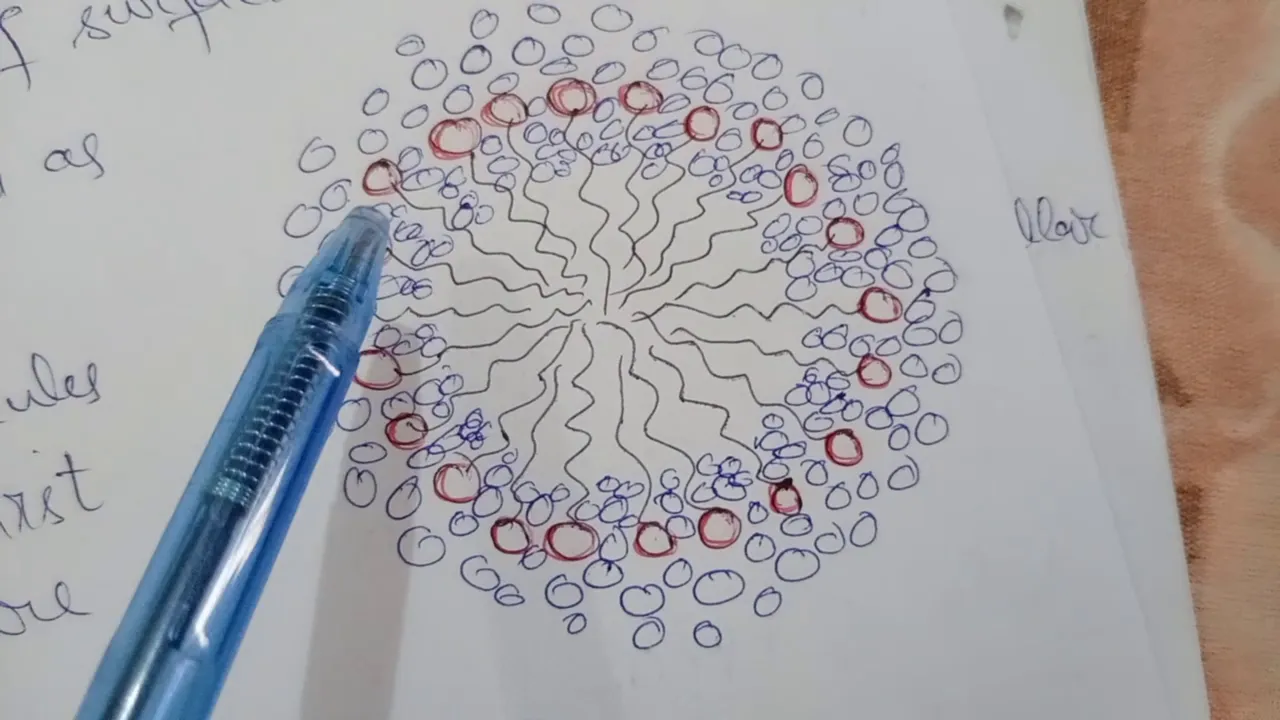

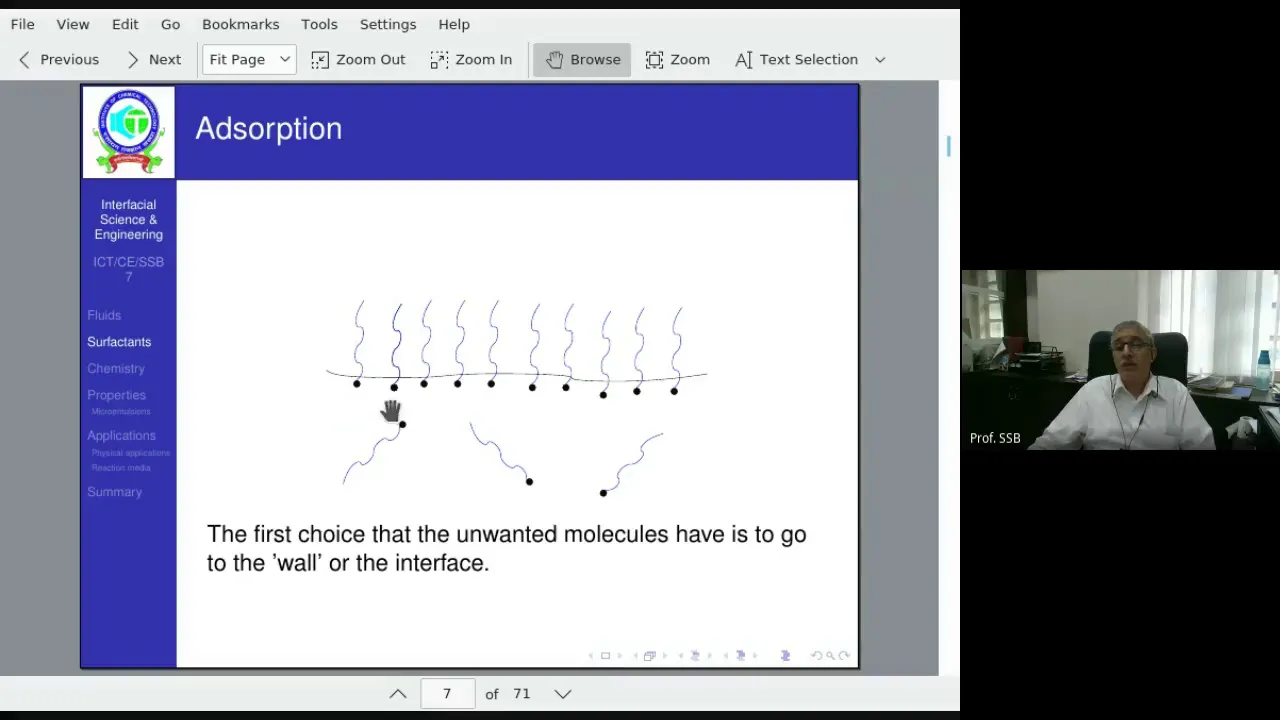


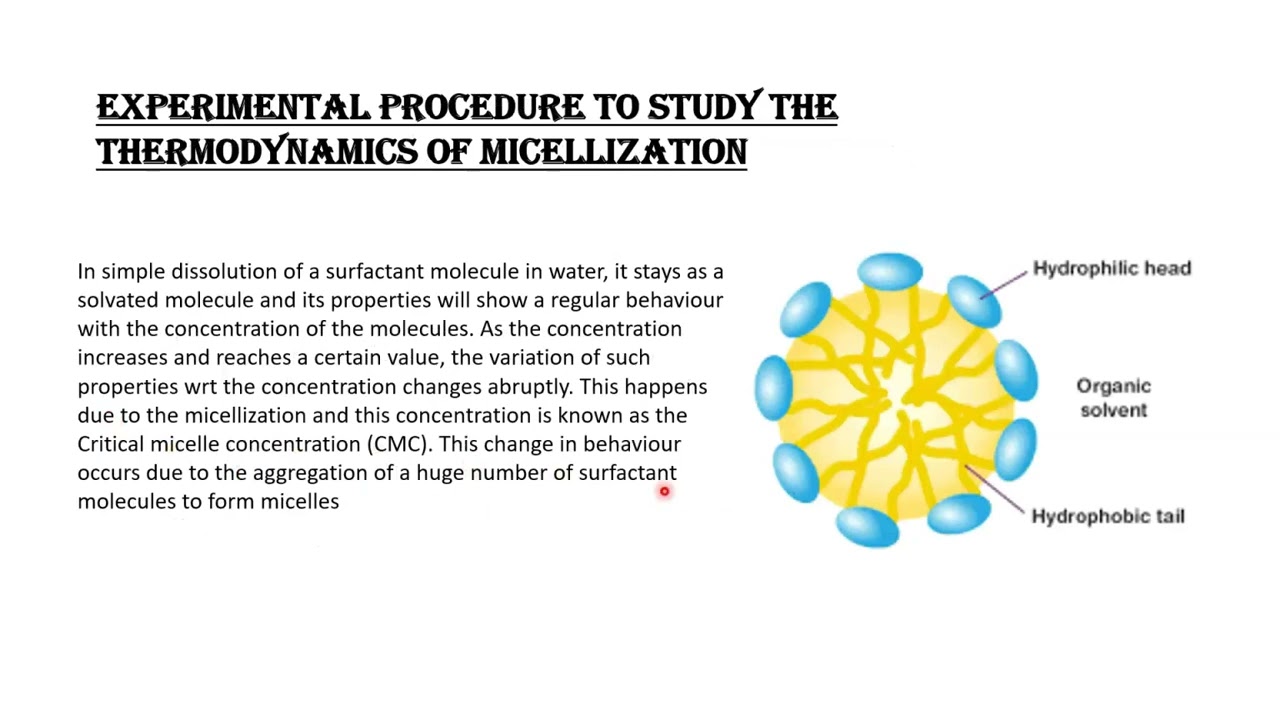


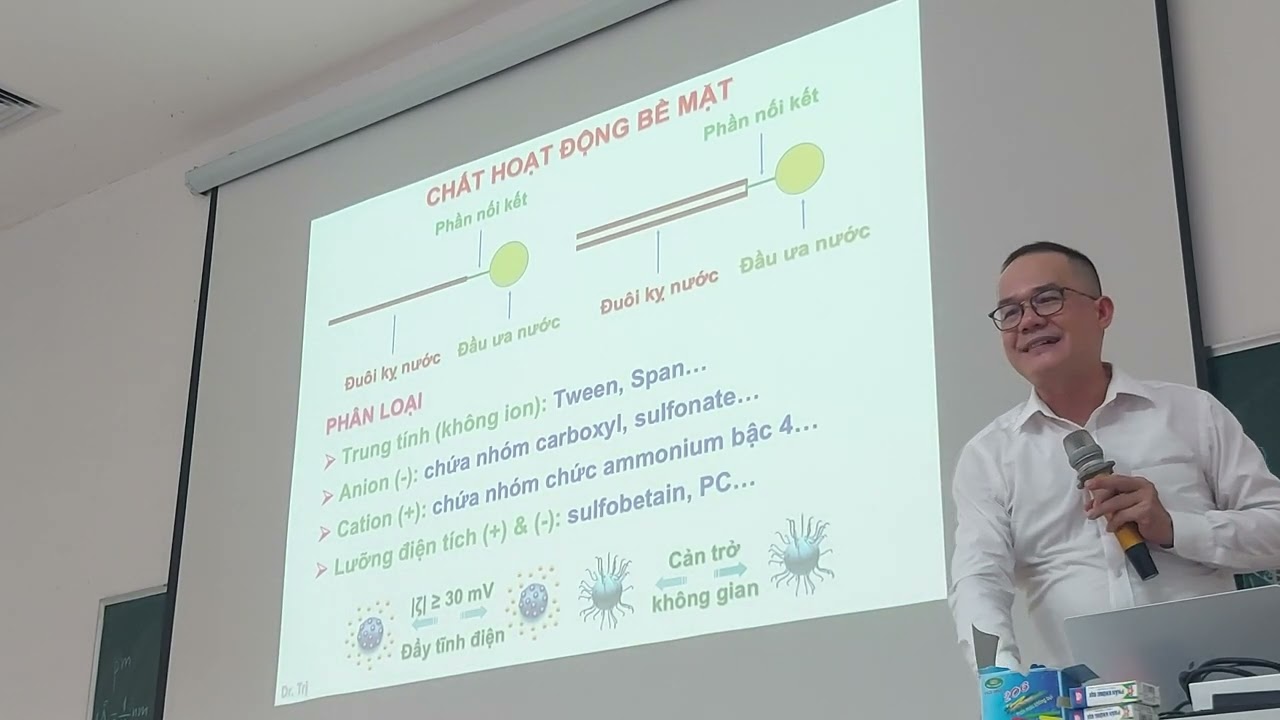

Surfactants are amphiphilic molecules with hydrophilic heads and hydrophobic tails that reduce surface tension by accumulating at interfaces; they form micelles above the critical micelle concentration (CMC), and the standard free energy of micelle formation can be calculated using ΔG° = RT ln(CMC), where a lower CMC indicates more favorable micelle formation due to increased entropy from water molecules becoming free to move in the bulk solution.
Surfactants and Micelle Thermodynamics Explained
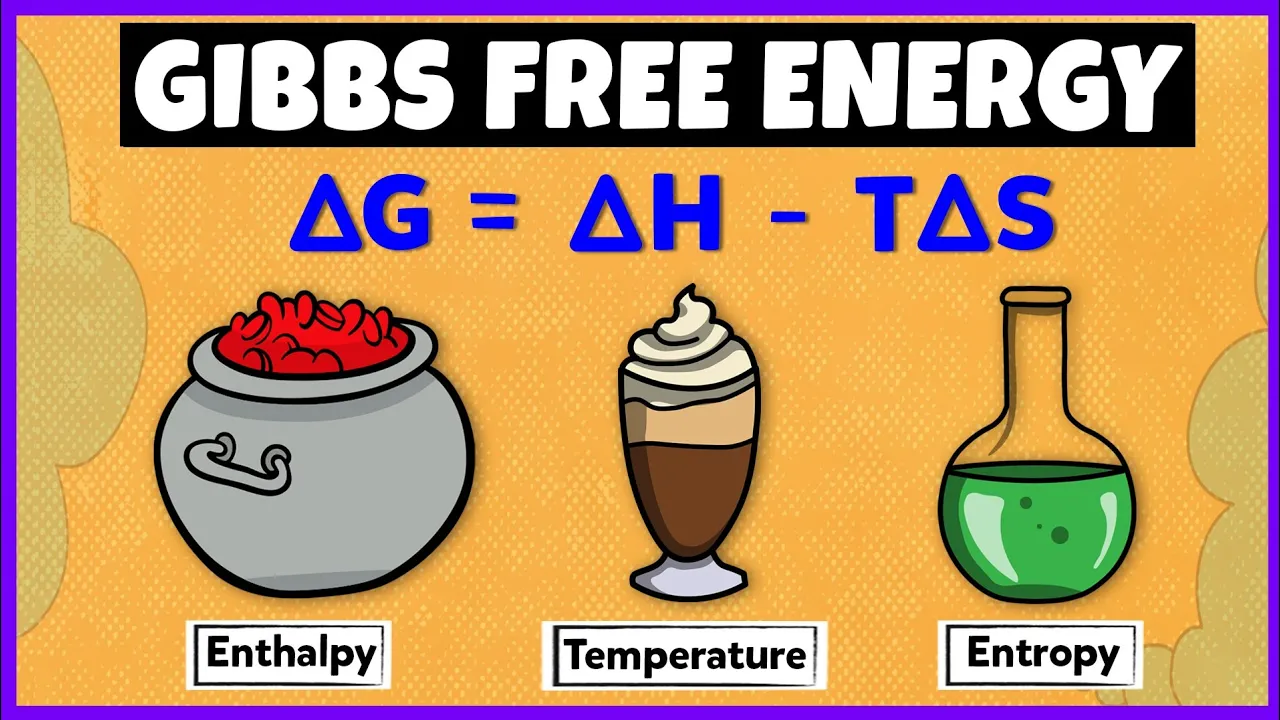
Added:Fundamental chemical thermodynamics, specifically Gibbs free energy, enthalpy, entropy, and the spontaneity equation (ΔG = ΔH - TΔS).
The hydrophobic effect and intermolecular forces, including how polar and nonpolar substances interact in aqueous environments.
Basic anatomy of surfactant molecules, distinguishing between hydrophilic (polar) head groups and hydrophobic (nonpolar) hydrocarbon tails.
Chemical equilibrium principles, particularly the relationship between the equilibrium constant (K) and standard free energy change (ΔG° = -RT ln K).
Factors influencing Critical Micelle Concentration (CMC), such as temperature, ionic strength, and surfactant tail length.
Advanced surfactant self-assembly structures beyond spherical micelles, including cylindrical micelles, bilayers, vesicles, and liquid crystals.
Experimental thermodynamic techniques like Isothermal Titration Calorimetry (ITC) to directly measure the enthalpy (ΔH) and entropy (ΔS) of micellization.
Industrial and pharmaceutical applications of micellar solubilization, specifically in drug delivery systems, enhanced oil recovery, and personal care formulations.
5.8K views133likes40:17Original Release: 2020-02-25
hello everyone this lecture is on the topics of surfactants and thermodynamics of micelles if you want a textbook to follow along with you can look at an introduction of interfaces and colloids the bridge to nanoscience by John Berg chapter three goes along nicely with this lecture in this lecture I hope that you'll be able to define surfactants differentiate between different types of surfactants describe qualitatively assembly in solution evaluate the critical micelle concentration and then finally solve the standard free energy of micelle formation a lot of these terms may not be familiar with you if this is your first time encountering this material and that's okay by the end of this lecture hopefully we'll be able to cover all of those topics now what we have here is we have a water Strider and you can see that it's on the surface of water right where its feet touch there seems to be some tension like if you would push a your finger into a balloon for example you see that tension there and surfactants do a lot with that tension surfactants are surface active agents it's where they get their name from you can see that here and surfactants are a compound that when present in small amounts reduced the surface tension by a significant amount and I gave some specific values there those are kind of arbitrarily defined but just for some reference points the blood glucose concentration in your blood is higher than what we say is a small amount of surfactant and the surface tension of water you can see we're approaching 50% of the total surface tension of water when we're saying reducing by a significant amount so surface tension that might be a term that you're familiar with or not we're going to look at an example of what surface tension is here and then we're going to try to explain it qualitatively so right now what you see is a video that I took of a paper clip on top of the surface of water and a paper clip it should sink right it's a much higher density than water but due to surface tension it can flow on the top of water and you may have seen this in many types of applications before what you see here is I'm introducing soap so there's a little bit of soap on the tip of that pipette there and what you saw and we can show it again here what you saw is that when the soap is able to diffuse in the water eventually the surface tension is broken and the paperclip sinks so we're gonna go into some detail about you know why that might be so let's think about water and maybe some sort of container and we have here some water and then we have here air so at the interface here there's something happening that seems to be interesting now water which we're just going to represent with these dots here water is going to be spread all around and moving around this would just be a snapshot in time of water waters happy when it can form these kind of nonbonding interactions with adjacent water molecules and what we'll see is that at the surface when you get to the surface this molecule here this molecule of water here has five neighbors that a likes a bond with when you get to the surface here there's no room at the top for that water to bond and so that water is not very happy and so what it does is ends up pulling on its neighbor and so it's gonna pull a little harder this way and then it's anybody's gonna pull a little harder that way and they're gonna pull strongly and that's kind of be kind of that tension that we see that surface tension so if you try to penetrate that surface tension it's gonna be a lot much harder to do it than if you were just trying to break up these molecules and water underneath the surface so that's kind of a qualitative description of surface tension and if we think about that last video where we had water and we introduced some soap which is a surfactant that means that the surfactants must do something to disrupt that pole on top and we're gonna hopefully find out what that but first we want to kind of sum a motivation why do we care about surfactants it turns out they're really common and a lot of things we use I showed soap already but you also have will have surfactants in paint or inks and cosmetics detergents firefighting food just about anything that has multi components and also is a foam or a solution it will contain surfactants so they're widely used you'll encounter them every day without knowing obviously they'd be really important to understand why they work how they work so you can modify maybe the structure and get the property that you want so to first understand this effect in sand uses we need to know their chemical structure in a commonality of all surfactants is that they have a structure that has two segregated components so that ends up being represented often something like this where you have a head and a tail so these are the two separate components the two segregated components and the tail is typically going to be hydrophobic whereas the head will be hydrophilic so hydrophobic water-hating hydrophilic water-loving more generally you might have these terms be lyall phobic or Lisle villach which would just mean solvent but oftentimes surfactants are going to be used in water so hydrophobic and hydrophilic are generally pretty suitable when we're talking about surfactants so let's think about some chemical structures so as I just mentioned on the previous slide the commonality of surfactants is that they have two segregated portions so here's a chemical structure of glucose if you remember we haven't taken organic chemistry or if you don't remember from organic chemistry we might draw structures like this that are abbreviated such that those corner points those vertexes are going to be C H X whatever amount of X is to satisfy the valence of carbon so anytime you see this kind of point here you shouldn't know that there's going to be carbon there in hydrogens that aren't shown so we have the structure of glucose glucose is not a surfactant on its own it does have this polar group which would be hydrophilic but it doesn't have any segregated group that would make it a surfactant now what about this molecule here do you think that this molecule will be a surfactant so you can think about it for a second and as it turns out this molecule is a surfactant and we have to segregated groups here and let's think about this structure here now this structure is this hydrophilic or hydrophobic so these are all carbons and hydrogen's so this would be hydrophobic and we have some polar units here and as I said those will be hydrophilic so this is a a surfactant one type of surfactants there's many types of surfactants and it's useful to give some general categories so that we can differentiate between the different types of surfactants so the first category that we'll talk about is anionic surfactants and an anionic surfactant example here is sodium stearate and there so again we have this long carbon chain and this hydrophilic anion here so we see that's the negative charge there that makes it the anionic surfactant so while we're looking at these structures kind of think about what are some commonalities in the structures and what are some differences that will lead to different properties here's another surfactant that's sodium dodecyl sulfate if you look at some household soaps or shampoos things like that you might see sodium dodecyl sulfate in there it has this structure here it's a different head group but what you see is you have that anion still an anionic surfactants are the most common type of surfactants they're common in soaps and detergents counter to those would be cationic surfactants so here's a cationic surfactants IDO trimethylammonium bromide see tab again you have this hydrophobic chain of carbons and hydrophilic and in this case we have that positive charge there make it cationic and just by changing the properties we change some of the functions of it so in this case see tab and other cationic surfactants we will have good antibacterial properties they're good for waterproofing anti statics among many other applications another very common type of surfactants more common than cationic but less common than anionic commercially are these non ionic surfactants and so these again you get this polar at group and you have this hydrophobic tail and this is an alkyl polyethylene oxide it's registered trademark and there's many other registered trademarks that you can see there like I said these are very common they're used in inks emulsifiers and the nice thing about them is that if we compare them to let's say our anionic surfactants we had calcium 2 plus which is in hard water if you have calcium 2 plus you would get some association of two of these surfactants now there oh - over here and that would ruin some of the properties of this affectin so these anti onyx would it be suitable for a lot of hard water applications where you would have calcium 2 plus but since these are non ionic they want to have that issue they're also compatible with organic solvents more soluble than ionic surfactants would be and there are many others so these are difference they're sort of different Twitter ionic or amphoteric Vitter ionic being the fact that it has a negative and positive charge on the chain and fatir ik would mean that at a different ph level this could be charged while this would not be charged or vice-versa and these a lot of natural surfactants are like these types of molecules here and might be useful in cosmetics and other sort of biological applications so we see you know just from a few different example is how the chemical structure that can be vastly different in my influence the properties of surfactant in solution ok what are those properties in solutions what is going to be the way that a surfactant assemble is in solution in water for example this so we'll draw this interface again where we have air and water and let's think about let's just say for example we'll have a surfactant just floating around in the water is this favorable that's what we're asking so favourable in the way we think about favorability we'll think about energy given enough time will this situation occur so let's think about that Gibbs free energy and for a Gibbs free energy to be favorable it must be equal less than a that's when less than or equal to 0 and the Gibbs free energy is just going to be the final energy minus the initial energy so Delta G solvating for example is going to equal so this is a definition where this is enthalpy and entropy so what's happening here that's going to affect these properties enthalpy and entropy let's kind of zoom in a little bit let's kind of zoom in here and you know we're saying that this molecule is in water still so we have this molecule here and in water it's going to be surrounded by water molecules it's gonna be surrounded by water molecules and the head group will also be surrounded by water molecules so that group likes water molecules these water molecules are free to dissociate and associate with the head group they can move around they don't have to be locked into this specific orientation but if we have these water molecules here on the tail group since the tail group is insoluble in water generally these water molecules will will take on a fixed structure and so we think about the two properties and through enthalpy and entropy so enthalpy maybe we have some Vander Waals interactions and enthalpy we want it to be negative so that we can get negative Delta G it would be maybe slightly negative due to these Vander Waal interactions the entropy we want to be positive we want actually to increase because we have this negative sign here and entropy generally increases when there's more places for energy to dissipate for energy that's to spread out and so if you think about this structure here there's only one way that we can arrange this structure around water in the head group there's many ways you can rearrange the structure of the water but on the tail it's not very happy and as it turns out that entropy is highly negative so that was water molecules they're stuck there and so this is not very a very happy state so there's negative times a negative would be a positive this negative is pretty small which would mean that Delta G would be positive so this is not favourable here so let's think about another situation so the other option here this here surfactants at the surface and you might see where this is going just based on the name surfactants that the surface and let's find out let's think about favorability so Delta G goes Delta G of surface C goes Delta H of surface minus T Delta s of surface and what are the interactions that are happening well we have some Vander Waals interactions happening here between the tails so we also have some electrostatic interactions happening between the heads so there's electrostatic those aren't so good they'll be less favorable but the Vander Waals forces would be Vander Waals interactions that we gave would be more favorable now what about the entropy we think about the entropy difference between the state where it was in the bulk and this state here so we have those water molecules that before we're surrounded by the tail surrounding the tail and now those water molecules that were surrounding the tail they can kind of just float around and move around freely fro so from a statistical standpoint so if I'm a statistical standpoint there's a lot more options you know these are stuck here so these molecules in the bulk they these water molecules have a lot more room to move around whereas before they were stuck around this surfactant molecule here so if we think about from the entropy standpoint we can say that the water is free you can move around and so there's more places to distribute energy so the entropy increases in this case which is good because we're getting that negative value here which means that Delta G is less than 0 this is favorable so the surfactants we might have expected this because we were thinking about reckons means surface active agents they do prefer to go to the surface over going to the interface and the reason is that these surfactants they seek the surface because that's the only place that they can satisfy the solubility requirements of both of their portions so going back to that example of surface tension where we were thinking about surface tension we had some molecules of water and again these in with a surf with surface 10 high surface tension these molecules are not satisfied they don't have the requisite number of bonds that they normally want in the bulk and now what we're doing is we're introducing those surfactant molecules here and we're breaking up that tension so that pulling that was happening here it's not as strong when we put these surfactant molecules in and that's why I would saw that paper clip once you put the soap in the surfactant moved to the top and that paper clip broke through the surface because the surface tension was at as high now we have to think about what happens when the surfaces are full because eventually we could have this surface be completely saturated with surfactant molecules and even the walls would start to become saturated with surfactant molecules then there's only one place for them to go and that's the bulk so thinking about those ideas of Delta G Delta H and Delta s here's a question that might check some understanding which molecule would lower the surface tension to a greater extent at some value that was less than or equal to 0.01 molar so if you're taking a second to think about that the molecule that would lower the surface tension more is this one here and if we're thinking about specifically changes in Delta s which affect Delta G you can think about those water molecules more of them here are needed to be satisfied in the bulk than here so that entropy change if we get a bunch of molecules locked in here versus this molecule going to the surface in these water molecules are free and compare that to a lot more molecules of water getting locked in here once this one goes to the surface there's a much greater entropy change so Delta G would be a lot more favorable for this molecule here and as it turns out this molecule acts as a surfactant according to our definitions that we laid out before whereas this one does not so now we want to think about what happens when we keep putting molecules in because eventually that surface is gonna get full right there'll be too much molecule is too much the fact dense and not enough space so here are some arbitrary units and we have the concentration of surfactant molecules and we're measuring the surface tension so as we increase for example the amount of soap and water the surface tension continues to go down but at a certain point what was observed is that the surface tension eventually starts to level out and you know the surface being full there must be something else that's happening there simultaneously some other properties could be measured and for example as turbidity would slowly increase but then just shoot up and turbidity is how cloudy the solution would appear so this solution is getting a lot more cloudier once we reach this value where the surface tension levels off there's a couple other properties here too that I won't go into detail about what they are but well you'll notice for both of them is that either there's an increase in a leveling off or a change in the slope of the decrease for this property here and they all occur at around the same value which is what is referred to as the critical micelle concentration and this is the value where micelles start to form so we were saying surfactants we're going to the surface now surfactants are gonna form micelles and so let's talk about what those are they're very important because surfactants change surface properties but utility escalates as we start to form micelles micelles are shown schematically here so this unit here would be a micelle and what we have is we have this value N and number of monomers of surfactants will form this n sized my cell so this formation of this micelle here it's energetically favorable in the same way that the formation of surfactants the surface was energetically favorable and that's because entropy again so here we have a bunch of water molecules interacting with the surfactant and they're stuck there they don't have a lot of entropy but once you put it form this micelle those water molecules don't really fit in there and so now they're you know just out floating around in the bulk moving around rotating bending doing what they want to do so the entropy is increased when we form micelles so to think about the thermodynamics on more of a quantitative level we can think about the reaction of micelle from a monomer so we can denote that here where we were defining a surfactant a weakened dono in a 1 so n number of monomers would react effectively deform in a and n sized a micelle and through this derivation we're gonna assume equilibrium ideology and a non ionic surfactant so what is the free energy of micelle formation that's what we want to ask and that's what we'll start to go through it's important to know first of all because it'll tell us more about the favorability of micelle formation which I just claimed was favorable and we'll see that it is but it's also important for structure property relationships so before I was talking about how different structures have different properties and maybe some of them relate to the concentration at which micelles form and you can tune that by tuning the structure knowing that thermodynamics will help you know those sort of relationships and then also you might want to know how environmental conditions conditions that you can change a lab would change the micelle formation so concentration of the surfactants for example temperature dependence how does that all change with micelle formation so in thinking about thermodynamics f-minus we take this equation here which is in chapter 3 of the book that I mentioned at the beginning byberg and this looks familiar maybe if you were taking a class on chemistry and you looked at equilibrium reactions so we have negative RT which are being the gas constant T being the temperature and K and being equilibrium constant for forming and n sized myself there's also this n value here which appears to be there to account for the change in free energy per surfactant so in terms of surfactants so let's talk about this k value this equilibrium constant like I said this might be familiar if you were took a general chemistry course where you talked about equilibrium constants in chemical equilibrium so if you have a a reaction where you have some a number of a molecules and you react to them with some B number of B molecules you have an equilibrium making C number of C molecules and little D number of Big D molecules and K would be the products the concentrations of the products over the reactants and you would also have to put in a subscript for each of the these values that lead in front of the chemical so there would be products over reactants would be the concentration of C to the C little C power the concentration of D to the little D power B to the little B power that a power so that's the equilibrium constant for formation of some chemical reaction like I said we're thinking about this chemical reaction it's not a chemical reaction but we can think about it that way it's an equilibrium reaction where we're taking an N number of monomers and forming an incised myself so we take the products over the reactants and we can do K sub n is equal to concentration of a sub n over a concentration of a sub 1 to the N power so we need to find out what these values are I'm gonna I didn't know these this value as C sub n over N which was see in a second why I do that and it's a VC C sub 1 to the N power so some values that we might know or not know would we see not the concentration of surfactants and solution that's just how much attractant we put in C 1 that's the concentration of surfactant molecule is existing in monomers which is a single part of a micelle and we have C n which the concentration of surfactant molecule is existing in my cells you would think that maybe that's where what I would put here but as I already mentioned I'm putting C n over N C n over N is a concentration of myself so there's a difference concentration of surfactant molecules in my cells versus concentration of my cells so that's where the difference is here and we're gonna explain that what that means so here's a tiny portion of a solution if surfactants in my cells that formed and it like I said it's very small 10 to the minus 16 milliliters and I counted all those molecules in there and what we have is 130 molecules and we want to know what the concentration of we want to know all the values you not see 1c and and you know what is C n versus C n over and so we'll do some simple dimensional analysis and so we need to get to moles per liter 6.022 times 10 to the 23rd molecules per one mole and we also want to get to liters so we go 1,000 liters to one liter and that ends up giving us zero point zero - one six moles per liter now we also have and that's that's our value of C not there we also have c1 and that was just if we go back counting up the number of surfactants a molecule in monomers so that's 25 molecules and monomers over 1 times 10 to the minus 16 milliliters and it's gonna be multiplied by this same dimensional analysis here that we did that ends up being zero point zero zero zero for two moles per liter and then we have CN cn remember we're just counting how many molecules of surfactant are in all of the micelles and that ends up being a hundred and five molecules you can see that that should be the remainder that we didn't include in the monomer and that's zero point zero zero one seven four moles per liter okay so this value here what we can see is that it's not telling us the concentration of my cells it's just telling us the concentration of molecules that are surfactants that are in my cells so that's why we take C n over N and C n over N 0.001 to moles per liter so if we go back and we look at this image here another way to do that would have been just to count the number of micelles and divide by the volume to get the concentration so there's 1 2 3 4 5 6 7 micelles per one times 10 to the minus 16 I mean so that's that's you know sort of to illustrate the difference between the C N and C and over N and why we need to have that in there okay so going back to this equation here Delta G naught of myselves is equal to negative RT over N of natural log of K N and so we want to know K n so k sub n is going to be equal to the concentration of my cells over the concentration of monomers to the N and we're assuming now that for any value of CI that's not equal to 1 or and it's approximately equal to zero so we don't have dimers we don't have two molecules associated we don't have trimers we only have like in our picture that I showed earlier molecule is existing as surfactants in two molecules that's existing as micelles and that allows us to define our concentration C naught as being equal to C 1 plus C n and we're gonna do something a little maybe it looks a little bit cursive at first but it ends up helping us and we're gonna define a new value called beta and beta is the fraction of monomers in my cells and this value can range from zero to one so that means that CN is just equal to beta times C naught and C sub 1 is equal to 1 minus beta C dot so what that allows us to do is to express kN all in terms of C naught and then is it being really useful because we know C naught we defined C naught if we're working in the lab we would put some fraction of surfactants some concentration of surfactants and that would be C naught so Cape sub n is now n values that we have some idea of maybe what they are so we don't specifically know beta yet and we don't know n but I'll give some rough definitions right now and the first one will be that n is going to be on the order of tens to 100s a few tens to one hundreds or even more whereas beta beta can be as I mentioned zero to one so can tells us whether this reaction favors products or reactants so if K and is much greater than one that means we are getting a lot of products if we look at this these numbers here the concentration C naught as we mentioned it's going to be much less than 0.01 molar so we're taking a small value like 0.01 or less and we're taking it to the exponent of tens to hundreds or even more and then on top we don't do that same exponential factor we don't have that same exponential factor and so we have a small really small value here and a large value here what means that K is going to be K sub n is going to be a lot greater than one telling us already that my self formation will be favorable alright so going back to our equation our standard free energy negative RT over n natural log of K and we now have a value for K n so let's plug that in ok so now we have this equation here and from our rules of natural log we can take something that we have a factor of either multiplying or dividing and we can use addition or subtraction we can also bring this n value to the front so that's what we're going to do now so Delta G naught micelle formation ok so we have this equation here and when we have some ends here that we can multiply through these can cancel out and that gives us ok so we have this equation here now let's think about what we can do to try to reduce it further we can think first about this end value so n as we said before in the tens to one hundredths which means that n is much greater than one and so as n gets larger and larger this value here effectively approaches zero and cancels out this value here so then what we get then what we get is Delta G standard of micelle formation is equal to RT times natural log of 1 minus beta times e naught now we have something that doesn't look too bad we have a value of concentration and we don't know really get what this beta is or how much of a difference even makes and we have temperature and our gas constant these are things that we know if we're thinking about this in a lab so let's think about beta so beta can be 0 to 1 beta approaches 0 when C naught approaches the critical micelle concentration so beta as you remember I mentioned is the fraction of monomers that are in micelles and so when you're at the critical micelle concentration just before you reach that value you have no monomers forming micelles so that would give us this equation here so as beta approaches 0 the free energy of my ization standard free energy of my salvation is equal to gas constant times temperature times natural log of the concentration the critical micelle concentration so this starts to tell us that the most important value to figure out Delta G maybe is this just this critical micelle concentration now let's use an example problem to see if that's true or not so the critical micelle concentration of some surfactant is 0.05 millimolar at 298 Kelvin at a standard state of 1 molar what is the standard free energy of my civilization and so let's go through this problem now what we have is our equation in Delta G nought of my cessation is equal to RT times the natural log of the critical micelle concentration and we said we're at a standard state of 1 molar so that means we need to have CMC is equal to 0.05 millimolar we need enough CMC in terms of molars in terms of molar to fit the standard state so we'll just convert to molar from from millimolar to molar and plug in these numbers so that the gas constant 8.314 joules per mole Kelvin temperature was 298 K and the natural log of zero point zero zero zero so we can put that into a calculator and what we get is negative 24 point five kilo joules per mole so that's some number in a vacuum but what it's telling us is that the my solution is favorable as you might expect from what we've talked about from a qualitative standpoint now let's think about our assumption how does that value chain or the Delta G nought if we had a concentration two times the critical micelle concentration with a beta value of zero point four so in this case I'm asking to use the second equation right after we did the large and assumption so that equation was Delta G nought of my cells a ssin is equal to RT natural log of 1 minus beta times the concentration so now I'm asking to put in some value of beta and some value of concentration and so we can you know put an R and T and we're still in a standard state of 1 mole and what we get is a value of 24 point zero eight kilojoules per mole so we compare the two values we had before twenty four point five four kilojoules per mole using RT natural log CMC and so this relative difference kind of tells us that our assumption is okay that the critical micelle concentration really has a strong effect on the Gibbs free energy so if you think about design of designing a new molecule that's gonna act as a surfactant really looking at the critical micelle concentration and seeing what kind of molecular changes lead to changes in free energy will help you lower that critical micelle concentration or raise it if it's required so we can use the free energy to think about what happens when you change the chemical structure of a surfactant these trends in free energy and critical micelle concentration can highlight trends that can be used to create tailored surfactants this is the end of the lecture here and I hope these key points are summarised well and you were able to kind of get some idea of the lecture goals here are the key points surfactants change the surface tension of solvents there are many types of surfactants and different segments have different properties surfactants assemble at the surface and it's entropically favorable surfactants form micelles at the critical micelle concentration and you can know the free energy of formation if you know the critical micelle concentration
Up Next

49:39
Vulcanised & Synthetic Rubber: Chemistry Form 5 KSSM Guide
@chemistrysciencemrsmbetong4893
1.9K views•2021-06-14
83:56
Biocatalysis and Catalysis in Islatravir Synthesis | Merck Webinar
@SCIwheresciencemeetsbusiness
675 views•2020-10-08
10:06
1H NMR: Determining Number of Peaks from Structure
@MSJChem
59.2K views•2017-04-06
17:31
Edible Water Bottles: A DIY Guide to Sodium Alginate Spherification
@ryan
10.5M views•2019-06-21
Related Study Plans & Knowledge Roadmaps
Structured learning paths in Chemistry
chemistry
Nuclear Chemistry: Decay, Meds & Fuel Cycle
01Introduction to Nuclear Structure and Radioactivity
02Decay Dynamics and Kinetics
03Radiation Interaction and Detection
+ 2 more learning modules
24h5 modules
Explore Roadmap
chemistry
Supramolecular Chemistry: Forces & Machines
01Foundations of Chemical Bonding and Intermolecular Forces
02Introduction to Host-Guest Chemistry
03Thermodynamics and Dynamics of Self-Assembly
+ 2 more learning modules
16h5 modules
Explore Roadmap
chemistry
Photochemistry: Excited States & Reactions
01Foundations of Light-Matter Interactions
02Molecular Orbitals and Electronic States
03Photophysical Processes and Jablonski Diagrams
+ 2 more learning modules
18h5 modules
Explore Roadmap
chemistry
Coordination Chemistry: Bonding & Properties
01Introduction to Transition Metals and Ligands
02Crystal Field Theory (CFT) and Geometry
03Magnetic Behavior and Spin States
+ 2 more learning modules
14h5 modules
Explore Roadmap