





















Islamic geometric design, developed since the 8th century CE, creates intricate patterns using only a compass and ruler by starting with a circle divided into equal sections (typically four, five, or six), drawing construction lines, selecting specific line segments to form a tile, and then tessellating (repeating) this tile across a grid; patterns with fourfold symmetry fit square grids, sixfold symmetry fits hexagonal grids, while fivefold patterns are more challenging to tessellate because pentagons don't neatly fill a surface.
Islamic Geometric Design: A Mathematical Art History
Added:Basic Euclidean Geometry: Familiarity with fundamental geometric shapes (circles, squares, regular hexagons), angles, and basic spatial reasoning.
Classic Compass and Straightedge Constructions: Understanding how to construct perpendicular bisectors, angle bisectors, and regular polygons using only a compass and an unmarked ruler.
Principles of Symmetry: Basic concepts of reflectional, rotational, and translational symmetry in a two-dimensional plane.
Historical Context of the Islamic Golden Age: A general awareness of the mathematical advancements, particularly in algebra and geometry, made by scholars between the 8th and 14th centuries.
Girih Tilings and Penrose Patterns: Investigating the highly complex, non-periodic decagram-based tilings that predate modern Western discoveries of quasi-crystals.
Wallpaper Groups (Group Theory): Studying the 17 distinct crystallographic groups that mathematically classify two-dimensional repetitive patterns, famously fully realized in the Alhambra.
Computational Design and Algorithmic Art: Learning how to use CAD software, Python, or vector graphics tools to programmatically generate and scale complex geometric patterns.
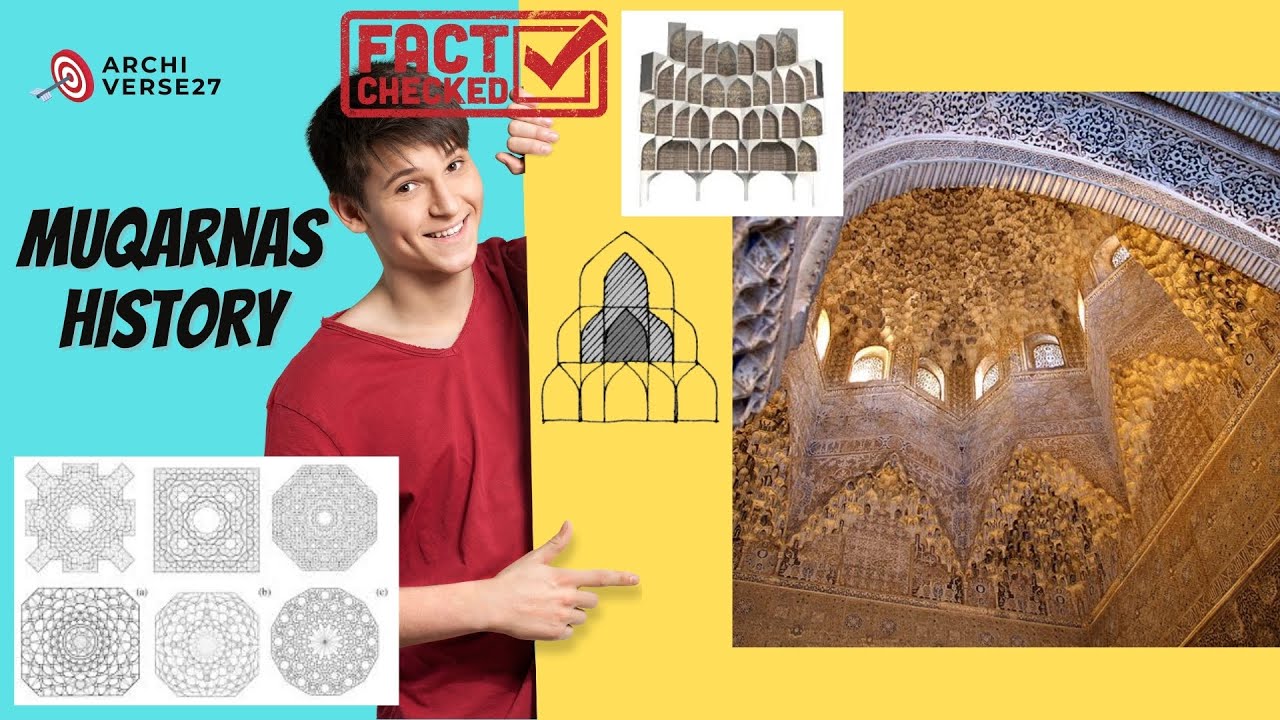
Muqarnas and Architectural Integration: Exploring how 2D geometric patterns are extruded into complex 3D corbeled architectural elements (stalactite vaulting) in historical Islamic domes.
3.6M views133.3Klikes5:06Original Release: 2015-05-14
In Islamic culture, geometry is everywhere.
You can find it in mosques, madrasas, palaces and private homes.
This tradition began in the 8th century CE during the early history of Islam, when craftsmen took preexisting motifs from Roman and Persian cultures and developed them into new forms of visual expression.
This period of history was a golden age of Islamic culture, during which many achievements of previous civilizations were preserved and further developed, resulting in fundamental advancements in scientific study and mathematics.
Accompanying this was an increasingly sophisticated use of abstraction and complex geometry in Islamic art, from intricate floral motifs adorning carpets and textiles, to patterns of tilework that seemed to repeat infinitely, inspiring wonder and contemplation of eternal order.
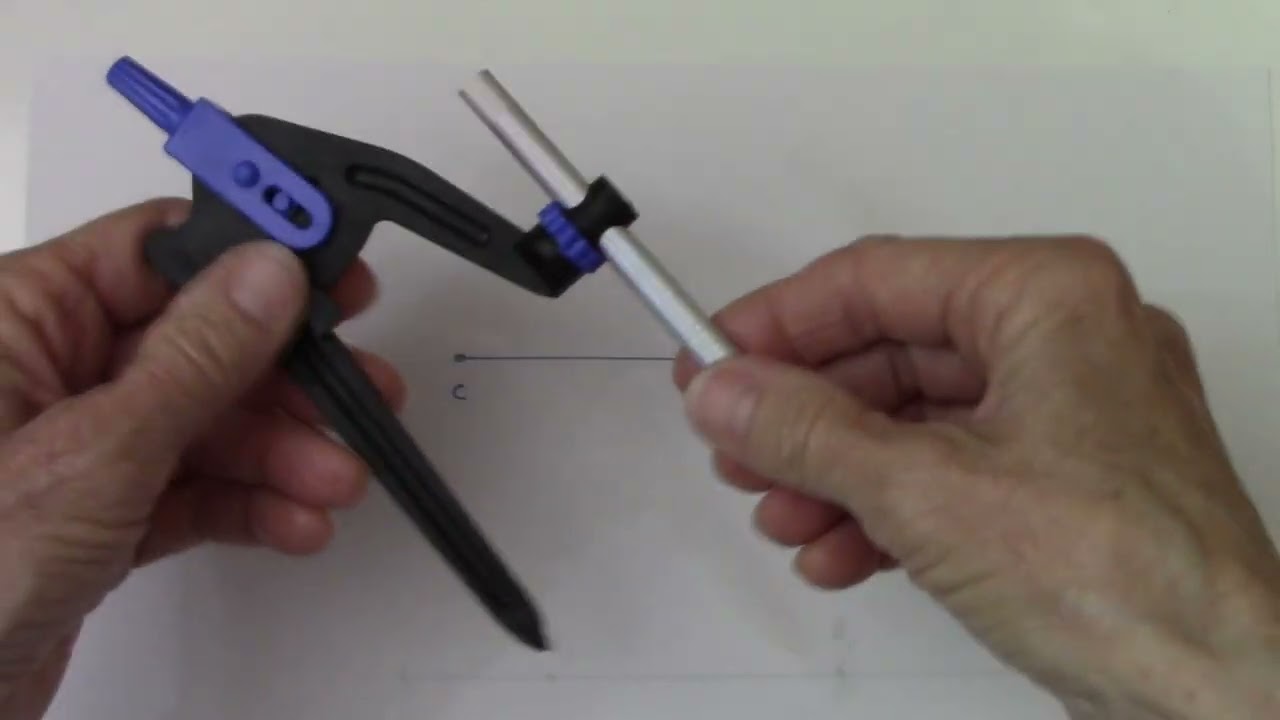
Despite the remarkable complexity of these designs, they can be created with just a compass to draw circles and a ruler to make lines within them.
And from these simple tools emerges a kaleidoscope multiplicity of patterns.
So how does that work?
Well, everything starts with a circle.
The first major decision is how will you divide it up?
Most patterns split the circle into four, five or six equal sections.
And each division gives rise to distinctive patterns.
There's an easy way to determine whether any pattern is based on fourfold, fivefold, or sixfold symmetry.
Most contain stars surrounded by petal shapes.
Counting the number of rays on a starburst, or the number of petals around it, tells us what category the pattern falls into.
A star with six rays, or surrounded by six petals, belongs in the sixfold category.
One with eight petals is part of the fourfold category, and so on.
There's another secret ingredient in these designs: an underlying grid.
Invisible, but essential to every pattern, the grid helps determine the scale of the composition before work begins, keeps the pattern accurate, and facilitates the invention of incredible new patterns.
Let's look at an example of how these elements come together.
We'll start with a circle within a square, and divide it into eight equal parts.
We can then draw a pair of criss-crossing lines and overlay them with another two.
These lines are called construction lines, and by choosing a set of their segments, we'll form the basis of our repeating pattern.
Many different designs are possible from the same construction lines just by picking different segments.
And the full pattern finally emerges when we create a grid with many repetitions of this one tile in a process called tessellation.
By choosing a different set of construction lines, we might have created this pattern, or this one.
The possibilities are virtually endless.
We can follow the same steps to create sixfold patterns by drawing construction lines over a circle divided into six parts, and then tessellating it, we can make something like this.
Here's another sixfold pattern that has appeared across the centuries and all over the Islamic world, including Marrakesh, Agra, Konya and the Alhambra.
Fourfold patterns fit in a square grid, and sixfold patterns in a hexagonal grid.
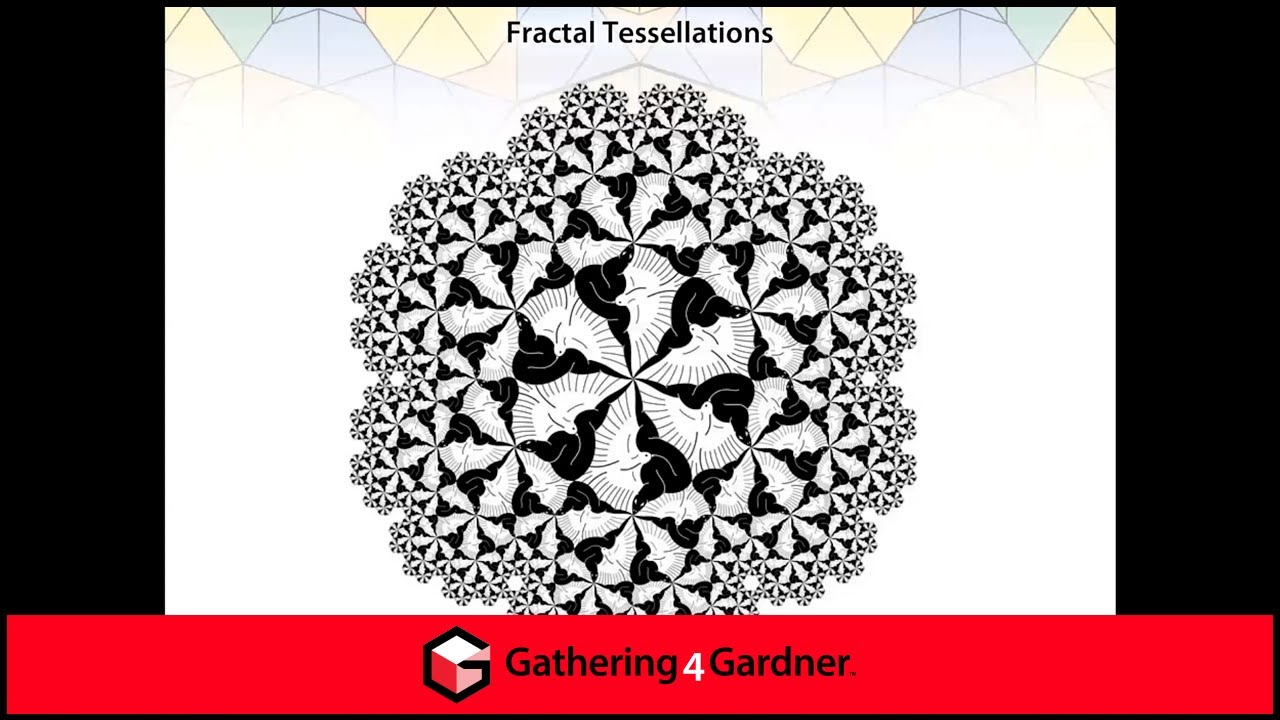
Fivefold patterns, however, are more challenging to tessellate because pentagons don't neatly fill a surface, so instead of just creating a pattern in a pentagon, other shapes have to be added to make something that is repeatable, resulting in patterns that may seem confoundingly complex, but are still relatively simple to create.
Also, tessellation is not constrained to simple geometric shapes, as M.C. Escher's work demonstrates.
And while the Islamic geometric design tradition doesn't tend to employ elements like fish and faces, it does sometimes make use of multiple shapes to craft complex patterns.
This more than 1,000-year-old tradition has wielded basic geometry to produce works that are intricate, decorative and pleasing to the eye.
And these craftsmen prove just how much is possible with some artistic intuition, creativity, dedication and a great compass and ruler.
Up Next
17:09
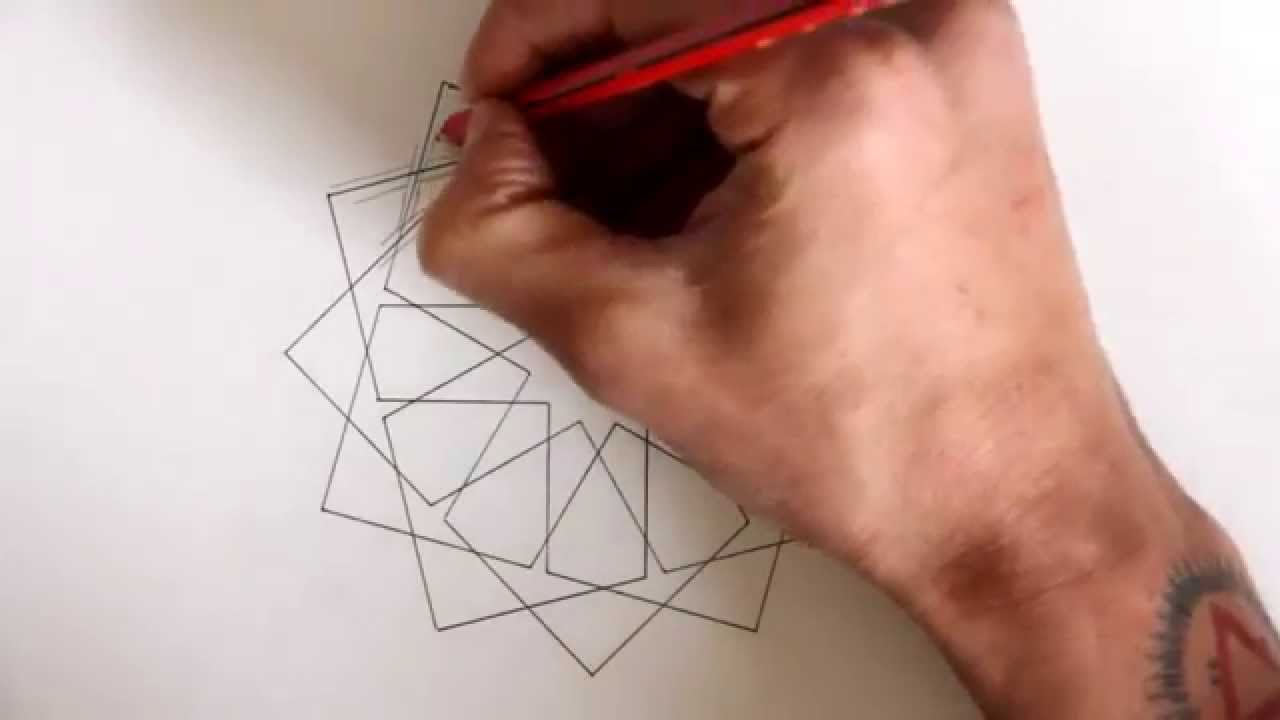
Islamic Geometric Design Tutorial: Drawing a 12-Fold Rosette
@LexWilson
998.1K views•2014-10-24

12:54
Triumph of Orthodoxy Icon: Byzantine Art & History Explained
@BenCallan
2.1K views•2024-08-06
5:22
The History of Toilets and Sanitation: From Ancient Rome to Today
@TEDEd
5.9M views•2021-06-15

1:42
Game of Thrones Opening Credits: A Cinematic Analysis
@gameofthrones
46.3M views•2011-04-18
Related Study Plans & Knowledge Roadmaps
Structured learning paths in General & Interdisciplinary Studies
general-studies
Elevator Engineering: History, Physics & Cities
01From Hoists to Safety Brakes: The Dawn of Vertical Lift
02Hydraulic vs. Traction: The Engineering Physics of Elevators
03Modern Speed, Safety, and Algorithms
+ 2 more learning modules
12h5 modules
Explore Roadmap
general-studies
Rubber: Material Science, History & Geopolitics
01Origins of Natural Rubber & Mesoamerican History
02The Chemistry of Natural Rubber & Vulcanization
03The Geopolitics of the Rubber Boom & Colonization
+ 2 more learning modules
12h5 modules
Explore Roadmap
general-studies
Containerization: Evolution, Logistics & Trade
01Ancient Trade & Bulk Cargo: Amphorae to Barrels
02The Industrial Revolution & Cardboard Packaging
03The Containerization Revolution: Malcom McLean
+ 2 more learning modules
12h5 modules
Explore Roadmap
general-studies
Textile Tech: Evolution, Labor & Global Impact
01Pre-Industrial Textiles: Handloom & Cottage Industry
02Mechanization: The Spinning Jenny to the Power Loom
03The Factory System & Global Labor Transformation
+ 2 more learning modules
10h5 modules
Explore Roadmap