



![[Piano] Mò Hợp Âm 1 Bài Hát Như Thế Nào ?](https://i.ytimg.com/vi_webp/SsDljXHayA0/maxresdefault.webp)











![{Transition Chords} & Contemporary Japanese Music - [Kashiwa, Kondo, et. al.]](https://i.ytimg.com/vi_webp/OsCHcAe3GNQ/maxresdefault.webp)






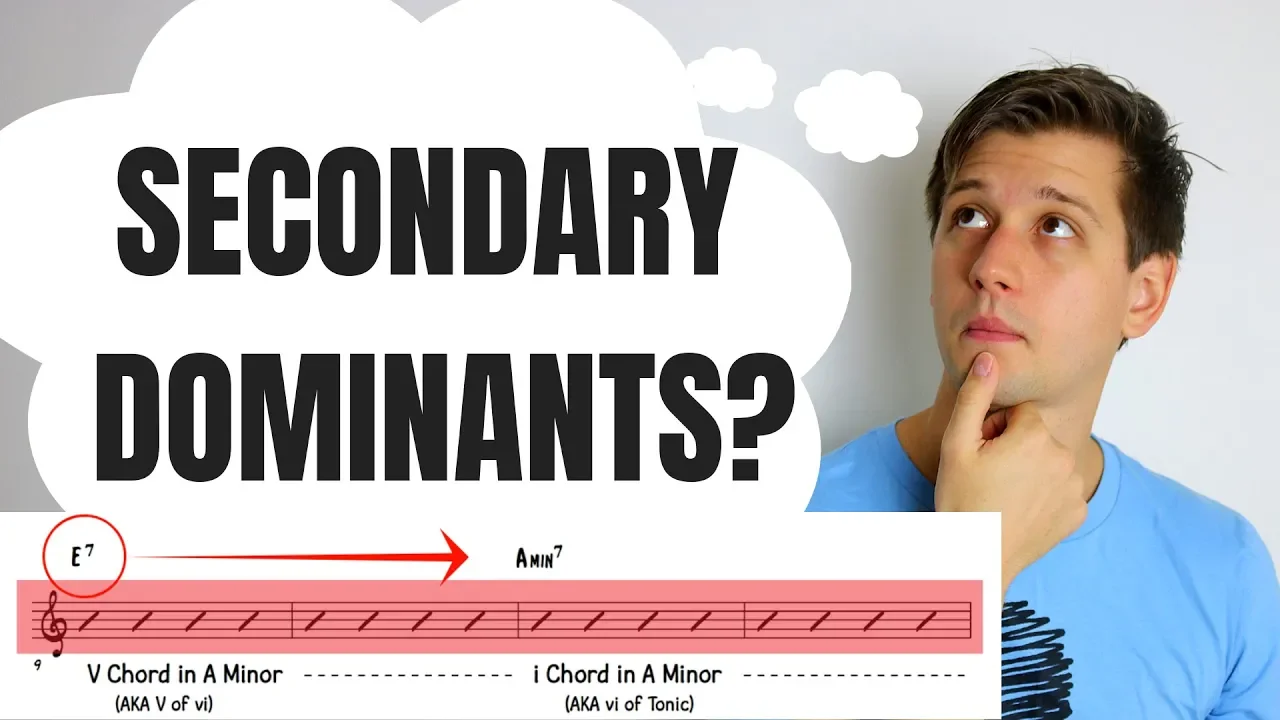

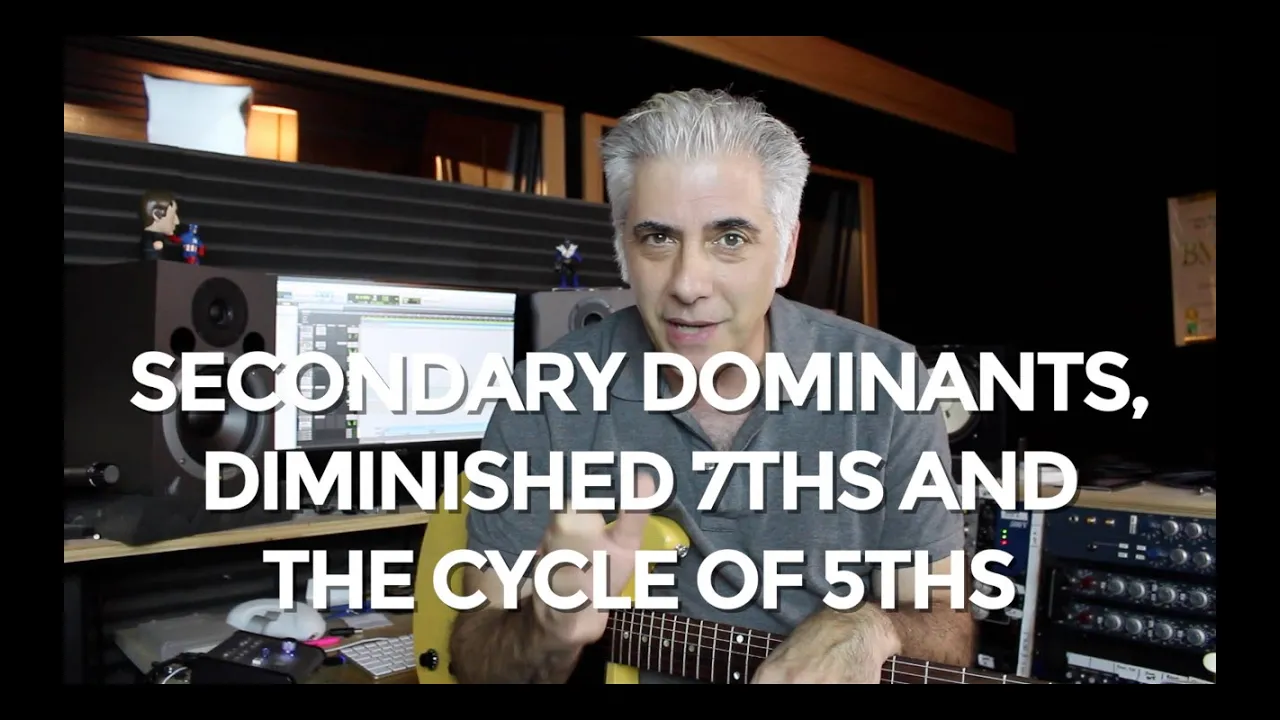
Secondary dominants are dominant seventh chords built from the fifth of any chord in a key, creating a stronger pull toward that chord than the primary dominant does; they can be found by identifying the fifth of the target chord and building a dominant seventh chord from it, and they work in both major and minor keys to add interest and tension to chord progressions.
Understanding Secondary Dominants in Guitar Music Theory
Added:Understanding the major scale and how diatonic chords (triads and seventh chords) are built within a key.
Familiarity with the concept of dominant function, specifically how the V chord (or V7) naturally resolves to the I chord.
Basic guitar fretboard navigation, including common open and barre chord shapes (such as the CAGED system).
Knowledge of Roman numeral analysis for identifying chord progressions in a key.
Exploring voice leading techniques on the guitar to smoothly connect secondary dominants to their target chords.
Studying secondary leading-tone chords (such as diminished 7th chords) as an alternative way to tonicize non-tonic chords.
Learning about modulation and how secondary dominants can be used as pivot chords to transition to new keys.
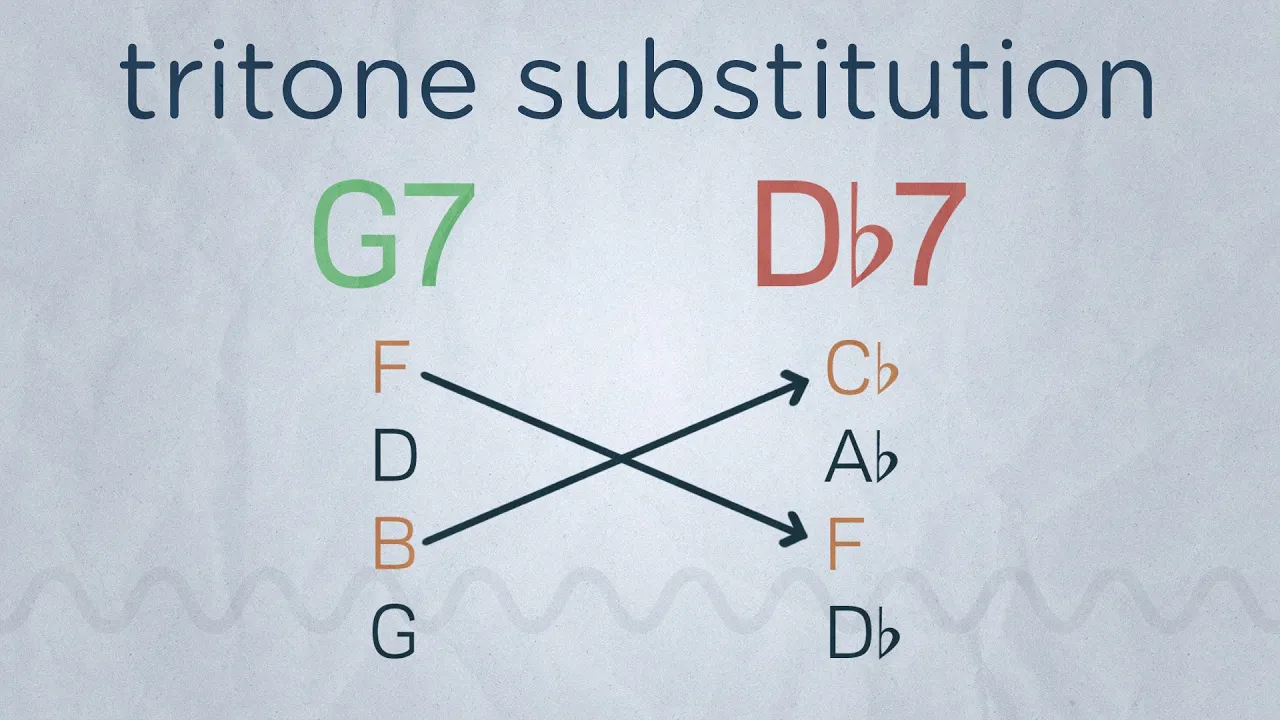
Understanding tritone substitution, a common jazz harmony concept that replaces a secondary dominant chord with a chord a tritone away.
Analyzing real-world song repertoire (jazz standards, classical, and pop) to identify and deconstruct secondary dominants in context.
51.2K views2.6Klikes5:50Original Release: 2022-01-14
let's talk about secondary dominance the main goal of this lesson is to help you understand and use secondary dominance as quickly as possible and as daunting as the name might appear you'll find that this is actually a very simple concept to learn so if you're tired of using the same old chords and are seeking a way to write far more interesting chord progressions then stick around to the end of this guitar lesson and you'll be able to do just that so we have seven chords in any given key the five chord in the key can be described as our primary dominant chord this creates a strong pull back to the one chord and is what's known as a perfect cadence [Music] this pull and resolution can be made stronger and more satisfying if we were to make our v chord a dominant seventh chord so a simple d7 in terms of intervals this simply means adding a flat 7 interval to our major triad this creates more tension in the chord and more tension equals greater resolution [Music] secondary dominance can create a similar five one resolution but to any other chord in the key allowing you to take a less direct route from one chord to another in a progression for example g to b minor so the one chord to the three chord in the key of g major would sound like this [Music] but if we were to play the secondary dominant of the b minor chord this being an f sharp seven chord before arriving in the b minor it would sound like this and as the secondary dominant really wants to resolve to its own one chord in this case the b minor then this really helps pull the listener in and strongly suggests what chord might be coming next we can easily find the secondary dominant of any chord by simply building a dominant seventh chord from the fifth for example if we wanted to know the secondary dominant of the two chord in the key of g this being an a minor then you would simply need to find the fifth of a you could do this by climbing up an a major scale starting from an a root note but stopping when you arrive at the fifth note in the scale as this is an e note we would now simply need to build a dominant seventh chord starting from this note which would give us an e7 chord so e7 resolving to a minor [Music] in this particular case you could write this down as the 5 of 2 as we are approaching our 2 chord from its very own 5 chord doing this for any other chord in any key works exactly the same way and is the essence of secondary dominance this will give you more interesting choices when writing chord progressions but now let me walk you through the easiest ways of identifying and playing any secondary dominant chord with next to no effort using two methods [Music] if you're trying to find the fifth of a chord with its root note on the low e string then the first method is to simply visualize a power chord when you play a power chord you're actually just playing the root and the fifth intervals and from here you just need to play the seventh chord starting from the fifth i would recommend using this common dominant seventh shape [Music] if you're trying to find the fifth of a chord that has its root on the a string then you could use the power chord method but it's much more useful to find this same note an octave lower which as you can see is right beside our root note and from here you could then play a standard seventh bar chord that you will all be familiar with this method also applies to any chord that has its root on a d string simply find the fifth in the same way however as our fifth interval is now on an a string you will need to use this common bar shape instead so now let's apply this to every chord in the key of g as discussed previously the one chord already has its own v chord within the key but you could still use the power chord method to quickly identify the fifth and then place down a seventh chord so d7 to g [Music] the two chord can use the same power chord approach as its root note is on the lowest e string this would reveal an e note giving us an e7 secondary dominant chord resolving to our two chord a minor as the root of the three chord b minor is on the a string we can apply the look back method to quickly find the fifth this would give us an f sharp note so f sharp 7 to b minor the iv chord is c major and the root of this chord is also on the a string so we can use the same look back method this would reveal g as the fifth so g7 to c the look back method would also work for the five chord which is a d this would reveal the fifth as a so a7 to d the sixth chord is e minor and in this case i'm playing this voicing starting on the d string simply to demonstrate the look back method for any chords you may wish to play starting with the root on the same string so once again simply look to the previous string on the same fret as the root note to find the fifth interval in this case a b note and make this into a seventh chord so b7 resolving to our e minor chord and you don't need to worry about the seven chord which is diminished this doesn't have a secondary dominant as diminished chords are too unstable to resolve to so any chord can have a secondary dominant apart from the one chord as it already has a 5 chord in the key and the 7 diminished chord it's also worth noting that this isn't limited to major keys secondary dominants work in minor keys also you can also simply play a major chord instead of a dominant 7th chord and it will function the same so you don't necessarily need to make a secondary dominant a dominant seventh chord for this to work as always use your ear to determine what is best for the song if this lesson helped you out then let me know in the comments and give this video a like and i'll see you in the next one
Up Next

25:26
Mastering ii-V-I Jazz Chord Progressions: Autumn Leaves for Guitar
@AlexFarranGuitar
15.4K views•2025-04-19

10:20
Mozart's Musical Dice Game Explained: History, Rules, & Fun
@webpianoacademy
5K views•2023-03-13

47:36
Understanding Diatonic 7th Chords in Major Keys | Music Theory Tutorial
@GracieTerzian
54.7K views•2022-03-02
10:49
Understanding John Coltrane's Giant Steps: A Music Theory Analysis
@Vox
10.4M views•2018-11-12
Related Study Plans & Knowledge Roadmaps
Structured learning paths in Music Theory
music-theory
Composing Galant Music: Partimento & Schemata
01Foundations of Figured Bass and Keyboard Harmony
02The Rule of the Octave (Regola dell'Ottava)
03Galant Schemata: The Building Blocks of Form
+ 2 more learning modules
30h5 modules
Explore Roadmap
music-theory
Decoding Overtone Series: Tuning & Drone Music
01Acoustic Foundations: The Physics of the Overtone Series
02Tuning Systems: Equal Temperament vs. Just Intonation
03Microtonality and Spectralism: Beyond Standard Pitches
+ 2 more learning modules
24h5 modules
Explore Roadmap
music-theory
Impressionist Harmony: Scales, Planing & RPGs
01Foundational Music Theory: Keys, Intervals, and Seventh Chords
02Impressionist Color: Chord Planing and Parallel Harmony
03Whimsical Textures: Pentatonic Cascades and Whole-Tone Scales
+ 1 more learning modules
14h4 modules
Explore Roadmap
music-theory
Negative Harmony: Axis Reflection in Indie Pop
01Music Theory Foundations: Scales, Intervals, and Triads
02Functional Harmony and the Circle of Fifths
03Demystifying the Negative Harmony Axis Reflection
+ 2 more learning modules
16h5 modules
Explore Roadmap