


















![Riffing With Modes #1: Writing with Major/Ionian [Rock/Prog style]](https://i.ytimg.com/vi/gbNLhx2eCXs/maxresdefault.jpg)






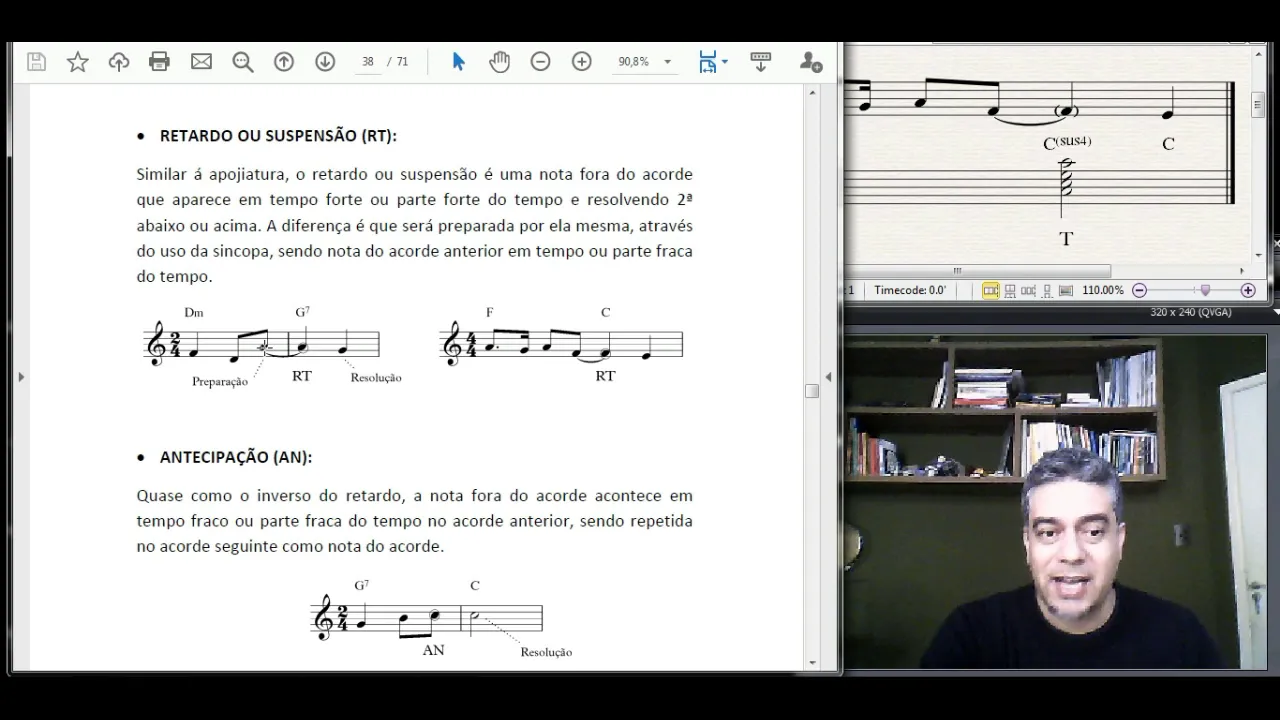
A suspension resolution is a musical technique where a chord tone is raised by one scale degree (creating a suspension) and then resolved back to its original position, creating tension and release; for example, in a G major chord, the third can be raised to a fourth (sus4) and then resolved back to the third, or the root can be raised to a second (sus2) and resolved back to the root, with the bass notes typically being the root or fifth of the chord.
Suspension Resolution Riff: Piano Chord Inversions Practice Guide
Added:Familiarity with basic major and minor triad construction and standard piano keyboard geography.
Understanding the concept and physical execution of chord inversions (root position, first, and second inversions).
Basic knowledge of music theory suspensions, specifically how a suspended note (like a 4th or 2nd) functions and resolves to a chord tone.
Fundamental rhythmic literacy, including keeping a steady pulse and understanding basic subdivisions (quarter, eighth, and sixteenth notes).
Applying voice leading principles to smoothly transition between inverted chords and resolutions across complex progressions.
Integrating suspensions into extended chord shapes, such as dominant 7th suspensions (7sus4) and 9th chords.
Developing advanced rhythmic syncopation techniques, such as polyrhythms, Latin piano montunos, or jazz swing feels.
Using suspension-resolution riffery for spontaneous improvisation, songwriting, and reharmonizing lead sheets.
Transposing the learned suspension-resolution patterns into all 12 major and minor keys to achieve complete keyboard fluency.
462 views1likes9:46Original Release: 2013-03-26
[Music] Heat.
[Music] Heat.
[Music] Heat. Heat.
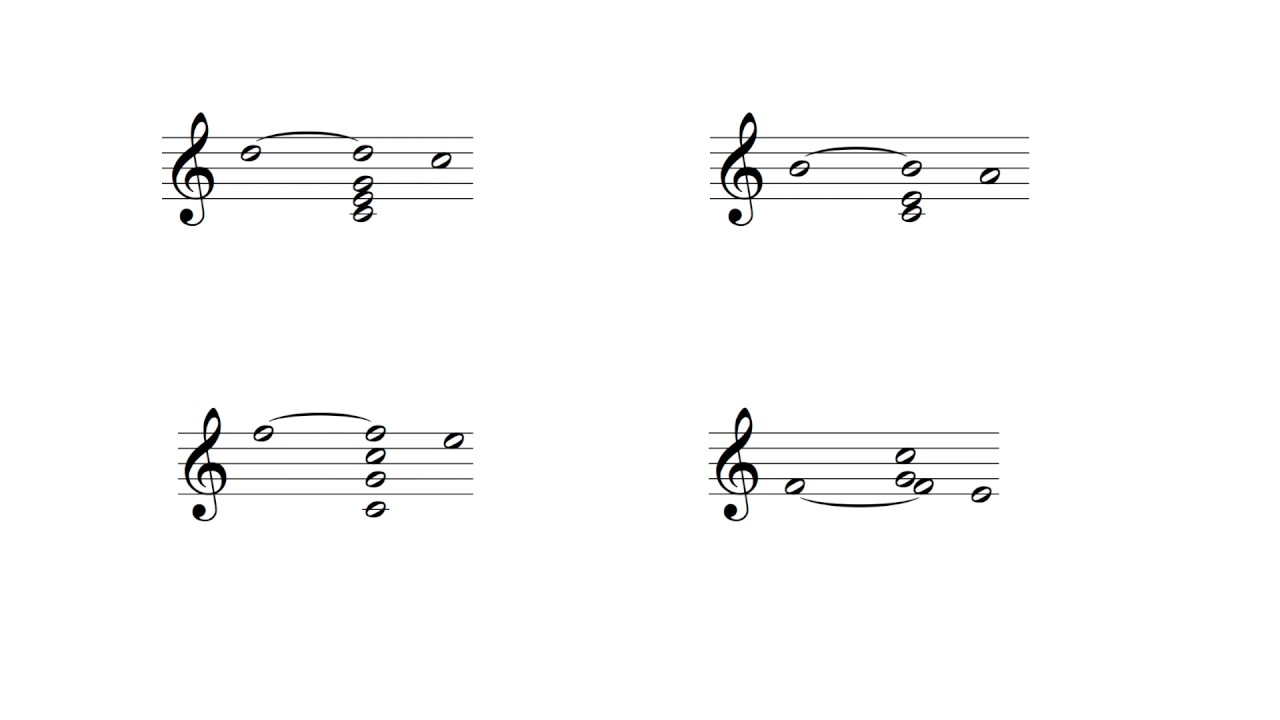
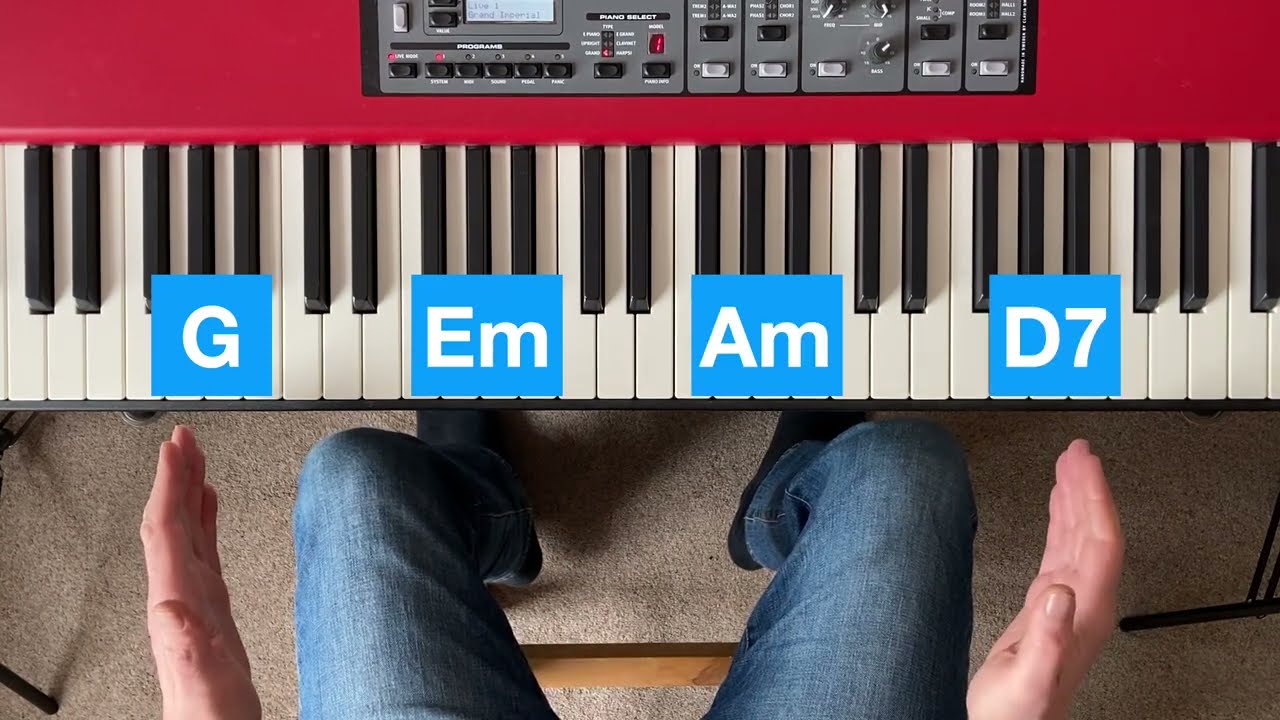
[Music] So the chords for this little suspension resolution riff are these. G major, root position in the right hand, a root in the left, root, third, fifth. One key to the right gives us a minor, root, third, fifth, root in the left, and a D chord. A D chord looks like that. But because we want a closest inversion, we're going to take the root up to the top first inversion and play the D chord there and back to G. And that is the chord sequence. G root position in the right hand. A minor root position in the right hand.
D first inversion in the right hand.
back to G major in position. Now, suspension resolution is a great way to get more out of any chords, you know. Here's how it works.
Here's our G root position chord. With suspension resolution, you take any of these chord tones and you drag them up one scale tone. That's called the suspension. Let's use the third. It's going to be dragged up. We play the fourth instead. And then we let it fall back or resolve back to where it was, the third.
You recognize the [Music] sound? And these suspension resolution pairs are indicated by the numbers of the chord terms. So this would be a sus resuspension resolution 43 4 3 suspended G sus 4 resolved. But in RF, we're not going to use the third. Not in the G chord anyway. We're going to use the root or one. And one is going to get dragged up to two, suspended to two, and then resolved.
[Music] Exactly the same thing in the A minor. A minor sus 2 [Music] one. Now then, if we were doing exactly the same thing in D, we'd be down here.
Of course, that's sounding too muddy, isn't it? And we're also missing out on something rather nice. We're coming from a minor. And you can hear a falling tune here.
It wants to go to there, isn't it? So in the D major, we're going to use a 43 suspension.
4 down to three. But remember that this chord is in first inversion. So our 43 suspension in D suspension resolution now looks like that.
four revolving back down to three. You have to use some fancy fingering to get it smooth like that. 1 3 5 and two over onto the F [Music] sharp back to G to one. And that's how you practice it like this. Starting again. G ses 2 1 A minor. The same [Music] thing. 4 three in D. First inversion.
The fancy fingering. Back to G.
[Music] The next element of our riff is the bass notes. Now, when you're playing a chord in the right hand, there's our G chord.
Your first choice for a bass note is the root always. Your second choice for a bass note is the fifth. Root, third, fifth. There it is.
It's note D. Now, we could have the fifth above the G or below.
root fifth. Root [Music] fifth. Exactly the same for the A minor chord. There's the A minor chord. Here's the root in the bass. Here's a fifth above the root and the fifth below the [Music] root. Now, for the D, we'll do something a little different because we don't really want to go down here like we didn't want to go down there for the chord. We wanted the closest inversion D chord. Same with the bass. So we'll have a root and a root and a fifth in the middle.
[Music] So the bass notes are in G, root, fifth, fifth, root. In A minor, root, fifth, fifth, root, and in D, the fifth, the root, root, fifth, back to G. Root, fifth, root, fifth, fifth, root. Sorry.
Now, the last element of the riff you're going to bring in is the syncupation, playing off the beat, mainly in the left hand, but not exclusively. Uh, you remember our riff is going to be something like this. 1 2 3 4 1 2 3 4.
We're going to dress it up with the fifth on four. And listen. 1 2 3 4 and 1 2 3 4 1 2 3 4 and 1 2 3 4 1 2 3 4 and 1 2 3 4 1 2 3 4 and 1 2 and 3 4 Oh, right hand's getting on the act. Do you hear that? 1 2 and 3 4 at the end. Why not?
Not that hard. Try 1 2 3 4 and 1 2 and 3 4 1 2 3 4 and 1 2 and 3 4 1 2 3 4 and 1 2 and 3 4 1 2 3 4 and 1 2 and 3 4 That's nice. But settle for that for a day, a week, however long it takes.
The next thing that's likely to happen is we'll have the other fifth in the bass root fifth. That fifth as well as that fifth. And that'll come on 1 2 3 count three. But I can tell you it's going to want to pull forward as well.
1 2 and 3 4 and 1 2 and 3 4 1 2 and 3 4 and 1 2 and 3 4 1 2 and 3 4 and 1 2 and 3 4 1 2 and 3 4 and 1 2 and 3 4 After that sky's is the limit as much as occurs to you and as you like the sound of 1 2 and 3 Oh [Music] yeah. Heat.
[Music] That's it for now. Thanks very much for listening. This is Bob Chapel aka Mr. Musicarter. Please come back for more.
Visit the website. It's www.mmusicarta.com and of course Mr. Musicart YouTube that you're watching now. Please subscribe to the site.
Please get the feed from the website and sign up for the newsletter so you know what's coming up. Thanks very much. Bye for now.
Up Next

12:26
Understanding Suspended Chords: Theory and Application in Music
@RickBeato
592K views•2018-09-20

10:20
Mozart's Musical Dice Game Explained: History, Rules, & Fun
@webpianoacademy
5K views•2023-03-13

47:36
Understanding Diatonic 7th Chords in Major Keys | Music Theory Tutorial
@GracieTerzian
54.7K views•2022-03-02
10:49
Understanding John Coltrane's Giant Steps: A Music Theory Analysis
@Vox
10.4M views•2018-11-12
Related Study Plans & Knowledge Roadmaps
Structured learning paths in Music Theory
music-theory
Composing Galant Music: Partimento & Schemata
01Foundations of Figured Bass and Keyboard Harmony
02The Rule of the Octave (Regola dell'Ottava)
03Galant Schemata: The Building Blocks of Form
+ 2 more learning modules
30h5 modules
Explore Roadmap
music-theory
Decoding Overtone Series: Tuning & Drone Music
01Acoustic Foundations: The Physics of the Overtone Series
02Tuning Systems: Equal Temperament vs. Just Intonation
03Microtonality and Spectralism: Beyond Standard Pitches
+ 2 more learning modules
24h5 modules
Explore Roadmap
music-theory
Impressionist Harmony: Scales, Planing & RPGs
01Foundational Music Theory: Keys, Intervals, and Seventh Chords
02Impressionist Color: Chord Planing and Parallel Harmony
03Whimsical Textures: Pentatonic Cascades and Whole-Tone Scales
+ 1 more learning modules
14h4 modules
Explore Roadmap
music-theory
Negative Harmony: Axis Reflection in Indie Pop
01Music Theory Foundations: Scales, Intervals, and Triads
02Functional Harmony and the Circle of Fifths
03Demystifying the Negative Harmony Axis Reflection
+ 2 more learning modules
16h5 modules
Explore Roadmap