












![[알릴레오 북's 100회] 군중 속에서 'NO'를 외치다 / 군중심리 - 이해찬 편](https://i.ytimg.com/vi/5mz-QctEiOs/maxresdefault.jpg)



![2026 스파르타 스포츠 지도사 2급 [스포츠 사회학] 이론 강의 (8강_스포츠와 일탈)](https://i.ytimg.com/vi/pHslFPsZQsY/maxresdefault.jpg)


![[단독] 광화문 지하철 통제! BTS 컴백날 벌어질 역대급 상황](https://i.ytimg.com/vi/eaUoOivR9es/maxresdefault.jpg)




Crowd psychology, a branch of social psychology, studies how individual psychology differs from and interacts with crowd psychology, with major theories including Gustave Le Bon's three-stage model (submergence, contagion, suggestion), Freud's unconscious mind theory, deindividuation theory explaining how anonymity reduces personal responsibility, convergence theory suggesting crowds form from like-minded individuals, emergent norm theory proposing that norms emerge within crowds, and social identity theory explaining how group membership shapes behavior.
Crowd Psychology: Theories and Dynamics in Social Psychology
Added:Basic concepts of social psychology, particularly social influence, conformity, and how group settings affect individual behavior.
An introductory understanding of Social Identity Theory (SIT) and self-categorization.
The psychological concept of deindividuation, where individuals lose self-awareness and personal responsibility in groups.
A general familiarity with historical 19th-century sociological thought, which influenced early thinkers like Gustave Le Bon.
Analysis of digital crowd dynamics, exploring how virality, online echo chambers, and 'smart mobs' operate on social media.
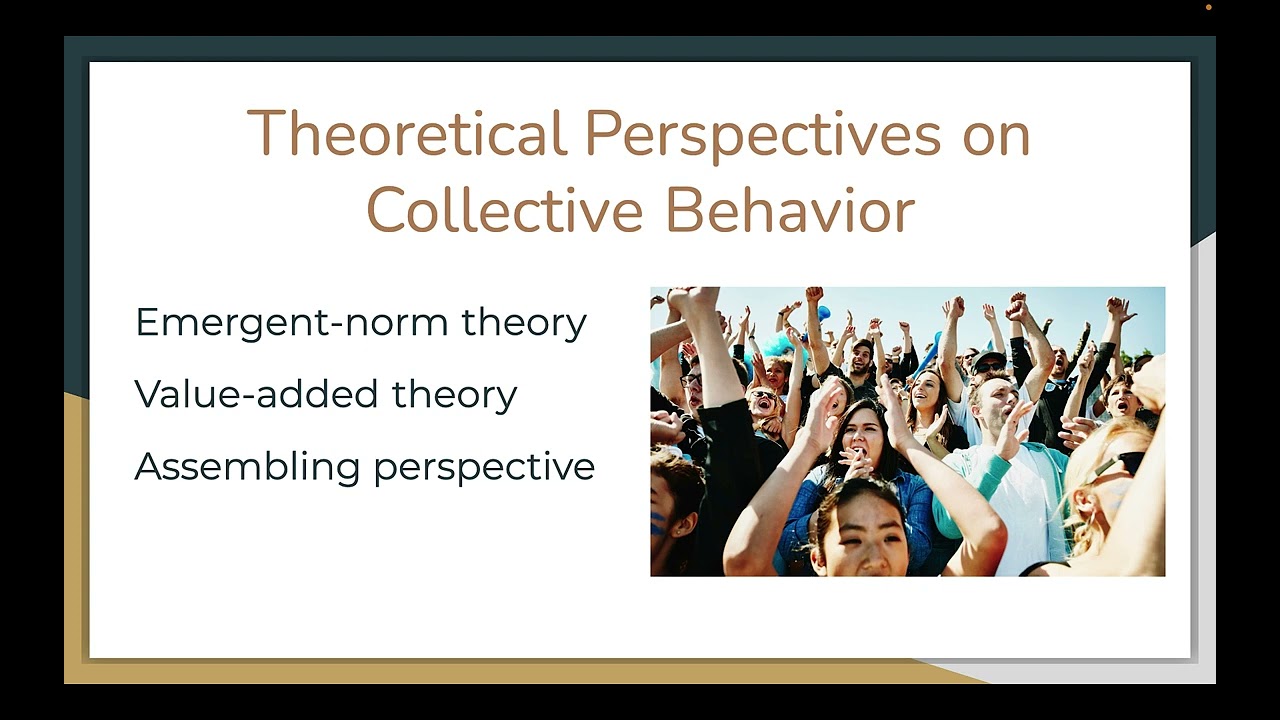
Advanced sociological frameworks of collective behavior, such as Emergent Norm Theory and Value-Added Theory.
Practical applications in urban planning, event management, and emergency response, focusing on crowd control and safety designs.
The intersection of crowd psychology with political science, specifically regarding mass mobilization, propaganda, and protest movements.
3.2K views13likes23:41Original Release: 2015-11-26
Crowd psychology, also known as mob psychology, is a branch of social psychology. Social psychologists have developed several theories for explaining the ways in which the psychology of a crowd differs from and interacts with that of the individuals within it. Major theorists in crowd psychology include Gustav Leon, Gabriel Sigman Freud, and Steve Riker.
This field relates to the behaviors and thought processes of both the individual crowd members and the crowd as an entity. Crowd behavior is heavily influenced by the loss of responsibility of the individual and the impression of universality of behavior. Both of which increase with the size of the crowd origins. The psychological study of crowd phenomena was documented decades prior to 1900 as European culture was imbued with thoughts of the finder clay.
This modern urban culture perceived that they were living in a new and different age. They witnessed marvelous new inventions and experienced life in new ways. The population now living in densely packed industrialized cities such as Milan and Paris witnessed the development of the light bulb, radio, photography, moving picture shows, the telegraph, the bicycle, the telephone, and the railroad system. They experienced a faster pace of life and viewed human life as segmented. So they designated each of these phases of life with a new name. They created new concepts like the adolescent, kindergarten, the vacation, camping in nature, the 5-minute segment, and travel for the sake of pleasure as a leisure class to describe these new ways of life. Likewise, the abstract concept of the crowd grew as a new phenomenon simultaneously in Paris, France, and Milan, the largest city in the Kingdom of Italy. Legal reformers motivated by Darwin's evolutionary theory, particularly in the Kingdom of Italy, argued that the social and legal systems of Europe had been founded on antiquated notions of natural reason or Christian morality, and ignored the irrevocable biology laws of human nature. Their goal was to bring social laws into harmony with biological laws. In pursuit of this goal, they developed the social science of criminal anthropology, which is tasked with the mission of changing the emphasis from one of the study of legal procedures to one of studying the criminal. Criminal anthropology writes senior Sergy studies the delinquent in his natural place, that is to say, in the field of biology and pathology. The Italian Sir Lombroso, professor of forensic medicine and hygiene in Turin, greatly advanced their agenda in 1878 when he published Lumo Delinquent, a highly influential book which went through five editions. The book published in English in 1900 under the title criminal man solidified the links between social evolutionary theories and the fear of crowds with its concept of the born criminal as the savage in the midst of civilized society. The book influenced both European and American legal experts interested in assigning responsibility to individuals engaged in dubious behavior while engaged within a crowd. The first debate in crowd psychology began in Rome at the first international congress of criminal anthropology on November 16th, 1885. The meeting was dominated by Sir Lombroso and his fellow Italians who emphasized the biological determinates. Lombroso detailed before the first congress his theories of the physical anomalies of criminals and his classification of criminals as born criminals or criminals by occasion and mtoids. Ferry expressed his view of crime as degeneration more profound than insanity for in most insane persons the primitive moral sense has survived the wreck of their intelligence. Along similar lines were the remarks of Benedict, Sergy and Maro. A weak response was offered by the French who put forward an environmental theory of human psychology. Mangali called attention to the importance of the influence of the social environment upon crime. Professor Alexander Lacasan thought that the atistic and degenerative theories is held by the Italian school were exaggerations and false interpretations of the facts and that the important factor was the social environment. In Paris during tenno August 17th, 1889, the Italian school received a stronger rebuke of their biological theories during the second international congress of criminal anthropology. A radical divergence in the views between the Italian and the French schools was reflected in the proceedings. Professor Lombroso laid stress upon epilepsy in connection with his theory of the born criminal. Professor La copyright once Pierre Manover characterized Lombroso's theory as nothing but the exploded science of phronology. The anomalies observed by Lombroso were met with honest men as well as criminals, Manovia claimed, and there is no physical difference between them. Baron Rafael Gafalo drill Alexander Lacasan and Benedict opposed Lombroso's theories in whole or in part found the cause of crime in the failure of the criminal to adapt himself to his social surroundings and Benedict with whom agreed held that physical defects were not marks of the criminal quay criminal. It is in this context that you have a debate between Cypio Siguel, an Italian lawyer and Gabrielle a French magistrate on how to determine criminal responsibility in the crowd and hence who to arrest.
Literature on crowds and crowd behavior appeared as early as 1841 with the publication of Charles Mikai's book extraordinary popular delusions and the madness of crowds. The attitude towards crowds underwent an adjustment with the publication of hippolite tain six volume to the origins of contemporary France.
In particular, Tain's work helped to change the opinions of his contemporaries on the actions taken by the crowds during the 1789 revolution.
Many Europeans held him in great esteem.
While it is difficult to directly link his works to crowd behavior, it may be said that his thoughts stimulated further study of crowd behavior.
However, it was not until the latter half of the 19th century that scientific interest in the field gained momentum.
French physician and anthropologist Gustav Leon became its most influential theorist. Types of crowds. There is limited research into the types of crowd and crowd membership and there is no consensus as to the classification of types of crowds. Two recent scholars Mambbois and Berongi focused upon purpose of existence to differentiate among crowds. Mambbois developed a system of four types casual, conventional, expressive and aggressive.
Berlongi classified crowds as spectator, demonstrator or escaping to correlate to the purpose for gathering. Another approach to classifying crowds is sociologist Herbert Bloomer's system of emotional intensity. He distinguishes four types of crowds casual, conventional, expressive and acting. His system is dynamic in nature. That is a crowd changes its level of emotional intensity over time and therefore can be classed in any one of the four types.
Generally, researchers in crowd psychology have focused on the negative aspects of crowds. But not all crowds are volatile or negative in nature. For example, in the beginning of the socialist movement, crowds were asked to put on their Sunday dress and march silently down the street. A more modern example involves the sitins during the civil rights movement. Crowds can reflect and challenge the held ideologies of their soi cultural environment. They can also serve integrative social functions creating temporary communities. Crowds can be active or passive. Active crowds can be further divided into aggressive, escapist, acquisitive, or expressive mobs. Aggressive mobs are often violent and outwardly focused. Examples of football riots in the LA riots of 1992. Escapist mobs are characterized by a large number of panicked people trying to get out of a dangerous situation.
These types of the mobs are why it is illegal to yell fire in a crowded theater. Inquisitive mobs occur when large numbers of people are fighting for limited resources, such as the crowds who looted after Hurricane Katrina in 2005. An expressive mob is any other large group of people gathering for an active purpose. Civil disobedience, rock concerts, and religious revivals all fall under this category. Theoretical perspectives equals Gustav Leon equals Leon held that crowds existed in three stages. Submergence, contagion, and suggestion. During submergence, the individuals in the crowd lose their sense of individual self and personal responsibility. This is quite heavily induced by the anonymity of the crowd.
Contagion refers to the propensity for individuals in a crowd to unquestioningly follow the predominant ideas and emotions of the crowd. In Leon's view, this effect is capable of spreading between submerged individuals, much like a disease.
Suggestion refers to the period in which the ideas and emotions of the crowd are primarily drawn from a shared racial unconscious. This behavior comes from an archaic shared unconscious and is therefore univilized in nature. It is limited by the moral and cognitive abilities of the least capable members.
Leon believed that crowds could be a powerful force only for destruction.
Additionally, Leon and others have indicated that crowd members feel a lessened sense of legal culpability due to the difficulty in prosecuting individual members of a mob. Leon's idea that crowds foster anonymity and generate emotion has been contested by some critics. Clark McFale points out studies which show that the Madding crowd does not take on a life of its own apart from the thoughts and intentions of members. Norris Johnson after investigating a panic at a 1979 the who concern concluded that the crowd was composed of many small groups of people mostly trying to help each other.
Additionally, Leon's theory ignores the socioultural context of the crowd which some theorists argue can disempower social change. A Brown disputes the assumption that crowds are homogeneous, suggesting instead that participants exist on a continuum, differing in their ability to deviate from social norms.
Equals Freudian theory equals Sigman Freud's crowd behavior theory primarily consists of the idea that becoming a member of a crowd serves to unlock the unconscious mind. This occurs because the super ego or moral center of consciousness is displaced by the larger crowd to be replaced by a charismatic crowd leader. McDougall argues similarly to Freud, saying that simplistic emotions are widespread and complex emotions are rarer. In a crowd, the overall shared emotional experience reverts to the least common denominator, leading to primitive levels of emotional expression. This organizational structure is that of the primal hoarder euro pre-ivilized society and Freud states that one must rebel against the leader in order to escape from it.
Muscovi expanded on this idea discussing how dictators such as Mao Zadong and Joseph Stalin have used mass psychology to place themselves in this horde leader position. Theodor Adorno criticized the belief in a spontaneity of the masses.
According to him, the masses were an artificial product of administrated modern life. The ego of the bourgeoa subject dissolved itself, giving way to the and the psychologized subject.
Furthermore, Adorno stated the bond linking the masses to the leader through the spectacle is feigned. When the leaders become conscious of mass psychology and take it into their own hands, it ceases to exist in a certain sense. Just as little as people believe in the depth of their hearts that the Jews are the devil, do they completely believe in their leader. They do not really identify themselves with him, but act this identification, perform their own enthusiasm, and thus participate in their leaders performance. It is probably the suspicion of this fictitiousness of their own group psychology which makes fascist crowds so merciless and unapproachable.
If they would stop to reason for a second, the whole performance would go to pieces and they would be left to panic. Equals dindividuation theory equals Dindividuation theory argues that in typical crowd situations, factors such as anonymity, group unity, and arousal can weaken personal controls by distancing people from their personal identities and reducing their concern for social evaluation.
This lack of restraint increases individual sensitivity to the environment and lessens rational forethought which can lead to antisocial behavior. More recent theories have stated that the individuation hinges upon a person being unable due to situation to have strong awareness of their self as an object of attention.
This lack of attention frees the individual from the necessity of normal social behavior. American social psychologist Leon Festinger and colleagues first elaborated the concept of dividuation in 1952. It was further refined by American psychologist Philip Zimbardo who detailed why mental input and output became blurred by such factors as anonymity, lack of social constraints and sensory overload. Zambardo's famous Stanford prison experiment is a strong argument for the power of dindividuation.
Further experimentation has had mixed results when it comes to aggressive behaviors and has instead shown that the normative expectations surrounding the situations of dividuation influence behavior. A further distinction has been proposed between public and private dividuation. When private aspects of self are weakened, one becomes more subject to crowd impulses, but not necessarily in a negative way. It is when one no longer attends to the public reaction and judgment of individual behavior that antisocial behavior is elicited. Equals convergence theory equals convergence theory holds that crowd behavior is not a product of the crowd but rather the crowd is a product of the coming together of like-minded individuals. Floyd Alport argued that an individual in a crowd behaves just as he would behave alone only more so.
Convergence theory holds that crowds form from people of similar dispositions whose actions are then reinforced and intensified by the crowd. Convergence theory claims that crowd behavior is not irrational. Rather, people in crowds express existing beliefs and values so that the mob reaction is the rational product of widespread popular feeling.
However, this theory is questioned by certain research which found that people involved in the 1970s riots were less likely than non-participant peers to have previous convictions. Critics of this theory report that it still excludes the social determination of self and action in that it argues that all actions of the crowd are born from the individual's intents.
Equals emergent norm theory equals Ralph Turner and Luis Killian put forth the idea that norms emerge from within the crowd. Emergent norm theory states that crowds have little unity at their outset but during a period of milling about key members suggest appropriate actions and following members fall in line forming the basis for the crowd's norms. Key members are identified through distinctive personalities or behaviors.
These garner attention and the lack of negative response elicited from the crowd as a whole stands as tacit agreement to their legitimacy. The followers form the majority of the mob as people tend to be creatures of conformity who are heavily influenced by the opinions of others. This has been shown in the conformity studies conducted by Sheriff and Ash. Crowd members are further convinced by the universality phenomenon described by Alport as the persuasive tendency of the idea that if everyone in the mob is acting in such and such a way then it cannot be wrong. Emergent norm theory allows for both positive and negative mob types as the distinctive characteristics and behaviors of key figures can be positive or negative in nature. An antisocial leader can incite violent action, but an influential voice of non-violence in a crowd can lead to a mass sitin. A major criticism of this theory is that the formation and following of new norms indicates a level of self-awareness that is often missing in the individuals and crowds. Another criticism is that the idea of emergent norms fails to take into account the presence of existence soy cultural norms. Additionally, the theory fails to explain why certain suggestions or individuals rise to normative status while others do not. Equals social identity theory. Equals social identity theory posits that the self is a complex system made up primarily of the concept of membership or non-membership in various social groups. These groups have various moral and behavioral values and norms. and the individual's actions depend on which group membership is most personally salient at the time of action. This influence is evidenced by findings that when the stated purpose and values of a group changes, the values and motives of its members are shown to also change. Crowds are an amalgam of individuals, all of whom belong to various conflicting groups.
However, if the crowd is primarily related to some identifiable group, then the values of that group will dictate crowd action. In crowds which are more ambiguous, individuals will assume a new social identity is a member of the crowd. This group membership is made more salient by confrontation with other groups, a relatively common occurrence for crowds. The group identity serves to create a set of standards for behavior.
For certain groups, violence is legitimate. For others, it is unacceptable. This standard is formed from stated values, but also from the actions of others in the crowd, and sometimes from a few in leadership type positions. A concern with this theory is that while it explains how crowds reflect social ideas and prevailing attitudes, it does not explain the mechanisms by which crowds enact social change. See also further reading. Burke, Richard A. Collective behavior. Dubac, Iowa. William C. Brown, 1974. Buffford, Bill. Among the thugs, the experience and the seduction of crowd violence. New York, New York. WW Norton and Company incororated.
Ketti Elias Crowds and Power Viking Adult ISBN0-670-24,999-8 Challenger R. Kle CW and Robinson MA Understanding Crowd Behaviors Multiolume Report for the UK Government's Cabinet Office London Cabinet Office.
http www.cabanto.govak Govak understanding crowd behaviors documents. Freud, Sigund, Group Psychology and the Analysis of the Ego, Standard Edition, V 18, pages 67 a euro 143. The Hogarth Press, London, 1981, ISBN070120067-7 Johnson, Norizar.
Panic at the who concerned stampede an empirical assessment. Social problems volume 34 number four 362 a euro 373 laba copyright tai at yen the politics of obedience the discourse of voluntary servitude with an introduction by Mari Rothbart free life editions 1975 ISBN0-914,156-11X Leon Gustav Psychology of Crowds Improved edition www.sparklingbooks.com. Leon Gustav The Crowd: A Study of the Popular Mind.
Retrieved November 15th, 2005. Mai, Charles, Extraordinary Popular Delusions and the Madness of Crowds. Wordssworth Editions.
ISBN1-85,326-349-4.
McDougall, William, The Group Mind, MC Fail. Clark, The Myth of the Madding Crowd, New York, Olding Duittita, 1991. Muscoviacy, Serge, English, Social Influence and Social Change, Academic Press, 1976. French Psychology, Des Minority Copyright S. Actives, PUF 1979.
French lies as fowls untra copyright historic psychology de masses fireard 1981 English social representations explorations in social psychology polity press 2000 Ringold Howard Smart Mobs the next social revolution 2003 Reich Wilhelm the mass psychology of fascism 1946 revised and enlarged US edition Surowayaki James, the wisdom of crowds, why the many are smarter than the few and how collective wisdom shapes business, economies, societies and nations 2004. Gabriel Leo demitation la logic social lein fa etc. Trotter Wilfried instincts of the herd in peace and war 1914 Turner Ralph and Luis M. Killian Collective Behavior 2D edgelwood cliffs New Jersey Apprentice Hall 1972 3D ed 1987 Fourth ed 1993 Vaninikin Crowds psychology and politics 1871 a euro 1899 New York Cambridge University Press 1992 Wells HG Men Like Gods 1923 Three pala soul mass psychology and why the average Joe is destined to lose retrieved September 20th 2015 references external links Dr. JP Vanderand on crowds crowd disasters by professor Dr. G. Keith Still, online crowds by Chris Russ. Mass phenomena and collective behavior on the internet.
Understanding crowd behaviors.
Up Next
25:49
The Lucifer Effect: Psychology of Good vs. Evil
@ArtificiallyAware
3.3M views•2024-08-10

68:32
Cognitive Skills for Differentiated Instruction | Teacher PD
@BrainWareLearning
631 views•2017-12-17

9:30
Divergent Thinking Explained: Definition, Traits & Creativity
@audiopedia5493
1.1K views•2015-11-25

6:40
The Nocebo Effect: How Beliefs Can Cause Real Harm
@CGPGrey
10.4M views•2013-12-23
Related Study Plans & Knowledge Roadmaps
Structured learning paths in Psychology
psychology
Neuroscience of Creativity: Networks & Training
01Foundations of Creative Cognition
02The Cognitive Neuroscience of Insight & Fixation
03The Triple Network Model of Creativity
+ 1 more learning modules
15h4 modules
Explore Roadmap
psychology
Imposter Syndrome: Etiology & CBT Framework
01Defining the Imposter Phenomenon
02Socio-Developmental Etiologies
03CBT Fundamentals & Thought Distortions
+ 2 more learning modules
15h5 modules
Explore Roadmap
psychology
Adult ADHD: Executive Dysfunction & Scaffolding
01Neurobiology of the ADHD Brain
02The Core Triad of Executive Deficits
03Executive Dysfunction and Emotional Regulation
+ 2 more learning modules
12h5 modules
Explore Roadmap
psychology
Loneliness: Evolution, Neurobiology & CBT
01Evolutionary Origins of Human Connection and Loneliness
02The Neurobiology and Physiology of Chronic Loneliness
03Maladaptive Social Cognition: The Psychological Loop
+ 2 more learning modules
12h5 modules
Explore Roadmap