
















![МИ ЗМОДЕЛЮВАЛИ ПОЧАТОК ЖИТТЯ НА ЗЕМЛІ [VERITASIUM]](https://i.ytimg.com/vi_webp/LjWgAA39XT0/maxresdefault.webp)



The Hawk-Dove game models evolutionary competition where aggressive individuals (Hawks) defeat sharers (Doves) but fight each other, while sharers share resources but lose to aggressors. Using replicator dynamics, we model population proportions X1 (sharers) and X2 (aggressors) with differential equations dX1/dt = X1(2X1 + X2 - Φ) and dX2/dt = X2(3X1 - 5), where Φ is the average fitness. When starting with mostly sharers and introducing an aggressive mutant, the population evolves toward an equilibrium where both strategies coexist rather than one completely dominating, demonstrating how evolutionary game theory predicts stable mixed strategy distributions.
Hawk Dove Game: Evolution of Aggression via Replicator Dynamics
Added:Basic Game Theory concepts, specifically the classical Hawk-Dove payoff matrix and Nash Equilibrium.
Foundational Evolutionary Biology principles, including natural selection, fitness, and phenotypic strategies.
Introductory Differential Equations, particularly how to interpret and solve first-order ordinary differential equations (ODEs).
The concept of an Evolutionarily Stable Strategy (ESS) as formulated by John Maynard Smith.
Advanced Multi-Strategy Models, such as the Rock-Paper-Scissors game modeled via multi-dimensional replicator dynamics.
Spatial and Network Evolutionary Game Theory, which explores how population structure and localization affect the evolution of cooperation.
Stochastic Replicator Dynamics, incorporating finite population effects, genetic drift, and random mutations into deterministic models.
Applications of evolutionary dynamics to human behavior, such as modeling the emergence of social norms, linguistic evolution, or economic market dynamics.
905 views15likes10:52Original Release: 2023-01-25
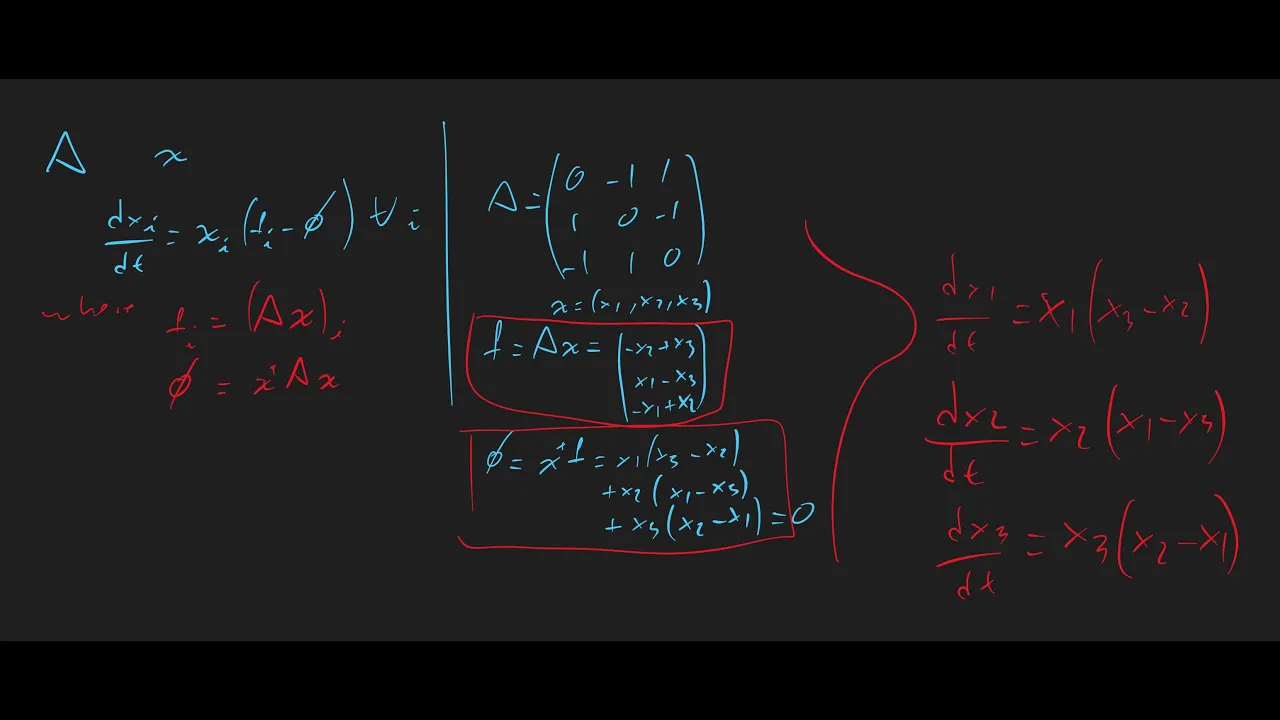
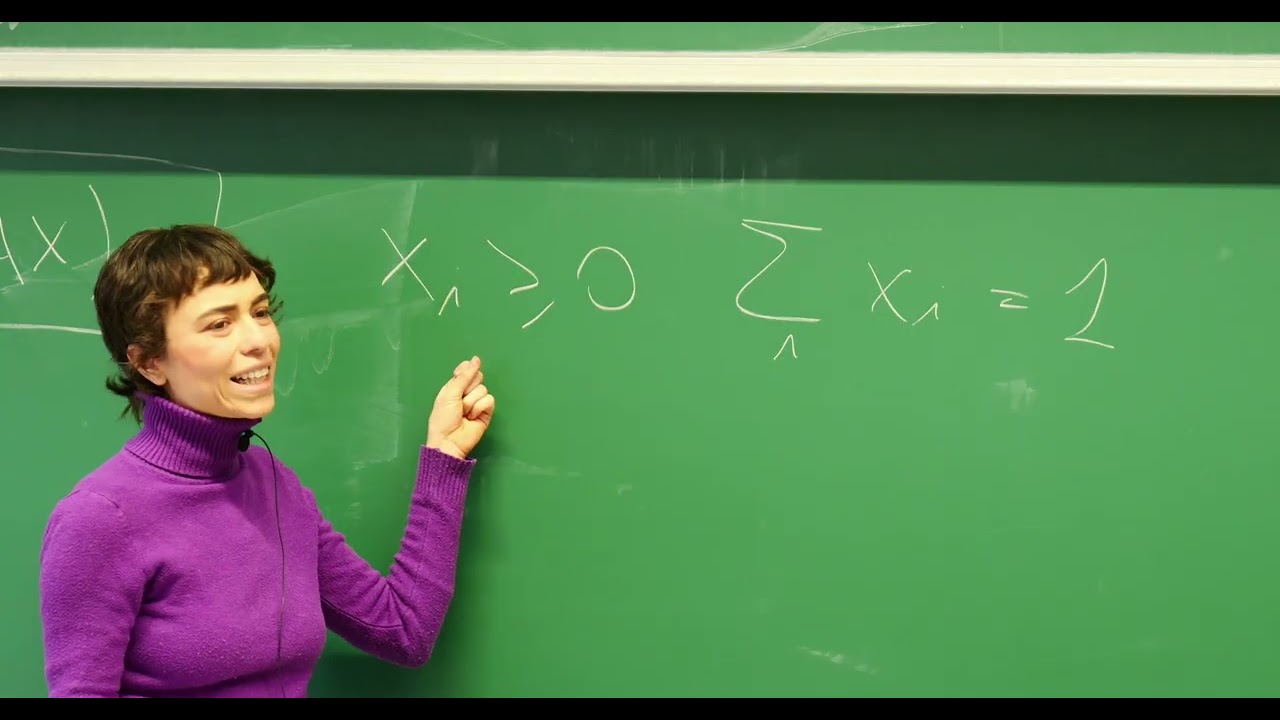
we're going to start talking about Evolution and how Game Theory uses differential equations to come up with really nice models for evolutionary processes and particularly to understand what sort of behavior might merge and what we're going to use is the the uh a famous game called The Hulk Dove game and the idea here is that in the Hulk Dev game we assume we have this population of uh Hawks and doves but the better way to think about it is we have a population of um aggressive uh animals or animals that share and what this game becomes is a model of when two of these animals interact um an aggressive over over some shared resources so food if two aggressive animals meet they will fight over the food if two sharing animals meet they will share the food and if an aggressive animal meets a sharer uh the aggressive animal will will defeat the sheriff and take the the food and a a way to to represent this numerically is with this game uh this Matrix here thank you and sort of a population of individuals that act according to this this model here uh it's called The Hulk dub game but we we essentially assume that the uh the doves are our first and so if two doves um uh meet if two uh sharers meets they they both get a utility of Two And if two aggressive animals uh meet they they both then get a utility of zero because they fight each other instead of getting the food and then we have this final point which is if an aggressive animal meets a sharer they get three and the share gets one so we essentially have four bits of food that will get shared or fought over or indeed lost okay now um what would happen if uh we let this population grow so what is the likely effect of let's say um we have a population of nothing but sharers and then there's a genetic mutation or a new animal is introduced to the population and we have an aggressive uh individual right well it's a aggressive individual take all the food and essentially over time uh gain more Fitness and take over the population so from generation to generation because the aggressive individual will have more food they'll be more likely to reproduce and they'll be more likely to pass on their genes and will have an aggressive population but of course as the number of aggressive individuals in the population grows the more likely we are to have a lower Fitness and perhaps the doves start start gaining um more or will this aggressive individual just immediately be overcome by the doves and and the doves will will essentially kick out this this mutation and so that's that's the interesting um question that game theory and this is the area of Game Theory called Evolution game theory uh asks uh asks and allows us to to answer um and the way we're going to do this is we're going to say all right let's assume we have a uh population uh X oops a population X which is just going to be a vector X1 and x two where X1 corresponds uh to um uh oops I should have said X1 corresponds to the shares and X2 corresponds uh to the aggressive ones and um these are not counts these are not numbers we assume we have an infinite population what we mean by infinite is that we simply do not care about the individual members we care about the proportions and so we immediately have that the sum of the x i um over over I which in this case is just X1 plus X2 is equal to one in other words these are proportions okay so a 50 a population with 50 percent of our our population being each would be well that would be 0.5 and that would be 0.5 okay and then what we get interested in is what happens to an individual in this population and uh this here is a an X and here I have an individual which will be denoted by a chi so a slightly fancier X I'll also try and use a a different color and this Chi will also be a vector of chi 1 and Chi 2. and that will just represent an individual who Chi one of the time shares and Chi 2 of the time uh acts aggressively and so he can immediately start making calculations based on this as to what is the fitness of such an individual so this individual here in this population what is their Fitness well this individual will meet an individual that acts sharingly x one of the time an individual that acts aggressively X2 at the time and Chi one of the time will act uh sharingly and kaitu at the time will act aggressively and so we can write down that the fitness of this individual will be given by will be given by Chi times The Matrix a Oops I meant to do that in times The Matrix a times x and if you think about it then you algebraically and what's happening with this relationship this will give you the overall uh Fitness in fact this thing here thank you ax will give you the fitness of um corresponding to each action so ax will be a vector which will correspond to the the fitness of being a sharer repeat this and the fitness of being aggressive and then Chi multiplied by that is just that expected uh average out and so this ax we will actually denote with f equals ax so in a population X in a population X we can write down the fitness of uh every type of individual f um once you've done that we can do a little bit more we can say what is the average fitness in the population well given that we know the population X we know how many individuals are getting this Fitness and how many individuals are getting that Fitness and so we can write down that the average fitness is given by Phi equals X transpose a X and once we've done that we've actually got quite a lot because what we can then say is that if your Fitness as an individual if your Fitness is above average then you will pass on your genes and if your Fitness is below average you won't pass on your genes you're less likely to take over the population and that corresponds to this differential equation which is that d x i um DT so the rate of change of individuals of type I in a population over time is equal to the amount of individuals times those individuals Fitness minus the average fitness so that if this is above average this is positive and if sorry if this is above average this is positive so this is positive so your population goes up and if this is below average then this is negative so this is negative so population goes down in our particular case let me zoom out to get everything on the board here in our particular case we can make all these calculations and we can obtain that the differential equations that dictate um the the situation we have actually give us and it's a direct result of that Matrix and that Matrix alone which tells us the interactions between the individuals give us that dx1 DT is equal to X1 times 2x1 plus X2 minus Phi and dx2 PT is equal to X2 times 3 x 1 minus 5.
where Phi is given by by this and this uh 2x1 plus X2 comes from the first row of a and uh 3x1 comes from the second row of of a because that is what the average uh Fitness is and what's quite neat is that these equations can be solved numerically and they look like this so here we're saying all right let's assume we start with a population mostly with X1 so our portion of X1 is quite high so we've got mostly sharing individuals and we introduce an aggressive individual what happens well neither individual takes so so the the aggressive individual isn't the right media kicked out the uh sharing individual don't sorry the aggressive individual is neither uh immediately kicked out or um uh the does the aggressive individual take global population so what happens is we get to some sort of equilibrium uh uh uh where we're going to have a population of both aggressive and um and sharing individuals and so this idea these equations written down are the basis for something called the replicator Dynamics equation
Up Next
80:27
Evolutionary Stable Strategies, Nash Equilibria & Iterated Games
@ecoevotheory
164 views•2024-05-30

4:43
Elliptic Curve Cryptography Explained: ECC, ECDSA, ECDH
@PracticalNetworking
28.5K views•2024-10-21
10:44
Fourier Series Introduction: The Big Idea Explained
@DrTrefor
387K views•2021-05-03

6:00
The Mathematical Impossibility of Accurate World Maps
@Vox
23.3M views•2016-12-02
Related Study Plans & Knowledge Roadmaps
Structured learning paths in Mathematics
mathematics
Tensor Calculus: Vectors to Riemann Curvature
01Mathematical Foundations: Linear Algebra & Calculus
02Covectors, Dual Spaces, and Tensor Basics
03The Metric Tensor and Index Gymnastics
+ 2 more learning modules
40h5 modules
Explore Roadmap
mathematics
Gödel's Incompleteness: Logic, Proofs & Limits
01Introduction to Formal Systems & Hilbert's Dream
02Set Theory, Cardinality, and Cantor's Diagonal Argument
03Arithmetization and Gödel Numbering
+ 2 more learning modules
14h5 modules
Explore Roadmap
mathematics
Galois Theory: Fields, Groups & Solvability
01Foundations of Abstract Algebra: Groups & Fields
02Polynomials & Field Extensions
03Splitting Fields & Symmetries
+ 2 more learning modules
24h5 modules
Explore Roadmap
mathematics
Non-Euclidean Geometry: Models & Geodesics
01Euclid's Fifth Postulate and the Birth of New Geometries
02Hyperbolic Space and the Poincaré Disk Model
03Geodesics: Defining Straight Lines in Curved Spaces
+ 2 more learning modules
15h5 modules
Explore Roadmap