















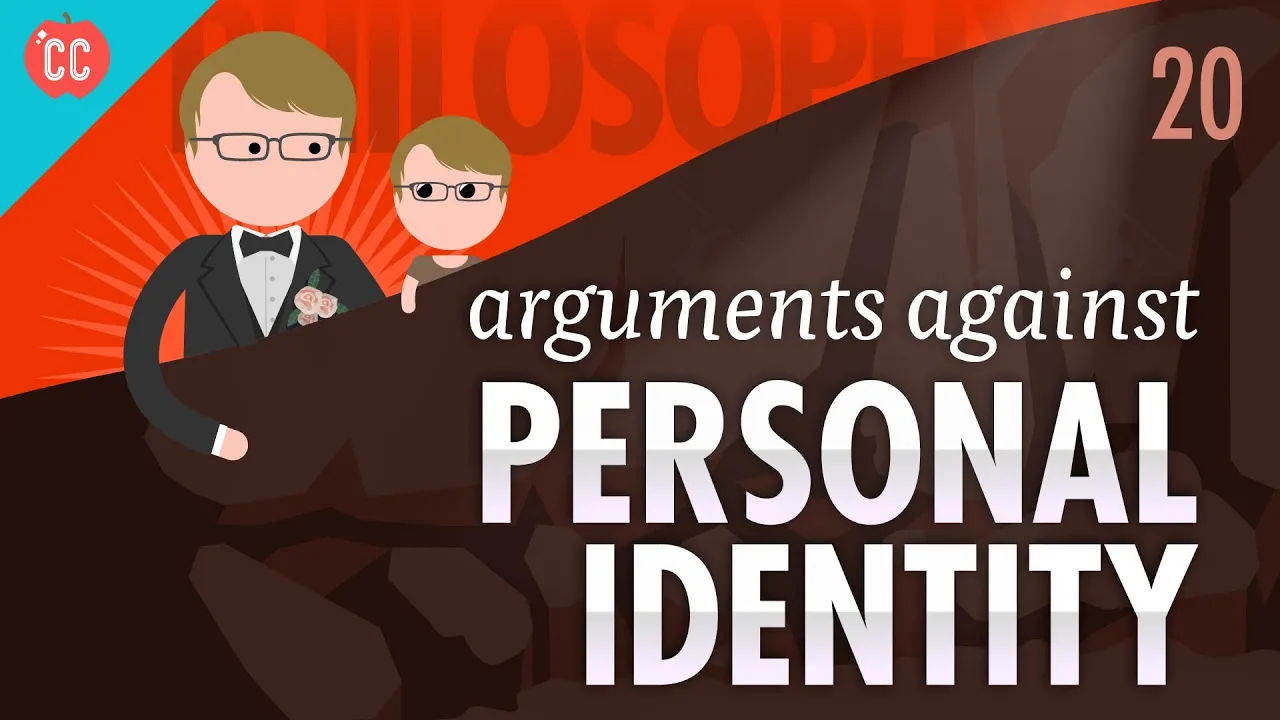






Personal identity is the philosophical question of what makes a person the same over time, with two main competing theories: the Body Theory (which holds that identity persists through physical continuity despite cellular replacement) and the Memory Theory (proposed by John Locke, which argues that identity is preserved through connected chains of memories), both facing significant challenges regarding the beginning and end of life, memory reliability, and practical implications for personal obligations and social relationships.
Personal Identity: Body vs. Memory | Philosophy
Added:The philosophical distinction between qualitative identity (sharing identical properties) and numerical identity (being one and the exact same entity over time).
Basic metaphysical concepts regarding the philosophy of mind, specifically the contrast between physicalism (the body/brain) and dualism (mind/soul separation).
An introduction to John Locke's empiricist philosophy, particularly his views on consciousness and how we acquire knowledge through experience.
Familiarity with classic identity puzzles, such as the Ship of Theseus, which examine how objects persist through the replacement of their parts.
Thomas Reid's 'Brave Officer Paradox' and other primary philosophical challenges to Locke's Memory Theory.
David Hume's 'Bundle Theory' of the self, which critiques both body and memory theories by arguing that the 'self' is a conceptual illusion.
Derek Parfit's contemporary views on personal identity, including psychological continuity and his famous 'teletransporter' thought experiment.
The practical, ethical, and legal implications of personal identity, such as determining moral responsibility in cases of advanced dementia, amnesia, or brain trauma.
2.1M views33Klikes8:32Original Release: 2016-06-27
Crash Course Philosophy is brought to you by Squarespace.
Squarespace: share your passion with the world.
Who is The Doctor? Is it this guy? Or this one? How about him?
As any good Whovian knows, the answer is yes, all of them.
But, also, wait: No.
In the show Doctor Who, each incarnation of The Doctor has a completely different body, different mannerisms, likes and dislikes and, to some extent, memories.
So… how are they all The Doctor?
Science fiction is great at giving us scenarios to grapple with that seem far-out and only barely possible.
But when you think about it, the issue of Who is Who isn’t that much more clear-cut in real life.
The fact is, you can take the same questions I asked about The Doctor, and ask them about anyone.
Like…me. I mean, are these people any more similar to each other…than these people?
[Theme Music] Last time, we talked about identity – or basically, what makes an object the same over time.
And the concept can get more complex when we talk about our own identity, or the identity of others.
When talking about ships or trees, we might be willing to say yeah, ok, that’s just not the same thing it used to be.
But when we’re talking about, say, me!
I have the strong belief that I’m the same person that mom and dad brought home from the hospital back in 1980.
I’m that same kid that cut his hand open on that broken flower pot – I have the scar to prove it!
And there’s some guy in the future who’s still going to be me, even though he’ll be all stooped over, and wrinkled, and gray. At least, I hope.
And you probably think of yourself in the same way – that you’ll keep being the same person, from birth to death.
But, you could argue – and some have – that the only thing that really remains constant about you your whole life is your name.
And for some of us, even that changes!
Philosophers have struggled with the issue of personal identity for a long time, trying to find that special something – that essential property – that makes you you, the thing that preserves your identity through time, and through all the changes that come with it.
Let’s take a look at some of ideas they’ve come up with.
First there’s the Body Theory.
This is sort of the default position that most people have – and the assumption that Doctor Who messes with so badly.
It says that personal identity persists over time because you remain in the same body from birth to death.
Now, in a sense, that’s true – I don’t know anybody outside of, like, Freaky Friday that’s had a body transplant.
But, it’s not like you consist of all of the same, identical stuff that you had when you were born.
You’ve sloughed off and replaced your outer layer of skin, for example, hundreds of times so far.
Your red blood cells only live about 4 months before they’re cycled out.
Even your skeleton is constantly being remodeled.
So, kind of like the Doctor – or the Ship of Theseus – you’re constantly being replaced by new physical versions of yourself.
And if you are your body, then how much of you can change until you become a new you?
Can you get a haircut? What if you lose or gain a lot of weight?
Or grow a beard? Or put John Travolta’s face on your face?
Let’s go over to the Thought Bubble and explore the ideas of our bodies, and ourselves, with some Flash Philosophy!
20th century English moral philosopher Bernard Williams proposed a thought experiment, to make us consider where we think our personal identity resides.
It goes something like this: You and I have been kidnapped by a mad scientist.
He tells us that, tomorrow morning, he’s going to transfer all of your mental content – all of your beliefs, memories, personality, everything – into my brain.
And then he’s gonna move all of my mental content into your brain.
Presumably, this is how he earned the title of mad scientist.
But he also tells us that, after the procedure is complete – and your mental content is in this body, and my mental content is in yours – he’ll give one of the bodies a million dollars, and the other body will be tortured.
And he’s decided to let you pick which body gets the torture and which one gets the cash.
What do you decide? Your answer should give you a clue about where you think your identity lies.
Thanks, Thought Bubble!
Now our friend John Locke didn’t cotton to the idea that the most essential aspect of a person is her body.
For Locke, the thing that makes you you is the non-physical stuff – your consciousness.
But Locke recognized that we don’t maintain a single consciousness over the course of our entire lives.
We go to sleep every day, but, when we wake up, our conscious selves remember who we were the day before.
So Locke posited a Memory Theory of personal identity.
He believed that your identity persists over time, because you retain memories of yourself at different points, and each of those memories is connected to one before it.
Now, we don’t remember every single moment – I mean, do you remember what you ate for lunch last Tuesday?
But you can probably remember a time when you did remember that – like, say, last Tuesday afternoon.
And if you can remember that version of yourself, then you’re still connected to the Tuesday-at-lunch person, through a chain of memory.
And this process can take us back a lot farther than last Tuesday.
Locke said that if you can remember back to your first day of kindergarten, you maintain a memory link to that person.
Sure, your Mom also remembers that day, but no one remembers it from the inside – the butterflies in your stomach; the way your new shoes felt stiff after a summer of running barefoot.
That’s your memory, and since it’s yours, you must be the same person who experienced that memory.
The memory theory actually makes a lot of sense, but it’s got some problems of its own.
First off, no one remembers being born.
Now that’s not a bad thing, really – I mean, I imagine none of us would really want to recall that particular experience – or the couple of years that we spent after that, pooping in our pants.
But, if personal identity requires a memory, then none of us became who we are until our first memory, which means we all lost at least a couple years at the beginning.
What’s more, if you’re committed to this view, you have to accept that people stop being the same person if they lose their memories.
So, say a person begins to suffer from dementia.
Once he’s lost the ability to remember his past, does he stop being that person?
So the memory theory presents problems for both the beginnings and ends of life, but there’s also the issue of false memories.
Memory, after all, is notoriously tricky.
We know that a group of eyewitnesses are likely to recount the same event very differently.
So, how do we know that the memories we have are accurate?
And if they’re not – if things didn’t actually happen the way you remember – then how do those faulty memories influence your identity?
Do they make you a partially fictional person?
So, at first, Locke’s theory seems to have some advantages over the Body Theory, because consciousness and memory persist through your body’s physical changes.
But, after just a little interrogation, you find that memory is pretty tenuous too.
Now, here’s the sixty-four-thousand-Altairian-dollar question: Does any of this really matter?
Like, who cares if there’s a you that persists from your birth to your death?
Maybe all you feel like you need to know is that your self has to go to work and pay bills, and that’s plenty.
But the matter of personal identity isn’t just a conceptual puzzle.
It’s also deeply important when you’re thinking about how you should live your life.
For example, do you believe that you have obligations to particular people in your life?
Well, if those people don’t persist as distinct identities, then your obligations might not either.
And the same goes for how people think about you.
Your boss only has to give you the raise she promised you, if each of you remains the same person you were when she made the promise.
In fact, if next Friday, you’re not the same person anymore, she doesn’t even have to pay you!
The fact is, we’ve all built our lives and our society on the expectations that individuals will continue to be who they are, unchanged – and those people expect the same thing out of you.
So now you can see…this really is your problem. You expect a paycheck.
You expect people to keep their promises.
But as we learned back with Clifford and James and epistemic responsibility, you don’t just get to believe things without reasons.
So if you think you deserve that paycheck, you need to figure out why.
Today we talked about personal identity.
We considered the two main answers people give to the question of where your identity lies – in your body, or in the connected memories of your consciousness.
We found some pretty significant problems with each of them, and then we talked about why the persistence of identity is actually something you should care about!
Next time, we’ll return to this issue, to talk about whether you really need the idea of a “you” that persists over time.
If you still exist then, I hope you join me.
This episode of Crash Course Philosophy is made possible by Squarespace.
Squarespace is a way to build a website, blog or online store for you and your ideas.
Squarespace features a user-friendly interface, custom templates and 24/7 customer support.
Try Squarespace at squarespace.com/crashcourse for a special offer.
Squarespace: share your passion with the world.
Crash Course Philosophy is produced in association with PBS Digital Studios.
You can head over to their channel and check out a playlist of the latest episodes from shows like Coma Niddy, Deep Look, and First Person.
This episode of Crash Course was filmed in the Doctor Cheryl C. Kinney Crash Course Studio with the help of these awesome people and our equally fantastic graphics team is Thought Cafe.
Up Next

8:54
Personal Identity: Philosophy of Self & Mind
@oxforduniversity
45.6K views•2011-04-14

164:01
John of Damascus on Holy Images: A Theological Defense
@BannedBooks
139 views•2026-04-25
9:20
How Can We Talk About Nonexistent Objects? | Philosophy
@crashcourse
872.8K views•2016-09-27
4:57
The Myth of Sisyphus: A Greek Legend of Eternal Punishment
@TEDEd
8.6M views•2018-11-13
Related Study Plans & Knowledge Roadmaps
Structured learning paths in Philosophy
philosophy
Frankfurt School: Critical Theory & Culture
01Foundations of the Frankfurt School and Critical Theory
02Horkheimer & Adorno: The Critique of Instrumental Reason
03The Culture Industry and Mass Deception
+ 2 more learning modules
12h5 modules
Explore Roadmap
philosophy
Philosophy of Language: From Frege to Austin
01The Linguistic Turn: An Introduction to Language in Philosophy
02Gottlob Frege: Sense and Reference
03Early Wittgenstein: The Picture Theory of Meaning
+ 3 more learning modules
15h6 modules
Explore Roadmap
philosophy
Feminist Epistemology: Standpoint & Injustice
01Introduction to Epistemology and Feminist Critiques
02Sandra Harding and Standpoint Theory
03Donna Haraway and Situated Knowledges
+ 2 more learning modules
12h5 modules
Explore Roadmap
philosophy
Environmental Philosophy: Ethics & Deep Ecology
01Foundations of Environmental Ethics & Anthropocentrism
02Biocentric Individualism and Animal Liberation
03Ecocentric Holism and Deep Ecology
+ 1 more learning modules
10h4 modules
Explore Roadmap