






















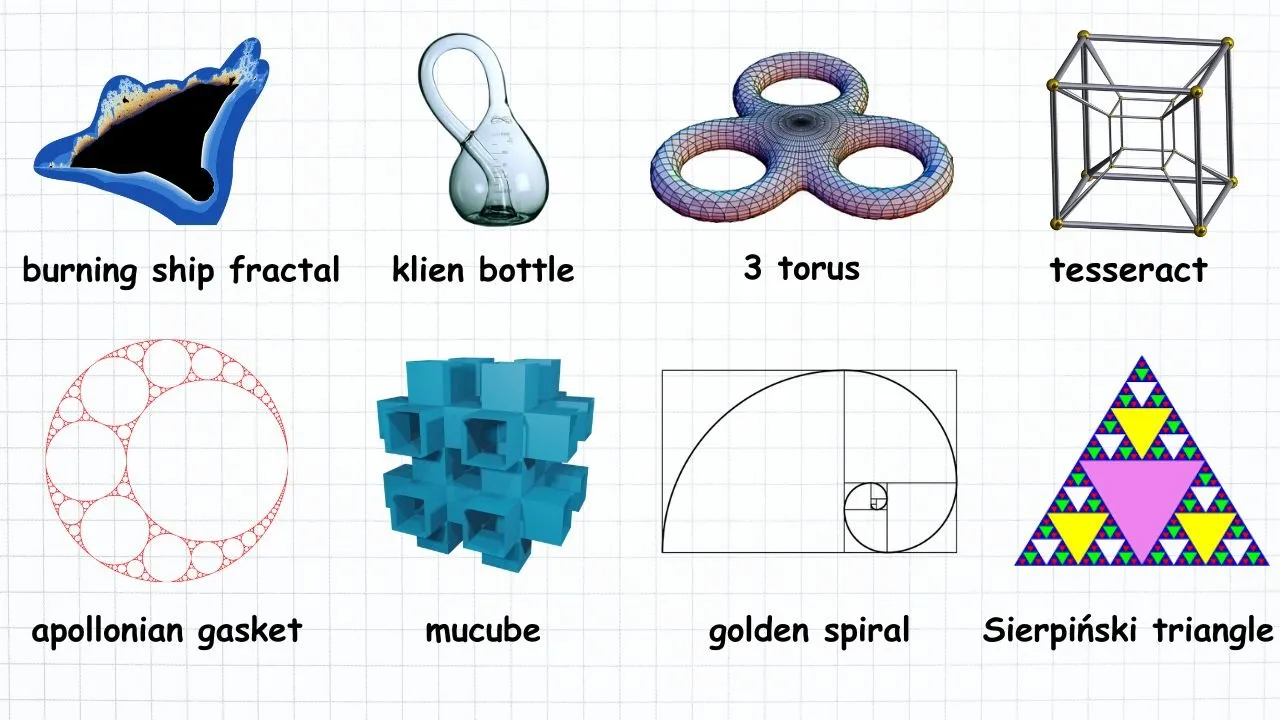

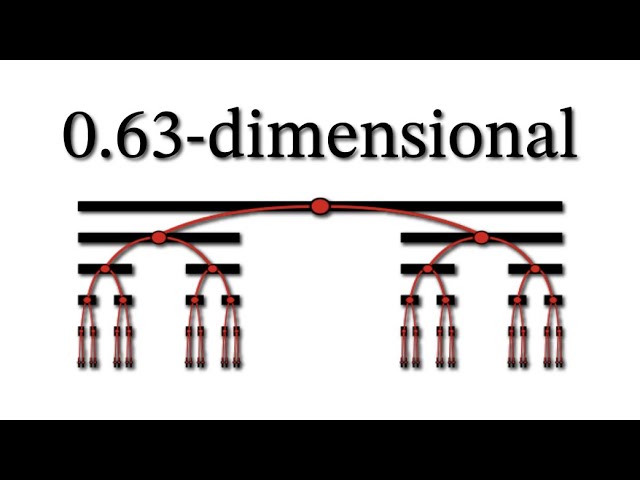
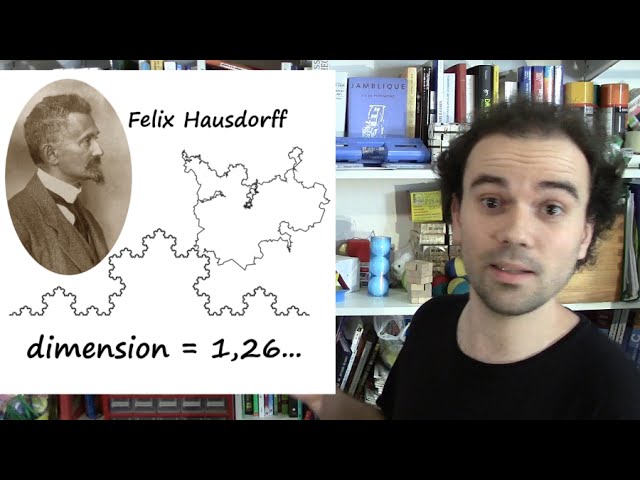




The Mandelbrot set is a fractal generated by iterating the quadratic function z = z² + c on the complex plane, where values of c that produce bounded sequences form the set; it serves as a catalog of all possible Julia sets, revealing intricate self-similar patterns at every scale, with mathematicians still investigating whether its boundary is locally connected (the MLC conjecture).
What Is the Mandelbrot Set? Math's Famous Fractal Explained
Added:Understanding of complex numbers, including their algebraic representation (a + bi) and representation on the complex plane.
The concept of mathematical iteration, specifically recursive processes where the output of a function is repeatedly fed back into itself.
The distinction between bounded sequences and those that diverge to infinity.
Basic knowledge of functions of a complex variable and coordinate mapping.
The formal study of Complex Dynamics, exploring the behavior of iterated holomorphic functions, Fatou sets, and Julia sets.
Advanced analysis of the MLC (Mandelbrot Local Connectedness) conjecture and its implications for the density of hyperbolicity.
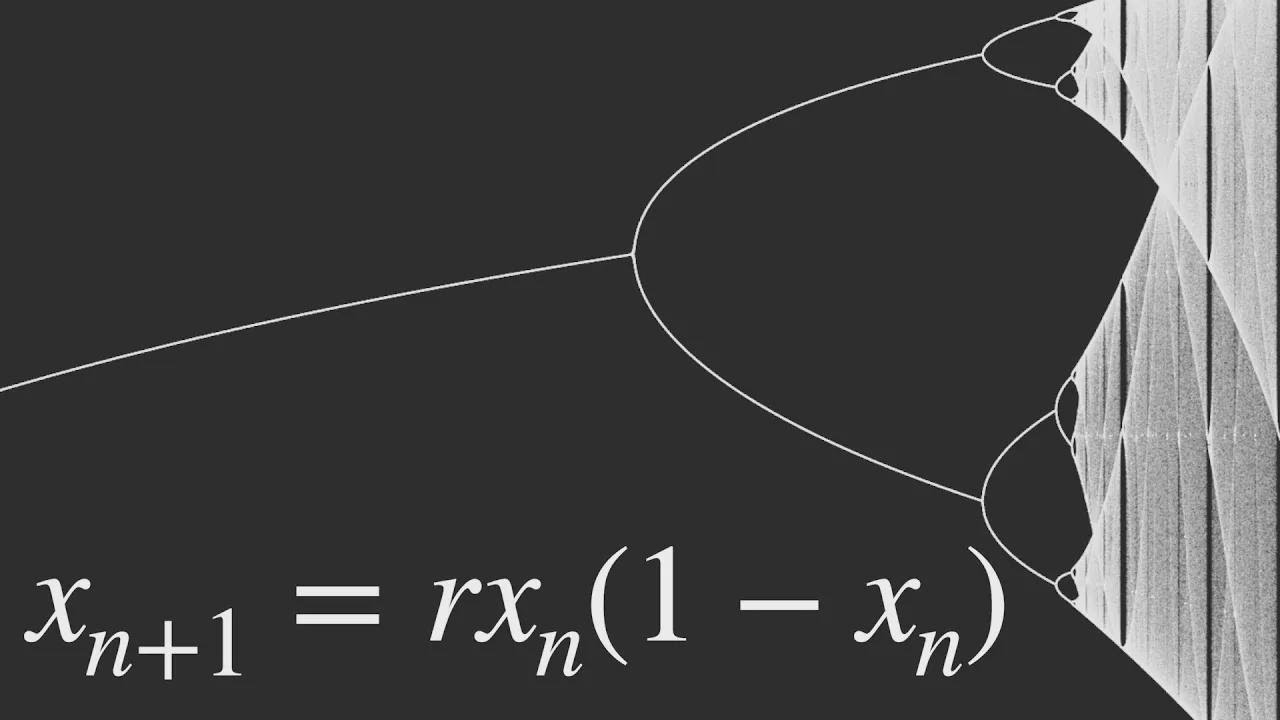
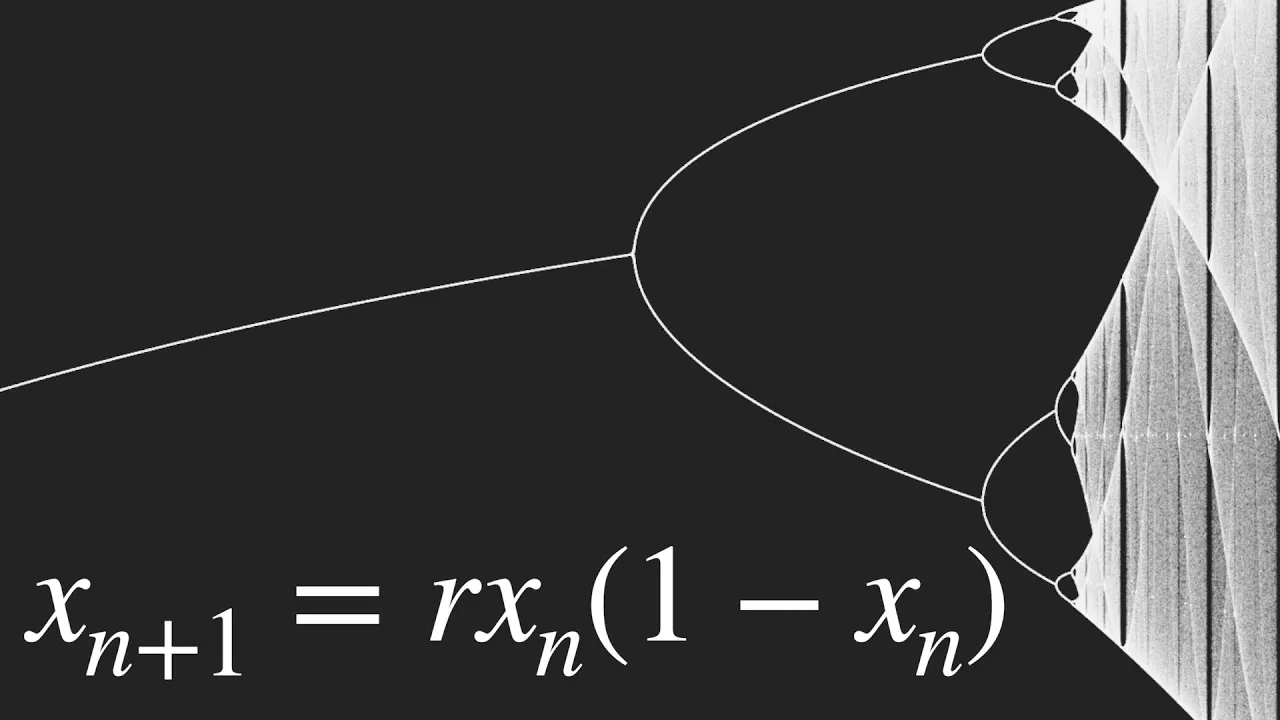
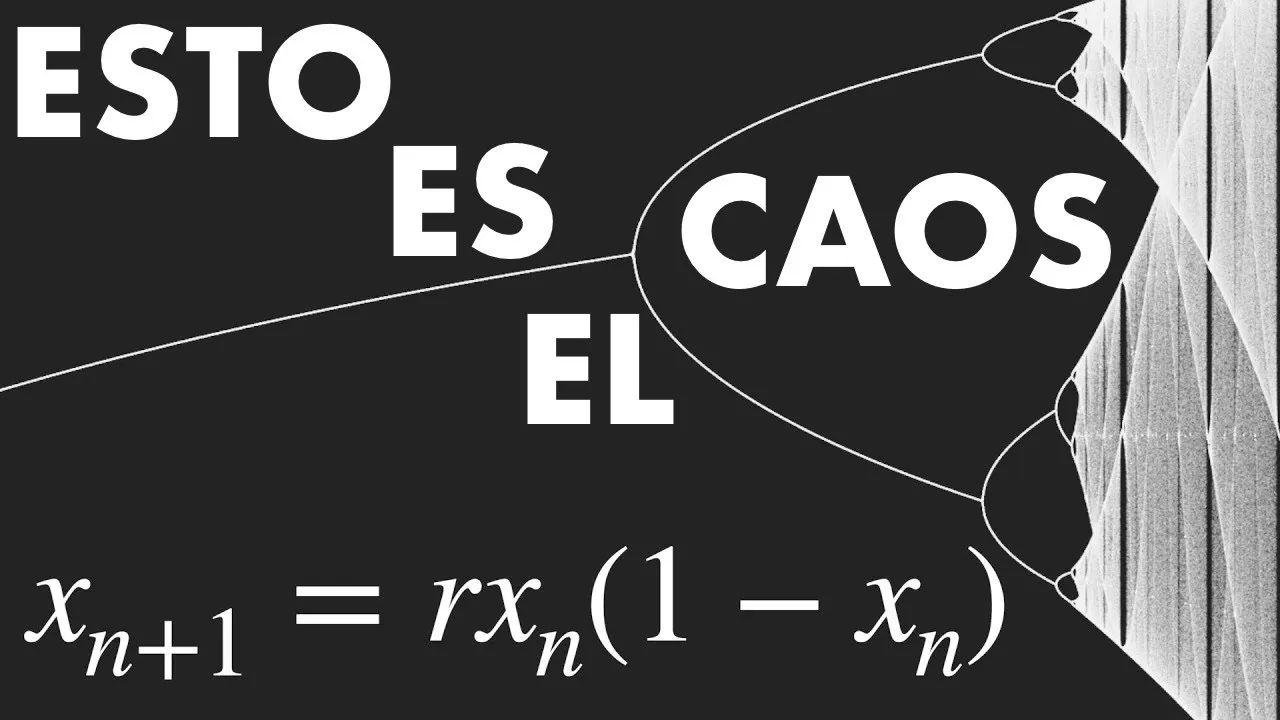
Chaos Theory and Bifurcation Theory, including the connection between the Mandelbrot set and the logistic map's period-doubling bifurcations.
Fractal Geometry, specifically calculating the Hausdorff-Besicovitch dimension of complex fractal boundaries.
Computational mathematics and fractal generation algorithms, such as the escape-time algorithm used to programmatically render these visualizations.
309.3K views7.6Klikes8:08Original Release: 2024-01-27
Behold, this infinite mathematical universe... a dizzying cascade of fractals.
Arrays of complex patterns filled with both satisfying self-similarity and surprising, novel features.
All of the structure and the patterns that you see there really do exist for a reason.
There is some sort of innate mathematical cause behind all of the phenomenon that you see.
This is the Mandelbrot set.
These trippy images represent a form of modern algorithmic exploration, one made possible by computers.
A handful of mathematicians have devoted their lives to uncovering this set's secrets.
It plays this very central role in our understanding of much, much, more complicated systems. It is step number one.
And we may be on the verge of finally understanding it.
So what exactly is the Mandelbrot set and how does it work?
The Mandelbrot set is a perfect example of how a simple rule can produce incredible complexity.
At its core, the set is generated by iterating a quadratic equation, a simple formula whose highest exponent is two.
To iterate a quadratic equation, choose a value for the variable, plug it into the function, then take the output and feed it back in again and again.
The study of how recursive functions like these change over time is central to a field of math called Complex Dynamical Systems.
This subject came about with the goal of understanding the real world.
What are the mathematics that underlie the physical world that we see?
Most important early example would've been the solar system.
So dynamical systems that you have some space where you have some rule that's assigning as time moves on, how that space evolves and how things move and change.
In the early 20th century, mathematicians, Pierre Fatou and Gaston Julia set the stage for the discovery of the Mandelbrot set with their exploration of dynamical systems.
To investigate these dynamical systems, mathematicians study intricate shapes.
today known as Julia Sets, Julis sets are produced by iterating a function of complex numbers.
A complex number is defined as the sum of two components, a real part and an imaginary part.
Each complex number can be visualized as a point in a 2D plane.
The real part is a number found on the number line.
The imaginary part is a multiple of the square root of negative one, which mathematicians write as 'i'.
Despite the name, imaginary numbers play a vital role in solving real world problems.
To construct a Julia set, start with a simple quadratic equation.
F of Z equals Z squared plus C.
Choose a value for C like negative one for example.
Then consider what happens when you iterate this equation for every possible starting value.
You repeatedly apply the function to the sequence of numbers that you're generating, and you ask whether or not that sequence is going off to infinity or whether it stays bounded.
For some initial values, your equation speeds off to infinity when iterated like this.
These values are not in a Julia set.
When you start iterating from other initial values, you might instead get a sequence of outputs that stay bounded.
When something comes back to itself, often we call that recurrent behavior, and that's where the complexity arises.
The boundary between points that stay bounded and those that don't, is a Julia Set.
You can fill it in by including all the bounded values.
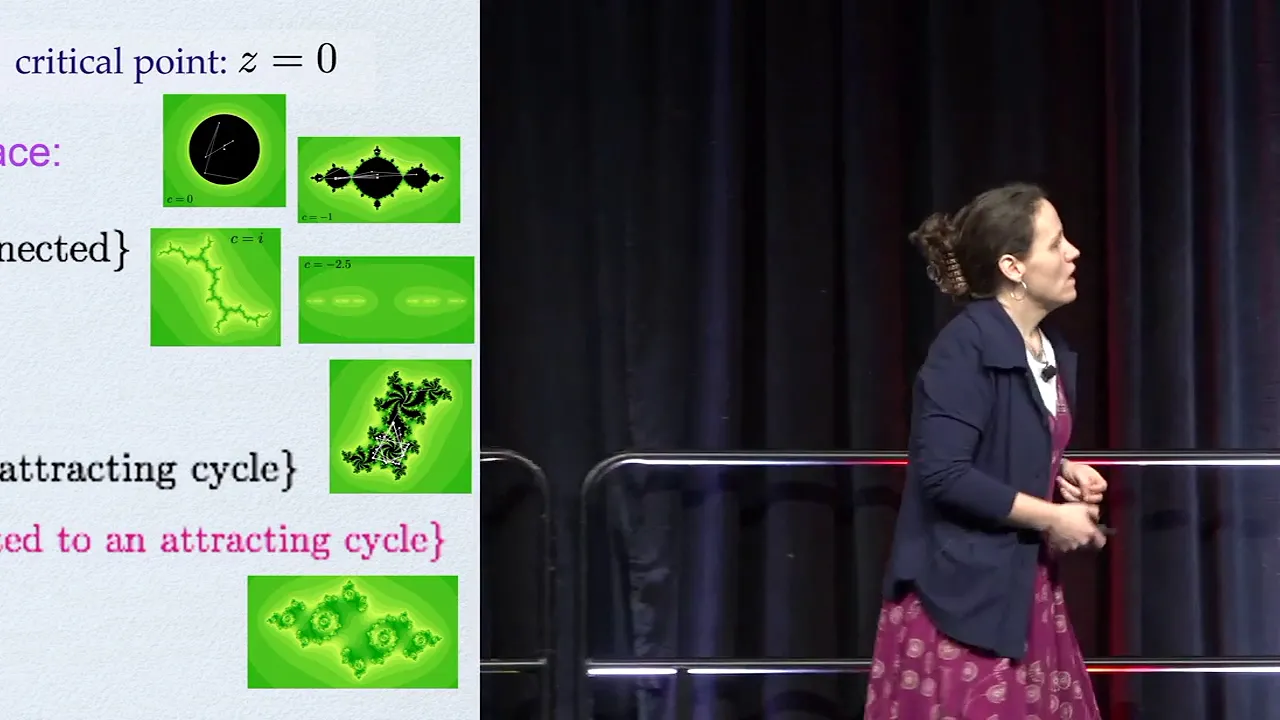
Different quadratic equations generate a wide range of filled Julia sets.
From basic blobs to intricate twisting tendrils.
Filled Juliia sets can be divided into two categories.
Sets where you can draw a line from one point to any other without lifting your pen are connected.
Sets where points look like scattered pieces of dust are disconnected.
The first rough plot of the Mandelbrot set appeared in a 1978 paper by the mathematicians Robert Brooks and J. Peter Matelski.
Soon after Benoit Mandelbrot, a researcher at IBM, who had access to more computing power, also discovered the set.
This led to further explorations.
These early computer graphics were crude, but the patterns revealed the presence of something far more complex.
Even with fuzzy, poorly made pictures in the Eighties, they were able to really glean a lot of interesting insight into what's going on.
Mandelbrot went on to popularize his now eponymous set to the world and became known as the father of fractals.
Today, mathematicians can use computers to explore the Mandelbrot set in far greater detail.
As soon as you have images just opens up this whole world.
The Mandelbrot set is drawn in the complex plane.
It's constructed by iterating the same quadratic equations used to produce Julia sets. But here things are flipped around.
Instead of iterating all values of Z for a fixed value of C, we fix the starting value of the iteration at zero and vary C.
Values of C, where iterations of Z squared plus C stay bounded are inside the Mandelbrot set.
While those that go to infinity are not.
Here, we can select points inside the Mandelbrot set to reveal their corresponding filled Julia sets.
The Mandelbrot set acts like an atlas, cataloging the different kinds of Julia sets.
Values of C inside the Mandelbrot set are associated with connected Julia sets.
While values outside the set correspond with disconnected dust.
The Mandelbrot set has many intriguing features, but its biggest mysteries lie in its complex fractal boundary.
Zooming in to different boundary regions reveals some astounding features.
A valley of seahorses, parades of elephants and miniature versions of the set itself.
So we can sort of keep finding nests, a sequence of smaller and smaller Mandelbrot sets sets, all one inside of the next.
Here at the boundary, mathematicians are probing for answers.
As you look at it, it sort of seems like one blob, but if you really ask, is it all connected? Or maybe if I zoom in far enough, there's some separating piece.
This question is central to a 40-year-old problem called the Mandelbrot Locally Connected Conjecture or MLC.
If the set is locally connected, that means that no matter what point you choose to examine or how far you zoom in, the area will always look like one nice connected section.
For example, if we closely examine a circle, we can see that it's locally connected at every point, but take a fine-toothed comb and zoom in.
While the comb is one connected shape, at close range, it can look disconnected.
If mathematicians can prove that MLC is true, then a complete understanding of the Mandelbrot set would be within reach.
This local connectivity question, if we can answer it, if it can be solved, this will give us almost complete control and understanding of what's going on.
The hope is that once we completely understand quadratic polynomials we can go on to looking at more complicated dynamical systems and be able to describe them more and more.
But a full understanding of the Mandelbrot set wouldn't put an end to our collective fascination with this famous fractal.
Hard to imagine that it wouldn't be interesting to people, even if we fully understood it, because it is so complicated and so rich and so beautiful.
Up Next
7:55
Approximating Pi via the Mandelbrot Set | Numberphile
@numberphile
871.6K views•2015-10-01

4:43
Elliptic Curve Cryptography Explained: ECC, ECDSA, ECDH
@PracticalNetworking
28.5K views•2024-10-21
10:44
Fourier Series Introduction: The Big Idea Explained
@DrTrefor
387K views•2021-05-03

6:00
The Mathematical Impossibility of Accurate World Maps
@Vox
23.3M views•2016-12-02
Related Study Plans & Knowledge Roadmaps
Structured learning paths in Mathematics
mathematics
Tensor Calculus: Vectors to Riemann Curvature
01Mathematical Foundations: Linear Algebra & Calculus
02Covectors, Dual Spaces, and Tensor Basics
03The Metric Tensor and Index Gymnastics
+ 2 more learning modules
40h5 modules
Explore Roadmap
mathematics
Gödel's Incompleteness: Logic, Proofs & Limits
01Introduction to Formal Systems & Hilbert's Dream
02Set Theory, Cardinality, and Cantor's Diagonal Argument
03Arithmetization and Gödel Numbering
+ 2 more learning modules
14h5 modules
Explore Roadmap
mathematics
Galois Theory: Fields, Groups & Solvability
01Foundations of Abstract Algebra: Groups & Fields
02Polynomials & Field Extensions
03Splitting Fields & Symmetries
+ 2 more learning modules
24h5 modules
Explore Roadmap
mathematics
Non-Euclidean Geometry: Models & Geodesics
01Euclid's Fifth Postulate and the Birth of New Geometries
02Hyperbolic Space and the Poincaré Disk Model
03Geodesics: Defining Straight Lines in Curved Spaces
+ 2 more learning modules
15h5 modules
Explore Roadmap