




























Cultural relativism is the philosophical view that all beliefs, customs, and ethics are relative to the individual within their own social context, meaning that right and wrong are culture-specific rather than universal; this perspective holds that no universal moral standard exists, so no society has the right to judge another's customs, which can lead to problematic consequences such as justifying harmful practices like terrorism or human sacrifice, and conflicts with perspectives that recognize absolute moral truths and the importance of condemning harmful cultural practices.
Cultural Relativism Explained: Definition, Dangers, and Impact
Added:Understanding the basic distinction between objective truth (independent of human opinion) and subjective opinion.
Familiarity with the fundamental concepts of ethics, morality, and how societies establish social norms.
A basic awareness of biblical worldview concepts, specifically the idea of absolute moral laws derived from a divine source.
The concept of cultural pluralism, which is the empirical observation that different cultures historically have different moral codes and practices.
Exploring philosophical critiques of cultural relativism, such as the argument from moral progress and the problem of self-refutation.
An in-depth study of Moral Objectivism and Ethical Realism as counter-frameworks to relativism.
Analyzing the tension between universal human rights (e.g., the UN Universal Declaration of Human Rights) and cultural sovereignty.
Investigating Divine Command Theory and Natural Law Theory to understand the theological foundations of absolute morality.
Examining real-world case studies where local cultural practices conflict with international ethical standards, such as human rights or gender equality.
230.8K views3.4Klikes4:47Original Release: 2020-05-20
What is cultural relativism?
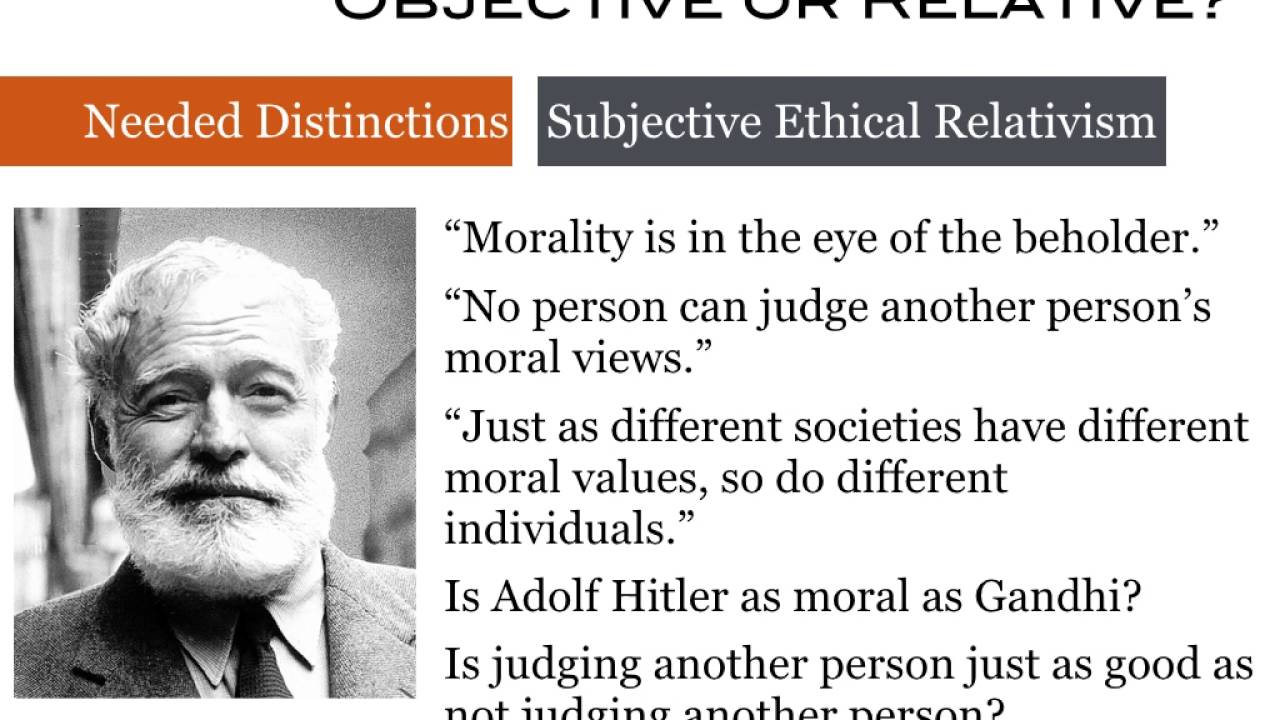
Cultural relativism is the view that all beliefs, customs, and ethics are relative to the individual within his own social context. In other words, right and wrong are culture specific.
What is considered moral in one society may be considered immoral in another.
And since no universal standard of morality exists, no one has the right to judge another society's customs.
Cultural relativism is widely accepted in modern anthropology.
Cultural relativists believe that all cultures are worthy in their own right and are of equal value. Diversity of cultures, even those with conflicting moral beliefs, is not to be considered in terms of right and wrong or good and bad.
Today's anthropologist considers all cultures to be equally legitimate expressions of human existence to be studied from a purely neutral perspective. Cultural relativism is closely related to ethical relativism which views truth as variable and not absolute. What constitutes right and wrong is determined solely by the individual or by society. Since truth is not objective, there can be no objective standard which applies to all cultures.
No one can say if someone else is right or wrong. It is a matter of personal opinion and no society can pass judgment on another society. Cultural relativism sees nothing inherently wrong and nothing inherently good with any cultural expression. So the ancient Mayan practices of self-mutilation and human sacrifice are neither good nor bad. They are simply cultural distinctions akin to the American custom of shooting fireworks on the 4th of July. Human sacrifice and fireworks both are simply different products of separate socialization.
In January 2002, when President Bush referred to terrorist nations as an axis of evil, the cultural relativists were mortified. That any society would call another society evil is anathema to the relativist. The current movement to understand radical Islam rather than to fight it is a sign that relativism is making gains. The cultural relativist believes Westerners should not impose their ideas on terrorists, including the idea that suicide bombing of civilians is evil. Islamic belief in the necessity of jihad is just as valid as any belief in Western civilization, the relativists assert. And America is as much to blame for the attacks of 9/11 as are the terrorists.
Cultural relativists are generally opposed to missionary work. When the gospel penetrates hearts and changes lives, some cultural changes always follow. For example, when Don and Carol Richardson evangelized the Sawi tribe of the Netherlands New Guinea in 1962, the Sawi changed. Specifically, they gave up their long-held customs of cannibalism and emilating widows on their husband's funeral pers. The cultural relativists may accuse the Richardsons of cultural imperialism, but most of the world would agree that ending cannibalism is a good thing. For the complete story of the Saw's conversion, as well as an exposition of cultural reform as it relates to missions, see Don Richardson's book, Peace Child. As Christians, we value all people regardless of culture because we recognize that all people are created in the image of God. We also recognize that diversity of culture is a beautiful thing and differences in food, clothing, language, etc. should be preserved and appreciated.
At the same time, we know that because of sin, not all beliefs and practices within a culture are godly or culturally beneficial. Truth is not subjective.
Truth is absolute. And there does exist a moral standard to which all people of every culture will be held accountable.
Our goal as missionaries is not to westernize the world. Rather, it is to bring the good news of salvation in Christ to the world. The gospel message will kindle social reform to the extent that any society whose practices are out of step with God's moral standard will change. Idolatry, polygamy, and slavery, for example, will come to an end as the word of God prevails. In amoral issues, missionaries seek to preserve and honor the culture of the people they serve.
Got questions? The Bible has answers and we'll help you find them.
[Music]
Up Next
101:07
Debating the Foundations of Morality | Philosophy Panel
@CosmicSkeptic
354.6K views•2025-07-14

164:01
John of Damascus on Holy Images: A Theological Defense
@BannedBooks
139 views•2026-04-25

68:32
Should We Destroy the Machines? Big Tech Surveillance Critique
@TheStoriesWeTell303
167.9K views•2025-11-30
4:57
The Myth of Sisyphus: A Greek Legend of Eternal Punishment
@TEDEd
8.6M views•2018-11-13
Related Study Plans & Knowledge Roadmaps
Structured learning paths in Philosophy
philosophy
Frankfurt School: Critical Theory & Culture
01Foundations of the Frankfurt School and Critical Theory
02Horkheimer & Adorno: The Critique of Instrumental Reason
03The Culture Industry and Mass Deception
+ 2 more learning modules
12h5 modules
Explore Roadmap
philosophy
Philosophy of Language: From Frege to Austin
01The Linguistic Turn: An Introduction to Language in Philosophy
02Gottlob Frege: Sense and Reference
03Early Wittgenstein: The Picture Theory of Meaning
+ 3 more learning modules
15h6 modules
Explore Roadmap
philosophy
Feminist Epistemology: Standpoint & Injustice
01Introduction to Epistemology and Feminist Critiques
02Sandra Harding and Standpoint Theory
03Donna Haraway and Situated Knowledges
+ 2 more learning modules
12h5 modules
Explore Roadmap
philosophy
Environmental Philosophy: Ethics & Deep Ecology
01Foundations of Environmental Ethics & Anthropocentrism
02Biocentric Individualism and Animal Liberation
03Ecocentric Holism and Deep Ecology
+ 1 more learning modules
10h4 modules
Explore Roadmap