









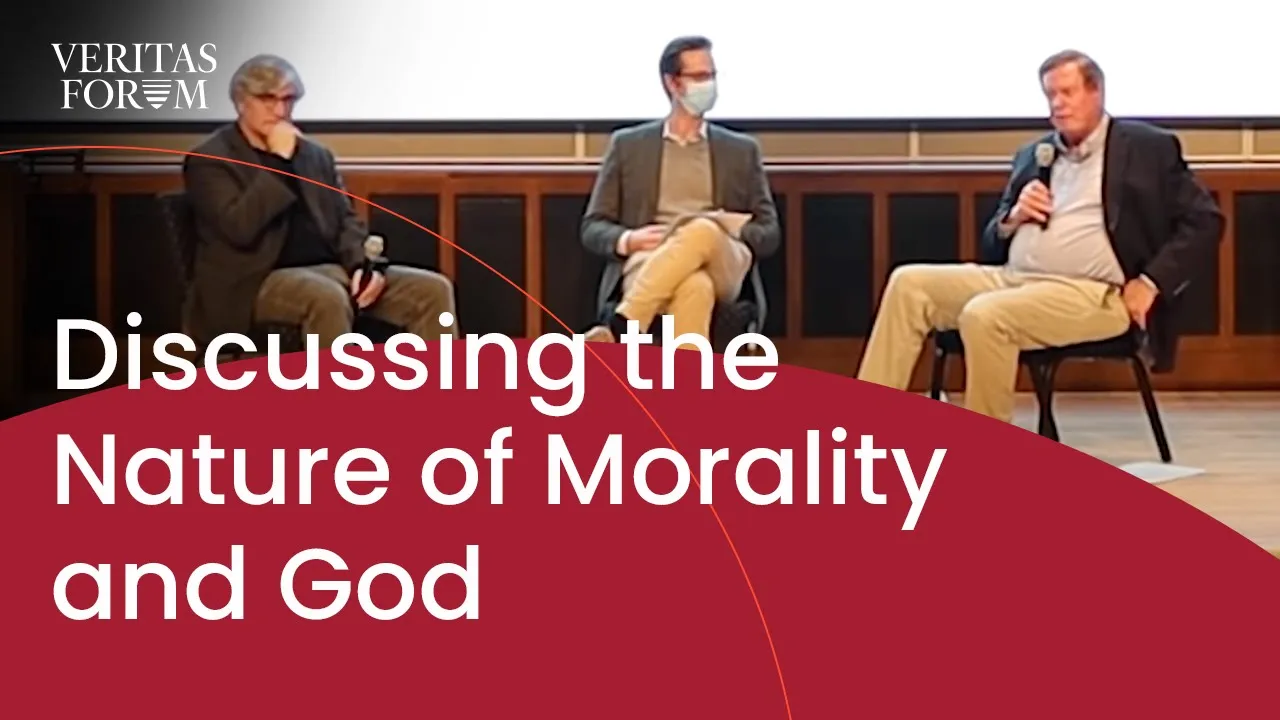
















This video presents a philosophical debate on the foundations of morality, featuring three perspectives: Peter Singer argues that morality is grounded in our capacity to reason and that all sentient beings—humans and non-humans alike—deserve equal moral consideration based on their capacity to experience pleasure and pain; Richard Swinburne presents a theistic view where moral obligations arise from divine command and promises, emphasizing duties to fulfill commitments regardless of consequences; and Alex O'Connor advocates for ethical emotivism, proposing that moral statements are expressions of emotion rather than truth-apt propositions, suggesting that moral disagreements often mask factual disputes. The discussion explores how moral reasoning should extend beyond human concerns to include non-human animals and potentially artificial intelligence, while examining whether moral facts exist independently of human psychology or are constructed through social and emotional processes.
Debating the Foundations of Morality | Philosophy Panel
Added:What is morality and where does it come from?
Is it woven into the fabric of the universe or something we invent to make our instincts and emotions make sense?
As we decide how to treat other animals and artificial intelligence, we need to understand the roots and the reach of moral thought.
From ancient religion to modern ethics, tonight we ask, are we any close to understanding what it means to be good?
Ladies and gentlemen of the Royal Institution Theater, please put your hands together for your host, BBC New Generation Thinker of 2024, Dr. Jack Size.
[Music] Nailed it. Beautiful. Beautiful.
Hello and welcome to the mystery of morality here at the beautiful Royal Institution Theater. Brought to you by our good friends at Premier Christian Radio's Unbelievable.
Every single time I come here, I'm just blown. I say this every time I come on.
I say I'm blown away by the support.
Another sellout show. I need to like I'm not I wasn't used to saying that the first two times, but I think this is the fifth show in a row that we've done.
Just give me a little show of hands if you've came to one of the shows before.
Wow. Okay, so maybe a third in the front there. Keep your hand up if you're one of those people who were heckling me in the audience last week.
He's up there, Paul. Make sure that Oh, no. Was it Was it you all along? Okay, take yourself out. Drag yourself around the back. Thank you all for being here.
We've got four exceptional thinkers waiting in the wings. So, without further ado, let's bring them out.
Please give them a huge warm welcome.
First of all, for the man who has God double-checking his moral reasoning, Professor Richard Swimburn Pro for what goes around comes around and always in a good way. It's Dr. Jessica Frasier, part-time skateboarder, fulltime philosopher. It's Alex O' Conor.
Now, please join me. If you've been here before, you may know that Rich has been with us before. Jessica's been with us before. Alex has been with us before.
I'm so excited tonight to welcome for the first time here at the Royal Institution Theater, Peter Singer.
Thank you all for being here. This is going to be I'm really excited about the discussion. We're going to set our stalls out in reference to a central question. We're having about an hour of free flowing conversation before we open it up to questions from you, the audience. The main questions we're thinking about tonight are what the grounds of morality are and who counts, who should come into our moral calculations, other animals, artificial intelligence, and the like. Peter, would you like to kick us off? What grounds morality and what counts morally?
Well, what grounds morality, I believe, is our capacity to reason. Now, that's not denying that morality, that our moral instincts, our intuitions have a base in evolution. We evolved as social mammals and we can find something like morality, a kind of protomorality in our closer relatives, the chimpanzees and bonobos for example. But if we really want to know what is right and wrong, I think we have to get beyond that. The fact that we have something that has evolved is not a reason for thinking that that is the right thing to do.
Especially not in the circumstances that we are now, which may be quite different from the circumstance in which we evolved. For example, we evolved in small communities of maybe 150 people, face-toface communities. We now live in a world where we can make a difference to people on the other side of the world. So what are our obligations regarding that? I think the answer is that if we really think about it, the interests of any one human being and any other uh should carry equal weight unless of course one of them has some problem so that they are incapable of experiencing pleasure or pain. Maybe they're not even conscious. That would mean that they they don't have interests in the relevant sense. And in fact, I will go further and say that just as we can see that the interests of one human has the same weight as another if those interests are comparable, I think that extends even beyond our species. So although we've reached a status at least officially of accepting a universal declaration of human rights, which is a kind of statement that all human beings matter morally and matter equally in some sense. I think we need to move beyond that and we need to recognize that the species of a being just like the race or the sex of a being is not in itself a reason for saying that the pain it may experience doesn't matter or the pleasure that it experiences doesn't matter. I think that we should regard all sentient creatures as moral subjects. That is, as beings with moral standing, which means we have obligations not to harm them and where we can to promote their happiness and well-being.
And uh it's also true then if we want to talk about the possibility that artificial intelligence should become conscious that if we it does convince us that we have conscious AI that it has feelings that matter that cares about things then that I think would also count as well. So that's my answer to the question who is a moral subject. Uh all sentient beings are moral subjects.
Jessica, you specialize in Hindu worldviews. Uh the popular conception is that they, you know, they have a better or I don't want to say better, but they have a very different approach to nonhuman animal rights than we have traditionally in the west. What grounds that?
>> Um well, okay, I'm going to put out a theory, if you like, of how to look at it that I think folds in. uh all beings who are able to experience good and bad and I'm coming partly from the angle indeed that in Asian religions you often don't have a particular god or a platonic good that is the point on which you hang all concepts of goodness so you have to come at it a different way I'm going to suggest um something like looking at it through an ethics of ascent where goodness is real but it's more emergent from out of the natural world and every being that can help generate an experience experience of good is part of that. So to illustrate that and we'll come to kind of how this fits into Hindu and Buddhist ideas, but to illustrate it, imagine the big bang just happened and suddenly there's space and time and there's matter and there's objects and relations. Is there ethics yet? Probably not. Next stage. Now there's chemicals, compounds, organic life, consciousness, experiences of anxiety, and of flourishing. Is there ethics yet?
Unclear. The next stage you've got now consciousness, emotion, empathy, the ability to discover emotions in other beings, to plan on whether to use your agency to create happiness or sadness in other beings. You've got stories, you've got feeling, you've got art, you've got the ability for self-sacrifice. Now, emerging out of that picture, it feels like we have ethics.
This is an idea that you find in a number of Indian texts. Um, there's an ancient text that uses the image of spices. If you take spices by themselves, there's nothing that exciting there. But mix them the right way and you get flavor, which is an emergent thing that happens in minds and it's a real thing.
And I want to argue that ethics is a certain way of looking at it that sees ethics and goodness as real. It's something that emerges and every being that is able to help generate it as an experience in some creature is part of that ethical realm. Three things I'll end on. One, it's a context ethics. That means there isn't one thing. It's going to arise differently in different situations. And so if you're a moral agent, you have to be able to be aware and skillful about how you manipulate your environment. Two, it means ethics is real. It's not a reductionist picture. It's a real ethical realm that is generated out of us partly just as numbers as stories are. So it's something we have to take very seriously. And three, it puts you in the driver's seat. Right? If you don't have a god or a good or a sign or a commandment, you have to be aware of how you're making good or bad every minute.
And it's that sense of being part of the emergent arising of the good that is really where ethics and ethical subjects lie. Richard, what do you make of this?
Is ethics something there at the beginning of time or does it emerge out of nature?
>> Let's could consider the individual person. Um we learn each of us uh ethical views from our parents who tell us this is wrong and that's right and they tell us that with regard to our own behavior and with regard to the behavior of others and so we start with certain uh particular judgments and then we come to notice uh that um these particular judgments exemplify general principles such as that one shouldn't uh uh unnecessarily hurt people and so on. And I don't think those principles are solely concerned with be benefiting the experiences of others. One of the deepest moral principles is an obligation to fulfill your promises. Uh whether or not it does anybody any good.
um uh if I am making a pro a promise to a dying man that I will do so and so and he dies and uh he will never know whether I do so and so or not and I think so and so is a bad thing to do. I would fail in my obligations if I didn't uh carry out his wishes. So it it extends a lot further than human experiences.
uh and what we learn is general we come to see to recognize as a result of the particular examples we've been given general principles which cover a lot of examples uh so showing that some actions are obligatory and others are just good but not obligatory and so on and um then we come into contact with other people who have different views how are we to resolve them well there's a couple of methods at least. One is by experience.
If someone says uh no government ought to admit illegal uh migrants and um we're originally taught that and then we go and find and learn on the telly what horrible things happened to illegal migrants that made them illegally migrate and we uh change our mind. But there is also a principle which is known as reflective equilibrium. That is to say, we fi find ourselves formulating general principles on the basis of what we have learned.
And someone points out to us that one of these uh judgments really doesn't fit with the other ones. And so we want must know whether we want to stand by the odd judgment or whether we wish to rule it out on the basis of what we have heard others say and that way we can make progress. Of course there will be some people one meets who have totally different moral views and I don't see any reason for calling those moral views moral views. It has to have some connection with the sort of thing that most of us recognize as moral. Um uh and um >> just to put just to push you on the the second part of the question briefly is the uh who counts as uh like who counts morally there with non-human animals and >> um it's um uh my point was that not all uh moral obligations are obligations to benefit somebody's experiences. Many of them are not all of them. um uh it's uh integral we recognize it's integral to humans that we must fulfill our promises and not lie whether or not it's to the benefit of human race the human race that we keep that and just one further general point I would like to make one principle which we come to recognize is if we have um received a very great benefit from someone and we've agreed to receive it on condition that uh uh we fulfill certain obligations we wouldn't have otherwise. Then of course we have a duty to fulfill those obligations. But our two greatest benefactors are benefactors who have given us life itself. Uh they are our parents who brought us into being and are the state who has kept us in being by security.
And um if we are uh appreciate what they have done otherwise we should be committing suicide. Uh if we appreciate what they have done it's reasonable to suppose that we have great obligations to them to do what they say and of course that is recognized. We we our children have to obey their parents in various ways even if there's no other reason for doing it. Um and likewise of course with the state and of course I would generalize that because the the benefit provided by God is far greater than the benefit provided by parents or the state. God makes uh gives the state and the the um our parents the power to do things and everything we do is is due to God who has brought us into being.
And it's reasonable to suppose for that reason that if we knew all the good things that had come to us in life, we would have accepted the obligation to follow him and what do he wants. So I think um uh unless it's wrong, of course, but a good God wouldn't command us to do wrong. But what a good God would command us to do is to do actions which are not obligatory, but are just fairly good.
And therefore, um, some of our obligations are obligations to do what God tells us.
>> Okay, good. I've I've got to keep my promise at holding to five minutes and I wouldn't want to do something immoral.
So, I'll come back to you on a couple of these, Richard. As Rich was speaking there, I picked on a bunch of things that I can imagine you disagree with, Alex, moral facts, and then we started talking about God as well. So, where do you want to start?
>> I think there's a lot to agree with, of course, in in what everybody said, as there always is. Um, I really like this idea of starting with sort of nothing and beginning to to build things into our universe and see when intuitively we think this thing called ethics might evolve. Uh, because it's quite a difficult thing to define, right?
Famously, terms like good and bad are extremely difficult to put into precise or imprecise definitions. So, okay, let's try to analyze what what it is that we think makes something moral and a universe in which that wouldn't exist.
One way of doing that might be to start with, you know, the atoms and the planets and then the people. And we might say that it's somewhere around where consciousness evolves. I agree with that. But think about everyday actions as well, right? Like if I'm walking down the street and you see me kick a homeless person for fun.
There are two things that's important.
There are two things that you could say, right? One is you could sort of think to yourself a descriptive fact. Alex just kicked a homeless person. That's a fact.
That's that's in your mind. it's a it's a proposition that you're thinking about. Another is like I think it's wrong that he did that. Right?
Propositions like that though, like they they don't sort of appear in your consciousness in that way. Some people think in sentences, but for me that proposition, Alex just kicked a homeless person would kind of exist in my mind before the before the words that I formulated them in did. Okay. So then I'm just going to ask like what's the difference between those kinds of like propositions or statements? a descriptive statement like the sky is blue um could be true or false. The sky is blue, the chairs are green.
Descriptive statements like that and moral statements that was wrong. You shouldn't have done that. For me, to cut it quite short because we only have 5 minutes, I am an ethical emotivist. I think the answer to this question is feeling. Um, and that's why I think that there is quite a lot to agree with in what in what Richard Swimburn said, although perhaps for different reasons.
Um, ethical emotivists think that ethical statements are expressions of emotion. So when you say that murder is wrong, crudely as AJ A had it, you're saying something a bit like boo murder, right? It's not the same thing as reporting on your feelings. It's not the same thing as saying I don't like murder. That's the kind of thing that could be true or false. That's a statement. Could be true that I don't like murder. I could be lying about that. But the expression of the emotion itself, that's what murder is wrong, means. There are a few famous problems for this. One of the most simple is the problem of moral disagreement. Now, how do we account then for the fact that you've got people who disagree ethically with each other and yet they seem to be talking meaningfully? Well, I agree with Professor Swinburn that you might see such a debate. I can't remember the exact example that >> that you gave. Oh, about immigration or something, right? and and you might sort of think that something's right or wrong and then you look on the TV and you see something and it changes your mind. But as a also pointed out, so much of what we call moral disagreement is actually just factual disagreement. It exists on that descriptive plane. Because if the thing that changed your mind was a factual statement that you saw on the news, a number of people who' been stopped at a border or an amount of suffering that had been caused, you haven't changed your mind on anything ethical. You've just changed your mind about a descriptive fact. And that descriptive fact has informed your ethical judgment on that particular uh instance. So another example might be like um gun laws in the United States.
You could have an ethical debate with somebody. You know that if you criminalize guns then more people die of guns. That's just like a fact that can be tested as true or false. That's not a moral claim. You know that swimming pools kill more children than guns do.
Maybe that's true. Maybe that's false.
But that's not a moral claim. That's a factual claim. And if those are the kinds of discussions you're having which are making you change your mind, you're not debating ethics at all. So I would start by answering that objection by saying that a lot of what we call moral disagreement isn't moral disagreement at all. There's more to say about where there might be fundamental moral disagreement. Of course, um but I should be careful here. I don't even know what time we started. But oh, but the other thing to say is that there was another response to this which is like, well, how else do we deal with uh moral disagreement? Apart from looking at things on the TV and stuff, there's also this wonderful concept of reflective equilibrium. um you might be familiar uh with it from the work of John Rules uh when talking about how we should organize society and and you kind of have this idea where you've got your moral principles that you feed into this big ethics machine and then you've got the consequences they cause. So Peter Singer has a wonderful idea that suffering matters no matter who's suffering and you plug that into the machine and what consequence does it give you? Well, we catch around 440 billion shrimp every single year. And for $1 donated to the shrimp welfare project, you can save one and a half thousand of them from being tortured essentially before their death, right?
Is that the best use of your money?
Maybe. But the reflective equilibrium says like, well, if you think that's a bit of an unintuitive use of your money, but you've also got this principle, this reflective equilibrium is sort of a tug and tussle between the two. What is governing >> how much stock you place in whether that conclusion is true? and I just have to accept it because of my premises or even though I've got those premises, I don't like the conclusions. I'm not so sure about that. I think it's feeling. In other words, >> Jessica, let's I want to bring you in here. Alex's position. I looked up before the the show. I was thinking how many professional philosophers, philosophers more generally, who subscribed to something like emotivism or some non-realism, non-cognitivism.
And I I saw on the Phil paper survey, this big survey of philosophers, I think it was like five years ago, 20% have a view similar to Alex's, 70% have a view which say there are like moral facts that are out there and famously this is a problem that they'd be very weird things, right? But you seem to be saying they're not actually that weird. They're sort of just like things we >> moral facts.
>> Moral facts. Yeah. So what do you think of emotivism and um and what would you say to Yeah. What would you say to Alex to to bring him over to the 70%. I think that it Oh, what would I say to Alex?
Oh, I think that's an interesting question here um about the status of emotion, right? Clearly emotion is part of this and clearly it's a good analysis of language that I'm not going oh let me consider at length my objective view on the kicking of that poor homeless man.
I'm feeling it directly and that's and I I think the way that I'm thinking of it that's that's a that's arising from my whole being >> from circumstance from feeling from all my instincts from many things I'm not sure I think it's not rational >> Mhm. with that and in a way I think it's precisely there is a there is a rational element there right it does matter to me whether you are kicking him because he asked you to uh or you were kicking him because you were a mean old sod mattered >> yeah see it doesn't matter or whether he killed your sister's that wonderful story about a guy who ate some other guy and he went to the police afterwards and said no but the guy told me to and he'd written down yeah it's okay you can do it mate right it's moral kind of confusion about what are the motives, what are the experiences being had, what are the um what are the various circumstantial factors generating the status of that act. And I think all of that together with reason and emotion generates our sense of what it is that's right and good. It's hard I find it hard to see how you separate them out. One real quick example, there's a there's there's a famous argument in Buddhism uh Shantaa talks about it. Can't remember the text. um in where he says it people don't exist, actions don't exist, things don't exist, nothing exists. It's all a kind of virtual magical matrix and nothing is really there. But you know what matters even if nothing exists that we do the right thing and are compassionate to other people.
>> So you get a strange status where actually maybe moral relations and facts are the realest things that we generate no matter what the status of anything else. I just want to drive a wedge very quickly between Alex and Richard because Alex made it seem like you you're agreeing with Richard on a few points but I wonder Richard if you've got any thoughts as well before Alex gives a response on you know on emotivism whether it's just >> plenty to say um um first I think it's a basic epistemic pro uh uh requirement that you should believe that things are as they seem to be in the absence of counter evidence.
If it seems to you that you're hearing me talk to you, you should believe that and rather than that you are dreaming.
Um, and that applies to absolutely everything. Uh, unless you've got positive evidence that that is your belief is mistaken, you should go along with it. It's no good saying your you should only believe this if people agree with you. Uh maybe but uh u you only believe but that would only be the case that you uh were then in the position as to whether they really did believe in you and whether they had said that they agreed with you. But then it would only be your belief that they had said to you that they agreed with you about the other belief. And that is the basic uh principle on everything and it applies to morals too. And if you start with the view that what I believe about morality is correct unless and correct I mean is a true proposition. Uh then you've got to produce evidence against it and the reflective equilibrium principle designed to do that. It's um not a principle that will solve everything. I quite agree. Uh it won't solve how many shrimps have to study, have to suffer in order to benefit something else. But it will settle quite a number of things. Uh a simple example um suppose someone has been brought up to say it's wrong to kill except uh um if you've been authorized by uh the state to kill uh a criminal who has broken the law in some way or unless you have uh um uh unless you're fighting in a just war for your country or unless in a wild west state uh someone has killed your relative, then you're entitled to kill them. Um uh and also they they may have been taught it's okay to kill somebody in a duel, a duel, a fight. Um and then somebody points out to you, well all your other principles apart from the last principle uh say that um life should never be taken away except to save life or in uh uh compensation for life. Um and then that rules out the principle of u killing in a duel being justified because it doesn't fit into this general pattern of of why why uh it's legitimate to kill. And of course you by reflection on that principle uh in general about the sacredness of life, you might come to the conclusion that it's only justified to kill in order to save life.
either in a just war or in some other way, but never in retribution.
>> Okay, let's uh bring Peter back in here.
Peter, thoughts on these opening remarks and perhaps on emotivism as well. Did you used to hold a view similar to emotivism back in the day?
>> Um, I did hold a view that there were no objective truths in ethics for some some time. Yes. Um, and I eventually came to the view that that doesn't give enough place for reasoning. as as Alex said, we do disagree on ethical matters and we don't just say as you know, we disagree on matters of taste. Um, I like strawberries better than raspberries.
You like raspberries better than strawberries. It's not worth arguing about that. Um, but we do want to argue about including matters where we are agreed on the facts, right? We might know all the facts about abortion and some people will think that abortion is right. Some people will think it's wrong. Admittedly, some of those facts or supposed facts might be about the existence of God and God has said one shouldn't kill or should never kill a human being and the fetus is a human being. So, so there can be perhaps some factual differences, but I think there are also moral differences that are not reducible to facts and they're still worth discussing and arguing. One other comment, I was a little bit surprised that Richard Swinburn um supported reflective equilibrium. Um, Alex did too, but I think it's more incompatible with your view, Richard, because reflective equilibrium really leads to a kind of relativism. And Rolls himself admitted this, um, that his reflective equilibrium that he worked at in theory of justice was one for basically western liberal societies. And if you had grown up in a different society, you would have a very different set of intuitions and the reflective equilibrium that you came to would be different. So it doesn't lead to an objective morality.
And that's one problem with it. The other problem with it, I think, is that even when we do have similar intuitions, as I said in my opening remarks, they may be just intuitions that we had because we all evolved in these smallcale face-to-face societies. And so we have the intuition that it would be terribly wrong not to save somebody in need uh face to face. But it's quite okay to continue to live our affluent lifestyle and buy the luxury goods that are on sale just a few blocks away. Um uh and not donate anything to organizations that are effectively acting to save the lives of children who are dying in other countries in the world. Um and as I say, I think the fact that we have this intuition does not at all count towards saying, well then that's right. Um it we don't have an obligation to people who are far away just because we don't perhaps grow up with that intuition that uh we ought to do something for them.
>> Um >> and the same may be true about about our intuitions about race. Certainly people in earlier centuries um did not have intuitions that it was we had obligations to grant Africans say the same kinds of rights that we grant Europeans. Um, and we today, I think, still are lacking in our intuitions about non-human animals.
>> Okay, let's bring Richard in for a second.
>> I think you misunderstand the principle of reflective equilibrium. I wasn't saying it will always give true answers.
I was saying that the um uh we we are more that the answer given by it is more probable than not. um and on the evidence available to us with and the evidence available to us is how strongly we feel about different things and whether they fit together. It's not guaranteed to get the answer. Uh it may lead you astray, but it probably won't.
And that's >> I think it quite likely will because those intuitions may be quite as >> Yeah, but I mean that's um I don't accept that. Uh but uh um that's the way progress has been made often. I may I took as it were a rather artificial example uh uh but um uh let's take another example uh of news uh the parable of the good Samaritan which uh Jesus told um uh the um uh lawyer who asked the Jewish lawyer who asked uh uh Jesus um he believed that uh uh why one should love one's neighbor. That's what the law said. And he said, well, who is my neighbor? And Jesus told the story of the good Samaritan to illustrate that that uh surely um putting in modern terminology what he was saying is that if somebody behaves if you come across someone who behaves like that to you uh surely there's no difference between him and the people uh um who uh keep the Old Testament law and What he's inviting you, Jesus is inviting his uh hearers to uh take account of is their conflicting uh their conflicting views about who is the neighbor plus their now strong conviction that he has urged them that there's really no difference between the two and once they've seen that then they've moved to the more general hypothesis. Do you want to come back briefly and then I want to bring Alex and just >> Well, I mean I I I totally agree that you know I if you like I I credit Jesus with extending the scope of morality for the people of his time beyond their own group beyond the the Jewish people and that's a good thing and there are many moral reformers who have done that >> but quite often they have to go against very deep intuitions for example um reforming our ideas about same-sex relationships there was people many people had very strong intuitions that there was something wrong about same-sex relationships and possibly they had an evolutionary explanation because they don't result in reproduction and societies that discouraged them might therefore have have grown more but you know we don't see that as justified and I think it's important that we rejected that and incidentally that was rejected a long time ago by utilitarian thinkers um although Jeremy Bentham wrote essays saying that there is you know why do we make it a crime time that people have particular sexual orientations. It was so much against the intuitions of his day in in the early 1800s that he didn't even dare publish that and it was only published relatively recently. So, but I think we really need to not take those intuition. We need to think more critically and on the basis I would say of principles as Bentham did about um not not harming people, not interfering with their behavior where it doesn't harm anyone else. uh and trying to have reforms that improve the quality of life of people in the community. Jessica, >> just a small thing on that. I think it's really an interesting issue that's raised, right? Obviously, intuitions, emotional, motivational intuitions are very, very powerful. At the same time, they're very different culture by culture and era by era. And what do we do with that if we want to build something based on those intuitions? Can we ever raise platonically up through the symposium to the good or not? It's interesting just historically you could make an argument that people start to do ethics when cultures meet each other when people start to go oh my god these guys have totally different intuitions than me and they have to start somehow generating that works for for people who don't have the same feelings. So you can kind of think about where people are starting to even do that work maybe away from mere motive and towards something a lot a bit more general in a way. I saw recent, not to make you blush, Alex, but I saw recently you rank Peter Singer as the second greatest philosopher of all time.
He lo you lost out to Aristotle. I did.
>> I would have lost this. Anyway, even that's a bit excessive.
>> We we well it was tournament style. So ladies and gentlemen, you will have to just apply a reflective equilibrium here to the value of tournaments on one side and that conclusion that Peter Singer is the second greatest philosopher of all time, living or dead, and figure out what you think somewhere in the middle.
Um, >> why does it sort of why why second place? So what why is it about his cuz you know I'm very utilitarian.
>> For for for clarity's sake, we sort of have in tournaments you have to sort of have twos twos twos and then the winners and the winners.
>> So I got to the final.
>> So you got to the final. Well, so you were the best of the group that we placed on the left side which did also >> such a back.
>> It also includes Christopher Hitchens and Richard Dawkins and and the like.
So, so >> make that and and who did I lose to in the final?
>> You know, I can't I can't remember.
>> No, I think it might have been Judith Jarvis Thompson.
>> I think might be who you who you lost to in the end. Um, which was the tricky one because I think both of you have are quite iconic in various ways. Uh, she of course for partly um it's a bit unclear who exactly came up with the idea I think uh popularizing has anyone heard of the trolley problem.
What a what a great little thought experiment which can tell us quite a lot actually. Um some interesting things in in what professor Swinburn said. Uh one thing I don't know if anybody noticed the use of the word feel that jumped out. I tried to sort of raise my eyebrows. I don't know if anybody else caught it but but reel back the video and look for the use of the word feel and see contextually why I think that that might work for ethical emotivism.
But the evidence was what's important.
you should believe things unless you have good counter evidence. Um the principle of incredul I think they call that right now I'm happy to grant that at at face value. There are a few things to say. The first is if we start with this thing that we believe in the absence of counter evidence that murder is wrong. I would first ask what do you mean like what what literally like naively if I'm like some alien with no moral sense like what do you mean? Can you describe what that is to me? And if you can't, and if it's something that kind of needs to be felt in the first place, then I'm not exactly sure what it is that's the obvious fact that I would need counter evidence to deny. If it is about feeling, there might be some interesting evidence here. People were asked about the trolley problem. Most people know it's one person on one track and five on the other, and you're asked if you would pull the lever to save five people and kill one innocent person.
Most people say they pulled the lever.
The situation has then changed such that you're now on a bridge and there's a same trolley going under that bridge and it's about to run over five people. This time you can save those people by pushing a rotunded man off the bridge.
You will collide with the train, killing that man and saving the five. Killing one to save five. Most people say that they would not do that. But what's the difference? Well, maybe it's got something to do with the sort of hands-on approach, right? that seems intimately related to how we feel about the situation versus our rationality.
So, as scientists often do, they put some people in MRI scanners and they asked them about the trolley problem.
And as it turns out, the people who said that they would both pull the lever and push the fat man. Uh when they were doing this under the MRI scanner, it was the part of the brain associated with rationality that was mostly lighting up.
Whereas people who said that they would not push the man but they would pull the lever. It's part of their brain that was dealing with emotions that was mostly lighting up. That might tell us something especially considering that most people would do the one but not the other. One important thing I really want to say about what uh what Peter here said is that is in regards to moral disagreement, right? And and I think it's really useful to compare ethics to aesthetics because like aesthetics like do you prefer vanilla or chocolate ice cream? you prefer this painting or that painting are a prime example of something most people think is subjective. But some people don't. There are a lot of ethicists who consider aesthetics to be a branch of ethics.
They say there is a correct answer to whether you prefer, I don't know, Shakespeare or insert some bad author who you who you don't like, Peter Hitchens Mail on Sunday column, whatever. But there is an objective answer to which of these you should prefer. And I think there's a lot to be learned here because for example, one thing you said is that when somebody says, "I like vanilla. I like ice cream." We don't really tend to even want to convince them. We don't really care. But if somebody says murder is wrong, >> we might sort of say, "Well, that feels like it could be a preference, but I want to change their mind, but that's because you picked an important ethical claim and a trivial uh aesthetic claim.
If it were a more important aesthetic claim or a more important, like if somebody said that they think that Shakespeare is a better writer than Peter Hitchens, you might be more affronted by that. you might sort of go, well actually I I kind of think that you're you're just wrong about that in some way. It's a harder pill to swallow.
But some stills just do. They say, "Okay, gosh, that's harder to accept."
But you know what? I guess it is all about preference, isn't it? And I think that's what the ethsist does. Because in the same way, if you have a trivial ethical uh dilemma or or debate, you also don't feel that it's worth discussing. Like if I said to you, you know, gosh, I was I was 5 minutes late today because uh because I overslept or something, which is not I know it's like 7 p.m., but that's not out of the question for someone with my temperament. And I said, I think that gosh, I think that was really bad. And you said, you know, I think it's fine.
And somebody else said, no, I think that's really bad. You should like that's not the kind of debate that I would like care about, not because there's no correct answer, but because in that particular instance, it's kind of just not worth it. I think that's the same with vanilla ice cream and chocolate ice cream, but it's definitely not the same in aesthetic preferences of of higher importance, like the bloody BT tower that I have to stare at every day, for example, which is if there is such thing as objective morality. If you want to plug something into the reflective equilibrium that will make me think that there might be objectivity in ethics, it's the building of that thing to to get rid of the BC. Oh, you don't like it?
>> Yeah. No. Gone.
>> I I quite like it, you know, and that's maybe sorry to say >> the brutalism of it. Uh, Peter, do you want to come back from Alex's argument here before we bring Jessica and Richard back in?
>> Well, I just point out in a way it supplements Alex's argument rather than contradicts it that why do we have these emotional reactions to pushing a heavy person off a bridge to save killing one to save five whereas we don't have the emotional reaction to pulling a switch?
Does it perhaps have something to do that for all of our evolutionary history we've been able to harm people by pushing them with their our hands maybe off a high place? um whereas switches are relatively recent and we haven't evolved any responses to switches. That seems to me a plausible explanation and again I think it shows the unreliability of the intuitive responses.
>> Yes.
>> Richard, you want to come in?
>> Uh yes, a lot of objections here. Um uh it seems very uh as it were uh simple to say for that same sex if um someone is homosexual and wants sexual relations with another homosexual uh society ought to allow that uh simply because you're just taking these two people into account. But if uh but the consequence of uh making this general uh might be rather disastrous and I think in some respects it would be because it would denigrate marriage and it would then and marriage is very important because it through marriage that we have stable families in which to build up children. Now two homosexuals can't uh have that sort of uh uh relation to their children. They can't have children in that way. So um uh if one encourages homosexuality instead of as it were discouraging that practice uh that will be to the benefit of uh um society as a whole and um no good saying well every people are born one or the other. I don't think they are born one or the other. Some people are born one or the other, but the statistics show some people are born binary and can go one way or the other.
And therefore, we ought not to encourage this homosexuality.
>> Going to bring Pete's response. You opened this can of worms, Peter. So, you better break your veganism and eat them with a response.
I just want to say that I I do strongly disagree with the claim that this is going to weaken relationships because of course people of the same sex are going to have sex. Sex is a very powerful desire and and in fact allowing them to marry um may make more stable relationships with them um as it may make with heterosexual people. So um I think to prevent people fulfilling their desires when as you say at least looking at the two of them they're not harming anyone else on the basis of a speculation that this is somehow going to weaken the marriage bond between heterosexuals who do have children and and incidentally of course we do now allow same-sex couples to adopt children so they may have children too. Uh I think that that's quite wrong. I I think that we would need much firmer grounds for saying that this is in some way going to be truly damaging to society as a whole or truly damaging to children um if we allow that. And I think in fact the experience that we've had now and we have some years of experience with same-sex marriages um doesn't go to confirm the idea that it's harmful.
>> But it's no good saying they will anyway do it.
But it's no good saying they will anyway do it. They may uh consider that it would be wrong to do it. And many people in certain religious communities and I include my own uh would think it wrong to do it. And although they were homosexually inclined, they would not do it. And they would not do it firstly because they believed God had forbidden it. And secondly, they would see he had a reason for uh making it uh for forbidding it in order to give us the opportunity to build up a society in which people aren't uh uh encouraged to be homosexual. I'm not saying it should be forbidden or anything like that. And thirdly, I do think that uh uh it's a matter of fact whether God has or has not approved of certain uh practices.
And uh uh I will uh if you like extra uh talk about that for some time.
>> But I'm just I'm going to bring Jessica in first of all before we go to Alex.
Jessica on the same topic.
>> Kind of on the same topic. Um I mean just on that issue. I'm not I'm not going to weigh in big time on that.
Everyone has their own views. Um it's interesting to know that there are there are cult so my favorite culture in the whole wide world best place beautiful society is uh in my own personal feeling Thailand England comes in second I love I love the ties as a culture they're really un un they're really intriguing it's a culture that has never had a problem as far as we can tell historically at any point with se homosexuality they've never found it odd or unpro problematic in any way and they've been perfectly happy to have couples in fact my experience when living there is they really gay couples because they actually are this lovely stable pleasant sort of group of people and female couples are seen as great in business. So I think these ideas about what it is even that makes society work, a practical point, a rational, not an ethical one, and what is actually good and natural and indeed what is emotionally triggering are extremely culturally diverse and relative. And then in a way that makes me want to ask um Alex, I'm just what happens when so motivism of course in some ways is very powerful, but is that the same thing as ethics? We've had whole societies who thought that slavery was very normal and natural, extremely instinctively normal and natural for centuries.
>> Yes.
>> And at some point people said, "Oh, I'm not sure. I think it is. I think maybe even though it's beneficial, maybe even though for large groups of people it's very very innately intuitive, we think it might still be wrong.
>> But this is kind of a it was a strange it came orthogonal to people's feelings in the culture. it came out of out of the blue. What happens when you've got feelings and a feeling about and and a sense of what is ethically right maybe in the same person at loggerheads?
One of the great problems with any kind of non-realist ethical system that include in includes subjective systems but also non-cognitive systems like emotism is that it doesn't seem to account for hypothetical or real historical situations in which people just have the wrong feelings or the wrong emotions. I I accept that as an objection in the sense that it's uncomfortable, but I that may just be the nature of what people are in fact doing when they have ethical conversations with each other. I don't mean it was the wrong feeling when they liked slavery. I mean that there was a strange thing that happened at some point where there seemed to be two feelings.
>> I mean I'm I'm I'm not sure that you know there were people who said oh it felt really natural to me to have slaves around and then who said at some point though I had this other thing going on in my mind that it felt in some way after I thought about the nature of the human mind wrong. And now whether that was a feeling in the same way as the other feeling, >> I'm not clear that that's the case cuz I'm not sure they always felt it as being the same intuition versus reason.
>> Oh yeah, neither am I. And I also think that people can have conflicting emotions about things. Maybe if you were being technical ultimately they wouldn't have conflicting emotions in that like if they really managed to isolate what they were thinking, emotions pointing one way were locked on something else and and it was all sort of getting a bit confused. But intuitively it does feel like we can feel emotively different about ethical scenarios. But the same is true of of aesthetics and art again like you know I painting is kind of weird and ugly but I kind of like it in a way.
Emotions can do that sometimes. I think also you can have higher order emotions and >> this is this is Simon Blackburn's crucial contribution to solving the the so-cal frag problem to to emotivist ethics which is the idea that you don't just have attitudes towards things you have you have attitudes towards those attitudes as well. Um I think I am going to wait in for a moment because a moment ago we we watched we witnessed a debate and I first want people to notice that it was a factual debate. It wasn't an ethical debate. There was discussion about the effect on society, the upbringing of children, the stability of marriage.
These although they have moral undertones are not moral statements, right? These are factual >> I made a moral statement that it was wrong to rely on specul speculation.
>> It wasn't what I mean.
The stat the statistics and people have gone into this uh say that the happiest and most flourishing uh children are those which are children of a happy marriage and they are biological children of that >> I would say two things bring Alex on on this point and maybe on this >> two important things to that firstly that is a descriptive statement it's a statistical statement >> yes but he was accusing me of unjustified >> that's what he was doing that's not what I'm doing what I'm saying what I'm doing is pointing out that people are often making factual statements in so-called moral debates. I would also repeat your words from earlier that um that sometimes mere adherence to to to preference or something like that might not be the the sole foundation of of our of our ethics.
Um I think it's important to note that that was a a mostly a mostly factual a mostly factual debate rather than strictly speaking a moral one and that it has a lot to do with feeling. I also wanted to point out that there is this important undertone of theism and atheism. This makes a huge difference.
>> Do you think that's a factual difference that Richard and I are having?
>> The moral question is more general. The moral question is whether uh the sort of behavior um um homosexual relations has a damaging effect whether we the only thing to take into account is whether the P two people involved like it. Um the question is whether that it has any certain effect on the wider people society and uh I think it does but if it was shown that it doesn't have any make any difference and everybody was firm in their sexual uh orientations then I would change my view. So the factual state so the fact that factual distinction would change your view on this issue which means that so much of what people might think is an ethical statement is a descriptive one. You have an ethical assumption and it's being informed by descriptive statements. So I would say that whether or not there is enough evidence is a descriptive statement but whether we should not rely on something without enough evidence is probably a moral statement. But crucially I also wanted to point out that it is true. It is true that the Bible does mention homosexuality a few times. It mentions it a bit in the Old Testament quite quite explicitly condemning it as a as at least a sexual practice uh if not an orientation. The New Testament, Paul mentions it possibly a few times, probably a few times, but it's always difficult to translate. Of course, Jesus didn't mention it.
>> It's not a matter of what necessarily scripture said. It's a matter of what the church has pretty unanimously taught for 20th century and the teaching of God. What I would invite people to do if they wish to see evidence of moral relativism, the kind of moral relativism that is often abhored by religious communities as dangerous, as flippant, as the idea that you could change your moral opinions yesterday to today, and that would show that there's no objective threat, or at least that we can't trust the source from which it comes. I would invite people to investigate the history of the church's relationship to slavery and particularly the uh scriptural injunctions towards the ownership of other human beings as private property, the bequething of them to your children as inheritable property and a differential treatment of slaves who are Israelites and slaves who are not. That is mentioned a lot more than homosexuality and it's much more uh in much more detail and with much more moral force I think. And so what I wanted to point out is that it's it's easy to say, you know, well, it's just a fact. If God says this is wrong, then this is wrong. God said a similar thing of slavery, but I I hope and trust that most people in this room would disagree with at least that.
>> Yes. But uh when when the Christian church started, what it says, the Old Testament must be interpreted in the light of the teaching of Jesus. and um uh the church itself uh was inspired by God to uh work out the consequences of this teaching. So um I mean the church at at very beginning ruled out all sorts of things that the old testament says not binding.
>> But of course also in in first Peter we read uh slaves be obedient to your masters not just the ones who are good.
>> Yeah.
enough time of scripture. find I'm not sure that it is I we we of course also find Jesus Jesus telling Jesus telling an analogy and quite casually including the status of a slave uh within an analogy or within a >> a metaphor that he was giving to his disciples when they he says to them well which one of you would when when a slave comes to you say come and eat at our table and wouldn't first say go and do your duty then come to me now that's not necessarily an explicit uh commandment to to own slaves or anything like that but you would think that if it was known to be wrong or thought to be wrong by Jesus. He would have at least chosen a different example. In other words, it's certainly normal still in the New Testament. I'm talking about and in at least one case in first Peter also commanded and possibly reaffirmed in Galatians 2 where Paul, interestingly, where Paul says, "There is neither slave nor free." This might be a reaffirmation of slavery. Uh he says, "There's neither slave nor free for we're all one in Christ." But he then says, "There's neither slave nor free, male nor female." I don't think that Paul was a radical gender abolitionist, ladies and gentlemen. I think that Paul was saying that although these statuses obviously exist on earth quite clearly, they're irrelevant to your salvation in Christ.
If that's the case, unless we want to accept that the New Testament is also uh as I say, radically gender uh nonconformist, then I think we have to accept that it I'm going to move us away from the debate around scripture and Christianity. And as promised on the bill, bring a couple of these applied ethics issue issues here. um one of which was non-human animal rights which um Jessica I mentioned at the start the principle of a himsa of non-suffering practiced within the Hindu tradition um I suppose like it is is this you agreeing with Peter from different continents here you know he's his principle of reduce suffering as much as possible the Hindu principle of you know try and eliminate it >> yeah this is a mean trick because I was about to bring in Ivan Caramatel and dstovski and get into the oh and what's the essence of it. We won't go into like what's the essence of um whether or not you think of god as the ultimate arbiter of good when your intuitions go against it. We'll take we'll put that over here.
Read the chapter rebellion from the brothers caramatsov. I'm sure you know it >> I think in front of rich swim and then you did just put god in the corner.
>> Put god in the corner.
>> God in the corner. Russian existentialists are on the on the top.
But um on the on the non-human animals thing, I mean Peter, I think has has important feelings on this that probably align with intuitions. It's interesting that in some cultures people thought of animals as kind of like almost vegetable machines and in some cultures they thought of animals as clearly sensient beings with exactly the same sorts of rights as humans. I mean it you then have to negotiate how you're going to deal with that in cases where for one reason or another people ended up killing animals sometimes for their own survival. But essentially both Hindu and most southeast South Asian continent Buddhists uh thought that yeah animals absolutely if you're sensient you are a being that can suffer you are a being that can feel good >> uh and therefore you are part of that moral sphere and we have an absolute responsibility to try and take care of them subject to all the other complications of life the if anyone's ever read the Bhagavad Gita It centers around this question. Um, a man says he's on a bad as a general on a battlefield against a bad regime who's not going to be good for anybody.
They're rapacious. They're dishonest.
They're corrupt. They're violent. And he's on the battlefield. He's about to fight. And then he says, "You know what?
I want to I want to not harm anyone. I want to live to a higher ideal right now, this second, and not kill anyone."
And the others are like, "We're on the battlefield." And uh they're going to win if you do this. And he's like, "No, I gota I gotta go find myself." And in this case, it's a religious text, but in an unusual way. God comes along, in this case, it's Krishna, and says, "Okay, look, mate. Here's the deal. One, if you don't fight, we're going to lose, right?
Two, you're also going to look bad." But anyway, back to the first one. We're going to lose. And this is this shows that you have a responsibility. It develops a concept called loca samraha.
Loca is to the world. Samraha is to hold the world together. And it says no matter what you do, no matter what you are, don't think about just your feeling, don't think about just uh the immediate situation. Look at the systems of the world that keep everybody going.
And that means in that moment the system that he was involved in was the system of keeping peace in situations of danger and war. And so his duty was in fact to fight in that case. So in that there are contexts where you have to be that that's that emphasis on skillfulness and awareness. That's why humans have a slightly different moral status from animals. Yeah, >> we have the ability to look at the situation, calculate the larger picture, decide what to do, build a build a car, drive around, etc. Animals may not be able to do that, but their right as experiencers to be considered is equal.
>> You're going to hate me using like the Hindu worldview as one big idea, but excuse me as I do it just this once. Um, Peter, what your thoughts on, you know, this Hindu worldview of where you've got the cycle of samsara of reincarnation and you might be reincarnated as a lesser being, a being which, you know, isn't as great as being a human being.
Is speciesism baked into the fabric of Hindu thought as well?
>> Could be Judith Jarvis Thompson, the person who came third.
>> So, look, I mean, yes, I think you know, but it depends on on the lives that these beings have, right? Because if if if they have bad lives and maybe they have bad lives because societ so society treats them badly, then if you believe in reincarnation, it's reasonable to say I wouldn't want to be reincarnated as one of them. I mean, you know, re be reincarnated as a factory farmed pig or a chick factory farmed chicken. Nothing could be worse. So, you know, if you believe in this whole stuff about reincarnation, um I think it maybe it makes sense to think you don't want to be reincarnated as as an animal or at least certainly not as as most animals. But you know to me that just seems a weird superstition.
I have to say I think that Richard's belief in God is an equally weird superstition given the nature of the world and the amount of suffering we have in it. But um I think that uh so I think I've lost the thread of what I want to say now. Sorry.
>> You just giving God a drive by very quickly.
>> Yes. Right. Yeah. So yeah. No, what I wanted to say was I think that there are some of these religions can be stripped down a bit. I had an interesting dialogue with a Taiwanese female Buddhist monastic who basically said about Buddhism um you know there are ethical messages about compassion for all sentient beings which on which she and I very closely agreed and she was also a vegetarian um and then there are these things like reincarnation which you can believe or not you know we we Buddhists agree that there's not compelling evidence for that though she did think that there was some evidence she talked about in you know the llamas who could pick out the object that belonged to the person they were supposed to have reincarnated from. Not something that I'm prepared to accept as scientific proof. Uh but she said, you know, you can you can simply strip all of that away >> and um take take Buddhism as a psychology of how to live well. Um and also some ethical requirements um about how to live well with other sentient beings.
>> Jessica and then we're going to bring out >> just yeah really briefly. it just to note that the sense that animals are really important moral sufferers and people we should take into account isn't really based on the idea of reincarnation. It's not that we might be them.
>> And people some it's interesting that westerners often treat it that way. They want to turn it into a calculation of oh my god it's still ultimately an egoistic kind of morality. I might be that moth next week so I better be or it might be my uncle from last week so I better be care you know but actually it is much more fundamental in some sense it's trying to say that we get this explicit argument from Shantaa the Buddhist thinker he says he says suffering should be ended because to know what suffering is is to know that is the kind of thing that calls to be ended >> absolutely >> it's simple as that you don't need to know anymore if understand what that is.
It by its very nature it's aversive to existing. It's the kind of thing that shouldn't be there. And you he doesn't say this and for me that's partly why I'm more interested in Hinduism and Buddhism. But he it does surely that implies that to know what joy or pleasure or love or kindness is should be to know that that's the kind of thing that is good to exist.
>> Yeah.
>> Right. And then you generate it. Alex, I once heard you say that you promised to buy Peter Singer's animal liberation book to anyone who would read the first chapter.
>> That's right.
>> There's 44 unfortunately audience. Does the offer still stand? Have you moved away from >> Since Peter's since that offer became public and the YouTube channel has grown, I've done an effective altruist calculation and worked out that that's probably not the best use of my money.
Um, >> there are a few copies outside people can buy that, right? I I would highly recommend people to to spend their own coin and if someone really can't afford it, then definitely send me an email and I might still be able to take you up on it because I I think it's worth reading.
But you do have to promise to read it.
Um although uh yeah, I I prefer the 1975 edition. You know, I know you've just rewritten it. There were some wonderful little arguments in the in the beginning of the of the original which I think were were omitted from from the second which are really useful for for thinking about these kinds of things. Um but that's up to you, of course. Um, >> you bought the argument there. You became a vegan.
>> And it was some of those particular thought experiments or ideas that were in the original, which which aren't in the updated edition. I understand why they're not there anymore. Uh, that that really initially got me to to to think about this kind of stuff. Um, I I think it is impossible to it's certainly impossible for any kind of materialist, any kind of atheist, I think, to come up with some kind of idea about why they value humans that doesn't in some way also encompass other uh non-human animals. The fact of the matter is you don't even need to convince most people that far because most people do care about at least some animals. There are protests in the street in this country sometimes about the practices of other countries and their treatment of animals which we consider to be if you like a bit sacred like dogs for example. a lot of protests against the dog trade, not just eating of dogs in other countries, but the breeding of dogs for fighting, for example, in this country, to an extent which no rational person can possibly think is utterly inconsistent with our popular intuitions about the treatment of animals who are reared for food, for example. A great example that I always like to point people to is the West Ham footballer Curt Zoomer. I don't know if any of you are familiar with him. Um, Curt Zoomer, for some still undisclosed reason, decided to film himself kicking his pet cat across his kitchen and put it on Snapchat because he thought it was funny. Um, quite a disgusting thing to do. It didn't look like the cat was having a very good time. And we saw not only widespread condemnation, not only the fans in the stands of West Ham's next game saying, you know, when he got fouled by an opponent and fell over, that's how your cat feels. That's how your cat feels. We also saw the mayor of London on Good Morning Britain saying that it was a disgrace. We saw him fined by the West Ham Football Club. Like all kinds of condemnation. And we also saw an official condemnation from the RSPCA who eventually confiscated Kurt Zuma's cat. They took the cat away. Now, in chicken farming, uh layer chicks, uh in in chicken, sorry, excuse me, in pig farming, uh piglets who are too sick to be profitable are usually disposed of.
And one of the ways that this is most commonly done is colloially known as thumping, blunt force trauma. They're taken by the hind legs and they have their skulls caved in on the concrete.
It's a very practical manual maneuver.
Uh this is an official method of slaughter of uh piglets or at least it was at the time by that self-same RSPCA.
If your piglet is too sick to be profitable, that is one of the ways that they approved of you dispatching of that piglet. The same RSPCA who confiscated Kurt Zoomer's cat because he kicked it across the kitchen. There was a high welfare farm. I think it was an abodine.
I can't remember and I don't like to name it in case I get it wrong, but there certainly was one that was found to be dispatching with these piglets by thumping them against the bars of the cages that their own mothers were being held in. This was on a high welfare farm as well. The RSPCA, which approved this as a method of slaughter, also confiscated Kurt Zoomer's cat because he kicked it across the kitchen. Why? Well, because that one's a cat. Most people don't need to be convinced that animals matter at all. They just need to be convinced that some animals that they don't think matter in here. Um I find Peter and if you'll forgive me saying so uh your moral system to be a very crude and lowgrade moral system you are only interested in pleasure and pain of the individuals. Uh now of course it's a good pain is as such a a bad thing and pleasure is as such a good thing but there are greater goods than these things >> well such as um forming a character uh such as uh um being honest uh uh not telling lies uh trying to uh uh encourage other people to be good uh to uh uh overcome their problems.
>> Making a rich society in which um what is valued is uh people being moral rather and low. One of the ways in which people are moral is of course promoting uh um well-being. Uh but um it's not the only way. Um uh the only thing that's important what's important is that people shall form a character uh for themselves and suffering may be necessary for them to do that and um uh um that they people should have freedom to choose whether or not to hurt or harm people within limits. uh having freedom uh to choose and having freedom to develop yourself in the light of what you choose and to uh be uh honest and uh prepared to die for certain causes is a great thing and you're low seem to be a very lowgrade borrower.
>> You see I I I would put it the other way round. I would I would value honesty in general and I would value developing character and I might even value going through suffering for some good purpose.
But to me if we ask what is intrinsically good and valuable it is states of consciousness that that states of consciousness should be not ones of pain and suffering and should be ones of >> but even Mill thought otherwise because he thought there are it's not the quantity of pain or pleasure it's the kinds of things you got plate I don't think Mills utilitarianism is really a very wellthoughtout essay it was it was written in a very short period um for a popular magazine uh and I think it has lots of mistakes. Um I actually uh with a colleague have written a critical edition of for for the Norton library of Mills utilitarianism and we are quite critical of it. I think if you want a good account of utilitarianism you should look at Henry Sidwick's the methods of ethics. Um it's a much longer book. It's less read because Sidwick is not as fluent a writer as Mill, but it contains a much more careful argument for utilitarianism.
>> I'm just gonna bring Jessica in and go to Alex because we're excuse me because we're close to audience questions. If I don't knock Alex out with my elbow before that, um Jessica, you want to come in on this point?
>> Just a just a small point. A word that Alex used. I mean, I I there's there's a lot of things I don't agree with you on, but I think that's an important important point that pleasure and pain, you know, Bentham talks about pleasure and pain. Everything is tied to pleasure and pain, and we know that that's not the whole story. And you use the word, oh, they're higher order motives, but we haven't really talked about that.
There's something important there about the idea that most people do not live for pleasure and pain. It's actually a a a fairly it can seem trivially um maybe wrong to think of it that way but it might be profoundly wrong >> because actually the things we think of as not just pleasant >> but as good are often precisely things that in some sense are going beyond that. You have an experience of seeing someone suffer for their child and their child goes through a lot but they help them and the child becomes strong and confident despite pain. that wasn't exactly about suffering >> and pleasure or it was about suffering perhaps but avoiding suffering but it was about something more than pleasure and I think one of the problems of the kind of semibiological way that we've been taught to think about good and bad and morality is that we have this kind of like that was tasty that was painful overly simplistic model of what good is actually most of human life is partly about striving towards numerous higher order goods to do with what is noble what is beautiful. What is kind?
>> Okay. Before we open to audience questions, Alex, some final remarks and you dodged my question. I asked you why you moved away from veganism and Peter's position and then you sort of went in a different direction. So, if I can push you on that as well.
>> Yeah. Well, I'm I have a about an hour and a half of conversation with Peter Singer. We've done two podcasts together. the older one which is in person. We spoke for about an hour and a half as to why I don't think if you'll forgive me for saying so your metics work or at least didn't convince me which is to say that I understand the intuitive force and I think that all epistemologies including moral epistemologies might need to start with some kind of brute intuition even if that's just the intuition that something can't be true and false at the same time that might just be best thought of as an intuition but it's one which we allow ourselves to build our practical epistemology on uh it seems to me at least at the time when we spoke that the intuition that that your form of utilitarianism was based upon was that something to do with like my pain being bad for me, my pleasure being good for me. And my problem was always the extrapolation metically from my pleasure is intuitively I'll just accept it at face value. This is good for me to me having to care about other people's pleasure. And it seemed like at the time the move that you wanted to make was to say, well, if my pleasure is good for me, that's evidence that pleasure is good. And if pleasure is good, then it's as good for me as it is for everybody else. That's the jump that I specifically I think uh >> I think Jessica put it very well when she said we I think you quoted a scripture, a Buddhist scripture um as saying that when we see this, when we experience it, we can't really deny that it is a good thing.
>> Yeah.
>> Um good. Yes. Good for me. I have the experience of it. But I can see that what I am experiencing is in general desirable, not just >> Yeah. So the the issue that I have is that that to the extent that something can be the foundation of an epistemology, it has to be essentially an undeniable intuition for everybody who's having that conversation. Otherwise, they'll just say, "Well, I disagree with you."
So you need to find a base intuition.
There's nobody who's going to think that their pain is good for them in a crude sense. They might enjoy harming themselves to some degree, but only in the sense that they get some enjoyment out of the harm, right? They don't harm themselves for harm's sake. Um, and you might think intuitively when you look upon someone else's good as well that that's beautiful, that that's noble, that that's great. And so do I. And I think that's wonderful. But I regret to inform anyone who didn't know already.
Not everybody thinks that way. And if you meet such a person, you have no way of getting through to them if all you can say is that well, it's just intuitively true that this is good. If they disagree with you, it seems like you just have different intuitions. But I really also want to pay close attention to your to your question because it's an important one. The first thing I would say is for me pleasure and pain are not the measure of morality.
That's what a utilitarian would say. An emotivist just thinks that ethical statements are expressions of emotions.
>> It's not tied to pleasure or pain. It might be that pleasurable experience give you an emotive reaction and painful ones give you an emotive reaction too.
>> But they're not uh they're not tied up in the same way. So I could say, for example, yes, I say boo pain and yay pleasure, but I also say yay nobility.
Yeah. like I have like a really strong emotive response to that. I could say that. But I do also want to like offer a little defense, not offer but but uh indicate my defense I should say off of Peter Singer's position that so many of what we call these completely separate other important values like nobility or like dignity or higher order goods or anything like that do I think at least conceivably collapse into pleasure when you understand that the utilitarian is it isn't using pleasure in the crude sense of like like a warm bath feels nice but any experience which is wanted when experienced. Define pleasure as any experience which is wanted when experienced and pain as any experience which is not wanted when experienced.
And I think you'll find that when considering any of these other things which you think are nice or good in the universe, it will ultimately be at least in in harmony with with that intuition.
>> On the contrary, >> we're going to have to audience questions here, but you can come back on these responses if you can weave it into your audience question answer. I'm just going to give you 60 seconds to workshop that question with the person next to you and then we're going to come back and we're going to do the Q&A. So, you got 60 seconds. Don't go anywhere. The doors are locked. There's no escape.
>> If those conversations are indicators for how many people have got questions, I could be in trouble here. It might have more hecklers on the way. Let's hope not. All right. So, we're going to take a question beginning here from this section. If you'd like to pick somebody yourself, someone with their hand up, Mr. Taylor, you can pick someone at random. And then our microphone at the top, pick someone from this side on the left for our second question. I can't see up there, so you'll have to pick someone you think looks uh like they've got a good one.
>> Oh, could you keep your question brief and direct it to one member of the panelist?
>> So, my question is for Peter Singer. Um, as a moral realist myself, I'm really curious to know what convinced you of moral realism. What is the main argument?
>> I'm very sorry. I do have a slight hearing problem.
>> The questions for Peter and it's why moral realism.
>> Yeah. So, one of the things that convinced me was uh Derek Parett's book on what matters and in particular the argument that he puts there um about this strange person who is indifferent to whatever happens to him on a future Tuesday. So this is an argument against David Hume's claim that reason in practice always starts from a desire or what Yume called a passion and Hume said um you know reason is slave to the passions and so Parford had asked us to imagine somebody who just doesn't have a desire about what happens to him on any future Tuesday. So if you ask him, you know, other respects, he's like us. If you ask him, would you prefer to have a mild headache or be tortured? And let's say you ask him this question on a Wednesday, um, and and the torture whatever is you're going to have to have the headache today or be tortured tomorrow, he will say, "Of course, I'd much rather have the headache." But if you ask him the question on a Monday, he would say, "Well, I don't really want a headache, and I don't care what happens to me on a future Tuesday. Um, so, uh, you know, I I don't want to have the headache." and then he's tortured. It's a Tuesday, but it's no longer a future Tuesday and he hates what's happening to him. So, Pettford argues, and I agree, that this is this person is clearly irrational. There's something, you know, gone wrong with his reasoning abilities.
And yet on Hume's view, that can't be the case. So, that means that we can have reasons even contrary to our desires. And Parford argues that one such reason, and this is why I said it really agrees with what Jessica was quoting, one such reason might be that if you're going to experience pain or agony, you have a reason to try to prevent that even if you don't care about the fact about it because it happens on a future Tuesday.
>> And so then we can have objective reasons and that can be a basis for realism.
>> Got a question up here in the top left, please.
Um, my question is to uh, Richard Swimborn on a point he made earlier about the um, happing and most flourishing children being in a marriage between a man and a woman.
>> Hi, sorry I'm up here. Um, if a homosexual person was in an unhappy marriage with a member of the opposite sex due to being in a society that didn't support homosexuality, would you still argue that it's best to actively not support homosexuality when that can lead to an unstable family unit and a child that doesn't flourish? Um there's nothing nothing wrong. Well, I mean it's uh undesirable, but it sometimes may be the best solution uh uh separation. But if separation is followed by divorce and marrying someone else, then um I do think that sets a bad example in to other people to follow that. And once again we should uh consider the effect on society and not merely whether the two people concerned would be happy. um Sebastian influencing the wider society and that I think is one reason why uh Jesus forbad divorce and uh that on the whole uh uh with recent exceptions the church has also uh uh banned it um because um uh we owe it to society uh how we behave not merely that will make us happy.
>> I'm going to ask for a question directed at Alex or Jessica from the middle, please. So, only raise your hand if it's for one of them. You've got the back there with the >> fantastic haircut. And then a preference whether this goes to Jessica or Alex. A question from the opposite. You can pick one from the the top there.
>> Hello. This question is to Alex. Um, this question is to Alex. The question is um people who struggle to feel emotions or outright can't how would the morality apply to them?
>> That's a great question right and I think that there are extents to which we can isolate different kinds of emotions right and and people feel different things very of varying strengths as well. If morality is an expression of emotion then what might we expect? We might expect that it does the same thing as some of these emotions. So some people seem more romantic than others.
Some people seem to have a a wider sense of humor or understanding of humor than others. For example, you also find that some people are like more moralizing than others. You know, some people are almost obsessed with the minutiae of moral behavior. They they trip over themselves in an almost compulsive sense to make sure they're doing the right thing. In fact, some people who suffer from OCD suffer from a kind of OCD related to ethical decision-making, constantly worrying that they've done the wrong thing. Uh for others the opposite extreme is the sort of moral apathy the person who just sort of doesn't really care that much maybe unless it affects them or they have some kind of uh intense experience. And so I do think that the strength of of emotions does vary and I think that that is also the case with uh with emotions within ethics. The really important thing to note, I think, is that the emotivist does not say that good and bad and terms like that like map on to other emotions that we're all familiar with like happiness, anxiety, sadness. At least this emotivist doesn't. They are their own unique kind of emotion, right?
So when I say that, you know, oh murder is wrong means kind of like boo murder, it doesn't actually mean the same thing as that. That's an analogy. So what I would say to to to help get that across is maybe to imagine that we had never come up with a word for anxiety. There's no such thing. We didn't know what that was. And yet you feel anxiety. You're like, "Okay, well, what is that?" Well, it's it's a little bit like sadness, but a little bit like being excited. So, it's kind of hard to put my finger on.
So, we sort of put a box around it and we give it a new label cuz it's unique enough. And we call it anxiety. So, when you see me kick that homeless person, you don't just think Alex kicked a homeless person. You think Alex kicked a homeless person. And there's something more something a bit like ew or like don't or or ah or girl or like there's something like there's some kind of thing that's going on. So what we do is we put a box around it and we give it a name. And that's what I think good is if that makes sense. And I also think that makes sense of the fact that when people are for example uh like if if you take somebody who's who's >> just briefly at the end here this for the next question >> somebody who's proactively uh proactively homophobic to the to the extent that they they really really don't like and I mean like the orientation anything like that a lot of the time they don't just tell you that it's wrong like rationally oh I've just considered it I think it's wrong they're disgusted by it or there and they say disgusted but it's not quite the same thing as being disgusted by food. It's something a bit analogous to that but again it's a feeling. So the good stuff and the bad stuff is all I think feelings that people will experience to varying degrees. So people who struggle to feel emotions might be really good at feeling those kinds of emotions but really bad at feeling those kinds of emotions or maybe really good at feeling them all and really bad at feeling them all too. But I think ethics works in the same way as happiness and sadness and humor.
>> Question for Jessica at the top there.
Where's my microphone? Where are you?
There you are.
>> There you go. Wow, you move quick here. Yeah, go ahead. You choose.
>> Hi. Sorry. My question is actually to either Alex or Peter, but whoever wants to >> go on go on very brief briefly to pick one and then we'll take Jessica's next.
>> Um, so with reference to the question of what is the status of a statement such as Sherlock Holmes wears red socks on a Tuesday? Yes.
>> What is the status of a question that is or a statement murder is wrong? with reference to the statement that okay so so uh I think Sherlock Holmes wears Red Sox on a Tuesday is a statement that does have truth value because I think that the reference for Sherlock Holmes there is like the idea of the character of Shakespeare and the an idea can have properties >> Shakespeare >> what about Shakespeare >> huh sorry >> he didn't write about Sherlock Holmes >> did I say what's that oh for Shakes so for Shakespeare I mean if somebody asked that question to Shakespeare he'd probably say who's Sherlock Holmes And then whatever image you like he came up with in his head based on your description would be the thing that he's referring to with that sentence. Right?
In the same way that if if you said to me that like the the the chairs the chairs are blue and I found out that like well I'm like I think that's wrong but then I just found out that what you mean by the chairs is what I call the sky. Then actually because your reference is that thing up there and it is blue. Like what you said is just true even if you're using a language that I don't understand. So, as long as somebody like knows who Sherlock Holmes is, or even if they don't, to the extent that the idea they have of Sherlock Holmes wears red socks, it would be true. Ideas can have properties. After all, imagine a triangle. Has it got four sides? No. Doesn't exist. It's in your mind. It's imaginary, but it's got properties that are true and false of it. Same thing could be true of fictional characters like Sherlock Holmes. Moral claims like murder is wrong is not like a subjectivist would say, me talking about something true or false that doesn't really exist. It doesn't have truth value. Commands like uh statements like boo murder, just like statements like go over there or stand up or gross. They're not the kinds of things that can even be true or false.
So the Sherlock Holmes thing I think can be true or false, but ethical emotivists say that moral statements can't be. They don't have what's called truth value.
There's neither true nor false. I hope that kind of maybe makes a bit of sense.
I'm not really sure.
>> Question for Jessica at the back there with the curly hair and a question.
We'll reset um over here. If you can pick anyone with their hand up for the next one.
>> Hi. Um, oh, this is just a question about kind of the assumption of kind of if you've experienced pain, you'll kind of know it's like a bad thing. Surely that's ignoring the is gap and it's just another assumption. The theist may have a similar one on experiencing the Holy Spirit. They feel that it's odd to assume that God doesn't exist. Surely we need to justify this and there are differences like there are so many problems with hedonism, the experience machine, etc., etc. >> Yeah. Good. I think that's a really helpful question because it does sound as if this guy is saying, you know, as soon as you experience pain, you're experiencing something that by the definition of the phenomenological qualium of it, what it feels like is for it to feel like it shouldn't be happening.
And in a way, it's not crossing that gap. saying, you know, hey, guy over there just experienced immense agony and every part of him wished it wasn't happening. And I saw that and it was, "Wow, that was really intense." But anyway, it happened. If it happens again, I'll walk past and observe it again. And I think that those Buddhists, it's interesting because these Buddhist thinkers like as I said, they don't they're not sure that anything else exists. But they think that if you can recog the feeling of me existing doesn't have much motivational character to it.
The feeling of there being a turtle on the floor, whatever, shrug, doesn't really matter. The feeling of uh something happening that every part of that experience in itself has the character this is horrible, it has to stop is seen to have a certain kind of motivational character. And whether that's crossing the isort gap, I think it's in a way it's saying to understand that is to understand it's the kind of thing that shouldn't be.
>> Yeah.
>> Right. And and you can then make a decision about whether you want to change that. Right. There's still an element of free will. End of the Bhagavad Gita back to Hindus that God doesn't say now go fight. He says think about all of this and do as you wish.
That's the only commandment in a way in the B would be to do as you wish having reflected on it. So I think it's a good point. It's not exactly crossing that gap but it's saying learn that there are certain kinds of phenomena that have in their own character something of a quality of should exist ought to be more of it shouldn't exist. Everything involved says this this is something that would be better if it wasn't there.
So it's trying to play in the middle.
Okay. I think you've got a question up there in the center.
>> Uh yeah, my one's for Jessica. Um if you could recommend uh those less in the west one uh Hindu philosopher to read, uh who would you recommend and why?
>> Can I answer Jessica Frasier with Hindu world views?
>> No, that's not true. No, please don't read that. Um nothing by me.
>> Reverse psychology. That's how she sells many books.
>> Like wait a second. Um Oh, it's really hard because then it gets very personal.
Um, if you're into theism, read the Bhagavad Gita. It's an interesting alternative account of theism. It's not about God. It's not about commandments.
It's a different kind of model. Uh but it can be quite beautiful if you're interested if you're kind of not into necessarily a religious angle but just want to think about spiritualities that are about spiritualities, ethical paths, ethics being bound together with something of what it is to be a spiritually flourishing developing human in a world of complex and beautiful strange reality. My personal favorite is the Apananishads. Um read the Chandogi Pananishad.
uh I just go oh find a good little compilation and read through them and they're quite beautiful and they I think they bridge a gap which is the religious secular gap they take you into a different place um and they kind of suggest that ethics is what you find on a spiritual path >> but philosophers on God which was edited by somebody on the panel and contributed to by Richard and yourself as well comes out in Spanish in a few months which is very exciting and the English copies uh on sale as Well, cool. I've seen a little clap from the Spanish members of the audience. Thank you for joining us.
You got time for another. Pick someone who looks like they've got a kooky question.
>> We might have time for a another on the top as well. If uh if you find somebody as well.
>> Hi. Um, I guess this is really a question for the theists in the room, but I'm really curious as to what you think the relationship between uh meaning and scripture is. Where is meaning contained in scripture? Is it as it would be read in its historical context? Or is it the intended meaning by the author? Or um can we really say that scripture can be meaningfully prescriptive when it's so unclear what exactly scriptural meaning means?
Richard, you like >> Yeah. You want a theory of how to interpret the Bible? Um, well, Augustine, um, there were many disputes in the third and fourth centuries about how much of scripture should be interpreted metaphorically and how much should in be taken literally.
Um it it was a serious issue before at the time when the when the church was deciding which books should belong to the Bible. And um uh what Augustine said is um take everything literally unless you've got a reason not to. And the reasons he took not to included um the latest discoveries of science. So he didn't quite put it that way. He said um you may remember Genesis talks about um dividing the waters above and below the firmament. And um uh there was a dispute in in ancient science as to whether there was uh whether there were waters above the firmament. Um and Augustine said if it were shown that there were no waters above the firmament, then this um particular passage has to be read in some metaphorical way. And also uh he said uh if it the passage was to be read in the light of the church's general overall teaching and if the church had I mean a lot of most of the church's teaching was developed in the second well first second third centuries before our main books of scripture were canonized and um um a lot of passages were regarded as uncchristian if they were interpreted literally in the light of the Christianity that had developed on the basis of other passages. So I think you can follow that uh by saying that the church the church should interpret and you should understand scripture in the light of the church's overall teaching and in the light of the discoveries of modern science and in so far as uh they they uh don't object to them uh you should take them seriously.
But in so far as they do, you do object to them that the the passage of scripture should be interpreted in the light of them.
>> Thank you, Paul, for picking a question on biblical harmonics right at the towards the end of the show. Um, >> I'm just going to ask for a final question up here, a very brief one.
We've just got time to squeeze in. I did promise. So, so if you can just pick somebody at the top there for Alex.
>> Oh, one on the side for Alex. Oh, hello.
Sorry. There. Um so I wanted to ask about your ethical emotivism. Um because you distinguish between you you gave the example that AJ gives of distinguishing between kind of ethical reasoning that is grounded in emotion and then factual reasoning. You know the example he gives of you know most ethical reasoning is actually just people arguing about stats and data and all that.
>> Not to risk strawmanning you but you've previously alluded to the idea that you don't necessarily see a distinction between thinking and feeling. Sorry. um and that you might be a kind of global emotivist in this sense.
>> Yeah.
>> First of all, do you actually still hold that position? And if that's the case, do you not risk losing this kind of Aryan distinction between um sort of factual reasoning and emotional reasoning? And would that not cause problems for your ethical emotivism if that's the case?
>> That's such a great and exciting question. I will try to be as as brief as I can. It's quite difficult to explain exactly what the problem is here, which is that like, okay, how can I put this? Um, you've alluded to the fact that I've said that a lot of thinking is just actually emoting. The reason I think that is because I mentioned Simon Blackburn earlier. I sorry it might get a bit techy just for a moment to keep it brief. There's a thing called the Frey gig each problem or the embedding problem for emotivist ethics. I invite you all to look it up. One of Simon Blackburn's responses to this and and a really popular response uh is to emotivize language that sounds like it isn't emotional. So if I say if I embed moral statements like you know I wonder if murder is wrong or if I say if murder is wrong then I should open a window. It feels like in a statement like that I'm not expressing an emotion when I say the words murder is wrong. Right? If I say if murder is wrong then murdering Peter is wrong. The words that came out of my mouth there murder is wrong and not expressing an emotion. It's all conditional. Right? Simon Blackburn's response is to emotivize all of that language. And so he says, well, when you say, you know, if murder is wrong, then murdering Peter is wrong. What you're really doing is, wait for it, boo brackets, boo murder at the same time as, yay, murdering Peter, right? That's what he says you're essentially doing, right?
And I was like, that's really cool and interesting. And then I was like, well, hold on. Can't you do that with like all propositions? Can't you do that with all conditionals, any if then statement? And if you can, does that imply that a lot of what we think is actually rational uh uh syllogistic reasoning is just emotional? If the answer is yes, and I don't have time to go into the reasons why I think that might be the case, um then yes, so much of what we call thinking is actually feeling and this does remove this Aryan distinction, but it does something really interesting.
Whereas most moral objectivists try to take the the sort of language of ethics and drag it up into the level of uh objectivity, what this would do is take the language of objectivity and description and drag it down into the realm of emotion. So what you do is you get back the similarity between talking about truth claims like the the chair is red and moral claims like murder is wrong because both are ultimately some form of expression of emotion. I think that if you say the chair is wrong, there is a really interesting argument to suggest that at least to some degree you are expressing an emotion.
Why? Because the chair is there and I think it exists. Okay. Why do I think that chair exists? Why do I ascent to that proposition? What am I expressing that? Well, because I can see it. Okay.
But why? Because I can see it doesn't mean the chair is there. Because I think my sense data is accurate. Okay. Well, why why do I think that? If I if I keep going back and back and back, I'll either get to something like, well, because if I don't believe in my sens data, I'll be in a cartisian skeptical hell hole, you know? And then you could say, well, why not just do that? And ultimately, at some point in that epistemology, you bottom out at a kind of like, no, boo, you know, even if you break it down to a law of logic, right?
And this is all foundationally based on the laws of logic. You know, P can't be true and false at the same time. Why not? Because it just can't. Just can't, man. And it it almost feels like it belongs in feeling. And when you say >> a rational judgment that the P and Q >> I'm not sure that it is. I think for many people would describe it as almost pre-rational. It's the kind of assumption which is a prerequisite for rationality. You know what I mean?
>> So I'd rather see it as a self-evident logical truth.
>> What does that mean self-evident?
>> Math's got just got really weird.
>> You know, how much how much in other words is it to do with feeling? But just I will wrap it up in 20 seconds. What that means and I there are many objections. Some of my friends look at me like I've lost my mind when I suggest this kind of thing. But what it mean if I'm right about this, what it would mean is when I say the chair exists, I'm expressing an emotional discontent with the negation of a fundamental premise upon which that relies. See what I'm saying? This relies on this relies on this, relies on this, relies on this.
Why do I like that? Because the opposite of that is boo.
>> You're rubbing up that >> in top level statement. So you can take it back. Yes, I think it does do that.
In other words, I'm so sorry. Ladies and gentlemen, >> please join me in thanking our wonderful panelists and everyone working behind the scenes as well.
>> Sorry about that. That was a hell of a question.
[Applause]
Up Next

Naturalism and Rationality: The Argument from Reason | Philosophy Podcast
@SummaContraEverybody
1.6K views•2026-08-04

The Arcades of Paris: Walter Benjamin on Urban Politics & Philosophy
@internationalcentreforcont7204
2.3K views•2013-06-19

Meta-Ethics: Simon Blackburn on Quasi-Realism and Emotivism
@CosmicSkeptic
178.3K views•2025-07-28
The Myth of Sisyphus: A Greek Legend of Eternal Punishment
@TEDEd
8.6M views•2018-11-13
Related Study Plans & Knowledge Roadmaps
Structured learning paths in Philosophy