






![[랜드프로-이정환 교수] 2018년 공인중개사 민법 기초입문강의(5강)](https://i.ytimg.com/vi/f4H0lOR9OW8/maxresdefault.jpg)
















This video explores the philosophical debate between libertarian free will (the view that humans can make genuinely free choices independent of prior causes) and hard determinism (the view that all human actions are causally determined by preceding events). Libertarian free will relies on the Principle of Alternate Possibilities, arguing that for an action to be free, the agent must have been able to do otherwise; however, this conflicts with the deterministic nature of the physical world. Hard determinism, exemplified by philosopher Baron D'Holbach, argues that all human actions are inevitable results of prior causes, including mental states like beliefs, desires, and temperament, making our sense of freedom merely an illusion. The video concludes that while libertarian free will struggles to provide satisfactory explanations for how free decisions originate, hard determinism offers a coherent account of human behavior within a causal framework, though it raises uncomfortable implications for personal responsibility.
Free Will vs. Determinism: Crash Course Philosophy #24
Added:Crash Course Philosophy is brought to you by Squarespace.
Squarespace: share your passion with the world.
Let’s say, for the sake of argument, that you love your father.
By which I mean, you want him to be alive.
And let’s also assume that you don’t have any attachments to your mother that you might describe as... romantic.
Well, guess who thought felt the same way about his parents? Oedipus.
According to ancient Greek legend, when Oedipus was born, a prophecy foretold that he would kill his father and marry his mother.
So his father left baby Oedipus in the wilderness, assuming he would die, and the prophecy would then not come true.
But instead, the abandoned baby was discovered and raised by another family.
As an adult, Oedipus learned of the prophecy that he would kill his father and marry his mother.
So, not knowing he was adopted, he left his adoptive parents in order to avoid fulfilling that prophecy, figuring that if he wasn’t near them, it couldn’t come true.
Lo and behold, as he was trying to flee his fate, Oedipus killed a stranger in a fit of rage, who turned out to be the father he had never met.
He then proceeded to marry the dead man’s widow, who was actually his mother, though he didn’t know it.
Needless to say, this is a fate that, needless to say, any of us would like to avoid.
But for philosophers, the whole point of the story of Oedipus is: there is no escaping fate.
[Theme Music] Are we free?
I mean, on the one hand, most of us have the clear sense that we are.
We feel free.
We feel like we make all sorts of decisions that lead to both beliefs and actions that are wholly of our own choosing.
Like, I could do that.
I had oatmeal this morning because I felt like it.
This view – that humans are capable of entirely free actions – is known as libertarian free will.
And to be clear, libertarian free will is nothing like political libertarianism.
Both views get their name from the word liberty, but political libertarians are all about freedom from government intervention, while people who accept libertarian free will could be anything from political libertarians to socialists.
They just think that, metaphysically, we can act freely.
So a lot of us figure that our thoughts and actions are free.
But, most of us also believe that every effect has a cause, And that everything that happens now, in the present, is the necessary result of events that occurred in the past.
This view is known as hard determinism.
And many of the people watching this probably think that they believe in both things; that many of your actions are free, and that the world is governed by cause and effect.
But, it turns out, you can’t rationally hold both views.
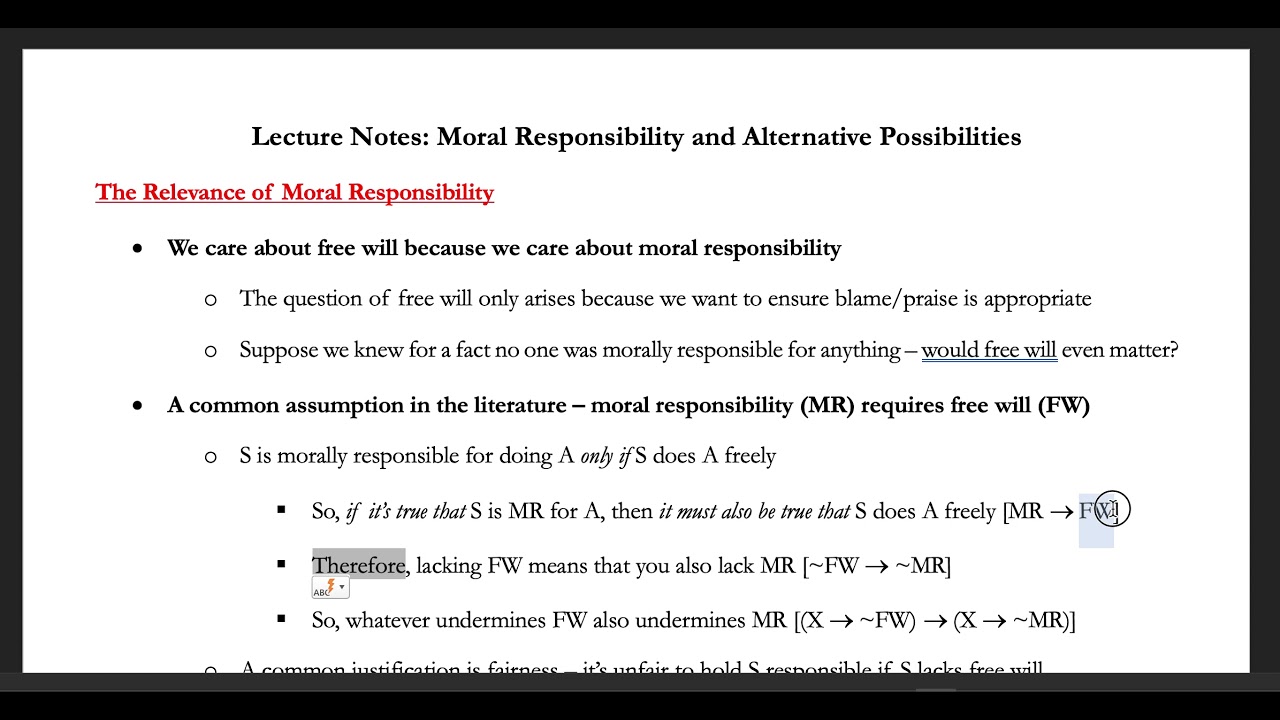
Because, traditionally, libertarians have defined free actions according to what’s known as the Principle of Alternate Possibilities.
That might sound like the plot device for a sci-fi show, but this principle says that an action is free only if the agent – that is, the person doing the thing – could have done otherwise.
So, truly free actions require options.
Determinism, by contrast, doesn’t allow options.
It holds that every event is caused by a previous event.
Which means that an agent can never have done anything other than what they did, and therefore, they are never free.
But let’s look at these two options more closely.
And also, let’s look at my breakfast.
Libertarianism says that my decision to eat oatmeal this morning wasn’t necessarily caused by anything that happened before it.
Instead, it could have been the result of non-physical events – specifically, my own thoughts – that originated right at that point.
I ate oatmeal because I decided to eat oatmeal!
End of story.
But libertarianism runs counter to what we know about the workings of the physical world, with one thing causing another.
So libertarians need a way to account for their view.
One way they do that is by making a distinction between what’s known as event causation, and agent causation.
Event causation means that no physical event can occur without having been caused by a previous physical event.
So, many libertarians concede that the physical world itself is deterministic.
Like, a baseball is flying through the air because someone hit that ball with a bat.
But many libertarians also argue that there’s such a thing as agent causation, which says that an agent – a being propelled by a mind – can start a whole chain of causality that wasn’t caused by anything else.
So, the person who hit the ball most likely did so because they just decided to do it.
By this logic, agents have the ability to affect the causal chain of the universe.
They can make stuff happen on their own.
But, many philosophers find this idea untenable.
Where would these free decisions, the ones that launch entirely new causal chains, come from, they ask?
Are they simply random?
What would compel an agent to make one decision, and not another?
And if you can answer those questions – if you can explain what would cause an agent to act – Then well, you’ve just reinforced the position that actions are caused, rather than free.
The fact is, it’s pretty difficult to find arguments that support libertarian free will.
The best argument in favor of it seems to be that it just feels an awful lot like we’re free.
And libertarians argue that we shouldn’t discount the legitimacy of our own personal, subjective experiences – so if we feel so free, we should seriously consider the possibility that we are.
That point has a certain intuitive appeal.
But if you can’t come up with an argument to defend your feeling, then good philosophical reasoning recommends that you reject it, or at least withhold judgment until you can get some evidence together.
So now let’s see if the hard determinists can do any better.
18th century French philosopher Baron D’Holbach said that none of our actions are actually free.
D’Holbach believed that everything that’s happening right now is the result of an unbroken chain of events.
Everything, he said, is the inevitable result of what came before.
Including everything that we do!
Our actions are caused in the same way that, say, home runs are caused by bats hitting balls, or tornadoes are caused by warm air systems hitting cool air systems in the right conditions.
This means that humans and our actions are just part of the physical world, bound by its physical laws.
This belief is often explained through a view known as reductionism.
Reductionism is the view that all parts of the world, and of our own experience, can be traced back – or reduced down – to one singular thing.
So, for example, you see your mind as being capable of making free decisions.
You think that what goes on in your head when you make a choice is not at all like bats and balls.
But, well, mental states are brain states, or at least they’re tied directly to your brain.
And brain states are biological.
And biological states are physical states.
And the physical world – as we already said – is deterministic.
There’s just no room for free will in this picture.
We think we’re free - but we’re not.
And really, as scientific thinkers, why would we assume that we are?
Why would we think that we’re any different than everything else in the universe?
What would make us so special?
Libertarians are right that it’s really hard to disregard the feeling of freedom.
If I didn’t choose to eat oatmeal this morning, why do I feel like I did?
And what made me do it?
But hard determinists say that the difference between the causes of human actions and the causes of physical events – like a bat hitting a ball – is that our actions have all sorts of invisible causes that happen in our brains.
Specifically, when beliefs team up with our desires and our temperament, they say, you get a deliberate human action.
Combine my belief that oatmeal is nutritious, with my desire for healthy nourishment, and the temperament that predisposes me to enjoy warm, carby comfort foods, and ta-da! – you get oatmealy breakfast!
Now, you might argue that those particular beliefs, desires, and temperaments might lead to any number of breakfast choices – cream of wheat, maybe, or some granola.
But, if you dig deep enough, you’d see that there are factors that rule out those options – as well as every other option.
Maybe I’m a little worried about one of my fillings coming loose, so I’m shying away from the granola because it’s too crunchy.
Or I just don’t think about cream of wheat very often.
I mean, they don’t have very good brand awareness anymore.
What even is cream of wheat exactly?
And the oatmeal is sitting right there in front of me.
Or maybe I think briefly of making one of those quinoa breakfast bowls that are so hip right now.
But my lazy temperament, or my belief that I’m running late, pushes me to choose the 90-seconds-in-the-microwave option.
See how it works?
All you have to do is change one factor – a belief, desire, or temperament – and you’ll get a different outcome.
Hard determinists argue that, just because we can’t pinpoint the exact factors that led us to an action, we could, in theory isolate them – if we knew enough about all the beliefs, desires, and temperaments swirling around in our brains.
So, in this view, what we call “decisions” are really just the inevitable results of a bunch of mental stuff combining in just the right way.
And maybe it feels free. But it’s not.
But hold up! Isn’t there some way out of this?
Like, what if I have someone choose my breakfast for me?
Or what if I fall back on randomness, by, like, flipping a coin?
After all, if I just flipped a coin, then it wouldn’t look like that decision was made by beliefs, desires, and temperaments.
But, well, no such luck.
Because even if I thought I chose randomly, my decision to flip the coin, or who I asked to pick for me, was just as determined as everything else.
And guess what!
If you’re getting angry right now about me telling you none of your choices are free, well, that anger was determined!
If you’re finding this whole topic confusing, or boring yep – still determined.
You think you can just freely choose to stop playing this video, but if you’re still watching me, good news: that’s determined too!
Determinists believe that you can’t help but feel and react the way you’re reacting right now.
You can think you’re choosing to act in ways that conform to the character that you’ve selected and shaped for yourself, but even that “choice” is the result of all sorts of already-determined factors about you and your place in the world.
Hard determinism is tough to refute.
And it has some really uncomfortable implications.
It means the deeply held feeling most of us have that we actually make free decisions?
Is just wrong.
And the whole concept of personal responsibility is thrown out the window, too.
As D’Holbach put it, we’re all just “cogs in a machine,” doing what we were always meant to do, with no actual volition.
Oedipus had to kill his dad and marry his mom.
I had to eat the oatmeal.
And you? You just had to keep watching! You couldn’t turn away!
Today we learned about libertarian free will and it’s counterpoint, hard determinism.
Next time, we’ll see if some middle ground can be found between determinism and libertarianism.
And I sure hope there can be.
Today's episode of Crash Course Philosophy was inevitably made possible by Squarespace.
Squarespace is a way to create a website, blog or online store for you and your ideas.
Squarespace features a user-friendly interface, custom templates and 24/7 customer support.
Try Squarespace at squarespace.com/crashcourse for a special offer.
Squarespace: share your passion with the world.
Crash Course Philosophy is produced in association with PBS Digital Studios.
You can head over to their channel and check out a playlist of the latest episodes from shows like Coma Niddy, Deep Look, and First Person.
This episode of Crash Course was filmed in the Doctor Cheryl C. Kinney Crash Course Studio with the help of these awesome people and our equally fantastic graphics team is Thought Cafe.
Up Next
John Searle on Free Will, Language, and Political Power at Google
@talksatgoogle
110.8K views•2007-11-09

John of Damascus on Holy Images: A Theological Defense
@BannedBooks
139 views•2026-04-25
How Can We Talk About Nonexistent Objects? | Philosophy
@crashcourse
872.8K views•2016-09-27
The Myth of Sisyphus: A Greek Legend of Eternal Punishment
@TEDEd
8.6M views•2018-11-13
Related Study Plans & Knowledge Roadmaps
Structured learning paths in Philosophy