Proximal Policy Optimization (PPO) is a reinforcement learning algorithm that enables robots to learn complex physical behaviors through trial and error, where the robot observes its state (joint positions, angular velocities, and environmental distances) and receives rewards for successful actions (jumping across gaps) while learning from failures (falling), ultimately mastering the task through iterative optimization of its neural network policy.
Reinforcement Learning Control of an 18-Joint Mecha-Spider for Gap Jumping
Added:Deep Dive
Foundational principles of Reinforcement Learning (RL), including Markov Decision Processes (MDPs), state-action spaces, and reward shaping.
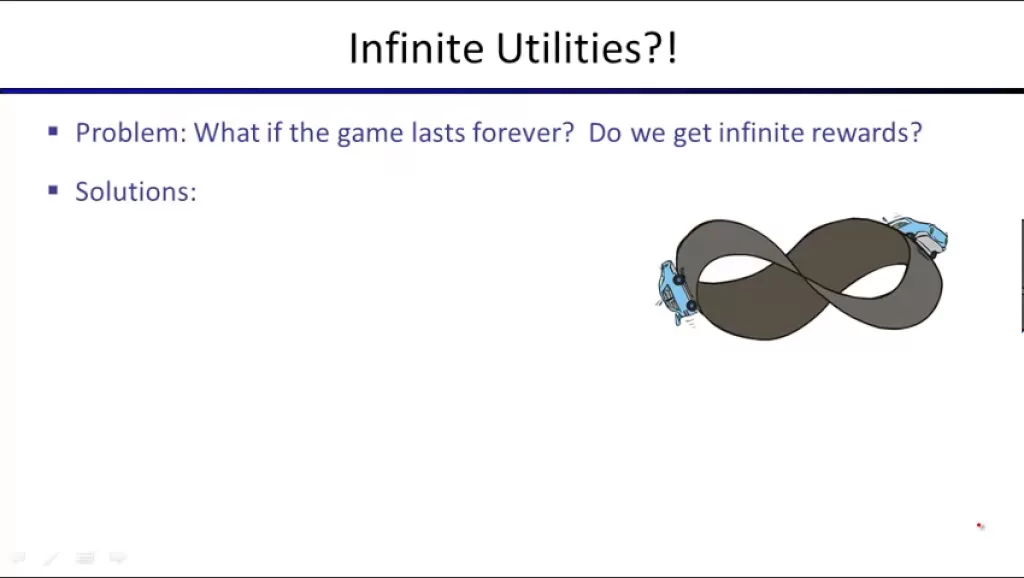
Markov Decision Processes (MDPs) Explained | CS188 Lecture 8
125.7K
This comprehensive section establishes the theoretical foundations of Markov Decision Processes (MDPs) and reinforcement learning through concrete examples. The lecture introduces MDPs using a robot navigating a grid world with fire pits and diamonds, where actions succeed probabilistically (80% success, 10% veer). Key topics covered: (1) MDP components: states, actions, transition model T(s,a,s'), reward function; (2) The Markov property ensuring future depends only on current state/action; (3) Policy definition as state-to-action mapping; (4) Living rewards encouraging quick termination; (5) Discounting (γ < 1) preferring earlier rewards, enabling infinite-horizon analysis; (6) Stationarity assumption ensuring consistent preferences across time; (7) How different γ values produce radically different optimal policies (cautious vs. risky strategies). The racing car example demonstrates thermal states (cool, warm, overheated) with actions (slow, fast) and corresponding rewards, illustrating trade-offs between immediate gains and long-term safety.
Click to watch →

Lec 69 Introduction to Reinforcement Learning : RL
107
The Markov Decision Process (MDP) provides the mathematical foundation for reinforcement learning. An MDP consists of five key components: (1) State space (S) - all possible states the agent can be in; (2) Action space (A) - all possible actions the agent can take; (3) Transition kernel - probability of transitioning between states given an action; (4) Reward function - maps state-action pairs to reward values (can be negative); (5) Discount factor (γ) - a number between 0 and 1 that determines how much future rewards are valued. The transition kernel does not depend on the reward function.
Click to watch →
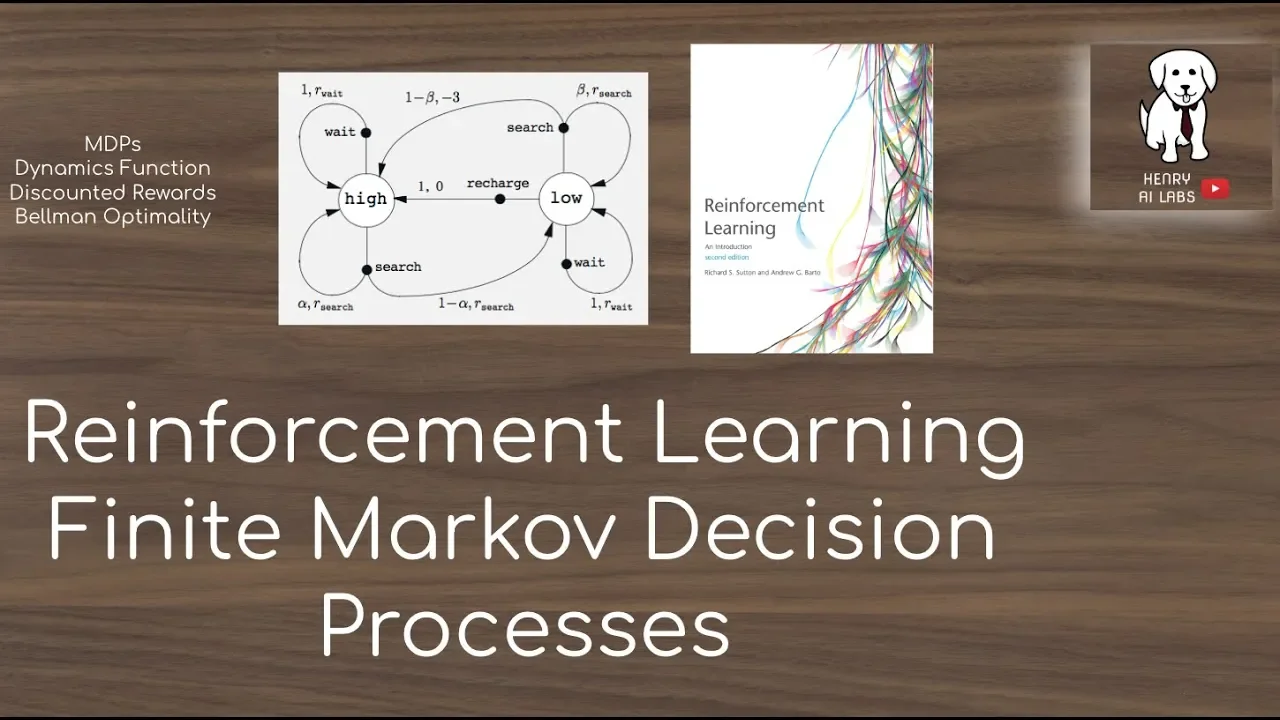
Markov Decision Process - Reinforcement Learning Chapter 3
31.9K
This comprehensive chapter covers the theoretical foundations of Markov Decision Processes (MDPs) for modeling sequential decision-making problems. Key topics include: (1) The agent-environment interface where agents receive states and rewards; (2) The Markov property stating that current state contains all information needed to predict future; (3) The dynamics function P(s', r | s, a) describing state transitions and reward probabilities; (4) Return definition as summation of rewards; (5) Episodic versus continuing tasks; (6) Discount factor gamma trading off immediate versus future rewards; (7) Bellman equations breaking down expected return into immediate reward plus discounted future return; (8) Value functions versus state-action functions; (9) Bellman optimality equations finding optimal values by maximizing over actions; (10) Constructing optimal policies from value functions. The recycling robot and grid world examples illustrate these concepts in practice.
Click to watch →
Reinforcement Learning #2: Markov Decision Process, Bellman, State Action Value, Policy
5.2K
A Markov Decision Process (MDP) is a mathematical framework for modeling decision-making in environments with uncertainty, consisting of states, actions, rewards, and transition probabilities, where the Markov property ensures that the future depends only on the present state and action; the Bellman equation provides a recursive relationship that connects the value of a state to its immediate reward plus the discounted value of the next state, enabling agents to evaluate policies and improve them iteratively through methods like policy evaluation and policy improvement to find optimal strategies that maximize expected discounted returns.
Click to watch →

Markov Decision Process (MDP) Tutorial
120K
A Markov Decision Process (MDP) is a mathematical framework for modeling decision-making in environments with uncertainty, consisting of states, actions, transition probabilities, and rewards; the utility of each state is defined recursively as the immediate reward plus gamma times the maximum expected utility of future states, where gamma (0 < gamma < 1) is a discount factor that reduces the value of future rewards compared to immediate ones.
Click to watch →
Deep Dive
The mechanics of Policy Gradient methods, specifically the Proximal Policy Optimization (PPO) algorithm used for continuous control.
An introduction to Policy Gradient methods - Deep Reinforcement Learning
256K
Proximal Policy Optimization (PPO) is a policy gradient method designed at OpenAI that balances sample efficiency, ease of implementation, and tuning simplicity. Unlike traditional policy gradients that suffer from unstable training due to changing data distributions and hyperparameter sensitivity, PPO addresses these issues by using a clipped probability ratio objective function that limits how far the new policy can diverge from the old policy. The algorithm combines the clipped PPO objective with value function estimation and entropy regularization in a unified loss function, achieving state-of-the-art performance across diverse tasks including robotic control, Atari games, and complex multi-agent environments like Dota 2.
Click to watch →

AI Learns To Swing Like Spiderman
7.1M
PPO (Proximal Policy Optimization) is a deep reinforcement learning algorithm that trains actor-critic networks through iterative improvement. The algorithm uses the value function as a baseline for performance, calculating the advantage function by subtracting the value function from actual discounted returns. Positive advantages encourage actions, while negative advantages discourage them. The actor is trained by multiplying advantage values with action probabilities. A critical innovation is the clamping mechanism, which prevents the actor from changing too much between training sessions, preventing catastrophic forgetting and ensuring stable learning.
Click to watch →
Proximal Policy Optimization Explained
76.2K
Proximal Policy Optimization (PPO) is a sample-efficient and stable reinforcement learning algorithm that balances exploration and exploitation by using a clipped objective function with a policy ratio bounded between 1-ε and 1+ε (typically ε=0.2), which prevents large policy updates that cause instability while allowing multiple training passes on the same data sample, making it particularly effective for control problems like robotics.
Click to watch →

PPO Implementation With PyTorch | Reinforcement Learning Tutorial
85.7K
Proximal Policy Optimization (PPO) is an actor-critic reinforcement learning algorithm that addresses the instability problem in traditional actor-critic methods, where small neural network parameter updates can cause dramatic performance drops. PPO achieves stability by constraining policy updates through a clipped objective function that limits the ratio of new to old policy probabilities within a range of [1-ε, 1+ε], preventing large parameter jumps. The algorithm uses Generalized Advantage Estimation (GAE) to calculate state advantages and employs mini-batch stochastic gradient ascent with multiple epochs per data sample. PPO maintains separate actor and critic networks, with the actor outputting action probabilities via softmax activation and the critic evaluating state values. The implementation involves storing trajectories in a fixed-length memory buffer, performing multiple network updates per trajectory, and combining actor and critic losses with appropriate coefficients for optimization.
Click to watch →

PPO - Proximal Policy Optimization | by OpenAI Paper explained
470
Proximal Policy Optimization (PPO) is a reinforcement learning algorithm introduced by OpenAI that addresses the limitations of earlier methods like policy gradients and TRPO by introducing a clipping mechanism that limits how much the probability of an action can change between updates, ensuring stable and efficient learning while maintaining simplicity and effectiveness across various domains from robotic control to game playing.
Click to watch →
Deep Dive
Basic robotic kinematics and dynamics, particularly multi-joint coordination and Degrees of Freedom (DoF) in legged locomotion.

5. Fundamentos de robótica. Grados de libertad de un sistema robótico
14.6K
Degrees of freedom (DOF) define the independent movements a mechanical system can perform. In three-dimensional space, any free object has six DOF: three linear movements along x, y, and z axes, and three rotational movements (yaw, pitch, roll). Linear movements include forward/backward, left/right, and up/down motions. Rotational movements are named from aviation: yaw (rotation about z-axis), pitch (rotation about x-axis), and roll (rotation about y-axis). Different joint types constrain motion differently: revolute joints allow rotation about one axis (1 DOF), prismatic joints permit linear movement along one axis (1 DOF), cylindrical joints combine rotation and translation along the same axis (2 DOF), spherical joints enable rotation about all three axes (3 DOF), and universal joints allow rotation about two perpendicular axes (2 DOF). Grubler's criterion calculates DOF using the formula: DOF = 6n - (j + 1) + Σf_i for 3D mechanisms, or DOF = 3n - (j + 1) + Σf_i for planar mechanisms, where n is the number of links, j is the number of joints, and Σf_i is the sum of DOF permitted by each joint.
Click to watch →
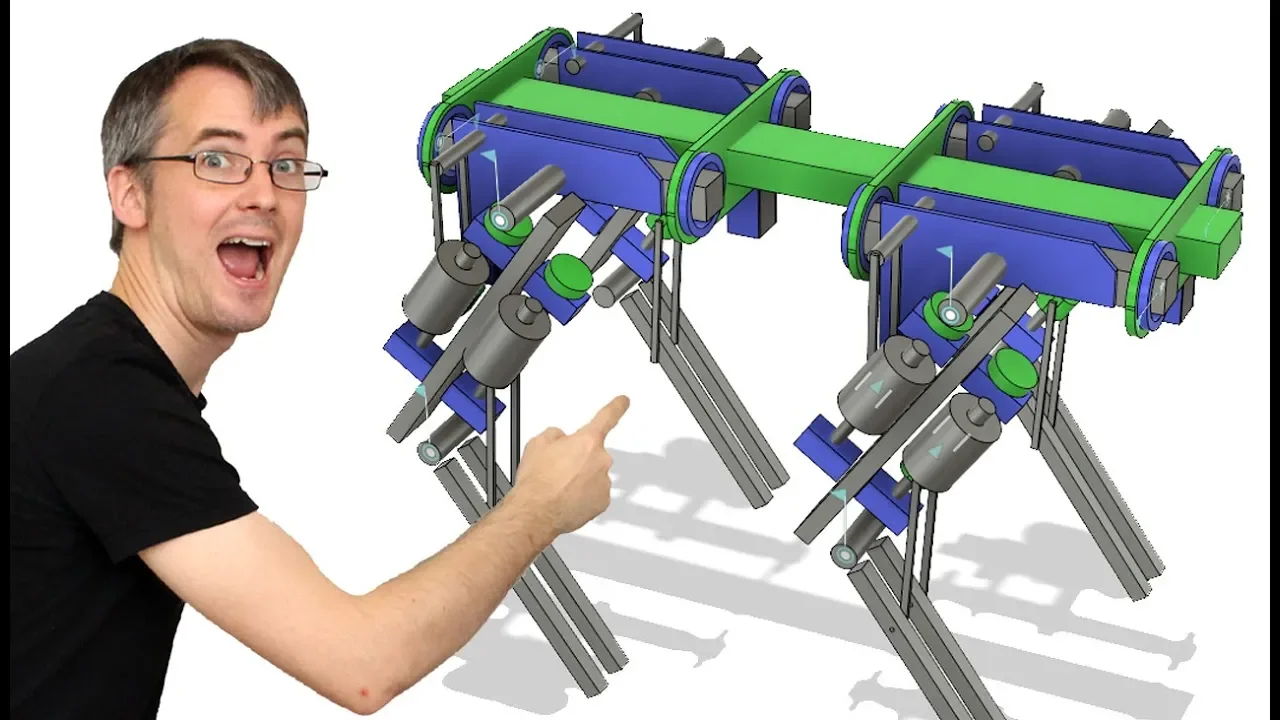
openDog Dog Robot #1 | Planning & Explanation | James Bruton
212.7K
This video demonstrates how to design and control a robot dog using mathematical kinematics. The key concepts include: (1) Robot legs with three joints per leg (hip, knee, foot) require 12 motors total for a four-legged robot; (2) Ball screw actuators provide precise linear motion for joint control with minimal backlash; (3) Inverse kinematics calculations use trigonometry to determine joint angles needed to position the foot at desired coordinates in 3D space; (4) Motor encoders provide position feedback for accurate control; (5) The ODrive motor driver enables precise control with encoder feedback. The design ensures that joint movements produce straight-line foot trajectories by offsetting ball screws to create perfect triangles in the mechanism.
Click to watch →

RoboPack with My Equation || Live Session 1
8.8K
Degrees of freedom (DOF) refers to the number of independent movements a robot can perform. There are six degrees of freedom: three linear motions along the X, Y, and Z axes, and three rotational motions (roll, pitch, yaw) around these axes. Roll is rotation around the Y-axis (vertical axis), pitch is rotation around the X-axis (lateral axis), and yaw is rotation around the Z-axis. These six DOF allow robots to move and rotate in all directions, similar to human arm movements.
Click to watch →

6 ROBOT PHYSICAL CONFIGURATION
6.9K
Robot kinematics describes the motion capabilities of robot manipulators. Degrees of freedom (DOF) represents the number of independent movements a robot can perform, typically 6 DOF for full 3D motion (3 translational + 3 rotational). Each joint contributes to the total DOF, with rotary joints providing rotational movement and linear joints providing translational movement. The DOF determines the robot's workspace and reachability. Rotational travel limits define the angular range each joint can move, which collectively determines the robot's operational envelope and task capabilities.
Click to watch →
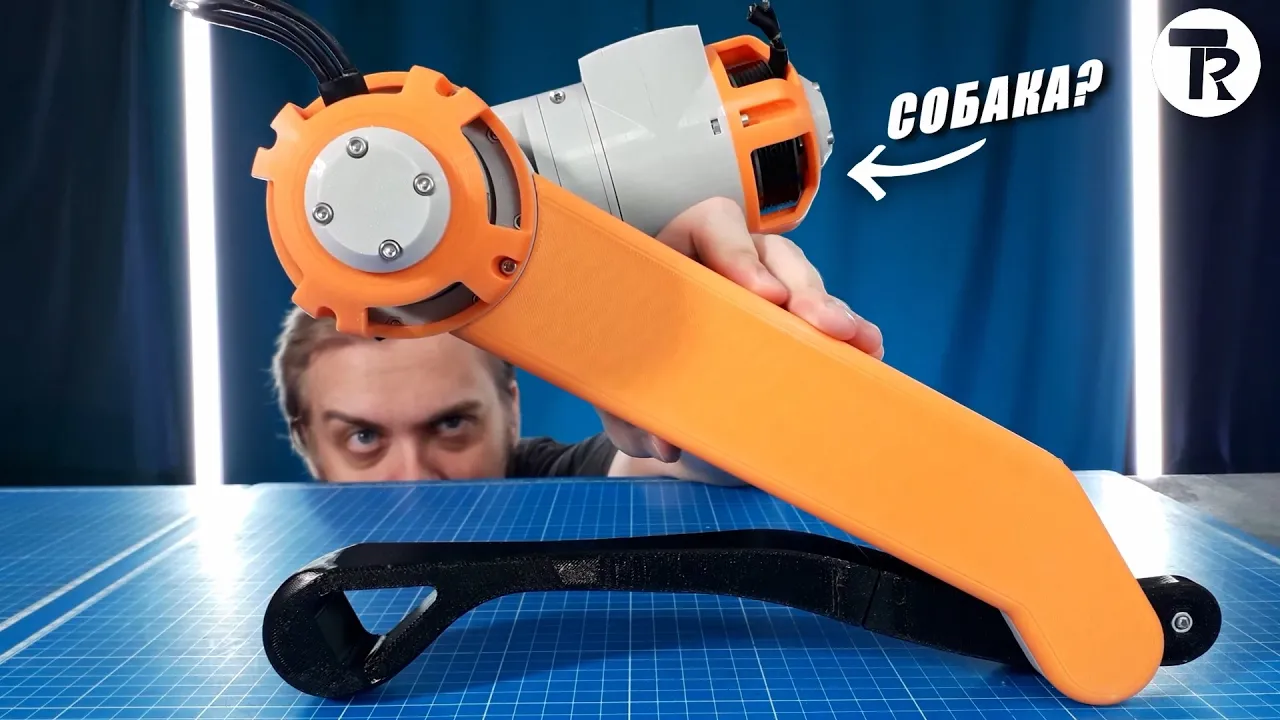
Как Сделать Робособаку на BLDC моторах | Часть №2
147.8K
Modern quadruped robots like Spot have relatively simple kinematics consisting of a base with four legs, where each leg has three segments and three degrees of freedom: two degrees of freedom in one plane and one rotational degree of freedom. This design allows for efficient movement while maintaining structural simplicity.
Click to watch →
Deep Dive
The role of physics engines (such as MuJoCo or PyBullet) in simulating robot environments for training RL agents safely.

Laura Graesser: Practical Reinforcement Learning with Robots
655
Physics engine selection depends on five key dimensions: scalability, differentiability, dynamics realism, visual fidelity, and documentation. PyBullet and MuJoCo excel in physics realism, while Unity leads in visuals. Differentiable physics enables gradient-based optimization methods. The choice depends on whether visual fidelity matters and whether differentiable capabilities are needed. For robot table tennis, the system architecture includes shared components (physics, state machine, reward module) and environment-specific components (real-world perception, safety layer). The transition from PyBullet to MuJoCo improved dynamics modeling, particularly for fluid dynamics needed to model ball spin.
Click to watch →

Robotics Simulations Tutorial @stochlabiisc1015
950
Robotic simulations are essential tools for designing controllers because real-world robot data collection is expensive, time-consuming, and poses safety risks; simulation environments like MuJoCo and PyBullet provide safe, scalable, and cost-effective alternatives for training and testing robot algorithms before real-world deployment. The Universal Robot Description File (URDF) is an XML-based format used to describe robot kinematics and physical properties, consisting of links (physical components) and joints (connections between links), with common joint types including revolute (rotational), prismatic (linear), continuous (unlimited rotation), and fixed joints.
Click to watch →

NVIDIA Just Changed Robotics Forever With GR00T N1 – See It in Action!
2.1M
Newton represents a collaborative physics engine developed through a partnership between DeepMind, Disney Research, and NVIDIA. This engine integrates harmoniously with Mujoco, a widely-used framework among roboticists worldwide. Newton enables super-real-time rigid body and soft body simulation, providing the verifiable physics rewards necessary for reinforcement learning in robotics applications.
Click to watch →

DeepMind MuJoCo presentation by Yuval Tassa
7.5K
MuJoCo (Multi-Joint Dynamics with Contact) is a physics simulator developed for robotics research that DeepMind has acquired and is open-sourcing under a permissive license. The simulator addresses critical needs in robotics research by providing a fast, accurate, and safe environment for training learning-based robots and developing classical control systems, while enabling researchers to understand and debug reality gaps between simulation and real-world performance. Key features include a transparent API, powerful scene description language, thread-safe C implementation, and a lean codebase designed for community collaboration and development.
Click to watch →

Simulate, Analyze, Learn: Python's Physics Simulation - Jan Margeta
175
Physics simulation libraries like SOFA, MuJoCo, and PyBullet enable scientists and engineers to create digital twins of real-world systems, allowing them to test insertion strategies for medical devices like cochlear implants, design soft robots, and develop reinforcement learning controllers for robots without risking physical damage or patient safety.
Click to watch →
Prerequisite Knowledge
- Concept 01Foundational principles of Reinforcement Learning (RL), including Markov Decision Processes (MDPs), state-action spaces, and reward shaping.
- Concept 02The mechanics of Policy Gradient methods, specifically the Proximal Policy Optimization (PPO) algorithm used for continuous control.
- Concept 03Basic robotic kinematics and dynamics, particularly multi-joint coordination and Degrees of Freedom (DoF) in legged locomotion.
- Concept 04The role of physics engines (such as MuJoCo or PyBullet) in simulating robot environments for training RL agents safely.
Subsequent Learning
- Step 01Sim-to-Real (Sim2Real) transfer challenges and techniques to deploy simulated control policies onto physical robotic hardware.
- Step 02Hierarchical Reinforcement Learning (HRL) to decouple high-level trajectory planning from low-level motor control.
- Step 03Safe Reinforcement Learning and constraint-based optimization to prevent physical damage to the robot during real-world training.
- Step 04Generalization and domain randomization techniques to help the legged robot adapt to unseen, dynamic, and uneven terrains.
Robot Spider
Learning Phase
Refining Jump
Building Skill
Victory Leap
Robot Spider
0:10Playing Section
- 1
Introduces 6m tall spider with 18 joints trained via reinforcement learning.
- 2
Task is to leap across 8m gaps using sensor data like joint angles.
- 3
Spider learns through trial and error, maximizing forward reward.
Model-Based Control and Trajectory Optimization
While model-free Reinforcement Learning (RL) techniques like PPO can discover novel, dynamic behaviors through trial-and-error, they face significant criticism in robotics due to extreme sample inefficiency, the 'sim-to-real' transfer gap, and a lack of formal safety and stability guarantees. Critics argue that Model-Based Control, such as Model Predictive Control (MPC) and Trajectory Optimization, offers a superior alternative. By utilizing explicit mathematical models of the robot's physics and kinematics, model-based approaches can calculate mathematically optimal and predictable trajectories in real-time. This provides provable stability bounds, ensures hardware safety, and eliminates the need for computationally expensive and unpredictable training phases, making it highly reliable for executing high-risk, high-DOF maneuvers like gap jumping.
Deep Dive
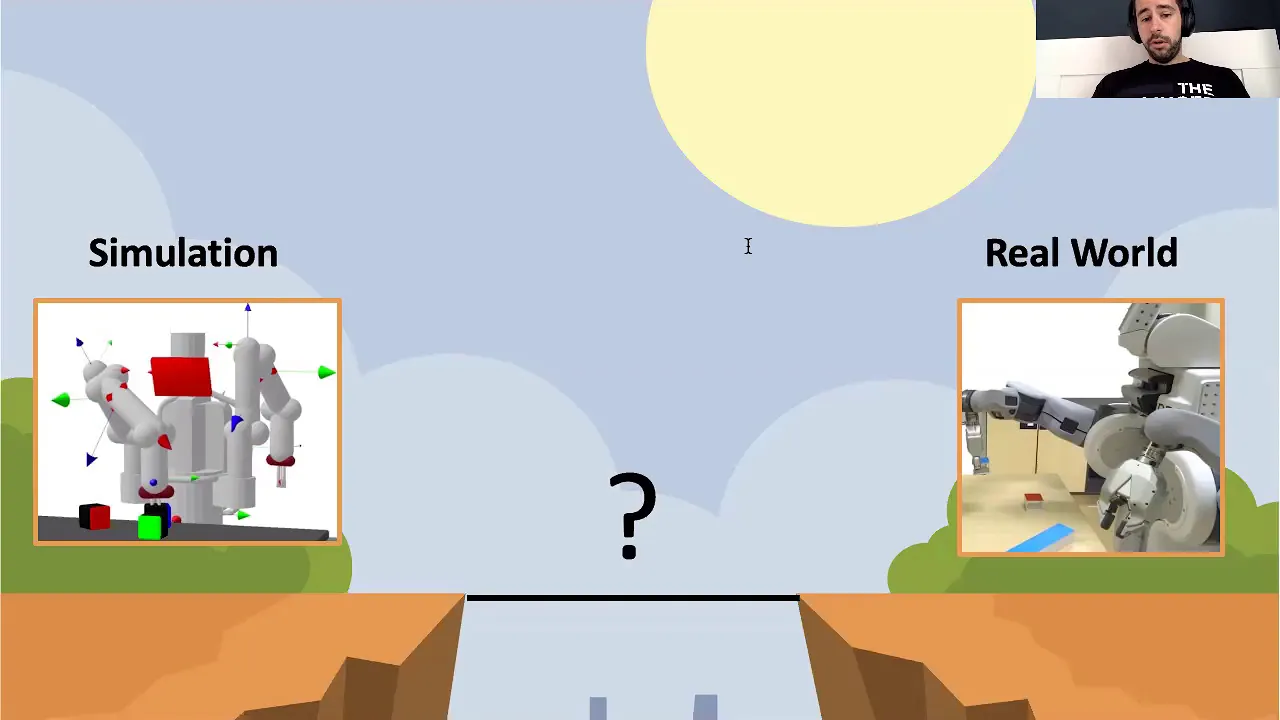
Sim-to-Real (Sim2Real) transfer challenges and techniques to deploy simulated control policies onto physical robotic hardware.

Control Legged Robots Reinforcement Learning, Jemin Hwangbo, KAIST, PhD at ETH 2019 Marco Hutter
835
Sim-to-real transfer enables training robot control policies in simulation and deploying them on physical hardware. Five critical factors determine success: active modeling (creating accurate system representations), accurate simulation (realistic physics-based environments), accurate state estimation, adaptive control, and dynamic randomization. The reality gap—the discrepancy between simulated and real systems—arises from communication delays, gearbox friction, lubrication effects, and unmodeled dynamics. Traditional cascaded modeling approaches fail because small errors multiply across multiple modules. Hybrid simulation combines physics-based Newtonian mechanics (fundamentally correct) with learned neural networks to capture complex actuator dynamics. Physics engine selection matters: hard contact simulation prevents surface penetration providing consistent behavior, while soft contact requires parameter tuning and produces inconsistent results. Rising physics engine is widely adopted for its hard contact capabilities and reinforcement learning utilities.
Click to watch →
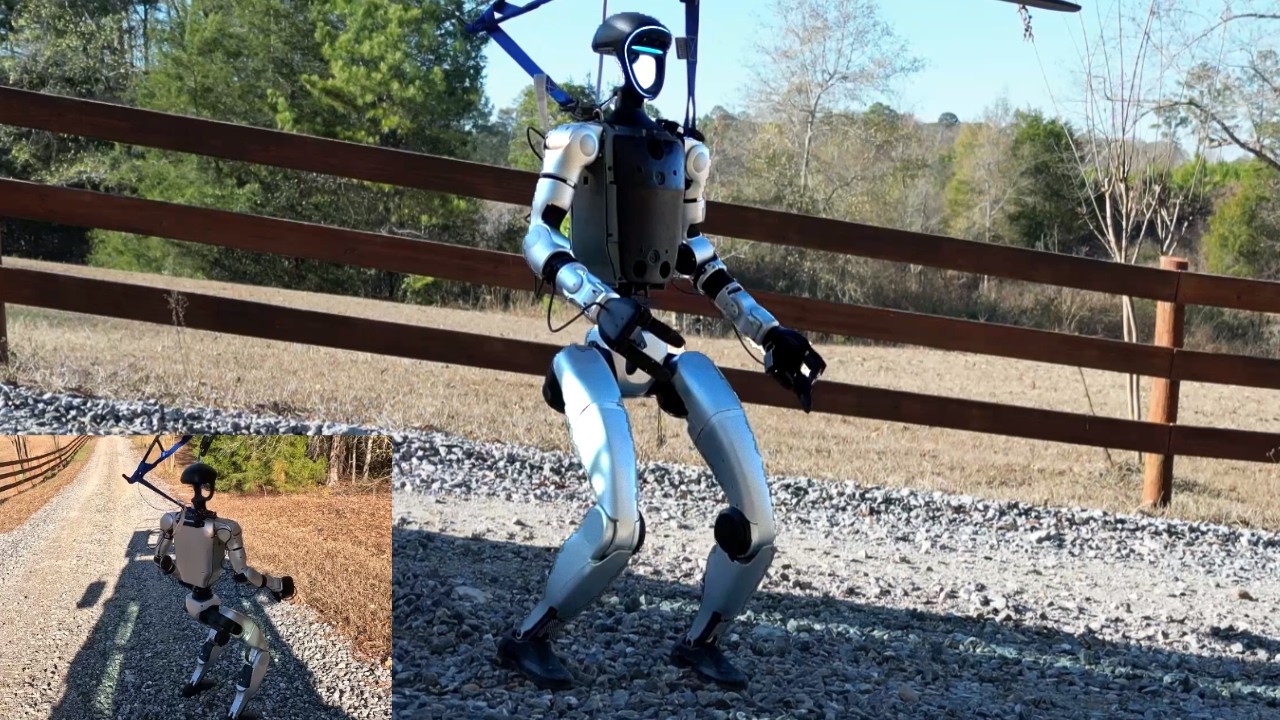
Training a Unitree G1 to Walk w/ Reinforcement Learning
27.7K
The sim-to-real challenge represents a fundamental barrier in robotics where neural networks trained in simulation fail catastrophically in the real world. This occurs because real-world physics, gravity, friction, and environmental conditions create out-of-distribution data that neural networks struggle to handle. Successful transfer requires addressing two critical controller design issues: implicit PD controllers in physics engines require privileged data and future information, creating gaps between simulation and reality; explicit PD controllers implemented as Python/Torch code ensure identical control logic across domains. Additionally, linear velocity estimation becomes necessary since real robots lack direct velocity measurements. Before attempting real-world deployment, researchers must first achieve successful sim-to-sim training using identical code and hardware interfaces to identify pipeline inconsistencies.
Click to watch →
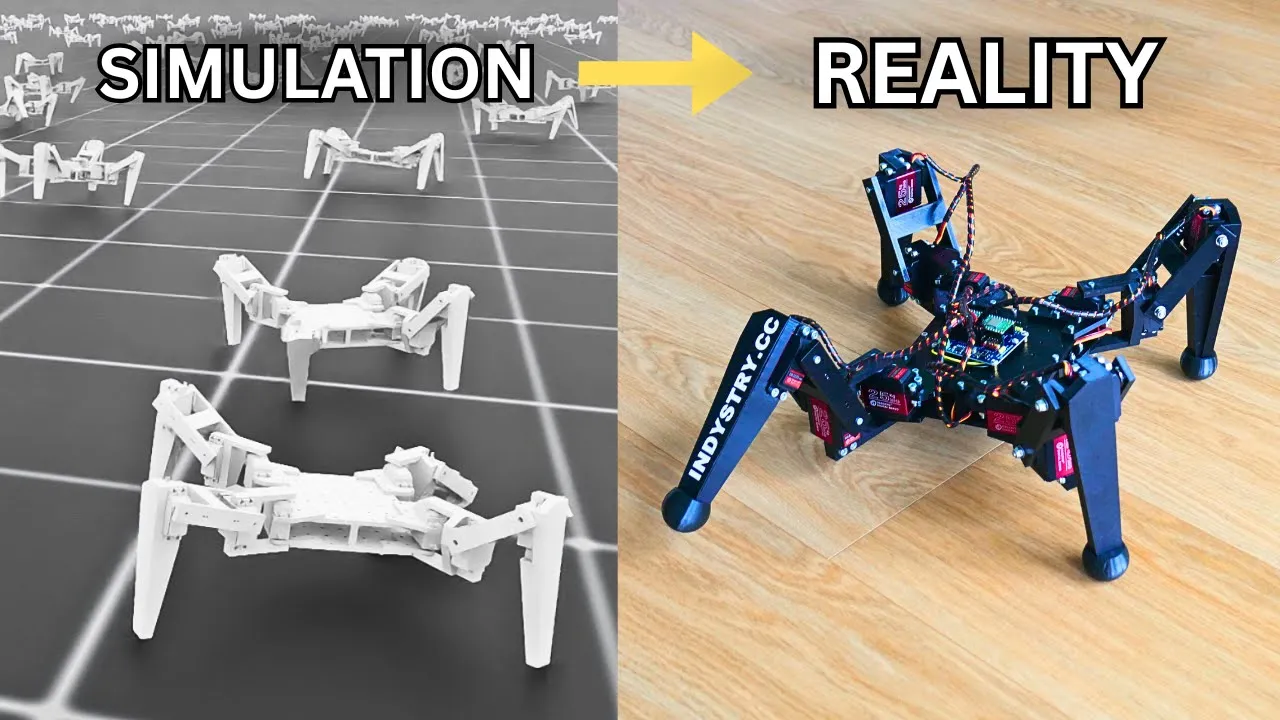
I Tried To Build a Robot Like Boston Dynamics With Isaac Sim
467.6K
This section explores the fundamental challenges of transferring robot policies from simulation to physical reality. The presenter demonstrates how robots trained in simulation may develop unexpected behaviors that exploit reward system loopholes—such as a spider robot learning to walk on two legs and balance on its head and tail like a dinosaur, which would fail on actual terrain. The section reveals the gap between simulation capabilities and real-world constraints, highlighting that observations available in simulation may not translate directly to physical robots. Training duration varies significantly (5 minutes to 1 hour depending on complexity), and policies require thorough validation in simulation before real-world deployment to ensure safety and effectiveness.
Click to watch →

城寨國際 I 21/2/26: 春晚機械人耗費過億 搭棚向全世界展示中共科技實力 經濟學人大力表揚法國世界報指東升西降 自主人形機械人技術全未成熟並無完全自主性 精細動全靠模型訓練 吹大造假欺騙世界
68.5K
The video explains the 'Sim2Real' transfer problem in robotics, which is the challenge of transferring skills learned in simulation to the real world. The technology called 'teleoperation' reduces human emotion to a high degree and fine-tunes movements to simulate the best possible performance. However, the real world presents many uncertainties that simulation cannot fully capture, including subtle sound changes, lighting changes, environmental factors, and unexpected events. These micro-inspections can cause robots to fall down or make wrong movements. The video explains that robot performance requires real-life teleoperation to achieve desired results, and that it is simply impossible to do completely autonomously in complex situations. The video questions whether robots can truly learn like humans, noting that while robots can learn within a few days with AI, this is not the same as human learning. The video explains that the main challenge in robot performance is balance control, and that robots often fall down and need to get back up, which is a fundamental challenge in robot design that remains unsolved.
Click to watch →

Deep-Dive Into Isaac Lab Workflows | Isaac Lab Office Hours
9.4K
Deploying trained policies from simulation to real robots requires several components: (1) State estimator to get real-world observations from robot sensors; (2) Trained policy model loaded from simulation training; (3) Action controller to translate policy outputs (like joint positions) into real robot commands (velocity, angular velocity); (4) Observation extractor to feed real-world data back into the policy if needed. Domain randomization during training helps ensure policies generalize to real-world conditions with sensor noise and environmental variations.
Click to watch →
Deep Dive
Hierarchical Reinforcement Learning (HRL) to decouple high-level trajectory planning from low-level motor control.

Learning Functionally Decomposed Hierarchies for Continuous Control Tasks with Path Planning
159
HiDe is a novel hierarchical reinforcement learning architecture that decouples high-level planning from low-level control by explicitly separating state-action spaces across hierarchy layers, enabling efficient long-horizon task solving and generalization to unseen environments through an RL-based planner that generates sub-goals using a valley map and attention mask, combined with a goal-conditioned control policy; this functional decomposition allows modular transfer of policy layers across different agents and scales to 300% larger environments while maintaining consistent success rates.
Click to watch →
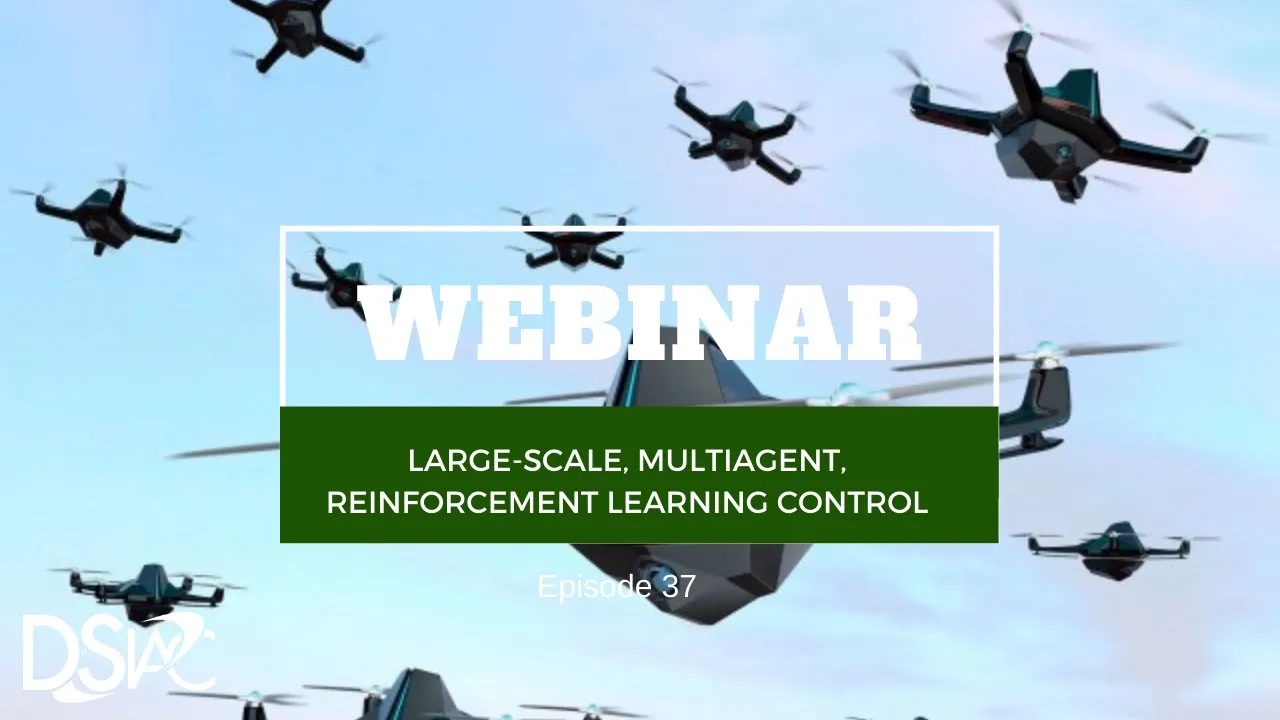
Large-Scale, Multiagent, Reinforcement Learning Control
882
The hierarchical RL approach provides a low-level optimal controller that enables smooth trajectory following toward waypoints. A high-level policy-driven controller can operate above this layer to handle higher-level objectives such as collision avoidance, formation constraints, and mission-specific requirements. This layered architecture separates optimal trajectory generation from high-level decision-making, enabling flexible and robust swarm operation.
Click to watch →

Training AI to Play Pokemon with Reinforcement Learning
9.2M
Hierarchical reinforcement learning decouples low-level control actions from high-level planning decisions, allowing agents to handle fine-grained movements and long-term strategic goals separately. This architecture enables more efficient learning by breaking down complex tasks into manageable subtasks, with higher-level policies directing lower-level execution. The separation allows specialized mechanisms for immediate actions and overarching strategy, improving both learning speed and performance on complex sequential tasks.
Click to watch →

Robotics Colloquium: David Held (Carnege Mellon University)
118
The common theme across projects is a hierarchical motion policy where the high-level predicts gripper actions at a higher level of temporal abstraction than the low-level. The high-level is not doing language reasoning but predicting gripper actions (sub-goals) that the low-level executes. Future directions include scaling up through large-scale simulation data and visual human demonstrations, combining learning and planning for long-horizon tasks, and tool use reasoning.
Click to watch →
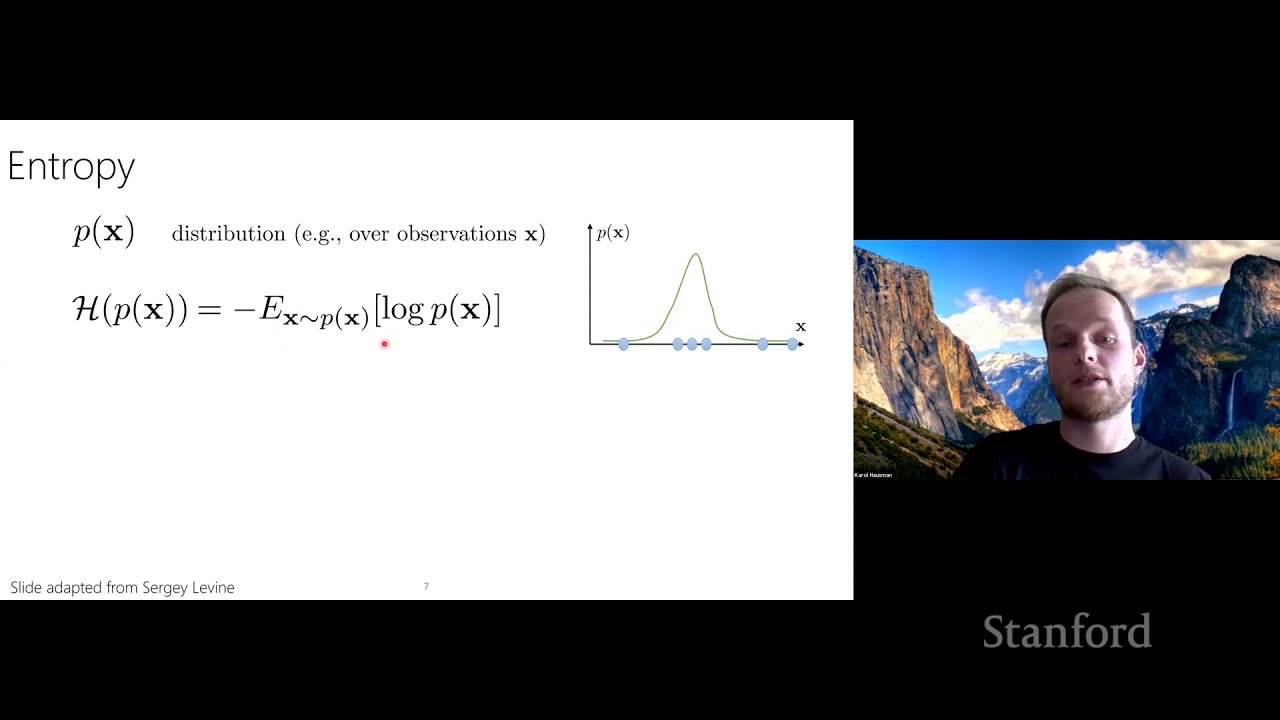
Stanford CS330:Multi-task and Meta Learning | 2020 | Lecture 14: Hierarchical RL and Skill Discovery
2.1K
This paper introduces hierarchical policies where a high-level recurrent neural network sends commands to a low-level policy every k time steps. Both policies are trained separately using policy gradients. The high-level policy receives privileged task information not available to the low-level policy. Initial exploration uses hierarchical noise—random commands sent to the pre-trained low-level policy—to discover useful behaviors. Results show improved navigation performance on snake-like robots compared to baselines.
Click to watch →
Deep Dive
Safe Reinforcement Learning and constraint-based optimization to prevent physical damage to the robot during real-world training.
Experimenting With Reinforcement Learning Using MushroomRL
127
Safe reinforcement learning enables training physical robots without causing damage through constraint-respecting exploration. This addresses critical safety concerns in real-world deployment where exploration could harm equipment or humans. Researchers have demonstrated safe RL on seven-degree-of-freedom robotic arms, learning complex manipulation tasks while maintaining safety boundaries. Beyond robotics, unexpected applications in finance show RL's broad applicability beyond traditional research domains.
Click to watch →

Recovery RL: Safe Reinforcement Learning with Learned Recovery Zones (ICRA 2021 Talk)
246
Reinforcement learning enables flexible policy optimization across robotics domains, but learning new tasks requires extensive exploration that can lead to unsafe behaviors causing constraint violations and inefficiencies. An unsafe behavior is defined as a transition indicating undesired behavior that damages the robot or surroundings, incurring real-world costs. The CMDP framework introduces three key components: constraint indicator functions, constrained discount factors, and constraint tolerance thresholds. Traditional approaches jointly optimize Lagrangian objectives combining safety and task objectives, but Recovery RL decouples these into separate policies—a task policy optimizing task reward and a recovery policy preventing constraint violations—using a safety critic to dynamically switch between them during online exploration.
Click to watch →
![[Lab Meeting] Learning Robot Trajectories Using Model-Free RL](https://i.ytimg.com/vi_webp/kkP5TeE5DqI/maxresdefault.webp)
[Lab Meeting] Learning Robot Trajectories Using Model-Free RL
211
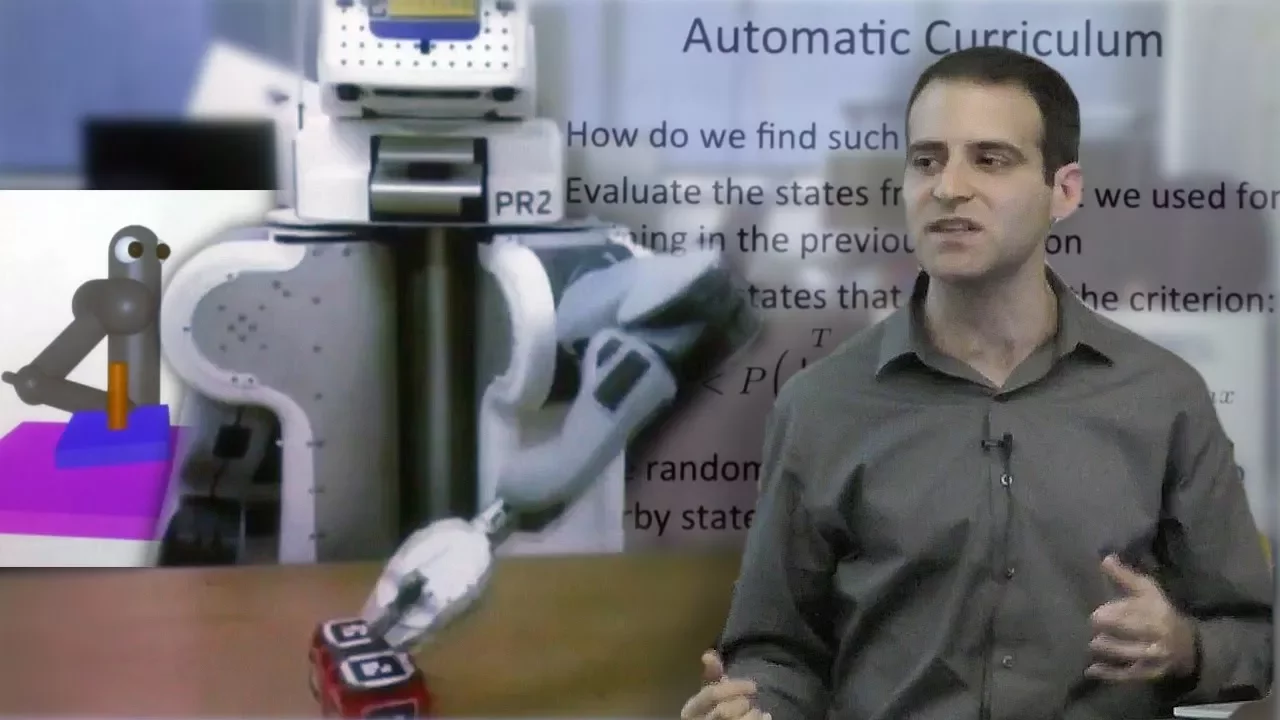
This section establishes the core motivation and technical foundations for safe robot learning. Industrial robots operate in known environments with pre-hardcoded movements, lacking human-like adaptability. Reinforcement learning offers a solution through trial-and-error learning, but introduces safety challenges. Three approaches address safety: practical engineering modifications, theoretical objective adjustments, and action replacement. Kinematic constraints—position, velocity, acceleration, and jerk limits—must be respected to prevent joint damage. Standard velocity-mapping approaches fail to guarantee constraint satisfaction. The action mapping technique computes upper and lower time-optimal trajectories at each time step, generating intermediate trajectories that guarantee constraint satisfaction regardless of neural network output. This enables fast learning without joint damage, demonstrated on path tracking and ball-balancing tasks with 89% simulation-to-real transfer success.
Click to watch →
RI Seminar: David Held: Robots Learning to Understand Environmental Changes
3.8K
Safe learning incorporates safety constraints alongside objectives, ensuring intermediate policies satisfy constraints—not just the final policy. Penalty-based approaches add costs for violations but require careful tuning; too large makes agents overly cautious, too small results in unsafe behavior. Constraint-based approaches treat safety as hard constraints, providing stronger guarantees. Local policy search finds new policies within a distance delta of the old policy (measured by KL divergence), providing guarantees of approximate performance improvement and constraint satisfaction. Smaller step sizes provide tighter safety guarantees but slower learning. This framework ensures safety throughout the learning process, critical for applications like autonomous vehicles and medical robots.
Click to watch →

CSL seminar: Jan Peters - Inductive Biases for Robot Reinforcement Learning
2.3K
Model-based reinforcement learning requires physically consistent models to avoid catastrophic failures. Black-box models, even highly accurate, can learn incorrect physical relationships (creating energy from nowhere) that lead to unstable policies. Pure system identification requires extensive manual effort while pure black-box learning risks overfitting. Hybrid approaches combining analytical priors (Lagrangian mechanics) with data-driven learning provide safety guarantees. Simulation optimization bias represents a fundamental mathematical limitation where optimization on simulated trajectories systematically produces suboptimal real-world policies. Safe robot learning requires directing exploration through constraints rather than encoding all safety in reward functions, which become excessively complex. Algorithms can construct constraint manifolds and explore within tangent spaces while correcting for curvature. Robot hardware design significantly impacts learning effectiveness: strong actuators, minimized moving masses, and safety features enable high accelerations while preventing self-damage.
Click to watch →
Deep Dive
Generalization and domain randomization techniques to help the legged robot adapt to unseen, dynamic, and uneven terrains.
How to build Humanoid: NVIDIA Isaac Lab, how to walk
55.9K
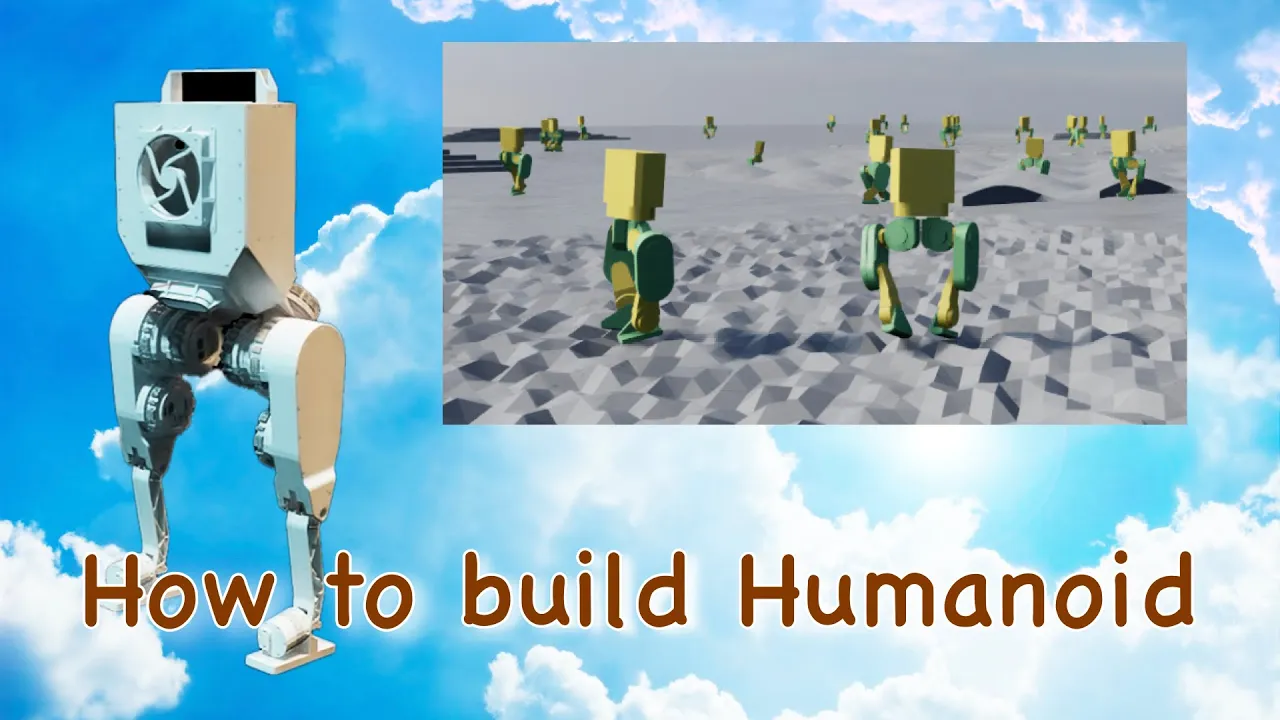
Domain randomization is a technique used in robot simulation training where physical parameters are randomized during training to improve generalization to real-world conditions. This includes randomizing friction parameters inside joints, masses of robot links, friction between feet and ground, and initial states of the robot. By exposing the policy to a wide range of parameter variations during training, the resulting controller becomes more robust when deployed on actual hardware with unknown or varying physical properties.
Click to watch →
These New Robots Do Previously Impossible Tasks!
77K
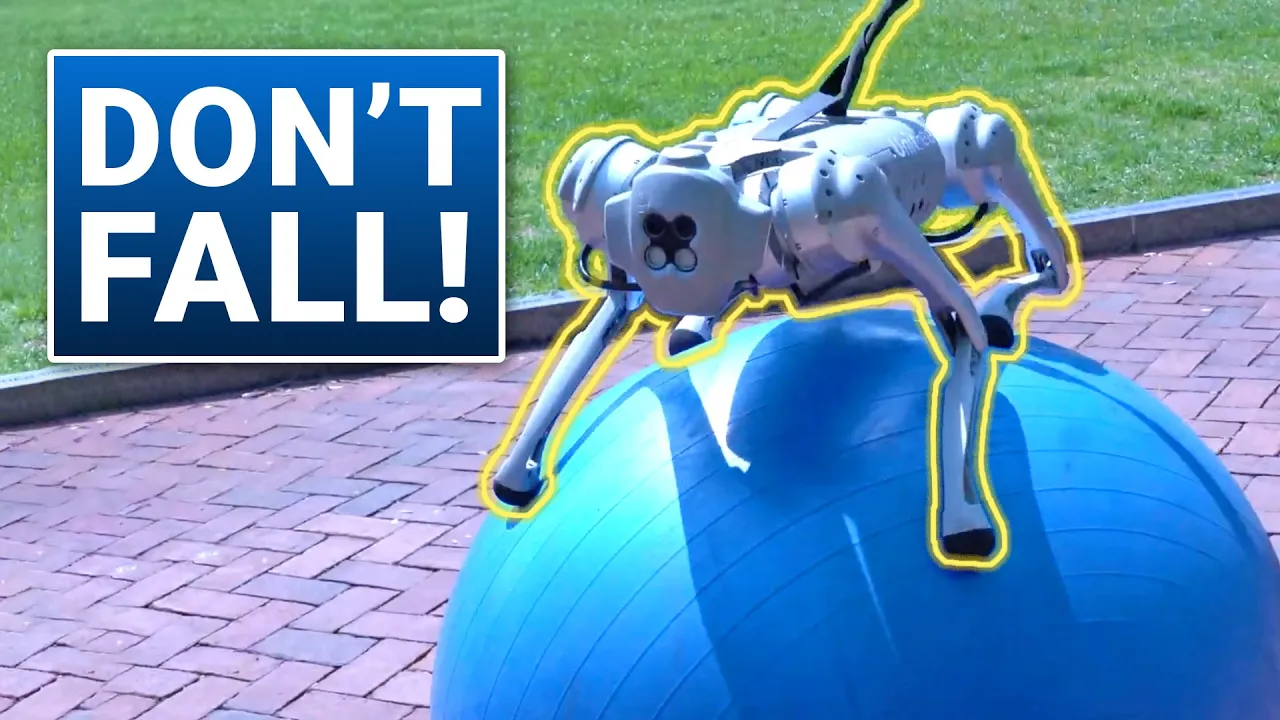
Domain randomization is a technique used in robot training where the environment variables are systematically varied during training. This includes changing colors, levels, and even the laws of physics within a simulated environment. The purpose is to create a robot that can generalize its learning across many different conditions, making it more adaptable when deployed in the real world.
Click to watch →

A Chat with Pieter Abbeel.
10.3K
Domain randomization is an approach where instead of trying to perfectly match simulation with reality, you create many versions of the simulator with different parameters (friction properties, mass properties, camera positions, etc.). If a single neural network can control the robot across all these variations, it learns something very robust that can handle the variations encountered in the real world. This addresses the simulation-to-reality gap by teaching the system to be robust across a wide range of conditions.
Click to watch →
Parkour in the Wild, Learning Agile Locomotion on any Terrain
9.6K
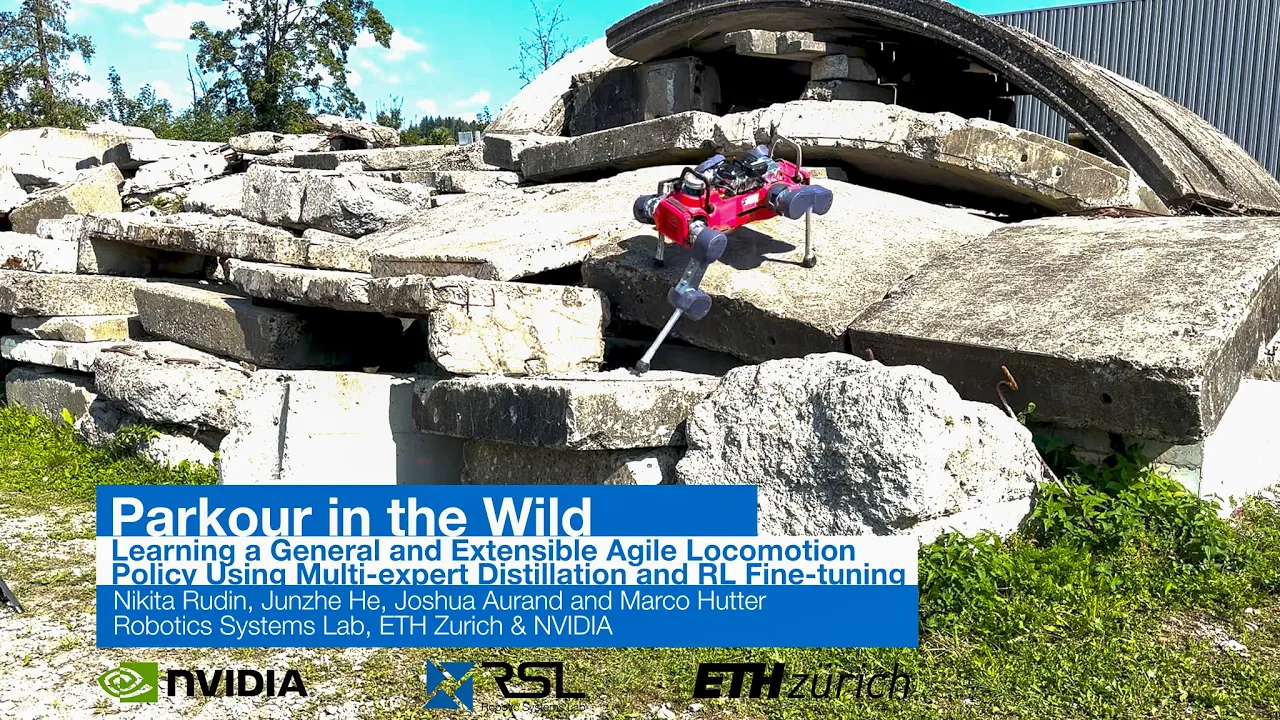
This video presents a three-step framework for teaching legged robots parkour-level agility on unstructured terrain: (1) train terrain-specific expert policies using reinforcement learning, (2) distill these experts into a unified foundation policy via the DAGGER algorithm, and (3) fine-tune the distilled policy on diverse terrains including real-world 3D scans. This approach enables robots to adapt to rubble, beams, and gaps while achieving robust generalization across unseen environments using only onboard depth cameras.
Click to watch →

Lecture 22 Sim2Real and Domain Randomization -- CS287-FA19 Advanced Robotics at UC Berkeley
10.3K
Domain randomization is a technique for bridging the gap between simulation and real-world robotics by training models on highly randomized simulated environments rather than trying to create an accurate simulator; this approach works because exposing models to extreme variation during training forces them to learn generalizable features that can adapt to the unpredictable real world, as demonstrated by successful applications in robotic grasping, manipulation, and computer vision tasks.
Click to watch →
Robot Spider
Learning Phase
Refining Jump
Building Skill
Victory Leap
Robot Spider
0:10- 1
Introduces 6m tall spider with 18 joints trained via reinforcement learning.
- 2
Task is to leap across 8m gaps using sensor data like joint angles.
- 3
Spider learns through trial and error, maximizing forward reward.
Model-Based Control and Trajectory Optimization
While model-free Reinforcement Learning (RL) techniques like PPO can discover novel, dynamic behaviors through trial-and-error, they face significant criticism in robotics due to extreme sample inefficiency, the 'sim-to-real' transfer gap, and a lack of formal safety and stability guarantees. Critics argue that Model-Based Control, such as Model Predictive Control (MPC) and Trajectory Optimization, offers a superior alternative. By utilizing explicit mathematical models of the robot's physics and kinematics, model-based approaches can calculate mathematically optimal and predictable trajectories in real-time. This provides provable stability bounds, ensures hardware safety, and eliminates the need for computationally expensive and unpredictable training phases, making it highly reliable for executing high-risk, high-DOF maneuvers like gap jumping.
Foundational principles of Reinforcement Learning (RL), including Markov Decision Processes (MDPs), state-action spaces, and reward shaping.
The mechanics of Policy Gradient methods, specifically the Proximal Policy Optimization (PPO) algorithm used for continuous control.
Basic robotic kinematics and dynamics, particularly multi-joint coordination and Degrees of Freedom (DoF) in legged locomotion.
The role of physics engines (such as MuJoCo or PyBullet) in simulating robot environments for training RL agents safely.
Sim-to-Real (Sim2Real) transfer challenges and techniques to deploy simulated control policies onto physical robotic hardware.
Hierarchical Reinforcement Learning (HRL) to decouple high-level trajectory planning from low-level motor control.
Safe Reinforcement Learning and constraint-based optimization to prevent physical damage to the robot during real-world training.
Generalization and domain randomization techniques to help the legged robot adapt to unseen, dynamic, and uneven terrains.
6.1K views68likes9:37@Dojo_AI_ChannelOriginal Release: 2025-07-02
Meet spidering. A massive 6 m tall make a spider with 18 articulated leg joints controlled by a neural network trained with the BPO reinforcement learning algorithm. Today's challenge, you need to jump across 8 m gaps between bridges or face the consequences of failure. A spider that it doesn't see like we do.
Instead, it observes joint positions, angular velocities, and the distance to the next gap. With this data, it must decide how much force to apply to each of its 18 joints to make the leap. At first, a spider will try random actions, learning from trial and error. Every time it succeeds, it remembers what work. Just like how our brains reinforce skills through practice, the reward system is simple. Moving forward equals good, falling equals bad. At first, spiking food even though it is jump. But over time, it will discover that jumping equals more reward equals survival. Will it masters the leap or plummet into the abyss? Let's find out. Training starts now.
[Music] Heat.
[Music] [Music] Heat.
Heat.
Heat.
Heat.
[Music] [Music] Heat.
[Music] [Music] Heat. Heat.
[Music] Heat.
[Music] Heat.
Heat.
Heat.
Heat.
[Music] Heat.
Heat.
Heat.
Heat.
Heat.
Heat. Heat.
[Music] [Music] Heat. Heat.
[Music] Heat. Heat.
Heat. Heat.
[Music] [Music] Heat up here.
[Music] Heat up here.
Heat. Heat.
[Music] Heat.
Heat.
[Music] After 48 million hours of training, Spider-Man has finally cracked the code.
Now, let's watch this hard air on victory in slow motion. A relief, every calculated move. If you enjoy this, make a spider's journey from cows to position. Don't forget to like the video and subscribe for more AI powered challenges. Until then, see you in the next epic training session.
[Music] [Music]
Up Next
8:38
Sim-to-Real Transfer in Robotics: RSS 2020 Workshop Opening
@sim2real
601 views•2020-07-12

58:25
MathWorks Virtual RoboSub Simulation Environment | Webinar 2026
@RoboNationInc
209 views•2026-03-10

11:04
How to Build a Self-Balancing Robot: Arduino Nano & MPU6050
@easytechzones
16.8K views•2022-03-09

25:22
Micromouse: The Fastest Maze-Solving Robots on Earth
@veritasium
23.5M views•2023-05-24
Related Study Plans & Knowledge Roadmaps
Structured learning paths in Robotics
robotics
Building Delta Robots: Kinematics & Pico
01Foundations of Delta Robots & Mechanical Design
02Electronics and Microcontroller Setup with Pi Pico
03Delta Robot Kinematics and Coordinate Math
+ 3 more learning modules
65h6 modules
Explore Roadmap
robotics
Building Ballbots: Dynamics, Kalman & LQR
01Embedded Electronics & Omniwheel Actuation
02Ballbot Kinematics & Rigid Body Dynamics
03IMU Sensors & Kalman Filter State Estimation
+ 2 more learning modules
42h5 modules
Explore Roadmap
robotics
Micromouse: Hardware, PID Control & Flood-Fill
01Electronics & Teensy Microcontroller Basics
02Sensors and Actuators: Motors, Encoders & IR
03Precision Movement: Implementing PID Control
+ 2 more learning modules
35h5 modules
Explore Roadmap
robotics
CDPR: Kinematics, Arduino & Winch Control
01Foundations of Arduino & Basic Electronics
02Stepper Motors and Winch Mechanics
03Kinematics of 2D Cable-Driven Robots
+ 2 more learning modules
28h5 modules
Explore Roadmap