














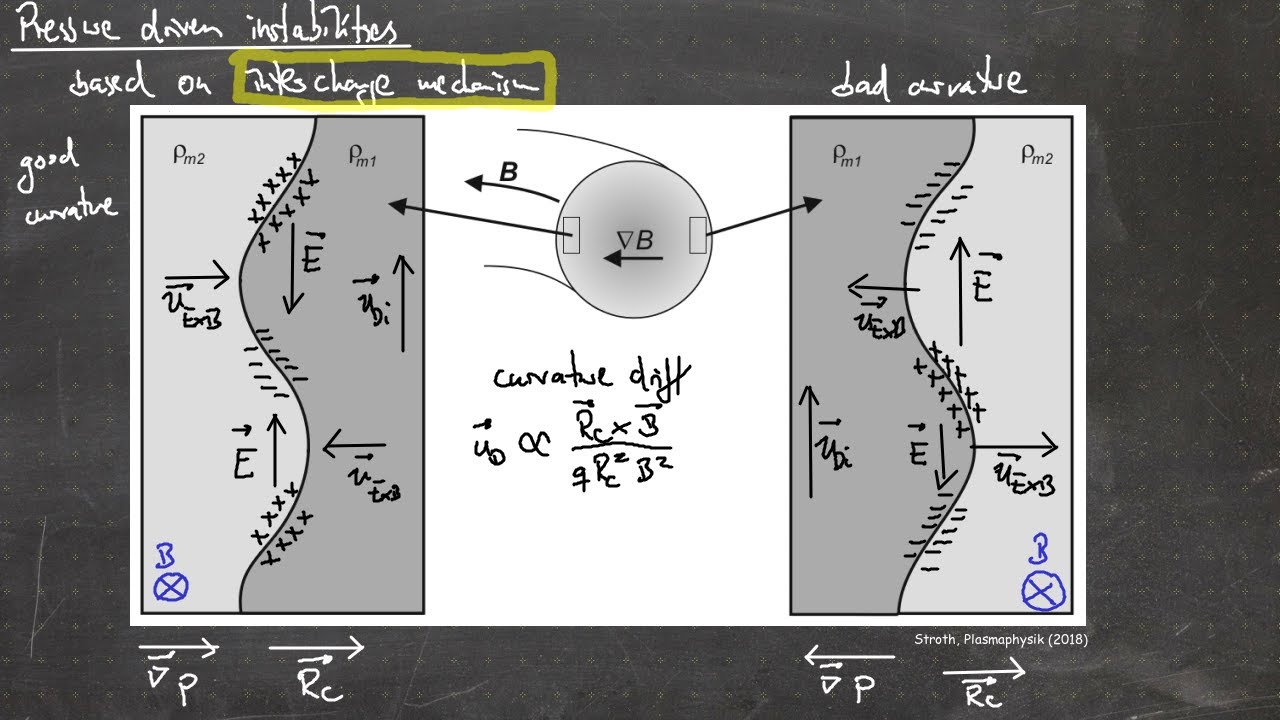





In plasma physics, charged particles moving through non-uniform magnetic fields experience two fundamental drift velocities: gradient drift, which occurs due to spatial variations in magnetic field strength and causes particles to drift perpendicular to both the magnetic field and its gradient, and curvature drift, which arises from the curvature of magnetic field lines and causes particles to drift perpendicular to both the field direction and the radius of curvature. These drift mechanisms are mathematically expressed as v_delB = (m v_perpendicular² / 2q) × (B × ∇B)/B³ for gradient drift and v_curv = (m v_parallel² / q) × (R_c × B)/(R_c² B²) for curvature drift, where m is mass, v_perpendicular and v_parallel are perpendicular and parallel velocities, q is charge, B is magnetic field strength, ∇B is the magnetic field gradient, and R_c is the radius of curvature of the magnetic field line. Together, these drifts cause charge separation in inhomogeneous magnetic fields, which is fundamental to understanding phenomena such as the Earth's planetary ring current in magnetospheric physics.
Gradient Drift and Curvature Drift in Plasma Physics
Added:Hello, dear students. Today we will try to understand; what is called as the Gradient Drift and the Curvature Drifts. So far in our discussions about plasma physics, we have been analysing various types of electric and magnetic fields and howa single charged particle with a mass m behaves in these different types of fields. So, we have seen how uniform and static electric field will influence the charged particle we are also seen how a uniform magnetic field will influence a charged particle. We also seen a perpendicular electric and magnetic fields how they will influence the charged particles trajectory. We have drawn these trajectories and with this understanding we have moved on to the idea of a varying magnetic field in space, but a static magnetic field. So, in this process we have seen that if the magnetic field is changing or if its strength is changing from one point to another point. We have taken a magnetic field such that its magnetic field strength is lower in a particular region and it is stronger it is at a particular region. So, we have seen that the main influence of the magnetic field strength changing will come in the terms of its radius of gyration of the particle. Since, we have known that the radius of gyration of a particle is defined as mv by q B. So, if the magnetic field is more the particle will gyrate in a smaller circle; circular path with a smaller radius and vice versa.
So, what we have seen so, far is that if the magnetic field is in this configuration such that the magnetic field lines are farther apart towards the negative y axis let us say. So, the axis that we have taken was such that. So, the magnetic field is grade is having a gradient along the y direction and the magnetic field is pointing outwards out of this page or we can say that the magnetic field is along the z direction. So, in this configuration we have seen that the particle will have a larger gyration radius here and the particle will gyrate in a smaller circle here. So, apart from this basic the basic idea was the particles radius of gyration changes as it moves across the y direction this leads to the formation or this leads to the idea of the drift velocity. So, this the difference in the radius of gyration as it moves along the positive y direction gives away the what is called as the drift velocity fine. So, in this process we made a simple assumptions saying that, if you define the length of inhomogeneity in the magnetic field with capital L. We have we have assumed that this length of inhomogeneity must be much greater than the radius of gyration of a single particle; that means, what we are trying to do is we are trying to make sure the particle while gyrating in one orbit will not experience any inhomogeneous magnetic field. So, having said that we have try to expand the magnetic field in Taylor series expansion B 0 is the magnetic field strength at the centre of gyration or the centre of orbit then if it is the case: then we have seen the magnetic field can be expanded as this. So, if the magnetic field is expanded we neglect all the higher order terms, then we have calculated the average force that the particle experiences along the three directions. Now, since the magnetic field is along the z direction and the if the particle is having a velocity v x, v y, v z the particle will not experience any force due to the magnetic field along the z direction. So, F z is always 0 and F x was evaluated to be 0 and F y was derived to be q v perpendicular r L by 2 dou B z by dou y. So, I remember having stopped at this point in the last lecture; that means, we have derived the average force that a particle experiences as it travels across this the across this gradient or across this non uniform magnetic field. Now, here our objective is to find the drift velocity let us say we call this as v F is we know that the generalized force will give away drift velocity as F cross B times B square. So, here F can be anything. So, while discussing the average or the generalized drift velocity, we have also said that the role of this F is to give a non zero velocity to the particles. So, that it comes under the influence of the magnetic field. So, if we know v F is this we call the drift velocity that arises due to the gradient in the magnetic field as v del B is equals to 1 by q since all other components of force are 0 F y cross B divided by B square. So, this F y the force that is experienced along y direction is obviously, along the y direction that is y cap is the direction or j cap and the magnetic field is along the z direction. So, if you substitute the value of F y into this equation; we can write 1 by q minus plus q v perpendicular r L by 2 dou B Z by dou y, y cross times B Z z cap divided by B Z square. So, here we have to determine the cross product between y cap and z cap and B Z being just the magnitude gets cancelled here.
So, we can write the velocity due to the drift in the magnetic field as minus plus v perpendicular r L divided by 2 B Z into dou B Z by dou y along x cap that, so that is the basic idea. So, basic idea is you have a magnetic field in this direction this is B Z and this is Z direction this is the x direction and this is the y direction. So, the magnetic field gradient is in this direction the magnetic field is in this direction. Now, we are able to see that the velocity of the particles is in this direction, this is the most interesting thing; that means, the velocity of the particle is perpendicular to B as well as del B. So, this is the most interesting thing; that means, the particle is moving in a direction which is perpendicular to both the magnetic field and the gradient of the magnetic field, which is allowing it to move. So, this is the velocity.. So, now as you see r L is defined to be m v perpendicular by q B. And we also know that the magnetic moment is W perpendicular by B. So that means velocity due to the plus minus that we have velocity is positive is in the positive x cap for electrons and is in the negative x cap for ions. So, what does it mean? It means that the gradient,we have a very important point if we look back if we consider a magnetic field which is homogeneous and static in nature; that means, B dou B by dou x is equals to 0. I am trying to make a point based on the particles moment. So, in this situation were which was the first or second particular case that we have discussed, we have seen that both the particles; were executing a simple harmonic motion or a circular motion where the x and y components of the velocity were giving you circular motion. We have seen thatboth the particles will gyrate along the same direction, but they will gyrate in opposite direction in the sense the gyrate,the circular motion was in the opposite direction. So, let us say this is for the ions and this is for the electrons, the radius of gyration proportionate to the mass. What we have seen is that both the particles will move in the same direction ofcourse, their radius of gyration will be depend will be different or they will more be proportionate to the amount of mass. So that means, electron being lighter particle will have a smaller radius of gyration whereas, the ion being a heavier particle will have a larger radius of gyration. But, one important aspect is that this uniform static magnetic field was not able to create any charge separation, but what you see when the magnetic field becomes non uniform. Or inhomogeneous what we see is the drift velocity is of course, dependent on the charge; that means, it is different for ion and it is in the different direction for an electron. That means, because we see a charge separation. That means so here the it is the arrow that is drawn here is for the positive x direction. So, ions are moving in these directions with the velocity, electrons are exactly moving in the opposite direction. So, what does it mean this leads towards the charge separation. So obviously, electrons and ions will go in opposite directions become; that means, that there is an electric field that will be set up and ions will try to move across this electric field and electrons will try to oppose this electric field.
So, the main important point is that the magnetic field being in homogenous allows charge separation. So, this is a important point. So, the magnetic field it being inhomogeneous allows charge separation and this the velocity that with which this particles will travel will is generally called as the gradient drift velocity. So, the gradient drift velocity can be more conveniently written as let us say V del B let us say, there are a few more points. So, plus minus v perpendicular r L divided by 2 B Z dou B Z by dou y along x cap. Now, for the given configuration of having the gradient along the y direction. So, let us say the gradient is along. So, the del B is in this direction and B being just one component is in this direction; for this configuration the particle trajectories will look something like this, this is for ion and this is for electron. So, what did I say ions So, here we made a mistake according to the science it will be positive x direction for the electrons and so this is the direction, this should be electrons and this should be ions. So, this is ions and electrons. Now what is the most important conclusion about the gradient drift velocity is that this separation of charges leads to something called as a very important aspect in magnetosphere. Or magnetospheric physics is leads to something called as the planetary ring current we will see how I mean how exactly and what is the importance of this planetary ring current. So, this planetary ring current is a very important aspect of space physics. I hope we canmake some connection between the gradient drift velocity and the planetary ring current. So, this was something about the gradient drift velocity generally what happens the gradient drift velocity can be more suitably or simplified in a more general form as so v del B is m v perpendicular square divided by 2 B Z or.
So, v perpendicular v del B is m v perpendicular square divided by 2 q times B cross del B divided by B q. So, now, for the given direction of del B and for the given direction of B that we have taken this form will again reduce to the same equation that we have derived earlier. Or this can also be written as W perpendicular, W perpendicular is the perpendicular kinetic energy divided by q times B cross del B divided by B cube. So, this is simply implies that the velocity is perpendicular to both B as well as del B for the case of earth the velocity will be in an equatorial plane along the longitudes. Now, so one very important understanding about themagnetic field vector B is that we know from the Maxwell equations that del dot B is equals to 0. So, what does it mean the first thing that comes to your mind is that the magnetic field monopoles will not exist; that means, the magnetic field should always; so, one very important understanding from this is that the magnetic field should always converge and diverge. So, if you take a simple bar magnet let us say if we take a simple bar magnet the magnetic let us say this is north and this is south. So, the you will always see that magnetic field lines will always be like this for a bar magnet. So, one thing that you notice is that the magnetic field lines are converging and diverging at the poles. So, what is the direction of magnetic field for this let us say direction of magnetic field is the direction along which unit north pole will travel so; that means, the direction of magnetic field is from north to south. So, for the case of earth the magnetic field lines diverge from the south-pole which is geographic; that means, they will diverge from the north-pole and they will converge to the south-pole. So, this is the direction of the magnetic field now what you see from this figure is that del dot B is 0 of course, the magnetic field lines converge and diverge at the poles; that means, the strength of the magnetic field is at the is maximum at the poles and is its minimum or it varies as a function of r. So, if you simply take a dipole magnetic field, the dipole magnetic field will look something like this the radial component B r is mu naught by 4 pi 2 m by r cube cos theta. And B theta is mu naught by 4 pi 2 m by r cube sin theta. So, what does it mean, it means that the magnetic field depends on the value of r. So, for different distances the magnetic field will be different. So, it means that the magnetic field any natural any realistic magnetic field that you find will always have a gradient. it is not possible that you will have a uniform magnetic field let us say for example, it may be possible, but over a very limited space. If the magnetic field lines are extending from infinity to infinity somewhere in between you may find magnetic field lines which are parallel and the magnetic field being uniform. But in all the other cases the magnetic field lines are always curved; and they are curved let us say between the two points, between one pole and between the other poles; that means, the magnetic field lines are always curved.
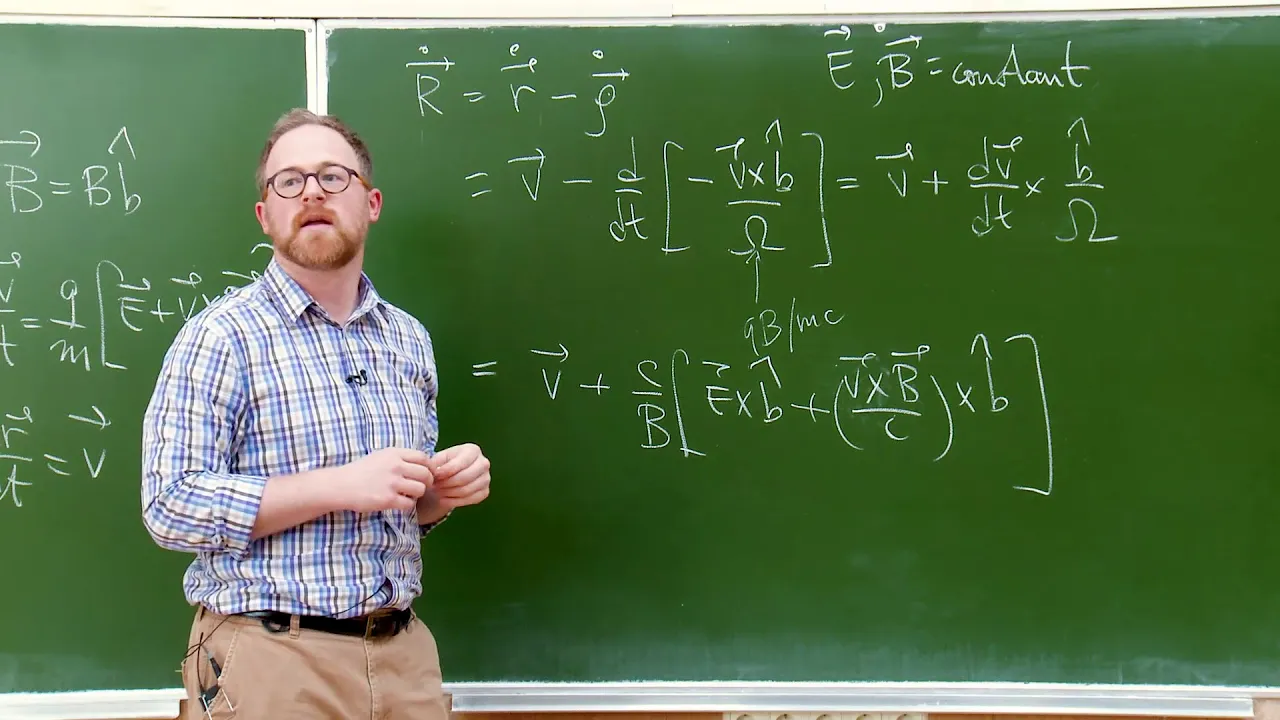
So, what does it mean? So, the magnetic field B is always associated with a gradient and a curvature of the magnetic field lines. So, now what we have seen is that the magnetic field due to its gradient gives away what is called as thegradient drift velocity we will also see that if the magnetic field. Let us say if the magnetic field is assumed to be this this curved magnetic field has a radius of curvature let us say is assumed to be R c now,a particle it is a charged particle will gyrate across this magnetic field line. Now as it gyrates it also experiences another force in addition tothe force that is created by the magnetic field the additional force can be called as the F CF, what is F CF? F CF is the centrifugal force which acts away from the centre of the curvature. So, due to the additional force F CF we can also find out a drift velocity which is called as the curvature drift velocity. That means, any realistic magnetic field will always be inhomogeneous and its magnetic field lines will always be curved. That means, if you see for example, if the magnetic field is stretched over a very long distance then it may be possible that this magnetic field lines are parallel over certain spatial distance, but otherwise the magnetic field lines are curved. So, if the magnetic field lines are curved it will give away what is called as the curvature drift velocity. Now the particle is of course, gyrating parallel I mean the particles velocity parallel to the curved magnetic field lines is taken as v parallel. Now we againuse v R is now the curvature drift velocity is again F cross B by B square. Now F the is the centrifugal force, which can be written as let us say F CF is m v parallel square divided by R c,which will act across R C. So, v R the centrifugal force can be 1 by q times m v perpendicular square divided by R c into R c cross B divided by B square; or we can write the unit vector R c as R c bar divided by mod R c.
So, in that case we can write the curvature drift as 1 by q m v parallel square divided by R c square B square times R c cross B. So, this is the drift that the particle experiences as it travels across the curved field line. So, now the drift velocity due to the gradient in the magnetic field is v del is written as m v perpendicular square divided by 2 q times B cross del B divided by B cube. So, this is again so, any realistic magnetic field should always have these two velocities associated with it any path. That means, any particle which comes across a realistic magnetic field will always experience these two magnetic field, these two drift velocities. So, these two drift velocities let us let us say what do you see you see that the drift velocity due to curvature. So, v R is perpendicular to R c of course, and B and v del is perpendicular to B and del B. Let us say for example, we put the example of the earth. So, let us say if the earth is like this. So, this is the geographic south-pole and this is the geographic north-pole and the magnetic field lines will look something like this a realistic magnetic field lines. So, the geographic north-pole is actually the geomagnetic south-pole and geographic south-pole is actually the geomagnetic north-pole. So, the magnetic field lines should look something like this the direction of this magnetic field lines should look something like this. Now if you want to understand the formation of ring current let us define the directions let us say. So, if the curved magnetic field line is like this the radius of curvature is of course in this direction. Now the gradient of the magnetic field is in this direction away from the equatorial plane let us say and the original magnetic field is in this direction this is the B and this is del B and this is R c this is the R c cap. Now so, the possible direction for the drift of the velocities the curvature drift should be perpendicular to R c and B. So, it should be along the x direction and the gradient drift should be perpendicular to B and del B. So, it should be along the x direction. So; that means, that when the particles come let us say when the particle the plasma particle come ,due to this gradient drift and the curvature drift this will lead into charge separation; that means, electrons will go in the positive direction of positive x direction and ions will go in the negative x direction; that means, electrons will go to if the; now the earth is revolving from west to east. So, sun is in this direction this is the sun. So, electrons will go towards the dusk and ions will go towards the dawn. So, this eventually creates charge separation and this charge separation will produce what is called as the planetary ring current earth nearly 6 to 8 re it will be very strong current in the sense that its magnitude will be of the order of several millions of amperes. So, we will talk more about this ring current and its and its effects in subsequent classes. But, however; it is reasonable that you combined the drift velocity due to the radius of curvature and the drift velocity due to the gradient and you call this as the total drift velocity v total. So, the idea is it is not possible to have drift velocity only due to the gradient because the gradient in the magnetic field imposes that there should always be a curvature. So, any realistic magnetic field should always have the curvature as well as the gradient. So, that then we define the total drift velocity of a particle which experiences a magnetic field; that means, any magnetic field will throw the gradient part as well as the curvature part. So, we can writethis as it is I mean we can combine this drift velocities as it is which is m v parallel square divided by R c square B square times R c cross B plus m v perpendicular square divided by 2 q B cross del B divided by B cube or we can take a particular geometry and combine them in a more convenient or in a more suitable form. So, this is the total drift velocity that a magnetic field will offer a charged particle. So, if this drift velocity depends on the mass and depends on the charge and depends on the magnetic field. So, there is another more important way to add these two drift velocity components by taking a cylindrical geometry into consideration, let us see we can do it in the next class.
Up Next

Plasma Fluid Equations | Magnetohydrodynamics Basics
@luciusfox9508
6.4K views•2015-12-24

21cm Hyperfine Transition in Neutral Hydrogen: Radio Astronomy Basics
@AaronRobertParsons
12.4K views•2011-10-13

NMR Spin Physics I: Zeeman Effect, Resonance Condition & Larmor Frequency
@nptel-indianinstituteofsci8064
2.3K views•2024-01-17

Entropy and the Second Law of Thermodynamics Explained
@veritasium
27.5M views•2023-07-01
Related Study Plans & Knowledge Roadmaps
Structured learning paths in Physics