Evaluating the Critical Period Hypothesis: L1 vs. L2 Brain
Learning Goal: Evaluate the cognitive and neurological evidence supporting the Critical Period Hypothesis in first language acquisition versus adult second language acquisition.
- Prerequisites: Basic understanding of cognitive psychology and general biology.
- Estimated Total Study Time: 12 hours
Module 1: Foundations of Language Acquisition
This module establishes the foundational theories of how human beings acquire language. It contrasts the classic behaviorist perspective (learning through reinforcement) with Noam Chomsky’s nativist theory of Universal Grammar. It also introduces the fundamental developmental and environmental differences between infant first language acquisition (L1) and adult second language acquisition (L2).
Why this video
This video provides a concise overview of the historic debate between B.F. Skinner’s behaviorist model of language learning and Noam Chomsky's nativist view. It outlines the core of Chomsky's argument: that children are born with an innate capacity for language, a concept essential to understanding why a biologically determined "critical period" might exist.
Knowledge Checkpoint
- Contrast B.F. Skinner’s reinforcement-based behaviorism with Noam Chomsky's nativist theory.
- Define "Universal Grammar" and explain the "poverty of the stimulus" argument.
- Identify how innate cognitive structures facilitate rapid L1 acquisition in infants compared to conscious study in adults.

Why this video
Dr. Patricia Kuhl explains the computational methods infants use to acquire language. This video is crucial because it demonstrates how infants act as "citizens of the world" by naturally distinguishing all phonetic contrasts, a capacity that narrows systematically as they specialize in their native language before age one. This represents the early physiological gating of language acquisition.
Knowledge Checkpoint
- Explain how infants use "statistical learning" to map and group the phonetic sounds of their environmental language.
- Describe the shift from being a phonetic "universalist" to a "culture-bound listener" between 6 and 10 months of age.
- Explain the role of human social interaction versus passive audio/visual exposure in early phonetic learning.

Why this video
This video systematically compares first language acquisition (an subconscious, natural, and universal process) with second language learning (an explicit, highly variable, and classroom-driven effort). Understanding these distinct developmental trajectories is a vital prerequisite before looking at the underlying neurobiology.
Knowledge Checkpoint
- Identify three major differences in cognitive processing between subconscious L1 acquisition and conscious L2 learning.
- Describe how affective factors (such as performance anxiety and motivation) impact adult L2 learning compared to infant L1 acquisition.
- Explain the differences in raw input volume and feedback structures experienced by L1 infants versus L2 adults.
Module 2: Deciphering the Critical Period Hypothesis
This module explores the historical roots of the Critical Period Hypothesis (CPH), formulated by neurologist Eric Lenneberg in 1967. Learners will evaluate behavioral and clinical evidence for CPH, specifically analyzing tragic case studies of extreme social and linguistic isolation, which serve as natural experiments on the biological limits of delayed language acquisition.
Why this video
This lecture provides an academic breakdown of Eric Lenneberg's formulation of the Critical Period Hypothesis. It explains the biological boundaries of the critical period—proposing that it starts around age two and closes at puberty—and links this decline in natural learning ability directly to lateralization and age-related loss of neural plasticity.
Knowledge Checkpoint
- Outline Eric Lenneberg’s primary criteria for a biologically defined "critical period" in language development.
- Explain the concept of hemispheric lateralization and how Lenneberg believed its completion at puberty closed the window for native acquisition.
- Discuss how age affects accent-free phonetic mastery versus structural grammatical acquisition.

Why this video
The case of Genie Wiley is the most thoroughly documented scientific case of extreme social and linguistic deprivation. This documentary illustrates the tragic real-world test of Lenneberg's hypothesis. It details how, despite intensive therapy after her rescue at age 13, Genie was able to build a large vocabulary but was permanently unable to master syntax or grammatical structures.
Knowledge Checkpoint
- Analyze Genie Wiley's language development to explain the neurological dissociation between vocabulary acquisition (lexicon) and grammatical development (syntax/morphology).
- Explain why case studies of feral or abused children are scientifically confounding when evaluating the Critical Period Hypothesis (e.g., distinguishing cognitive deprivation/trauma from purely linguistic deprivation).
- Describe the differences in left-hemisphere versus right-hemisphere processing observed during Genie's language tests.

Why this video
This specialized linguistics lecture examines critical periods in first-language acquisition, utilizing empirical evidence from deaf children. Deaf children born to hearing parents often experience delayed exposure to their first accessible language (sign language). This serves as a clean, trauma-free test of the Critical Period Hypothesis, isolating age of acquisition from environmental abuse.
Knowledge Checkpoint
- Synthesize the findings on deaf individuals exposed to American Sign Language (ASL) at different ages (infancy vs. early childhood vs. post-puberty).
- Describe the morphosyntactic errors typical of late L1 learners compared to native, early-exposed signers.
- Evaluate how late L1 acquisition differs from late L2 acquisition in terms of overall cognitive and syntactic achievement.
Module 3: The Neuroscience of Language
To evaluate the biological basis of the Critical Period Hypothesis, we must first understand how the brain processes language. This module covers classical and modern functional neuroanatomy of language, focusing on Broca's and Wernicke's areas. It also addresses the underlying cellular mechanisms of neuroplasticity and the developmental milestone of synaptic pruning.
Why this video
This video explains the traditional Wernicke-Geschwind model of language processing alongside modern updates. It provides a visual guide to the structural layout of language centers in the left hemisphere, detailing the specific responsibilities of Broca’s area (expressive syntax/production), Wernicke’s area (receptive comprehension), and the arcuate fasciculus that connects them.
Knowledge Checkpoint
- Identify the anatomical locations and core functions of Broca's area, Wernicke's area, and the arcuate fasciculus.
- Describe the differences between expressive (Broca's) aphasia and receptive (Wernicke's) aphasia.
- Explain why the classical localist model (isolated brain regions) has been expanded by modern neuroscience into a distributed, network-based model of language processing.

Why this video
This clip focuses on the fundamental biological mechanics of neuroplasticity. It explains how connections between neurons (synapses) physically form, strengthen, and adapt in response to environmental stimuli and learning. This biological adaptability is the physical foundation of language acquisition.
Knowledge Checkpoint
- Define neuroplasticity and explain how structural changes occur at the synaptic level during learning.
- Describe the role of myelination in accelerating neural signaling and how it changes across the lifespan.
- Explain how age-related declines in baseline synaptic plasticity affect the speed and effort required for adult learning.
Why this video
This short segment from NOVA contrasts the neurological architecture of a young child’s brain with that of an adult. It illustrates how a child's brain has a massive overabundance of synapses (inefficient "back-country roads") which are eventually cut in half through "synaptic pruning" to create a highly optimized, but less plastic, adult brain.
Knowledge Checkpoint
- Describe the process of synaptic pruning and explain its developmental timeline from toddlerhood to adulthood.
- Explain why a high density of unpruned synapses makes a child's brain highly receptive to language input, yet structurally inefficient at specialized tasks.
- Discuss how the completion of major pruning phases in early adolescence relates to the proposed closing of the critical period.
Module 4: Neurological Shifts in Adult L2 Learners
This module focuses on the neurological changes that occur during adult second language acquisition. Using functional neuroimaging (fMRI) data, learners will examine how the brain physically organizes and processes an L2 compared to an L1, with particular attention to how the age of acquisition affects cortical representation.

Why this video
Dr. Thomas Bak, a prominent cognitive researcher, introduces the concept of neural lateralization and structural organization in early versus late bilinguals. He outlines how early-acquired languages tend to share overlapping neural activation patterns in Broca’s and Wernicke's areas, whereas later-acquired L2s rely on more distributed, separate networks.
Knowledge Checkpoint
- Compare the cortical organization of L1 and L2 in an early bilingual (simultaneous acquisition before age 7) to a late bilingual (sequential acquisition after puberty).
- Explain how fMRI scans reveal differences in Broca's area activation during L1 vs. L2 production in late bilinguals.
- Define the cognitive reserve benefits that result from managing two active language networks in one brain.

Why this video
This video explains the mechanics of functional magnetic resonance imaging (fMRI) in linguistics. Understanding how neuroimaging detects changes in blood oxygen levels (BOLD signal) to map linguistic tasks in real-time is necessary for evaluating the empirical data behind bilingual brain studies.
Knowledge Checkpoint
- Explain the physiological principles of fMRI, specifically how Blood Oxygen Level Dependent (BOLD) signals track real-time cognitive processing.
- Discuss the spatial resolution limitations of fMRI when mapping tiny sub-structures of language networks.
- Relate localized cortical activation during grammar processing tasks to the neural effort required by L2 speakers versus L1 native speakers.

Why this video
This video synthesizes the cognitive, physiological, and environmental hurdles that adults face during language learning. By looking at differences in raw exposure hours, structural brain development, and performance anxiety, it helps explain why adult L2 learners must deploy conscious problem-solving networks (prefrontal cortex) to accomplish tasks children perform automatically.
Knowledge Checkpoint
- Contrast the native-like intuitive processing of children with the rule-based, analytical language processing common in adults.
- Explain how differences in environmental immersion and communicative demand affect the success rate of L1 vs. L2 learners.
- Describe the role of the prefrontal cortex in filtering conscious errors during L2 speech preparation.
⚠️ Curriculum Gap & Supplemental Research Challenge
While the video pool covers the general challenges of adult bilingualism, it lacks detailed fMRI brain map visualizations illustrating the physical separation of language networks in late bilinguals.
To bridge this gap and deepen your understanding, search Google Scholar for the landmark 1997 study by Kim et al., Nature: "Distinct cortical areas associated with native and second languages."
Independent Study Task: Read the paper and determine how fMRI scans of Broca’s area and Wernicke’s area differ when late bilinguals switch between L1 and L2, compared to when early bilinguals do the same.
Module 5: Critical vs. Sensitive Periods & Modern Debates
This module examines the modern academic consensus surrounding biological limits on language acquisition. Rather than a strict "critical period" that closes abruptly at puberty, modern cognitive science increasingly supports a gradual "sensitive period." Learners will evaluate the cognitive, environmental, and socio-affective variables that allow some adult learners to beat the biological odds and achieve native-like fluency.
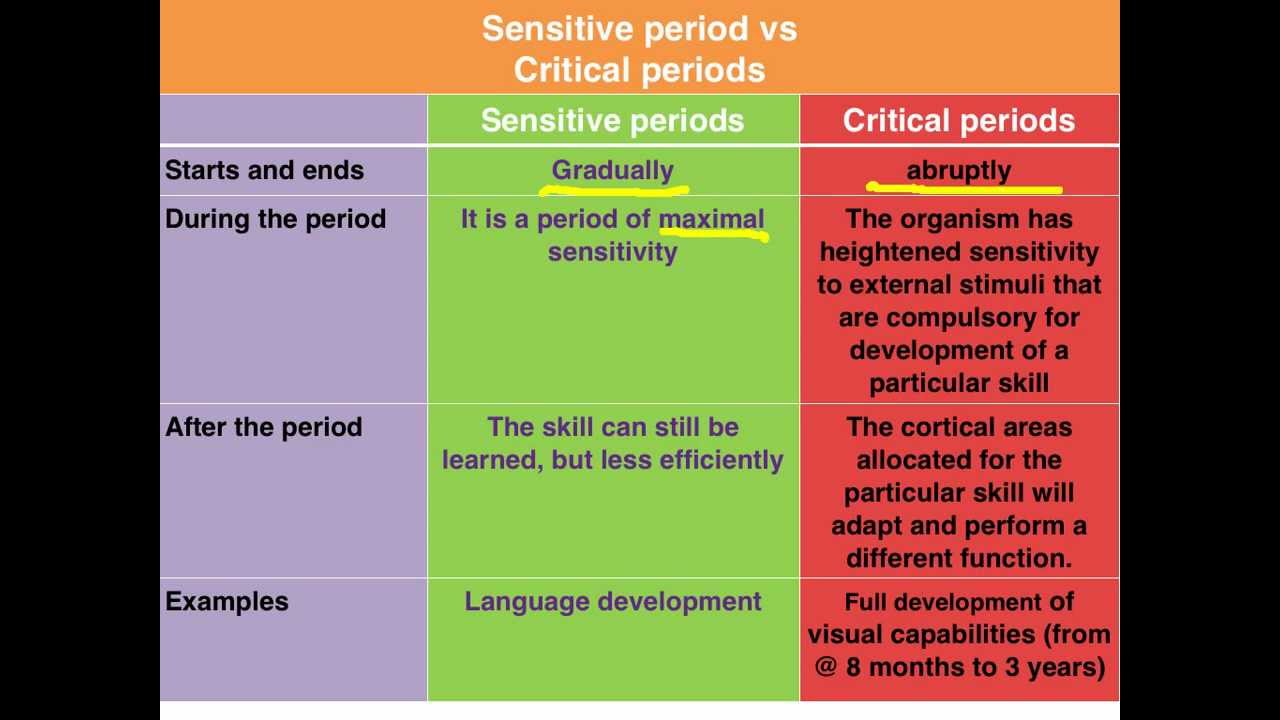
Why this video
This video clarifies a vital terminological distinction in developmental psychology: "critical periods" versus "sensitive periods." Understanding this distinction is central to modern debates over whether adult native-like language acquisition is biologically impossible or simply highly inefficient.
┌────────────────────────────────────────────────────────┐ │ WINDOWS OF LEARNING │ ├───────────────────────────┬────────────────────────────┤ │ CRITICAL PERIOD │ SENSITIVE PERIOD │ ├───────────────────────────┼────────────────────────────┤ │ • Abrupt start and end │ • Gradual onset and decline│ │ • Absolute biological limit│ • Period of maximum utility│ │ • Deprivation = permanent │ • Learning possible later, │ │ structural deficits │ but requires more effort │ └───────────────────────────┴────────────────────────────┘
Knowledge Checkpoint
- Differentiate between a strict "critical period" and a gradual "sensitive period."
- Explain how a gradual sensitive period model accommodates adult L2 learners who achieve native-like grammatical mastery.
- Identify developmental domains outside of language (e.g., visual system development, attachment) that align more closely with strict critical periods.
Why this video
This developmental psychology lecture introduces how modern science views environmental interactions during periods of high plasticity. It highlights that while sensitive periods represent optimal developmental windows, they are longer, more flexible, and more dependent on cognitive and social factors than once thought.
Knowledge Checkpoint
- Explain why biological predispositions require specific environmental "triggers" or rich input to complete normal developmental pathways.
- Discuss how environmental enrichment can alter or extend a developmental window.
- Evaluate how the shift from a critical to a sensitive period model changes the expectations of adult L2 instruction.

Why this video
This video explores the cellular and systemic environmental triggers that open and close developmental windows. It highlights the role of metabolic factors, stress, and environmental input in driving synaptic changes, emphasizing that these periods are controlled by complex biological interactions rather than simple, independent timers.
Knowledge Checkpoint
- Describe the cellular mechanisms (e.g., inhibitory neurotransmitter maturation, extracellular matrix formation) that physically "close" a sensitive period.
- Explain how variations in stress, nutrition, and environmental enrichment influence the duration of developmental windows.
- Summarize the modern consensus on how adult brains manage complex, demanding tasks without infant-level plasticity.
⚠️ Curriculum Gap & Supplemental Research Challenge
The video pool has limited coverage of the modern scientific debate over the exact age of decline for language acquisition. For a long time, it was believed that the window slammed shut at puberty. However, a major 2018 study of over 600,000 native and non-native speakers shifted this timeline.
To explore this evidence, search Google Scholar for Hartshorne et al., Cognition (2018): "A critical period for second language acquisition: Evidence from 2/3 million English speakers."
Independent Study Task: Read the paper and write down:
- At what age does the ability to master the syntax of a new language begin to decline, according to their large-scale data?
- What reasons do the authors propose for why this decline occurs so much later than Lenneberg's proposed puberty boundary?
Course Map
This flowchart maps the recommended pathway through the curriculum, highlighting module dependencies and the progression from behavioral theory to cellular neurobiology.
Key People Index
| Scholar / Researcher | Core Context & Contributions |
|---|---|
| Noam Chomsky | Linguist who pioneered Nativist theory, proposing the innate Language Acquisition Device (LAD) and Universal Grammar, challenging behaviorist models. |
| B.F. Skinner | Radical behaviorist who argued language is acquired entirely through operant conditioning, stimulus-response association, and parent reinforcement. |
| Patricia Kuhl | Neuroscientist specializing in early childhood language development. Discovered that infants use statistical tracking to map phonemes and identified the social gating of language acquisition. |
| Eric Lenneberg | Neurologist who formulated the Critical Period Hypothesis (1967), proposing that language acquisition is constrained by biological windows tied to brain lateralization, ending around puberty. |
| Paul Broca | 19th-century French physician who identified Broca's area in the left frontal lobe, the region responsible for structural syntax and speech production. |
| Carl Wernicke | 19th-century German physician who identified Wernicke's area in the left temporal lobe, the region responsible for speech comprehension and semantic decoding. |
| Thomas H. Bak | Cognitive neuroscientist who studies bilingualism across the lifespan, demonstrating the cognitive benefits of managing two active language networks and how age of acquisition influences lateralization. |
Final Self-Assessment
Complete this comprehensive self-assessment to verify your mastery of the cognitive, developmental, and neurobiological arguments surrounding the Critical Period Hypothesis.
- I can contrast B.F. Skinner’s behaviorist theory of language acquisition with Noam Chomsky's Universal Grammar, citing the primary arguments for each.
- I can describe the cognitive shifts that occur when an infant transitions from a universal phonetic listener to a language-specific phoneme processor between 6 and 10 months of age.
- I can outline Eric Lenneberg’s Critical Period Hypothesis, identifying its proposed biological start/end boundaries and its relationship to hemispheric lateralization.
- I can explain how Genie Wiley's syntactic deficits support the idea of a critical period for structural grammar, while her vocabulary growth shows that lexical acquisition remains possible after puberty.
- I can analyze studies of deaf individuals exposed to sign language late in childhood, using them to evaluate the CPH without the confounding variable of developmental trauma.
- I can pinpoint the anatomical locations and functions of Broca’s area, Wernicke’s area, and the arcuate fasciculus, describing the linguistic impairments that result from damage to each.
- I can explain the cellular processes of synaptogenesis, myelination, and synaptic pruning, and describe how these developmental milestones change the learning profile of the brain over a lifespan.
- I can outline the functional differences in cortical activation (as shown in fMRI scans) when late L2 bilinguals process their second language compared to early bilinguals.
- I can differentiate between a strict "critical period" and a gradual "sensitive period," supporting my explanation with neurodevelopmental evidence.
- I can explain how adult learners can bypass certain neurobiological limitations to achieve native-like fluency by leveraging alternative cognitive systems, such as the prefrontal executive network.