





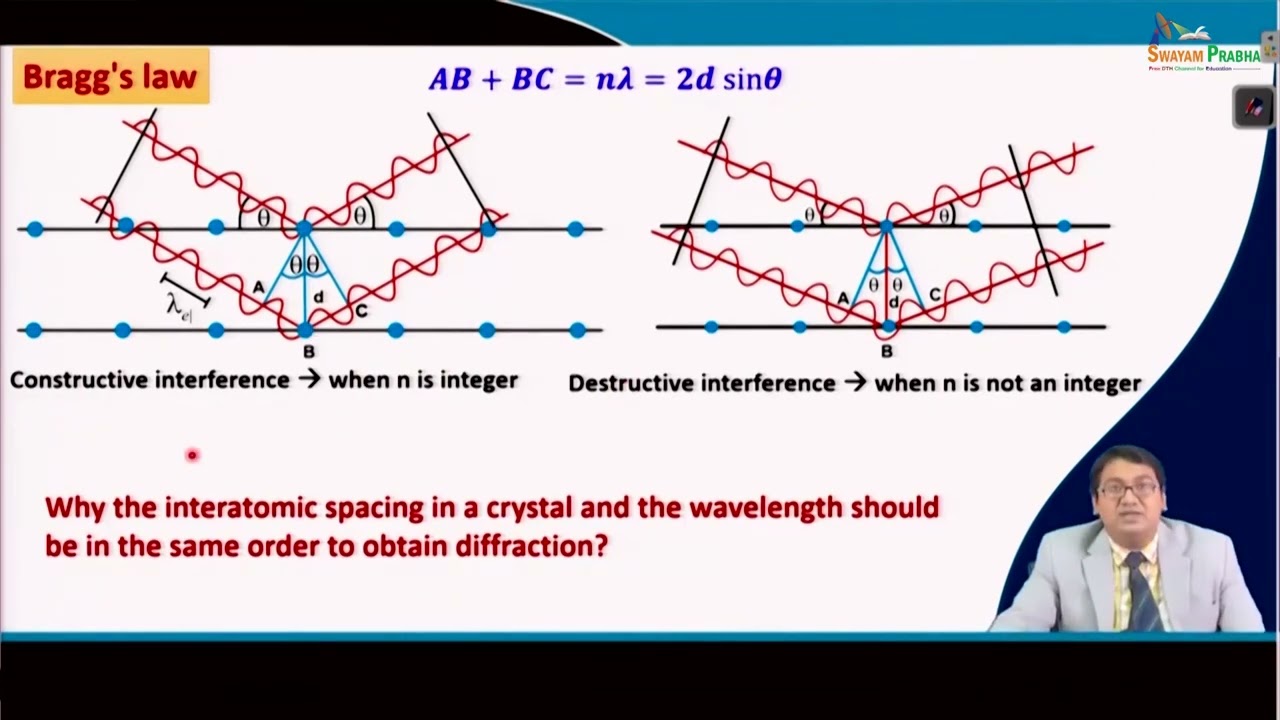





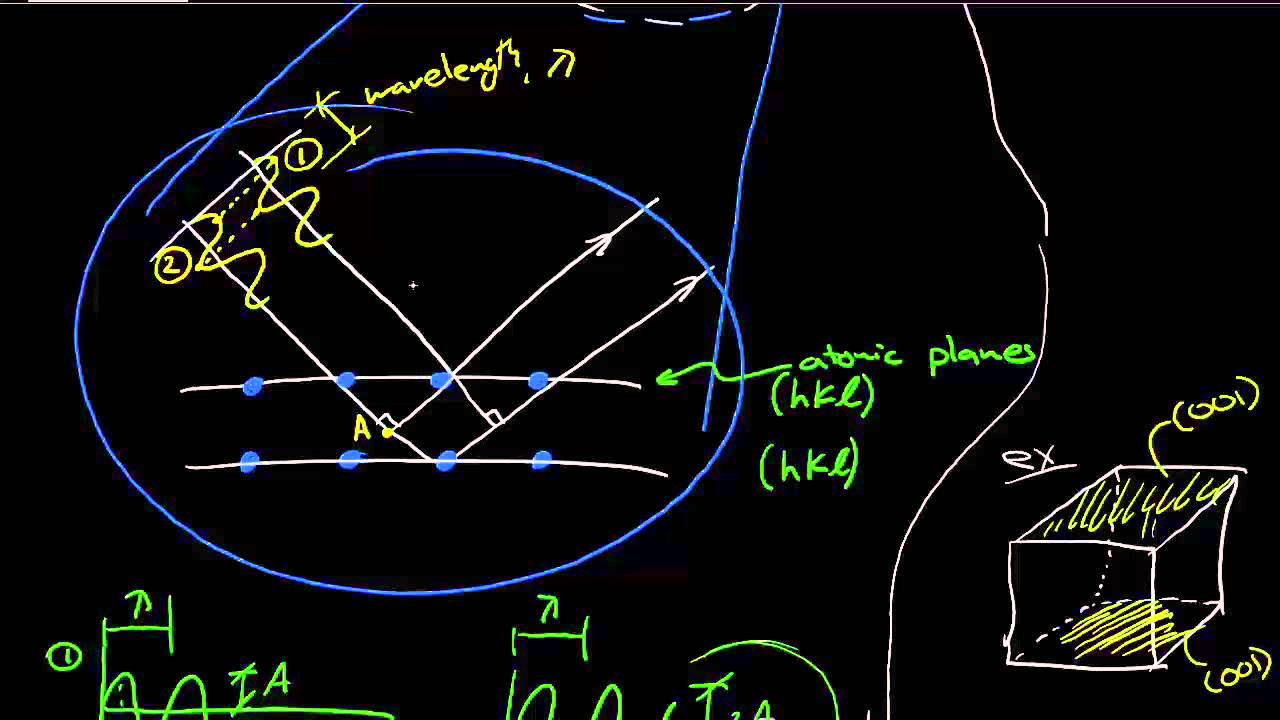





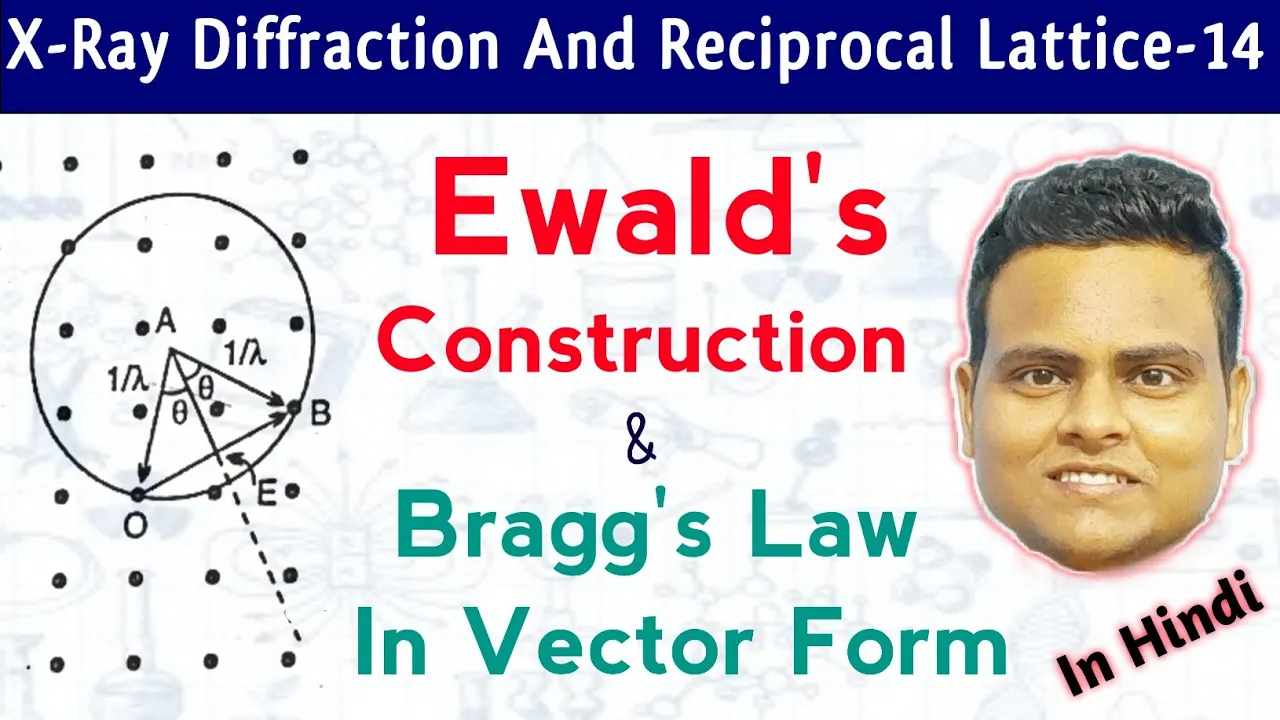
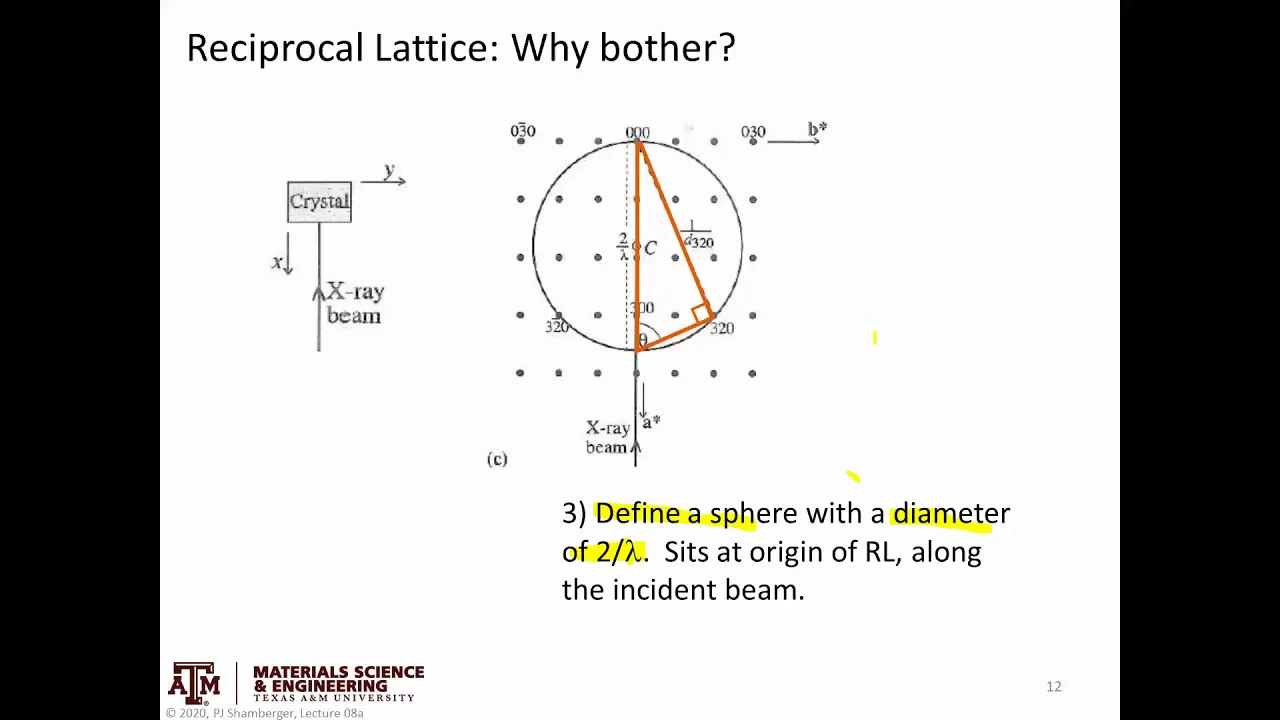





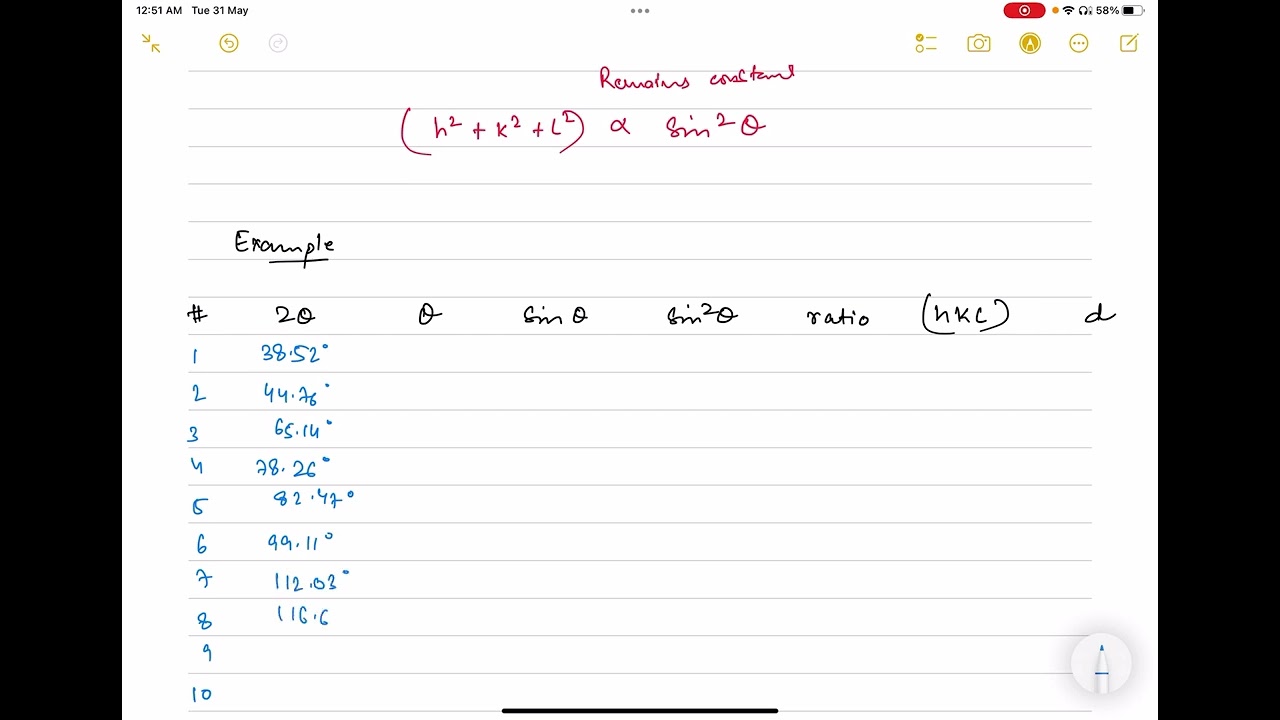


Bragg's Law (2D sinθ = nλ) describes the condition for constructive interference in X-ray diffraction, where D is the interplanar spacing, θ is the Bragg angle, n is the diffraction order, and λ is the X-ray wavelength. The structure factor S = Σ exp[2πi(u_j h + v_j k + w_j l)] determines which crystal planes produce diffraction peaks: for simple cubic, all planes are visible; for body-centered cubic, peaks appear only when h+k+l is even; for face-centered cubic, peaks appear when h,k,l are all even or all odd.
Condensed Matter Physics: Bragg's Law Part 2 & Structural Factor
Added:Fundamentals of crystallography, including unit cells, Bravais lattices (SC, BCC, FCC), and Miller indices (hkl).
The basic physical principles of wave interference, path difference, and electromagnetic radiation diffraction.
An introductory understanding of Bragg's Law (Part 1) and the basic geometric conditions for constructive interference.
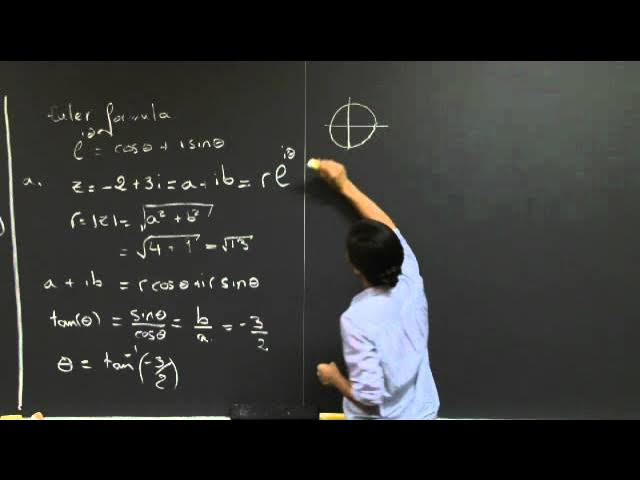
Familiarity with complex numbers and Euler's formula, which are essential for representing wave phases and deriving scattering amplitudes.
The concept of the Reciprocal Lattice and the Ewald Sphere construction in diffraction theory.
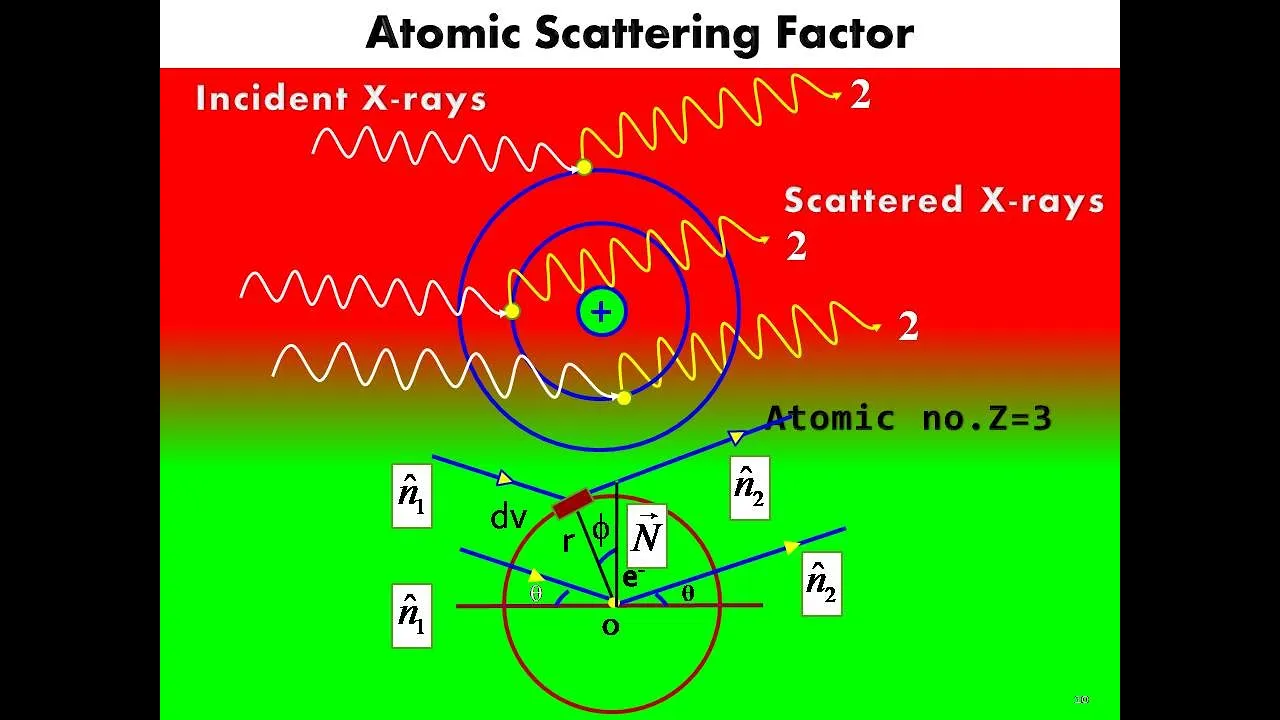
The Atomic Form Factor, which accounts for the spatial distribution of electrons within individual atoms during scattering.
Practical X-ray Diffraction (XRD) data analysis, including peak indexing and crystal structure determination of unknown materials.
Advanced scattering techniques such as Neutron and Electron Diffraction, comparing their structural factors and interaction mechanisms to X-rays.
1.5K views40likes1:02:38Original Release: 2023-09-15
yes good evening okay so in last class we were discussing the X-ray diffraction and drag slot right so I told you all the story today we are going to see the we are going to see the main things okay from where the question has to be arrived the basic concept is a part difference go for the constructive interference here just took to the N Lambda we are going to derive that relation okay but before that I was I just want to write one statement for which gave by the brags okay so everyone just write down this statement on your notebook first of all put the heading x-ray deflection x-ray diffraction okay so the statement is I am means conveying you just write down everyone for every diffractant beam for every diffracted beam for every diffracted beam there exists a set of Crystal planes there exist a set of Crystal planes there exist a set of Crystal planes such that the diffracted beam such that the diffracted beam such that the diffracted beam appears such that the diffracted beam appears to be reflected from these planes beam appears to get reflected from this plane from this plane another clearer everyone basically this is a statement what we have studied in last class okay the brags had to introduce the concept of the plane that's what I have written here okay so now let's derive the Brax equation okay let's derive the that's equation so for that just take the simple planes okay just take the planes first of all this will be some planes right okay now now what will happen the X-ray will get incident on this plane and reflection occurs so let's suppose there is a ring incident on this plane and it get drag defect okay and similarly this is another way incident here and it also get distracted clear everyone okay now see let's suppose let's suppose this is O and this is o dash obviously I told you we have to take the angles from the plane right we have to take the angle from the plane so this angle would be Theta or obviously this angle will also be Theta okay now we have to use basically the concept of diffraction and interference basically what is happening here the two Ray get diffracted and will get interfere okay and from that interference there will be some constructive and destructive interface both will be there but we have to see for the constructive interference we only get the peak when there will be a constructive constructive interference so what is the necessary condition for the constructive interference what is the necessary condition for the constructive interference that is the path difference the path difference of this Ray the path difference that is Delta it should be equal to integral multiple of the wavelength of the array that is n Lambda Delta is equals to n Lambda now the whole concept comes to what will be the path difference part difference okay so let's say it's quite easy what is the distance first of all tell me what will be the distance this will be D OK the inter planar separation right now let's give naming let's suppose this is a okay this is B now just draw the normal from this to this point from these two this point okay and similarly this angle will also be Theta and this angle will also be Theta problem sorry it's not a parallel it's look like a parallel parallel is just a thing like one Ray get diffracted reflected and it will interfere at some point interference okay incident Rays obviously incident Ray is I told you I told you in the last class now when x-ray will get hit on the plane foreign okay now so what will be the path difference let's naming them let's suppose this point is C and this point is capital T right so what will be the path difference see if anyone else has confusion I want I will tell you the ray came here incident at this point and defected came heated and diffracted till this point till this C Point both the ray both the rate only means so the path of both that I are saying till this point the path of both the ray same and similarly from D to infinite point the other part difference is also segmentally means the path is also same so where the difference come around different is just a c to B and B 2D right here C to B and b2d so the part difference will be path difference that will be BC CV plus b d or B C plus b d u b c plus b d now can anyone tell what will be the value of BC and BD what will be the value of VC and BD first of all track take a triangle ACB triangle a c b now tell me if we use sine Theta term if we use sine Theta then what will be the ratio what will be the ratio b c Upon A B clear ok so what is the value of BC BC we have to find out just write it at VC and what is the value of a b here entrepreneur separation that is d small d so the value of BC is D sine Theta D sine Theta similarly by the Symmetry or by the mathematics you can get the value of BD by stranglement so the value of BD will be also BD will also be D sine Theta so we got the value of BC we got the value of BD both are D sine Theta just put in the this equation this master equation what is what does it say is that the path difference that is Delta is equals to n Lambda for the constructive interference right what is the pulse difference D sin Theta D sin Theta that is 2D and Theta and that is equals to n Lambda and what is n here n is the order of reflection one two three and so on and is called the order of diffraction order of diffraction this is your very famous expression 2D sine Theta is equals to n Lambda so the people think that Brax got the Nobel Prize for this relation but basically Brax got the Nobel Prize for that statement which I had written earlier statements that this equation is a bipart of that theory okay that was under single bracks that was the pair of Father and Son law that was not a single scientist that was a two scientists Father and Son both means come together and just give the state okay so basically we have come to this relation 2D sine Theta is equals to and Lambda now this is quite famous and quite important relation important here that this relation can tell the complete structure information of any solid so we'll talk on this expression okay now yes yeah sorry Lambda value I'm going to write that don't worry I'm going to discuss that thing see they go the expression we got the expression now we have to talk on that music okay just see there so the expression is 2 D sine Theta is equals to n Lambda okay just for the Simplicity just take n is equals to 1 and we'll talk about the first ordered effect okay so the two D sine Theta 2D sine Theta will be equals to Lambda so sine Theta will be accessed to how much Lambda upon 2 D Lambda upon 2D what is the constraint on sine Theta what is the constraint on sine Theta that sine Theta value must be or less than equal to 1 yes okay so it must be less than equal to one yeah so can we write Lambda upon 2D less than is equals to 1 which implies that Lambda should be equal to or less than the 2 t Lambda is less than or equal to the 2D what are you getting what information you are getting from this expression that is Lambda is equals to Lambda is less than and equal to the 2D what information you are getting that is visible light visible light cannot do the x r d visible light cannot do the xrd what is the wavelength of visible light what is the wavelength of visible light it is around around 4000 to 7000 angstrom right now the wavelength Lambda for the visible light is around 4000 angry storm to 7000 engagement but here what you are getting the order of D the inter planar suppressing spacing is the order of three angry storm only so the Lambda should be less than or equal to around 6 Ang strong six angry storms wavelength for the xrd and here the wavelength is what much much more than thousand times more okay so means wavelength visible light what is suggesting it is suggesting the energy of visible light will be low okay we all know that it is equals to SC by Lambda so whose Lambda is greater their energy will be less so the visible light does not have that sufficient amount of energy so that they can perform the xrd that's why visible light cannot perform the X-ray diffraction right clear okay so this is quite informative things you can root done write down on your notebook that is why visible light cannot show the xrd why visible light can't show that shadow you can write it down if you talk about this expression so this expression suggests that 2D sine Theta is equals to n of Lambda okay but we all know D is the inter plane is facing for every spacing for every plane there is a sum indices Miller indices okay and since we know that that relation between the interclinear spacing and the lattice constant is D is equals to for the cubic Crystal if you talk about for the cubic Crystal or just leave it just do the discussion for the general case so that D is equals to 1 upon root under H Square over a square K Square over b square and plus L Square over C Square okay so when you put this expression here the whole theory of Branch converted with respect to what Miller indices with respect to the indices of the planes right so is h k l k mother say with the help of this hkl while performing the xrd we are able to get the plane okay this plane will be present this plane will not be present this is the quite important relation both of these together that thing I told you that here it is just Entertainer spacing explicitly but the main use which we will see in the Brax law and that's the reflection so basically use of interplanar spacing is here in brexit yes Lambda is a wavelength of x-ray wavelength of x-ray and this thing is clear from here also P Lambda is less than equal to 2D yes it is okay so a problem there was a problem that what would be the means wavelength of this x-ray initially when nothing was known about the X-ray there was some problem there was some confusion then what will be the wavelength of x-ray so from this x-ray diffraction and Brax concept scientist will get to know scientists would get to know that okay the wavelength of X-ray will be around means in angostron in angry storm and is six angstrom or five Angus strong basically less than the six angstrom order okay wavelength okay and that was the reason the name of this Ray is x-ray if anyone don't know I want to tell you this x ray where this x came from this x came from our mathematics that when we do know we do not know something we just name them X seriously this came from that when we don't know something just we take okay this is X let's suppose this distance is x in a similar version in a similar way the name of this Ray has been taken as X that's called X um I have send you I have sent you first of all solve the question tifr 2020.
difr 2020.
yes yes I am telling you uh there is a question number 37 just look at that where the Miller indices is 0 0 5.
37 a beam of X-ray is incident upon a powder sample of a material everyone got that yes question number is 37 37 question number is 37.
foreign a bmos a beam of X-ray is incident upon a powder sample of a material okay solve everyone let's find out the what is the value of this wavelength I am solving here the lattice constant is given as equals to 5.5 angry strong and this question is from tifr 2020 2020.
logic constant is 5.5 anger storm and the plane plane is 0 0 5 0 0 5 is the plane okay find out everyone what will be the value of wavelength what is the value of wavelength 2.2 angular storm is correct answer is 2.2 English see it's quite trivial later we have to just use the relation right we have to use just a relation 2D sine Theta is equals to n Lambda there is something about the order of diffraction in the question when there is nothing about the order of diffraction just taken is equal to one okay now the 2D sine details equals to Lambda what we have to find we have to find the Lambda so Lambda will be equals to 2D sine of theta it will be 2 multiplied by 5.5 Angus term divided by root under 0 plus 0 Plus 25.
and sine Theta what will be you take the value of theta yes it should be the pi by 2.
yes sine of 90 and when you will solve this you will get 2.2 angle stop clearance foreign yes just solve the second one another question just 2012 I think this is a question which is written I have written from the pen yes this is the questions the second order Maxima in the diffraction of x-ray of 0.40.20 actually 0.20 nanometer wavelength is quite simple question based from the jest just 2012.
question just 2012.
the question says the second order Maxima in the diffraction of x-ray of 0.20 nanometer wavelength from a simple cubic crystal is found to occur at an angle 30 degree okay so the distance between the lattice plane that is inter planar separation foreign okay now let's solve next question next question is solid with FCC Crystal a solid with FCC Crystal a solid with FCC crystal structure is the question from Jam 2020 the question I have written from my pen now below that question this is a question from Jam 2020 solve everyone please Jam 2020 so everyone find out the value of lattice parameter yes it is a is around 0.57 nanometer 0.57 nanometer not angry Stone 0.57 nanometer here sorry that's foreign structure is probe using x-ray of wavelength 0.2 nanometer for the crystallographic plane the crystallographic plane given by two zero zero means two zero zero is a plane find out the first order diffraction Peak is observed for the Bragg's angle of 21 degree the unit size unit cell size unit cell size means lattice parameters two zero zero girls are written here 0.5 nanometer 0.5 nanometer now just so last question quickly an x-ray beam of wavelength 1.54 angstrom one one zero planes first order break diffraction of corset together first order drag deflection what will the value ocean B yeah sine inverse one upon 2 root two if anyone is facing problem while doing this question I can solve on the board but please solve everyone okay foreign [Music] okay I'm telling you see it is saying there is an x-ray whose beam wavelength 1.54 anger Stone and it is get diffracted from 110 planes of a solid with cubic lattice whose lattice constant is 3.0 at angle strong so they are asking that the first order brat diffraction occurs at means at what angle the first order black diffraction will occur at what angle the first order Branch diffraction will occur that means basically they are asking the Theta kiss angle pay first order diffraction for the one one zero plane okay foreign [Music] okay for the D there is the lattice parameters given and hkl is also given just put all the value answer is B Theta is sine inverse 1 upon 2 root 2.
the answer is B m [Music] w [Music] each question means the question is saying that this plane will get the diffraction Maxima is these are two type of questions the main question the main question is basically whether all the plane will be visible or not this is your man [Music] which is because in the question they are telling you precisely that this plane is visible this plane is visible information this is a other type of question is tell me whether Ford every lattice every plane will be means visible will get will give us the diffraction Maxima the answer is no answer is no okay that's what I'm going to discuss the intensity of X-ray diffraction okay from this article you will get to know that there is a some condition on indices which indices Miller indices Miller indices conditions okay and according to that condition we are able to say that okay if the crystal is simple cubic This Plane will be visible this plane is not visible if our crystal is face centered cubic this will be visible this will be not visible clearer clear ing [Music] its answer is b b sine inverse 1 upon 2 root 2.
okay now now the article which we are going to discuss uh I'm telling you I will not go in the means derivation portion because it is just means useless for our exam point of view it's a very quite big derivation if anyone want I will solve by hand and will send back I'm not in going in the derivation portion because it is a work of your graduation or post graduation thing we will see the result because if we see the exam point of view the question which came till this date in the means number of exams the question basically is from one relation so it is so means useless to go for the derivation which is still if anyone wants I will send him okay write down the heading intensity of xrd pattern intensity of x r d pattern intensity of xrd pattern yes [Music] for the different different crystal structure This Plane will be present this plane will not be present right yeah okay that's what I'm going to discuss but I am telling you what I said I was saying that my question is from you guys tell me that if you talk about simple cubic Crystal whether the all of the plane will give the diffraction Maxima if you talk about the body centered cubic will all the planes one one zero one zero one one two two two one two three two one all will give the diffraction Maxima okay so the answer is sorry yes exactly that that's what I'm telling all will not give the diffraction Maxima there is some constraint that is some restriction over there for restrictions intensity of xrd pattern so the intensity we all know that it is the square of the amplitude okay now here the amplitude a amplitude a is is equals to F into s into what is the F here f is f is atomic a scattering Factor Atomic scattering Factor and what is s here s is geometric structural Factor geometric is structural Factor or structure Factor Atomic scattering factor and geometrical structure Factor okay so basically what the atomic structure factor is it measures the scattering power of an atom what does the f is it measures it measures the scattering power of atom scattering power of atom so how it will measure is scattering power atom s is mehu my body is stronger or you are saying that means okay Virat Kohli is a best cricketer Virat Kohli is the best cricketer um when you are saying that okay this man's power is means very good so basically you are comparing this man with anyone else in the similar way when we are saying F denotes the measure of scattering power of atom so here the other one that is the electron that is the electron there is a complete discussion I will not go there okay so Electronics means when the X-ray hit on the atoms electron get excited and electron also react and get means foreign [Music] f is basically this is the amplitude of radiation is scattered from atom this is a ratio of amplitude of atom amplitude of radiation amplitude of radiation amplitude of radiation is scattered from atom divided by the amplitude of radiation amplitude of radiation is scattered from electron is scattered from Electronics like you are saying there's a copper metal like you are saying it's a copper metal so copper metal atoms electrons so this is basically invariable things the main thing which I told you is s s is a geometrical structure Factor okay s is the geometrical structural Factor let's some do discussion on this s is a geometrical structure Factor and what does it means this is I'm writing down here summation of summation of amplitude summation of amplitude from all of the atom summation from amplitude of radiation from all the atoms from all the atoms this is basically this is simple cubic structure in a simple cubic structure what is the effective number of atom in a simple cubic this is one this is one in a similar way for the Body Center it is to though one atom is let's suppose present at the origin and the other atom is present at the one by two one by two one by two Center accidents right similarly whose name is okay okay so basically zero zero zero say a radiation foreign so the X-ray will come hit at the origin atom it will give some amplitude similarly it will have another atom it will give amplitude similarly one by one it will hit the all the four atoms and after hitting on each item there is a sum radiation which will have some amplitude then we will get the foreign write down the expression the expression is s is equal to summation e to the power 2 pi I u j h plus v j k Plus W J AR is then you don't need to do anything now what is the u j v j and WJ u j v J and W J basically the position coordinate of jth atom okay u j v J and W J is the position coordinate position coordinate of jth atom J Theta means what by different different Crystal structures one by one you will guys see here is means is expression helps it with the help of this expression we are going to see that if you talk about FCC not all the plane will be present not all the plane will be present okay so just put in your mind this expression on your notebook also I'm telling again these are no need for the derivation that's why I'm not wasting the time for the derivation okay but the expression this expression is quite useful okay so we will just we will do some discussion on this expression okay so let's start let's start with this with the help of this expression so the structure Factor we got the structure Factor we got a summation e to the power 2 pi I u j h v j k or you can also write it x y j don't worry if you are not comfortable with uvw you can also write it x y z okay or a b c whatever you want foreign obviously so the intensity will be what FS mod Square subscribe now one by one we'll see uh the different different crystals first of all let's talk about the simple cubic lattice let's talk about the huh multiplication multiplication okay so let's see for the simple cubic and for the body centered cubic I will solve here homework really for space centered cubic and other will be means for other Crystal like diamond NaCl hexagonal close back the direct information I will give okay you have to just remember that information right or is expression so for the simple cubic for the simple cubic lattice what is the n effective one that is there is one atom present in the unit cell obviously and let's suppose this atom present at the origin right zero zero zero products okay now is coordinates zero zero zero what is it represent u j is equal to zero v j is equal to 0 W J is equal to zero now put the value there s is equals to why is only one atom no need to write the summation okay so the S will be equal to e to the power 2 pi I and what 0.
that is s is equal to one is it represents it represent that simple cubic structure I'm saying again simple cubic structure will give Maxima for all the planes clear enough it will give Maxima for all the planes means all the planes all the planes gives refraction maximum gives maximum or you can say or you can say the Peak from every Miller indices or every plane will be present for the simple cubic clear it information simply F Square yes okay I'm repeating again don't worry no need to be sorry for that okay I am saying I have write down the expression for the structure Factor here I I hope you have understand this okay what is the UJ Vision WJ here I am taking a simple cubic lattice we have done the thorough discussion on that for the simple cubic what is the value of n effective that is one okay and that atom will be present at the origin so the coordinate of u j b j w j will be equals to what zero zero zero so s is equals to 2 pi I multiplied by zero all term will be 0 so the value of s is one okay [Music] there is only one atomic unit cell and that atom will be present obviously foreign and this is the big statement for your exam point of view I will also make a chart for this complete number of structure all the planes give Maxima sorry planes visible for the simple cubic yes foreign again I am saying this statement is quite useful for you all the planes give Maxima yes body centered cubic structure so let's write down the expression for that summation e to the power s is equals to summation e to the power 2 pi I u j h v j k foreign let's talk about the body centered qubits what is the n effective for the Body Center two and what are the coordinate of that two atom if we suppose there's one atom at the origin then other atom which will present at [Music] um one by two one by two one by two okay other atom will be present at one by two one by two one by two okay foreign and then we will find the value of s for one by two one by two one by two let's solve for us now electronic classes start Omega notification but we will complete this okay now for the zero zero zero zero zero zero what will the value of s U to the power 2 pi I into Zero by SAR x r is 0 okay value of s is one clear now for the one by two one by two one by two [Music] h plus K plus k l now tell me if h plus K plus L is even if h plus K plus L is even means 0 2 4 6 then what will the value of s tiger h plus K plus l in key value even here then obviously e to the power Pi I that will be e to the power 2 pi I means cos 2 pi plus I sine 2 pi cos 4 pi plus I sine 4 Pi sine term will be vanishes at any point see if h plus K plus L is even then it will become cos means what if it is 2 let's suppose these two cos 2 pi plus I sine 2 pi this will be 0 and this will be 1.
the value of S Plus K plus L is even only then this Factor will give what plus 1 only then s will be plus one clearer but if h plus K plus L is odd I am writing here if X plus h plus K plus L is when then s is equals to Plus 1.
and if I'm writing down here if h plus K plus L is odd then s is minus 1 if h plus K plus l is odd a very odd hair then cos 3 Pi 5 Pi 7 Pi Pi all will be minus 1 already minus 1 then the value of s is minus 1 okay now subscribe if h plus K plus n is even number then s is equals to plus 1 for the 1 by 2 1 by 2 and 1 by 2 coordinate clearance okay if h plus K plus L is odd if h plus K plus L is odd then s is equals to minus 1. for 1 by 2 1 by 2 1 by 2 and S is equals to 1 is already here for zero zero zero foreign so what the information you get here just by seeing the Miller indices that for the body centered cubic lattice if some of all the integers is even then only the peak will be present by Tabitha intensity if the all the three integer sum is odd then intensity will be vanished foreign okay if you talk about one one zero two zero zero or two two zero all this plane will be present for the word for the BCC okay and if we see 2 0 1 1 1 1 or 1 1 you can say three that will be not present for the BCC clear present clearance similar thing you have to do for the FCC route down write down the homework you have to find the structure Factor for the FCC lattice obviously there will be a four atom there is you know all the coordinates of all the all the four atoms just write down the coordinate find out the structure factor and tell me the what is the summation and the intensity of the FCC clearer and tomorrow I will complete write down the all the property of every other Crystal and we will do some good question on that foreign but for the FCC there will be some other restrictions first of all please you guys find out and send me this is your homework okay then we will discuss tomorrow put out put out a BCC okay yes [Music] okay huh [Music] [Music] summation which Origins yeah okay yes yes about another foreign okay this summation is for different atoms foreign clearer okay just go and take your electronics class thank you
Up Next

8:09
Structural Factor Calculation for SC, BCC & FCC
@chemistry_by_divya
8.1K views•2017-09-11

12:53
21cm Hyperfine Transition in Neutral Hydrogen: Radio Astronomy Basics
@AaronRobertParsons
12.4K views•2011-10-13

32:32
NMR Spin Physics I: Zeeman Effect, Resonance Condition & Larmor Frequency
@nptel-indianinstituteofsci8064
2.3K views•2024-01-17

27:14
Entropy and the Second Law of Thermodynamics Explained
@veritasium
27.5M views•2023-07-01
Related Study Plans & Knowledge Roadmaps
Structured learning paths in Physics
physics
Nuclear Physics (Decay, Fission & Reactors)
01Atomic Structure and the Binding Force
02Radioactive Decay and Half-Life
03Nuclear Fission Mechanics and Chain Reactions
+ 2 more learning modules
12h5 modules
Explore Roadmap
physics
Soft Matter (Polymers, Colloids & Rheology)
01Foundations of Soft Matter & Thermal Forces
02Polymer Physics and Macromolecules
03Colloids, Surfactants, and Self-Assembly
+ 2 more learning modules
38h5 modules
Explore Roadmap
physics
Analytical Mechanics: Lagrangian & Hamiltonian
01Mathematical Foundations: Calculus of Variations
02From Newtonian Mechanics to Constraint Dynamics
03The Principle of Least Action & Lagrangian Mechanics
+ 3 more learning modules
28h6 modules
Explore Roadmap
physics
General Relativity (Spacetime & Cosmology)
01Foundations of Relativity: Special Relativity
02The Geometry of Spacetime: Equivalence Principle & Curvature
03Einstein's Field Equations: The Mathematics of Gravity
+ 2 more learning modules
55h5 modules
Explore Roadmap