









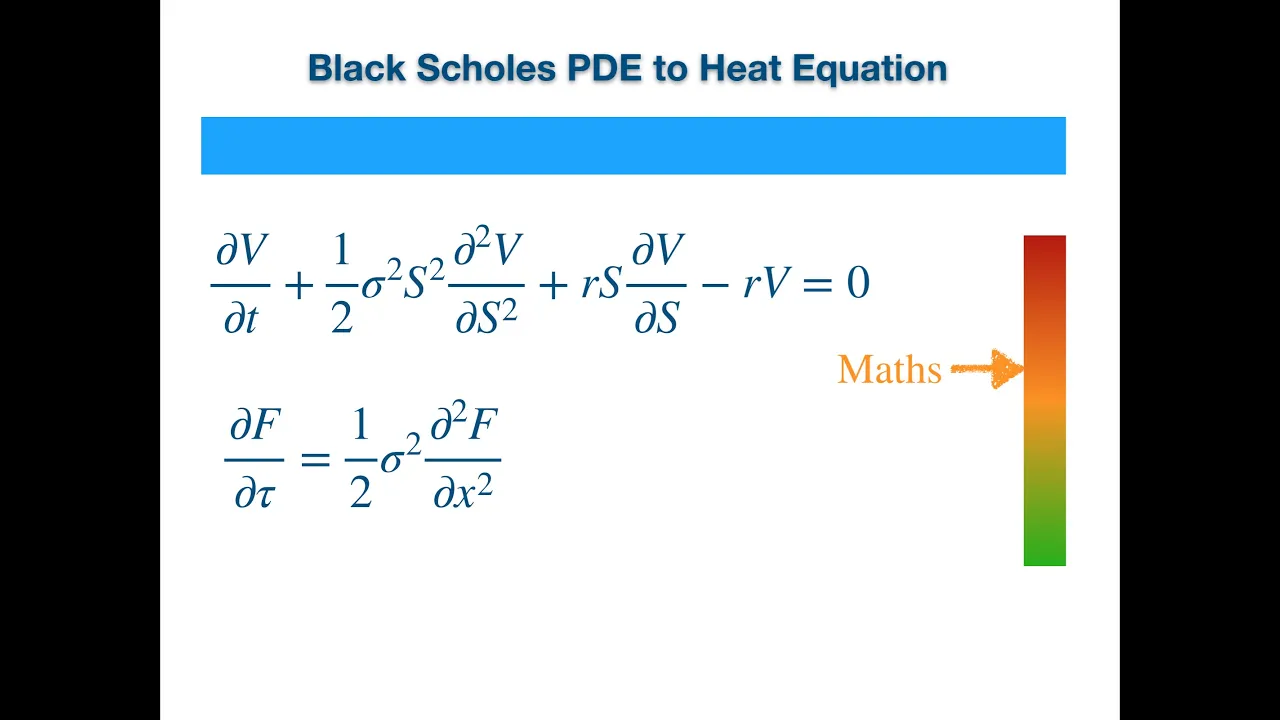
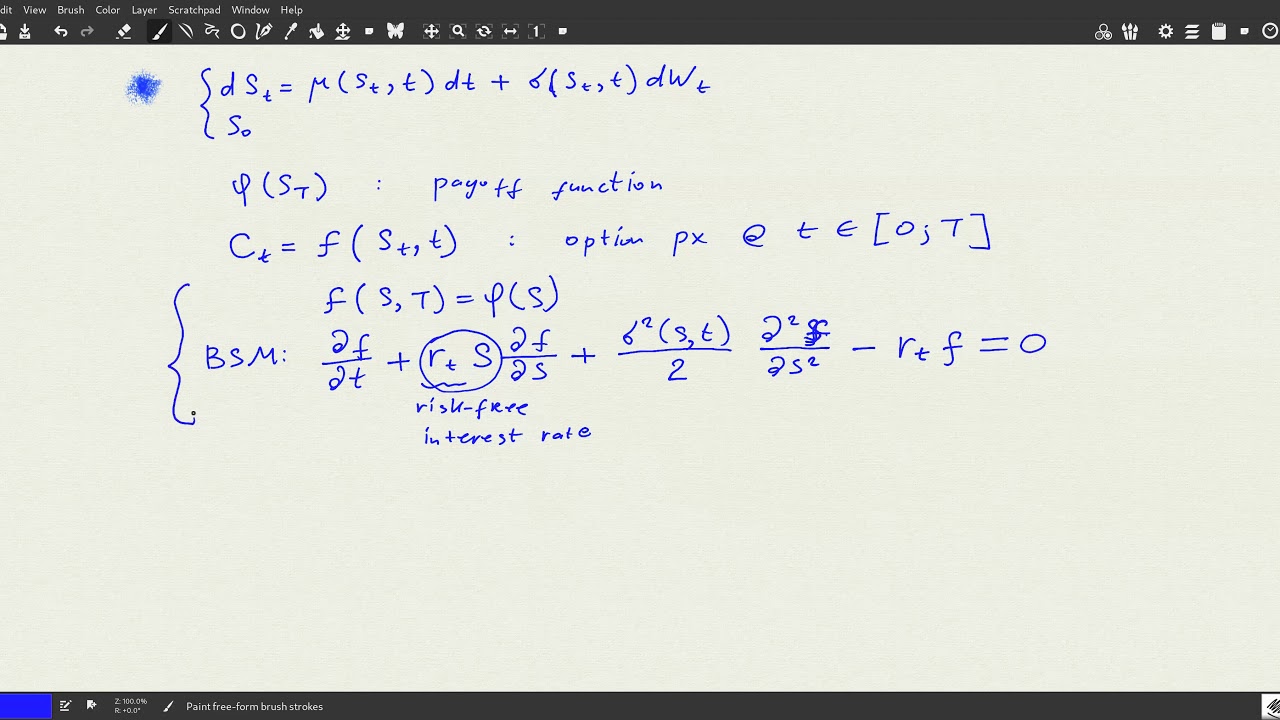












The Black Scholes PDE is derived by constructing a self-financing portfolio consisting of an option and the underlying stock, where the stochastic component is eliminated by setting the number of stock units (Delta) equal to the partial derivative of the option price with respect to the stock price, leaving a deterministic drift that must equal the risk-free rate, resulting in the equation ∂V/∂t + rS∂V/∂S + (1/2)σ²S²∂²V/∂S² - rV = 0.
Black-Scholes PDE Derivation via Delta Hedging
Added:Basic understanding of Geometric Brownian Motion (GBM) as a model for asset price dynamics.
Familiarity with stochastic calculus, specifically Ito's Lemma for calculating differentials of stochastic processes.
Fundamental concepts of financial options, including the definition of a European contract and the principle of no-arbitrage.
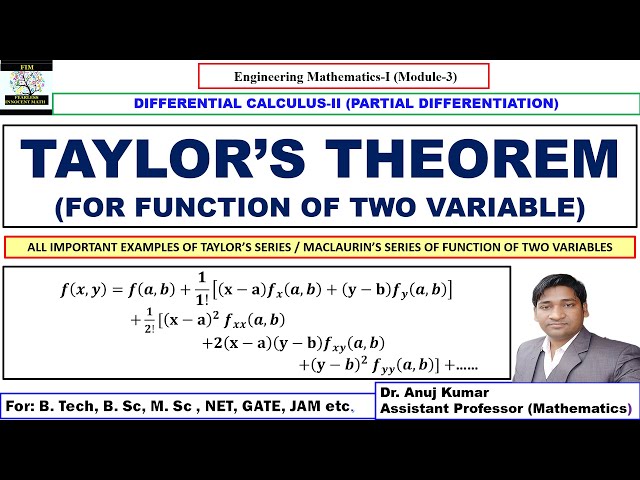
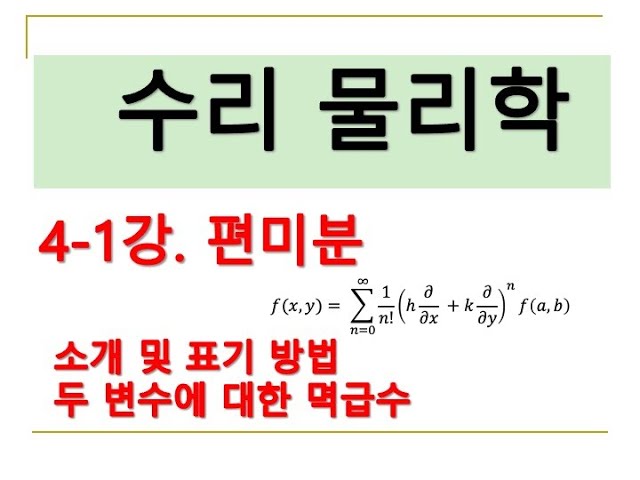
Introductory multi-variable calculus and partial derivatives, as used in Taylor series expansions.
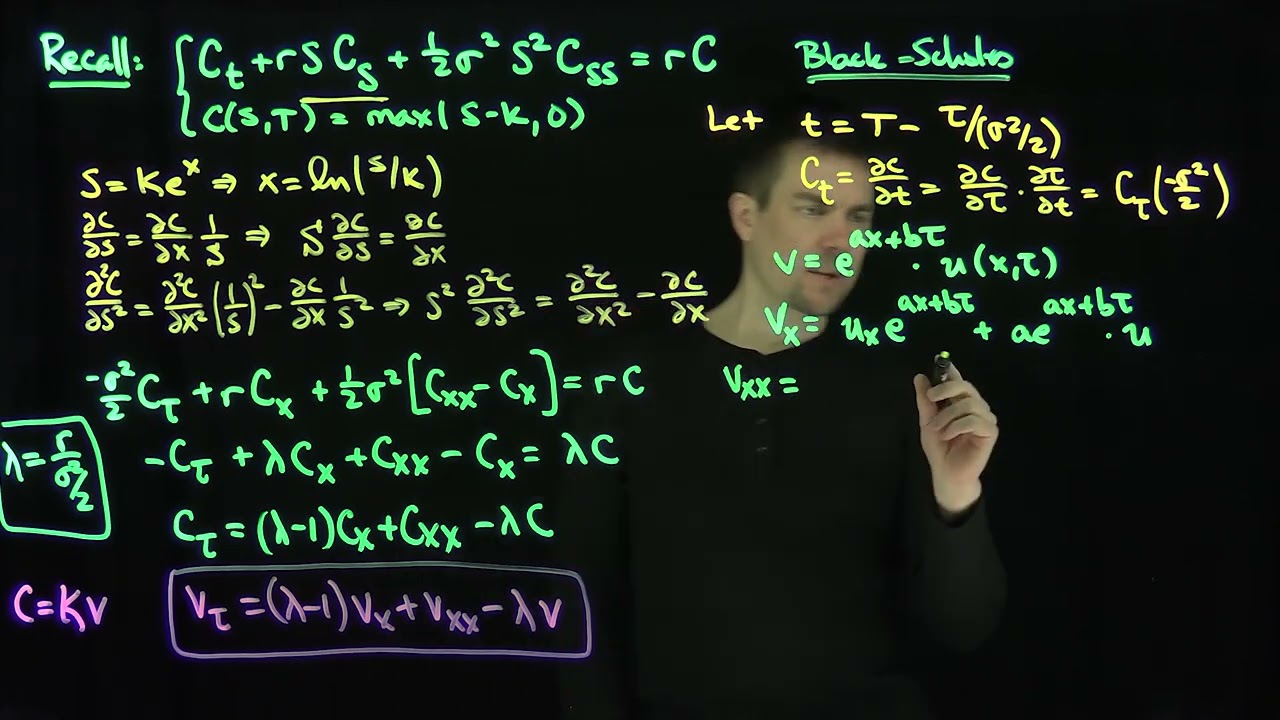
Solving the Black-Scholes PDE analytically by transforming it into the standard Heat Equation.
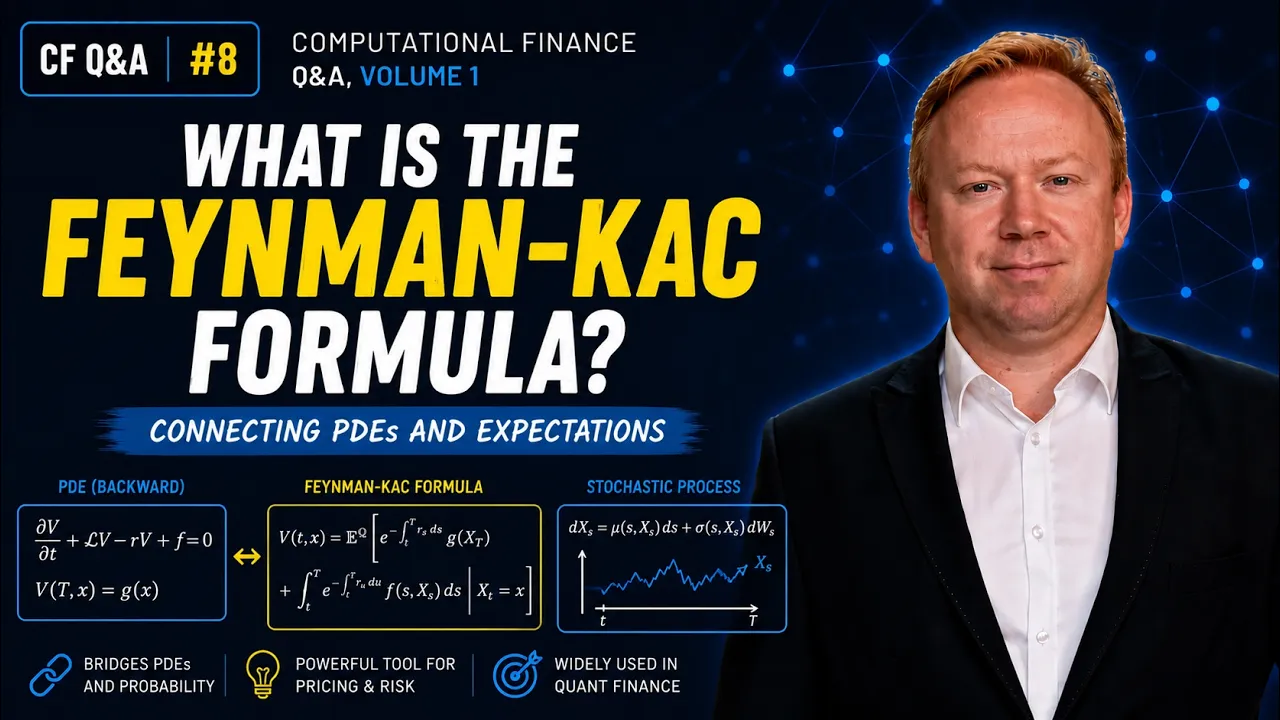
Understanding risk-neutral valuation and the Feynman-Kac theorem to link PDEs with expectation-based pricing.
Calculating and interpreting 'The Greeks' (Delta, Gamma, Theta, Vega, Rho) for portfolio risk management.
Analyzing model limitations, such as the constant volatility assumption, leading to the study of implied volatility smiles.
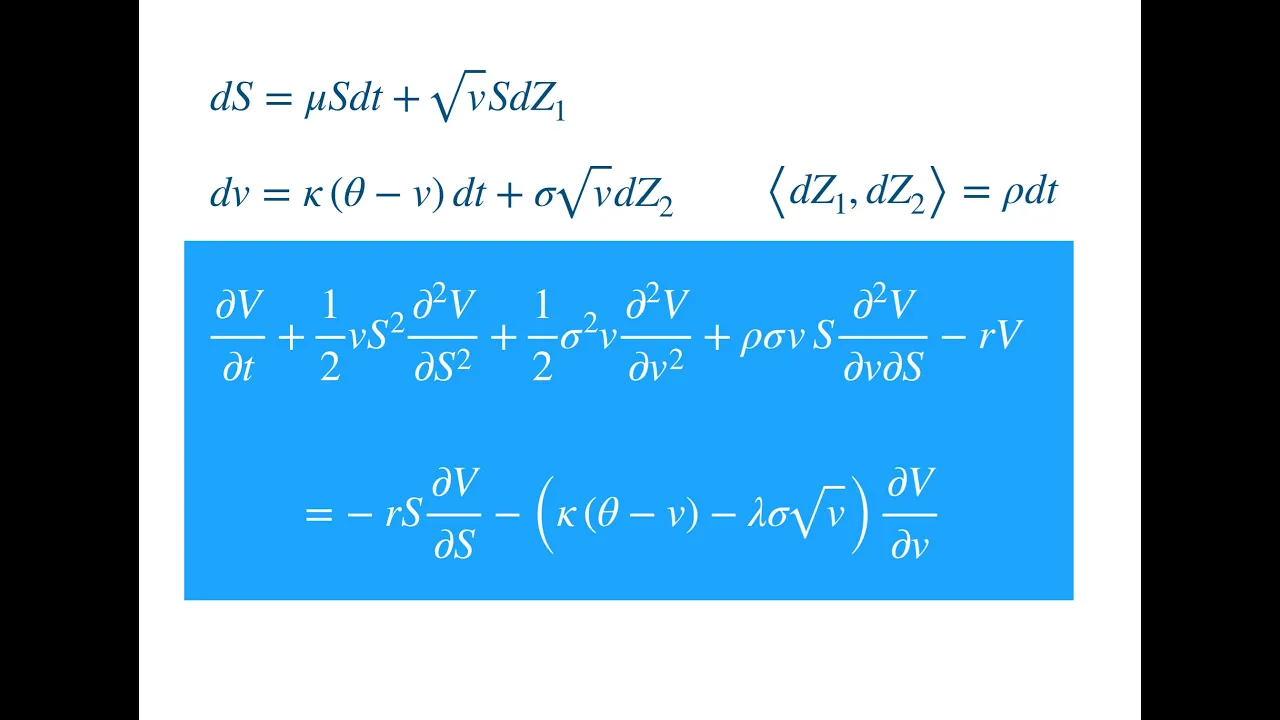
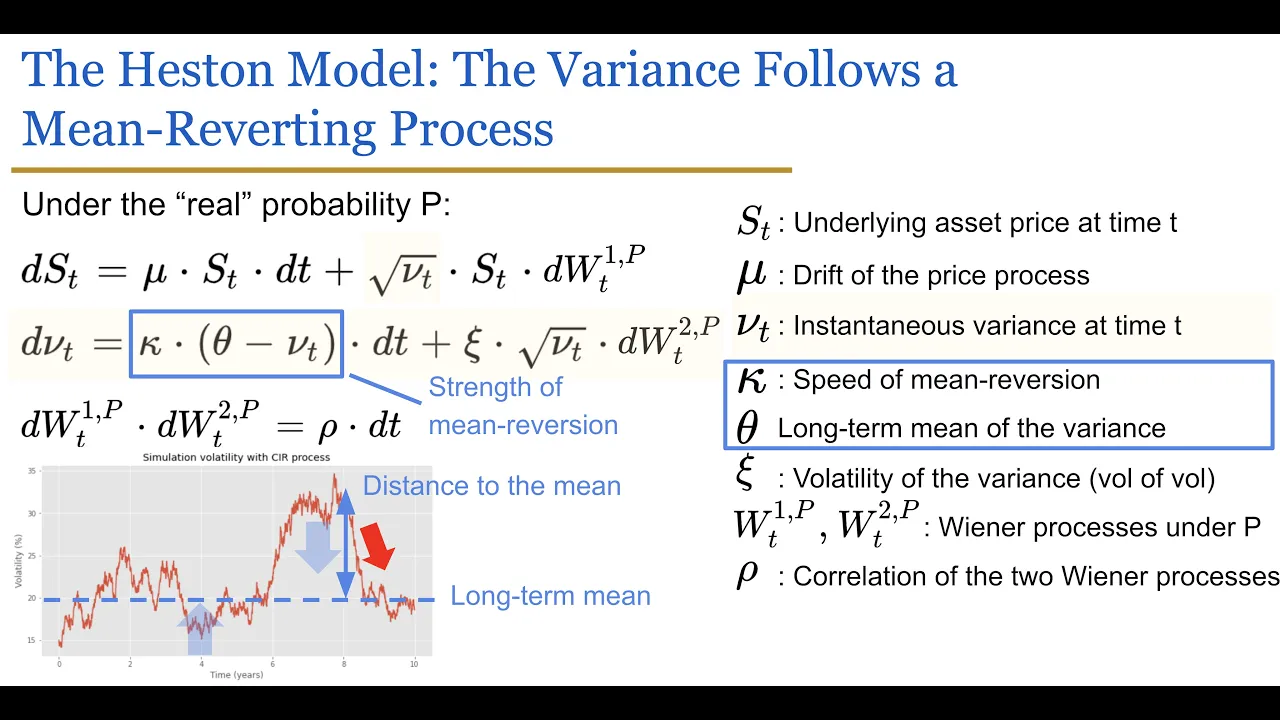
Exploring advanced models that relax Black-Scholes assumptions, such as the Heston Stochastic Volatility model or Jump-Diffusion models.
41.3K views521likes12:45Original Release: 2019-06-16
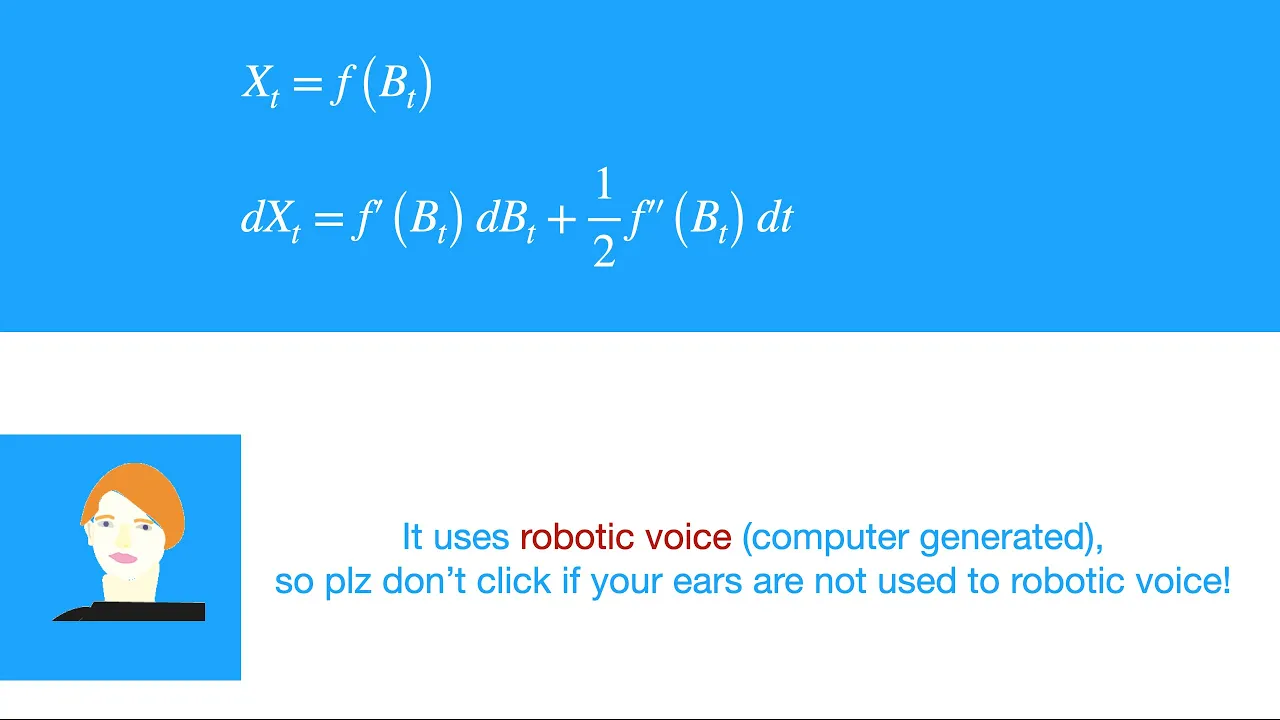
hi everyone and a warm welcome to you called pie in the first video of this slice-and-dice series we will derive the black Scholes PDE using the famous Delta hedging arguments there are a few variations on the approach which we will regroup under two main arguments the first of which uses a more modern approach to showcased a self-financing assumption the second of which uses the original black Scholes arguments after going through the first argument the second argument will seem a tad sloppy in comparison anywho under each argument we will explore two approaches for deriving the PDE this is just to cover all the bases because of different people would have been introduced to the PDE from different starting points and our main goal is to demonstrate that the PDE is relatable and that all approaches boil down to the same assumptions this is a PDE it looks quite inspiring but we will gradually come to view it as quite intuitive once we unpack the steps let's dive right in by quickly recalling the black-scholes settings the price on the stock is assumed to follow the geometric Brownian motion process with some constant mu and some constant Sigma the interest rate is assumed to be constant so the differential of the bank account is easier no stochastic term the option price is a function of five factors price of the stop time to maturity Sigma R and the strike price however if the last three parameters are set to constant then we can write it the option price as a function of a stop price and maturity only we could also represent it with a subscript T because it is a stochastic process but we are after the intuition here so let's drop the subscript for this video the value of this option will change with time and the underlying stock movements we know from Ito's lemma that the differential of the function of a stochastic process is equal to the derivative of the function times the differential plus half the second derivative times the quadratic term and as V is also a function of time we need to add the differential with respect to T as well by the way we have to revise Ito's lemma in another video so do watch that video if you feel like brushing up on this topic we substitute the differential of s and we know that DS squared is equal to the square of the coefficient of the diffusion term times DT we combine the DD terms I don't know a left with a recognizable ste which has a drift term and a stochastic term the stochastic term exposes us to the Brownian motion which is the same one driving the price of the store now the black-scholes magic lies in using a delta hedging strategy to eliminate the stochastic component among ourselves it means hedging the risk of the option by trading in the underlying stock as both are driven by the same Brownian we eliminate or shall we say almost eliminate our way exposure to the Brownian in the option by trading the underlying this is all fine and dandy but how many units of the underlying to buy or sell and when to buy or sell or until when should we keep the position hedged well this is a tricky part that we tackle now assume we are hedging a short position in a call option so our strategy will involve buying stocks buying stocks will of course mean funding considerations so we assume we have unlimited access to a bank account debt which we of course want to be able to repay plus we also need to pay the bank interest rate when we borrow and conversely the bank will pay us the interest rate when we have excess cash now let's say we bought Delta units of the stock Delta here's just as a number of the units of the stock and borrowed alpha units of the bank account where Delta and alpha can be negative or positive now as we saw with the option price the value of this portfolio will change as the stock price moves or time changes let's substitute the differential of the stock and the bank account we can again combine the DT terms and we have the familiar SDE of our portfolio now our total portfolio consists of an option Delta units of the stock and other units of the bank account and our aim is to choose Delta so that the coefficient of the stochastic term becomes zero isolating Sigma to the left hand side and canceling this Sigma s term we find that the Delta is equal to the derivative of the option price with respect to the stock price if we substitute with this in our combined portfolio the stochastic term becomes zero and we are left with some nice drift terms to combine terms cancel and we are left with a far simpler expression we can substitute for Delta in the value of our portfolio of stock and bank account and let's put it up there for future reference now the total portfolio has only a deterministic term and hence it must carry the risk-free rate to avoid arbitrage we substitute for pi equate the right hand side cancel to be turns we get the black Scholes PDE the PDE looks complicated but it has a very simple and intuitive interpretation if you shift the last two terms to the right-hand side then you can see the right-hand side represents the return under bank account and what does that bank account balance consist of well it is equal to the option premium minus the amount we borrowed to finance the purchase of the Delta units of the stock that eternal expense in an infinitesimal period is equal to the balance times the interest rate the left-hand side is essentially representing how the value of the Delta hedged option changes in an infinitesimal period the first term captures the impact of the shortening maturity and the second term the gamma impact which is the risk that remains after the Delta is hedged and if you're tuning in from the physics world then it is just a backward parabolic PDE with source term equals to R times V and the convection term equals to R times s times the Delta and if you are tuning in from the probability world then it is more or less the backward diffusion equation some textbooks would explain the approach that we just outlined by constructing a replicating portfolio let's quickly go through this variation we illustrated the Delta hedging by constructing a riskless portfolio through a combination of an option stock and bond and the gain loss of the portfolio was then given by this differential and we then determine the Delta hedging strategy by setting the coefficient of the stochastic tempters zero the alternative approach would replicate the option by a portfolio of stock and bank account and construct a portfolio of stock and bank account that replicates the value of the option and its gain process the rest is then familiar we would substitute Ito's lemma for the differential of V and then the dynamics of the stock and then of the bank account and then equate the coefficient of the stochastic term so both approaches are pretty straightforward the only complicated step was calculating the gain of the portfolio of stock and bank account remember we said the gain of the portfolio can be written as follows if we were to apply Ito's lemma in its base form then we would be applying the product rule to each term on the right hand side meaning we obtain five terms three from the differential of the stock term and two from the differential of the bank account but the game processors assume that the Delta and the Alpha are deterministic this simplification boils down to the self financing portfolio so the change in the value of the portfolio is down to the change in the prices of the two assets only in the classic black Scholes this step does sound sloppy but the end result comes out correctly for reasons that we will see when we analyze the pricing from a more modern perspective for now to help appreciate this self financing strategy the easier way is to analyze this in discrete settings let's analyze one stir in the discrete process let's say we are at I minus one one step before the ice time we decide how many units of the stock and the units of the bank account to hold in order to hedge our position now time moves to step I and the prices are revealed we can determine the value of our portfolio now as the prices have moved the Delta would have shifted and we need to rebalance the portfolio quickly before the time moves to the next step we won't deport for you to be self-financing so we will not be injecting any new money so the self financing portfolio means the value of our portfolio after the rebalancing must be equal to its current essentially we have just redistributed our wealth between the stock and the bank account without injecting or taking any money out of the portfolio now time marches on to the next step I plus one and again the prices are revealed and we get to know the valuable portfolio so you can see that the portfolio value is changing because of the changes in the market prices and we are able to hold the position fixed for a short period let's calculate the change in the value of our portfolio in one generous step the value at each step is just a number of the units times the price from the self financing assumption we can substitute the rebalanced units at the ice stir now we can arrange by combining the Delta and the Alpha terms and the continuous time version of this is essentially the equation at the top right and we can now understand how the gain process works now let's quickly outline the black-scholes original argument no doubt it looks a bit strange by current standards but black-scholes actually contracted their hedge as one unit of the stock with one over Delta unit of the option so we are long one unit of the stock and we are dynamically hedging it by buying or selling options we can easily calculate the game notice again the one over Delta is assumed to be locally constant which is equivalent to the hardest part in the previous section that we had to explain with a self financing strategy now as before the familiar territory we know the SD of s we also know the differential of V which is given by Ito's lemma we plug the two differentials into the portfolio and we get now we combine the terms with set Delta equal to the derivative of the option price with respect to s and we are left with only a deterministic term and as this portfolio is deterministic it must grow at the risk-free rate we substitute for pi now we equate the right hand size of the two differentials right on summit rid of the brackets on the right hand side and then disrupted the Delta to get the black Scholes PDE BAM the textbooks these days will outline this hedging strategy as one unit of the option with Delta units of the stock so that's another variation on the approach which is again very familiar so in comparison with the black Scholes approach the portfolio looks like this and the gain process is also very familiar all four variations boiled down to the same thing so just pick the one that makes the most sense to you but do pick a side of the argument and a stick to your guns
Up Next

49:33
Black-Scholes Equation: Mathematical Methods for Engineers
@mitocw
29.6K views•2008-05-19

4:43
Elliptic Curve Cryptography Explained: ECC, ECDSA, ECDH
@PracticalNetworking
28.5K views•2024-10-21
11:27
Ito's Lemma Derivation: Stochastic Chain Rule Proof | Step-by-Step
@quantpie
25.4K views•2018-12-09

6:00
The Mathematical Impossibility of Accurate World Maps
@Vox
23.3M views•2016-12-02
Related Study Plans & Knowledge Roadmaps
Structured learning paths in Mathematics
mathematics
Tensor Calculus: Vectors to Riemann Curvature
01Mathematical Foundations: Linear Algebra & Calculus
02Covectors, Dual Spaces, and Tensor Basics
03The Metric Tensor and Index Gymnastics
+ 2 more learning modules
40h5 modules
Explore Roadmap
mathematics
Gödel's Incompleteness: Logic, Proofs & Limits
01Introduction to Formal Systems & Hilbert's Dream
02Set Theory, Cardinality, and Cantor's Diagonal Argument
03Arithmetization and Gödel Numbering
+ 2 more learning modules
14h5 modules
Explore Roadmap
mathematics
Galois Theory: Fields, Groups & Solvability
01Foundations of Abstract Algebra: Groups & Fields
02Polynomials & Field Extensions
03Splitting Fields & Symmetries
+ 2 more learning modules
24h5 modules
Explore Roadmap
mathematics
Non-Euclidean Geometry: Models & Geodesics
01Euclid's Fifth Postulate and the Birth of New Geometries
02Hyperbolic Space and the Poincaré Disk Model
03Geodesics: Defining Straight Lines in Curved Spaces
+ 2 more learning modules
15h5 modules
Explore Roadmap