Linguistic relativity theory, also known as the Sapir-Whorf hypothesis, proposes that the structure and vocabulary of a language influence how its speakers perceive, think about, and remember the world. While language does not completely control thought, it shapes attention, memory, and conceptualization—evidenced by how speakers of languages with different organizational systems for time, space, and color may notice and process these concepts differently. For instance, languages using compass directions rather than left/right references often produce speakers who excel at spatial orientation, while languages with more color terminology enable speakers to distinguish subtle color variations more readily.
Linguistic Relativity Theory: Sapir-Whorf Hypothesis Explained
Added:Deep Dive
Basic definitions of linguistics, including semantics (the study of meaning) and syntax (the study of sentence structure).

What is semantics?
72.5K
Semantics is the branch of linguistics that studies meaning in language, examining meaning at different levels including words, phrases, clauses, and sentences; it differs from syntax (which studies sentence structure) and pragmatics (which studies speaker meaning), and encompasses phenomena such as polysemy (words with multiple meanings), synonymy, antonymy, metonymy, and semantic roles like agent, theme, and patient.
Click to watch →

TET ENGLISH GRAMMAR AND PEDAGOGY| @mrajesha8994 #tet #english #tetenglish #tetexam #tet2025 #viral
27.9K
Semantics is the study of the meaning of words and sentences. Syntax is the study of how to arrange words to form meaningful sentences. For example, 'The chair ate the banana' has correct syntax but incorrect semantics (meaning), while 'The boy ate the banana' has both correct syntax and semantics.
Click to watch →

Linguistics An introduction
153
Morphology and syntax are branches of linguistics concerned with the internal structure of words and sentences, and with word order. Morphology studies how words are formed and modified, including prefixes and suffixes that change meaning. Syntax studies the rules that govern how speakers organize words into sentences. Semantics is the study of meaning, examining the meaning of each word and each sentence. It includes lexical semantics (study of word meanings) and phraseology (study of fixed word combinations). Semantics also deals with resolving ambiguity in language, as human language can be unclear at certain levels.
Click to watch →

सम्पूर्ण English PEDAGOGY मैराथन | CTET JAN 2024 | ONE SHOT by Rohit Vaidwan Sir
196.7K
Syntax is the study of sentence structure, examining how words are arranged and combined to form grammatically correct sentences. Semantics is the study of meaning in language, examining how words and sentences convey meaning. These components work together to form the structure and meaning of language, enabling effective communication.
Click to watch →

Semantics: Crash Course Linguistics #5
415.5K
Semantics is the branch of linguistics concerned with meaning and the many ways we can describe it. While dictionaries provide definitions, they are created by people called lexicographers who still need other methods to determine word meanings. This field explores how meaning works beyond simple dictionary definitions.
Click to watch →
Deep Dive
Fundamental concepts of cognitive psychology, specifically how the human brain processes perception, memory, and categorization.
How To Hack Your Brain (Cognitive Psychology Explained)
665
Cognitive psychology investigates core mental processes that shape human experience. Perception transforms raw sensory input (sights, sounds, smells, tastes, textures) into meaningful experiences through active brain organization rather than passive recording. Attention acts as a gatekeeper, selectively focusing awareness on relevant stimuli while filtering out distractions—enabling selective attention to single sources and divided attention across multiple inputs. Memory comprises three interconnected systems: sensory memory briefly holds incoming information, short-term memory serves as a mental workspace for immediate use, and long-term memory stores accumulated knowledge, skills, and experiences. Together, these processes form the foundation of how we interact with and understand our world.
Click to watch →
What's Cognitive Psychology? (#7)
12.6K
Perception is sensory signals received through bodily senses combined with how the mind interprets them. Attention is focused perception, representing what we are consciously aware of. Memory is divided into short-term (working memory, immediately accessible like RAM) and long-term memory (stored in deeper consciousness like hard disk storage). Unlike computers, human memory is purpose-driven and time-sensitive, favoring meaningful information. We cannot consciously delete long-term memories, which remain and can be triggered involuntarily.
Click to watch →
Introducing Concepts and Categories-01
6.8K
Concepts are mental representations that store knowledge about objects, events, or patterns, while categorization is the process of organizing information into mental 'buckets' based on shared features; three major models explain this process: the classical view (which holds that concepts have individually necessary and collectively sufficient features with clear-cut boundaries), the prototype view (which suggests concepts are idealized mental averages representing typical members of a category), and the exemplar view (which proposes that concepts consist of stored examples or instances that new items are compared against); each model addresses different aspects of how humans organize and retrieve knowledge efficiently given the brain's limited capacity.
Click to watch →

Психология познавательных процессов – курс Марии Фаликман / ПостНаука
718K
Cognitive processes provide information about the world, distinguishing them from emotions based on personal needs. Vekker classified processes into those providing world information and those organizing information along psychological time. Sensation reflects individual properties; perception constructs whole objects with subjective components; thinking reflects relationships and extracts essential properties. Memory, attention, and imagination represent psychological past, present, and future. The cognitive revolution emerged in the mid-20th century as a counter-revolution to behaviorism. Key figures like Bartlett (schemas), Luria (systemic organization), and computer scientists (Turing, von Neumann) laid foundations. The 1956 MIT symposium marked the birth of cognitive science with Chomsky, Miller, and Simon/Newell's Logic Theorist. Sensation theory evolved from sensationalism through Wundt's elementism to modern classification systems. Perception is active construction of sensory images from physical energy, with dual nature: resulting from external impact yet actively constructed by the perceiver.
Click to watch →
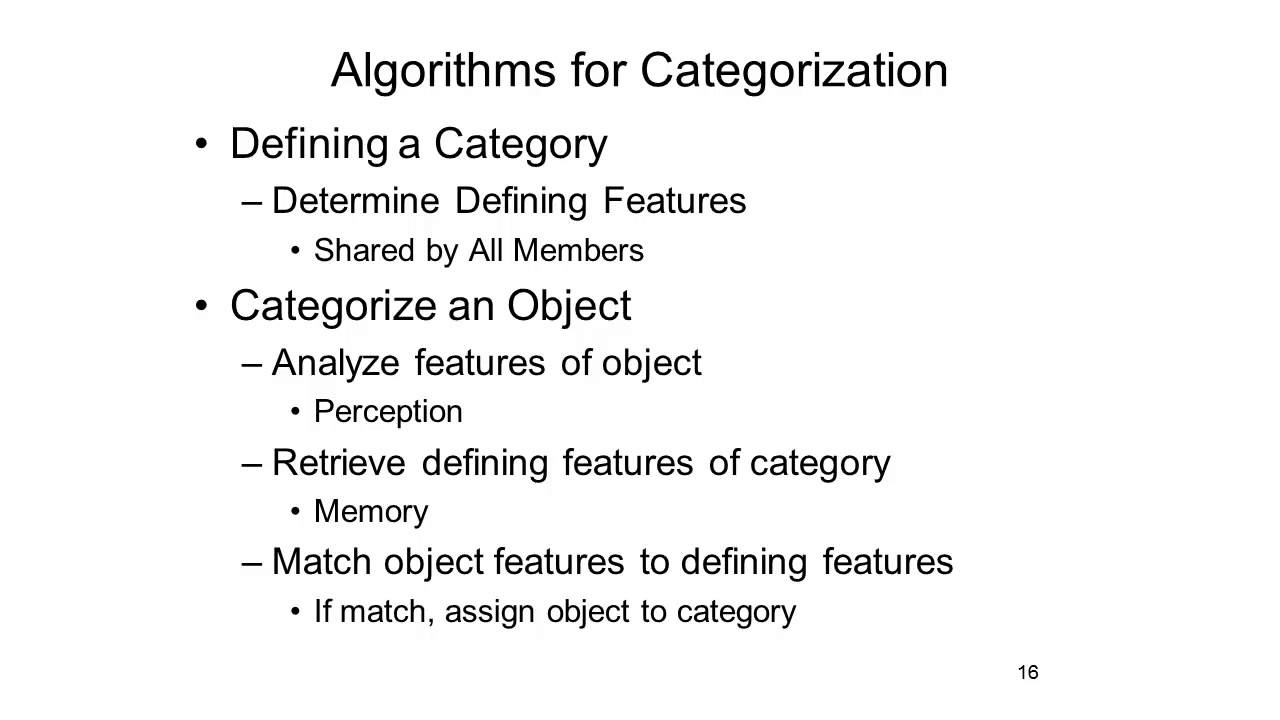
Psych-W1_Lecture21
190
Learning, perceiving, and remembering are hypothesis-testing processes rather than mere stimulus-response associations. Learning involves figuring out what predicts what in the environment; perception is constructive, determining what exists and what it means; memory is reconstructive, determining what happened in the past. These functions depend on reasoning, inference, and problem-solving. Every act of perception is categorization—identifying the form and function of objects by matching stimulus information to pre-existing knowledge. Categories are groups sharing common attributes, while concepts are mental representations abstracted from instances. Categories exist in the real world, concepts in the mind, though psychologists use terms interchangeably.
Click to watch →
Deep Dive
An introductory understanding of cultural anthropology and how societal norms and values are transmitted.

مدخل إلى علم الاجتماع: شرح كامل وبسيط لفهم المجتمع للمبتدئين
5.9K
Culture encompasses all the knowledge, values, beliefs, and practices that members of a society share. It includes language, customs, traditions, rituals, symbols, and ways of thinking that give meaning to human experience. Children are not born knowing cultural norms but learn them through socialization—the lifelong process of acquiring language, values, skills, and behavioral patterns necessary for functioning within their society. Primary agents of socialization include family, schools, peer groups, media, and other institutions. Social values are the underlying principles that a society considers important, while norms are specific rules guiding behavior in particular situations. Some norms are formal and written (laws), while others are informal but widely understood. Cultures are not static but continuously evolve in response to changing social conditions, economic transformations, technological innovations, and increased global contact. Cultural relativism advocates understanding cultures on their own terms rather than judging them by one's own cultural standards, promoting tolerance and deeper understanding of human diversity.
Click to watch →

Antropologia Cultural - Prof. Gabriela (Instituto Transcultural de Missões)
415
Cultural anthropology is the study of human culture as a set of behaviors, ideas, and characteristics that are transmitted across generations, examining various aspects of human society including family organization, political systems, economic structures, religious practices, linguistic features, and aesthetic expressions to understand cultural differentiation between peoples.
Click to watch →
![Chapter-3 & 4 Sociology & Society (11th NCERT) | Sociology [UPSC CSE/IAS 2020/21/22] Rinku Singh](https://i.ytimg.com/vi/1OJYbzmqnHQ/maxresdefault.jpg)
Chapter-3 & 4 Sociology & Society (11th NCERT) | Sociology [UPSC CSE/IAS 2020/21/22] Rinku Singh
59.3K
Culture is transmitted from one generation to the next through socialization. Children learn cultural values, behaviors, and practices from their families and communities. This transmission includes learning about appropriate behaviors, social norms, and values that guide conduct. Cultural transmission ensures that cultural knowledge and practices are preserved and passed on to future generations.
Click to watch →
![CONCEPTS OF SOCIOLOGY AND ANTHROPOLOGY [Social Nutrition] by SAFIN [DIU,NFE]](https://i.ytimg.com/vi/DRpojPuzWXo/maxresdefault.jpg)
CONCEPTS OF SOCIOLOGY AND ANTHROPOLOGY [Social Nutrition] by SAFIN [DIU,NFE]
547
Cultural transmission is the process by which cultural knowledge, norms, values, and practices are passed from one generation to the next through socialization. Agents include family, education, friends, and media. Symbolic interactionism focuses on how meaning is created through symbols and language, which create shared meanings enabling social interaction. Cultural identity can change through socialization, and cultural change occurs through adaptation as societies evolve.
Click to watch →

Understanding Bio archaeological Remains Archaeoanthropology (INDCUL)
548
Cultural anthropology studies the complex whole of knowledge, morals, traditions, arts, and customs that people learn as part of their society. These cultural elements are transferred across generations non-biologically through words and symbols. Cultural anthropologists try to understand the logic behind cultural norms without judging any tradition or practice as wrong. They live within communities, observe customs, and compare practices across different societies to understand human cultures and their manifestations.
Click to watch →
Deep Dive
The conceptual distinction between 'thought' and 'language', and the debate on whether thought can exist independently of language.

psycholinguistics01
6.6K
Thought and language are different cognitive processes. Evidence includes: (1) People who cannot speak (infants, children, those with language disorders) can still think; (2) Animals can think and solve problems but lack language; (3) Specific Language Impairment (SLI) affects only language acquisition without affecting thinking abilities; (4) Williams syndrome shows the opposite pattern—normal language but impaired intellectual development; (5) Bilinguals can express thoughts in multiple languages, proving thought is independent of any particular language system.
Click to watch →

Penser avec le langage - François Recanati
11K
This extended section presents the core philosophical debate about the relationship between thought and language. The dependence thesis, supported by Avicenna, Locke, and Darwin, argues that we think with language as an instrument—internalized speech enables complex thought. The independence thesis counters that thought exists prior to and independently of linguistic expression, as the same thought can be expressed in multiple ways. The resolution involves distinguishing thought as content (independent of language) from thought as activity (requiring language for reflection). Language enables self-control, self-evaluation, and self-correction by making thought perceptible and manipulable. Contemporary philosopher David Caplan argues that language not only facilitates thought manipulation but actually broadens the horizon of what can be thought, challenging strict independence. This foundational tension sets up the subsequent analysis of verbal thinking and conceptual frameworks.
Click to watch →

مقالة اللغة والفكر شعبة 3اداب وفلسفة ولغات فقط 💪
29.5K
The relationship between language and thought is one of interconnection rather than separation, as language serves as the essential medium through which thought is formed, expressed, and communicated; while thought and language differ in nature (thought is non-material and language is material), they are complementary and interdependent, with language providing the structure and form that enables thought to exist and be shared, as demonstrated by philosophers like Herder, Hamilton, and Merleau-Ponty who argue that thought cannot exist independently of language.
Click to watch →

Stephen Pinker- Language and Consciousness ستيفن بينكر - هل نستطيع التفكير بدون لغة
8.2K
Thoughts are not constrained by language limitations. People think in visual images, auditory images, and abstract propositions, not in words. Language serves as a communication tool to transfer thoughts between minds. Words can be ambiguous (e.g., 'stud tires out' has multiple meanings), proving thoughts exist independently of linguistic expression. The Eskimo snow vocabulary myth is debunked—dictionaries show only 12-20 words, not hundreds. People invent slang and jargon to express pre-existing thoughts, not the reverse. Language includes cadence, sounds, and pitches that create emotional effects, explaining why great literature is hard to translate. Meaning exists as a web of connected concepts with visual and bodily associations, not as linear linguistic structures.
Click to watch →

مقال العلاقة بين اللغة والفكر موجه لشعبة آداب وفلسفة ولغات أجنبية
229.8K
The separationist view argues thought precedes and exceeds language. Al-Jahiz argues meaning is unlimited while words are limited. Descartes argues language comes from the body while thought comes from the soul. Bergson argues language is intermittent while thought is continuous. Chinese philosophy holds a single image is better than a thousand words. This view suggests language cannot fully express thought.
Click to watch →
Prerequisite Knowledge
- Concept 01Basic definitions of linguistics, including semantics (the study of meaning) and syntax (the study of sentence structure).
- Concept 02Fundamental concepts of cognitive psychology, specifically how the human brain processes perception, memory, and categorization.
- Concept 03An introductory understanding of cultural anthropology and how societal norms and values are transmitted.
- Concept 04The conceptual distinction between 'thought' and 'language', and the debate on whether thought can exist independently of language.
Subsequent Learning
- Step 01Empirical cross-linguistic studies, such as research on color perception (e.g., Berlin and Kay) and grammatical gender's influence on object description.
- Step 02Neo-Whorfianism and modern cognitive science experiments that investigate the 'weak' form of linguistic relativity.
- Step 03The cognitive and psychological effects of bilingualism and multilingualism on decision-making and worldview.
- Step 04Cognitive Metaphor Theory (pioneered by George Lakoff and Mark Johnson) which explores how abstract concepts are structured by metaphorical language.
- Step 05Implications of linguistic relativity in Artificial Intelligence, exploring how the structure of training languages affects LLM reasoning.
Theory Basics
Implications
Theory Basics
0:00Playing Section
- 1
Explores how language influences thought, not controls it.
- 2
Origin in early 20th century research on language diversity.
- 3
Strong vs. soft versions: influence on attention and memory.
Linguistic Universalism and the Innateness Hypothesis
In contrast to the Sapir-Whorf hypothesis, Linguistic Universalism—pioneered by scholars like Noam Chomsky and popularized by Steven Pinker—argues that human thought is fundamentally independent of language. Universalists posit that humans share an innate biological framework for language (Universal Grammar) and think in a non-verbal mental language called 'mentalese.' Rather than language shaping our perception, language is viewed merely as a medium for translating pre-existing thoughts. Key evidence for this perspective comes from cross-cultural studies on color perception (such as those by Brent Berlin and Paul Kay), which reveal that humans categorize colors in highly consistent, predictable ways due to shared biological sensory mechanisms, regardless of the vocabulary available in their native tongues. From this viewpoint, human cognition and perception are shaped by universal biological structures, not by the specific language one speaks.
Deep Dive
Empirical cross-linguistic studies, such as research on color perception (e.g., Berlin and Kay) and grammatical gender's influence on object description.
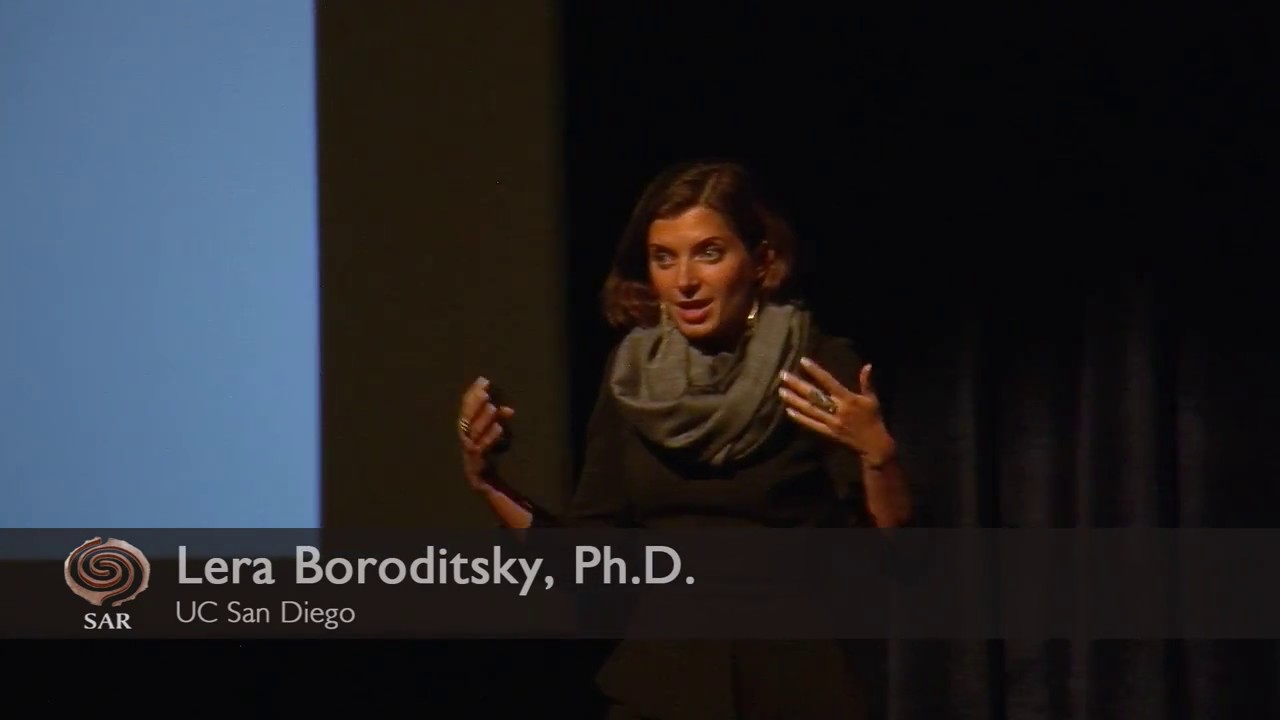
Lera Boroditsky, How the Languages We Speak Shape the Ways We Think
85.5K
Languages categorize color differently, affecting perception. Russian distinguishes light blue (goluboy) and dark blue (siniy), while English uses one term; Russian speakers distinguish these shades more easily. Korean makes distinctions in yellow-green space that English doesn't. Grammatical gender further shapes object perception: German assigns feminine to the sun and masculine to the moon, while Spanish reverses this. Children learning gendered languages assign voices to objects matching their language's gender. Adults describe bridges with stereotypically gendered adjectives. Art personifications align with artists' native language genders (78% prediction accuracy).
Click to watch →

Lera Boroditsky - Beyond the Physics: How Languages Help us Construe & Construct
44.9K
Languages with grammatical gender (German, Spanish) categorize all nouns into gender classes that differ dramatically across languages (sun is feminine in German, masculine in Spanish). Research shows speakers assign adjectives consistent with grammatical gender: German speakers describe bridges as beautiful/elegant while Spanish speakers describe them as strong/towering. Children as young as 5 assign voices to objects based on grammatical gender. Artists choose gender for personifications based on their native language's grammatical gender system, with 78% predictability from language alone.
Click to watch →

Color Is A lot More Confusing Thank You Think
48.6K
In 1969, Brent Berlin and Paul Kay studied 20 different languages and identified 11 basic color categories: white, black, red, green, yellow, blue, brown, purple, pink, orange, and gray. They discovered that languages follow a specific pattern in which color terms appear: brown, purple, pink, orange, and gray never appear in languages that don't already distinguish between green and blue. The sequence is: red is most basic, followed by green and yellow, then blue, then brown, and finally purple, pink, orange, and gray.
Click to watch →

What You Didn’t Know about Language Barriers | Roxanne Pomerantz | TEDxBGU
1.9M
Scientific experiments have shown that gender associations in language impact people's perception. In one study, German speakers (who use masculine words) described keys as heavy, durable, strong, useful, and metal, while Spanish speakers (who use feminine words) described keys as golden, lovely, little, delicate, and shiny. This demonstrates how the grammatical gender assigned to objects in different languages affects how people perceive and describe those objects.
Click to watch →

China's Lost Color
105K
Linguists Brent Berlin and Paul Kay proposed seven stages in how languages develop color terminology: Stage 1 (light/dark), Stage 2 (red), Stage 3 (green or yellow), Stage 4 (both green and yellow, with blue as green shade), Stage 5 (blue), Stage 6 (brown), Stage 7 (orange, pink, purple, gray). They claimed this pattern is near-universal across languages. Some languages like those in New Guinea have only three basic terms (white, black, red), requiring metaphorical descriptions for blue objects. When languages first develop a term for red, it typically covers all warm colors, gradually splitting into more specific terms. This theory explains why some languages treat blue and green as the same color, while others have developed sophisticated distinctions.
Click to watch →
Deep Dive
Neo-Whorfianism and modern cognitive science experiments that investigate the 'weak' form of linguistic relativity.

46 Культура и познание
22.5K
This section presents the hypothesis that language structure influences cognition, distinguishing weak linguistic relativity (language influences thought) from strong linguistic determinism (language determines thought). Examples include Native American languages lacking abstract concepts requiring detailed description, and Northern peoples having many color terms for snow differentiation. Early experiments by Brown and Lenneberg found weak correlations between naming ease and recognition accuracy, leading to methodological refinements emphasizing communicative context. This theoretical framework sets up subsequent research on how language shapes cognitive organization and perception across cultures.
Click to watch →

Linguistic Relativity
70.5K
Linguistic relativity, also known as the Sapir-Whorf Hypothesis, proposes that the language or languages one speaks shapes the way one thinks and perceives the world; this hypothesis exists in two versions—a strong version suggesting language determines thought, and a weak version suggesting language merely influences thought—with research demonstrating that languages differ significantly in how they encode spatial relationships (such as prepositions in English versus verb-framed constructions in Spanish), categorization systems (like classifiers in Navajo and Guugu Yimithirr), lexicalization of concepts (such as snow terms in Inuit), color terminology (with Berlin and Kay's implicational hierarchy), and directional systems (geocentric versus geographic), all of which constrain speakers' attention to and conceptualization of different aspects of reality.
Click to watch →
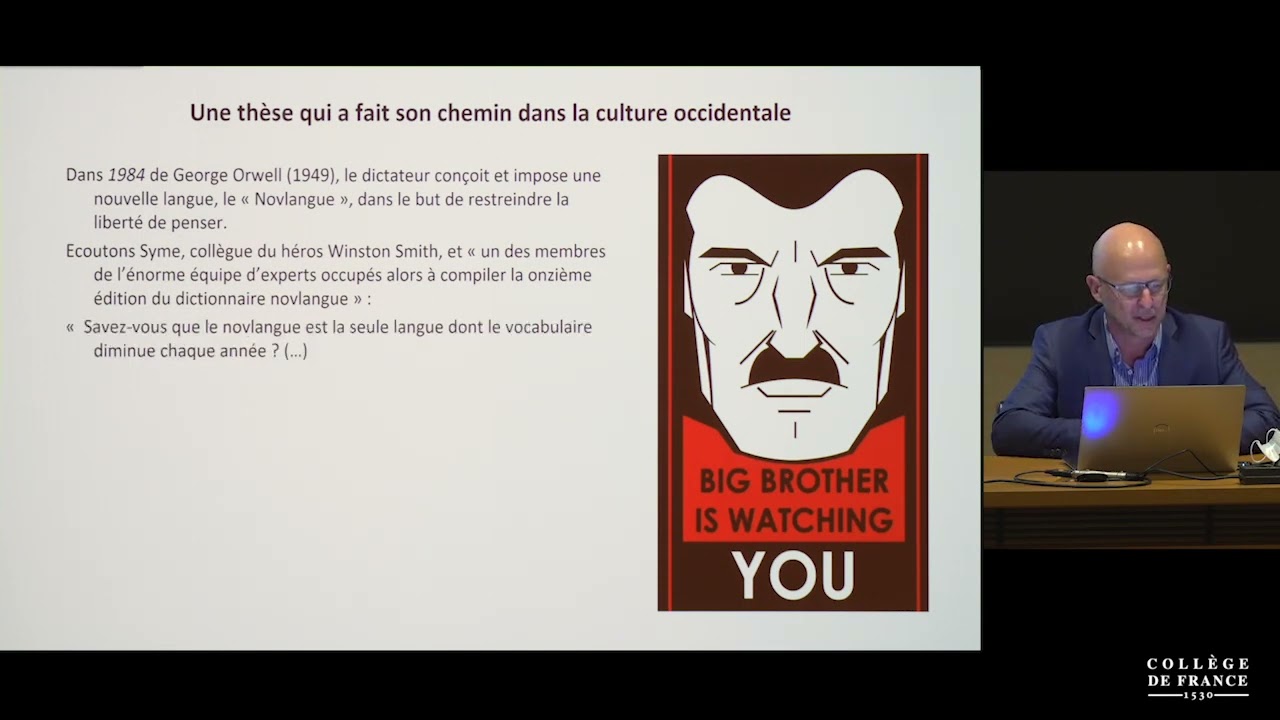
L'influence du langage et des symboles sur la perception... (1) - Stanislas Dehaene (2020-2021)
7.9K
Contemporary cognitive science distinguishes between strong and weak versions of linguistic relativity. The strong version claims that language determines thought so completely that speakers of different languages think fundamentally differently—a position largely rejected due to overwhelming evidence of universal cognitive foundations. The weak version accepts that while humans share a common foundation of thought, small variations exist at the margins, sometimes having significant effects at both perceptual and conceptual levels. This nuanced view acknowledges that language can influence thinking without determining it absolutely, representing the current consensus in cognitive science.
Click to watch →

Lec 5: Categorization: contd.
700
Dani speakers with only two color terms could learn English color terms, refuting strong linguistic relativity. Research in many domains has refuted the strong hypothesis, but new research supports the weaker version. The debate was sidelined after Chomsky's innateness hypothesis but revived after the cognitive revolution. Cognitive linguistics and bilingualism research have brought new insights into the language-cognition interface.
Click to watch →

Whorf's anti-racist idea about language
119
The neo-Whorfian approach systematically investigates language-cognition relationships through multiple dimensions. It examines effect strength—whether language influences cognition subtly (small perceptual differences like four-millisecond variations) or fundamentally (inability to process certain concepts). It explores plasticity: can cognitive patterns change through altered linguistic experience, expectations, or context? It investigates acquisition processes: how do linguistic feature development relate to cognitive performance changes? Finally, it considers biological constraints: since language may be an epiphenomenon, it can only interface with perceptual processes within limits set by human brain and body capabilities. This multi-faceted approach provides rigorous methods for testing how deeply language shapes thought.
Click to watch →
Deep Dive
The cognitive and psychological effects of bilingualism and multilingualism on decision-making and worldview.
Multilingualism: Living Life in High Definition | Panos Athanasopoulos | TEDxLondonBusinessSchool
55.2K
Multilingualism functions like binocular vision, expanding cognitive capabilities by integrating multiple linguistic worldviews; research demonstrates that bilingual individuals develop enhanced perceptual discrimination (such as distinguishing more shades of blue), reduced susceptibility to gender stereotypes, flexible temporal reasoning, improved economic decision-making, and significantly better protection against cognitive decline in old age, with multilinguals experiencing approximately five additional years of healthy brain function compared to monolinguals.
Click to watch →

Revealing Secret Spells Hidden In The English Language w/ Laurel Airica
129K
A French psychoanalyst said that having two languages is to have two souls. The word gives us our worldview, and the more languages you speak, the more diverse your worldview becomes. The more you can see through the programming and the veil of illusion created by a particular culture. People who have access to different cultures and languages often carry deep wisdom because they can blend different sets of coding. This suggests that multilingualism provides cognitive flexibility and broader perspectives on human experience.
Click to watch →

【英語脳を手に入れる】世界的な心理言語学者 ビオリカ・マリアンと「言語の力」/母語以外で思考すると、人考え方も変わる?/バイリンガルは才能なのか【PIVOT GLOBAL】
76.4K
Research in psycholinguistics demonstrates that language significantly influences decision-making, with bilingual individuals showing different moral judgments when asked the same ethical dilemmas in their native versus second language (e.g., 20% vs. 33% willingness to sacrifice one life to save five). Language shapes perception by providing frameworks for categorizing reality, such as grammatical gender affecting how people describe objects, and multilingualism enhances cognitive flexibility, creativity, and may provide cognitive reserve against age-related decline.
Click to watch →

The Italian Radio Hour - Abruzzese is a language not a dialect with Prof. Roberta D'Alessandro
469
This segment presents research findings on the cognitive and social benefits of bilingualism for children. Managing two languages requires the brain to constantly inhibit one language while using the other, improving attentional control and executive function. Research shows bilingual individuals make faster decisions between options and demonstrate greater cognitive flexibility. Exposure to multiple grammatical systems helps children understand that there are multiple valid ways to encode reality, fostering tolerance for diversity. Code-switching, far from being random, follows specific grammatical rules, demonstrating that bilinguals maintain separate but interconnected language systems. The professor argues that multilingualism represents the human norm rather than an exception, contrasting this with the modern emphasis on 'one nation, one language' that emerged in the 19th century with nation-state formation.
Click to watch →

Does Being Bilingual Make You Smarter?
272.9K
Research from the University of Edinburgh shows that being bilingual can enhance cognitive abilities, including improved general intelligence, better reading comprehension, and enhanced decision-making skills, while also potentially slowing brain aging and delaying dementia; these benefits apply regardless of when a second language is learned, even after age 18, though bilingual individuals may experience slightly slower word retrieval due to the brain activating both languages simultaneously.
Click to watch →
Deep Dive
Cognitive Metaphor Theory (pioneered by George Lakoff and Mark Johnson) which explores how abstract concepts are structured by metaphorical language.
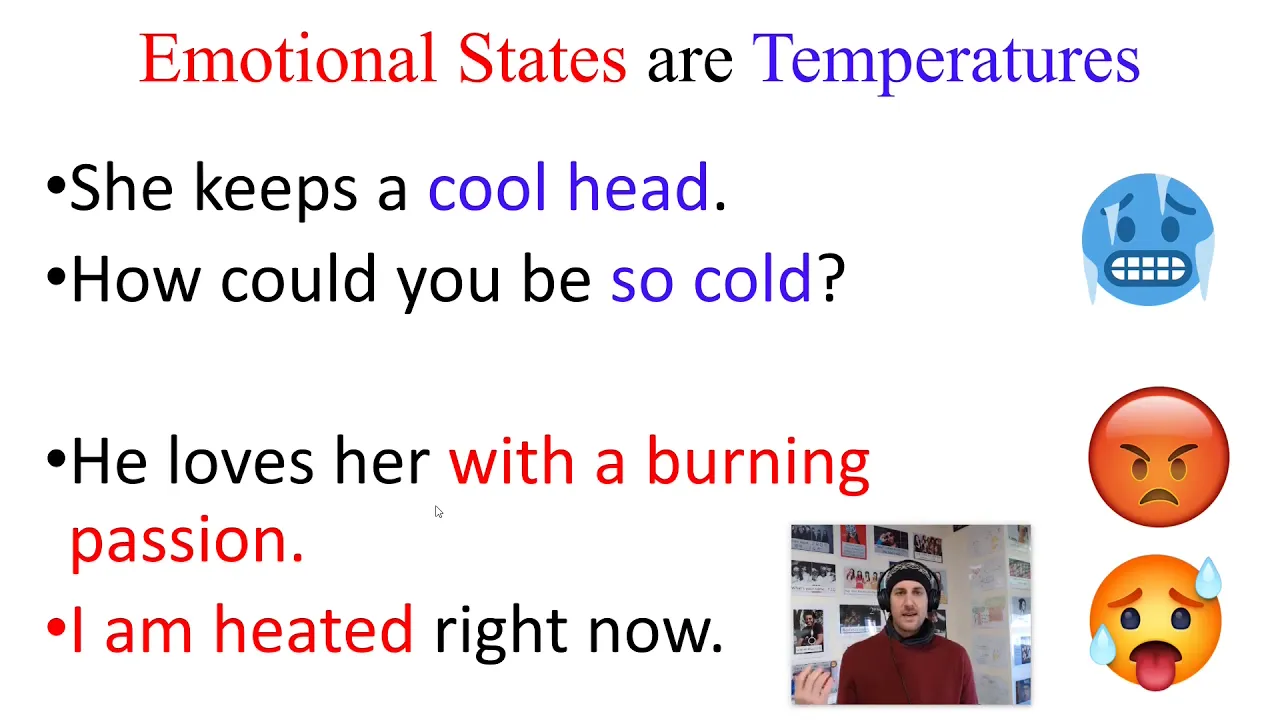
Conceptual Metaphor Lecture (2021)
4.2K
Conceptual metaphor theory, developed by linguists George Lakoff and Mark Johnson, explains that abstract concepts are understood through concrete, sensory domains; for example, emotional states are conceptualized as temperatures (hot/cold), knowledge is understood as vision (seeing/blindness), and relationships are framed as journeys (crossroads/travel), demonstrating that our entire conceptual system is fundamentally metaphorical rather than purely literal.
Click to watch →

Raymond Gibbs -- Second of a Double Feature: Metaphor and Embodied Cognition
13K
Conceptual metaphors are pervasive frameworks that structure how humans think about abstract concepts. George Lakoff and Mark Johnson's 1980 work established that metaphor is not merely rhetorical but fundamental to ordinary thought, particularly for abstract concepts. Abstract domains like love relationships are structured through multiple metaphorical mappings simultaneously—relationships can be understood as journeys, natural forces, buildings, or containers. Primary metaphors, rooted in recurring embodied correlations (big is important, up is good, warmth is affection), form the foundation for all conceptual metaphors. These primary metaphors explain why abstract concepts can be understood through embodied experiences, as they emerge from the most salient correlations in human bodily experience.
Click to watch →

71. Metafore e analogie VS Logica formale e matematica
235
George Lakoff and Mark Johnson argue that the essence of metaphor is to understand and live one type of thing in terms of another type of thing. Metaphor is not decorative but part of conceptual systems that highlight some aspects and hide others. Conceptual metaphors can be described at the neural level as mappings between conceptual domains where structures of the source domain are reused to reason about the target domain. These mappings are typically partial and learned automatically without consciousness. In 'Where Mathematics Comes From', they argue that many mathematical ideas use conceptual metaphors to make available inferential structures, and concepts like actual infinity would be fundamentally metaphorical constructions distinct from potential infinity understood as an endless process.
Click to watch →

El Uso de las metáforas con fines pedagógicos - I Jornada Académica Carmen Lyra 2026
144
George Lakoff and Mark Johnson challenge the traditional view of metaphor as merely poetic or rhetorical. They argue that metaphor impregnates not just language but also thought and action. Our ordinary conceptual system, through which we think and act, is fundamentally metaphorical in nature. Metaphors are fruits of our knowledge about immediate reality, particularly for abstract concepts like peace or intelligence that resist direct expression. They produce knowledge by providing forms through which we learn about realities before us. Metaphors also connect cognition to action, as we do not merely contemplate the world but engage in dialogue with it, acting upon it and with those around us.
Click to watch →

Teoria da metáfora conceptual
1.9K
The Conceptual Metaphor Theory, proposed by George Lakoff and Johnson, argues that metaphor is not merely a literary device but a fundamental cognitive mechanism that structures human thought and understanding. According to this theory, we comprehend abstract concepts (target domains) by mapping them onto concrete experiences (source domains), such as understanding 'time' through the domain of 'money' or 'discussion' through the domain of 'war'. This conceptual mapping occurs unconsciously in everyday language and thought, making metaphor a ubiquitous and necessary tool for human cognition rather than an ornamental linguistic feature.
Click to watch →
Deep Dive
Implications of linguistic relativity in Artificial Intelligence, exploring how the structure of training languages affects LLM reasoning.

Stanford CS25: V2 I Emergent Abilities and Scaling in LLMs
12.5K
Language models can perform Chain-of-Thought reasoning in languages that occupy very small fractions of their training data (e.g., Swahili, Bengali, Telugu, Thai). Despite these languages representing less than 0.01% of pre-training data, models perform surprisingly well on math word problems in these languages. This suggests that reasoning abilities may be somewhat language-independent, with models deriving reasoning structure separately from language-specific patterns.
Click to watch →

Does language shape how we think? Linguistic relativity & linguistic determinism -- Linguistics 101
396.3K
Linguistic relativity (also known as the Sapir-Whorf hypothesis) proposes that the structure of a language influences how its speakers perceive and conceptualize reality, meaning that different languages may lead to fundamentally different worldviews; this theory ranges from the weaker claim that language affects thought to the stronger claim of linguistic determinism that language determines thought, though it remains controversial with ongoing debate about whether language shapes cognition or merely reflects universal human thinking patterns.
Click to watch →

Matthew Riemland: Does AI think? Reflecting on the labor of language in the age of AI
494
The overwhelming majority of language-based AI tools focus on English and perform much better for languages like English and more globally dominant languages because smaller languages have far less available training data. For GPT-3, 93% of its training data was in English. LLMs combine languages with each other, mixing them into the same model so they all learn from each other. This means the model might begin to make certain patterns or vocabulary in Polish, for example, look more like the patterns of grammar and vocabulary in English because of the imbalance of training data. Additionally, models will reflect any ideological biases implicit in their training data, such as those related to race or gender.
Click to watch →

LLMs prove Structuralism was Correct all Along
265
Lang is virtual - it's everywhere but not in the pieces of the expression. AI training data is 500 million paroles (individual utterances), and by looking at this carefully, humans can infer the structure of meaning (lang). AI gets to the thing that linguists are trying to study - the virtual totality of language - by training on massive amounts of parole.
Click to watch →

#33 Guillaume Lample (Cofounder & Chief Scientist @ Mistral.AI) : Les secrets des Large Language ...
1.6K
LLMs trained primarily on English data (99% of Llama's training data) perform better in English than in other languages. Even when asked questions in French, translating to English, generating the response in English, then translating back often yields better results. This bias occurs because most training data and evaluation benchmarks are in English.
Click to watch →
Theory Basics
Implications
Theory Basics
0:00- 1
Explores how language influences thought, not controls it.
- 2
Origin in early 20th century research on language diversity.
- 3
Strong vs. soft versions: influence on attention and memory.
Linguistic Universalism and the Innateness Hypothesis
In contrast to the Sapir-Whorf hypothesis, Linguistic Universalism—pioneered by scholars like Noam Chomsky and popularized by Steven Pinker—argues that human thought is fundamentally independent of language. Universalists posit that humans share an innate biological framework for language (Universal Grammar) and think in a non-verbal mental language called 'mentalese.' Rather than language shaping our perception, language is viewed merely as a medium for translating pre-existing thoughts. Key evidence for this perspective comes from cross-cultural studies on color perception (such as those by Brent Berlin and Paul Kay), which reveal that humans categorize colors in highly consistent, predictable ways due to shared biological sensory mechanisms, regardless of the vocabulary available in their native tongues. From this viewpoint, human cognition and perception are shaped by universal biological structures, not by the specific language one speaks.
Basic definitions of linguistics, including semantics (the study of meaning) and syntax (the study of sentence structure).
Fundamental concepts of cognitive psychology, specifically how the human brain processes perception, memory, and categorization.
An introductory understanding of cultural anthropology and how societal norms and values are transmitted.
The conceptual distinction between 'thought' and 'language', and the debate on whether thought can exist independently of language.
Empirical cross-linguistic studies, such as research on color perception (e.g., Berlin and Kay) and grammatical gender's influence on object description.
Neo-Whorfianism and modern cognitive science experiments that investigate the 'weak' form of linguistic relativity.
The cognitive and psychological effects of bilingualism and multilingualism on decision-making and worldview.
Cognitive Metaphor Theory (pioneered by George Lakoff and Mark Johnson) which explores how abstract concepts are structured by metaphorical language.
Implications of linguistic relativity in Artificial Intelligence, exploring how the structure of training languages affects LLM reasoning.
525 views8likes3:11@social-science-explainerOriginal Release: 2025-05-13
Linguistic relativity theory is the idea that the language we speak can shape the way we think. It suggests that people who speak different languages might see and understand the world in different ways because their languages organize information differently. This doesn't mean language controls our thoughts, but it may influence how we notice things, what we remember, and how we describe events. For example, if one language has many words for something, speakers of that language may be more aware of small differences in that thing than speakers of a language with only one word for it.
Now, let's look at the origin of this theory. Linguistic relativity grew out of research in the early 20th century when scholars began to notice how language and thought might be connected.
They studied different languages around the world and saw that some languages had unique ways of organizing time, space, color, and actions. These differences raised the question, does the structure of a language affect the way its speakers think. This question became the foundation of linguistic relativity and started a lot of discussion in the fields of language, psychology, and culture. Linguistic relativity makes two main claims. First, it says that the structure of a language, like its grammar or vocabulary, can influence how its speakers think. This is called the strong version, but it is not widely accepted because it's hard to prove. The second, more accepted version says that language influences thought in softer, more flexible ways. For example, language might shape attention, memory, or how easily we can talk about certain ideas. Most researchers today support the idea that language can influence thinking, but it does not completely control it. Now, let's look at some examples. Some languages use compass directions like north, south, east, and west instead of left and right. Speakers of these languages are often better at knowing directions and staying oriented in space. Another example is how different languages talk about time.
Some imagine the future as in front and the past behind, while others picture time flowing from top to bottom. Color words are also different across languages. Some have more words for shades of blue or red, which may help speakers notice color differences more easily. These examples show how language might guide the way people think or notice things in the world. Now, let's consider some implications of linguistic relativity. One implication is that learning a new language might also open new ways of thinking or seeing the world. It could also affect how people from different cultures understand each other since their languages may shape their focus or values differently. This theory also encourages respect for language diversity, reminding us that every language has unique ways of expressing ideas.
Finally, it suggests that language is not just a tool for communication, but also a part of how we make sense of life. Understanding this can help us think more deeply about how we learn, teach, and translate across languages.
Up Next

101:11
How Language Shapes Thought: Lera Boroditsky's Cognitive Research
@longnow
197.2K views•2020-06-11
36:52
Constraint Interaction in Optimality Theory: Epenthesis & Deletion
@Vidyamitra
180 views•2018-08-20

8:59
Forensic Linguistics: How Language Solves Crimes | PBS
@pbsstoried
1M views•2024-01-25

21:32
Accent Expert Explains U.S. Regional Dialects | Part 1
@WIRED
9.3M views•2021-01-21
Related Study Plans & Knowledge Roadmaps
Structured learning paths in Linguistics
linguistics
Optimality Theory: Tableaux & Constraints
01Phonological Basics: Sounds, Syllables & Rules
02Foundations of Optimality Theory: GEN, CON, and EVAL
03The Constraint Inventory: Markedness vs. Faithfulness
+ 2 more learning modules
15h5 modules
Explore Roadmap
linguistics
Morphosyntactic Alignment: S, A & P Systems
01Foundations of Syntax: Transitivity and Arguments
02The Linguistic Variables: Mapping S, A, and P
03Nominative-Accusative Alignment
+ 3 more learning modules
12h6 modules
Explore Roadmap
linguistics
Analyzing Sign Language: Phonology & Syntax
01Foundations of Sign Language Linguistics
02Phonology: The Five Parameters of a Sign
03Morphology: Word Formation and Classifiers
+ 2 more learning modules
14h5 modules
Explore Roadmap
linguistics
Pragmatics: Speech Acts, Grice & Politeness
01Introduction to Pragmatics: Meaning in Context
02Grice’s Cooperative Principle & Implicature
03Speech Act Theory
+ 2 more learning modules
14h5 modules
Explore Roadmap