































Central banking evolved from medieval private banking families to national institutions through several key stages: the Casa di San Giorgio (1407) as the first government deposit bank, the Bank of Amsterdam (1609) which pioneered non-convertible deposit money and became a lender of last resort, Johan Palmstruch's Stockholms Banco (1656) which introduced the world's first banknotes before collapsing, and finally Sveriges Riksbank (1668) as the first true national central bank. Despite central banks' stated missions of price and financial stability, historical evidence shows mixed results, with periods of both stability and crisis, ultimately leading to their global adoption despite inherent tensions between monetary policy goals and political pressures.
The Origins of Central Banking: A Historical Analysis
Added:Central banks are the supposed champions of both price stability and financial stability.... But, have prices and finance really been very stable?
or was the world of money actually more stable before central banking was invented?
Hi, I am Joeri and to find out, I have collected the best works from economic historians and summarized them into what I believe is the true origin story of central banking.
And, to be honest, after doing the research, I am no longer surprised about the popularity of central bank conspiracy theories Okay, the scene is 13th century Europe, a golden era of rising trade.
And to facilitate that trade, the various princes, dukes, and kings each offered their own silver, gold, or other metallic coins.
However, while the official prices of these coins were based on their precious metal content, the actual metal content of these coins frequently changed, making them not as pure as you might have expected, and therefore not always reliable.
This uncertainty, along with the difficulty of carrying around heavy coins and the cost of protecting them, meant that merchants, that needed to do larger or possibly even international transactions, relied on famous European banking families such as the Bardi, Perruzi and Medici to transform their debts into tradeable deposit money.
However, the increasing reliance on private deposit money brought with it another problem and that is that, since money is kind off essential for any economy, if one of these banking houses went out of business, it often took the economy down with it.
For example, when both the Bardi and Peruzzi family banks went belly up after King Edward the 3rd of England failed to repay his loans in the 14th century, there were massive economic repercussions in Italy.
In this light it is not surprising that the first government owned deposit bank, the Casa di San Giorgio, was created in Italy (Genoa) in 1407.
So, was this the origin of central banking?
Well the definition of central banking is that of a: a national bank that provides financial and banking services for its country's government and commercial banking system, as well as implementing the government's monetary policy and issuing currency.
where, banking means an institutions that provides deposit and credit facilities.
Now, this public bank Casa di San Giorgio took in deposit but it did not yet provide loans or credit to the state.
It just promised that for each deposit, there would coin of equal value in the bank.
In this way the Casa di San Giorgio along with many of its contemporaries in 14th and 15th century Italy and Spain was a publicly owned 100% reserve banks.
It provided the important service of settlement of large transactions by using a ledger rather than coins, How would this work in practice though?
Well, say that one prominent merchants wanted to pay another.
At least one of them would then have to go to the bank to make their intentions known.
Then, later they would both have to return in person and make the payment via changes in their deposit accounts, with a notary there to confirm it all.
While, still quite a hassle, you can imagine that for large transactions this deposit money was still a lot easier than using bags of coins that all needed to be counted.
Especially, since there were many coins in circulation with different values.
So, nothing wrong with these public deposit banks and the honest people that ran them then... Well, not so fast In the research I read, it states that in practice the full reserve rule was frequently broken... especially when there was a public emergency... for example... When the Taula de Valancia was restructured in 1613 it came to light that it had made several illegal advances to city officials and even illegal loans to the city itself.
So, then you could say that these Southern European deposit banks were in fact the first central banks since they did two things that define what a central bank is.
They issued currency... and... even though it was illegal... they provided credit to the state... But, since this was on such a small scale, and outside of their mandate, I consider them the ancestors of modern central banks... not the first central banks themselves.
No, for the next stage in the evolution of central banking, we need to go to my home country.... the Netherlands.
The year is 1609... roughly 30 years after the founding of the Dutch Republic.... Dutch trade with the Baltic nations was flourishing but cloth importers were demanding monetary reform... why?
... well because there were 14 mints in the small republic all making their own coins... making it extremely difficult to exchange them and to separate good from bad coins.... In response, the city of Amsterdam founded a bank and named it... de Amsterdamse Wisselbank.... which translates literally to the Exchange Bank of Amsterdam, but is better known as the Bank of Amsterdam.
Like its South European predecessors it was known as a public deposit bank or full reserve bank.
Here is what Adam Smith had to say about it in his famous book the Wealth of Nations: "At Amsterdam, however, no point of faith is better established than that for every guilder, circulated as bank money, there is a correspondent guilder in gold or silver to be found in the treasure of the bank."
However, recent research of old ledgers of the bank has revealed that in fact Adam Smith was wrong.... As you can see in this graph (graph1), from very early on the Bank of Amsterdam did provide some credit to both the city of Amsterdam and the Dutch East India Company.
So, again, the bankers of Amsterdam were not completely honest.
Even, if, you can see that the Bank did basically start out as a full-reserve bank whose primary function was to provide deposit money to merchants.
And again, this type of deposit money was primarily used for large transactions.
This was desperately needed and highly valued as we can see from the fact that Bank of Amsterdam deposit money typically traded at a 5% premium over metallic coin money.... Meaning that you had to offer more money in coins to the Bank of Amsterdam than you would get back as deposit money – and you would be happy to do so, so popular was the deposit money.
Of course, this led to more public city banks being founded in the Netherlands.
For example, the Bank of Middelburg was founded in 1616, the bank of Delft in 1621, and the bank of Rotterdam in 1635.
And these all weren't full reserve banks.
They provided credit.
We know this because in 1672 when the French, English, and two German armies simultaneously invaded the Netherlands, a bank run occurred and they couldn't repay all of their depositors.
Meanwhile the Bank of Amsterdam could – apparently it had enough coins, or could attract enough coins in time, to make the payments.
The Economy of the Dutch republic never fully recovered after the attack.
But, the Bank of Amsterdam, with its proven resilience, did not just survive, it became stronger than ever.
In 1683, the bank had grown so strong that it basically created an early European fiat currency when it changed its policies such that not all deposits would be redeemable for coins anymore.
This meant that those non-redeemable deposits were purely based on the trust in the authority of the bank of Amsterdam.
That being said, this non-redeemable deposit money was still implicitly tied to metal because the people that accepted them did so knowing that on the secondary market they could still trade them for metal coins, if need be.
And that power came in handy when, in the panic of 1763, at the end of the seven years’ war between France and England, the massively overstretched Merchant banking house Gebroeders de Neufvill went bust, sending shockwaves through the financial centres of Europe.
While the crisis ravaged the banking houses of Hamburg and Venice, the crisis was contained in Amsterdam thanks to the Bank of Amsterdam stepping in as a lender of last resort, hence becoming a banker of the banking system as well as of the city of Amsterdam.
Furthermore, the Bank of Amsterdam started increasing its credit services to both the city of Amsterdam and the Dutch East India Company.
This was fine at first, having almost no impact on the Bank of Amsterdam deposit money premium.
However, trust in the Bank of Amsterdam was still largely based on its supposedly large reserves of metal because by now the bank had grown so large that, even if the city of Amsterdam wanted to, it wouldn't be able to bail it out in a crisis.
And that crisis came in the form of the fourth Anglo-Dutch war which broke out because the Dutch kept trading with the rebellious British colonies of the United States.
With the British attacking the Dutch East India Company, souring those loans, and the city of Amsterdam demanding more and more credit, trust in the Bank of Amsterdam quickly turned sour, a bank run occurred and while the Bank of Amsterdam did technically survive, it was never able to return to its former glory, and was ultimately dissolved in 1819 having become obsolete thanks to the establishment of the Dutch Central Bank in 1814.
So, was the Bank of Amsterdam it the first central bank?
No!
it was definitely the next step in the evolution towards central banking thanks to it providing credit somewhat more openly, acting as a lender of last resort to the financial system, and introducing non-convertible deposit money.
However, what is keeping it back is that it was not a national bank... it was a city bank... Sure, you could argue that that is a tiny detail because the Netherlands was just more decentralised than it is today.
But, it turned out to be detail of massive importance since the Dutch republic might have been able to bail it out, whereas the city of Amsterdam... was not.
So, even though it was not the first central bank, it did inspire a Latvian born citizen in Amsterdam for 'unknown reasons', and the kind that moved abroad to Sweden immediately when he was released in 1646.
And with him, he brought a suspicious wealth of knowledge about economics, finance, and specifically the workings of the Bank of Amsterdam.
The Swedes promptly appointed him head of the Chamber of Commerce from where he was in the position to propose to King Karl Gustav to establish for Sweden a bank that would provide both deposit (Wechselbank) and credit (Lanebank) services for the Swedish state.
Noticeably, this bank, named Stockholms Banco, was established in 1656 as a privately owned bank with shareholders including the King, the City of Stockholm, and, of course, none other than Johan Palmstruch himself.
Now at the time in Sweden, a deposit bank was sorely needed since the Swedes mainly used copper coins for trade, which are much heavier and more cumbersome than silver or gold coins.
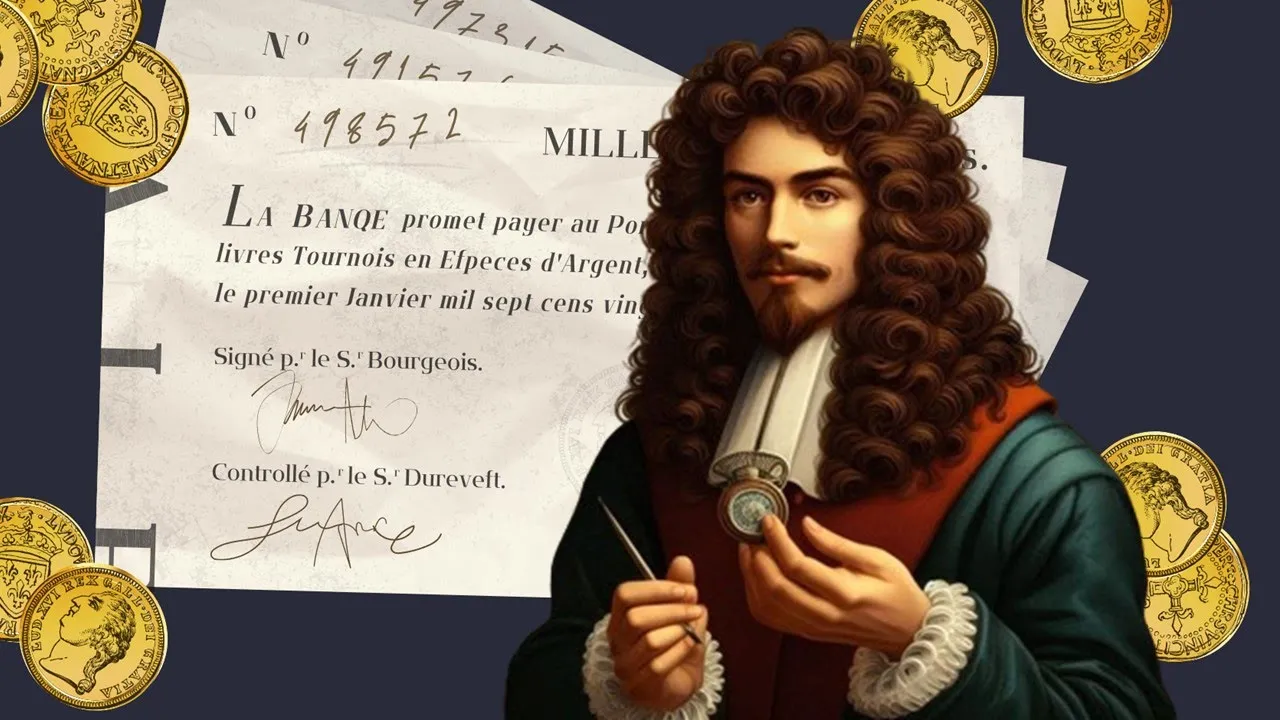
And so, it is perhaps not surprising that it was here in Sweden, in 1661, that Banco Stockholm premiered the use of a spectacularly innovative slip of paper that allowed people to pay with deposit money without both parties needing to go to the bank with a notary to verify a transaction..... Exactly, Palmstruch's Banco Stockhold issued the first recorded bank notes... However, that is where his triumphant story ends.
Johan was a rooky central banker after all and after having lent too much too quickly while trying to pay below market rates on deposits, Johan found out the hard way the meaning of a bank run and Sweden experienced its first banking crisis.
Banco Stockholm promptly collapsed and poor Johan again found himself charged for financial crimes by the state.
However, having experienced the benefits of both deposit money and not having to borrow from wealthy individuals, the Swedish state took over the Banco Stockholm in 1668 and rebranded the Sveriges Riksbank (literaly Swedish State Bank).
A bank that provided financial and banking services for the Swedish nation.... And that last part is why, technically the Swedish and not the Dutch, invented central banking.
But, did having a central bank bring price and financial stability to Sweden?
Well, that is not immediately clear, if we look a historical time series of inflation in Sweden... we don't see a clear effect.
You could even argue that prices got less stable in spite of price stability being at the center of the Riksbank design right from the start with its stated mission to "maintain the domestic coinage at its right and fair value."
One reason for this might have been that the central bank was able to provide much cheaper credit to the state... mainly used to Finance some of Sweden's 17th, century wars.
And while you could argue that this extended the lifespan of the Swedish Empire which had already peaked before the establishment of the Riksbank, the Riksbank was never able to rival the power of the Bank of Amsterdam at the end of the 17th century Swedish bills of exchange were mainly cleared in Amsterdam even though the bulk of Swedish exports went to England.
So, while the Sveriges Riksbank is technically the first central bank, we need to head to late 17th century England for the next evolution in central banking.
The year is 1688, and England has just been invaded.... by the Dutch.
That's right, the last successful invasion of England was by a Dutch army, led by its ruler William of Orange the third.
But, while it pains this Dutch economist to admit it.... this was as much of a coup as it was an invasion since the royal British army actually helped the Dutch invaders to overthrow the British Monarchy and William of Orange to become King William the Third.
What is more interesting for our financial story though is that, in an ironic twist, economic historians believe that this invasion ultimately created the central bank that would overtake the Bank of Amsterdam.
You see, one of the first things that the Dutch king William did was granting the Bank of England its charter in 1694.
Notably, though, much like the Riksbank, it had two departments right from the start, one for lending and another for deposit services.
Another similarity was that it started as a for profit enterprise owned by the crown and wealthy merchants- many of them happened to be Dutch Yeah... there was a lot of corruption in Europe back then... That being said, economists widely agree that the primary reason for its establishment was to help England fight the Nine Year war with France.
One way it did this was by transmitting to funds to troops on the continent via Amsterdam.
But, more importantly, it funded the war through the issuance of bank notes and... because war is expensive... this quickly turned into the excessive issuance of new notes... causing inflation... So again, did the Bank increase price stability?
It seems that the opposite happened at first.
Although, if we consider longer-term inflation, inflation was lower the century after the inception of the Bank of England than in the century before that.
But, this might have a had little to do with the central bank and more with the massive inflow of Silver from the American continent and a spike in population driving up agricultural prices in the 16th century.
Okay, so, what about financial stability?
Well, not long after the inception of the Bank of England, the UK experienced its first massive bubble in the form of the South Sea Bubble.
However, this was not directly the fault of the Bank of England.
In fact the British South Sea company could be seen as a competitor for the Bank of England because it was primarily used as a vehicle to finance the British state and various agents of the state therefore had an interest in this bubble.
However, it should be noted that when the bubble popped, its impact on the economy was limited.
Possibly, thanks to emergency lending by the Bank of England.
And, as London's financial might grew, so did the frequency of its financial crises.
For example in in the crisis of 1793.... West India Merchants got into trouble due to a war with France and went to the Bank of England.. for support... which they got.
But supporting the economy and government while you are tied to gold is tricky.
So, not surprisingly, when gold supplies got low compared to issued notes, the Bank of England had to suspend convertibility to gold in 1797.
The suspension lasted almost 25 years and so in practice the Bank of England, like the Bank of Amsterdam before it, now issued fiat currency.
This allowed it to further support first its (slave trading) merchants in 1799, while slowly moving to a lender of last resort function for banks during the early 19th century.
Here it should be noted that not all banks were to be saved whatever the cost, since for the longest time the Bank of England followed the rule formulated by Bagehot: central banks should lend early and without limit, to solvent banks, that were able to post good collateral, and at 'high rates.'
And with that rule in place, it does appear that financial crises became a thing of the past under the Bank of England.
And actually right up to the second world war.... British prices seemed to be more stable than in the decade before the Bank of England.
So, while the history of central banking is one steeped in lies, crises, profiteering businessmen, corrupt politicians, and even support of slave trading, it did seem to stabilise prices and finance.
Not surprisingly, all of continental Europe introduced their own central banks, and even in the USA, which had stumbled form one banking crisis to another in the era of free banking came up with its own... and so all seemed to be well in central banking land... up to the 1950s when central banks were still there, but high economic growth along with inflation became the new norm, and then finally in the 90s and early 2000s when financial instability made a big come-back.
So, what happened there?
To find out, consider subscribing to the channel or supporting it by becoming a Patron or member
Up Next

17th Century Dutch Art Market: How Artists Made a Living
@smarthistory-art-history
17.4K views•2023-01-19

The Great Schism of 1054: Causes and Consequences
@SacredCathedrals
113.5K views•2026-02-19

The Geopolitics of the Ukraine War and the Rise of Global Autocracy
@JordanHarbingerShow
468K views•2025-04-19

Understanding the Cold War: Superpower Conflicts and the Road to Détente
@OverSimplified
46.1M views•2019-01-24
Related Study Plans & Knowledge Roadmaps
Structured learning paths in History