


















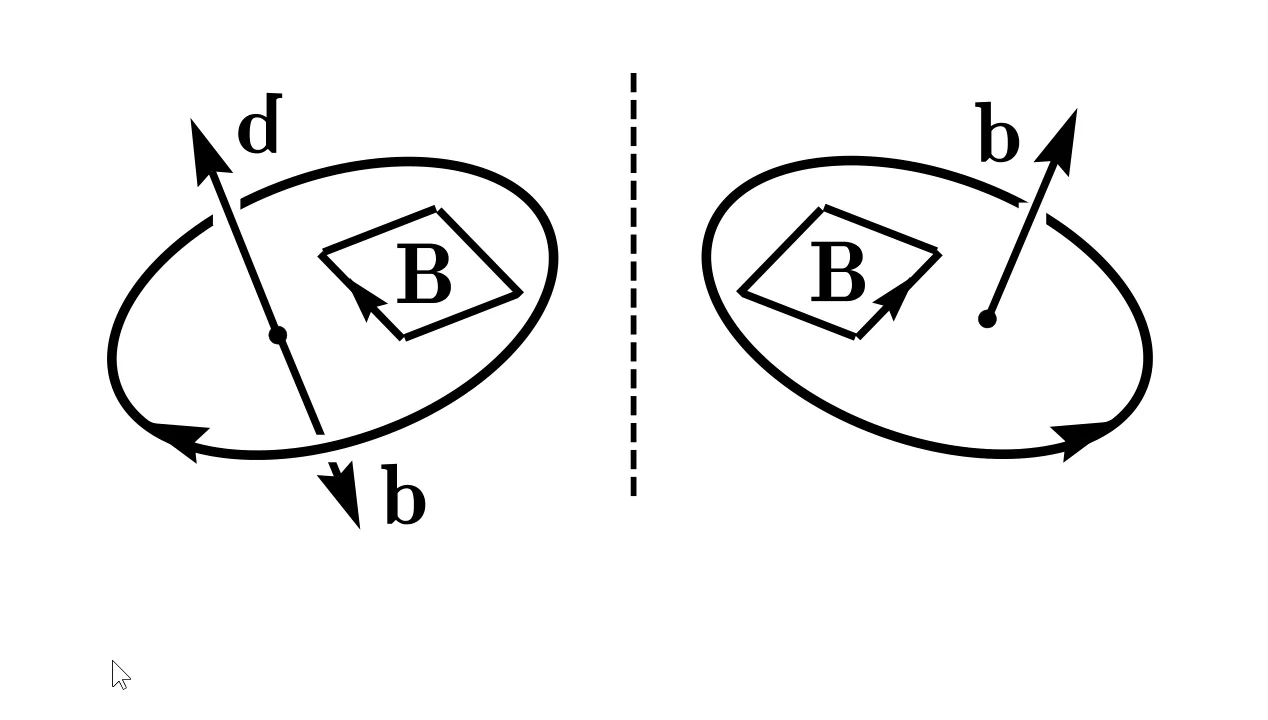
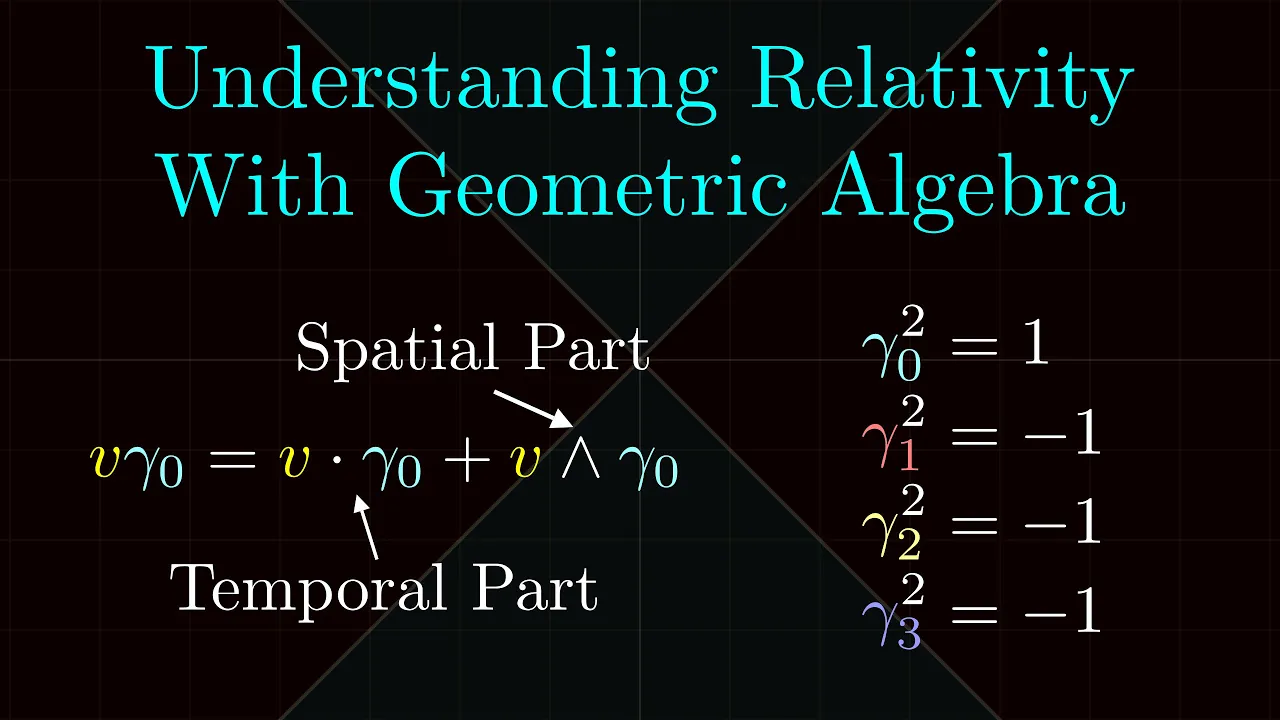

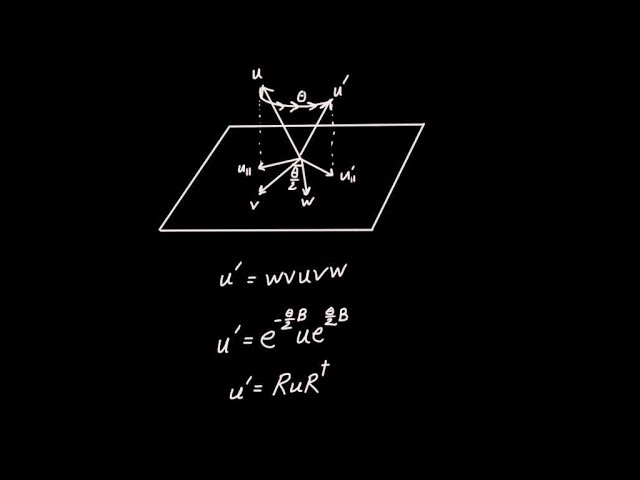





A bivector is a two-dimensional object in geometric algebra, representing an oriented plane segment characterized by its area (magnitude) and orientation; unlike vectors which are one-dimensional arrows, bivectors can be moved around and reshaped without changing their identity as long as their area and orientation remain constant, and in two dimensions, they behave similarly to scalars (called pseudoscalars), but become more complex in higher dimensions where orientation becomes more nuanced.
Introduction to Bivectors: Geometric Algebra Explained
Added:Vector Algebra Fundamentals: A solid understanding of vectors, vector addition, scalar multiplication, and Cartesian coordinate systems.
Dot and Cross Products: Familiarity with standard vector products, particularly how the dot product measures projection and the cross product represents orthogonal vectors in 3D.
Concept of Dimension and Orientation: An intuitive grasp of 2D planes, 3D space, and the concept of directed orientation (such as clockwise versus counterclockwise rotation).
Linear Transformations and Determinants: Basic knowledge of matrices and how determinants relate to the scaling of areas and volumes.
The Outer (Wedge) Product: Studying the algebraic operator that formally constructs bivectors from two vectors.
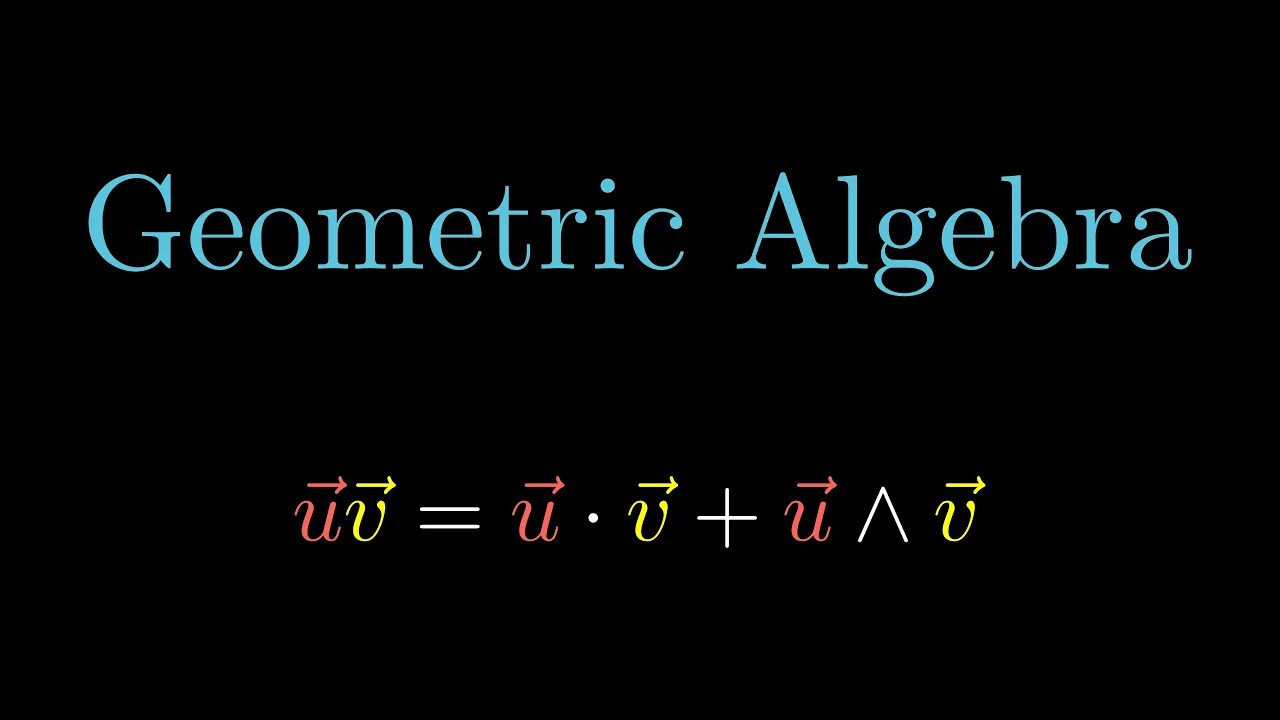
The Geometric Product: Understanding the unified product that combines the inner (dot) product and outer (wedge) product to form the core of Geometric Algebra.
Multivectors and Pseudoscalars: Extending the algebra to higher dimensions, including trivectors (representing volume elements) and the concept of the pseudoscalar.
Rotors and Rotations: Exploring how bivectors serve as the generators of rotation, replacing complex numbers, quaternions, and rotation matrices in a unified framework.
Applications in Physics and Computer Science: Investigating how geometric algebra simplifies classical mechanics, electromagnetism (Maxwell's equations), and 3D computer graphics.
11.7K views797likes7:08Original Release: 2025-01-29
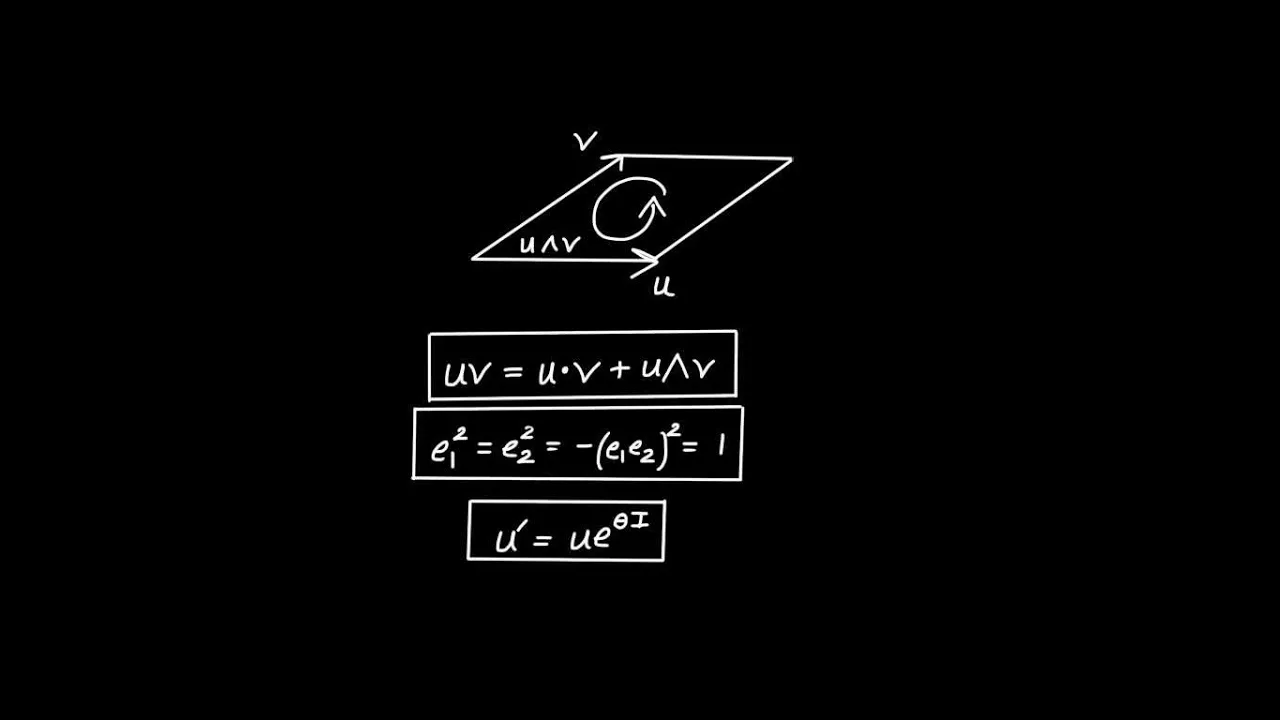
up to this point we have mainly been looking at vectors which we most often think of as arrows in space given how much we've been focusing on them you may think that geometric algebra is the study of vectors but that is not the case in this chapter we will look at multiv vectors on extension of vectors which are the main objects we study in geometric algebra the first Stepping Stone Forest towards multiv vectors will be bi vectors which will be the topic of the next few videos this video is a part of from zero to Geo a series where we formulate geometric algebra an incredibly powerful branch of mathematics from the ground up to start our journey away from vectors let's first take a closer look at them again we think of vectors as oriented line segments with this geometric interpretation vectors are one-dimensional objects if vectors are one-dimensional can we find a two-dimensional analog to vectors instead of an oriented line segment what if we had an oriented plane segment formalizing this idea a little more will lead us to bi vectors so let's think about oriented plane segments there are two main properties of a bi Vector its area and its orientation the area of a bi Vector is represented by a number similar to vectors we also sometimes call the area of a b Vector its magnitude now what about the orientation of a bi Vector what exactly can the orientation of a plane segment be well in two Dimensions we have two orientations clockwise and counterclockwise things get more complicated in higher Dimensions but let's focus on two dimensions for the moment like with vectors we say that moving a bi Vector around does not make it a different bi Vector since a vector is determined purely by its magnitude and orientation we say that a b Vector is determined purely by its magnitude and orientation as well however because of the greater Freedom that we have in two Dimensions this statement has much greater consequences for bi vectors than it does for vector if a bi Vector is purely determined by its magnitude and orientation that would mean that rotating a bi Vector in its plane will also not change it since the area and orientation are the same in fact if we change the shape of the bi Vector without changing its area it will still be the same bi Vector thus this bi Vector this bi Vector this bi vector and even this by Vector are all equal because they all have the same area and orientation because of this we tend to not represent bi vectors using weird shapes and we will actually be able to just think about bi vectors as parallelograms most of the time in fact it's often best to not think of bi vectors as representing a particular shape at all and to instead think of them as a pure orientation and magnitude before we move on let's do an exercise that may seem familiar here are a bunch of bi vectors let's ask three questions which of these bi vectors have the same magnitude which of these bi vectors have the same orientation and finally which of these bi vectors are equal please pause the video and answer these questions before continuing let's solve these questions in order first which of these bi vectors have the same magnitude I purposely made all of the area simple to calculate so this shouldn't be too hard we have these two B vectors which have an area of one these two bi vectors which have an area of two these two by vectors which have an area of three and these two B vectors which have an area of four next which of these B vectors have the same orientation in two Dimensions we only have two orientations clockwise and counterclockwise looking at the bi vectors we see that these four are clockwise and these four are counterclockwise finally which of these bi vectors are equal this can be solved by looking back at the previous answers and seeing which bi vectors have the same magnitude and orientation in this case these two bi vectors are both clockwise with an area of one and these two B vectors are both counterclockwise with an area of four and none of the other bi vectors are equal to each other now at this point you may have realized something if the shape of a bi Vector doesn't really matter and if 2D B vectors only have two orientations can't we describe 2D B vectors with just a single number if we associate the two different orientations with positive and negative numbers we can get a direct correspondence between between scalers and 2D B vectors because of this correspondence we often call 2D B vectors pseudo scalers it's important to realize that bi vectors are called pseudo scalers only in two dimensions in fact in one dimension vectors are pseudo scalers this is because one-dimensional vectors also have a correspondence with scalers there exist higher dimensional pseudo scalers too but we haven't looked at what objects those are yet so we'll talk about them later now because 2D B vectors seem indistinguishable from scalers currently you may think that bi vectors are useless however bi vectors get a lot more interesting when we move up to higher Dimensions here are several bi vectors in three dimensions now while all of these bi vectors have the same area none of them are equal because the orientation of each bi Vector is different like in two Dimensions you can move bi vectors around in three-dimensional space and even change their shape without changing what bi vectors they are again the only thing that matters is the magnitude and the orientation of the bi Vector now at this point I would like to give you an exercise involving 3D B vectors but there's a problem doing 3D geometry is hard you can't draw three-dimensionally that easily and trying to do 3D problems visually can be difficult thus I will hold off on having too many exercises involving 3D by vectors until we have the tools to be able to handle them better one last thing I want to talk about regarding by vectors is the labels we use to describe them for vectors we've been using letters with an arrow above them to distinguish them from scalers which we write without an arrow to describe by vectors some people use a capital letter with this Arrow which is what I have done in the past however I recently have been coming to like this notation for by vectors where we use a double arrow above a letter it can get a bit unwieldy at times with how big it is but I like how explicit this double arrow is thus for the most most part I'll use this double arrow notation for bi vectors at this point if you were to compare vectors and bi vectors you might think that b vectors aren't too useful we know how to add and scale vectors which enables us to do quite a bit but what can we do with bi vectors quite a lot actually and we will start to explore the operations on B vectors in the next video e
Up Next
16:47
Understanding Rotors in Geometric Algebra for 3D Rotations
@marctenbosch
170.5K views•2020-01-30
51:00
Conformal Geometric Algebra Explained: Lines, Spheres & Inverse Kinematics
@bivector
1.5K views•2024-09-05

54:37
Projective Geometric Algebra Explained: A Swift Introduction
@sudgylacmoe
112.9K views•2023-08-13

6:00
The Mathematical Impossibility of Accurate World Maps
@Vox
23.3M views•2016-12-02
Related Study Plans & Knowledge Roadmaps
Structured learning paths in Mathematics
mathematics
Tensor Calculus: Vectors to Riemann Curvature
01Mathematical Foundations: Linear Algebra & Calculus
02Covectors, Dual Spaces, and Tensor Basics
03The Metric Tensor and Index Gymnastics
+ 2 more learning modules
40h5 modules
Explore Roadmap
mathematics
Gödel's Incompleteness: Logic, Proofs & Limits
01Introduction to Formal Systems & Hilbert's Dream
02Set Theory, Cardinality, and Cantor's Diagonal Argument
03Arithmetization and Gödel Numbering
+ 2 more learning modules
14h5 modules
Explore Roadmap
mathematics
Galois Theory: Fields, Groups & Solvability
01Foundations of Abstract Algebra: Groups & Fields
02Polynomials & Field Extensions
03Splitting Fields & Symmetries
+ 2 more learning modules
24h5 modules
Explore Roadmap
mathematics
Non-Euclidean Geometry: Models & Geodesics
01Euclid's Fifth Postulate and the Birth of New Geometries
02Hyperbolic Space and the Poincaré Disk Model
03Geodesics: Defining Straight Lines in Curved Spaces
+ 2 more learning modules
15h5 modules
Explore Roadmap