




















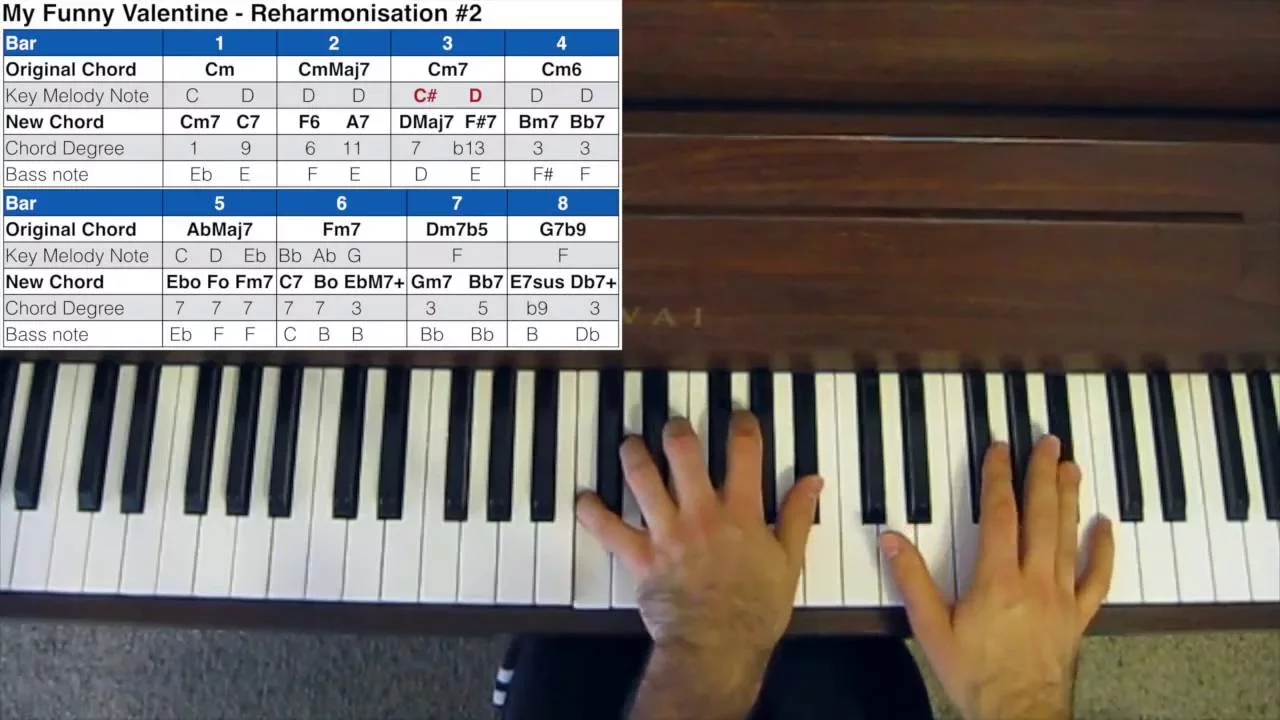
This exercise teaches how to reharmonize any chord progression by selecting a single melody note as the top note of all voicings and moving the bass note up and down in half steps, which forces you to find multiple chords that work with that melody note regardless of the bass note, thereby training your ear to hear and understand voice leading and harmonic possibilities in real-time.
Mastering Real-Time Reharmonization: Neo Jazz Piano Exercise
Added:Familiarity with jazz chord construction, including 7th chords and basic extensions (9ths, 11ths, 13ths).
Understanding of diatonic harmony, Roman numeral analysis, and basic voice-leading principles.
A foundational understanding of modal interchange and how to borrow chords from parallel scales.
Basic keyboard proficiency, specifically the ability to sustain a melody note while changing chord shapes underneath.
Applying reharmonization techniques to full melodies and standard jazz lead sheets rather than static, single-note exercises.
Mastering advanced neo-soul and jazz piano voicings, such as quartal harmony, upper-structure triads, and rootless voicings.
Studying advanced harmonic substitution theories, including tritone substitutions, secondary dominants, and chromatic passing chords.
Developing real-time improvisational strategies to solo over complex, spontaneously reharmonized chord progressions.
59.5K views3.3Klikes8:36Original Release: 2021-06-18
do hey everybody and welcome to my channel my name is noah kellman and i am here to teach you everything that i know about modern jazz piano so today i'm going to show you one of my absolute favorite reharmonization exercises this exercise should really help you learn to actually hear reharmonization at a higher level it's going to help you understand how you can take a single melody note and actually do so much with it from the harmonic standpoint how could you actually create an entire chord progression under literally one single note that is what we're going to be talking about today really quick if you're new to the channel please consider clicking subscribe and the little bell to turn on notifications so you don't miss any more videos just like this one also just a super quick announcement i'm also going to be opening up my course jazz piano secrets which focuses a lot on some modern techniques about neo jazz piano in fact it actually talks about something called the neo jazz piano method which is really just my methodology that i've put together for non-functional harmony and chord progressions so if you're interested in modern jazz piano and you really want to learn an entire method for actually creating chord progressions and mastering improvisation and harmony and reharmonization over those modern progressions be sure to click the link in the description of this video and make sure you're on the wait list because weightlisters get first dibs at new spots in the program all right without further ado let's dive right into the lesson alright so the basic version of this exercise is actually really really simple we're just going to choose one single melody note which becomes the top note of all of our voicings so in this case i chose f right but you can choose literally any note you want so the real core concept here is when you choose a top melody note you should be able to find a chord that works regardless of what the bass note is in fact you should be able to find in many cases multiple chords that work being able to do that quickly and effectively is so key in fact it's such an amazing skill to have if you want to be able to very quickly and in real time be re-harmonizing different melodies and or chord progressions so let's start really really simple and this is actually what i did in the intro to this video so what we're going to do is we're going to take our top melody note right and i'm just choosing f arbitrarily here and we're going to move our baseline up and down in half steps right then what we're going to do is actually fill this in with chords so first question is right what f chord is going to work with an f in the top well obviously this is a really easy place to start because any f chord f major f minor um any of these are going to work you know with the f in top f is literally our root but of course where this starts to get a bit tricky is when we start moving the bass line up so we move up to f sharp or g flat whatever you want to call it so what are some options now where the f is in the melody and we've got the uh g flat in the root right so obviously g flat major seven in this case i'm actually playing g flat major 9 because i've got this b flat in here so of course the f becomes the major 7 in the key of g flat so basically now the chords that are going to work are the ones that have this major 7. so we could of course do a g flat major seven or a g flat major nine like what i'm doing here we could also do a minor major seven in this case a minor major seven with the nine in there this little cluster right there are obviously some other tonalities that might work here um right so there are different sounds that we can actually get with this same combination but the important thing to keep in mind is that we actually have this major seven now right and of course if we move the bass note up again now this f becomes the minor seven in the key of g so we could do like a g minor 11 um you know any kind of g minor chord that's going to have this minor seven right so what we want to do is you know when just starting out we can take this really slow figure out some different options but eventually we want to get to the point where we can really kind of freely move up and down have an option regardless right [Music] and be able to do the same thing on the way down and so that is a really really amazing exercise to do really quick if you've been enjoying the lesson so far please consider clicking the like button i would really really appreciate it but of course you might have guessed already that the exercise doesn't have to stop there we could actually do some different variations in the left hand so we could actually do whole steps and of course that becomes trickier right we could also do some different patterns like we could do up a half step down up up down up up down right i don't know if i said that right but i think you get the point so so what this exercise is really going to do is train you to actually hear and also visually see and theoretically understand all of the different options that can come from even just one single melody note and bass note combination as we move the bass note around it's going to force you to hear where we can go and in addition to that it's actually helping you really understand voice leading in your ear so i love giving exercises that force you to use your ears right and in this case this is a great example of one of those you're going to have to start hearing how that one melody note can have different harmonic colors and tonalities and shapes as you play different chords on the piano right all just one melody note there's so much we can do right all right so that is all i have for you today but that exercise in and of itself can really really help you move forward in your path to be able to do real-time top-level professional reharmonization and again if you are interested in this kind of material and you want a nice step-by-step course to really walk you through mastering modern harmony and improvisation be sure to sign up for the waitlist for jazz piano secrets the link is in the description now jazz piano secrets is a video course but if you would actually prefer some one-on-one guidance whether it's a you know private lesson or something even deeper feel free to actually click the link in the description to set up a totally free strategy call so that call would be with either myself or one of the coaches who are working with me they all know all of my teaching methods and are really amazing people and basically the call is just to help you figure out you know what would be the best next step in terms of taking your playing to the next level i also work with some people on you know building up their social media and business and things like that so if you're interested in working with me um or you know learning some of my methods in kind of a more one-on-one format feel free to schedule a call we'll talk about the options and see if there's something that would make sense for you all right thank you so much for watching seriously appreciate each and every one of you who are watching my videos and being a part of this awesome modern jazz piano community so much fun talking about all this stuff and i look forward to the next video and please leave me any questions you have in the comments i love talking to all of you and interacting with you and with all that i will see you next time
Up Next

8:25
Jazz Piano: 3 Steps to Reharmonize Pop Songs
@KentHewittpiano88
3.6K views•2023-06-05

10:20
Mozart's Musical Dice Game Explained: History, Rules, & Fun
@webpianoacademy
5K views•2023-03-13

47:36
Understanding Diatonic 7th Chords in Major Keys | Music Theory Tutorial
@GracieTerzian
54.7K views•2022-03-02
10:49
Understanding John Coltrane's Giant Steps: A Music Theory Analysis
@Vox
10.4M views•2018-11-12
Related Study Plans & Knowledge Roadmaps
Structured learning paths in Music Theory
music-theory
Composing Galant Music: Partimento & Schemata
01Foundations of Figured Bass and Keyboard Harmony
02The Rule of the Octave (Regola dell'Ottava)
03Galant Schemata: The Building Blocks of Form
+ 2 more learning modules
30h5 modules
Explore Roadmap
music-theory
Decoding Overtone Series: Tuning & Drone Music
01Acoustic Foundations: The Physics of the Overtone Series
02Tuning Systems: Equal Temperament vs. Just Intonation
03Microtonality and Spectralism: Beyond Standard Pitches
+ 2 more learning modules
24h5 modules
Explore Roadmap
music-theory
Impressionist Harmony: Scales, Planing & RPGs
01Foundational Music Theory: Keys, Intervals, and Seventh Chords
02Impressionist Color: Chord Planing and Parallel Harmony
03Whimsical Textures: Pentatonic Cascades and Whole-Tone Scales
+ 1 more learning modules
14h4 modules
Explore Roadmap
music-theory
Negative Harmony: Axis Reflection in Indie Pop
01Music Theory Foundations: Scales, Intervals, and Triads
02Functional Harmony and the Circle of Fifths
03Demystifying the Negative Harmony Axis Reflection
+ 2 more learning modules
16h5 modules
Explore Roadmap