













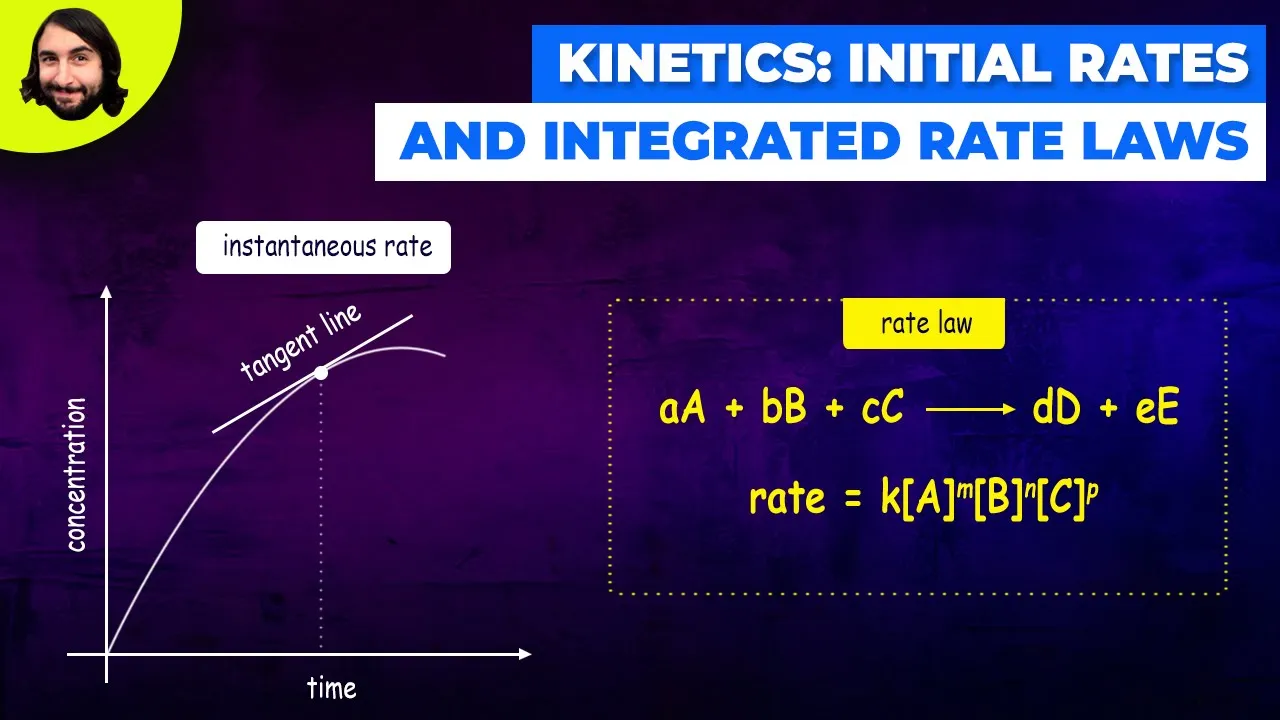











The rate law expresses how the rate of a chemical reaction depends on reactant concentrations, with the general form rate = k[A]^m[B]^n, where m and n are the reaction orders determined experimentally, not from stoichiometry; for example, if doubling [A] doubles the rate, the reaction is first-order in A, and if doubling [B] quadruples the rate, it is second-order in B, with the overall order being the sum of individual orders (e.g., 1+2=3), and the rate constant k has units that depend on the overall order (e.g., for a third-order reaction, units are M⁻²·s⁻¹).
Rate Law and Reaction Order | AP Chemistry Kinetics
Added:Fundamental understanding of chemical reactions, stoichiometry, and balancing chemical equations.
The concept of reaction rate, defined as the change in concentration of reactants or products over time.
Basic collision theory, including how concentration and temperature qualitatively affect the frequency of molecular collisions.
Algebraic proficiency in working with exponents, ratios, and logarithms to solve for unknown variables.
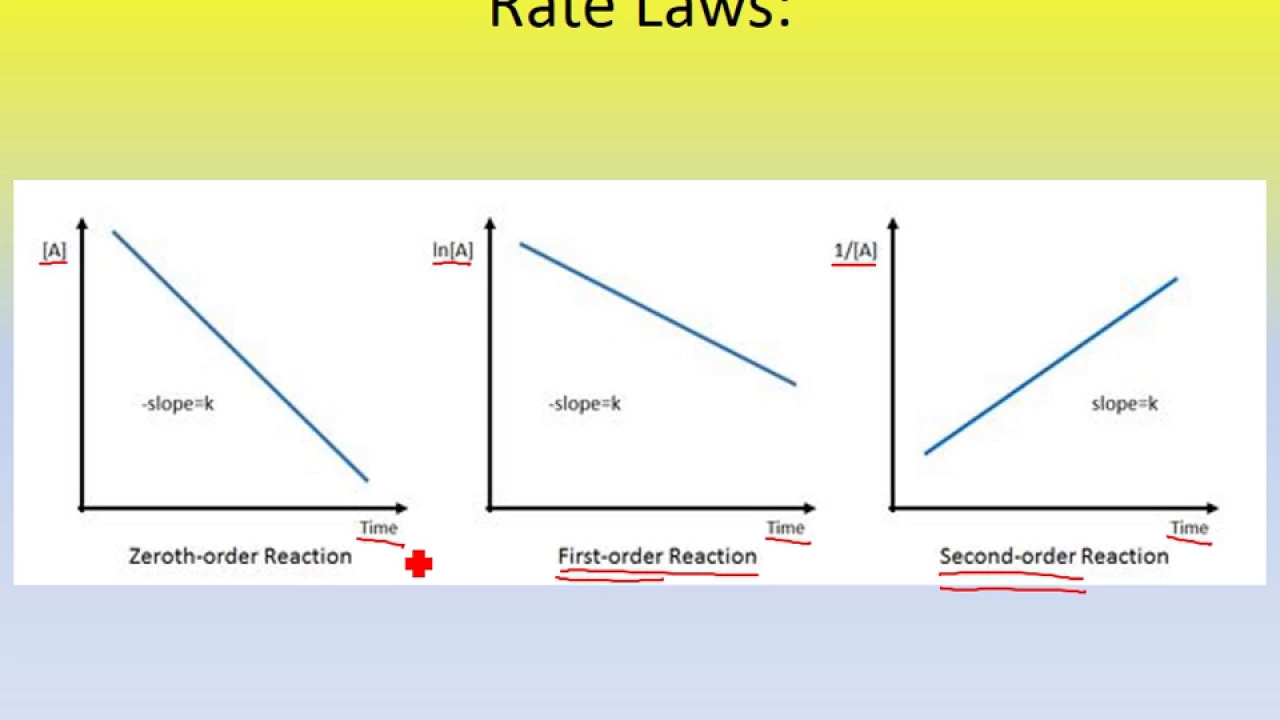
Integrated rate laws, which describe how reactant concentration changes as a function of time and how to identify reaction order graphically.
Calculating reaction half-lives, particularly the constant half-life characteristic of first-order reactions.
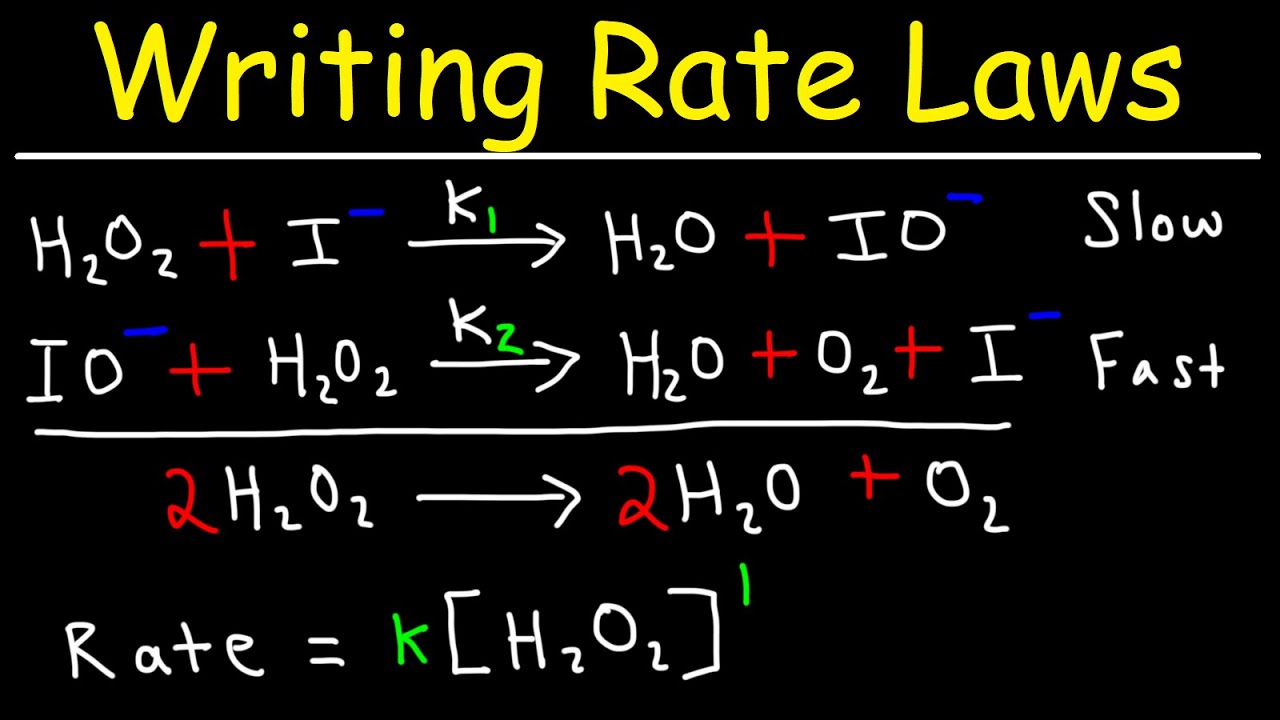
Reaction mechanisms, including identifying intermediate species, catalysts, and the rate-determining step.
The Arrhenius equation, to understand how temperature and activation energy quantitatively influence the rate constant (k).
900.7K views3.1Klikes10:39Original Release: 2014-10-12
- [Voiceover] Let's take a reaction where A plus B gives us our products.
And the lower case a and the lower case b represent the coefficients for our balanced equation.
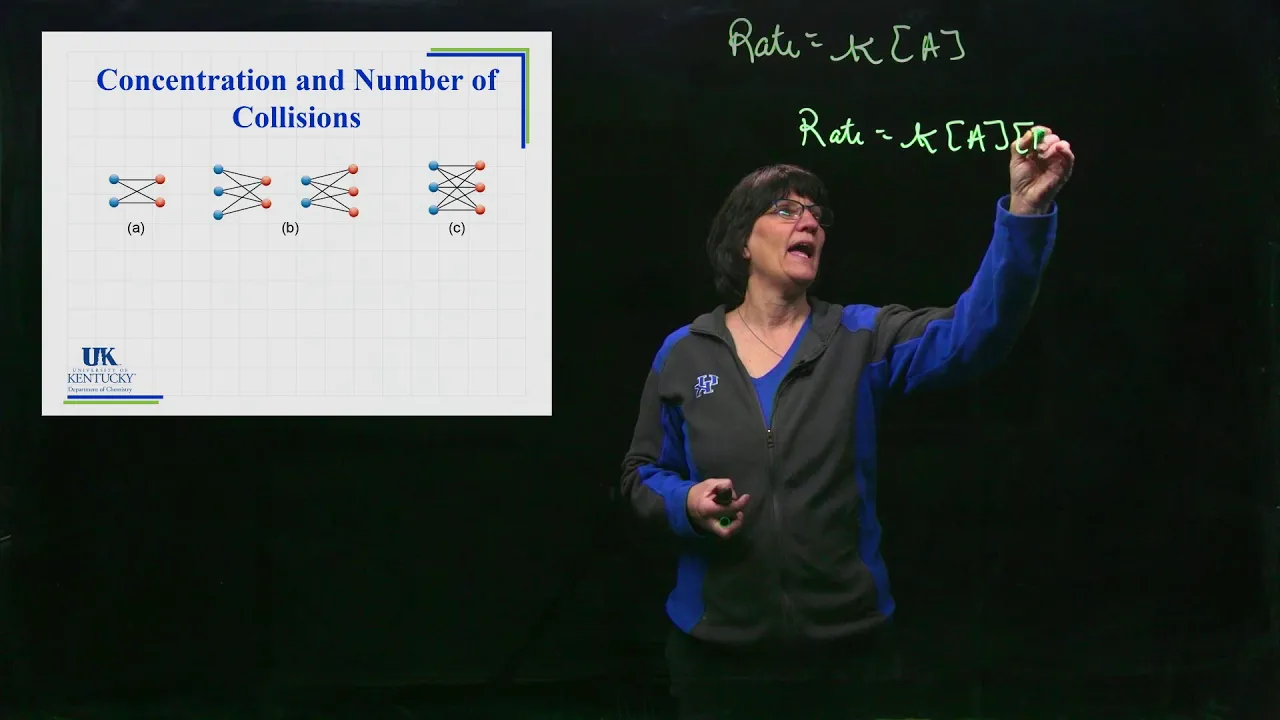
It makes sense if we increase the concentration of A and B, right, A and B would be closer together in space and more likely to react, therefore increasing the rate of our reaction.
And this is true for most reactions.
If you increase the concentration of your reactants, you increase the rate of your reaction.
We can check this by doing some experiments.
So let's say we wanna figure out what the effect of the concentration of A has on our rate of our reaction.
So we're gonna hold the concentration of B constant, so we hold the concentration of B constant in our experiments.
We change the concentration of A, and we see what effect that has on the rate of our reaction.
We're going to use the initial rate of the reaction.
And that's because as our reaction proceeds, the concentration of products will increase.
And since reactions are reversible, if we have some products present, right, that can affect the rate of our reaction.
And that's not our goal.
Our goal is to figure out what the concentration, what effect the concentration of our reactants has on our rate.
And so we use the initial rate, where we have only reactants present, and no products.
So in our first experiment, let's say the concentration of A is one molar, and the rate of our reaction, the initial rate of our reaction is.01 molar per second.
And our second experiment, we increase the concentration of A to two molar.
We hold the concentration of B constant, and we observe the rate of our reaction to increase to.02 molar per second.
So we've increased the concentration of A by a factor of two.
And what happened to our rate?
Our rate went from.01 to.02.
So the rate increased by two as well.
All right, let's compare our first experiment with our third experiment now.
We're going from a concentration of A of one, to a concentration of A of three.
So we've increased the concentration of A by a factor of three.
And what happened to the rate?
The rate went from.01 to.03.
So the rate increased by a factor of three.
All right, to figure out the relationship, if you think to yourself, two to what power X is equal to two?
Obviously that would be two to the first.
Two to the first is equal to two.
All right, we could have done it for our other comparison as well.
Three to what power X is equal to three?
Obviously three to the first is equal to three.
So the rate, the rate of our reaction is proportional to, and that's what this funny symbol means here, the rate of our reaction is proportional to the concentration of A to the first power.
All right, let's do the same thing for the concentration of B.
So we do some experiments where we change the concentration of B, and we see what effect that has on our initial rate.
So for all of these, we're gonna hold the concentration of A constant, therefore, whatever we do to B is reflected in the rate of our reaction.
So in our first experiment, the concentration of B is one molar and the rate is.01 molar per second.
And then we change the concentration of B to two molar.
Right, we double the concentration of B while holding the concentration of A constant.
And we observe the initial rate of our reaction to be.04 molar per second.
So we've increased the concentration of B, not A, and let me change that (laughs).
We've increased the concentration of B by a factor of two.
We've gone from one molar to two molar.
And what happened to the rate?
The rate went from.01 to.04.
So we've increased the rate by a factor of four.
Let's compare our first experiment with our third experiment now.
We're going from a concentration of B of one molar to three molar.
So we've increased the concentration of B by a factor of three.
And what happens to the rate?
The rate goes from.01 to.09.
So we've increased the rate by a factor of nine.
So now we think to ourself, two to what power, I'll make it Y, two to what power is equal to four?
Obviously Y would be equal to two.
Two to the second power is equal to four.
Or three to what power Y is equal to nine?
Obviously, three to the second power is equal to nine.
So we've determined that the rate of our reaction is proportional to the concentration of B to the second power.
All right, now we can put those together.
We can put these together to write what's called a rate law.
Ok, So we know that the rate of our reaction is proportional to the concentration of A to the first power, and we know that our rate is proportional to the concentration of B to the second power.
And then we put in, we put in what's called a rate constant here, K.
And this represents our rate law.
So let's go through these one by one here.
So, capital R is the rate of our reaction, right?
This is the rate of our reaction.
All right?
K is what's called the rate constant.
So this is the rate constant.
And there's a difference between the rate of our reaction and the rate constant.
If we change the concentration of our reactants, we change the rate of our reaction.
But if we change the concentration of our reactants, we don't change the rate constants, right?
And this is constant.
It does depend on the temperature, though, so we'll talk about that in later videos.
Here we have that the reaction is concentration of A to the first power.
We say the reaction is first order in A.
So we say that our reaction is first order, first order in A.
And we found, we found that it's second order in B.
Right, so we had a two here.
So this is second order, second order in B.
And we can also talk about the overall order of our reaction.
So if we're first order in A, right, we're first order in A, and second order in B, the overall order, the overall order would be one plus two, which is equal to three.
So the overall order of our reaction is three.
All right, let's go back up here to the general reaction that we started with, all right, so let's go back, right back up to here.
We have, we have this.
And let's write a general rate law.
So if this is your reaction, your general rate law would be R is equal to your rate constant, times the concentration of A to some power, I'll make it X, times the concentration of B to some power which I will make Y.
And the reason why I'm showing you this, is to show you that you can't just take your coefficients, right, you can't take your coefficients and stick them into here.
Right? So it doesn't work that way.
You'd have to know the mechanism of your reaction.
So these orders have to be determined experimentally.
So you have to look at your experimental data here.
And the orders affect the units for your rate constant.
For example, let's go back down to here.
And let's figure out the units for the rate constant for this example.
So the rate of our reaction, the rate of our reaction was in molar per seconds, right?
This is molar per second.
We're trying to find the units for K.
The units for concentration are molar.
All right, so this would be molar, and this would be to the first power.
And this would be molar to the second power.
So we'd have molar to the second power.
All right, so solving for K, right, you could just go ahead and cancel out one of these molars right here, and solve for K.
So you would get, this would be one over seconds now on the left.
So one over seconds, right, and divide by molar squared.
So one over seconds times molar squared.
Or you could write this one over molar squared times seconds.
Those would be your units for K for this reaction, right?
With an overall order of three.
But it can change. Right?
It can change depending on the order.
Now let's look at this reaction.
We have only one reactant, A, turning into our products.
And if we look at the two experiments, in our first experiment, the concentration of A is one molar, and the initial rate of reaction is.01 molar per second.
If we double the concentration of A to two molar, the rate stays the same.
It's still point zero one molar per second.
So even though the concentration of A is going from one molar to two molar, right, that's doubling the concentration, or increasing the concentration of A by a factor of two, the rate stays the same.
So you could say, the rate, it's the rate times one.
'Cause it's the same rate.
So two, all right, so two to what power X, two to what power X is equal to one?
Obviously X would have to be equal to zero.
Two to the zero power is equal to one.
So any number to the zero power is equal to one.
So this reaction is zero order, it's zero order in A.
Now if we wanted to write our rate law, we would write the rate of the reaction is equal to the rate constant K times the concentration of A.
We have only one reactant here.
And since this is zero order in A, we could just write the rate of the reaction is equal to the rate constant K.
And so if you wanted to know the units for the rate constant K, well, the rate is in molar per second.
And so those would also be your units for K.
K would be in molar per second.
So here's an example of how your units for K change, depending on the overall order of your reaction.
Up Next

9:57
Chemical Kinetics: Collision Theory and Rate Laws Explained
@crashcourse
1M views•2013-09-24
83:56
Biocatalysis and Catalysis in Islatravir Synthesis | Merck Webinar
@SCIwheresciencemeetsbusiness
675 views•2020-10-08

10:10
Properties of Ethers and Crown Ethers | Organic Chemistry
@readysetorgo
57.9K views•2012-09-19

17:31
Edible Water Bottles: A DIY Guide to Sodium Alginate Spherification
@ryan
10.5M views•2019-06-21
Related Study Plans & Knowledge Roadmaps
Structured learning paths in Chemistry
chemistry
Nuclear Chemistry: Decay, Meds & Fuel Cycle
01Introduction to Nuclear Structure and Radioactivity
02Decay Dynamics and Kinetics
03Radiation Interaction and Detection
+ 2 more learning modules
24h5 modules
Explore Roadmap
chemistry
Supramolecular Chemistry: Forces & Machines
01Foundations of Chemical Bonding and Intermolecular Forces
02Introduction to Host-Guest Chemistry
03Thermodynamics and Dynamics of Self-Assembly
+ 2 more learning modules
16h5 modules
Explore Roadmap
chemistry
Photochemistry: Excited States & Reactions
01Foundations of Light-Matter Interactions
02Molecular Orbitals and Electronic States
03Photophysical Processes and Jablonski Diagrams
+ 2 more learning modules
18h5 modules
Explore Roadmap
chemistry
Coordination Chemistry: Bonding & Properties
01Introduction to Transition Metals and Ligands
02Crystal Field Theory (CFT) and Geometry
03Magnetic Behavior and Spin States
+ 2 more learning modules
14h5 modules
Explore Roadmap